Network Design
and Management
COURSE INSTRUCTOR: FAROOQ JAVEED
 Network design should be a complete process
that matches business needs to available
technology to deliver a system that will
maximize an organization’s success
 In the LAN area it is more than just buying
a few devices
 In the WAN area it is more than just calling the
phone company
 Don’t just start connecting the dots
 Analyze business and technical goals first
 Explore divisional and group structures to
find out who the network serves and where
they reside
 Determine what applications will run on
the network and how those applications
behave on a network
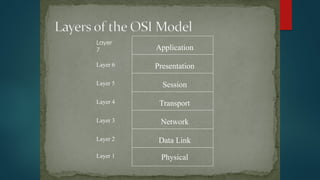
 Focus on Layer 7 and above first
Application
Presentation
Session
Transport
Network
Data Link
Physical
Layer 1
Layer
7
Layer 6
Layer 5
Layer 4
Layer 3
Layer 2
 A focus is placed on understanding data flow, data types, and
processes that access or change the data.
 A focus is placed on understanding the location and needs of user
communities that access or change data and processes.
 Several techniques and models can be used to characterize the
existing system, new user requirements, and a structure for the
future system.
 A logical model is developed before the physical model.
 The logical model represents the basic building blocks, divided by function,
and the structure of the system.
 The physical model represents devices and specific technologies and
implementations.
 SDLC: Does it mean Synchronous Data Link Control or Systems
Development Life Cycle?
 The latter for the purposes of this class!
 Typical systems are developed and continue to exist over a
period of time, often called a systems development life cycle
(SDLC)
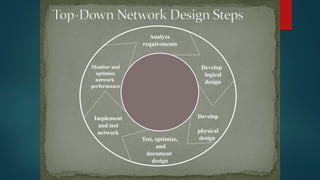
Analyze
requirements
Develop
logical
design
Develop
physical
design
Test, optimize,
and
document
design
Monitor and
optimize
network
performance
Implement
and test
network
 Phase 1 – Analyze Requirements
 Analyze business goals and
constraints
 Analyze technical goals and
tradeoffs
 Characterize the existing network
 Characterize network traffic
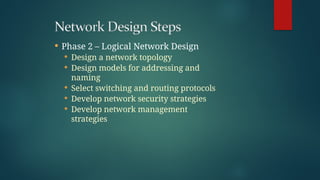
 Phase 2 – Logical Network Design
 Design a network topology
 Design models for addressing and
naming
 Select switching and routing protocols
 Develop network security strategies
 Develop network management
strategies
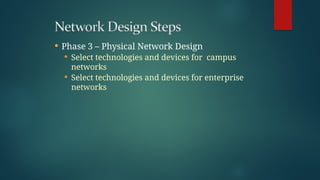
 Phase 3 – Physical Network Design
 Select technologies and devices for campus
networks
 Select technologies and devices for enterprise
networks
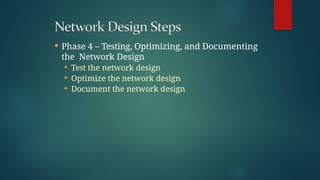
 Phase 4 – Testing, Optimizing, and Documenting
the Network Design
 Test the network design
 Optimize the network design
 Document the network design
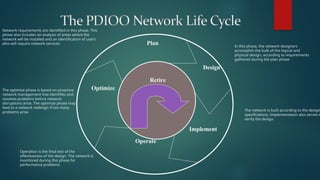
Plan
Design
Implement
Operate
Retire
Optimize
Network requirements are identified in this phase. This
phase also includes an analysis of areas where the
network will be installed and an identification of users
who will require network services
In this phase, the network designers
accomplish the bulk of the logical and
physical design, according to requirements
gathered during the plan phase
The network is built according to the design
specifications. Implementation also serves t
verify the design.
Operation is the final test of the
effectiveness of the design. The network is
monitored during this phase for
performance problems
The optimize phase is based on proactive
network management that identifies and
resolves problems before network
disruptions arise. The optimize phase may
lead to a network redesign if too many
problems arise
 Increase revenue
 Reduce operating costs
 Improve communications
 Shorten product development cycle
 Expand into worldwide markets
 Build partnerships with other companies
 Offer better customer support or new
customer services
 Mobility
 Security
 Resiliency (fault tolerance)
 Business continuity after a disaster
 Network projects must be prioritized
based on fiscal goals
 Networks must offer the low delay required
for real- time applications such as VoIP
 Budget
 Staffing
 Schedule
 Politics and
policies
 Before meeting with the client, whether
internal or external, collect some basic
business-related information
 Such as
 Products produced/Services supplied
 Financial viability
 Customers, suppliers, competitors
 Competitive advantage
 Try to get
 A concise statement of the goals of the
project
 What problem are they trying to solve?
 How will new technology help them be more
successful in their business?
 What must happen for the project to
succeed?
 What will happen if the project is a failure?
 Is this a critical business function?
 Is this project visible to upper management?
 Who’s on your side?
 Discover any biases
 For example
 Will they only use certain company’s products?
 Do they avoid certain technologies?
 Do the data people look down on the voice people or
vice versa?
 Talk to the technical and management staff
 Get a copy of the organization chart
 This will show the general structure of the organization
 It will suggest users to account for
 It will suggest geographical locations to account for
 Get a copy of the security policy
 How does the policy affect the new design?
 How does the new design affect the policy?
 Is the policy so strict that you (the network designer) won’t be
able to do your job?
 Start cataloging network assets that security should protect
 Hardware, software, applications, and data
 Less obvious, but still important, intellectual property, trade
secrets, and a company's reputation
 Small in scope?
 Allow sales people to access network via a VPN
 Large in scope?
 An entire redesign of an enterprise network
 Use the OSI model to clarify the scope
 New financial reporting application versus new routing
protocol versus new data link (wireless, for example)
 Does the scope fit the budget, capabilities of staff and
consultants, schedule?
 Applications
 Now and after the project is completed
 Include both productivity applications and system
management applications
 User communities
 Data stores
 Protocols
 Current logical and physical architecture
 Current performance
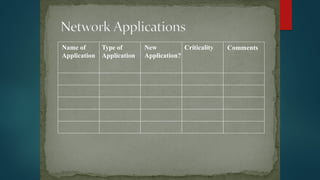
Name of
Application
Type of
Application
New
Application?
Criticality Comments
 Systematic approach
 Focus first on business requirements and constraints, and
applications
 Gain an understanding of the customer’s corporate structure
 Gain an understanding of the customer’s business style
 What are the main phases of network design per the top-down
network design approach?
 What are the main phases of network design per the PDIOO
approach?
 Why is it important to understand customer’s business
style?
 What are some typical business goals for organizations
today?

1606662359-chapter-1-top-down-network-design.pptx

  • 1.
    Network Design and Management COURSEINSTRUCTOR: FAROOQ JAVEED
  • 3.
     Network designshould be a complete process that matches business needs to available technology to deliver a system that will maximize an organization’s success  In the LAN area it is more than just buying a few devices  In the WAN area it is more than just calling the phone company
  • 4.
     Don’t juststart connecting the dots  Analyze business and technical goals first  Explore divisional and group structures to find out who the network serves and where they reside  Determine what applications will run on the network and how those applications behave on a network  Focus on Layer 7 and above first
  • 5.
  • 6.
     A focusis placed on understanding data flow, data types, and processes that access or change the data.  A focus is placed on understanding the location and needs of user communities that access or change data and processes.  Several techniques and models can be used to characterize the existing system, new user requirements, and a structure for the future system.  A logical model is developed before the physical model.  The logical model represents the basic building blocks, divided by function, and the structure of the system.  The physical model represents devices and specific technologies and implementations.
  • 7.
     SDLC: Doesit mean Synchronous Data Link Control or Systems Development Life Cycle?  The latter for the purposes of this class!  Typical systems are developed and continue to exist over a period of time, often called a systems development life cycle (SDLC)
  • 8.
  • 9.
     Phase 1– Analyze Requirements  Analyze business goals and constraints  Analyze technical goals and tradeoffs  Characterize the existing network  Characterize network traffic
  • 10.
     Phase 2– Logical Network Design  Design a network topology  Design models for addressing and naming  Select switching and routing protocols  Develop network security strategies  Develop network management strategies
  • 11.
     Phase 3– Physical Network Design  Select technologies and devices for campus networks  Select technologies and devices for enterprise networks
  • 12.
     Phase 4– Testing, Optimizing, and Documenting the Network Design  Test the network design  Optimize the network design  Document the network design
  • 13.
    Plan Design Implement Operate Retire Optimize Network requirements areidentified in this phase. This phase also includes an analysis of areas where the network will be installed and an identification of users who will require network services In this phase, the network designers accomplish the bulk of the logical and physical design, according to requirements gathered during the plan phase The network is built according to the design specifications. Implementation also serves t verify the design. Operation is the final test of the effectiveness of the design. The network is monitored during this phase for performance problems The optimize phase is based on proactive network management that identifies and resolves problems before network disruptions arise. The optimize phase may lead to a network redesign if too many problems arise
  • 14.
     Increase revenue Reduce operating costs  Improve communications  Shorten product development cycle  Expand into worldwide markets  Build partnerships with other companies  Offer better customer support or new customer services
  • 15.
     Mobility  Security Resiliency (fault tolerance)  Business continuity after a disaster  Network projects must be prioritized based on fiscal goals  Networks must offer the low delay required for real- time applications such as VoIP
  • 16.
     Budget  Staffing Schedule  Politics and policies
  • 17.
     Before meetingwith the client, whether internal or external, collect some basic business-related information  Such as  Products produced/Services supplied  Financial viability  Customers, suppliers, competitors  Competitive advantage
  • 18.
     Try toget  A concise statement of the goals of the project  What problem are they trying to solve?  How will new technology help them be more successful in their business?  What must happen for the project to succeed?
  • 19.
     What willhappen if the project is a failure?  Is this a critical business function?  Is this project visible to upper management?  Who’s on your side?
  • 20.
     Discover anybiases  For example  Will they only use certain company’s products?  Do they avoid certain technologies?  Do the data people look down on the voice people or vice versa?  Talk to the technical and management staff
  • 21.
     Get acopy of the organization chart  This will show the general structure of the organization  It will suggest users to account for  It will suggest geographical locations to account for
  • 22.
     Get acopy of the security policy  How does the policy affect the new design?  How does the new design affect the policy?  Is the policy so strict that you (the network designer) won’t be able to do your job?  Start cataloging network assets that security should protect  Hardware, software, applications, and data  Less obvious, but still important, intellectual property, trade secrets, and a company's reputation
  • 23.
     Small inscope?  Allow sales people to access network via a VPN  Large in scope?  An entire redesign of an enterprise network  Use the OSI model to clarify the scope  New financial reporting application versus new routing protocol versus new data link (wireless, for example)  Does the scope fit the budget, capabilities of staff and consultants, schedule?
  • 24.
     Applications  Nowand after the project is completed  Include both productivity applications and system management applications  User communities  Data stores  Protocols  Current logical and physical architecture  Current performance
  • 25.
  • 26.
     Systematic approach Focus first on business requirements and constraints, and applications  Gain an understanding of the customer’s corporate structure  Gain an understanding of the customer’s business style
  • 27.
     What arethe main phases of network design per the top-down network design approach?  What are the main phases of network design per the PDIOO approach?  Why is it important to understand customer’s business style?  What are some typical business goals for organizations today?