Traditional Network Design
• Based on a set of general rules
– “80/20”
– “Bridge when you can, route when you must”
– Can’t deal with scalability & complexity
• Focused on capacity planning
– Throw more bandwidth at the problem
– No consideration to delay optimization
– No guarantee of service quality
– Less importance given to network RMA (Reliability,
Maintainability, and Availability) compared to throughput
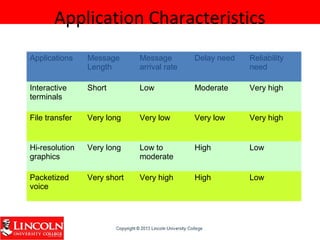
Application Characteristics
Applications Message
Length
Message
arrival rate
Delay need Reliability
need
Interactive
terminals
Short Low Moderate Very high
File transfer Very long Very low Very low Very high
Hi-resolution
graphics
Very long Low to
moderate
High Low
Packetized
voice
Very short Very high High Low
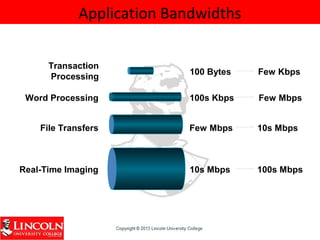
Application Bandwidths
Word Processing
File Transfers
Real-Time Imaging
100s Kbps Few Mbps
Few Mbps 10s Mbps
10s Mbps 100s Mbps
Transaction
Processing
100 Bytes Few Kbps
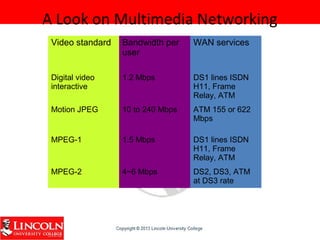
A Look on Multimedia Networking
Video standard Bandwidth per
user
WAN services
Digital video
interactive
1.2 Mbps DS1 lines ISDN
H11, Frame
Relay, ATM
Motion JPEG 10 to 240 Mbps ATM 155 or 622
Mbps
MPEG-1 1.5 Mbps DS1 lines ISDN
H11, Frame
Relay, ATM
MPEG-2 4~6 Mbps DS2, DS3, ATM
at DS3 rate
Some Networking Issues
• LAN, MAN and WAN
• Switching and routing
• Technologies: Ethernet, FDDI, ATM …
• Wireless/Mobile networking
• Internetworking
• Applications
• Service quality
• Security concerns
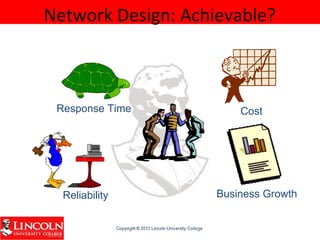
Network Design: Achievable?
Response Time Cost
Business GrowthReliability
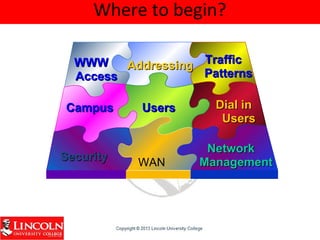
Where to begin?
WAN
CampusCampus
TrafficTraffic
PatternsPatterns
Dial inDial in
UsersUsers
SecuritySecurity
WWWWWW
AccessAccess
UsersUsers
NetworkNetwork
ManagementManagement
AddressingAddressing
• Performance
– Depends on Network Elements
– Measured in terms of Delay and Throughput
• Reliability
– Failure rate of network components
– Measured in terms of availability/robustness
• Security
– Data protection against corruption/loss of data due to:
– Errors
– Malicious users
Network Criteria
Traditional Network Design Methodology
• Many network design tools and methodologies that have
been used resemble the “connect-the-dots” game
• These tools let you place internetworking devices on a palette
and connect them with LAN or WAN media
• Problem with this methodology:
– It skips the steps of analyzing a customer's requirements, and
selecting devices and media based on those requirements
Top-Down Network Design Methodology (1/2)
• Good network design
– Recognizes that a customer’s requirements embody many
business and technical goals
– May specify a required level of network performance, i.e.,
service level
– Includes difficult network design choices and tradeoffs that
must be made when designing the logical network before any
physical devices or media are selected
• When a customer expects a quick response to a network
design request
– A bottom-up (connect-the-dots) network design methodology
can be used, if the customer’s applications and goals are well
known
Top-Down Network Design Methodology (2/2)
• Network designers often think they understand a customer’s
applications and requirements.
• However, after the network installation, they may discover
that:
– They did not capture the customer's most important needs
– Unexpected scalability and performance problems appear as
the number of network users increases
Top-Down Network Design Process (1/2)
• Begins at the upper layers of the OSI reference model before
moving to the lower layers
– Focuses on applications, sessions, and data transport before the
selection of routers, switches, and media that operate at the
lower layers
• Explores divisional structures to find the people:
– For whom the network will provide services, and
– From whom to get valuable information to make the design
succeed
Top-Down Network Design Process (2/2)
• It is an iterative process:
– It is important to first get an overall view of a customer's
requirements
– More detail can be gathered later on protocol behavior,
scalability requirements, technology preferences, etc.
• Recognizes that the logical model and the physical design may
change as more information is gathered
• A top-down approach lets a network designer get “the big
picture” first and then spiral downward into detailed
technical requirements and specifications
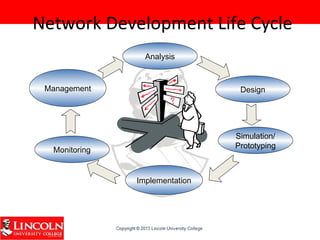
Network Development Life Cycle
Management
Analysis
Design
Simulation/
Prototyping
Implementation
Monitoring
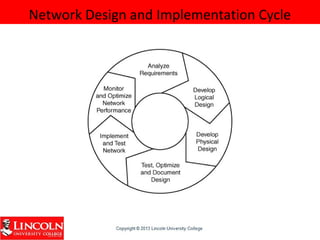
Network Design and Implementation Cycle
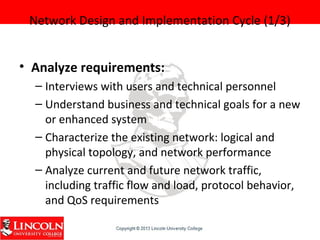
Network Design and Implementation Cycle (1/3)
• Analyze requirements:
– Interviews with users and technical personnel
– Understand business and technical goals for a new
or enhanced system
– Characterize the existing network: logical and
physical topology, and network performance
– Analyze current and future network traffic,
including traffic flow and load, protocol behavior,
and QoS requirements
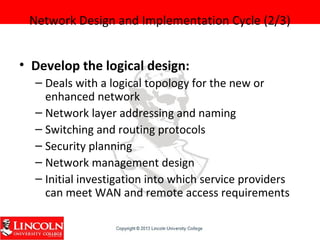
Network Design and Implementation Cycle (2/3)
• Develop the logical design:
– Deals with a logical topology for the new or
enhanced network
– Network layer addressing and naming
– Switching and routing protocols
– Security planning
– Network management design
– Initial investigation into which service providers
can meet WAN and remote access requirements
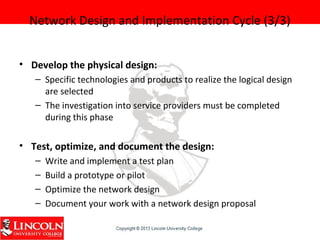
Network Design and Implementation Cycle (3/3)
• Develop the physical design:
– Specific technologies and products to realize the logical design
are selected
– The investigation into service providers must be completed
during this phase
• Test, optimize, and document the design:
– Write and implement a test plan
– Build a prototype or pilot
– Optimize the network design
– Document your work with a network design proposal
Another Perspective
• Data collection
– Traffic
– Costs
– Constraints
• Design process
• Performance analysis
• Fine tuning
• A painstaking iterative process
PDIOO Network Life Cycle (1/3)
(Cisco)• Plan:
– Network requirements are identified in this phase
– Analysis of areas where the network will be installed
– Identification of users who will require network services
• Design:
– Accomplish the logical and physical design, according to
requirements gathered during the Plan phase
• Implement:
– Network is built according to the Design specifications
– Implementation also serves to verify the design
PDIOO Network Life Cycle (2/3)
(Cisco)• Operate:
– Operation is the final test of the effectiveness of the design
– The network is monitored during this phase for performance
problems and any faults, to provide input into the Optimize phase
• Optimize:
– Based on proactive network management which identifies and
resolves problems before network disruptions arise
– The optimize phase may lead to a network redesign
• if too many problems arise due to design errors, or
• as network performance degrades over time as actual use and
capabilities diverge
– Redesign may also be required when requirements change
significantly
PDIOO Network Life Cycle (3/3)
(Cisco)
• Retire:
– When the network, or a part of the network, is out-of-date, it may
be taken out of production
– Although Retire is not incorporated into the name of the life cycle
(PDIOO), it is nonetheless an important phase
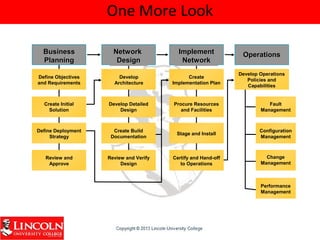
One More Look
Define Objectives
and Requirements
Create Initial
Solution
Define Deployment
Strategy
Develop
Architecture
Create Build
Documentation
Develop Detailed
Design
Review and Verify
Design
Create
Implementation Plan
Procure Resources
and Facilities
Stage and Install
Certify and Hand-off
to Operations
Develop Operations
Policies and
Capabilities
Configuration
Management
Fault
Management
Change
Management
Performance
Management
Review and
Approve
BusinessBusiness
PlanningPlanning
OperationsOperationsImplementImplement
NetworkNetwork
NetworkNetwork
DesignDesign
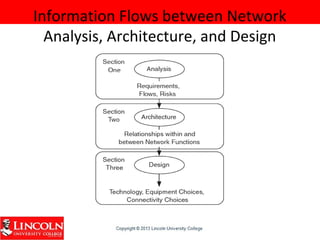
Information Flows between Network
Analysis, Architecture, and Design
Network Analysis and Design Methodology
- Overall Characteristics -
• Requirements (business, application, and data) definition is
required prior to network design activities
• Expected compliance with requirements in a Request For
Proposal (RFP) by both in-house personnel and outside
consultants
• Activities from various stages often take place simultaneously
and backtrack to previous activities is sometimes needed
• This methodology is an overall guideline to the network
development process rather than “cookbook” instructions
Network Analysis and Design Methodology
- Critical Success Factors of the NDLC (1/3) -
• Identification of all potential customers and constituencies
– All groups must be consulted
• Political awareness:
– Corporate culture: hierarchical, distributed, or open
– Backroom politics can play a role in systems design
– Find ways to ensure objectivity of the analysis and design process
(e.g., measurable goals)
• Buy-in:
– Reach consensus on the acceptability of results of each stage
– Approved results of one stage become the foundation or starting
point for the next stage
– Makes the final presentation smoother
Network Analysis and Design Methodology
- Critical Success Factors of the NDLC (2/3) -
• Communication:
– With all groups
– Write memos, communicate with key people in person, etc.
• Detailed project documentation:
– Prepare agendas
– Take meeting minutes
– Action items
– Use a project binder for all the above
Network Analysis and Design Methodology
- Critical Success Factors of the NDLC (3/3) -
• Process/Product awareness:
– Stay focused: what is the process/product at each stage?
– Keep meeting on track: no off-subject discussions
• Be honest with yourself:
– Be your own harshest critic (no one else knows the potential
weaknesses or areas for improvement in your proposal better
than you)
– Use peer reviews
– Not all weaknesses can be corrected (e.g., financial or time
constraints)
Network Analysis and Design Methodology
- Overall Guidelines -
• Start with a clearly defined problem:
– Identify affected parties and representatives
– Held brainstorming sessions to define problems and
requirements of a solution
• Understand strategic business objectives defined by senior
management
• Collect baseline data from customer groups about the
current status of the system and network
– This is used to measure eventual impact of the installed
network
• Perform a feasibility study: problem definition and associated
alternative recommendations for further study
Customer’s Requirements
- Understanding the Customer -
• A good network design must recognize the customer’s
requirements - need to make sure your design meets THEIR
needs and not just YOURS!
• The “Customer” may be your own firm, the “who” you are
designing the network for
• Need an overview of a customer’s requirements
• The best designed network will fail miserably without the
support of people
Customer’s Requirements
- Users’ Needs -
What do the users want?
– Services
What do the users need?
What don’t they know but they
need?
Organize and Prioritize Requirement
Customer’s Requirements
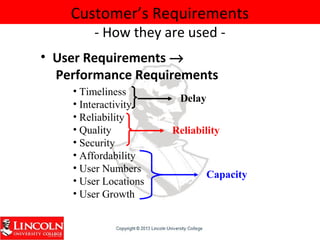
- How they are used -
• User Requirements →
Performance Requirements
• Timeliness
• Interactivity
• Reliability
• Quality
• Security
• Affordability
• User Numbers
• User Locations
• User Growth
Capacity
Reliability
Delay
Analysis and Design Processes
• Set and achieve goals
– Maximizing performance
– Minimizing cost
• Optimization with trade-offs
– Recognizing trade-offs
– No single ‘best’ answer
• Hierarchies
– Provide structure in the network
• Redundancy
– Provides availability & reliability
Approaches Used for Design
• Heuristic – by using various algorithms
• Exact – by working out mathematical
solutions based on linear programming, etc.,
minimizing certain cost functions
• Simulation – often used when no exact
analytical form exists. Experiments are
conducted on simplified models to see the
performance of a network
Design and Study of a System
Art or Science?
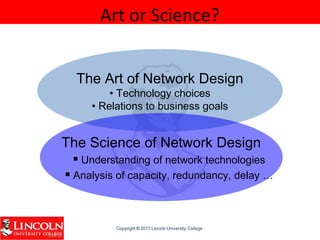
The Art of Network Design
• Technology choices
• Relations to business goals
The Science of Network Design
 Understanding of network technologies
 Analysis of capacity, redundancy, delay …
Types of Network Design
• New network design
• Re-engineering a network design
• Network expansion design
New Network Design
• Actually starting from scratch
• No legacy networks to accommodate
• Major driver is the budget, no compatibility
issues to worry about
• Getting harder to find these situations
Re-engineering a Network Design
• Modifications to an existing network to
compensate for original design problems
• Sometimes required when network users
change existing applications or functionality
• More of the type of problems seen today
Network Expansion Design
• Network designs that expand network
capacity
• Technology upgrades
• Adding more users or networked equipment
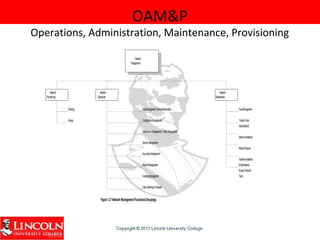
OAM&P
Operations, Administration, Maintenance, Provisioning
Network
Management
Network
Provisioning
Network
Operations
Network
Maintenance
Planning
Design
FaultManagement
TroubleTicket
Administration
NetworkInstallation
NetworkRepairs
FacilitiesInstallation
&Maintenance
Routine Network
Tests
FaultManagement/ServiceRestoration
ConfigurationManagement
PerformanceManagement/TrafficManagement
SecurityManagement
AccountingManagement
ReportsManagement
InventoryManagement
DataGathering&Analyses
Figure1.21NetworkManagementFunctionalGroupings
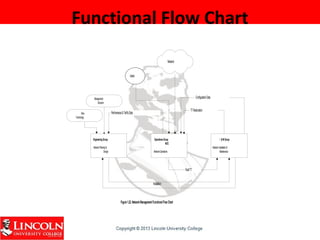
Functional Flow Chart
EngineeringGroup
-NetworkPlanning&
Design
OperationsGroup
NOC
-NetworkOperations
I &M Group
-NetworkInstallation&
Maintenance
FaultTT
ConfigurationData
TTRestoration
Performance&TrafficData
Installation
Figure1.22.NetworkManagementFunctionalFlowChart
New
Technology
Network
Users
Management
Decision

Sept 2017 network design

  • 1.
    Traditional Network Design •Based on a set of general rules – “80/20” – “Bridge when you can, route when you must” – Can’t deal with scalability & complexity • Focused on capacity planning – Throw more bandwidth at the problem – No consideration to delay optimization – No guarantee of service quality – Less importance given to network RMA (Reliability, Maintainability, and Availability) compared to throughput
  • 2.
    Application Characteristics Applications Message Length Message arrivalrate Delay need Reliability need Interactive terminals Short Low Moderate Very high File transfer Very long Very low Very low Very high Hi-resolution graphics Very long Low to moderate High Low Packetized voice Very short Very high High Low
  • 3.
    Application Bandwidths Word Processing FileTransfers Real-Time Imaging 100s Kbps Few Mbps Few Mbps 10s Mbps 10s Mbps 100s Mbps Transaction Processing 100 Bytes Few Kbps
  • 4.
    A Look onMultimedia Networking Video standard Bandwidth per user WAN services Digital video interactive 1.2 Mbps DS1 lines ISDN H11, Frame Relay, ATM Motion JPEG 10 to 240 Mbps ATM 155 or 622 Mbps MPEG-1 1.5 Mbps DS1 lines ISDN H11, Frame Relay, ATM MPEG-2 4~6 Mbps DS2, DS3, ATM at DS3 rate
  • 5.
    Some Networking Issues •LAN, MAN and WAN • Switching and routing • Technologies: Ethernet, FDDI, ATM … • Wireless/Mobile networking • Internetworking • Applications • Service quality • Security concerns
  • 6.
    Network Design: Achievable? ResponseTime Cost Business GrowthReliability
  • 7.
    Where to begin? WAN CampusCampus TrafficTraffic PatternsPatterns DialinDial in UsersUsers SecuritySecurity WWWWWW AccessAccess UsersUsers NetworkNetwork ManagementManagement AddressingAddressing
  • 8.
    • Performance – Dependson Network Elements – Measured in terms of Delay and Throughput • Reliability – Failure rate of network components – Measured in terms of availability/robustness • Security – Data protection against corruption/loss of data due to: – Errors – Malicious users Network Criteria
  • 9.
    Traditional Network DesignMethodology • Many network design tools and methodologies that have been used resemble the “connect-the-dots” game • These tools let you place internetworking devices on a palette and connect them with LAN or WAN media • Problem with this methodology: – It skips the steps of analyzing a customer's requirements, and selecting devices and media based on those requirements
  • 10.
    Top-Down Network DesignMethodology (1/2) • Good network design – Recognizes that a customer’s requirements embody many business and technical goals – May specify a required level of network performance, i.e., service level – Includes difficult network design choices and tradeoffs that must be made when designing the logical network before any physical devices or media are selected • When a customer expects a quick response to a network design request – A bottom-up (connect-the-dots) network design methodology can be used, if the customer’s applications and goals are well known
  • 11.
    Top-Down Network DesignMethodology (2/2) • Network designers often think they understand a customer’s applications and requirements. • However, after the network installation, they may discover that: – They did not capture the customer's most important needs – Unexpected scalability and performance problems appear as the number of network users increases
  • 12.
    Top-Down Network DesignProcess (1/2) • Begins at the upper layers of the OSI reference model before moving to the lower layers – Focuses on applications, sessions, and data transport before the selection of routers, switches, and media that operate at the lower layers • Explores divisional structures to find the people: – For whom the network will provide services, and – From whom to get valuable information to make the design succeed
  • 13.
    Top-Down Network DesignProcess (2/2) • It is an iterative process: – It is important to first get an overall view of a customer's requirements – More detail can be gathered later on protocol behavior, scalability requirements, technology preferences, etc. • Recognizes that the logical model and the physical design may change as more information is gathered • A top-down approach lets a network designer get “the big picture” first and then spiral downward into detailed technical requirements and specifications
  • 14.
    Network Development LifeCycle Management Analysis Design Simulation/ Prototyping Implementation Monitoring
  • 15.
    Network Design andImplementation Cycle
  • 16.
    Network Design andImplementation Cycle (1/3) • Analyze requirements: – Interviews with users and technical personnel – Understand business and technical goals for a new or enhanced system – Characterize the existing network: logical and physical topology, and network performance – Analyze current and future network traffic, including traffic flow and load, protocol behavior, and QoS requirements
  • 17.
    Network Design andImplementation Cycle (2/3) • Develop the logical design: – Deals with a logical topology for the new or enhanced network – Network layer addressing and naming – Switching and routing protocols – Security planning – Network management design – Initial investigation into which service providers can meet WAN and remote access requirements
  • 18.
    Network Design andImplementation Cycle (3/3) • Develop the physical design: – Specific technologies and products to realize the logical design are selected – The investigation into service providers must be completed during this phase • Test, optimize, and document the design: – Write and implement a test plan – Build a prototype or pilot – Optimize the network design – Document your work with a network design proposal
  • 19.
    Another Perspective • Datacollection – Traffic – Costs – Constraints • Design process • Performance analysis • Fine tuning • A painstaking iterative process
  • 20.
    PDIOO Network LifeCycle (1/3) (Cisco)• Plan: – Network requirements are identified in this phase – Analysis of areas where the network will be installed – Identification of users who will require network services • Design: – Accomplish the logical and physical design, according to requirements gathered during the Plan phase • Implement: – Network is built according to the Design specifications – Implementation also serves to verify the design
  • 21.
    PDIOO Network LifeCycle (2/3) (Cisco)• Operate: – Operation is the final test of the effectiveness of the design – The network is monitored during this phase for performance problems and any faults, to provide input into the Optimize phase • Optimize: – Based on proactive network management which identifies and resolves problems before network disruptions arise – The optimize phase may lead to a network redesign • if too many problems arise due to design errors, or • as network performance degrades over time as actual use and capabilities diverge – Redesign may also be required when requirements change significantly
  • 22.
    PDIOO Network LifeCycle (3/3) (Cisco) • Retire: – When the network, or a part of the network, is out-of-date, it may be taken out of production – Although Retire is not incorporated into the name of the life cycle (PDIOO), it is nonetheless an important phase
  • 23.
    One More Look DefineObjectives and Requirements Create Initial Solution Define Deployment Strategy Develop Architecture Create Build Documentation Develop Detailed Design Review and Verify Design Create Implementation Plan Procure Resources and Facilities Stage and Install Certify and Hand-off to Operations Develop Operations Policies and Capabilities Configuration Management Fault Management Change Management Performance Management Review and Approve BusinessBusiness PlanningPlanning OperationsOperationsImplementImplement NetworkNetwork NetworkNetwork DesignDesign
  • 24.
    Information Flows betweenNetwork Analysis, Architecture, and Design
  • 25.
    Network Analysis andDesign Methodology - Overall Characteristics - • Requirements (business, application, and data) definition is required prior to network design activities • Expected compliance with requirements in a Request For Proposal (RFP) by both in-house personnel and outside consultants • Activities from various stages often take place simultaneously and backtrack to previous activities is sometimes needed • This methodology is an overall guideline to the network development process rather than “cookbook” instructions
  • 26.
    Network Analysis andDesign Methodology - Critical Success Factors of the NDLC (1/3) - • Identification of all potential customers and constituencies – All groups must be consulted • Political awareness: – Corporate culture: hierarchical, distributed, or open – Backroom politics can play a role in systems design – Find ways to ensure objectivity of the analysis and design process (e.g., measurable goals) • Buy-in: – Reach consensus on the acceptability of results of each stage – Approved results of one stage become the foundation or starting point for the next stage – Makes the final presentation smoother
  • 27.
    Network Analysis andDesign Methodology - Critical Success Factors of the NDLC (2/3) - • Communication: – With all groups – Write memos, communicate with key people in person, etc. • Detailed project documentation: – Prepare agendas – Take meeting minutes – Action items – Use a project binder for all the above
  • 28.
    Network Analysis andDesign Methodology - Critical Success Factors of the NDLC (3/3) - • Process/Product awareness: – Stay focused: what is the process/product at each stage? – Keep meeting on track: no off-subject discussions • Be honest with yourself: – Be your own harshest critic (no one else knows the potential weaknesses or areas for improvement in your proposal better than you) – Use peer reviews – Not all weaknesses can be corrected (e.g., financial or time constraints)
  • 29.
    Network Analysis andDesign Methodology - Overall Guidelines - • Start with a clearly defined problem: – Identify affected parties and representatives – Held brainstorming sessions to define problems and requirements of a solution • Understand strategic business objectives defined by senior management • Collect baseline data from customer groups about the current status of the system and network – This is used to measure eventual impact of the installed network • Perform a feasibility study: problem definition and associated alternative recommendations for further study
  • 30.
    Customer’s Requirements - Understandingthe Customer - • A good network design must recognize the customer’s requirements - need to make sure your design meets THEIR needs and not just YOURS! • The “Customer” may be your own firm, the “who” you are designing the network for • Need an overview of a customer’s requirements • The best designed network will fail miserably without the support of people
  • 31.
    Customer’s Requirements - Users’Needs - What do the users want? – Services What do the users need? What don’t they know but they need? Organize and Prioritize Requirement
  • 32.
    Customer’s Requirements - Howthey are used - • User Requirements → Performance Requirements • Timeliness • Interactivity • Reliability • Quality • Security • Affordability • User Numbers • User Locations • User Growth Capacity Reliability Delay
  • 33.
    Analysis and DesignProcesses • Set and achieve goals – Maximizing performance – Minimizing cost • Optimization with trade-offs – Recognizing trade-offs – No single ‘best’ answer • Hierarchies – Provide structure in the network • Redundancy – Provides availability & reliability
  • 34.
    Approaches Used forDesign • Heuristic – by using various algorithms • Exact – by working out mathematical solutions based on linear programming, etc., minimizing certain cost functions • Simulation – often used when no exact analytical form exists. Experiments are conducted on simplified models to see the performance of a network
  • 35.
    Design and Studyof a System
  • 36.
    Art or Science? TheArt of Network Design • Technology choices • Relations to business goals The Science of Network Design  Understanding of network technologies  Analysis of capacity, redundancy, delay …
  • 37.
    Types of NetworkDesign • New network design • Re-engineering a network design • Network expansion design
  • 38.
    New Network Design •Actually starting from scratch • No legacy networks to accommodate • Major driver is the budget, no compatibility issues to worry about • Getting harder to find these situations
  • 39.
    Re-engineering a NetworkDesign • Modifications to an existing network to compensate for original design problems • Sometimes required when network users change existing applications or functionality • More of the type of problems seen today
  • 40.
    Network Expansion Design •Network designs that expand network capacity • Technology upgrades • Adding more users or networked equipment
  • 41.
    OAM&P Operations, Administration, Maintenance,Provisioning Network Management Network Provisioning Network Operations Network Maintenance Planning Design FaultManagement TroubleTicket Administration NetworkInstallation NetworkRepairs FacilitiesInstallation &Maintenance Routine Network Tests FaultManagement/ServiceRestoration ConfigurationManagement PerformanceManagement/TrafficManagement SecurityManagement AccountingManagement ReportsManagement InventoryManagement DataGathering&Analyses Figure1.21NetworkManagementFunctionalGroupings
  • 42.
    Functional Flow Chart EngineeringGroup -NetworkPlanning& Design OperationsGroup NOC -NetworkOperations I&M Group -NetworkInstallation& Maintenance FaultTT ConfigurationData TTRestoration Performance&TrafficData Installation Figure1.22.NetworkManagementFunctionalFlowChart New Technology Network Users Management Decision

Editor's Notes

  • #3 Networks must be work independent of the fine details of applications, e.g., message arrival scheme.
  • #35 In this course we will be investigating mainly two approaches – heuristic