Chapter 6 Planning & Promotion
Planning............... is the process of  setting of objectives  and  writing a  marketing plan
What are your  objectives and plans? Shopping  at the supermarket To go abroad  Watch a movie Finding a job
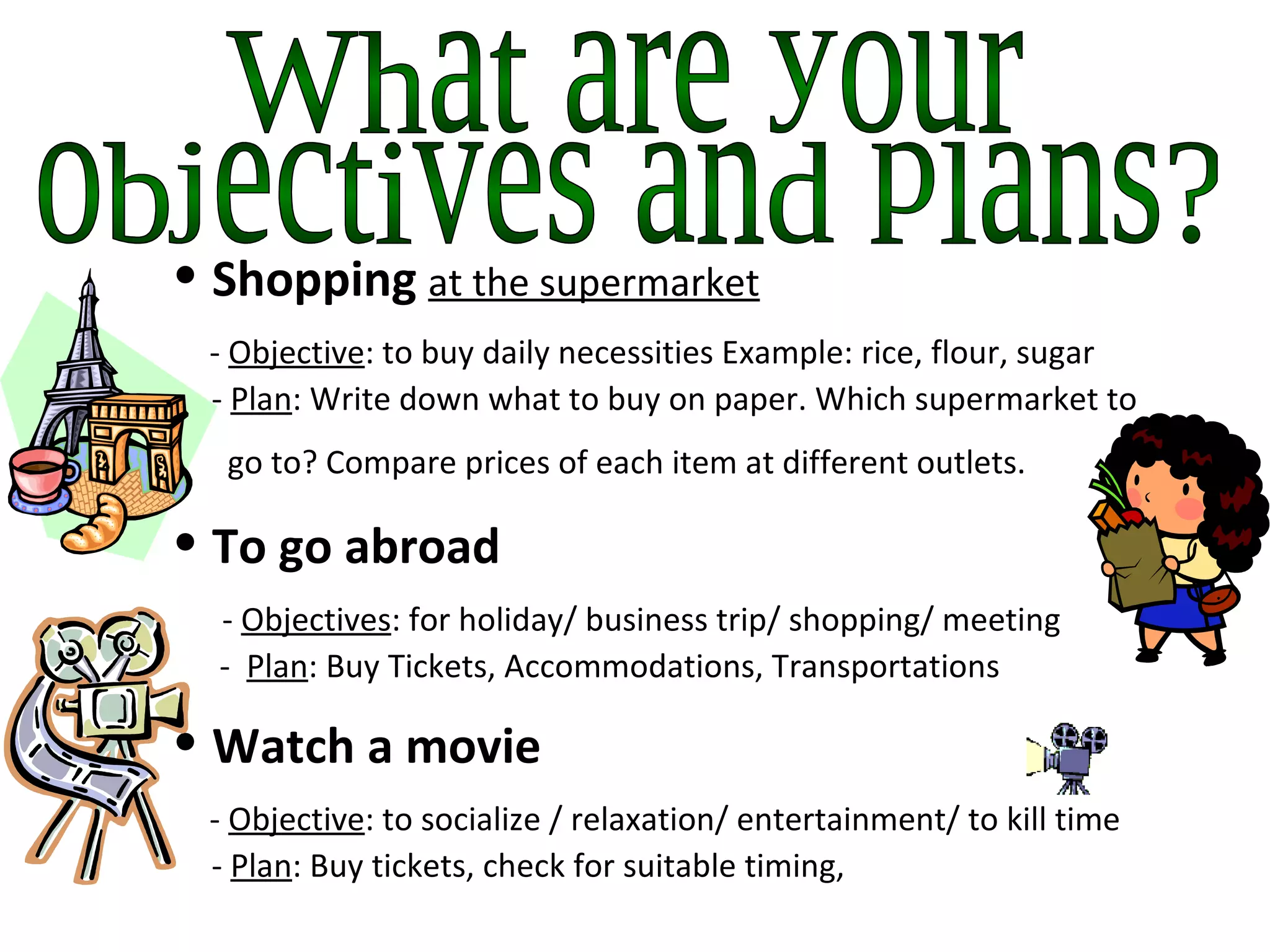
What are your  objectives and plans? Shopping   at the supermarket   -  Objective : to buy daily necessities Example: rice, flour, sugar    -  Plan : Write down what to buy on paper. Which supermarket to   go to? Compare prices of each item at different outlets.   To go abroad    -  Objectives : for holiday/ business trip/ shopping/ meeting   -  Plan : Buy Tickets, Accommodations, Transportations  Watch a movie   -  Objective : to socialize / relaxation/ entertainment/ to kill time   -  Plan : Buy tickets, check for suitable timing,
Marketing Plan Marketing Plan is a written    document describing the 4Ps  How a product will be marketed    to its target customers It is a guide for marketing    department to check   and coordinate their    actions 4Ps
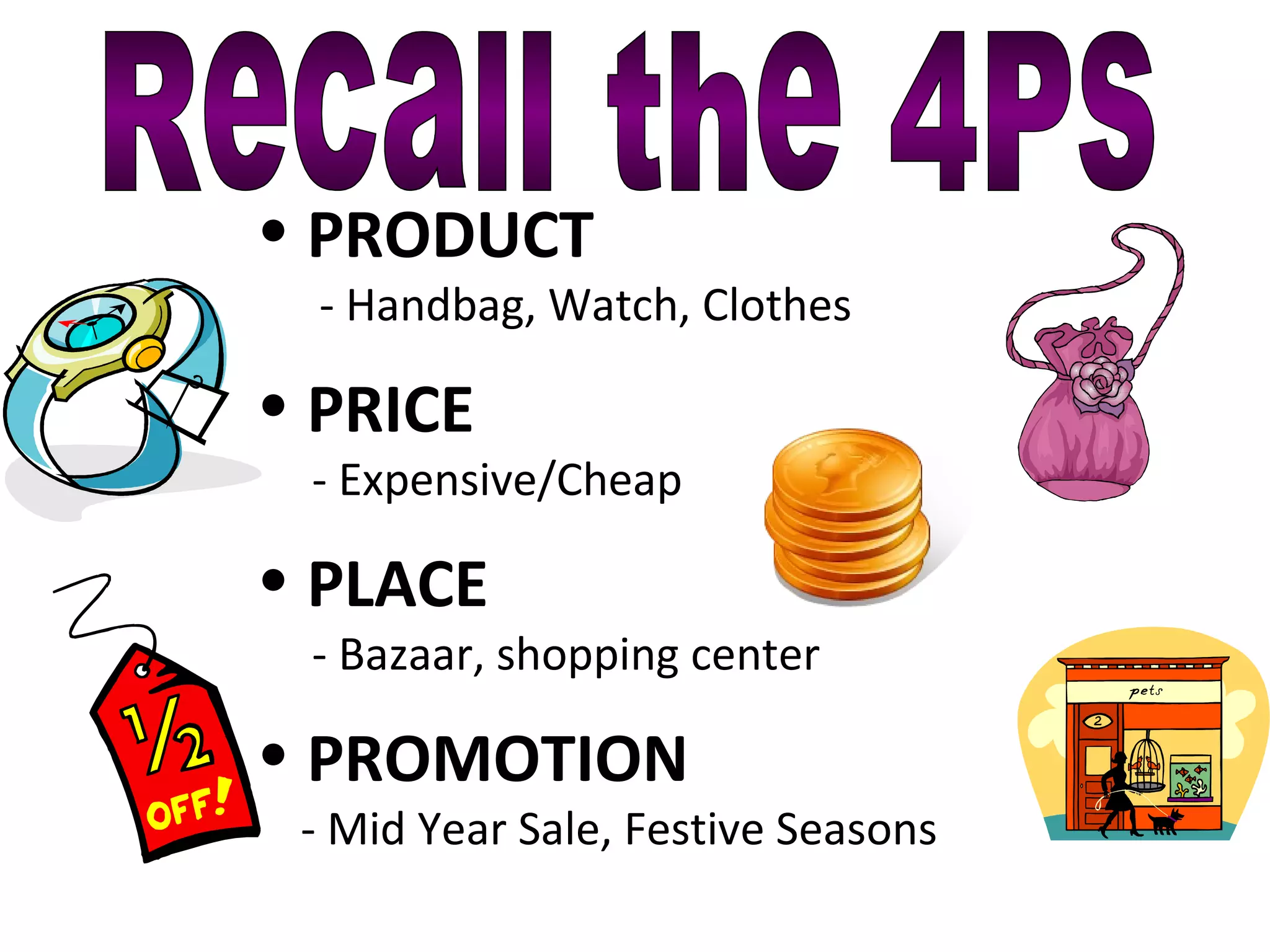
Recall the 4Ps PRODUCT   - Handbag, Watch, Clothes PRICE   - Expensive/Cheap PLACE   - Bazaar, shopping center PROMOTION   - Mid Year Sale, Festive Seasons
Think Pair Share Come up with questions that you may want to include in a marketing plan For example   PRODUCT  : Who should we sell it to?  PRICE : How much?
Marketing Information Before writing the marketing plan, you need to collect information about Target Group Needs and Wants  Respond to the 4Ps of marketing To gather information, you need to conduct a survey!
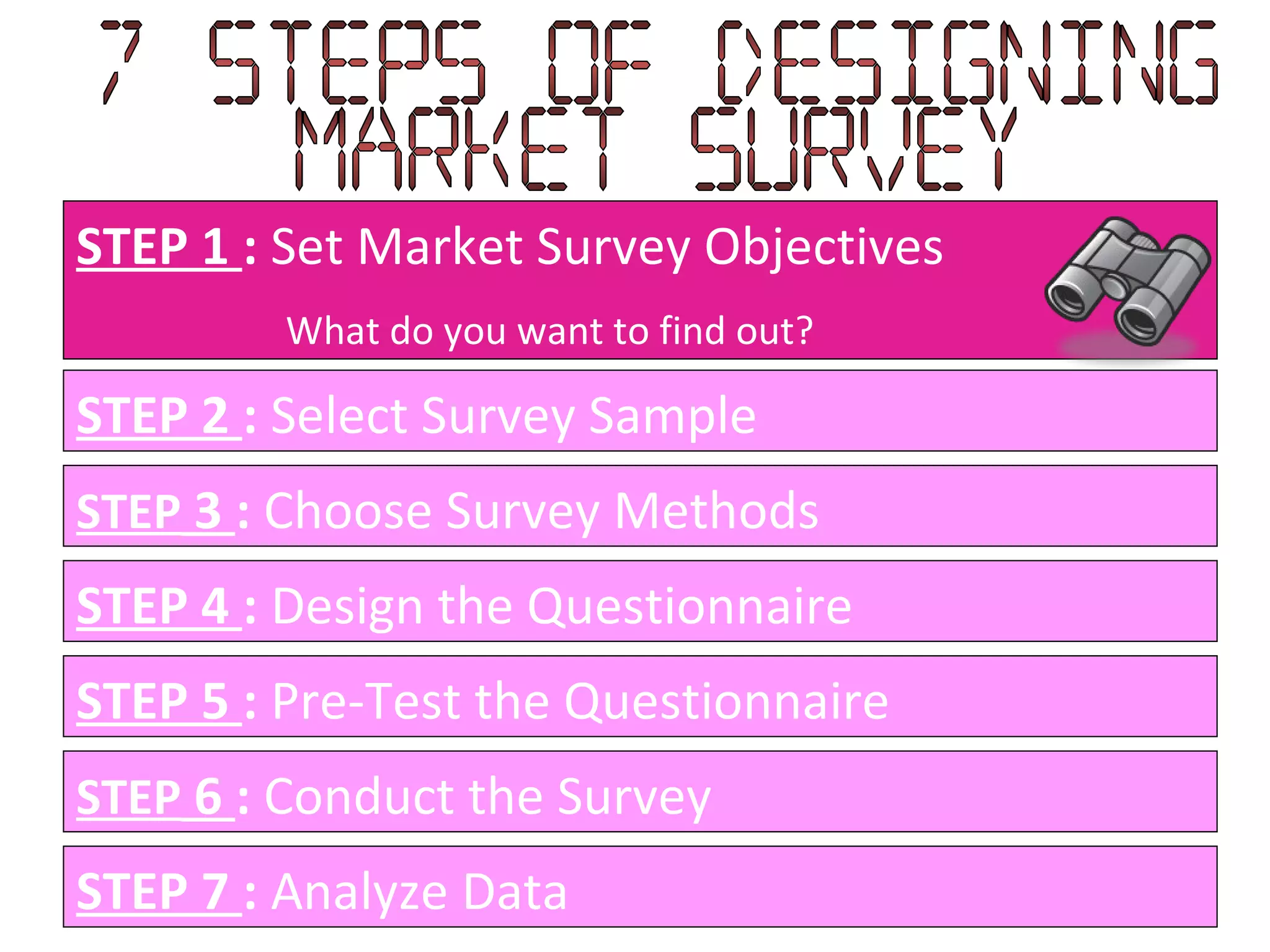
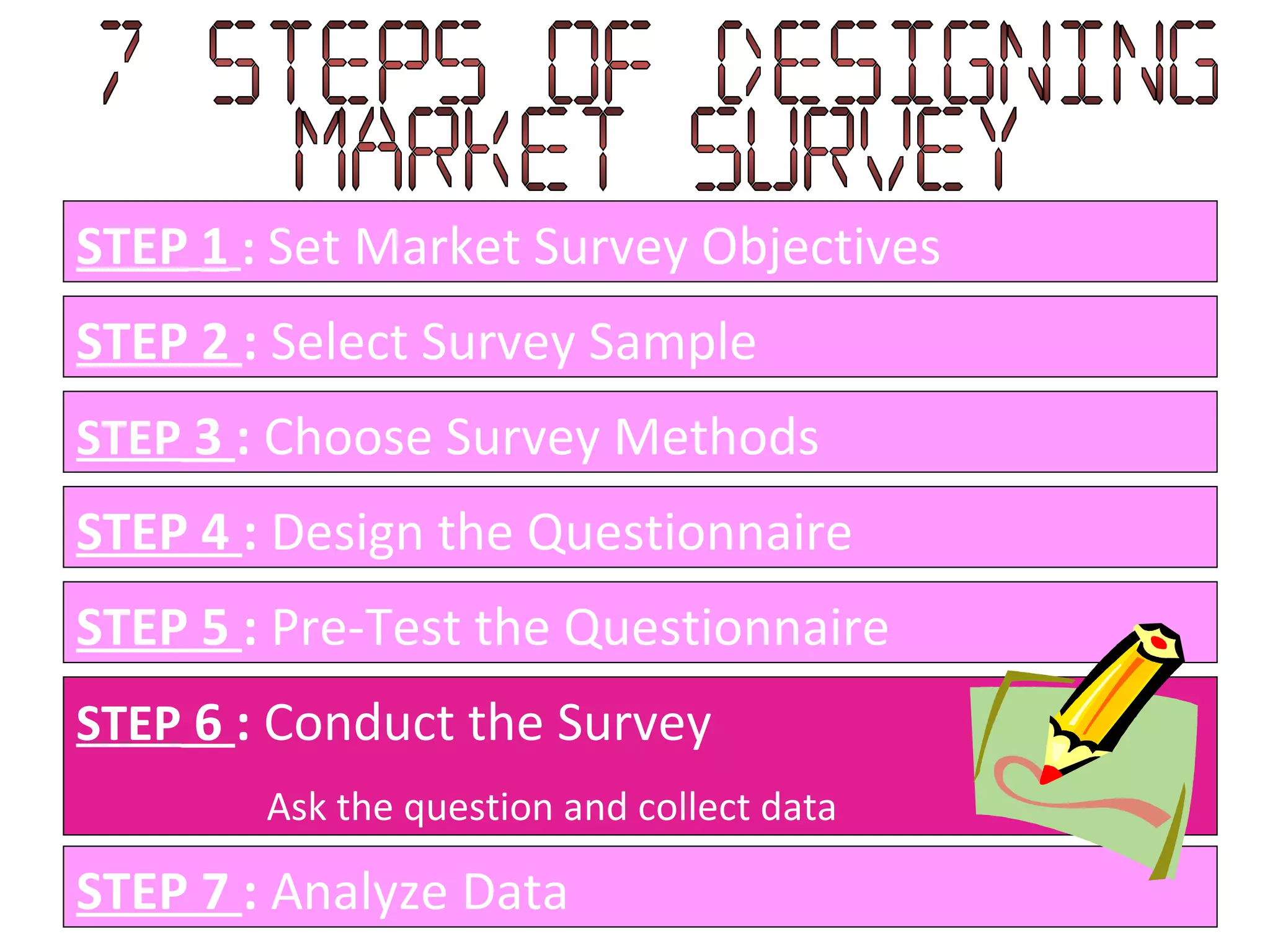
STEP 1  :  Set Market Survey Objectives What do you want to find out? STEP 2  :  Select Survey Sample STEP  3  :  Choose Survey Methods STEP 4  :  Design the Questionnaire STEP 5  :  Pre-Test the Questionnaire STEP  6  :  Conduct the Survey STEP 7  :  Analyze Data 7 Steps of designing  Market Survey
Step 1: Set Market  Survey Objectives WHAT DO YOU WANT TO KNOW? Find out more about    - our customers   - how they respond to the 4Ps Are there any competitions? Eg. StarHub, M1, SingTel  Surveys help to find out more about the 4Ps Set clear objectives by asking the right questions Specific survey objectives will give useful marketing    information
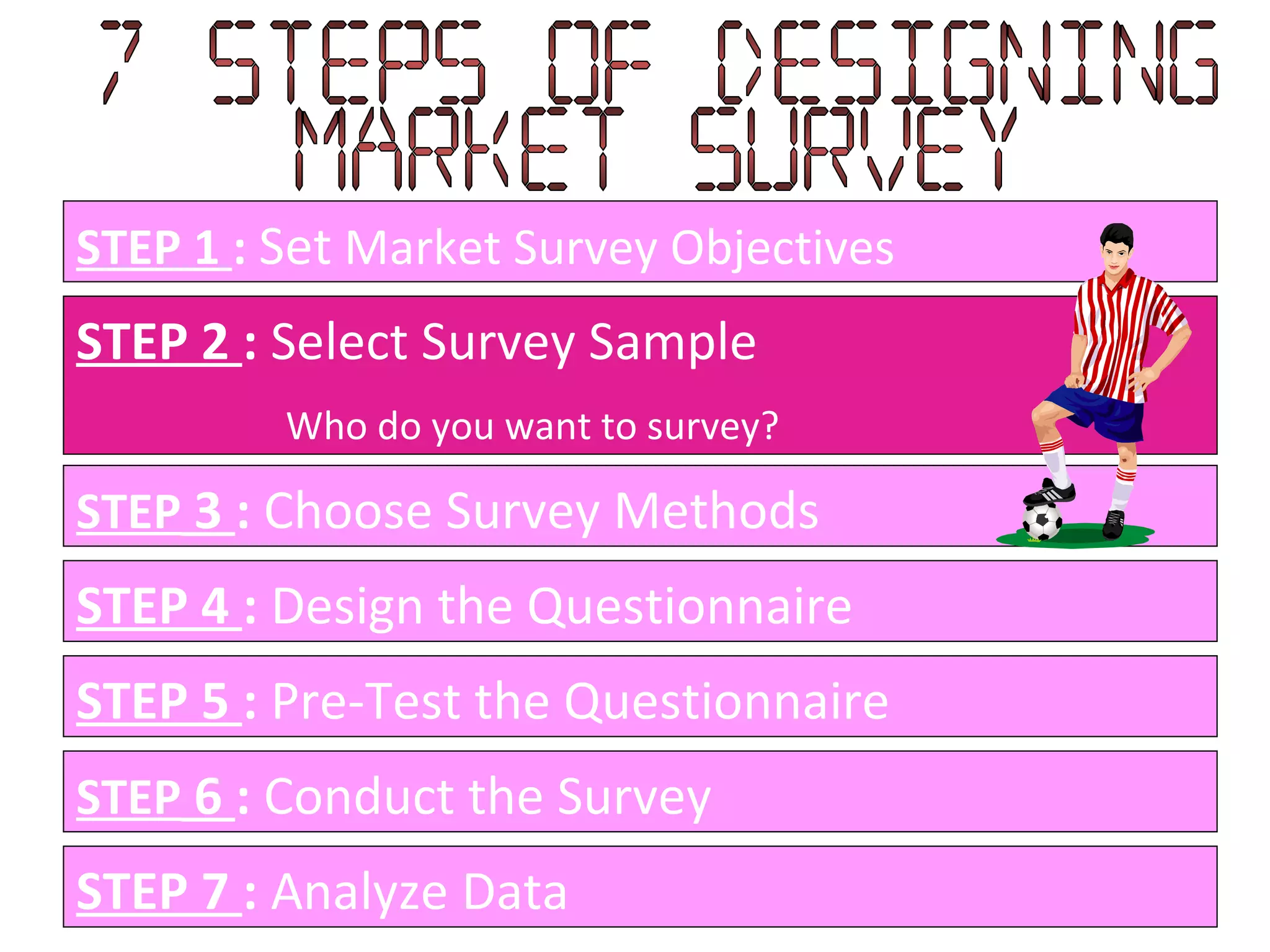
STEP 1  :   Set  Market Survey Objectives STEP 2  :  Select Survey Sample Who do you want to survey? STEP  3  :  Choose Survey Methods STEP 4  :  Design the Questionnaire STEP 5  :  Pre-Test the Questionnaire STEP  6  :  Conduct the Survey STEP 7  :  Analyze Data  7 Steps of designing  Market Survey
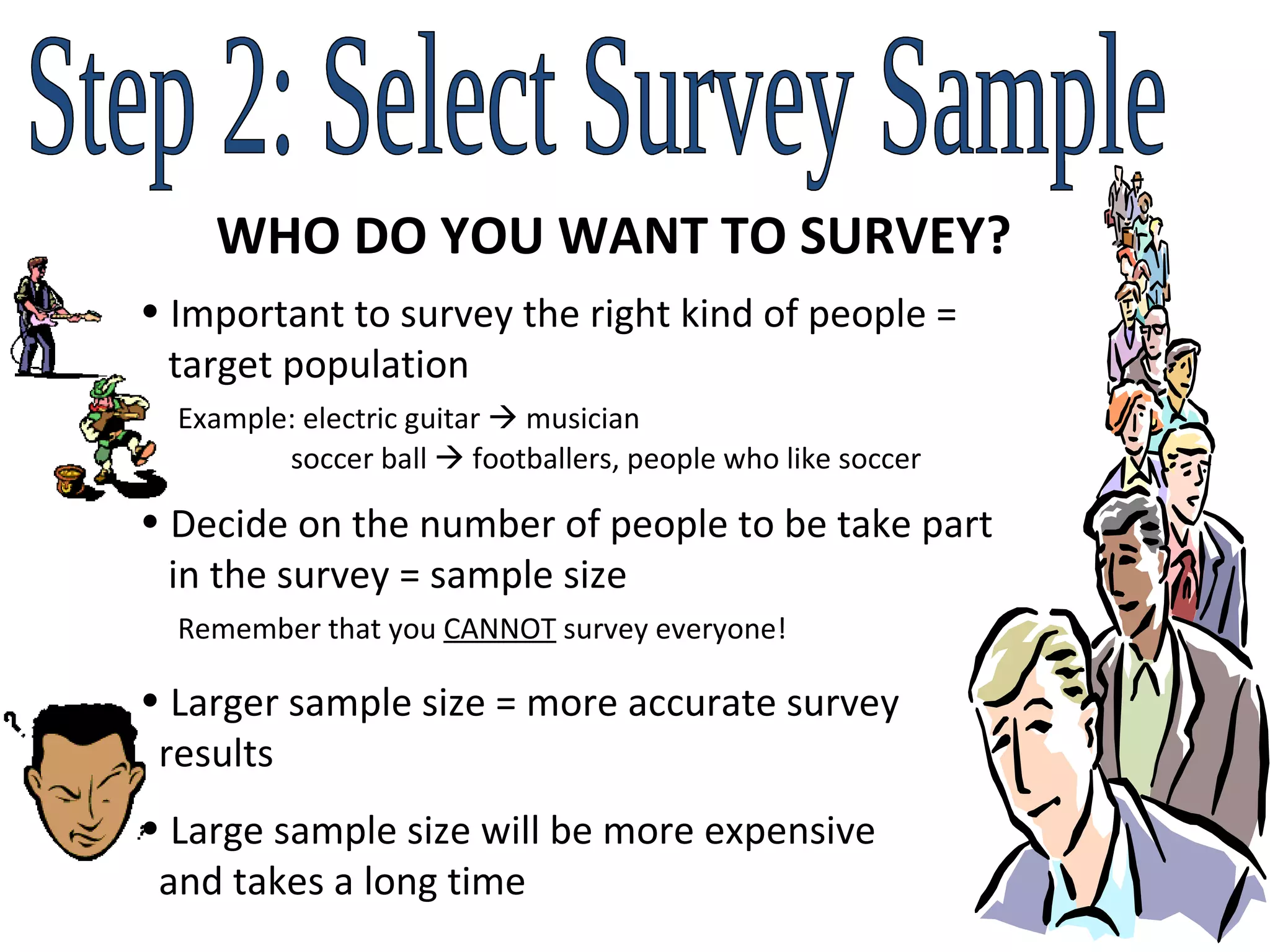
Step 2: Select Survey Sample WHO DO YOU WANT TO SURVEY? Important to survey the right kind of people =    target population   Example: electric guitar    musician   soccer ball    footballers, people who like soccer  Decide on the number of people to be take part    in the survey = sample size   Remember that you  CANNOT  survey everyone!  Larger sample size = more accurate survey    results Large sample size will be more expensive    and takes a long time
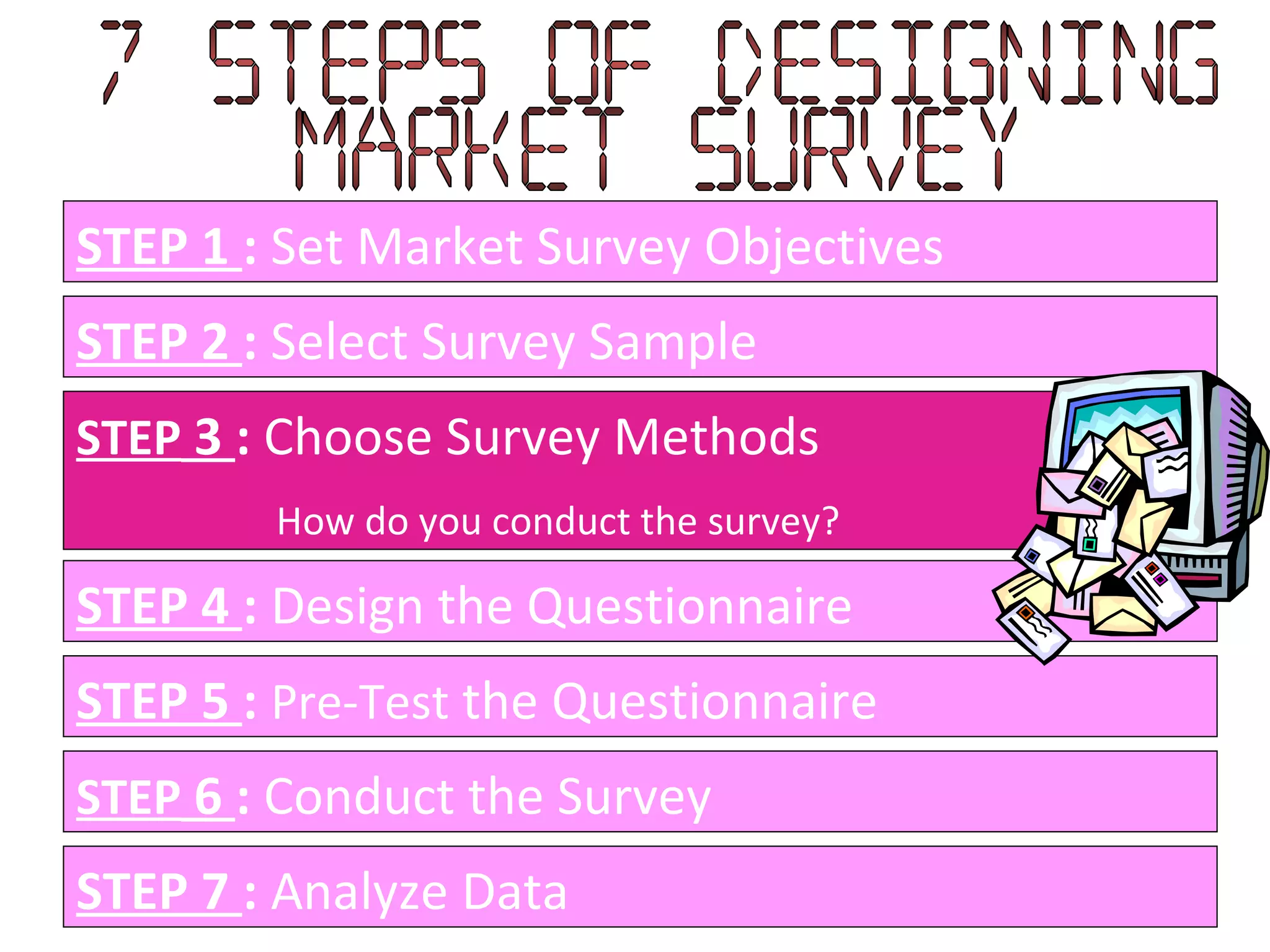
STEP 1  :  Set Market Survey Objectives STEP 2  :  Select Survey Sample STEP  3  :  Choose Survey Methods How do you conduct the survey? STEP 4  :  Design the Questionnaire STEP 5  :   Pre-Test  the Questionnaire STEP  6  :  Conduct the Survey STEP 7  :  Analyze Data 7 Steps of designing  Market Survey
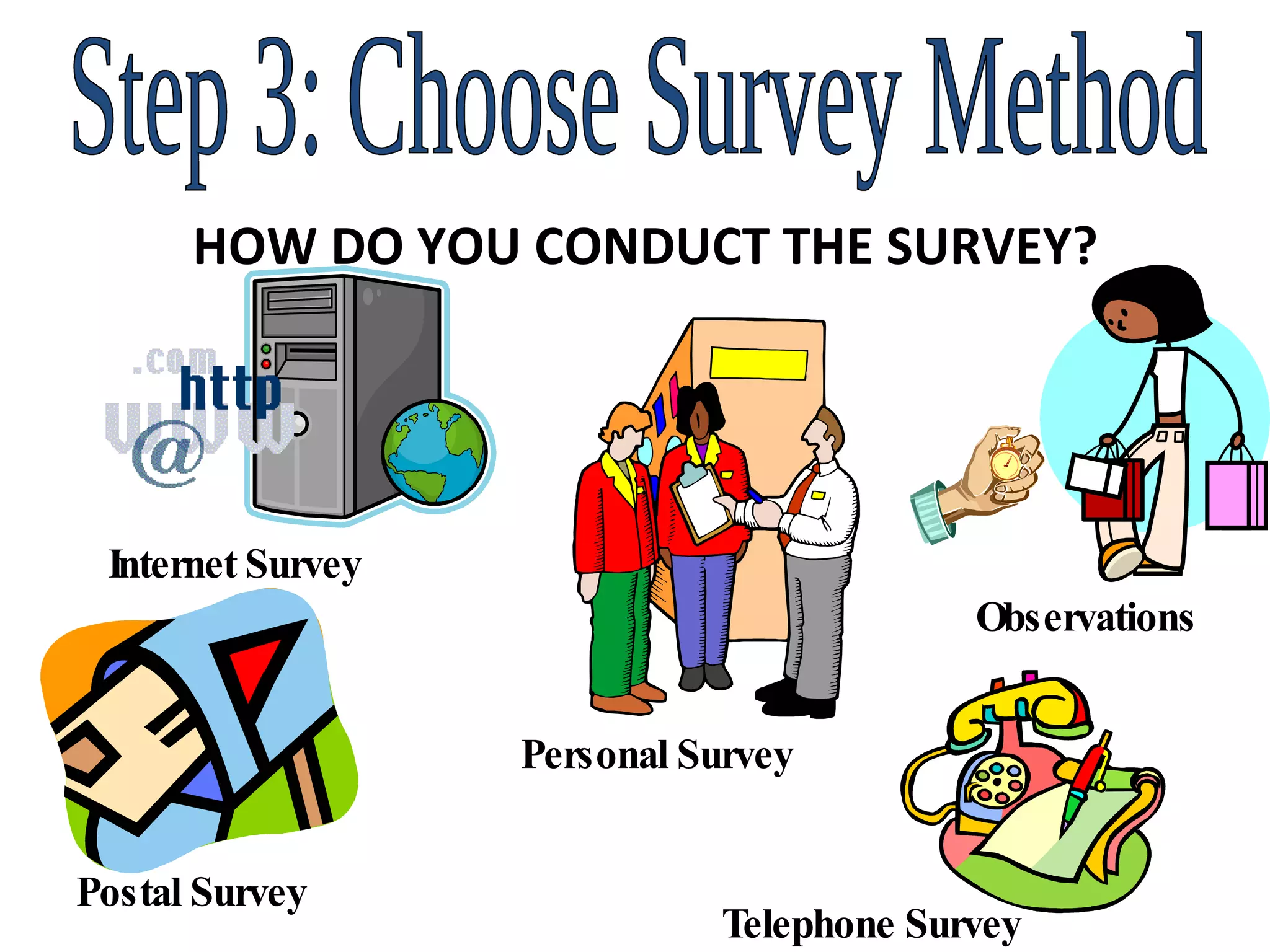
Step 3: Choose Survey Method HOW DO YOU CONDUCT THE SURVEY? Internet Survey Postal Survey Telephone Survey Personal Survey Observations
Step 3: Choose Survey Method HOW DO YOU CONDUCT THE SURVEY? Internet Survey   - Cheap and Fast   - upload the questions on websites like    surveymonkey.com    - Responses of the survey can be downloaded and    analyzed immediately STEP 1:  Collate the e-mail addresses of respondents STEP 2:  Ensure the survey questions are ready STEP 3:  Post the questions on the website STEP 4:  E-mail the lost of the website to the respondents    and invite them to participate
Step 3: Choose Survey Method HOW DO YOU CONDUCT THE SURVEY? Personal Survey   - meet the  respondents  face to face with questionnaire    - ask for their responses    - example: Food tasting or StarBucks sample drinks STEP 1:  Approach respondent STEP 2:  Introduce yourself to the respondent STEP 3:  Explain the purpose of the survey STEP 4:  Ask the respondents if they want to participate in the    survey STEP 5:  If he/she is willing, read the questions STEP 6:  Record their responses STEP 7:  Thank the respondent
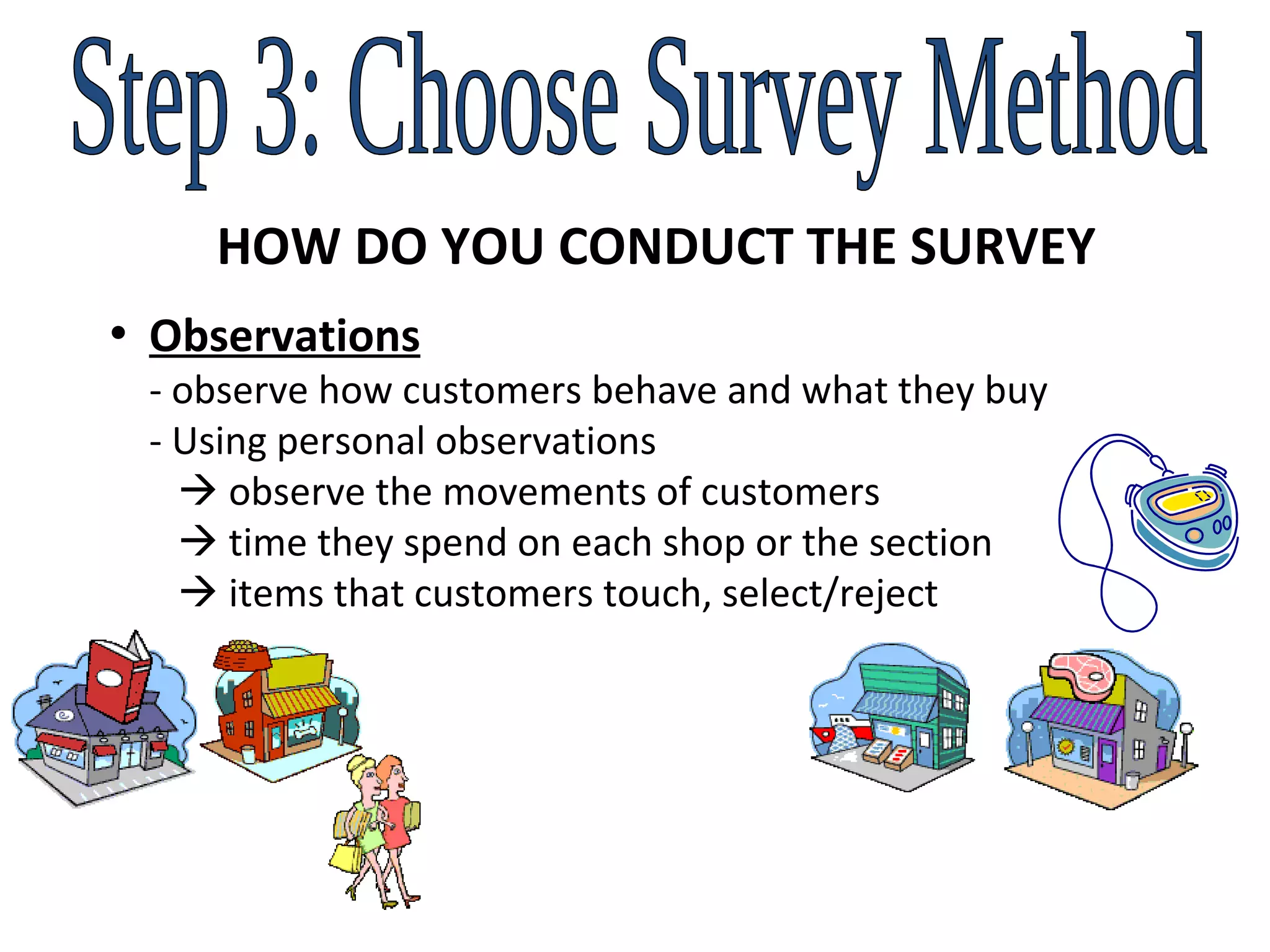
Step 3: Choose Survey Method HOW DO YOU CONDUCT THE SURVEY Observations  - observe how customers behave and what they buy   - Using personal observations     observe the movements of customers      time they spend on each shop or the section      items that customers touch, select/reject
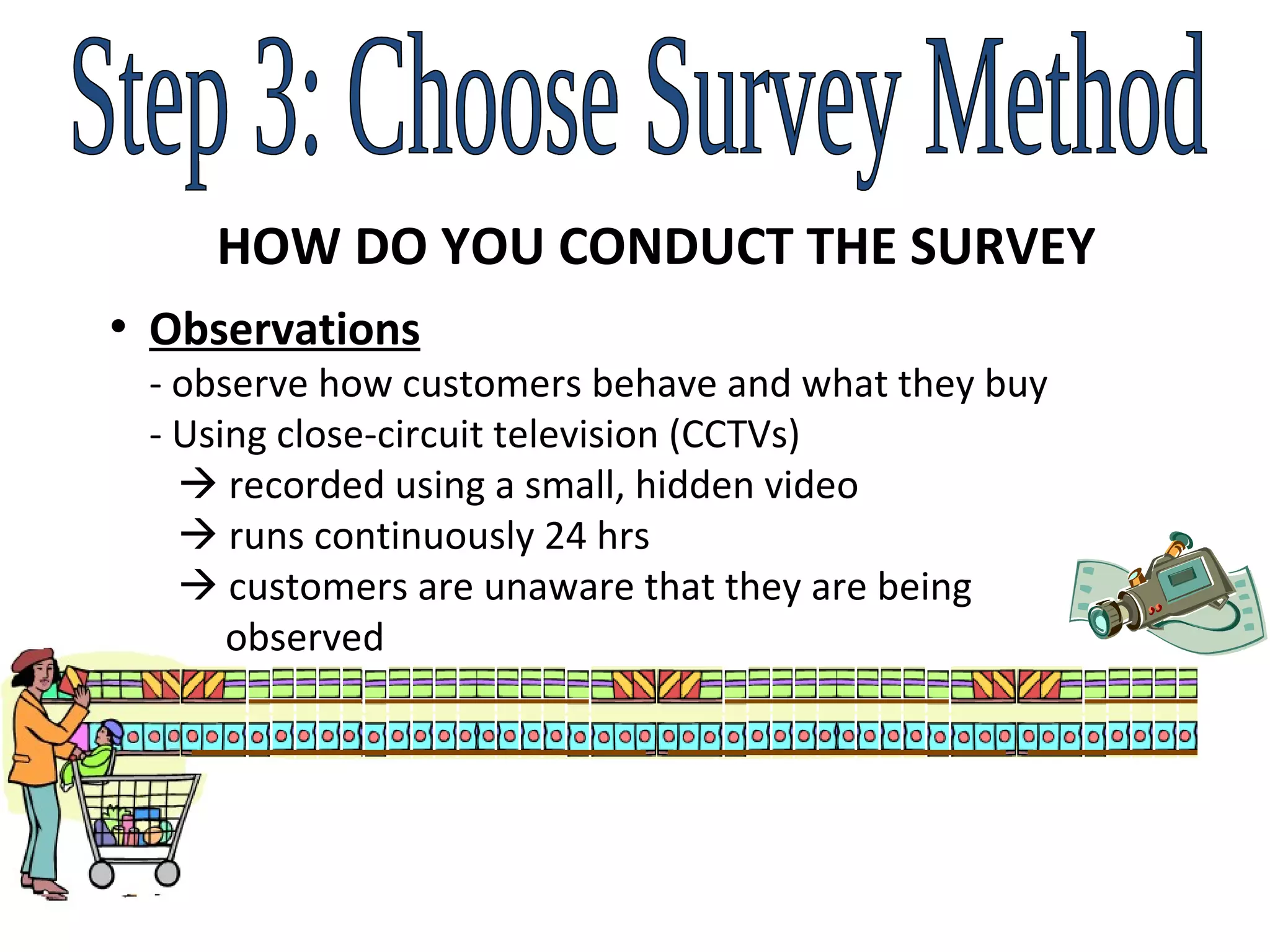
Step 3: Choose Survey Method HOW DO YOU CONDUCT THE SURVEY Observations  - observe how customers behave and what they buy   - Using close-circuit television (CCTVs)     recorded using a small, hidden video     runs continuously 24 hrs      customers are unaware that they are being    observed
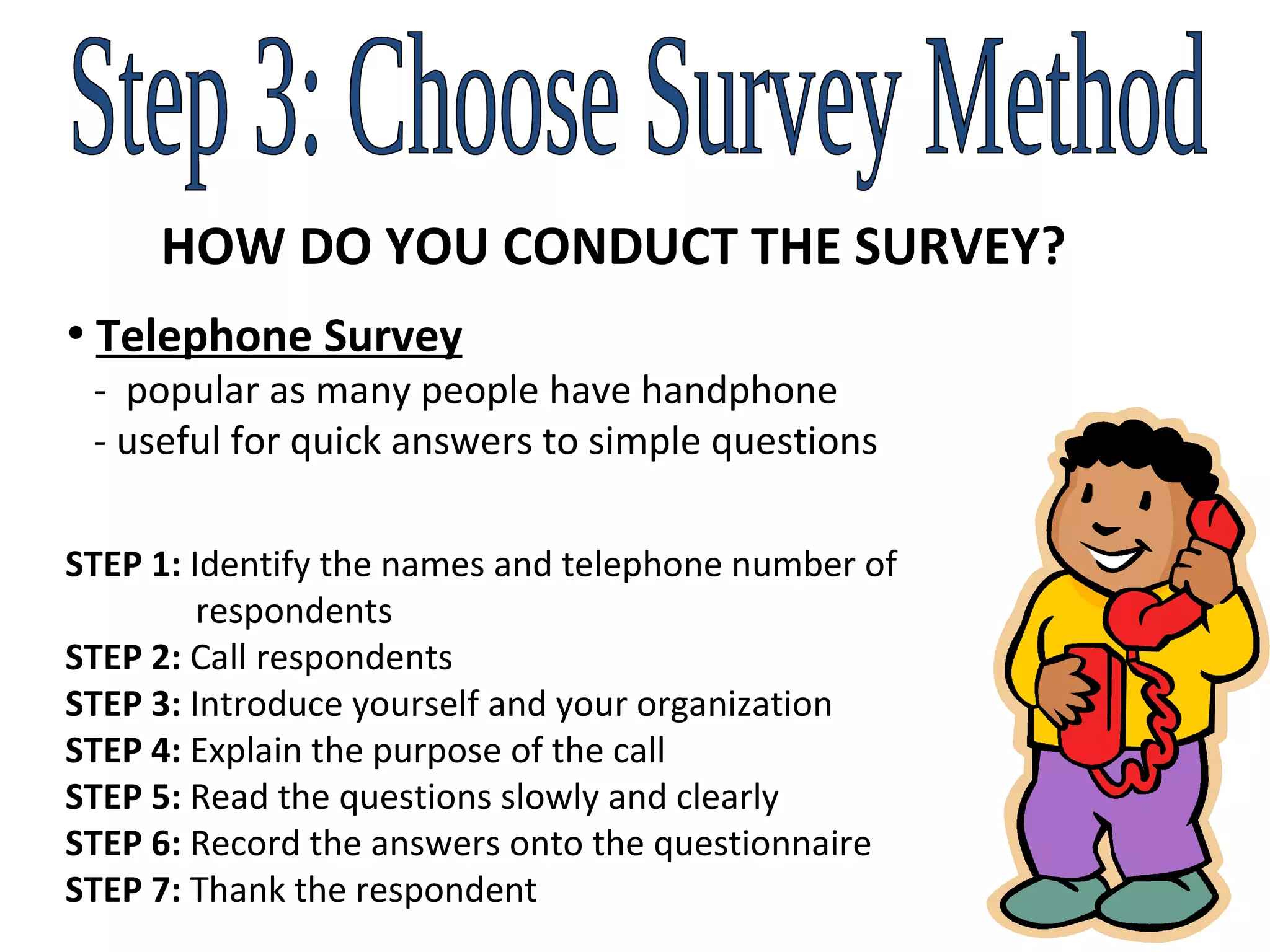
Step 3: Choose Survey Method HOW DO YOU CONDUCT THE SURVEY? Telephone Survey   -  popular as many people have handphone   - useful for quick answers to simple questions STEP 1:  Identify the names and telephone number of    respondents STEP 2:  Call respondents STEP 3:  Introduce yourself and your organization STEP 4:  Explain the purpose of the call STEP 5:  Read the questions slowly and clearly  STEP 6:  Record the answers onto the questionnaire STEP 7:  Thank the respondent
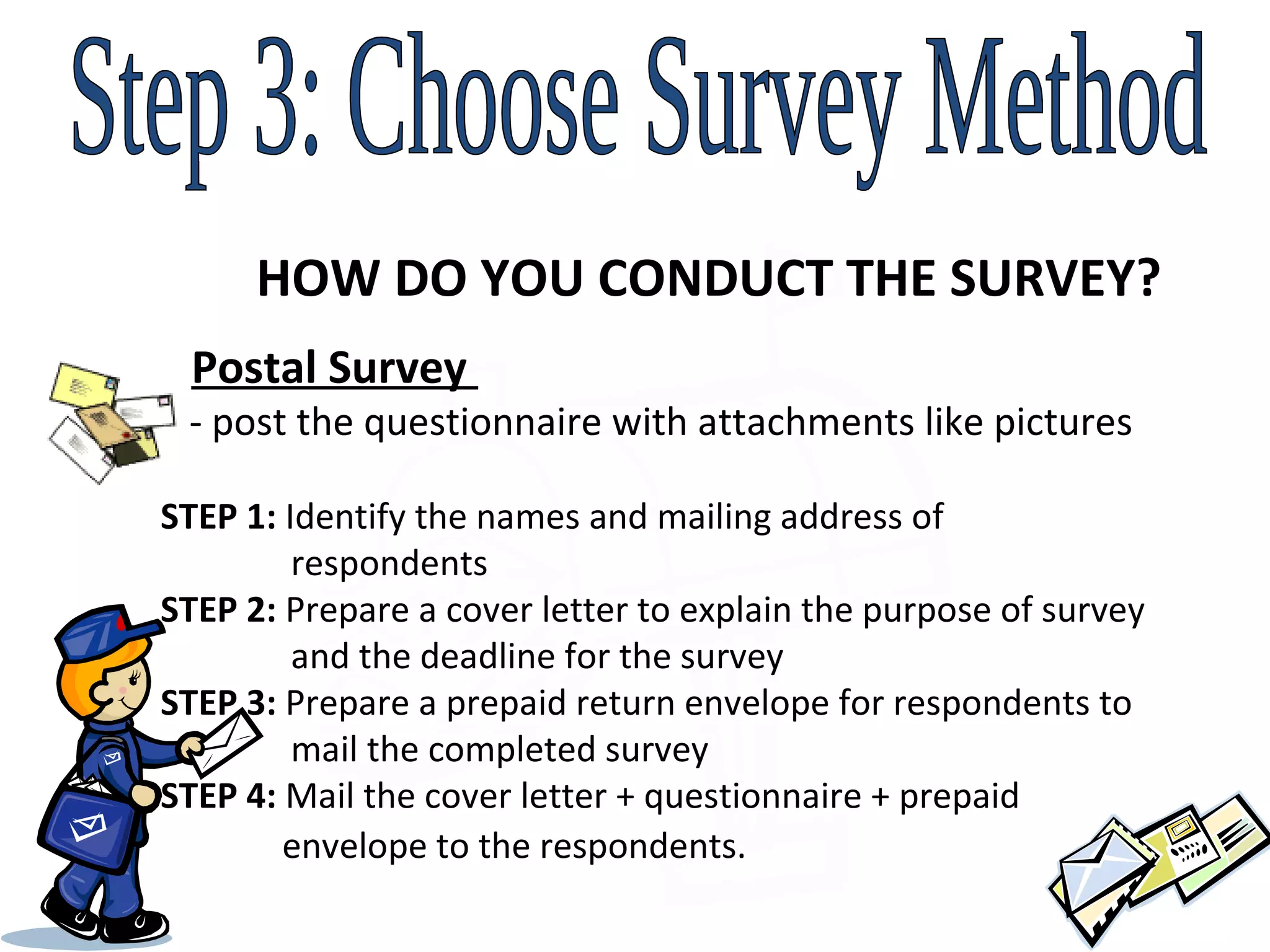
Step 3: Choose Survey Method HOW DO YOU CONDUCT THE SURVEY? Postal Survey    - post the questionnaire with attachments like pictures  STEP 1:  Identify the names and mailing address of    respondents STEP 2:  Prepare a cover letter to explain the purpose of survey    and the deadline for the survey STEP 3:  Prepare a prepaid return envelope for respondents to    mail the completed survey STEP 4:  Mail the cover letter + questionnaire + prepaid    envelope to the respondents.
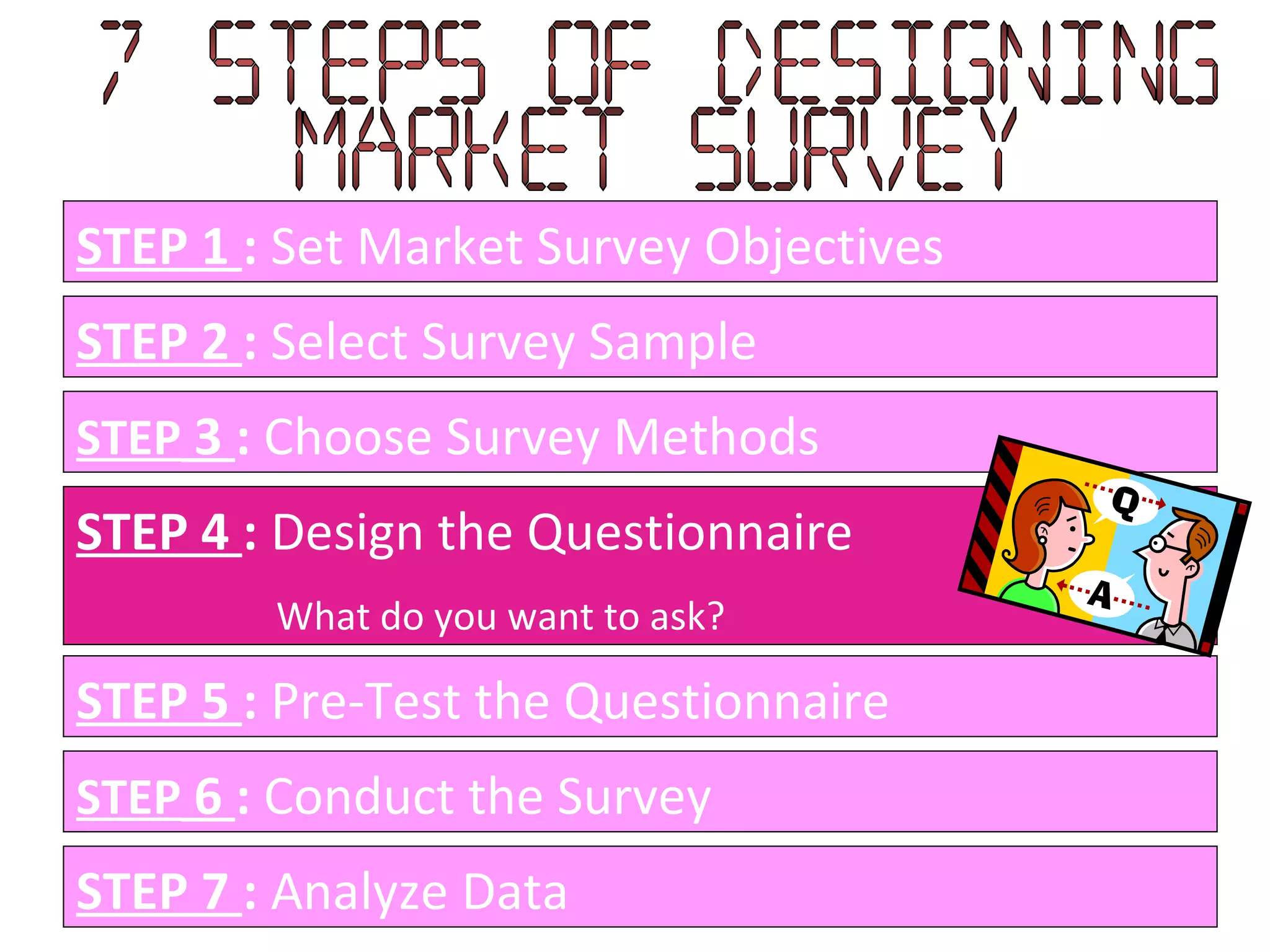
STEP 1  :  Set Market Survey Objectives STEP 2  :  Select Survey Sample STEP  3  :  Choose Survey Methods STEP 4  :  Design the Questionnaire What do you want to ask? STEP 5  :  Pre-Test the Questionnaire STEP  6  :  Conduct the Survey STEP 7  :  Analyze Data 7 Steps of designing  Market Survey
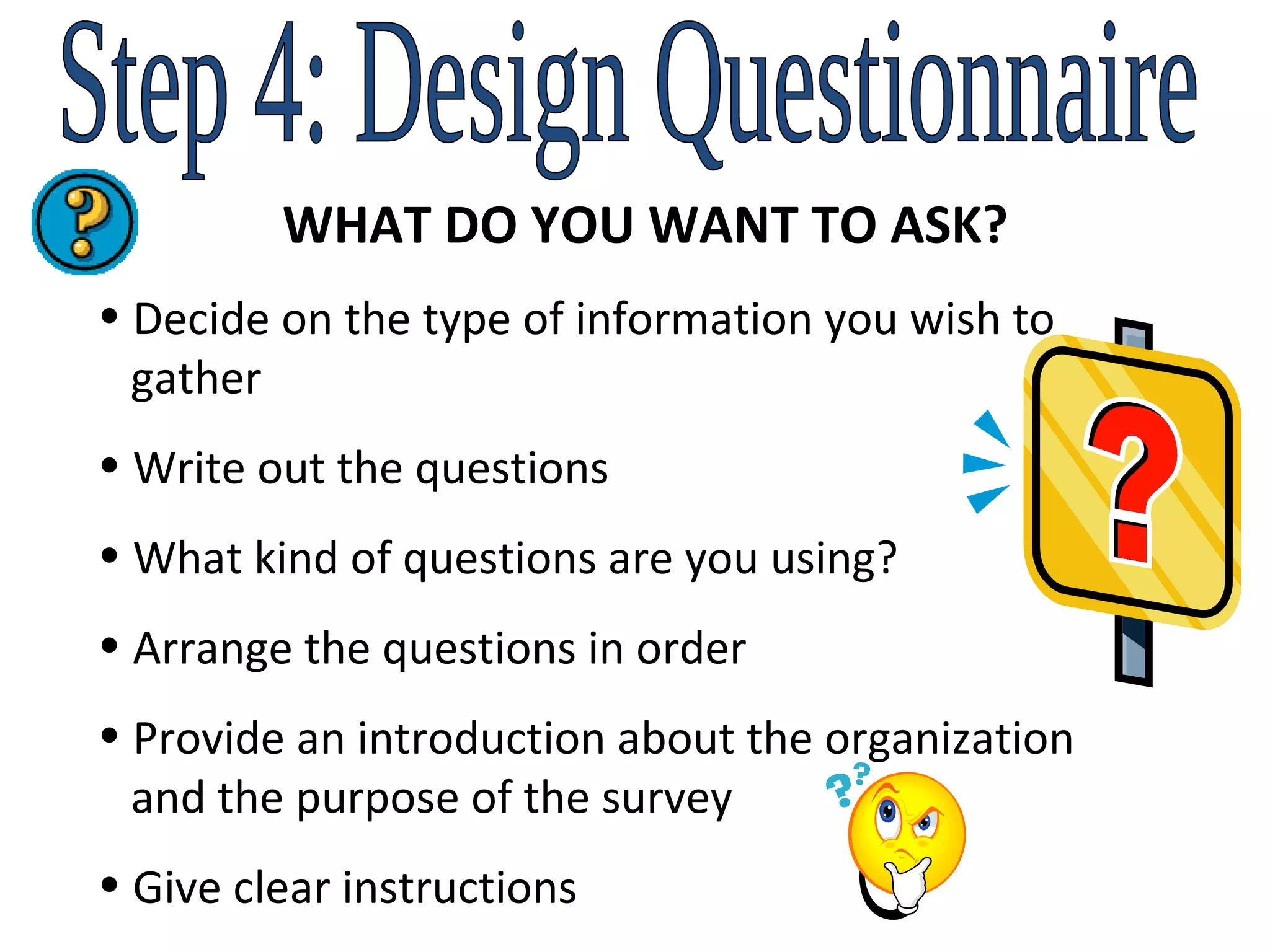
Step 4: Design Questionnaire WHAT DO YOU WANT TO ASK? Decide on the type of information you wish to    gather Write out the questions What kind of questions are you using? Arrange the questions in order Provide an introduction about the organization    and the purpose of the survey Give clear instructions
Step 4: Design Questionnaire WHAT DO YOU WANT TO ASK? Decide on the type of information you wish to    gather Write down what you want to find out  Design the questions around the things that you    want to find out Example Scenario:  Setting up a bakery in your school.  Questions:  We want to know who will buy, how much are they willing to pay, what kind of pastries do they like, when is the best time to set up the stall?
Step 4: Design Questionnaire WHAT DO YOU WANT TO ASK? Write out the questions Important to write the questions accurately  Use short simple sentences Ask for one information at a time Ask clear and straight to the point questions Ask questions respondents have knowledge about Ask questions related to the objectives of survey Give a range when asking for confidential information    like age and income
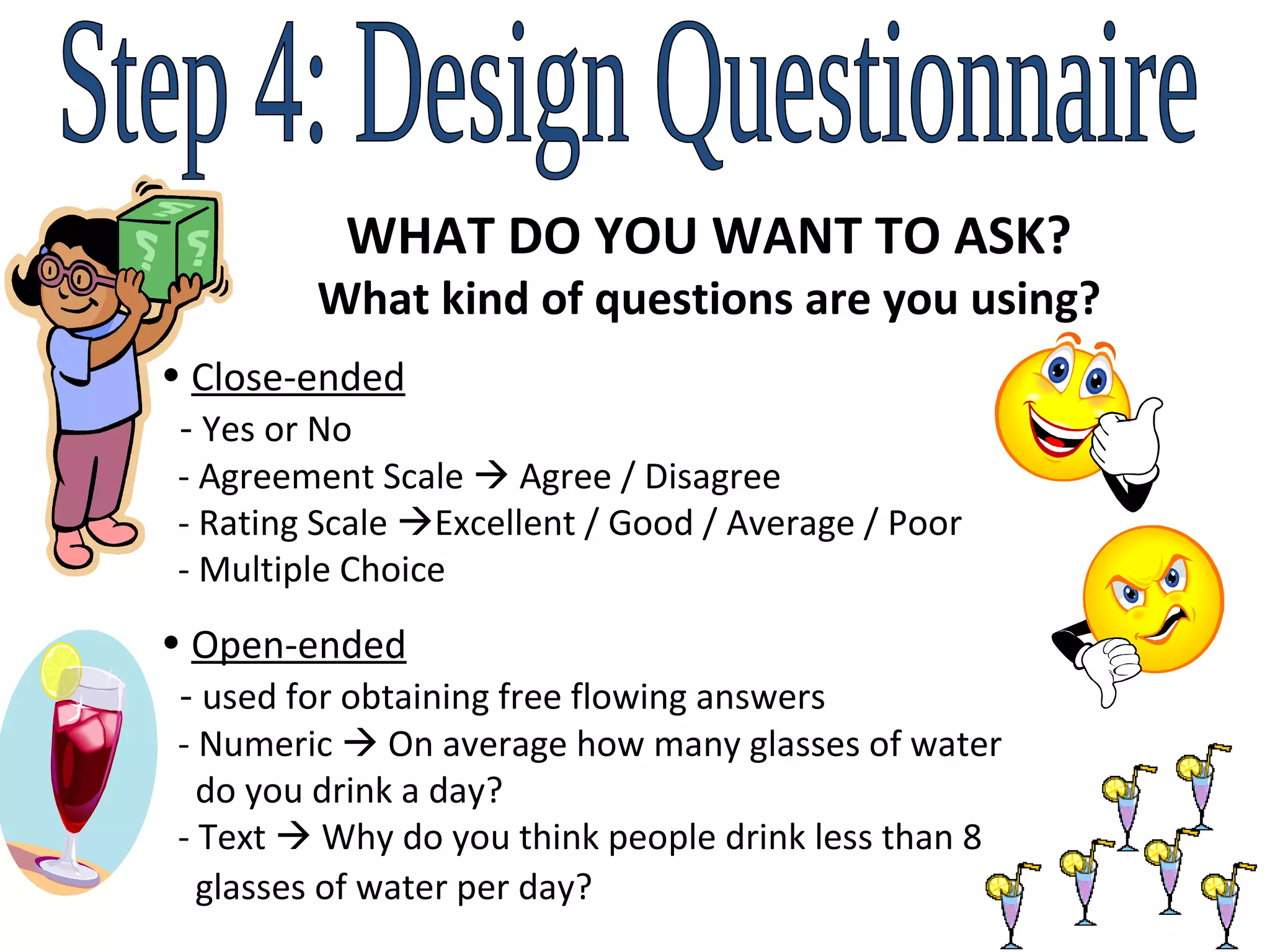
Step 4: Design Questionnaire WHAT DO YOU WANT TO ASK? What kind of questions are you using? Close-ended   -  Yes or No    - Agreement Scale    Agree / Disagree    - Rating Scale   Excellent / Good / Average / Poor   - Multiple Choice  Open-ended   -  used for obtaining free flowing answers   - Numeric    On average how many glasses of water    do you drink a day?    - Text    Why do you think people drink less than 8    glasses of water per day?
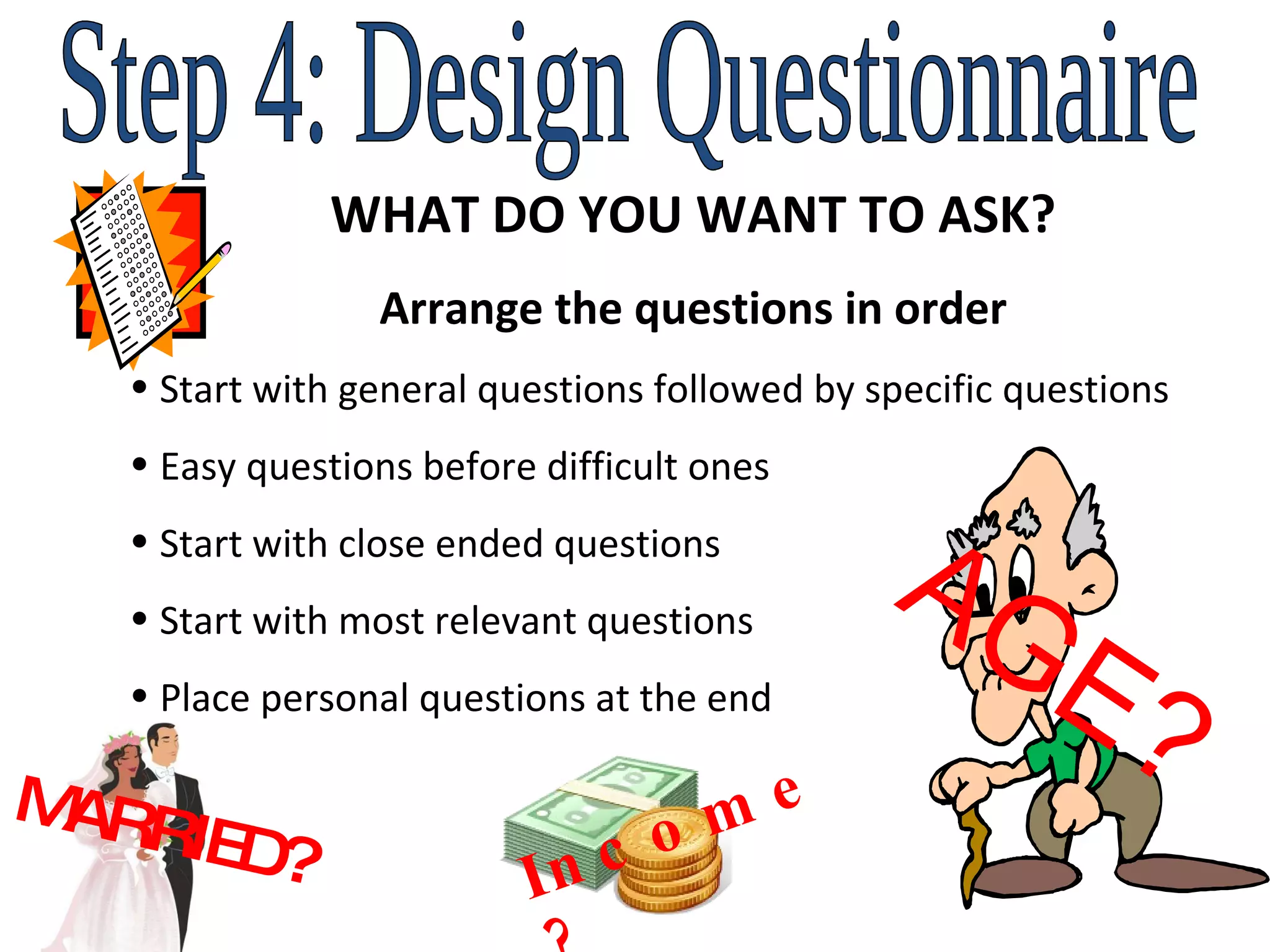
Step 4: Design Questionnaire WHAT DO YOU WANT TO ASK? Arrange the questions in order Start with general questions followed by specific questions Easy questions before difficult ones Start with close ended questions Start with most relevant questions Place personal questions at the end Income? AGE? MARRIED?
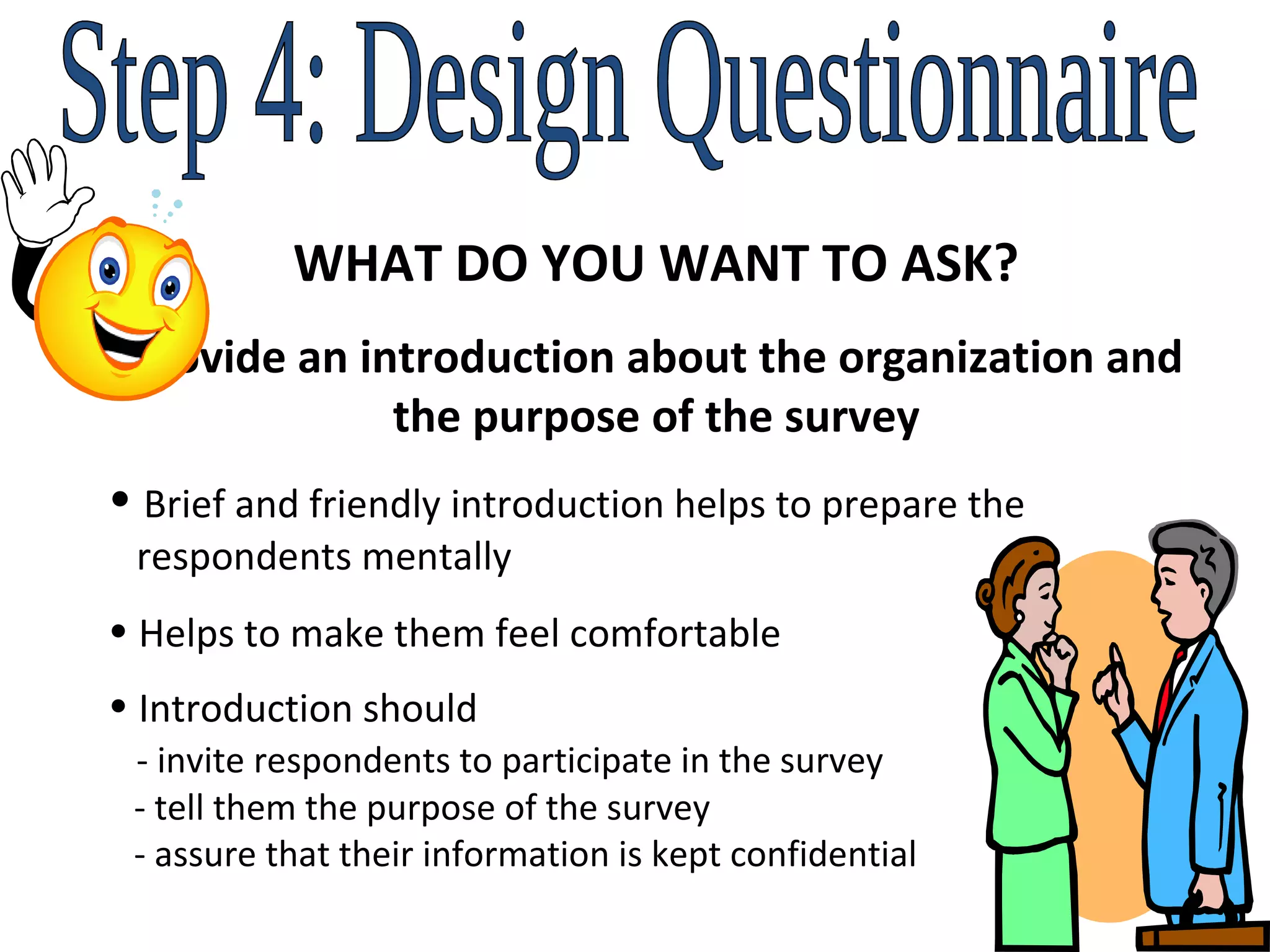
Step 4: Design Questionnaire WHAT DO YOU WANT TO ASK? Provide an introduction about the organization and the purpose of the survey Brief and friendly introduction helps to prepare the    respondents mentally Helps to make them feel comfortable Introduction should    - invite respondents to participate in the survey   - tell them the purpose of the survey   - assure that their information is kept confidential
Step 4: Design Questionnaire WHAT DO YOU WANT TO ASK? Give clear instructions To prevent confusion to the respondents Provide clear instructions on how to    complete the survey Thank the respondents for their    participation
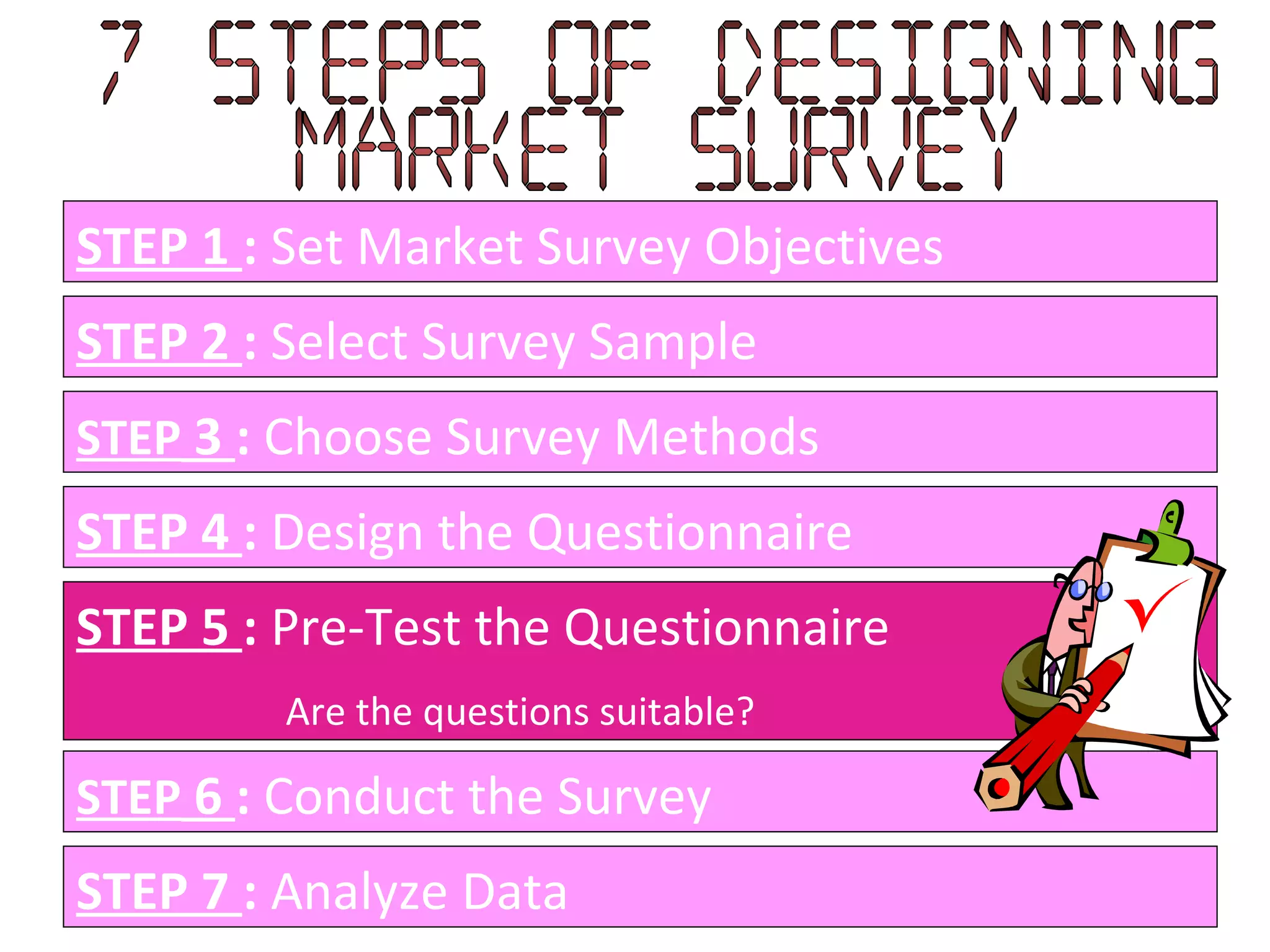
STEP 1  :  Set Market Survey Objectives STEP 2  :  Select Survey Sample STEP  3  :  Choose Survey Methods STEP 4  :  Design the Questionnaire STEP 5  :  Pre-Test the Questionnaire Are the questions suitable?  STEP  6  :  Conduct the Survey STEP 7  :  Analyze Data 7 Steps of designing  Market Survey
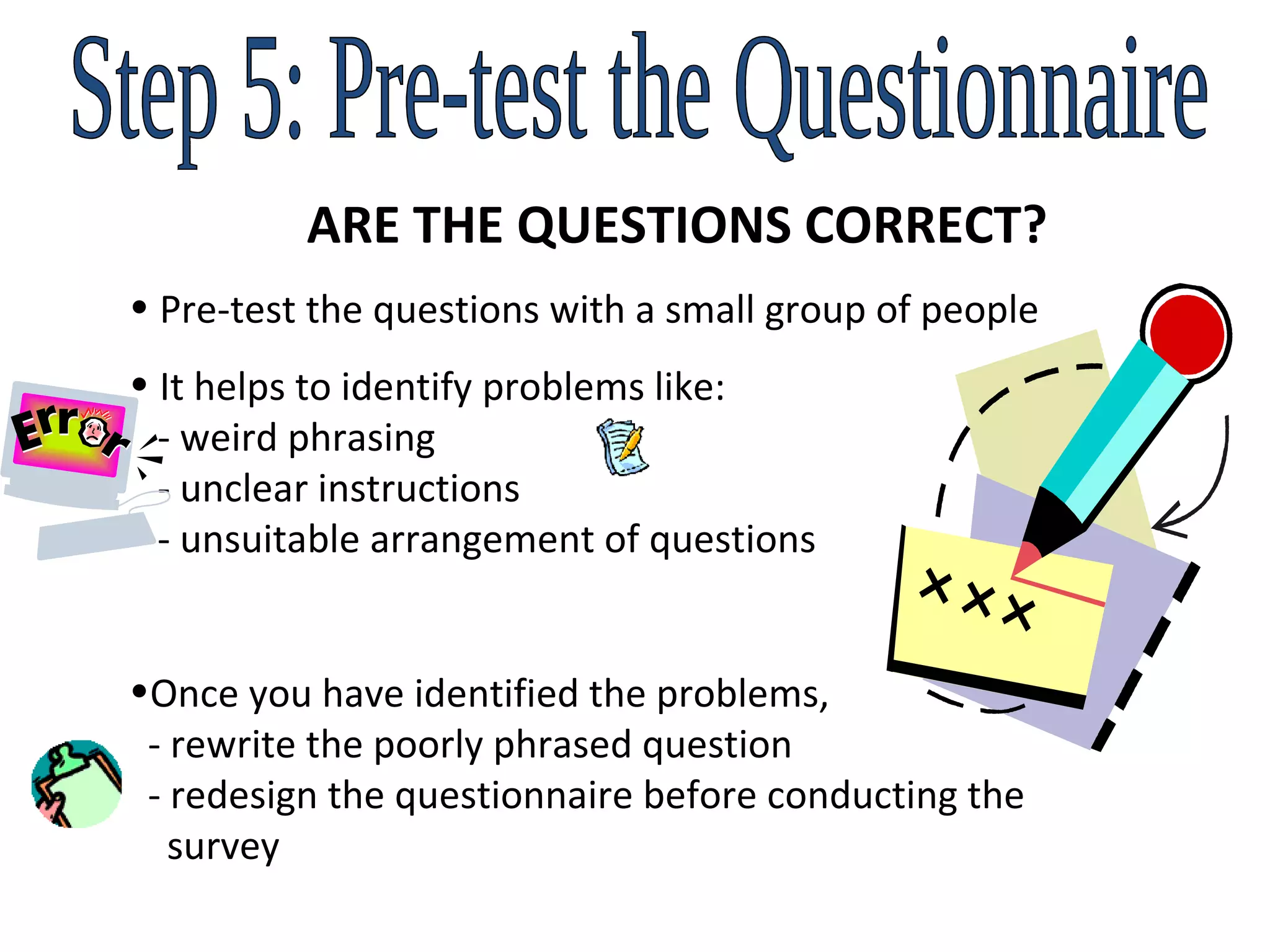
Step 5: Pre-test the Questionnaire ARE THE QUESTIONS CORRECT? Pre-test the questions with a small group of people It helps to identify problems like:   - weird phrasing   - unclear instructions   - unsuitable arrangement of questions Once you have identified the problems,    - rewrite the poorly phrased question   - redesign the questionnaire before conducting the    survey
STEP   1   :   Set Market Survey Objectives STEP 2  :  Select Survey Sample STEP  3  :  Choose Survey Methods STEP 4  :  Design the Questionnaire STEP 5  :  Pre-Test the Questionnaire STEP  6  :  Conduct the Survey Ask the question and collect data STEP 7  :  Analyze Data 7 Steps of designing  Market Survey
Step 6: Conduct the Survey ASK QUESTIONS AND RECORD DATA? Choose a suitable method that you have learnt in STEP    3 to conduct your survey Set a deadline for completing the survey Record all the responses obtained on the questionnaire  DEADLINE
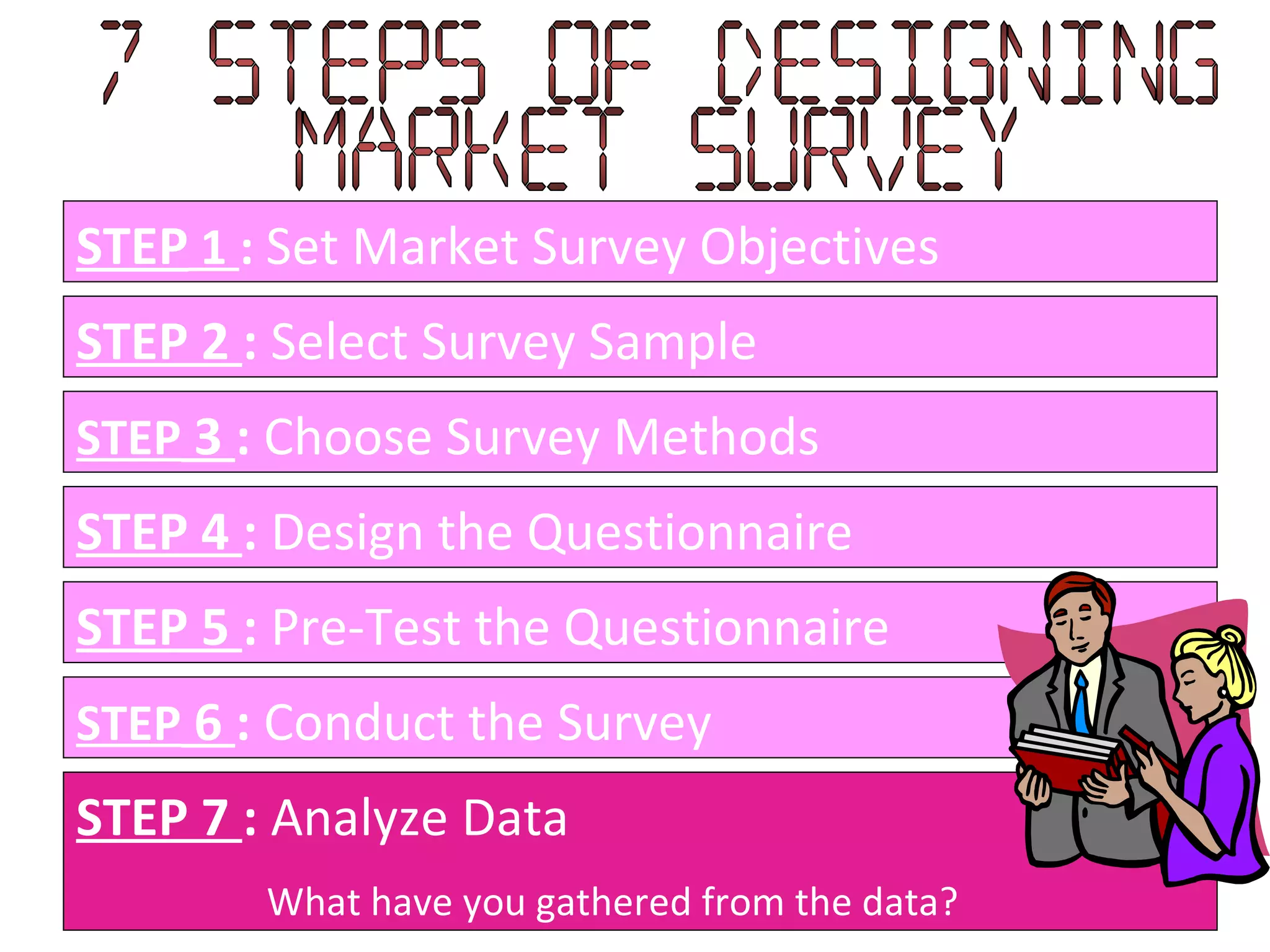
STEP  1  :   Set Market Survey Objectives STEP 2  :  Select Survey Sample STEP  3  :  Choose Survey Methods STEP 4  :  Design the Questionnaire STEP 5  :  Pre-Test the Questionnaire STEP  6  :  Conduct the Survey STEP 7  :  Analyze Data What have you gathered from the data? 7 Steps of designing  Market Survey
Step 7: Analyse the Data WHAT HAVE YOU GATHERED? After completing the survey,  Collate the data   - using frequency table   - use Microsoft Excel to display graphs and charts Analyse the data   - What have learnt from the survey?   - What is the conclusion? Use the answers from the survey    to write your marketing plan
ADVERTISING  TECHNIQUES
ADVERTISING TECHNIQUES 1. Television advertising (eg: Television commercials) 2. Print advertising (eg: Newspapers & Magazines) 3. Radio advertising (eg: Radio promotions)  4. Cinema advertising (eg: Cinema commercials) 5. Outdoor advertising (eg: Bus posters & banners)
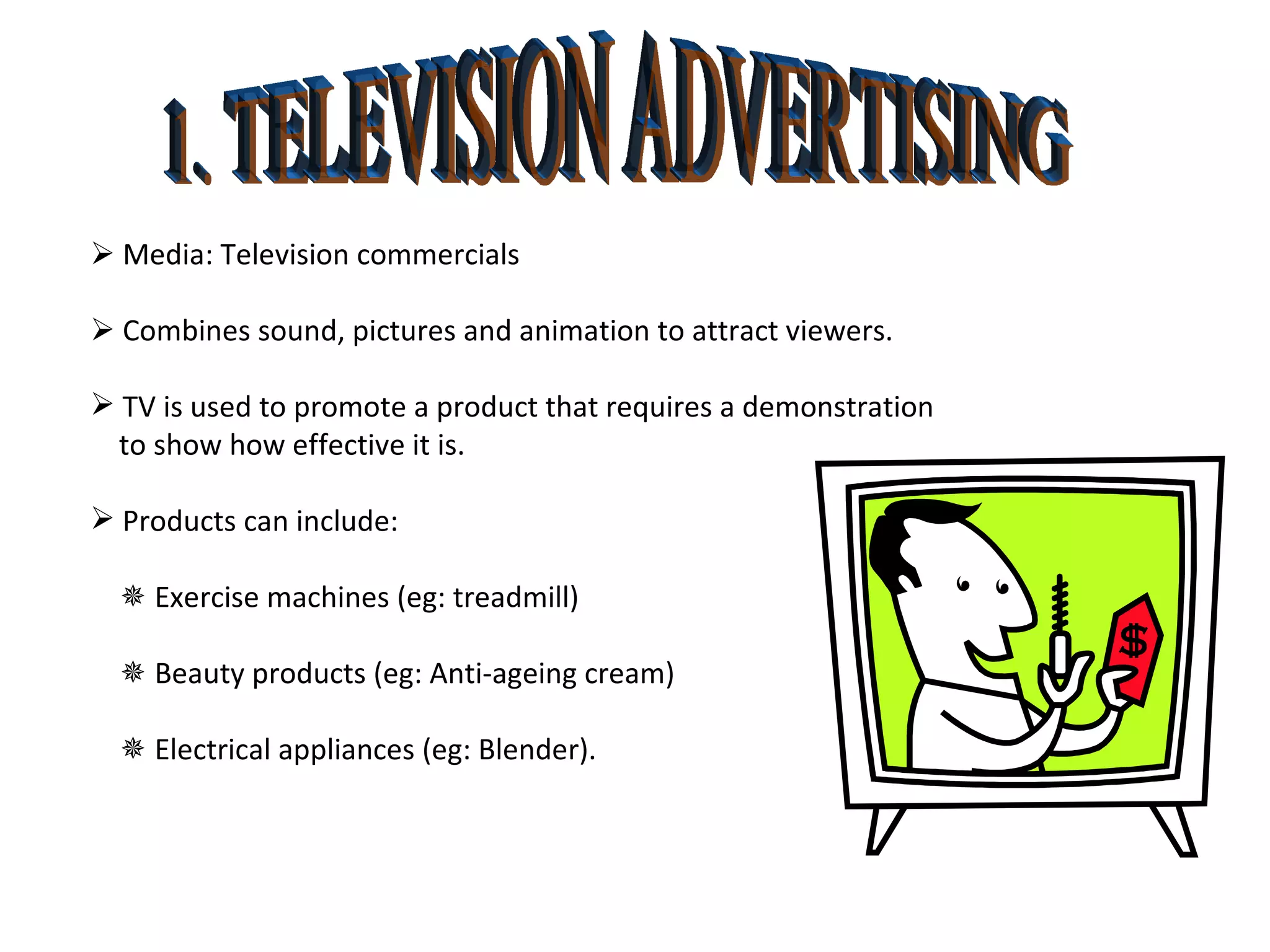
1. TELEVISION ADVERTISING    Media: Television commercials    Combines sound, pictures and animation to attract viewers.  TV is used to promote a product that requires a demonstration  to show how effective it is.  Products can include:    Exercise machines (eg: treadmill)     Beauty products (eg: Anti-ageing cream)    Electrical appliances (eg: Blender).
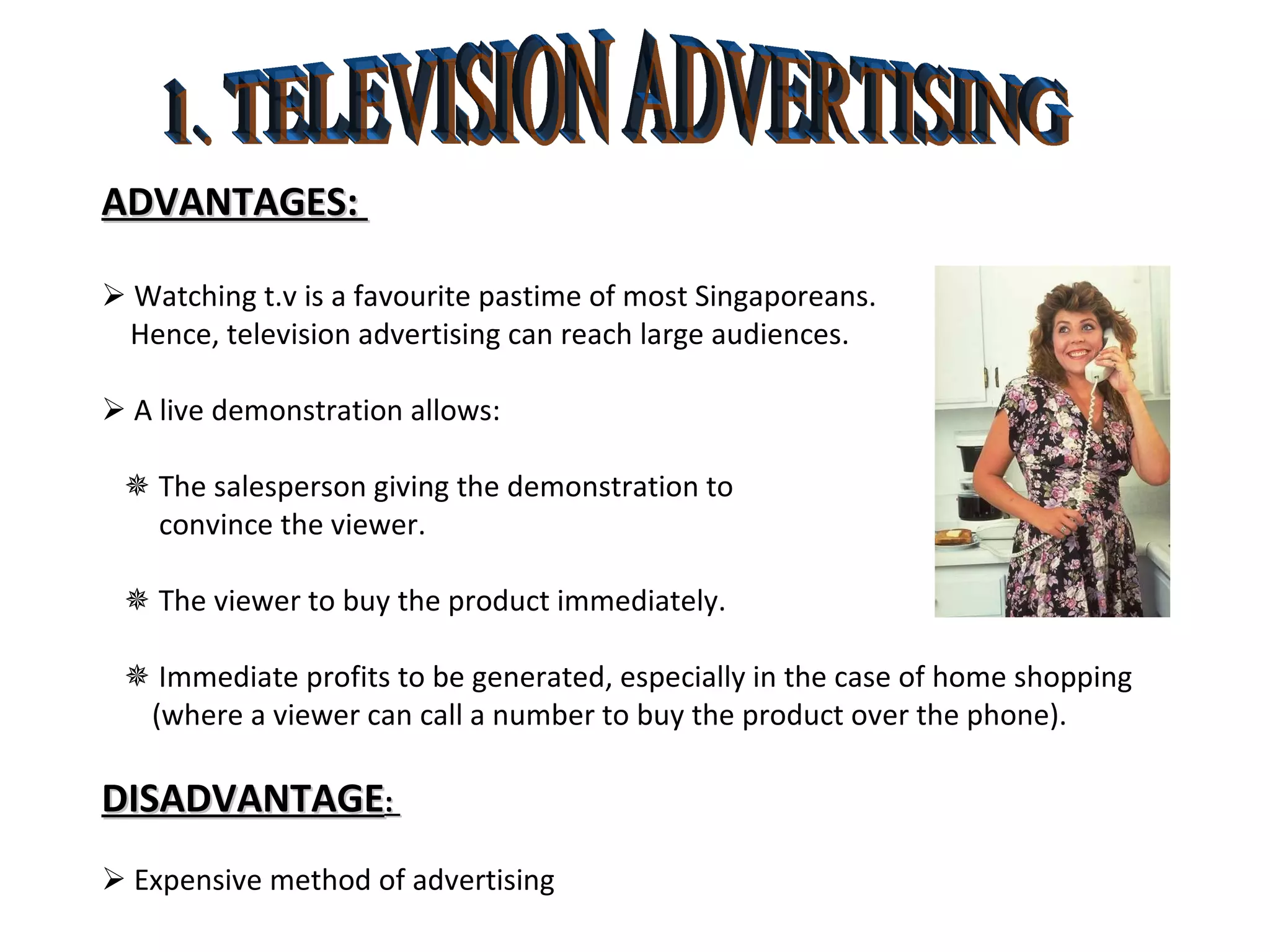
1. TELEVISION ADVERTISING ADVANTAGES:     Watching t.v is a favourite pastime of most Singaporeans. Hence, television advertising can reach large audiences.    A live demonstration allows:    The salesperson giving the demonstration to  convince the viewer.    The viewer to buy the product immediately.    Immediate profits to be generated, especially in the case of home shopping (where a viewer can call a number to buy the product over the phone). DISADVANTAGE :     Expensive method of advertising
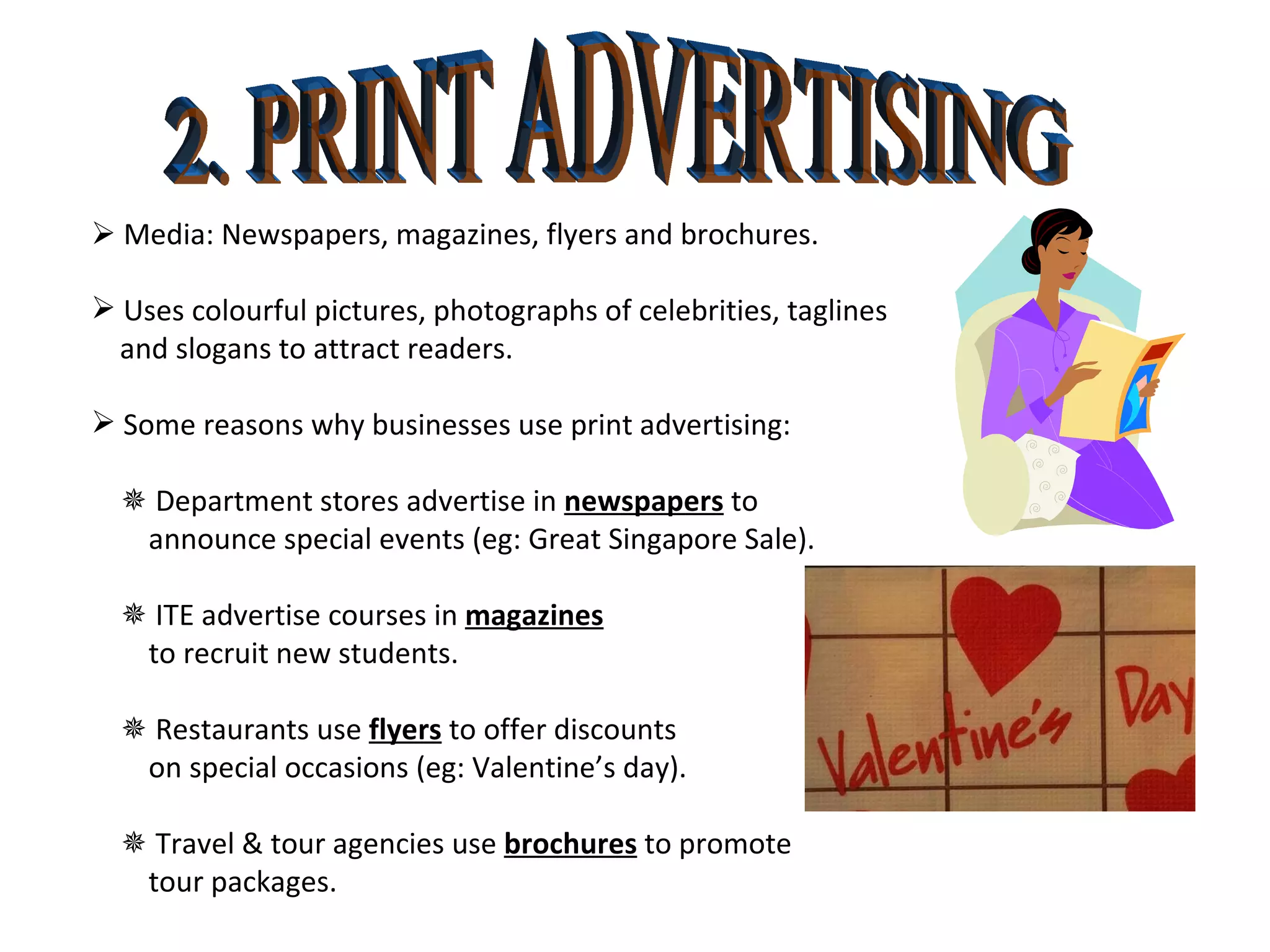
2. PRINT ADVERTISING    Media: Newspapers, magazines, flyers and brochures.  Uses colourful pictures, photographs of celebrities, taglines and slogans to attract readers. Some reasons why businesses use print advertising:    Department stores advertise in  newspapers  to  announce special events (eg: Great Singapore Sale).    ITE advertise courses in  magazines   to recruit new students.    Restaurants use  flyers  to offer discounts  on special occasions (eg: Valentine’s day).    Travel & tour agencies use  brochures  to promote  tour packages.
2. PRINT ADVERTISING ADVANTAGES:     Cheaper than television and cinema advertising.    Reader can keep aside the material (eg: newspaper) and look at it again later. DISADVANTAGE:    Reader might throw away the material (eg: flyer) without reading it.
3. RADIO ADVERTISING    Media: Radio commercials. Uses voice, sound effects and music to attract listeners. Example of radio advertising:  Jingles combined with short dialogues promoting  fast food services, or announcing sales at  department stores.
3. RADIO ADVERTISING ADVANTAGES:     Cheaper than television and cinema advertising.    Can reach listeners even in faraway & remote places. Different radio stations reach different target audiences:    Ria 89.7 broadcasts in Malay.    YES 93.3 broadcasts in Chinese.    FM 98.7 broadcasts in English. DISADVANTAGE:    Commercial lasts only a few seconds and might not have impact on listeners.
4. CINEMA ADVERTISING    Media: Cinema. Uses sound, pictures and animation (similar to t.v) to attract movie-goers. Cinema advertising is used:    To promote consumer products such as mobile phones,  credit cards and soft drinks.    To promote upcoming movies.    Restaurants advertise discounts on special  occasions.     Department stores advertise special events.
4. CINEMA ADVERTISING ADVANTAGES:     Commercials last much longer than radio commercials. Is shown on a big screen with excellent sound system to  create an impact with the viewer.  DISADVANTAGE: Is shown only to the people who are in the cinema.     Expensive method of advertising.
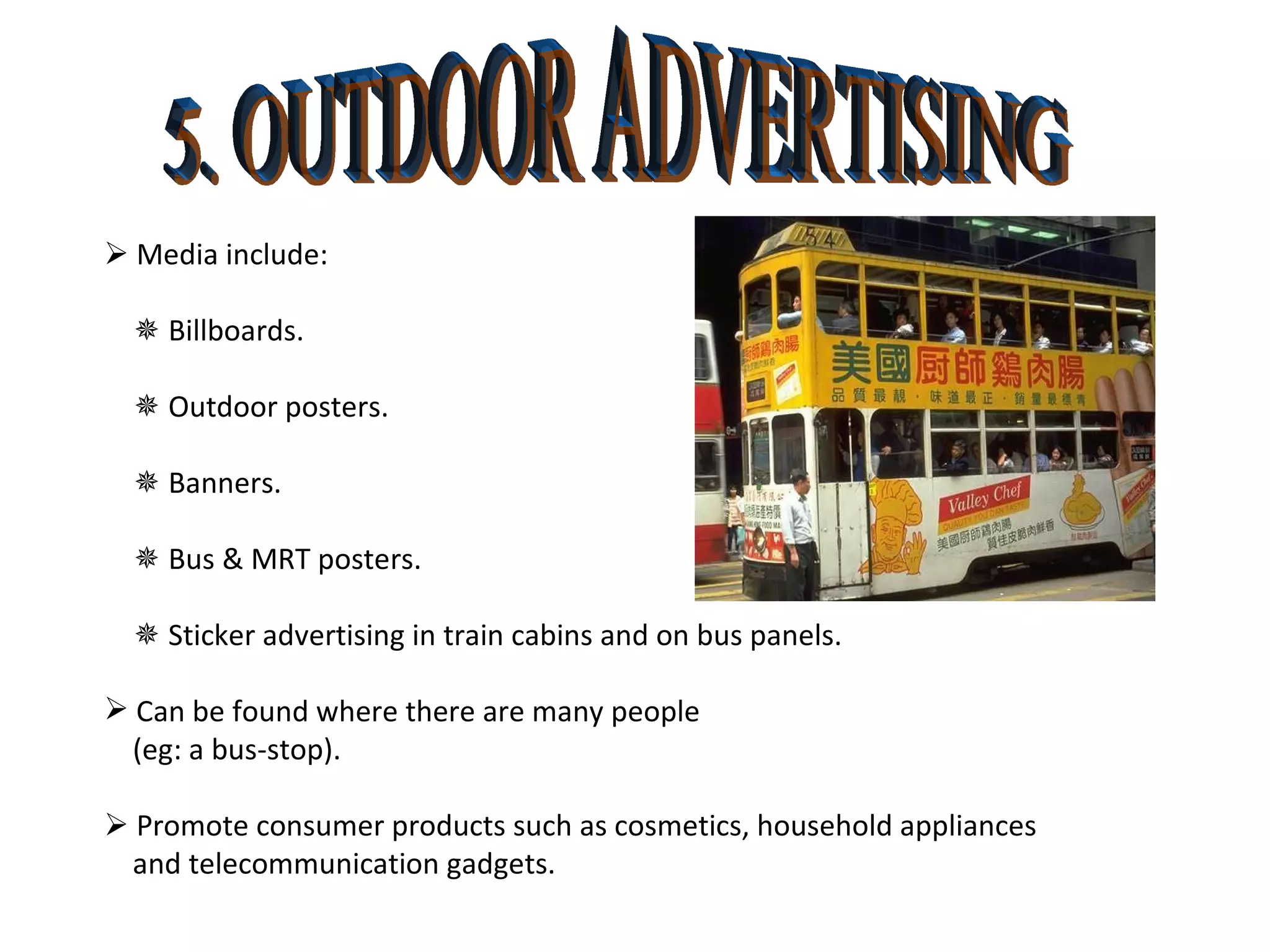
5. OUTDOOR ADVERTISING    Media include:    Billboards.     Outdoor posters.    Banners.     Bus & MRT posters.    Sticker advertising in train cabins and on bus panels. Can be found where there are many people (eg: a bus-stop).    Promote consumer products such as cosmetics, household appliances and telecommunication gadgets.
5. OUTDOOR ADVERTISING ADVANTAGES:  Can be found in many places, thus reaching a large number of viewers. Many different media to choose from, thus suitable for any budget.  DISADVANTAGE:    Advertising relies heavily on colourful pictures and  smart taglines to attract audience. Is not as effective as advertising that uses voice, animation and sound effects.
SALES  PROMOTION TECHNIQUES
SALES PROMOTION TECHNIQUES    Attract customers to buy our products  now  rather than later.    Customers want to act quickly to receive benefits (eg: free gift) when they buy the product on promotion.    Common sales promotion techniques: 1. Discount coupons. 4. Free Gifts.  2. Price discounts. 5. Product samples.  3. Contests.  6. Loyalty reward programmes   (eg: M1 Sunperk rewards)
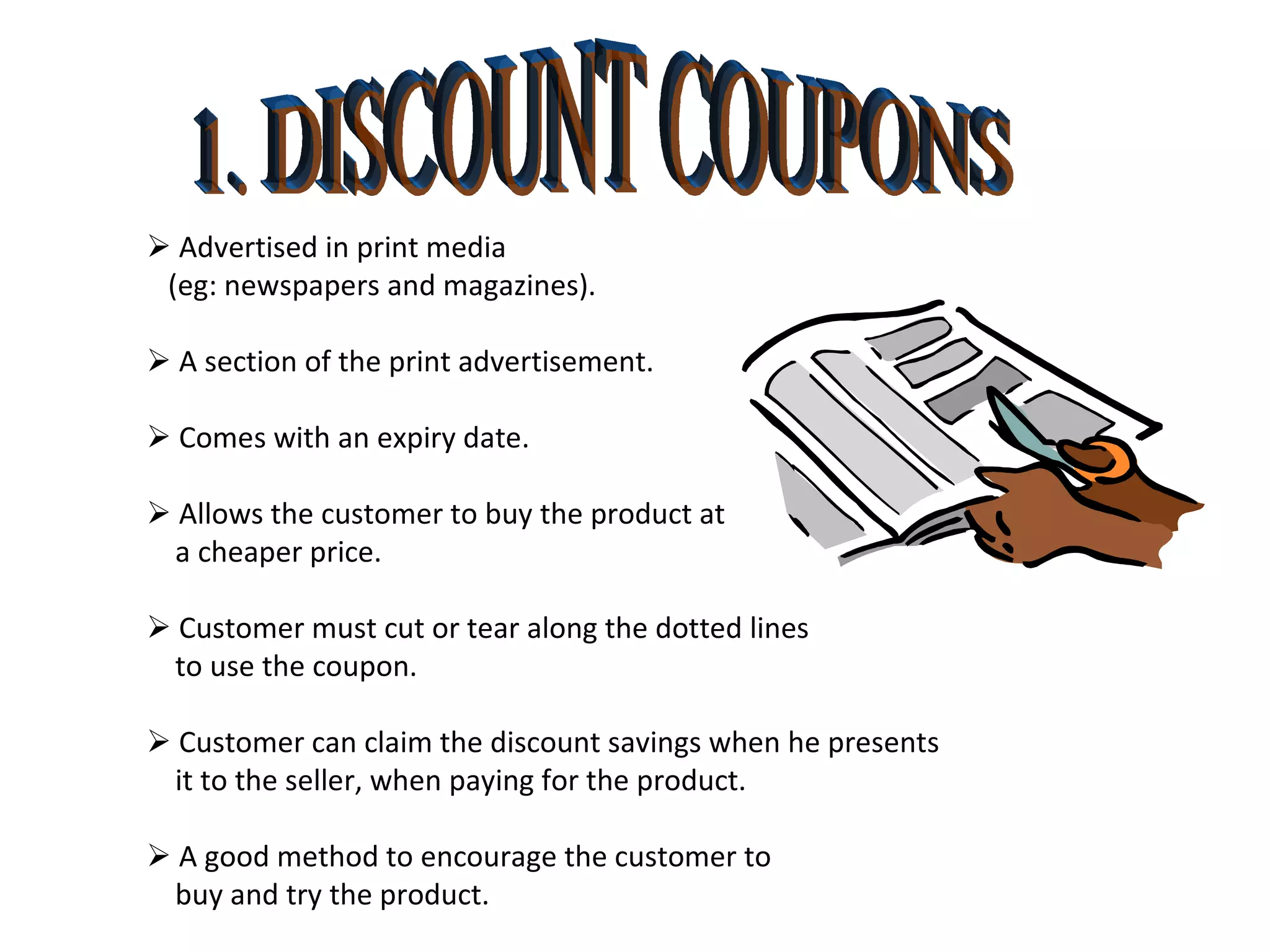
1. DISCOUNT COUPONS    Advertised in print media  (eg: newspapers and magazines).    A section of the print advertisement.    Comes with an expiry date.    Allows the customer to buy the product at  a cheaper price.    Customer must cut or tear along the dotted lines  to use the coupon.     Customer can claim the discount savings when he presents it to the seller, when paying for the product.    A good method to encourage the customer to buy and try the product.
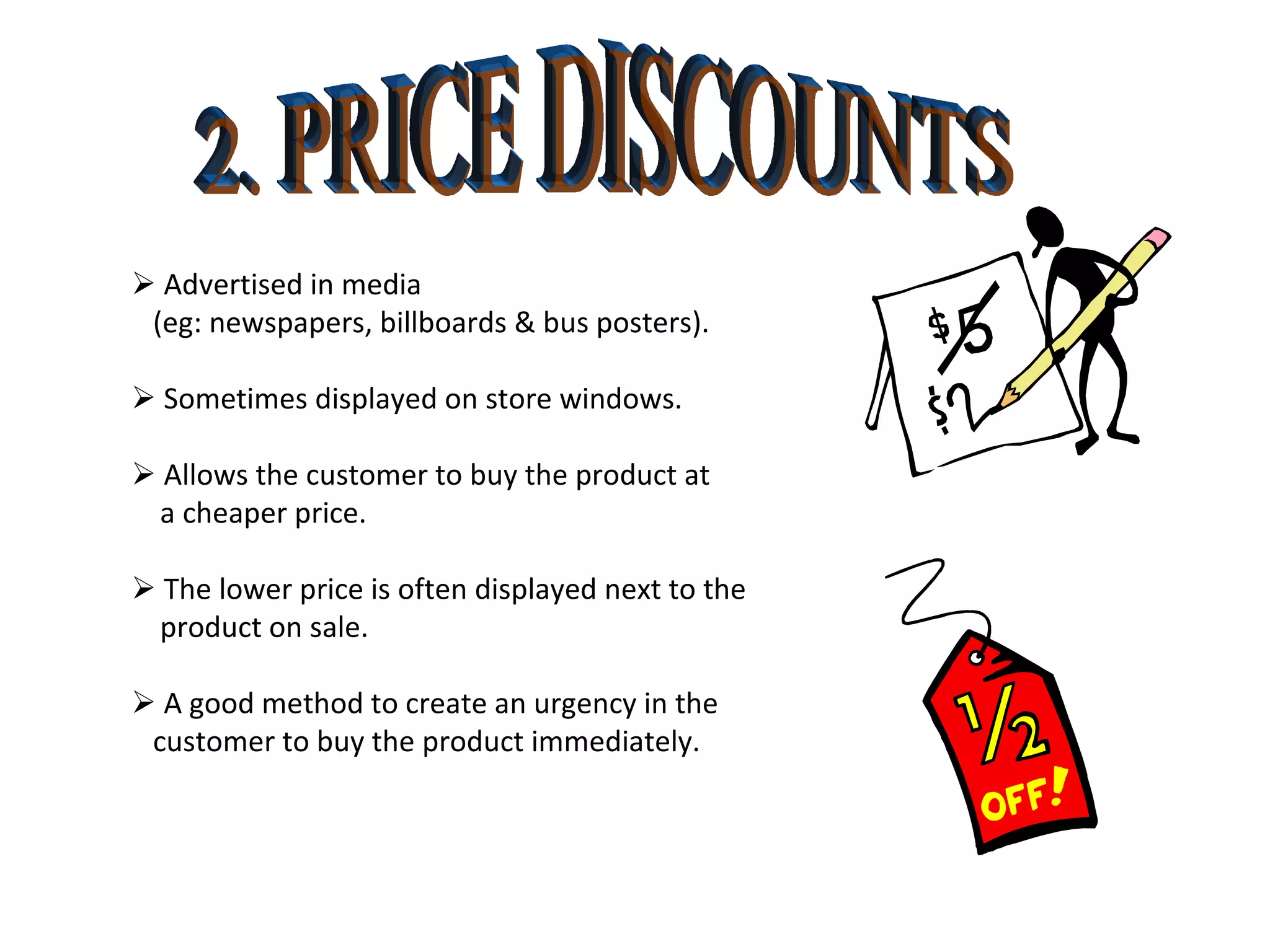
2. PRICE DISCOUNTS    Advertised in media  (eg: newspapers, billboards & bus posters).    Sometimes displayed on store windows.    Allows the customer to buy the product at  a cheaper price.    The lower price is often displayed next to the product on sale.    A good method to create an urgency in the  customer to buy the product immediately.
3. CONTESTS    Contest forms are given to customers when  they buy the product.    Contest forms can also be part of print advertisements in newspapers or magazines.    Contests are a popular form of sales promotion during festive seasons.    Customers compete for prizes by completing contest forms which may require:    Writing a slogan.     Designing a logo    Answering a simple question.
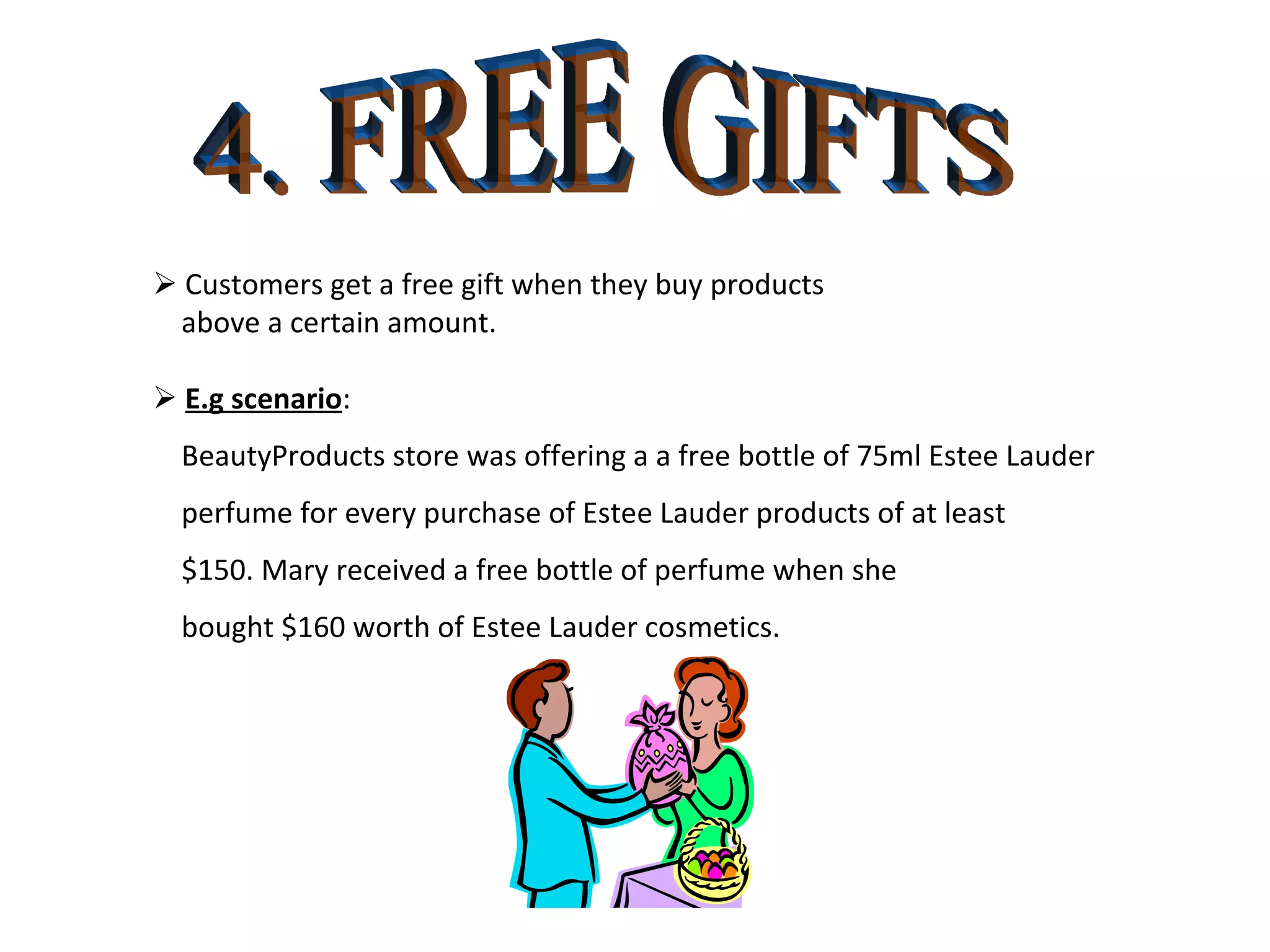
4. FREE GIFTS    Customers get a free gift when they buy products  above a certain amount.    E.g scenario : BeautyProducts store was offering a a free bottle of 75ml Estee Lauder perfume for every purchase of Estee Lauder products of at least $150. Mary received a free bottle of perfume when she  bought $160 worth of Estee Lauder cosmetics.
5. PRODUCT SAMPLES    A sample is a small amount of a given product in a small packet.    A good method to allow customers to try  new  products.    A sample normally comes bundled together with another product (normally the sample is related to the product).    Eg 1: A bottle of shampoo is bundled with a small packet of free conditioner. Customers get free product samples.    Samples encourage customers to buy the product  after trying it.    Eg 2: Sales promoters (in supermarkets) give away food samples.
6. LOYALTY REWARD PROGRAMMES    Programme rewards customers in the form of price discounts and  gifts (eg: M1 Sunperk rewards).    The rewards encourage customers to continue to buy or use the company’s products or services. Customers earn points for each purchase  (for services, points are earned each time the bill is paid for the services provided).    The points earned can be used to claim a gift or get a price discount  for the next purchase or payment.    Sometimes, customers also earn points when they purchase products or services  from a partner company.    Programmes are popular with mobile phone service providers, credit card and airline companies (Frequent Flyer Miles reward programme).
USE OF  INFORMATION & COMMUNICATION  TECHNOLOGIES
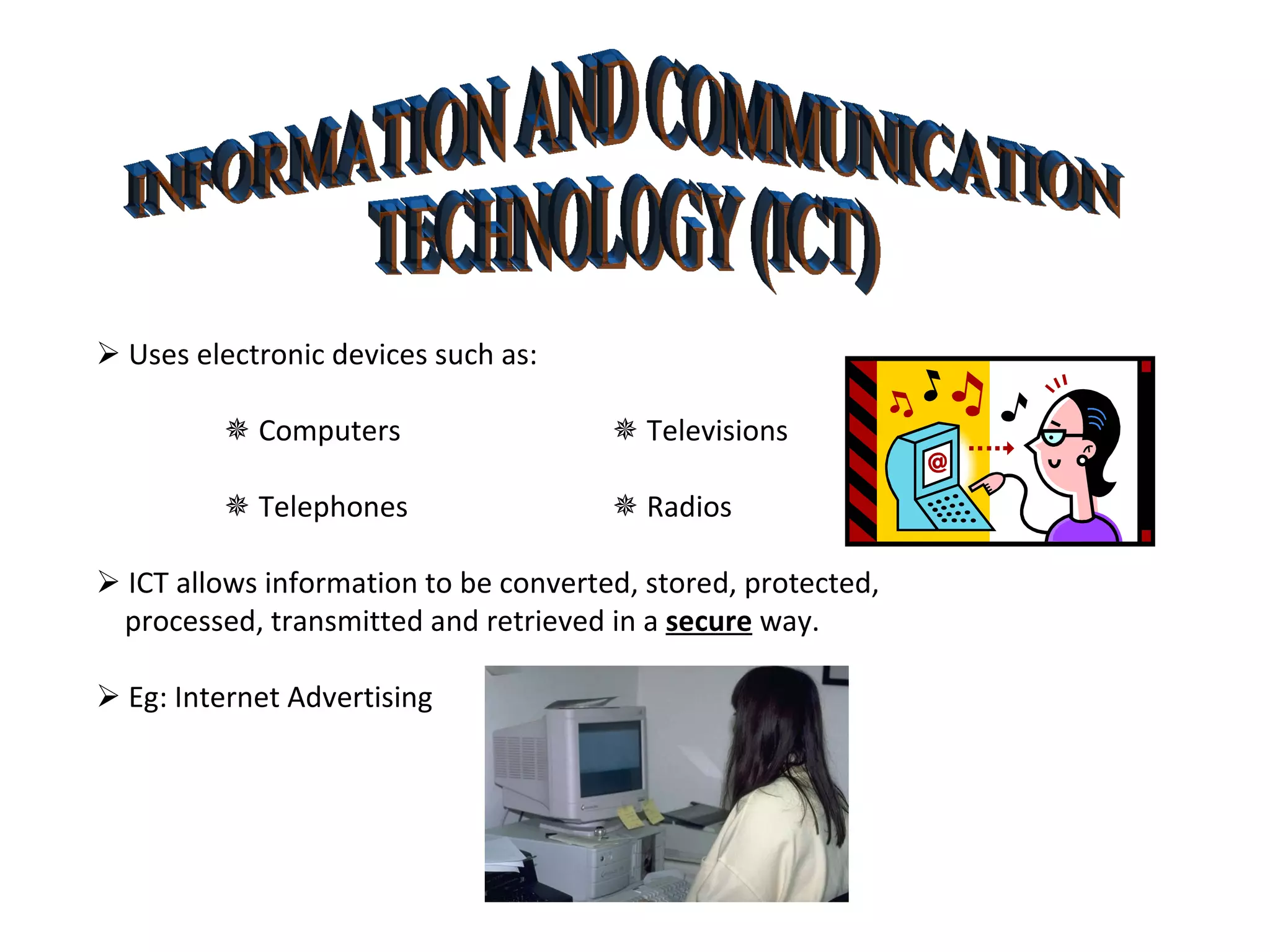
INFORMATION AND COMMUNICATION  TECHNOLOGY (ICT)    Uses electronic devices such as:    Computers     Televisions    Telephones     Radios    ICT allows information to be converted, stored, protected, processed, transmitted and retrieved in a  secure  way.    Eg: Internet Advertising
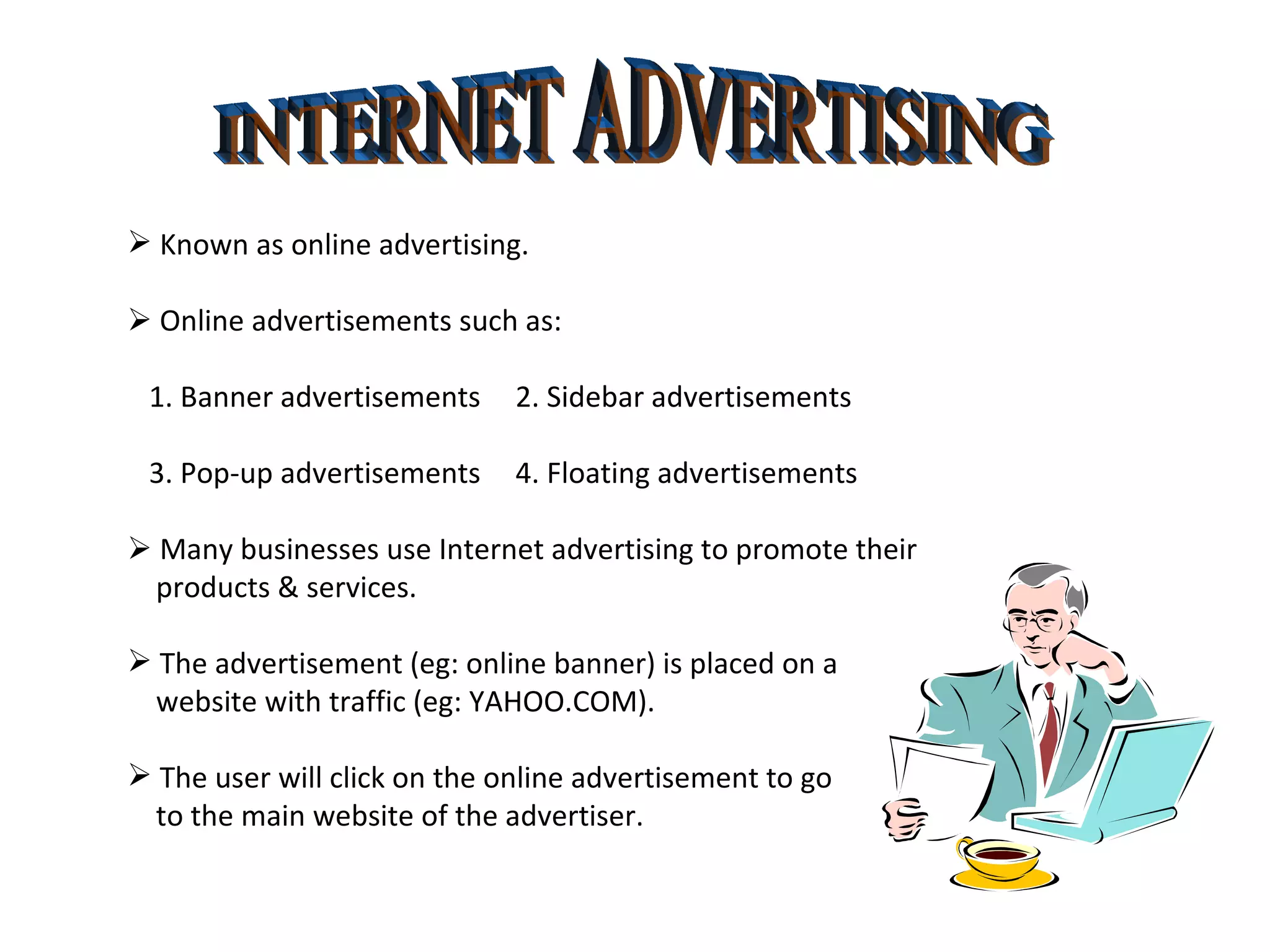
INTERNET ADVERTISING Known as online advertising.    Online advertisements such as: 1. Banner advertisements  2. Sidebar advertisements 3. Pop-up advertisements   4. Floating advertisements    Many businesses use Internet advertising to promote their products & services. The advertisement (eg: online banner) is placed on a  website with traffic (eg: YAHOO.COM). The user will click on the online advertisement to go  to the main website of the advertiser.
INTERNET ADVERTISING ADVANTAGES:    More interactive than traditional advertising.    The website is often linked to other websites to provide more information to the web user.
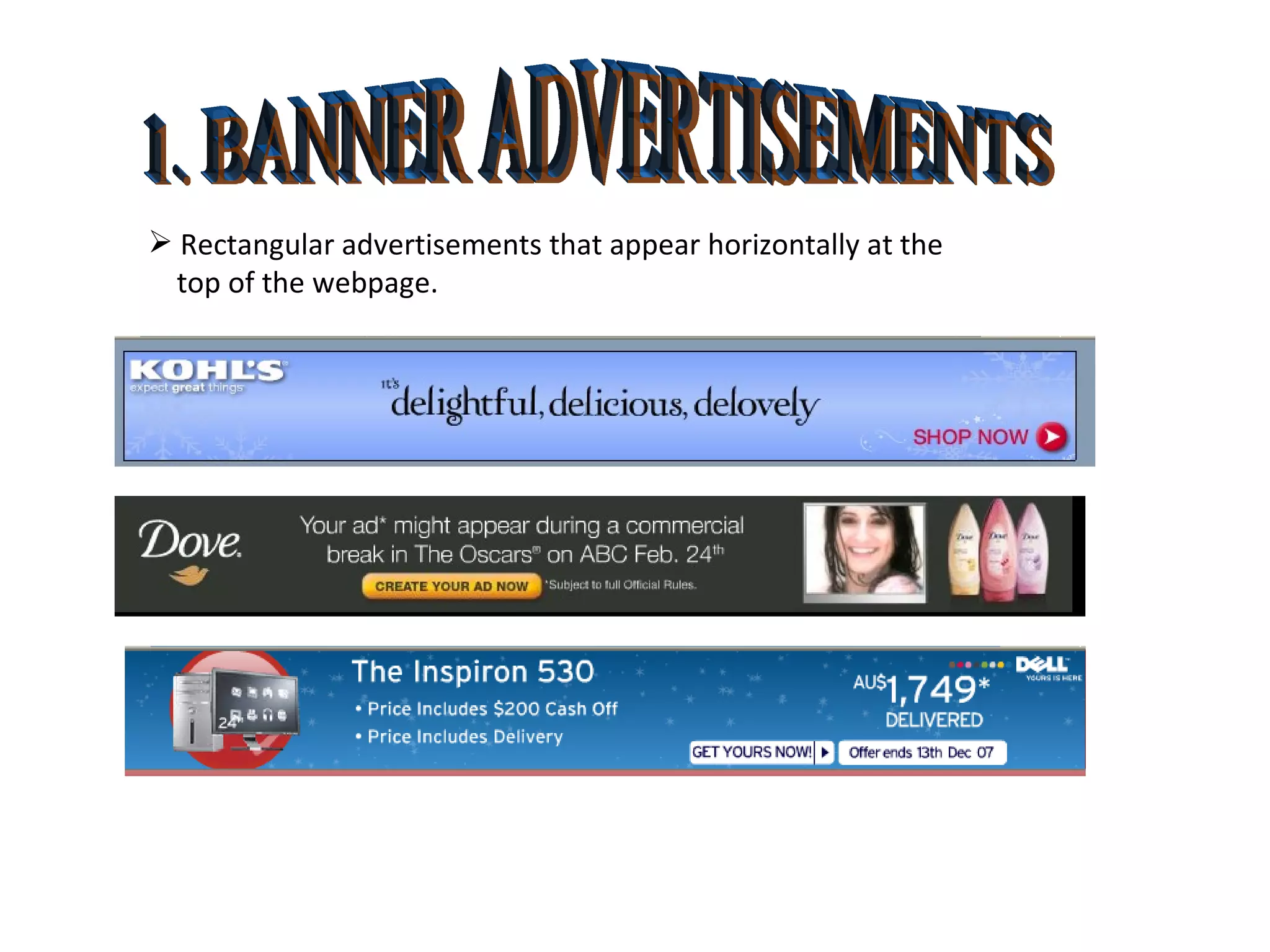
1. BANNER ADVERTISEMENTS Rectangular advertisements that appear horizontally at the top of the webpage.
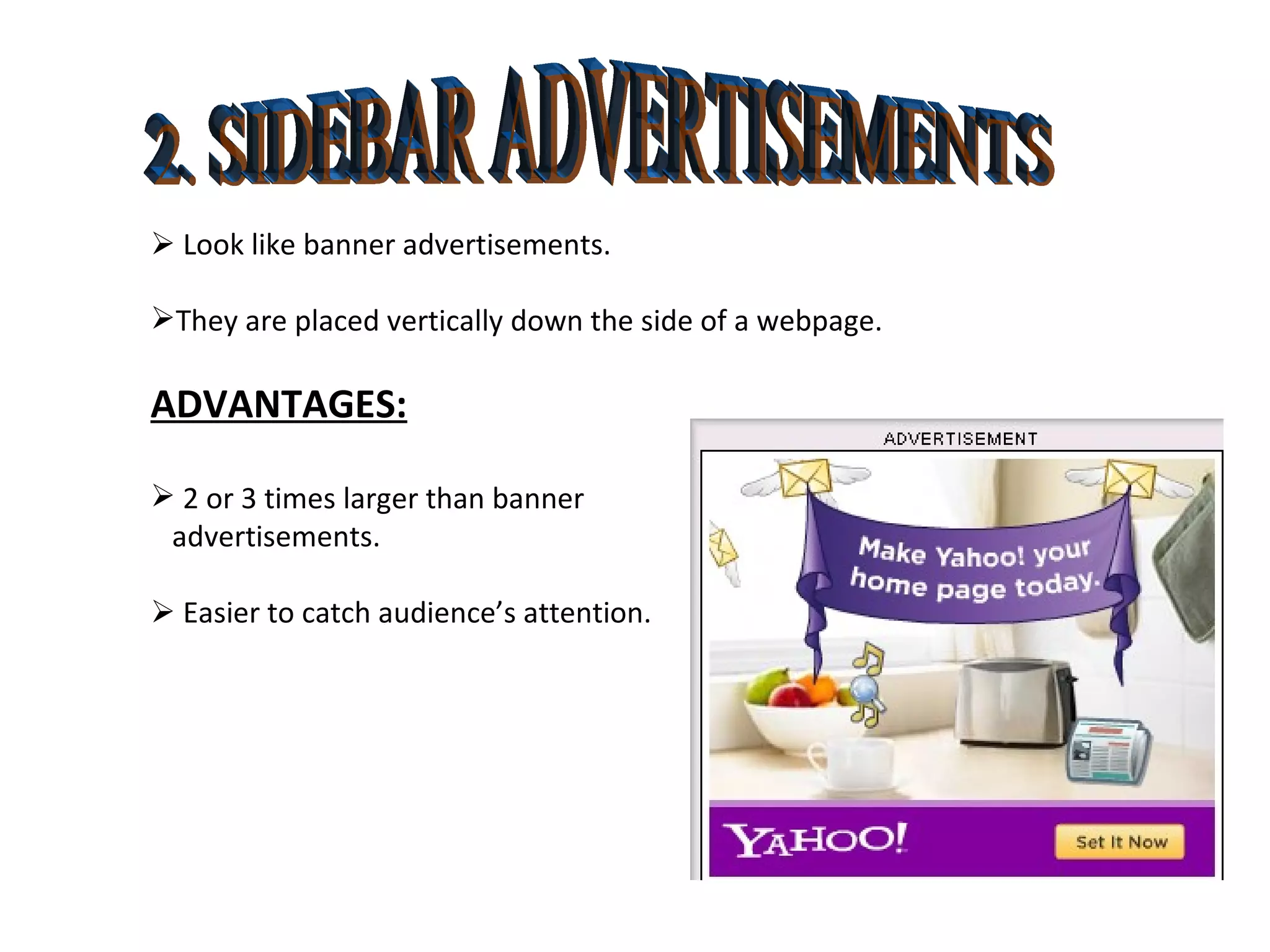
2. SIDEBAR ADVERTISEMENTS    Look like banner advertisements. They are placed vertically down the side of a webpage. ADVANTAGES: 2 or 3 times larger than banner  advertisements.    Easier to catch audience’s attention.
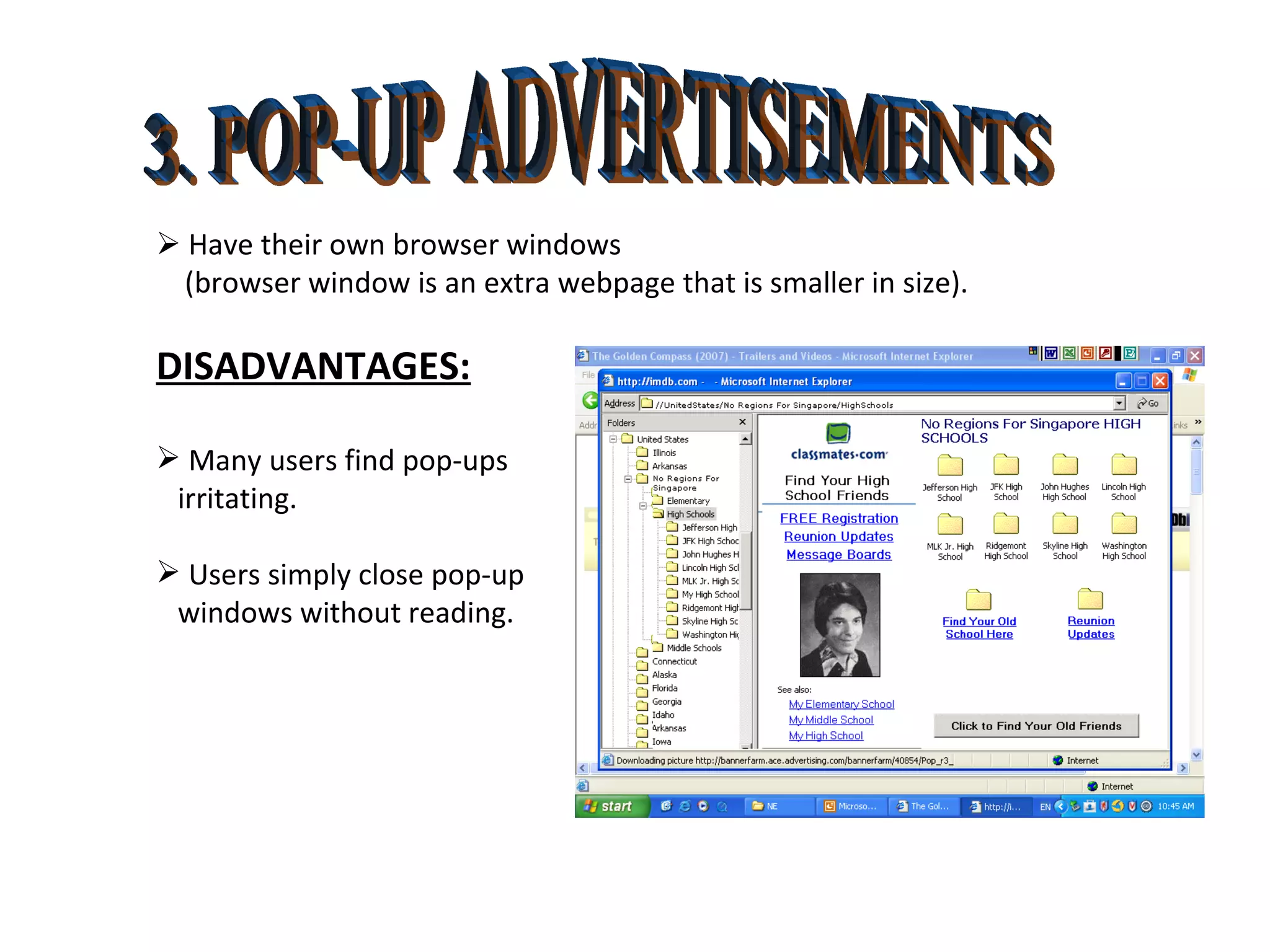
3. POP-UP ADVERTISEMENTS    Have their own browser windows (browser window is an extra webpage that is smaller in size). DISADVANTAGES: Many users find pop-ups  irritating. Users simply close pop-up  windows without reading.
4. FLOATING ADVERTISEMENTS    Appear when we first open a webpage.    They float over the page for five to thirty seconds. ADVANTAGES:    Cannot be closed.    Users are forced to view the advertisements. DISADVANTAGES :    Many users find floating advertisements irritating.
HOW TO CREATE MATERIAL FOR  PRINT  ADVERTISING
AIDA    Effective print advertisements attract the customers  to buy the product .    AIDA model is used as a guide to create effective advertisements.    AIDA  : 1)  A  - Attention. 2)  I  - Interest 3)  D  - Desire 4)  A  - Action
1) A - ATTENTION    The first thing we must do is get the attention of target customers.    We must do 3 things:    Use large and bold letters for the headlines.      e.g:  30% OFF ALL ITEMS!      Use attractive and colourful pictures.      Use popular celebrities (actors/singers) to endorse the product.
2) I - INTEREST    After we get the attention of our customers, we must get them to be  interested in the product.    We must do 4 things:    Use humour or something  that is funny (e.g: cartoons).      Use attention-grabbing statements.      e.g:  HALF-PRICE FOR THE FIRST 100 CUSTOMERS!    Have an unusual layout.    Use persuasive words or phrases.      e.g:  ONCE IN A LIFETIME DEAL!
3) D - DESIRE    The advertising message has to convince the customers that they need the product.    We must do 3 things:    Highlight the unique features of the product.      e.g:  NO WASHING IS NEEDED!    Highlight the benefits of using the product.      e.g:  YOU SEE RESULTS IN 1 DAY!    Appeal to the target customers’ emotional needs.      e.g:  NO MORE SPLIT ENDS!
4) A - ACTION    Persuade the customers to take action and buy the product.    We must do 3 things:    Provide a telephone number for customers to call  if they want to buy the product.    e.g:  CALL 65559890 RIGHT NOW!    List some locations where the product can be bought.    e.g:  PRODUCT IS AVAILABLE AT: WATSONS  &  COLD STORAGE    Offer a gift if the customer buys the product immediately.    e.g:  FREE BAG FOR THE FIRST 50 CUSTOMERS!
TIPS    An effective print advertisement  conveys a clear & precise message.    Useful tips on designing an effective print advertisement:    Use pictures & colours.    Put the  important information  as the title & main headings.    Use as  few words  as possible.    Use phrases &  key words .     Write in  active voice .    Use words that are  easily understood .
HOW EFFECTIVE  ARE THE  PROMOTIONAL TECHNIQUES?
EVALUATION    Important because we need to know if the promotional campaign is successful.    Promotional techniques are working only if the promotional campaign is successful. If the promotional techniques are not working, we must think of other ways to attract customers & sell the product.
EVALUATION    Ways of finding out if the promotional campaign is effective:    Compare the sales  of the product before the campaign with    the sales after the campaign.    If coupons are used,  count the number of coupons redeemed   by customers.    Conduct a survey  to find out how many more customers know    about the product after the promotional campaign.

Elements of business skills chapter 6 slides

  • 1.
    Chapter 6 Planning& Promotion
  • 2.
    Planning............... is theprocess of setting of objectives and writing a marketing plan
  • 3.
    What are your objectives and plans? Shopping at the supermarket To go abroad Watch a movie Finding a job
  • 4.
    What are your objectives and plans? Shopping at the supermarket - Objective : to buy daily necessities Example: rice, flour, sugar - Plan : Write down what to buy on paper. Which supermarket to go to? Compare prices of each item at different outlets. To go abroad - Objectives : for holiday/ business trip/ shopping/ meeting - Plan : Buy Tickets, Accommodations, Transportations Watch a movie - Objective : to socialize / relaxation/ entertainment/ to kill time - Plan : Buy tickets, check for suitable timing,
  • 5.
    Marketing Plan MarketingPlan is a written document describing the 4Ps How a product will be marketed to its target customers It is a guide for marketing department to check and coordinate their actions 4Ps
  • 6.
    Recall the 4PsPRODUCT - Handbag, Watch, Clothes PRICE - Expensive/Cheap PLACE - Bazaar, shopping center PROMOTION - Mid Year Sale, Festive Seasons
  • 7.
    Think Pair ShareCome up with questions that you may want to include in a marketing plan For example PRODUCT : Who should we sell it to? PRICE : How much?
  • 8.
    Marketing Information Beforewriting the marketing plan, you need to collect information about Target Group Needs and Wants Respond to the 4Ps of marketing To gather information, you need to conduct a survey!
  • 9.
    STEP 1 : Set Market Survey Objectives What do you want to find out? STEP 2 : Select Survey Sample STEP 3 : Choose Survey Methods STEP 4 : Design the Questionnaire STEP 5 : Pre-Test the Questionnaire STEP 6 : Conduct the Survey STEP 7 : Analyze Data 7 Steps of designing Market Survey
  • 10.
    Step 1: SetMarket Survey Objectives WHAT DO YOU WANT TO KNOW? Find out more about - our customers - how they respond to the 4Ps Are there any competitions? Eg. StarHub, M1, SingTel Surveys help to find out more about the 4Ps Set clear objectives by asking the right questions Specific survey objectives will give useful marketing information
  • 11.
    STEP 1 : Set Market Survey Objectives STEP 2 : Select Survey Sample Who do you want to survey? STEP 3 : Choose Survey Methods STEP 4 : Design the Questionnaire STEP 5 : Pre-Test the Questionnaire STEP 6 : Conduct the Survey STEP 7 : Analyze Data 7 Steps of designing Market Survey
  • 12.
    Step 2: SelectSurvey Sample WHO DO YOU WANT TO SURVEY? Important to survey the right kind of people = target population Example: electric guitar  musician soccer ball  footballers, people who like soccer Decide on the number of people to be take part in the survey = sample size Remember that you CANNOT survey everyone! Larger sample size = more accurate survey results Large sample size will be more expensive and takes a long time
  • 13.
    STEP 1 : Set Market Survey Objectives STEP 2 : Select Survey Sample STEP 3 : Choose Survey Methods How do you conduct the survey? STEP 4 : Design the Questionnaire STEP 5 : Pre-Test the Questionnaire STEP 6 : Conduct the Survey STEP 7 : Analyze Data 7 Steps of designing Market Survey
  • 14.
    Step 3: ChooseSurvey Method HOW DO YOU CONDUCT THE SURVEY? Internet Survey Postal Survey Telephone Survey Personal Survey Observations
  • 15.
    Step 3: ChooseSurvey Method HOW DO YOU CONDUCT THE SURVEY? Internet Survey - Cheap and Fast - upload the questions on websites like surveymonkey.com - Responses of the survey can be downloaded and analyzed immediately STEP 1: Collate the e-mail addresses of respondents STEP 2: Ensure the survey questions are ready STEP 3: Post the questions on the website STEP 4: E-mail the lost of the website to the respondents and invite them to participate
  • 16.
    Step 3: ChooseSurvey Method HOW DO YOU CONDUCT THE SURVEY? Personal Survey - meet the respondents face to face with questionnaire - ask for their responses - example: Food tasting or StarBucks sample drinks STEP 1: Approach respondent STEP 2: Introduce yourself to the respondent STEP 3: Explain the purpose of the survey STEP 4: Ask the respondents if they want to participate in the survey STEP 5: If he/she is willing, read the questions STEP 6: Record their responses STEP 7: Thank the respondent
  • 17.
    Step 3: ChooseSurvey Method HOW DO YOU CONDUCT THE SURVEY Observations - observe how customers behave and what they buy - Using personal observations  observe the movements of customers  time they spend on each shop or the section  items that customers touch, select/reject
  • 18.
    Step 3: ChooseSurvey Method HOW DO YOU CONDUCT THE SURVEY Observations - observe how customers behave and what they buy - Using close-circuit television (CCTVs)  recorded using a small, hidden video  runs continuously 24 hrs  customers are unaware that they are being observed
  • 19.
    Step 3: ChooseSurvey Method HOW DO YOU CONDUCT THE SURVEY? Telephone Survey - popular as many people have handphone - useful for quick answers to simple questions STEP 1: Identify the names and telephone number of respondents STEP 2: Call respondents STEP 3: Introduce yourself and your organization STEP 4: Explain the purpose of the call STEP 5: Read the questions slowly and clearly STEP 6: Record the answers onto the questionnaire STEP 7: Thank the respondent
  • 20.
    Step 3: ChooseSurvey Method HOW DO YOU CONDUCT THE SURVEY? Postal Survey - post the questionnaire with attachments like pictures STEP 1: Identify the names and mailing address of respondents STEP 2: Prepare a cover letter to explain the purpose of survey and the deadline for the survey STEP 3: Prepare a prepaid return envelope for respondents to mail the completed survey STEP 4: Mail the cover letter + questionnaire + prepaid envelope to the respondents.
  • 21.
    STEP 1 : Set Market Survey Objectives STEP 2 : Select Survey Sample STEP 3 : Choose Survey Methods STEP 4 : Design the Questionnaire What do you want to ask? STEP 5 : Pre-Test the Questionnaire STEP 6 : Conduct the Survey STEP 7 : Analyze Data 7 Steps of designing Market Survey
  • 22.
    Step 4: DesignQuestionnaire WHAT DO YOU WANT TO ASK? Decide on the type of information you wish to gather Write out the questions What kind of questions are you using? Arrange the questions in order Provide an introduction about the organization and the purpose of the survey Give clear instructions
  • 23.
    Step 4: DesignQuestionnaire WHAT DO YOU WANT TO ASK? Decide on the type of information you wish to gather Write down what you want to find out Design the questions around the things that you want to find out Example Scenario: Setting up a bakery in your school. Questions: We want to know who will buy, how much are they willing to pay, what kind of pastries do they like, when is the best time to set up the stall?
  • 24.
    Step 4: DesignQuestionnaire WHAT DO YOU WANT TO ASK? Write out the questions Important to write the questions accurately Use short simple sentences Ask for one information at a time Ask clear and straight to the point questions Ask questions respondents have knowledge about Ask questions related to the objectives of survey Give a range when asking for confidential information like age and income
  • 25.
    Step 4: DesignQuestionnaire WHAT DO YOU WANT TO ASK? What kind of questions are you using? Close-ended - Yes or No - Agreement Scale  Agree / Disagree - Rating Scale  Excellent / Good / Average / Poor - Multiple Choice Open-ended - used for obtaining free flowing answers - Numeric  On average how many glasses of water do you drink a day? - Text  Why do you think people drink less than 8 glasses of water per day?
  • 26.
    Step 4: DesignQuestionnaire WHAT DO YOU WANT TO ASK? Arrange the questions in order Start with general questions followed by specific questions Easy questions before difficult ones Start with close ended questions Start with most relevant questions Place personal questions at the end Income? AGE? MARRIED?
  • 27.
    Step 4: DesignQuestionnaire WHAT DO YOU WANT TO ASK? Provide an introduction about the organization and the purpose of the survey Brief and friendly introduction helps to prepare the respondents mentally Helps to make them feel comfortable Introduction should - invite respondents to participate in the survey - tell them the purpose of the survey - assure that their information is kept confidential
  • 28.
    Step 4: DesignQuestionnaire WHAT DO YOU WANT TO ASK? Give clear instructions To prevent confusion to the respondents Provide clear instructions on how to complete the survey Thank the respondents for their participation
  • 29.
    STEP 1 : Set Market Survey Objectives STEP 2 : Select Survey Sample STEP 3 : Choose Survey Methods STEP 4 : Design the Questionnaire STEP 5 : Pre-Test the Questionnaire Are the questions suitable? STEP 6 : Conduct the Survey STEP 7 : Analyze Data 7 Steps of designing Market Survey
  • 30.
    Step 5: Pre-testthe Questionnaire ARE THE QUESTIONS CORRECT? Pre-test the questions with a small group of people It helps to identify problems like: - weird phrasing - unclear instructions - unsuitable arrangement of questions Once you have identified the problems, - rewrite the poorly phrased question - redesign the questionnaire before conducting the survey
  • 31.
    STEP 1 : Set Market Survey Objectives STEP 2 : Select Survey Sample STEP 3 : Choose Survey Methods STEP 4 : Design the Questionnaire STEP 5 : Pre-Test the Questionnaire STEP 6 : Conduct the Survey Ask the question and collect data STEP 7 : Analyze Data 7 Steps of designing Market Survey
  • 32.
    Step 6: Conductthe Survey ASK QUESTIONS AND RECORD DATA? Choose a suitable method that you have learnt in STEP 3 to conduct your survey Set a deadline for completing the survey Record all the responses obtained on the questionnaire DEADLINE
  • 33.
    STEP 1 : Set Market Survey Objectives STEP 2 : Select Survey Sample STEP 3 : Choose Survey Methods STEP 4 : Design the Questionnaire STEP 5 : Pre-Test the Questionnaire STEP 6 : Conduct the Survey STEP 7 : Analyze Data What have you gathered from the data? 7 Steps of designing Market Survey
  • 34.
    Step 7: Analysethe Data WHAT HAVE YOU GATHERED? After completing the survey, Collate the data - using frequency table - use Microsoft Excel to display graphs and charts Analyse the data - What have learnt from the survey? - What is the conclusion? Use the answers from the survey to write your marketing plan
  • 35.
  • 36.
    ADVERTISING TECHNIQUES 1.Television advertising (eg: Television commercials) 2. Print advertising (eg: Newspapers & Magazines) 3. Radio advertising (eg: Radio promotions) 4. Cinema advertising (eg: Cinema commercials) 5. Outdoor advertising (eg: Bus posters & banners)
  • 37.
    1. TELEVISION ADVERTISING Media: Television commercials  Combines sound, pictures and animation to attract viewers. TV is used to promote a product that requires a demonstration to show how effective it is. Products can include:  Exercise machines (eg: treadmill)  Beauty products (eg: Anti-ageing cream)  Electrical appliances (eg: Blender).
  • 38.
    1. TELEVISION ADVERTISINGADVANTAGES:  Watching t.v is a favourite pastime of most Singaporeans. Hence, television advertising can reach large audiences.  A live demonstration allows:  The salesperson giving the demonstration to convince the viewer.  The viewer to buy the product immediately.  Immediate profits to be generated, especially in the case of home shopping (where a viewer can call a number to buy the product over the phone). DISADVANTAGE :  Expensive method of advertising
  • 39.
    2. PRINT ADVERTISING Media: Newspapers, magazines, flyers and brochures. Uses colourful pictures, photographs of celebrities, taglines and slogans to attract readers. Some reasons why businesses use print advertising:  Department stores advertise in newspapers to announce special events (eg: Great Singapore Sale).  ITE advertise courses in magazines to recruit new students.  Restaurants use flyers to offer discounts on special occasions (eg: Valentine’s day).  Travel & tour agencies use brochures to promote tour packages.
  • 40.
    2. PRINT ADVERTISINGADVANTAGES:  Cheaper than television and cinema advertising.  Reader can keep aside the material (eg: newspaper) and look at it again later. DISADVANTAGE:  Reader might throw away the material (eg: flyer) without reading it.
  • 41.
    3. RADIO ADVERTISING Media: Radio commercials. Uses voice, sound effects and music to attract listeners. Example of radio advertising:  Jingles combined with short dialogues promoting fast food services, or announcing sales at department stores.
  • 42.
    3. RADIO ADVERTISINGADVANTAGES:  Cheaper than television and cinema advertising.  Can reach listeners even in faraway & remote places. Different radio stations reach different target audiences:  Ria 89.7 broadcasts in Malay.  YES 93.3 broadcasts in Chinese.  FM 98.7 broadcasts in English. DISADVANTAGE:  Commercial lasts only a few seconds and might not have impact on listeners.
  • 43.
    4. CINEMA ADVERTISING Media: Cinema. Uses sound, pictures and animation (similar to t.v) to attract movie-goers. Cinema advertising is used:  To promote consumer products such as mobile phones, credit cards and soft drinks.  To promote upcoming movies.  Restaurants advertise discounts on special occasions.  Department stores advertise special events.
  • 44.
    4. CINEMA ADVERTISINGADVANTAGES:  Commercials last much longer than radio commercials. Is shown on a big screen with excellent sound system to create an impact with the viewer. DISADVANTAGE: Is shown only to the people who are in the cinema.  Expensive method of advertising.
  • 45.
    5. OUTDOOR ADVERTISING Media include:  Billboards.  Outdoor posters.  Banners.  Bus & MRT posters.  Sticker advertising in train cabins and on bus panels. Can be found where there are many people (eg: a bus-stop).  Promote consumer products such as cosmetics, household appliances and telecommunication gadgets.
  • 46.
    5. OUTDOOR ADVERTISINGADVANTAGES: Can be found in many places, thus reaching a large number of viewers. Many different media to choose from, thus suitable for any budget. DISADVANTAGE:  Advertising relies heavily on colourful pictures and smart taglines to attract audience. Is not as effective as advertising that uses voice, animation and sound effects.
  • 47.
    SALES PROMOTIONTECHNIQUES
  • 48.
    SALES PROMOTION TECHNIQUES Attract customers to buy our products now rather than later.  Customers want to act quickly to receive benefits (eg: free gift) when they buy the product on promotion.  Common sales promotion techniques: 1. Discount coupons. 4. Free Gifts. 2. Price discounts. 5. Product samples. 3. Contests. 6. Loyalty reward programmes (eg: M1 Sunperk rewards)
  • 49.
    1. DISCOUNT COUPONS Advertised in print media (eg: newspapers and magazines).  A section of the print advertisement.  Comes with an expiry date.  Allows the customer to buy the product at a cheaper price.  Customer must cut or tear along the dotted lines to use the coupon.  Customer can claim the discount savings when he presents it to the seller, when paying for the product.  A good method to encourage the customer to buy and try the product.
  • 50.
    2. PRICE DISCOUNTS Advertised in media (eg: newspapers, billboards & bus posters).  Sometimes displayed on store windows.  Allows the customer to buy the product at a cheaper price.  The lower price is often displayed next to the product on sale.  A good method to create an urgency in the customer to buy the product immediately.
  • 51.
    3. CONTESTS  Contest forms are given to customers when they buy the product.  Contest forms can also be part of print advertisements in newspapers or magazines.  Contests are a popular form of sales promotion during festive seasons.  Customers compete for prizes by completing contest forms which may require:  Writing a slogan.  Designing a logo  Answering a simple question.
  • 52.
    4. FREE GIFTS Customers get a free gift when they buy products above a certain amount.  E.g scenario : BeautyProducts store was offering a a free bottle of 75ml Estee Lauder perfume for every purchase of Estee Lauder products of at least $150. Mary received a free bottle of perfume when she bought $160 worth of Estee Lauder cosmetics.
  • 53.
    5. PRODUCT SAMPLES A sample is a small amount of a given product in a small packet.  A good method to allow customers to try new products.  A sample normally comes bundled together with another product (normally the sample is related to the product).  Eg 1: A bottle of shampoo is bundled with a small packet of free conditioner. Customers get free product samples.  Samples encourage customers to buy the product after trying it.  Eg 2: Sales promoters (in supermarkets) give away food samples.
  • 54.
    6. LOYALTY REWARDPROGRAMMES  Programme rewards customers in the form of price discounts and gifts (eg: M1 Sunperk rewards).  The rewards encourage customers to continue to buy or use the company’s products or services. Customers earn points for each purchase (for services, points are earned each time the bill is paid for the services provided).  The points earned can be used to claim a gift or get a price discount for the next purchase or payment.  Sometimes, customers also earn points when they purchase products or services from a partner company.  Programmes are popular with mobile phone service providers, credit card and airline companies (Frequent Flyer Miles reward programme).
  • 55.
    USE OF INFORMATION & COMMUNICATION TECHNOLOGIES
  • 56.
    INFORMATION AND COMMUNICATION TECHNOLOGY (ICT)  Uses electronic devices such as:  Computers  Televisions  Telephones  Radios  ICT allows information to be converted, stored, protected, processed, transmitted and retrieved in a secure way.  Eg: Internet Advertising
  • 57.
    INTERNET ADVERTISING Knownas online advertising.  Online advertisements such as: 1. Banner advertisements 2. Sidebar advertisements 3. Pop-up advertisements 4. Floating advertisements  Many businesses use Internet advertising to promote their products & services. The advertisement (eg: online banner) is placed on a website with traffic (eg: YAHOO.COM). The user will click on the online advertisement to go to the main website of the advertiser.
  • 58.
    INTERNET ADVERTISING ADVANTAGES: More interactive than traditional advertising.  The website is often linked to other websites to provide more information to the web user.
  • 59.
    1. BANNER ADVERTISEMENTSRectangular advertisements that appear horizontally at the top of the webpage.
  • 60.
    2. SIDEBAR ADVERTISEMENTS Look like banner advertisements. They are placed vertically down the side of a webpage. ADVANTAGES: 2 or 3 times larger than banner advertisements.  Easier to catch audience’s attention.
  • 61.
    3. POP-UP ADVERTISEMENTS Have their own browser windows (browser window is an extra webpage that is smaller in size). DISADVANTAGES: Many users find pop-ups irritating. Users simply close pop-up windows without reading.
  • 62.
    4. FLOATING ADVERTISEMENTS Appear when we first open a webpage.  They float over the page for five to thirty seconds. ADVANTAGES:  Cannot be closed.  Users are forced to view the advertisements. DISADVANTAGES :  Many users find floating advertisements irritating.
  • 63.
    HOW TO CREATEMATERIAL FOR PRINT ADVERTISING
  • 64.
    AIDA  Effective print advertisements attract the customers to buy the product .  AIDA model is used as a guide to create effective advertisements.  AIDA : 1) A - Attention. 2) I - Interest 3) D - Desire 4) A - Action
  • 65.
    1) A -ATTENTION  The first thing we must do is get the attention of target customers.  We must do 3 things:  Use large and bold letters for the headlines.  e.g: 30% OFF ALL ITEMS!  Use attractive and colourful pictures.  Use popular celebrities (actors/singers) to endorse the product.
  • 66.
    2) I -INTEREST  After we get the attention of our customers, we must get them to be interested in the product.  We must do 4 things:  Use humour or something that is funny (e.g: cartoons).  Use attention-grabbing statements.  e.g: HALF-PRICE FOR THE FIRST 100 CUSTOMERS!  Have an unusual layout.  Use persuasive words or phrases.  e.g: ONCE IN A LIFETIME DEAL!
  • 67.
    3) D -DESIRE  The advertising message has to convince the customers that they need the product.  We must do 3 things:  Highlight the unique features of the product.  e.g: NO WASHING IS NEEDED!  Highlight the benefits of using the product.  e.g: YOU SEE RESULTS IN 1 DAY!  Appeal to the target customers’ emotional needs.  e.g: NO MORE SPLIT ENDS!
  • 68.
    4) A -ACTION  Persuade the customers to take action and buy the product.  We must do 3 things:  Provide a telephone number for customers to call if they want to buy the product.  e.g: CALL 65559890 RIGHT NOW!  List some locations where the product can be bought.  e.g: PRODUCT IS AVAILABLE AT: WATSONS & COLD STORAGE  Offer a gift if the customer buys the product immediately.  e.g: FREE BAG FOR THE FIRST 50 CUSTOMERS!
  • 69.
    TIPS  An effective print advertisement conveys a clear & precise message.  Useful tips on designing an effective print advertisement:  Use pictures & colours.  Put the important information as the title & main headings.  Use as few words as possible.  Use phrases & key words .  Write in active voice .  Use words that are easily understood .
  • 70.
    HOW EFFECTIVE ARE THE PROMOTIONAL TECHNIQUES?
  • 71.
    EVALUATION  Important because we need to know if the promotional campaign is successful.  Promotional techniques are working only if the promotional campaign is successful. If the promotional techniques are not working, we must think of other ways to attract customers & sell the product.
  • 72.
    EVALUATION  Ways of finding out if the promotional campaign is effective:  Compare the sales of the product before the campaign with the sales after the campaign.  If coupons are used, count the number of coupons redeemed by customers.  Conduct a survey to find out how many more customers know about the product after the promotional campaign.