Cryptography and Network Security:
Principles and Practice
Eighth Edition
Chapter 3
Classical Encryption Techniques
Copyright © 2020 Pearson Education, Inc. All Rights Reserved.
Definitions (1 of 2)
• Plaintext
– An original message
• Ciphertext
– The coded message
• Enciphering/encryption
– The process of converting from plaintext to ciphertext
• Deciphering/decryption
– Restoring the plaintext from the ciphertext
Copyright © 2020 Pearson Education, Inc. All Rights Reserved.
Definitions (2 of 2)
• Cryptography
– The area of study of the many schemes used for
encryption
• Cryptographic system/cipher
– A scheme
• Cryptanalysis
– Techniques used for deciphering a message without
any knowledge of the enciphering details
• Cryptology
– The areas of cryptography and cryptanalysis
Copyright © 2020 Pearson Education, Inc. All Rights Reserved.
Figure 3.1 Simplified Model of
Symmetric Encryption
Copyright © 2020 Pearson Education, Inc. All Rights Reserved.
Symmetric Cipher Model
• There are two requirements for secure use of conventional
encryption:
– A strong encryption algorithm
– Sender and receiver must have obtained copies of the
secret key in a secure fashion and must keep the key
secure
Copyright © 2020 Pearson Education, Inc. All Rights Reserved.
Figure 3.2 Model of Symmetric
Cryptosystem
Copyright © 2020 Pearson Education, Inc. All Rights Reserved.
Cryptographic Systems
• Characterized along three independent dimensions:
• The type of operations used for transforming plaintext to
ciphertext
– Substitution
– Transposition
• The number of keys used
– Symmetric, single-key, secret-key, conventional
encryption
– Asymmetric, two-key, or public-key encryption
• The way in which the plaintext is processed
– Block cipher
– Stream cipher
Copyright © 2020 Pearson Education, Inc. All Rights Reserved.
Cryptanalysis and Brute-Force Attack
• Cryptanalysis
– Attack relies on the nature of the algorithm plus some
knowledge of the general characteristics of the
plaintext
– Attack exploits the characteristics of the algorithm to
attempt to deduce a specific plaintext or to deduce the
key being used
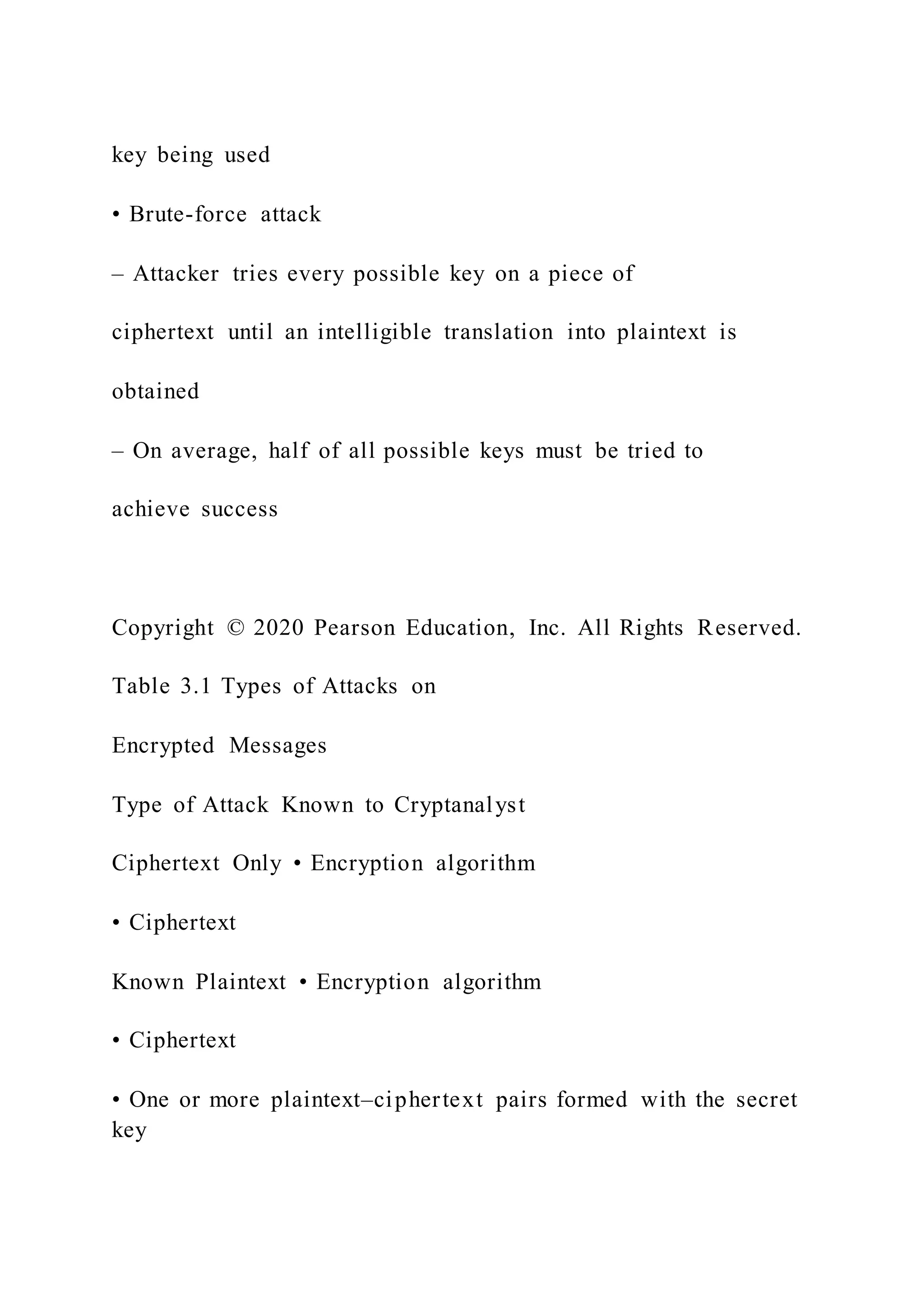
• Brute-force attack
– Attacker tries every possible key on a piece of
ciphertext until an intelligible translation into plaintext is
obtained
– On average, half of all possible keys must be tried to
achieve success
Copyright © 2020 Pearson Education, Inc. All Rights Reserved.
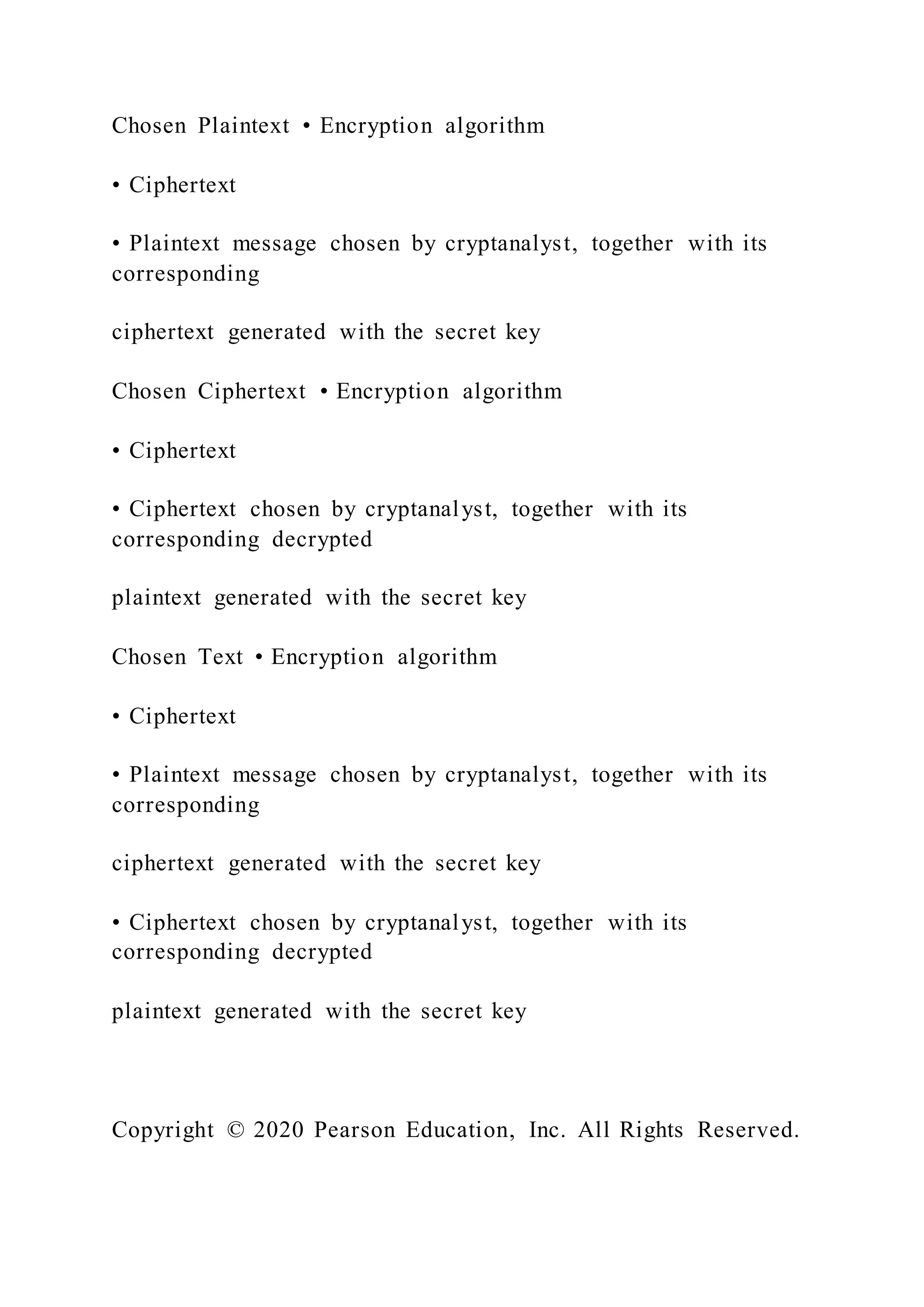
Table 3.1 Types of Attacks on
Encrypted Messages
Type of Attack Known to Cryptanalyst
Ciphertext Only • Encryption algorithm
• Ciphertext
Known Plaintext • Encryption algorithm
• Ciphertext
• One or more plaintext–ciphertext pairs formed with the secret
key
Chosen Plaintext • Encryption algorithm
• Ciphertext
• Plaintext message chosen by cryptanalyst, together with its
corresponding
ciphertext generated with the secret key
Chosen Ciphertext • Encryption algorithm
• Ciphertext
• Ciphertext chosen by cryptanalyst, together with its
corresponding decrypted
plaintext generated with the secret key
Chosen Text • Encryption algorithm
• Ciphertext
• Plaintext message chosen by cryptanalyst, together with its
corresponding
ciphertext generated with the secret key
• Ciphertext chosen by cryptanalyst, together with its
corresponding decrypted
plaintext generated with the secret key
Copyright © 2020 Pearson Education, Inc. All Rights Reserved.
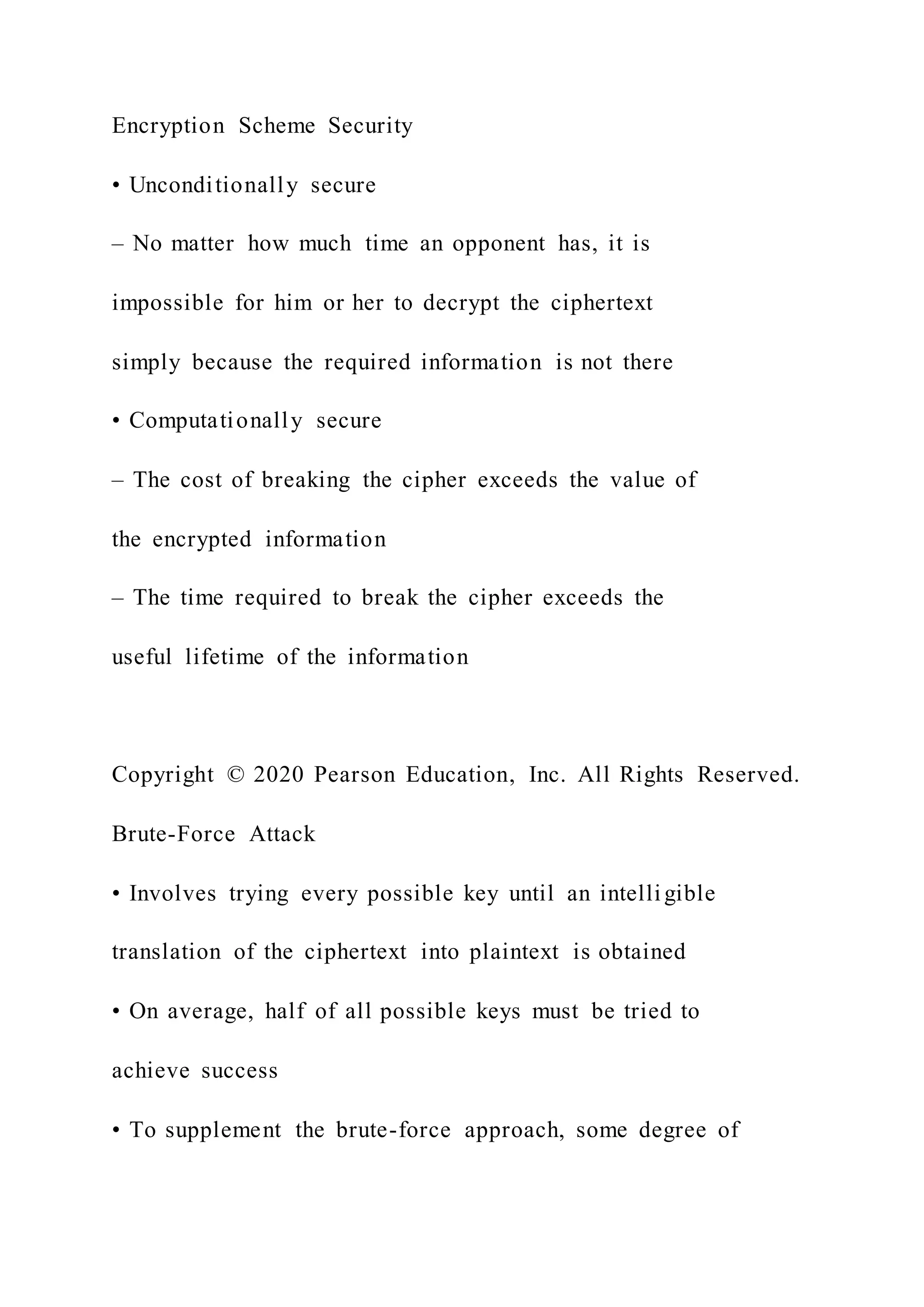
Encryption Scheme Security
• Unconditionally secure
– No matter how much time an opponent has, it is
impossible for him or her to decrypt the ciphertext
simply because the required information is not there
• Computationally secure
– The cost of breaking the cipher exceeds the value of
the encrypted information
– The time required to break the cipher exceeds the
useful lifetime of the information
Copyright © 2020 Pearson Education, Inc. All Rights Reserved.
Brute-Force Attack
• Involves trying every possible key until an intelligible
translation of the ciphertext into plaintext is obtained
• On average, half of all possible keys must be tried to
achieve success
• To supplement the brute-force approach, some degree of
knowledge about the expected plaintext is needed, and
some means of automatically distinguishing plaintext from
garble is also needed
Copyright © 2020 Pearson Education, Inc. All Rights Reserved.
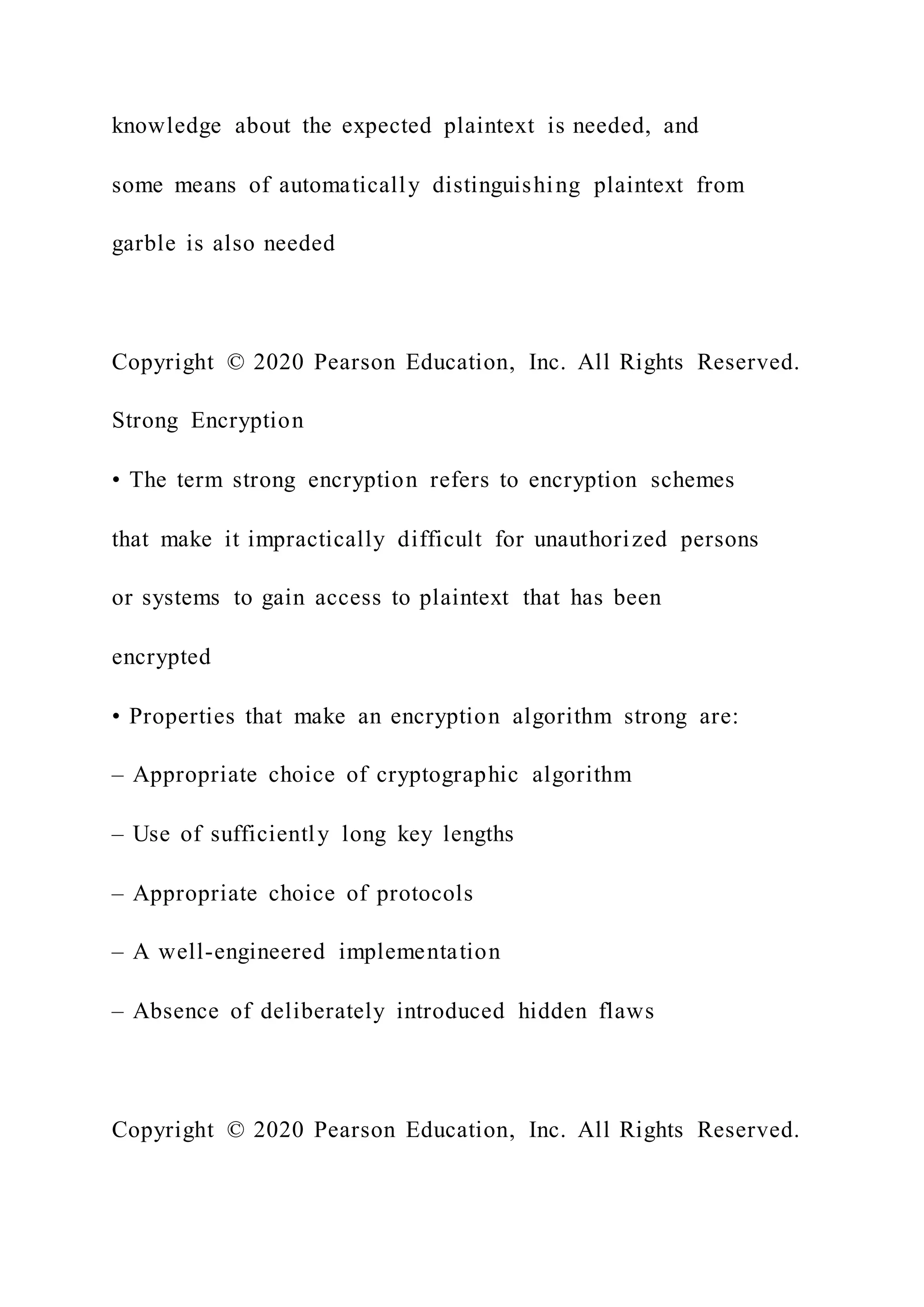
Strong Encryption
• The term strong encryption refers to encryption schemes
that make it impractically difficult for unauthorized persons
or systems to gain access to plaintext that has been
encrypted
• Properties that make an encryption algorithm strong are:
– Appropriate choice of cryptographic algorithm
– Use of sufficiently long key lengths
– Appropriate choice of protocols
– A well-engineered implementation
– Absence of deliberately introduced hidden flaws
Copyright © 2020 Pearson Education, Inc. All Rights Reserved.
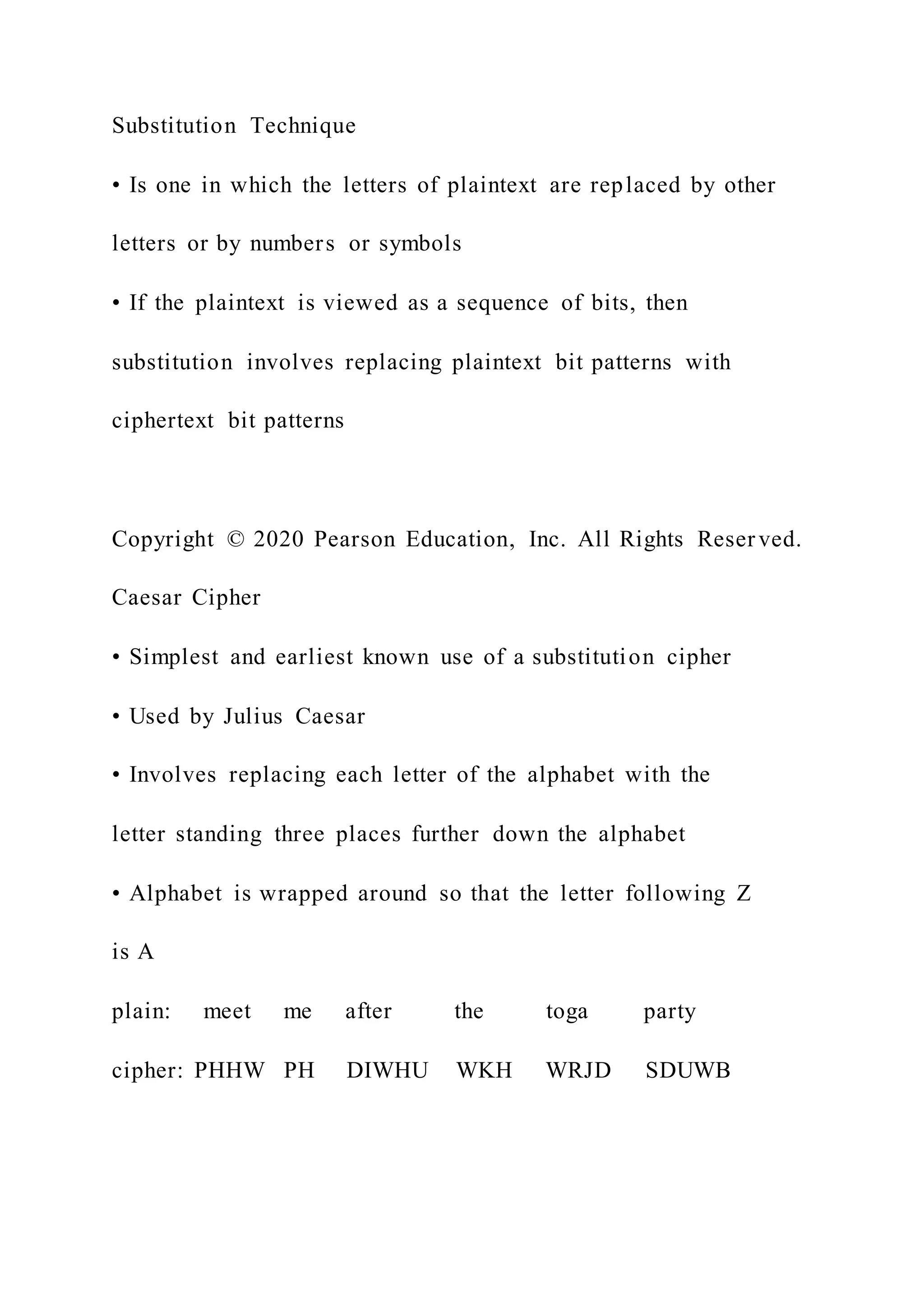
Substitution Technique
• Is one in which the letters of plaintext are replaced by other
letters or by numbers or symbols
• If the plaintext is viewed as a sequence of bits, then
substitution involves replacing plaintext bit patterns with
ciphertext bit patterns
Copyright © 2020 Pearson Education, Inc. All Rights Reser ved.
Caesar Cipher
• Simplest and earliest known use of a substitution cipher
• Used by Julius Caesar
• Involves replacing each letter of the alphabet with the
letter standing three places further down the alphabet
• Alphabet is wrapped around so that the letter following Z
is A
plain: meet me after the toga party
cipher: PHHW PH DIWHU WKH WRJD SDUWB
Copyright © 2020 Pearson Education, Inc. All Rights Reserved.
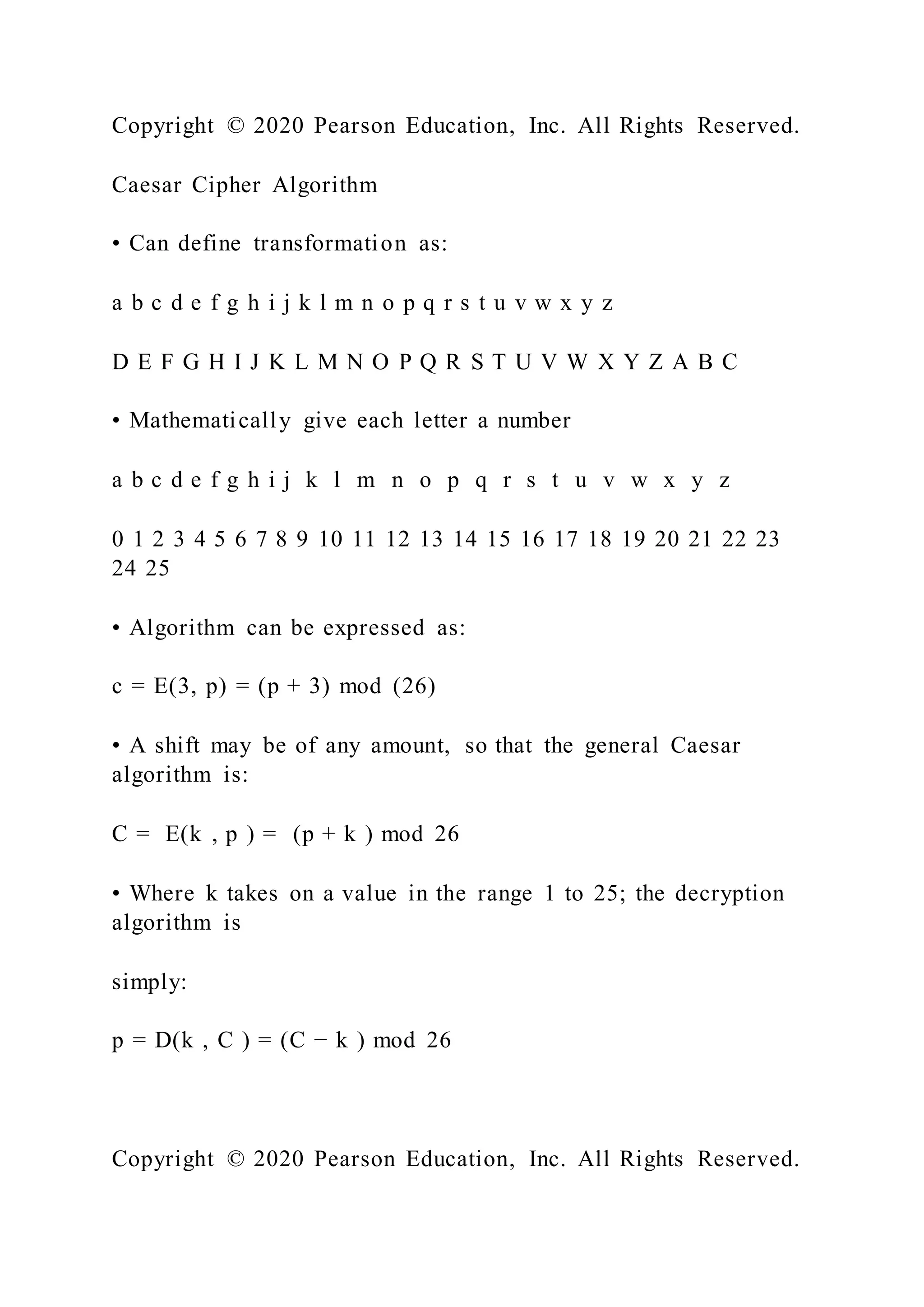
Caesar Cipher Algorithm
• Can define transformation as:
a b c d e f g h i j k l m n o p q r s t u v w x y z
D E F G H I J K L M N O P Q R S T U V W X Y Z A B C
• Mathematically give each letter a number
a b c d e f g h i j k l m n o p q r s t u v w x y z
0 1 2 3 4 5 6 7 8 9 10 11 12 13 14 15 16 17 18 19 20 21 22 23
24 25
• Algorithm can be expressed as:
c = E(3, p) = (p + 3) mod (26)
• A shift may be of any amount, so that the general Caesar
algorithm is:
C = E(k , p ) = (p + k ) mod 26
• Where k takes on a value in the range 1 to 25; the decryption
algorithm is
simply:
p = D(k , C ) = (C − k ) mod 26
Copyright © 2020 Pearson Education, Inc. All Rights Reserved.
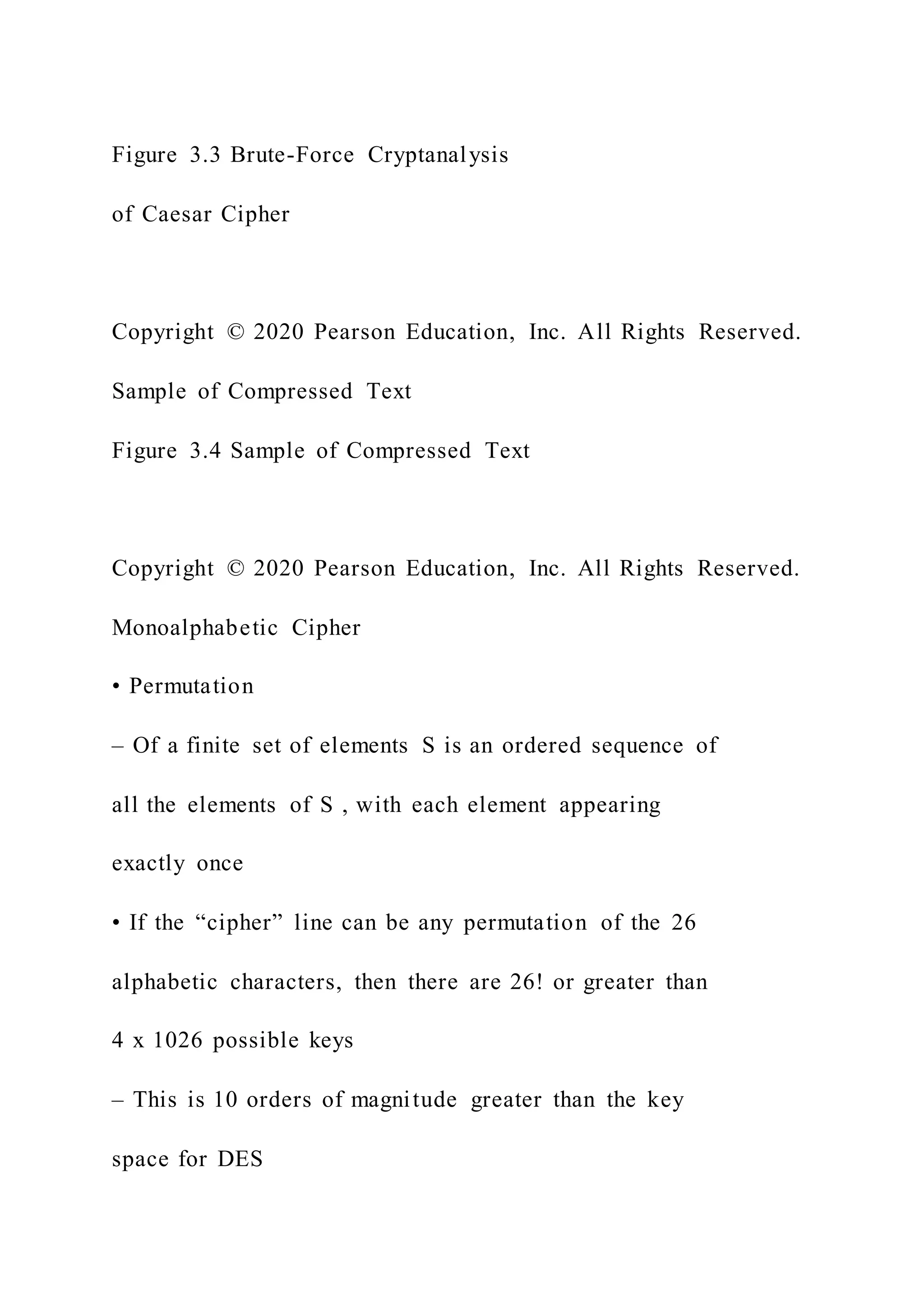
Figure 3.3 Brute-Force Cryptanalysis
of Caesar Cipher
Copyright © 2020 Pearson Education, Inc. All Rights Reserved.
Sample of Compressed Text
Figure 3.4 Sample of Compressed Text
Copyright © 2020 Pearson Education, Inc. All Rights Reserved.
Monoalphabetic Cipher
• Permutation
– Of a finite set of elements S is an ordered sequence of
all the elements of S , with each element appearing
exactly once
• If the “cipher” line can be any permutation of the 26
alphabetic characters, then there are 26! or greater than
4 x 1026 possible keys
– This is 10 orders of magnitude greater than the key
space for DES
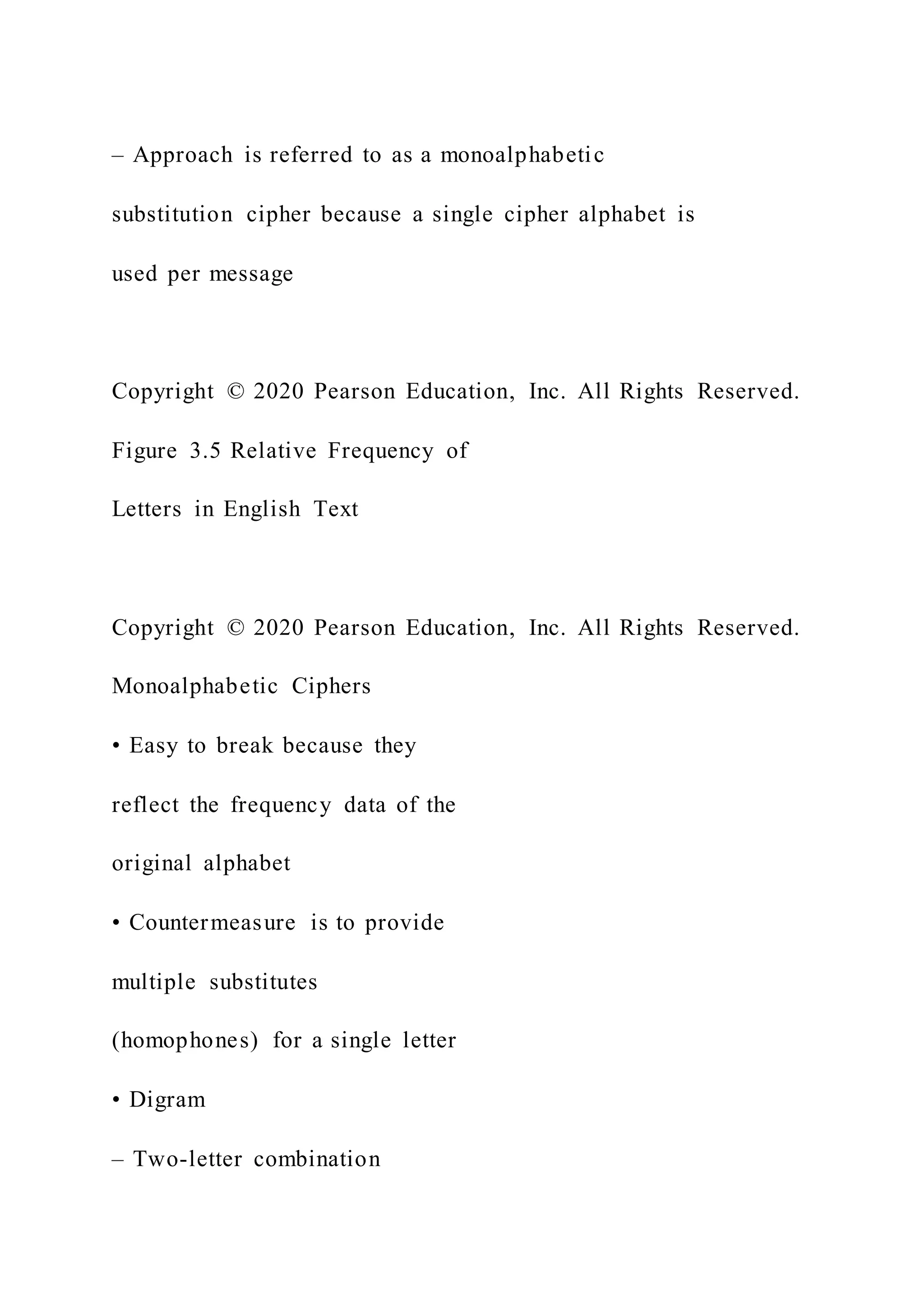
– Approach is referred to as a monoalphabetic
substitution cipher because a single cipher alphabet is
used per message
Copyright © 2020 Pearson Education, Inc. All Rights Reserved.
Figure 3.5 Relative Frequency of
Letters in English Text
Copyright © 2020 Pearson Education, Inc. All Rights Reserved.
Monoalphabetic Ciphers
• Easy to break because they
reflect the frequency data of the
original alphabet
• Countermeasure is to provide
multiple substitutes
(homophones) for a single letter
• Digram
– Two-letter combination
– Most common is th
• Trigram
– Three-letter combination
– Most frequent is the
Copyright © 2020 Pearson Education, Inc. All Rights Reserved.
Playfair Cipher
• Best-known multiple-letter encryption cipher
• Treats digrams in the plaintext as single units and
translates these units into ciphertext digrams
• Based on the use of a 5 × 5 matrix of letters constructed
using a keyword
• Invented by British scientist Sir Charles Wheatstone i n
1854
• Used as the standard field system by the British Army in
World War I and the U.S. Army and other Allied forces
during World War II
Copyright © 2020 Pearson Education, Inc. All Rights Reserved.
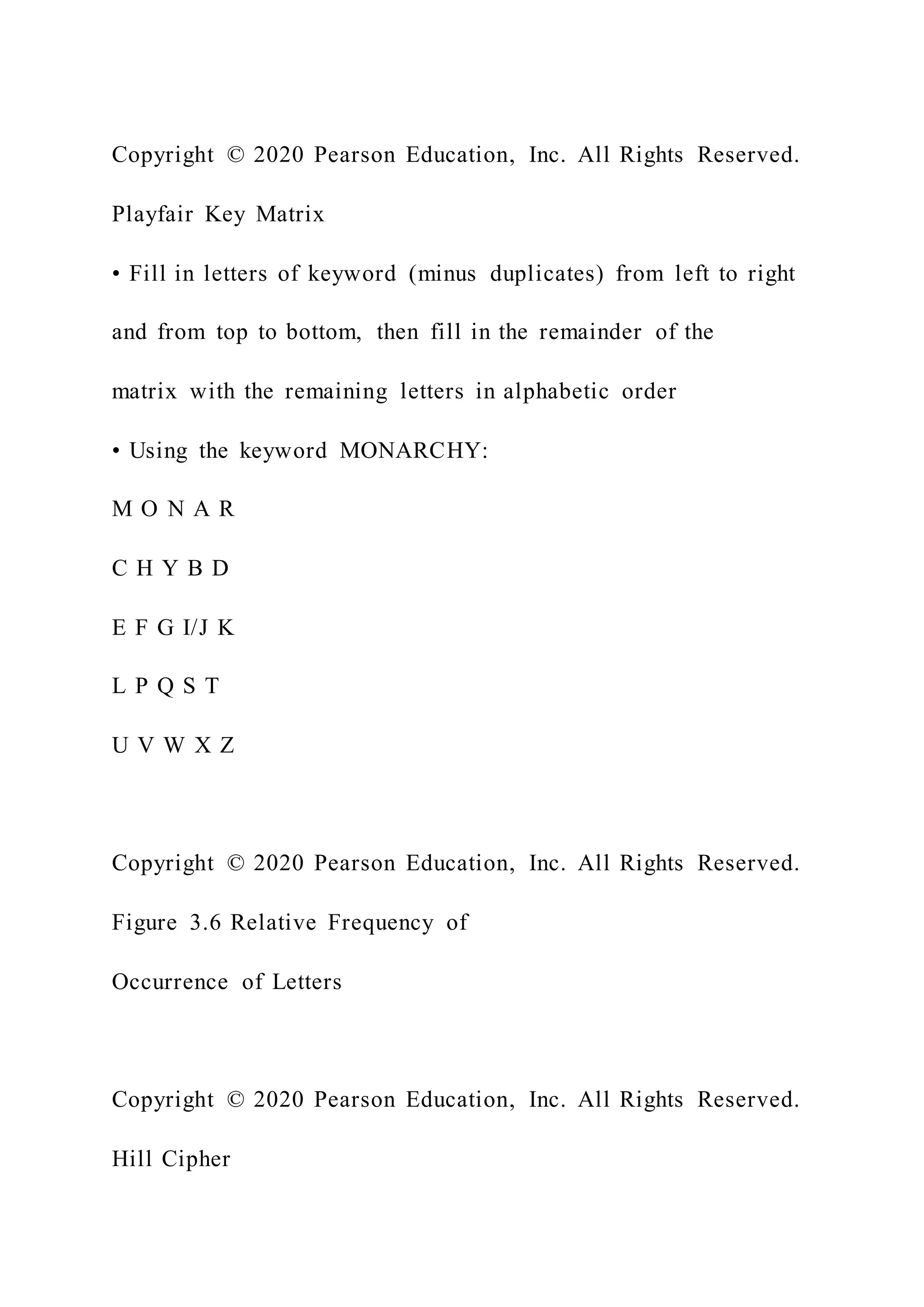
Playfair Key Matrix
• Fill in letters of keyword (minus duplicates) from left to right
and from top to bottom, then fill in the remainder of the
matrix with the remaining letters in alphabetic order
• Using the keyword MONARCHY:
M O N A R
C H Y B D
E F G I/J K
L P Q S T
U V W X Z
Copyright © 2020 Pearson Education, Inc. All Rights Reserved.
Figure 3.6 Relative Frequency of
Occurrence of Letters
Copyright © 2020 Pearson Education, Inc. All Rights Reserved.
Hill Cipher
• Developed by the mathematician Lester Hill in 1929
• Strength is that it completely hides single-letter frequencies
– The use of a larger matrix hides more frequency
information
– A 3 x 3 Hill cipher hides not only single-letter but also
two-letter frequency information
• Strong against a ciphertext-only attack but easily broken
with a known plaintext attack
Copyright © 2020 Pearson Education, Inc. All Rights Reserved.
Polyalphabetic Ciphers
• Polyalphabetic substitution cipher
– Improves on the simple monoalphabetic technique by
using different monoalphabetic substitutions as one
proceeds through the plaintext message
• All these techniques have the following features in
common:
– A set of related monoalphabetic substitution rules is
used
– A key determines which particular rule is chosen for a
given transformation
Copyright © 2020 Pearson Education, Inc. All Rights Reserved.
Vigenère Cipher
• Best known and one of the simplest polyalphabetic
substitution ciphers
• In this scheme the set of related monoalphabetic
substitution rules consists of the 26 Caesar ciphers with
shifts of 0 through 25
• Each cipher is denoted by a key letter which is the
ciphertext letter that substitutes for the plaintext letter a
Copyright © 2020 Pearson Education, Inc. All Rights Reserved.
Example of Vigenère Cipher
• To encrypt a message, a key is needed that is as long as
the message
• Usually, the key is a repeating keyword
• For example, if the keyword is deceptive, the message “we
are discovered save yourself” is encrypted as:
key: deceptivedeceptivedeceptive
plaintext: wearediscoveredsaveyourself
ciphertext: ZICVTWQNGRZGVTWAVZHCQYGLMGJ
Copyright © 2020 Pearson Education, Inc. All Rights Reserved.
Vigenère Autokey System
• A keyword is concatenated with the plaintext itself to
provide a running key
• Example:
key: deceptivewearediscoveredsav
plaintext: wearediscoveredsaveyourself
ciphertext: ZICVTWQNGKZEIIGASXSTSLVVWLA
• Even this scheme is vulnerable to cryptanalysis
– Because the key and the plaintext share the same
frequency distribution of letters, a statistical technique
can be applied
Copyright © 2020 Pearson Education, Inc. All Rights Reserved.
Vernam Cipher
Figure 3.7 Vernam Cipher
Copyright © 2020 Pearson Education, Inc. All Rights Reserved.
One-Time Pad
• Improvement to Vernam cipher
proposed by an Army Signal
Corp officer, Joseph
Mauborgne
• Use a random key that is as
long as the message so that
the key need not be repeated
• Key is used to encrypt and
decrypt a single message and
then is discarded
• Each new message requires a
new key of the same length as
the new message
• Scheme is unbreakable
– Produces random output
that bears no statistical
relationship to the
plaintext
– Because the ciphertext
contains no information
whatsoever about the
plaintext, there is simply
no way to break the code
Copyright © 2020 Pearson Education, Inc. All Rights Reserved.
Difficulties
• The one-time pad offers complete security but, in practice, has
two
fundamental difficulties:
– There is the practical problem of making large quantities of
random keys
▪ Any heavily used system might require millions of random
characters on a regular basis
– Mammoth key distribution problem
▪ For every message to be sent, a key of equal length is needed
by both sender and receiver
• Because of these difficulties, the one-time pad is of limited
utility
– Useful primarily for low-bandwidth channels requiring very
high
security
• The one-time pad is the only cryptosystem that exhibits
perfect
secrecy (see Appendix F)
Copyright © 2020 Pearson Education, Inc. All Rights Reserved.
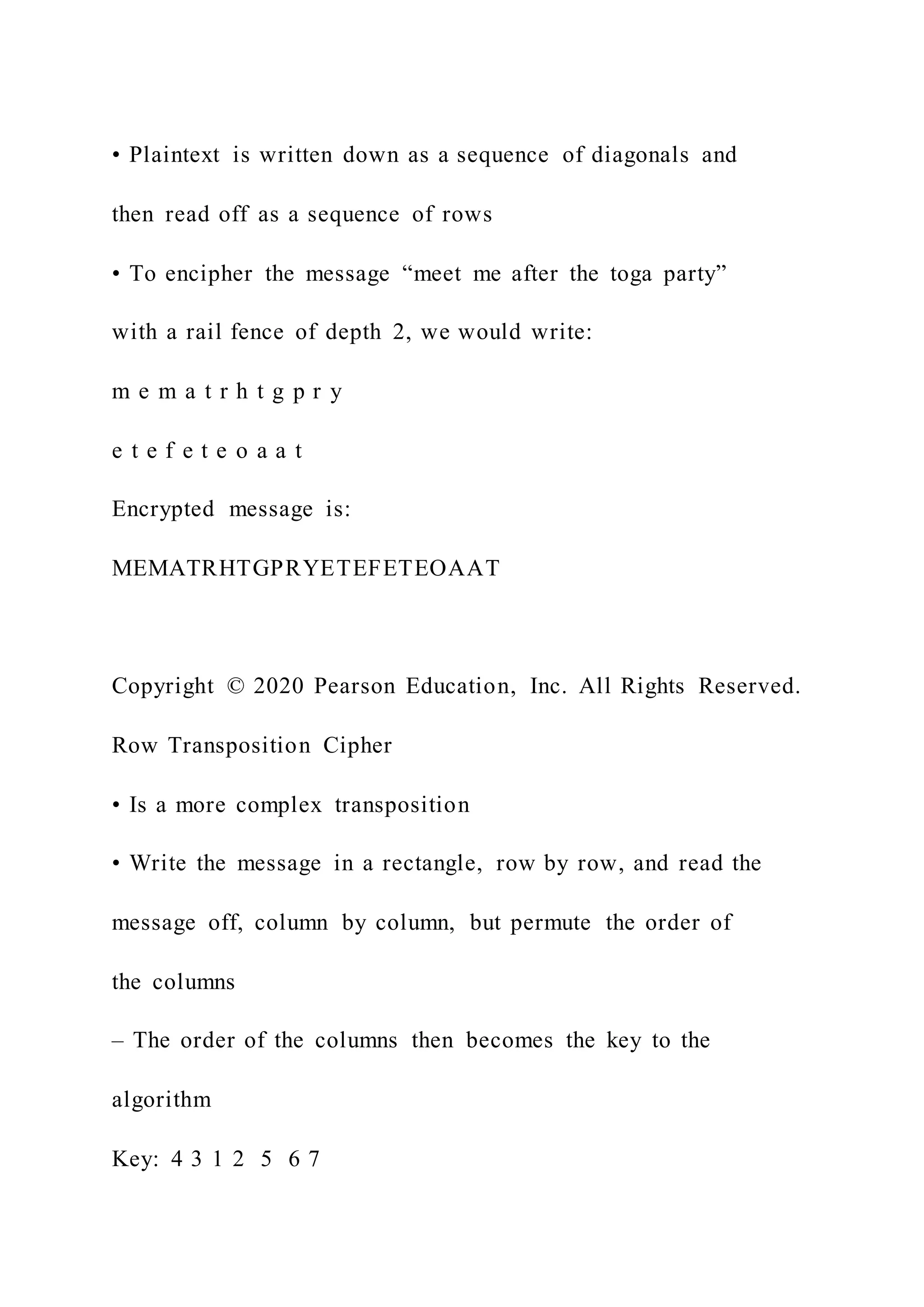
Rail Fence Cipher
• Simplest transposition cipher
• Plaintext is written down as a sequence of diagonals and
then read off as a sequence of rows
• To encipher the message “meet me after the toga party”
with a rail fence of depth 2, we would write:
m e m a t r h t g p r y
e t e f e t e o a a t
Encrypted message is:
MEMATRHTGPRYETEFETEOAAT
Copyright © 2020 Pearson Education, Inc. All Rights Reserved.
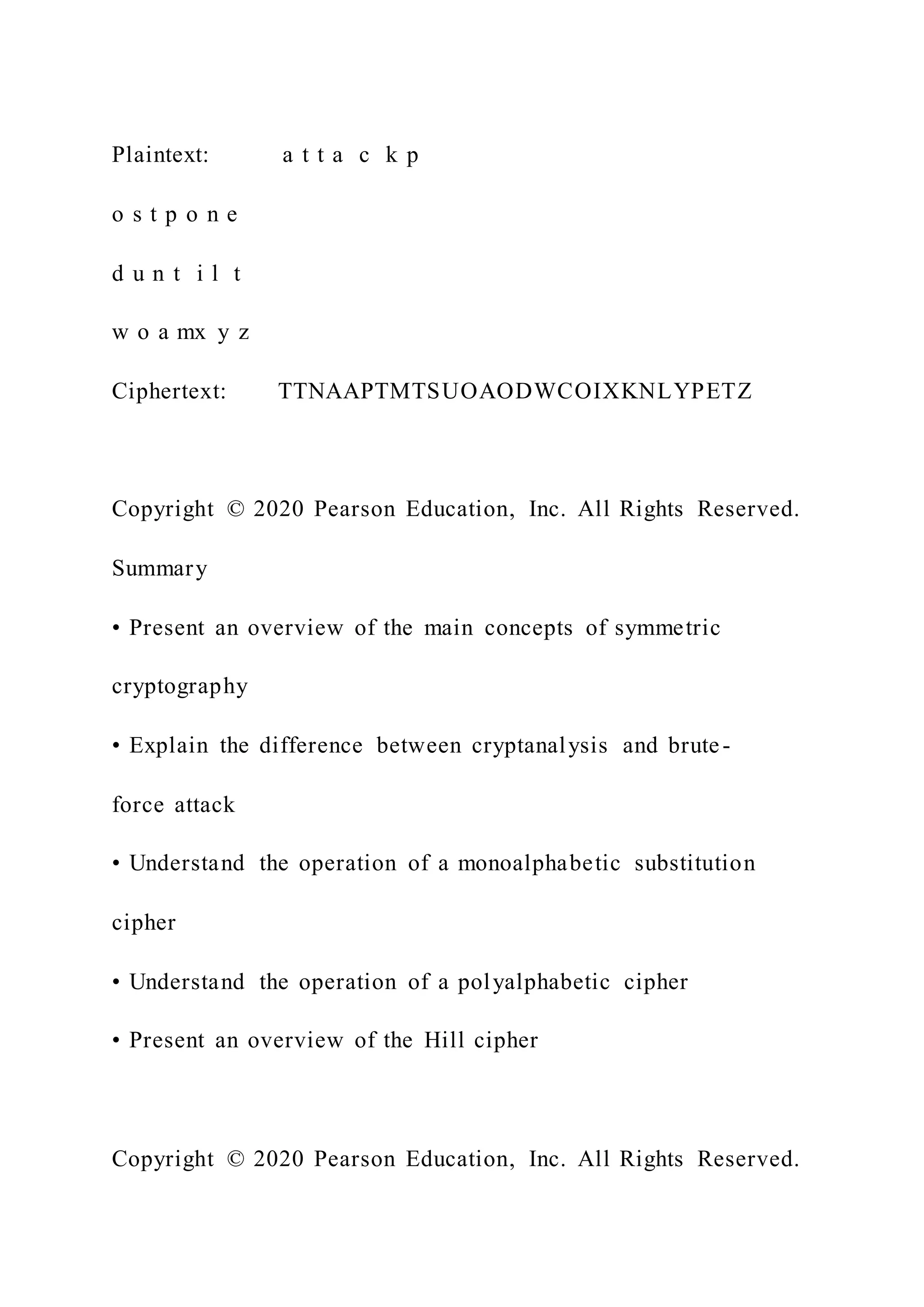
Row Transposition Cipher
• Is a more complex transposition
• Write the message in a rectangle, row by row, and read the
message off, column by column, but permute the order of
the columns
– The order of the columns then becomes the key to the
algorithm
Key: 4 3 1 2 5 6 7
Plaintext: a t t a c k p
o s t p o n e
d u n t i l t
w o a mx y z
Ciphertext: TTNAAPTMTSUOAODWCOIXKNLYPETZ
Copyright © 2020 Pearson Education, Inc. All Rights Reserved.
Summary
• Present an overview of the main concepts of symmetric
cryptography
• Explain the difference between cryptanalysis and brute-
force attack
• Understand the operation of a monoalphabetic substitution
cipher
• Understand the operation of a polyalphabetic cipher
• Present an overview of the Hill cipher
Copyright © 2020 Pearson Education, Inc. All Rights Reserved.
Copyright
This work is protected by United States copyright laws and is
provided solely for the use of instructors in teaching their
courses and assessing student learning. Dissemination or sale of
any part of this work (including on the World Wide Web) will
destroy the integrity of the work and is not permitted. The work
and materials from it should never be made available to students
except by instructors using the accompanying text in their
classes. All recipients of this work are expected to abide by
these
restrictions and to honor the intended pedagogical purposes and
the needs of other instructors who rely on these materials.
Examples of an operational problem: staffing shortages,
throughput issues, financial challenges, limited access,
processes needed through standard work.
**An operational problem is solving a short term problem that
impacts things such as throughput.
Deliverables for Week 1's assignment:
Submit the following:
1. What the operational problem is that you will be solving.
2. The facility/organization and department where the problem
is occurring - this can be fictional or non-fictional but you need
to have framework around this to set the stage.
3. What has caused the problem - any historical information.
4. What you hope to accomplish with this project.
Paper Requirements
Maximum 1 page
No reference requirements
View Rubric
Reflection Paper Rubric
Criteria
Ratings
Pts
Quality of Information: Information clearly relates to the main
topic. It includes several supporting details and/or examples.
Personal opinions can be provided in addition to topic
requirements.
view longer description
/ 15 pts
Organization: Information is very organized with well-
constructed paragraphs and optional subheadings.
view longer description
/ 5 pts
Mechanics: There are no grammatical, spelling or punctuation
errors. The essay fulfills the length requirement if applicable.
Meets APA and paper requirements.
view longer description
/ 5 pts
Total Points: 0
Choose a submission type
Submission type Upload, currently selectedUpload
More submission optionsMore
Submit file using WebcamWebcam
Submit file using Canvas FilesCanvas Files
Drag a file here, or click to select a file to uploadDrag a file
here, or

Cryptography and Network Security Principles and Practice

  • 1.
    Cryptography and NetworkSecurity: Principles and Practice Eighth Edition Chapter 3 Classical Encryption Techniques Copyright © 2020 Pearson Education, Inc. All Rights Reserved. Copyright © 2020 Pearson Education, Inc. All Rights Reserved. Definitions (1 of 2) • Plaintext – An original message • Ciphertext – The coded message • Enciphering/encryption – The process of converting from plaintext to ciphertext • Deciphering/decryption – Restoring the plaintext from the ciphertext
  • 2.
    Copyright © 2020Pearson Education, Inc. All Rights Reserved. Definitions (2 of 2) • Cryptography – The area of study of the many schemes used for encryption • Cryptographic system/cipher – A scheme • Cryptanalysis – Techniques used for deciphering a message without any knowledge of the enciphering details • Cryptology – The areas of cryptography and cryptanalysis Copyright © 2020 Pearson Education, Inc. All Rights Reserved. Figure 3.1 Simplified Model of Symmetric Encryption
  • 3.
    Copyright © 2020Pearson Education, Inc. All Rights Reserved. Symmetric Cipher Model • There are two requirements for secure use of conventional encryption: – A strong encryption algorithm – Sender and receiver must have obtained copies of the secret key in a secure fashion and must keep the key secure Copyright © 2020 Pearson Education, Inc. All Rights Reserved. Figure 3.2 Model of Symmetric Cryptosystem Copyright © 2020 Pearson Education, Inc. All Rights Reserved. Cryptographic Systems • Characterized along three independent dimensions: • The type of operations used for transforming plaintext to ciphertext
  • 4.
    – Substitution – Transposition •The number of keys used – Symmetric, single-key, secret-key, conventional encryption – Asymmetric, two-key, or public-key encryption • The way in which the plaintext is processed – Block cipher – Stream cipher Copyright © 2020 Pearson Education, Inc. All Rights Reserved. Cryptanalysis and Brute-Force Attack • Cryptanalysis – Attack relies on the nature of the algorithm plus some knowledge of the general characteristics of the plaintext – Attack exploits the characteristics of the algorithm to attempt to deduce a specific plaintext or to deduce the
  • 5.
    key being used •Brute-force attack – Attacker tries every possible key on a piece of ciphertext until an intelligible translation into plaintext is obtained – On average, half of all possible keys must be tried to achieve success Copyright © 2020 Pearson Education, Inc. All Rights Reserved. Table 3.1 Types of Attacks on Encrypted Messages Type of Attack Known to Cryptanalyst Ciphertext Only • Encryption algorithm • Ciphertext Known Plaintext • Encryption algorithm • Ciphertext • One or more plaintext–ciphertext pairs formed with the secret key
  • 6.
    Chosen Plaintext •Encryption algorithm • Ciphertext • Plaintext message chosen by cryptanalyst, together with its corresponding ciphertext generated with the secret key Chosen Ciphertext • Encryption algorithm • Ciphertext • Ciphertext chosen by cryptanalyst, together with its corresponding decrypted plaintext generated with the secret key Chosen Text • Encryption algorithm • Ciphertext • Plaintext message chosen by cryptanalyst, together with its corresponding ciphertext generated with the secret key • Ciphertext chosen by cryptanalyst, together with its corresponding decrypted plaintext generated with the secret key Copyright © 2020 Pearson Education, Inc. All Rights Reserved.
  • 7.
    Encryption Scheme Security •Unconditionally secure – No matter how much time an opponent has, it is impossible for him or her to decrypt the ciphertext simply because the required information is not there • Computationally secure – The cost of breaking the cipher exceeds the value of the encrypted information – The time required to break the cipher exceeds the useful lifetime of the information Copyright © 2020 Pearson Education, Inc. All Rights Reserved. Brute-Force Attack • Involves trying every possible key until an intelligible translation of the ciphertext into plaintext is obtained • On average, half of all possible keys must be tried to achieve success • To supplement the brute-force approach, some degree of
  • 8.
    knowledge about theexpected plaintext is needed, and some means of automatically distinguishing plaintext from garble is also needed Copyright © 2020 Pearson Education, Inc. All Rights Reserved. Strong Encryption • The term strong encryption refers to encryption schemes that make it impractically difficult for unauthorized persons or systems to gain access to plaintext that has been encrypted • Properties that make an encryption algorithm strong are: – Appropriate choice of cryptographic algorithm – Use of sufficiently long key lengths – Appropriate choice of protocols – A well-engineered implementation – Absence of deliberately introduced hidden flaws Copyright © 2020 Pearson Education, Inc. All Rights Reserved.
  • 9.
    Substitution Technique • Isone in which the letters of plaintext are replaced by other letters or by numbers or symbols • If the plaintext is viewed as a sequence of bits, then substitution involves replacing plaintext bit patterns with ciphertext bit patterns Copyright © 2020 Pearson Education, Inc. All Rights Reser ved. Caesar Cipher • Simplest and earliest known use of a substitution cipher • Used by Julius Caesar • Involves replacing each letter of the alphabet with the letter standing three places further down the alphabet • Alphabet is wrapped around so that the letter following Z is A plain: meet me after the toga party cipher: PHHW PH DIWHU WKH WRJD SDUWB
  • 10.
    Copyright © 2020Pearson Education, Inc. All Rights Reserved. Caesar Cipher Algorithm • Can define transformation as: a b c d e f g h i j k l m n o p q r s t u v w x y z D E F G H I J K L M N O P Q R S T U V W X Y Z A B C • Mathematically give each letter a number a b c d e f g h i j k l m n o p q r s t u v w x y z 0 1 2 3 4 5 6 7 8 9 10 11 12 13 14 15 16 17 18 19 20 21 22 23 24 25 • Algorithm can be expressed as: c = E(3, p) = (p + 3) mod (26) • A shift may be of any amount, so that the general Caesar algorithm is: C = E(k , p ) = (p + k ) mod 26 • Where k takes on a value in the range 1 to 25; the decryption algorithm is simply: p = D(k , C ) = (C − k ) mod 26 Copyright © 2020 Pearson Education, Inc. All Rights Reserved.
  • 11.
    Figure 3.3 Brute-ForceCryptanalysis of Caesar Cipher Copyright © 2020 Pearson Education, Inc. All Rights Reserved. Sample of Compressed Text Figure 3.4 Sample of Compressed Text Copyright © 2020 Pearson Education, Inc. All Rights Reserved. Monoalphabetic Cipher • Permutation – Of a finite set of elements S is an ordered sequence of all the elements of S , with each element appearing exactly once • If the “cipher” line can be any permutation of the 26 alphabetic characters, then there are 26! or greater than 4 x 1026 possible keys – This is 10 orders of magnitude greater than the key space for DES
  • 12.
    – Approach isreferred to as a monoalphabetic substitution cipher because a single cipher alphabet is used per message Copyright © 2020 Pearson Education, Inc. All Rights Reserved. Figure 3.5 Relative Frequency of Letters in English Text Copyright © 2020 Pearson Education, Inc. All Rights Reserved. Monoalphabetic Ciphers • Easy to break because they reflect the frequency data of the original alphabet • Countermeasure is to provide multiple substitutes (homophones) for a single letter • Digram – Two-letter combination
  • 13.
    – Most commonis th • Trigram – Three-letter combination – Most frequent is the Copyright © 2020 Pearson Education, Inc. All Rights Reserved. Playfair Cipher • Best-known multiple-letter encryption cipher • Treats digrams in the plaintext as single units and translates these units into ciphertext digrams • Based on the use of a 5 × 5 matrix of letters constructed using a keyword • Invented by British scientist Sir Charles Wheatstone i n 1854 • Used as the standard field system by the British Army in World War I and the U.S. Army and other Allied forces during World War II
  • 14.
    Copyright © 2020Pearson Education, Inc. All Rights Reserved. Playfair Key Matrix • Fill in letters of keyword (minus duplicates) from left to right and from top to bottom, then fill in the remainder of the matrix with the remaining letters in alphabetic order • Using the keyword MONARCHY: M O N A R C H Y B D E F G I/J K L P Q S T U V W X Z Copyright © 2020 Pearson Education, Inc. All Rights Reserved. Figure 3.6 Relative Frequency of Occurrence of Letters Copyright © 2020 Pearson Education, Inc. All Rights Reserved. Hill Cipher
  • 15.
    • Developed bythe mathematician Lester Hill in 1929 • Strength is that it completely hides single-letter frequencies – The use of a larger matrix hides more frequency information – A 3 x 3 Hill cipher hides not only single-letter but also two-letter frequency information • Strong against a ciphertext-only attack but easily broken with a known plaintext attack Copyright © 2020 Pearson Education, Inc. All Rights Reserved. Polyalphabetic Ciphers • Polyalphabetic substitution cipher – Improves on the simple monoalphabetic technique by using different monoalphabetic substitutions as one proceeds through the plaintext message • All these techniques have the following features in common: – A set of related monoalphabetic substitution rules is
  • 16.
    used – A keydetermines which particular rule is chosen for a given transformation Copyright © 2020 Pearson Education, Inc. All Rights Reserved. Vigenère Cipher • Best known and one of the simplest polyalphabetic substitution ciphers • In this scheme the set of related monoalphabetic substitution rules consists of the 26 Caesar ciphers with shifts of 0 through 25 • Each cipher is denoted by a key letter which is the ciphertext letter that substitutes for the plaintext letter a Copyright © 2020 Pearson Education, Inc. All Rights Reserved. Example of Vigenère Cipher • To encrypt a message, a key is needed that is as long as the message
  • 17.
    • Usually, thekey is a repeating keyword • For example, if the keyword is deceptive, the message “we are discovered save yourself” is encrypted as: key: deceptivedeceptivedeceptive plaintext: wearediscoveredsaveyourself ciphertext: ZICVTWQNGRZGVTWAVZHCQYGLMGJ Copyright © 2020 Pearson Education, Inc. All Rights Reserved. Vigenère Autokey System • A keyword is concatenated with the plaintext itself to provide a running key • Example: key: deceptivewearediscoveredsav plaintext: wearediscoveredsaveyourself ciphertext: ZICVTWQNGKZEIIGASXSTSLVVWLA • Even this scheme is vulnerable to cryptanalysis – Because the key and the plaintext share the same frequency distribution of letters, a statistical technique
  • 18.
    can be applied Copyright© 2020 Pearson Education, Inc. All Rights Reserved. Vernam Cipher Figure 3.7 Vernam Cipher Copyright © 2020 Pearson Education, Inc. All Rights Reserved. One-Time Pad • Improvement to Vernam cipher proposed by an Army Signal Corp officer, Joseph Mauborgne • Use a random key that is as long as the message so that the key need not be repeated • Key is used to encrypt and decrypt a single message and then is discarded
  • 19.
    • Each newmessage requires a new key of the same length as the new message • Scheme is unbreakable – Produces random output that bears no statistical relationship to the plaintext – Because the ciphertext contains no information whatsoever about the plaintext, there is simply no way to break the code Copyright © 2020 Pearson Education, Inc. All Rights Reserved. Difficulties • The one-time pad offers complete security but, in practice, has two
  • 20.
    fundamental difficulties: – Thereis the practical problem of making large quantities of random keys ▪ Any heavily used system might require millions of random characters on a regular basis – Mammoth key distribution problem ▪ For every message to be sent, a key of equal length is needed by both sender and receiver • Because of these difficulties, the one-time pad is of limited utility – Useful primarily for low-bandwidth channels requiring very high security • The one-time pad is the only cryptosystem that exhibits perfect secrecy (see Appendix F) Copyright © 2020 Pearson Education, Inc. All Rights Reserved. Rail Fence Cipher • Simplest transposition cipher
  • 21.
    • Plaintext iswritten down as a sequence of diagonals and then read off as a sequence of rows • To encipher the message “meet me after the toga party” with a rail fence of depth 2, we would write: m e m a t r h t g p r y e t e f e t e o a a t Encrypted message is: MEMATRHTGPRYETEFETEOAAT Copyright © 2020 Pearson Education, Inc. All Rights Reserved. Row Transposition Cipher • Is a more complex transposition • Write the message in a rectangle, row by row, and read the message off, column by column, but permute the order of the columns – The order of the columns then becomes the key to the algorithm Key: 4 3 1 2 5 6 7
  • 22.
    Plaintext: a tt a c k p o s t p o n e d u n t i l t w o a mx y z Ciphertext: TTNAAPTMTSUOAODWCOIXKNLYPETZ Copyright © 2020 Pearson Education, Inc. All Rights Reserved. Summary • Present an overview of the main concepts of symmetric cryptography • Explain the difference between cryptanalysis and brute- force attack • Understand the operation of a monoalphabetic substitution cipher • Understand the operation of a polyalphabetic cipher • Present an overview of the Hill cipher Copyright © 2020 Pearson Education, Inc. All Rights Reserved.
  • 23.
    Copyright This work isprotected by United States copyright laws and is provided solely for the use of instructors in teaching their courses and assessing student learning. Dissemination or sale of any part of this work (including on the World Wide Web) will destroy the integrity of the work and is not permitted. The work and materials from it should never be made available to students except by instructors using the accompanying text in their classes. All recipients of this work are expected to abide by these restrictions and to honor the intended pedagogical purposes and the needs of other instructors who rely on these materials. Examples of an operational problem: staffing shortages, throughput issues, financial challenges, limited access, processes needed through standard work. **An operational problem is solving a short term problem that impacts things such as throughput. Deliverables for Week 1's assignment: Submit the following: 1. What the operational problem is that you will be solving. 2. The facility/organization and department where the problem is occurring - this can be fictional or non-fictional but you need to have framework around this to set the stage.
  • 24.
    3. What hascaused the problem - any historical information. 4. What you hope to accomplish with this project. Paper Requirements Maximum 1 page No reference requirements View Rubric Reflection Paper Rubric Reflection Paper Rubric Criteria Ratings Pts Quality of Information: Information clearly relates to the main topic. It includes several supporting details and/or examples. Personal opinions can be provided in addition to topic requirements. view longer description / 15 pts Organization: Information is very organized with well- constructed paragraphs and optional subheadings. view longer description / 5 pts Mechanics: There are no grammatical, spelling or punctuation errors. The essay fulfills the length requirement if applicable. Meets APA and paper requirements. view longer description / 5 pts Total Points: 0 Choose a submission type Submission type Upload, currently selectedUpload More submission optionsMore
  • 25.
    Submit file usingWebcamWebcam Submit file using Canvas FilesCanvas Files Drag a file here, or click to select a file to uploadDrag a file here, or