9 ECOSYSTEMS
3ºESO. HUMANITAS BILINGUAL SCHOOL
A Little bit of etymology
 Ecology: is the science
that studies ecosystems.
 Root: ECO (Oikos):
HOUSE (in terms of
place where a living
being lives)
 ECO-SYSTEM: how the
“house” works or is
organized
 ECO-LOGY: the study of
the “house”
 ECO-SPHERE: sphere of
houses. The great
terrestrial ecosystem.
1. What is an ecosystem?
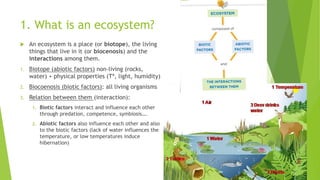
 An ecosystem is a place (or biotope), the living
things that live in it (or biocenosis) and the
interactions among them.
1. Biotope (abiotic factors) non-living (rocks,
water) + physical properties (Tª, light, humidity)
2. Biocoenosis (biotic factors): all living organisms
3. Relation between them (interaction):
1. Biotic factors interact and influence each other
through predation, competence, symbiosis….
2. Abiotic factors also influence each other and also
to the biotic factors (lack of water influences the
temperature, or low temperatures induce
hibernation)
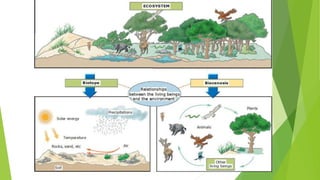
Recognize the different components in these
ecosystems.
2. Abiotic factors and the biocenosis
 2 types of adaptations:
 Anatomical adaptations: related to the physical characteristics (plants with spines to prevent water loss)
 Behavioral adaptations (like migrations)
 ABIOTIC FACTORS THAT AFFECT THE BIOCENOSIS (they determine the type of adaptation and the
distribution of the biocenosis in the biotope (WATER, LIGHT AND TEMPERATURE):
 WATER: (basically to prevent water loss)
 Plants: spines, waterproof layers of wax
 Animals: exoskeleton, scales.
 LIGHT: (affect the habits)
 Photosynthetic organisms: wide leaves to capture more light in ecosystems that are darker. (sea bottom, forest floor)
 Behavior of animals can be nocturnal (owls, bats) or diurnal (pigeons, horses)
 TEMPERATURE (there is a range of temperature for each organism, varies day/night, altitude and seasonaly)
 Plants: lose their leaves (deciduous) or these are protected against low temperatures (needles). Bloom in warm temperatures.
 Animals: fur, fat for cold. Refrigeration (big ears). Behavious (hibernate
Say the type of adaptation and
the abiotic factor that is
influencing.
3. Relationships in the biocooenosis.Intraspecificrelationships
Family
associations
Gregarious
associations
Social
associations
Colonial
associations
Interespecific
relationships
Interespecific
competition
Predation
Parasitism
Mutualism
Commensalism
Intraespecific relationships:
among individuals of the same species
 Family: related to one another.
Purpose to reproduce and take
care of offspring
 Gregarious: not necessarily
related. Specific purpose
(defend themselves, look for
food, migrate)
 Social: they form a hierarchy
and organize the work.
 Colonial: have the same
progenitor and remain together
Family: pride of lions
Gregarious: Flock of
cranes
Social: society of
bees
Colony: colony of
corals
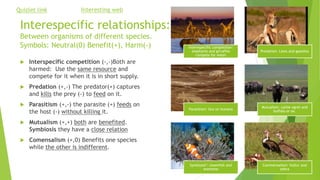
Interespecific relationships:
Between organisms of different species.
Symbols: Neutral(0) Benefit(+), Harm(-)
 Interspecific competition (-,-)Both are
harmed: Use the same resource and
compete for it when it is in short supply.
 Predation (+,-) The predator(+) captures
and kills the prey (-) to feed on it.
 Parasitism (+,-) the parasite (+) feeds on
the host (-) without killing it.
 Mutualism (+,+) both are benefited.
Symbiosis they have a close relation
 Comensalism (+,0) Benefits one species
while the other is indifferent.
Interespecific competition:
elephants and girraffes
compete for water
Predation: Lions and gazelles
Parasitism: lice on humans
Mutualism: cattle egret and
buffalo or ox.
Symbiosis*: clownfish and
anemone
Commensalism: Vultur and
zebra
Quizlet link Interesting web
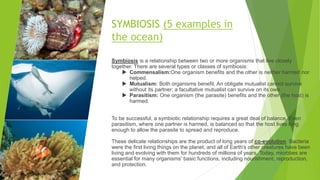
SYMBIOSIS (5 examples in
the ocean)
Symbiosis is a relationship between two or more organisms that live closely
together. There are several types or classes of symbiosis:
 Commensalism:One organism benefits and the other is neither harmed nor
helped.
 Mutualism: Both organisms benefit. An obligate mutualist cannot survive
without its partner; a facultative mutualist can survive on its own.
 Parasitism: One organism (the parasite) benefits and the other (the host) is
harmed.
To be successful, a symbiotic relationship requires a great deal of balance. Even
parasitism, where one partner is harmed, is balanced so that the host lives long
enough to allow the parasite to spread and reproduce.
These delicate relationships are the product of long years of co-evolution. Bacteria
were the first living things on the planet, and all of Earth's other creatures have been
living and evolving with them for hundreds of millions of years. Today, microbes are
essential for many organisms' basic functions, including nourishment, reproduction,
and protection.
Examples of interespecific relations.
Identify the type.
School of fish Elephants Gnu, wildebeest Ants
Examples of interespecific relations.
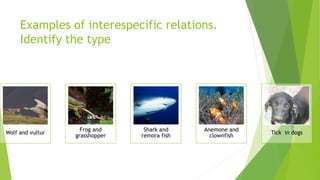
Identify the type
Wolf and vultur
Frog and
grasshopper
Shark and
remora fish
Anemone and
clownfish
Tick in dogs
4. Trophic levels
 Trophic level consists of all the organism in an ecosystem which
obtain their food in the same way. There are three trophic levels.
 Producers: autotrophic. Convert inorganic matter into organic matter
using the energy contained in light. Green plant, algae and some
bacteria
 Consumers: heterotrophic that feed on other living things.
 Primary consumers: herbivores. Feed on producers. (Deer, rabit, mice)
 Secondary consumers: feed on primary consumers. (some snakes)
 Tertiary consumers: feed on secondary consumers. (Eagles, wolves) (on top of
the food chain)
 Decomposers: heterotrophic that feed on the remains of the other
trophic levels. Release minerals, water and gases (which producers use
to make their food) Bacteria and fungi.
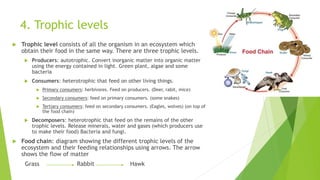
 Food chain: diagram showing the different trophic levels of the
ecosystem and their feeding relationships using arrows. The arrow
shows the flow of matter
Grass Rabbit Hawk
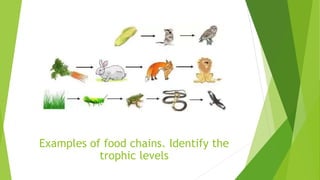
Examples of food chains. Identify the
trophic levels
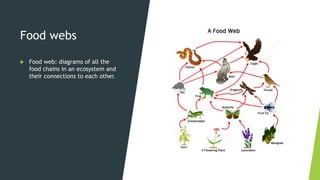
Food webs
 Food web: diagrams of all the
food chains in an ecosystem and
their connections to each other.
Create a food web with the following
information of a specific ecosystem
 Ivy leaves, snail trush and a falcon represent a
chain.
 Wheat, hare and fox represent a chain.
 Alfalfa, rabbit and fox represent a chain.
 Fruit, squirrel and eagle represent a chain.
 Eagle also eat rabbits and falcons also eat hare
(liebres).
 Rabbits also eat fruit.
5. Aquatic
ecosystems
Plankton: drifting microscopic organisms.
Amoebas, protozoa, small crustaceans.
Nekton: swim and move independently. Fish,
marine mammals
Benthos: live on the seabed or riverbed,
attached to a substrate. Algae, anemones.
Classify the following organisms according to their
way of life in plankton, nekton and benthos
The multicelular red algae that lives on the rocks.
Sea urchin
Sardine
Crustacean larvae that floats int he wáter
Unicellular green algae
Anemone
Whale
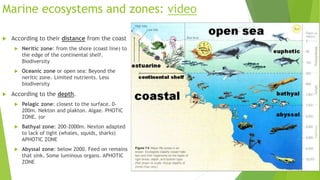
Marine ecosystems and zones: video
 According to their distance from the coast
 Neritic zone: from the shore (coast line) to
the edge of the continental shelf.
Biodiversity
 Oceanic zone or open sea: Beyond the
neritic zone. Limited nutrients. Less
biodiversity
 According to the depth.
 Pelagic zone: closest to the surface. 0-
200m. Nekton and plakton. Algae. PHOTIC
ZONE. (or
 Bathyal zone: 200-2000m. Nexton adapted
to lack of light (whales, squids, sharks)
APHOTIC ZONE
 Abyssal zone: below 2000. Feed on remains
that sink. Some luminous organs. APHOTIC
ZONE
Adaptations to
marine life video
 After watching the video,
answer to the questions:
 What adaptations do you think
the living things that live in the
abyssal zone have developed?
 How can organisms adapt to the
increasement of pressure?
 Why aren´t there algae in the
bathyal and abyssal zones?
 In which zones do the nekton
organisms live and why?
Freshwater ecosystems:
 Lentic: Standing water (lakes, ponds, wetlands)
 Lotic : Flowing water (torrents, rivers)
Lake-lago Ponds-charca Wetland-humedales
River Torrent
Wetlands
(humedales):
lentic ecosystem covered with a
shallow layer of water that sometimes
dry up. Can have a mixture of fresh
and salty water
IMPORTANCE OF WETLANDS
 Endemic species (only live there)
 Migratory birds stop there (cranes-grullas, flamingos)
 Source of resources (rice-arroz, reed-cañas, sedge-juncos)
 Control of floods-inundaciones.
 Recharge aquifers (ground water)
Marshes-
marismas
Swamps-
zonas
pantanosas
Delta-delta
Types of wetlands
(identify the pictures)
 Delta: the exit of a river to the ocean.
(the mouth of the river) Presence of
sediments.
 Marshes-marismas: low-lying land
which is flooded in wet seasons or at high tide,
and typically remains waterlogged (encharcada) at
all times (Doñana)
 Swamp-Manglares: (zonas
pantanosas) in the tropical weather. Presence
of trees. Florida swamps.
Identify the species (flamingo, catfish, crane,
reed, sedges, rice, foch, alligator)
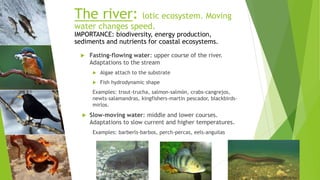
The river: lotic ecosystem. Moving
water changes speed.
IMPORTANCE: biodiversity, energy production,
sediments and nutrients for coastal ecosystems.
 Fasting-flowing water: upper course of the river.
Adaptations to the stream
 Algae attach to the substrate
 Fish hydrodynamic shape
Examples: trout-trucha, salmon-salmón, crabs-cangrejos,
newts-salamandras, kingfishers-martin pescador, blackbirds-
mirlos.
 Slow-moving water: middle and lower courses.
Adaptations to slow current and higher temperatures.
Examples: barberls-barbos, perch-percas, eels-anguilas
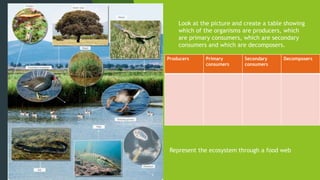
 Look at the picture and create a table showing
which of the organisms are producers, which
are primary consumers, which are secondary
consumers and which are decomposers.
Represent the ecosystem through a food web
Producers Primary
consumers
Secondary
consumers
Decomposers
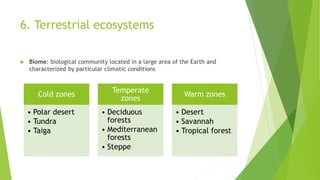
6. Terrestrial ecosystems
 Biome: biological community located in a large area of the Earth and
characterized by particular climatic conditions
Cold zones
• Polar desert
• Tundra
• Taiga
Temperate
zones
• Deciduous
forests
• Mediterranean
forests
• Steppe
Warm zones
• Desert
• Savannah
• Tropical forest
Climatic zones
In the book you have information about
the different biomes.
 Get in groups of 2 or 3.
 Create a presentation using “presentaciones de google” for your classmates
about the biomes of one big climatic zone (you can chose between COLD
ZONES, TEMPERATE ZONES or WARM ZONES) All zones need to be studied at
least for one group
 Each member of the group must study one biome.
 Use the information given in the book about location, vegetation and fauna.
 Include photos that show information about the location and the biome.
 Include photos of vegetation and fauna, with the names both in English and Spanish
 Share the presentation with your teacher.

9. ecosystems

  • 1.
  • 2.
    A Little bitof etymology  Ecology: is the science that studies ecosystems.  Root: ECO (Oikos): HOUSE (in terms of place where a living being lives)  ECO-SYSTEM: how the “house” works or is organized  ECO-LOGY: the study of the “house”  ECO-SPHERE: sphere of houses. The great terrestrial ecosystem.
  • 3.
    1. What isan ecosystem?  An ecosystem is a place (or biotope), the living things that live in it (or biocenosis) and the interactions among them. 1. Biotope (abiotic factors) non-living (rocks, water) + physical properties (Tª, light, humidity) 2. Biocoenosis (biotic factors): all living organisms 3. Relation between them (interaction): 1. Biotic factors interact and influence each other through predation, competence, symbiosis…. 2. Abiotic factors also influence each other and also to the biotic factors (lack of water influences the temperature, or low temperatures induce hibernation)
  • 5.
    Recognize the differentcomponents in these ecosystems.
  • 6.
    2. Abiotic factorsand the biocenosis  2 types of adaptations:  Anatomical adaptations: related to the physical characteristics (plants with spines to prevent water loss)  Behavioral adaptations (like migrations)  ABIOTIC FACTORS THAT AFFECT THE BIOCENOSIS (they determine the type of adaptation and the distribution of the biocenosis in the biotope (WATER, LIGHT AND TEMPERATURE):  WATER: (basically to prevent water loss)  Plants: spines, waterproof layers of wax  Animals: exoskeleton, scales.  LIGHT: (affect the habits)  Photosynthetic organisms: wide leaves to capture more light in ecosystems that are darker. (sea bottom, forest floor)  Behavior of animals can be nocturnal (owls, bats) or diurnal (pigeons, horses)  TEMPERATURE (there is a range of temperature for each organism, varies day/night, altitude and seasonaly)  Plants: lose their leaves (deciduous) or these are protected against low temperatures (needles). Bloom in warm temperatures.  Animals: fur, fat for cold. Refrigeration (big ears). Behavious (hibernate
  • 7.
    Say the typeof adaptation and the abiotic factor that is influencing.
  • 8.
    3. Relationships inthe biocooenosis.Intraspecificrelationships Family associations Gregarious associations Social associations Colonial associations Interespecific relationships Interespecific competition Predation Parasitism Mutualism Commensalism
  • 9.
    Intraespecific relationships: among individualsof the same species  Family: related to one another. Purpose to reproduce and take care of offspring  Gregarious: not necessarily related. Specific purpose (defend themselves, look for food, migrate)  Social: they form a hierarchy and organize the work.  Colonial: have the same progenitor and remain together Family: pride of lions Gregarious: Flock of cranes Social: society of bees Colony: colony of corals
  • 10.
    Interespecific relationships: Between organismsof different species. Symbols: Neutral(0) Benefit(+), Harm(-)  Interspecific competition (-,-)Both are harmed: Use the same resource and compete for it when it is in short supply.  Predation (+,-) The predator(+) captures and kills the prey (-) to feed on it.  Parasitism (+,-) the parasite (+) feeds on the host (-) without killing it.  Mutualism (+,+) both are benefited. Symbiosis they have a close relation  Comensalism (+,0) Benefits one species while the other is indifferent. Interespecific competition: elephants and girraffes compete for water Predation: Lions and gazelles Parasitism: lice on humans Mutualism: cattle egret and buffalo or ox. Symbiosis*: clownfish and anemone Commensalism: Vultur and zebra Quizlet link Interesting web
  • 11.
    SYMBIOSIS (5 examplesin the ocean) Symbiosis is a relationship between two or more organisms that live closely together. There are several types or classes of symbiosis:  Commensalism:One organism benefits and the other is neither harmed nor helped.  Mutualism: Both organisms benefit. An obligate mutualist cannot survive without its partner; a facultative mutualist can survive on its own.  Parasitism: One organism (the parasite) benefits and the other (the host) is harmed. To be successful, a symbiotic relationship requires a great deal of balance. Even parasitism, where one partner is harmed, is balanced so that the host lives long enough to allow the parasite to spread and reproduce. These delicate relationships are the product of long years of co-evolution. Bacteria were the first living things on the planet, and all of Earth's other creatures have been living and evolving with them for hundreds of millions of years. Today, microbes are essential for many organisms' basic functions, including nourishment, reproduction, and protection.
  • 12.
    Examples of interespecificrelations. Identify the type. School of fish Elephants Gnu, wildebeest Ants
  • 13.
    Examples of interespecificrelations. Identify the type Wolf and vultur Frog and grasshopper Shark and remora fish Anemone and clownfish Tick in dogs
  • 14.
    4. Trophic levels Trophic level consists of all the organism in an ecosystem which obtain their food in the same way. There are three trophic levels.  Producers: autotrophic. Convert inorganic matter into organic matter using the energy contained in light. Green plant, algae and some bacteria  Consumers: heterotrophic that feed on other living things.  Primary consumers: herbivores. Feed on producers. (Deer, rabit, mice)  Secondary consumers: feed on primary consumers. (some snakes)  Tertiary consumers: feed on secondary consumers. (Eagles, wolves) (on top of the food chain)  Decomposers: heterotrophic that feed on the remains of the other trophic levels. Release minerals, water and gases (which producers use to make their food) Bacteria and fungi.  Food chain: diagram showing the different trophic levels of the ecosystem and their feeding relationships using arrows. The arrow shows the flow of matter Grass Rabbit Hawk
  • 15.
    Examples of foodchains. Identify the trophic levels
  • 16.
    Food webs  Foodweb: diagrams of all the food chains in an ecosystem and their connections to each other.
  • 17.
    Create a foodweb with the following information of a specific ecosystem  Ivy leaves, snail trush and a falcon represent a chain.  Wheat, hare and fox represent a chain.  Alfalfa, rabbit and fox represent a chain.  Fruit, squirrel and eagle represent a chain.  Eagle also eat rabbits and falcons also eat hare (liebres).  Rabbits also eat fruit.
  • 18.
    5. Aquatic ecosystems Plankton: driftingmicroscopic organisms. Amoebas, protozoa, small crustaceans. Nekton: swim and move independently. Fish, marine mammals Benthos: live on the seabed or riverbed, attached to a substrate. Algae, anemones.
  • 19.
    Classify the followingorganisms according to their way of life in plankton, nekton and benthos The multicelular red algae that lives on the rocks. Sea urchin Sardine Crustacean larvae that floats int he wáter Unicellular green algae Anemone Whale
  • 20.
    Marine ecosystems andzones: video  According to their distance from the coast  Neritic zone: from the shore (coast line) to the edge of the continental shelf. Biodiversity  Oceanic zone or open sea: Beyond the neritic zone. Limited nutrients. Less biodiversity  According to the depth.  Pelagic zone: closest to the surface. 0- 200m. Nekton and plakton. Algae. PHOTIC ZONE. (or  Bathyal zone: 200-2000m. Nexton adapted to lack of light (whales, squids, sharks) APHOTIC ZONE  Abyssal zone: below 2000. Feed on remains that sink. Some luminous organs. APHOTIC ZONE
  • 21.
    Adaptations to marine lifevideo  After watching the video, answer to the questions:  What adaptations do you think the living things that live in the abyssal zone have developed?  How can organisms adapt to the increasement of pressure?  Why aren´t there algae in the bathyal and abyssal zones?  In which zones do the nekton organisms live and why?
  • 22.
    Freshwater ecosystems:  Lentic:Standing water (lakes, ponds, wetlands)  Lotic : Flowing water (torrents, rivers) Lake-lago Ponds-charca Wetland-humedales River Torrent
  • 23.
    Wetlands (humedales): lentic ecosystem coveredwith a shallow layer of water that sometimes dry up. Can have a mixture of fresh and salty water IMPORTANCE OF WETLANDS  Endemic species (only live there)  Migratory birds stop there (cranes-grullas, flamingos)  Source of resources (rice-arroz, reed-cañas, sedge-juncos)  Control of floods-inundaciones.  Recharge aquifers (ground water) Marshes- marismas Swamps- zonas pantanosas Delta-delta
  • 24.
    Types of wetlands (identifythe pictures)  Delta: the exit of a river to the ocean. (the mouth of the river) Presence of sediments.  Marshes-marismas: low-lying land which is flooded in wet seasons or at high tide, and typically remains waterlogged (encharcada) at all times (Doñana)  Swamp-Manglares: (zonas pantanosas) in the tropical weather. Presence of trees. Florida swamps.
  • 25.
    Identify the species(flamingo, catfish, crane, reed, sedges, rice, foch, alligator)
  • 26.
    The river: loticecosystem. Moving water changes speed. IMPORTANCE: biodiversity, energy production, sediments and nutrients for coastal ecosystems.  Fasting-flowing water: upper course of the river. Adaptations to the stream  Algae attach to the substrate  Fish hydrodynamic shape Examples: trout-trucha, salmon-salmón, crabs-cangrejos, newts-salamandras, kingfishers-martin pescador, blackbirds- mirlos.  Slow-moving water: middle and lower courses. Adaptations to slow current and higher temperatures. Examples: barberls-barbos, perch-percas, eels-anguilas
  • 27.
     Look atthe picture and create a table showing which of the organisms are producers, which are primary consumers, which are secondary consumers and which are decomposers. Represent the ecosystem through a food web Producers Primary consumers Secondary consumers Decomposers
  • 28.
    6. Terrestrial ecosystems Biome: biological community located in a large area of the Earth and characterized by particular climatic conditions Cold zones • Polar desert • Tundra • Taiga Temperate zones • Deciduous forests • Mediterranean forests • Steppe Warm zones • Desert • Savannah • Tropical forest
  • 29.
  • 30.
    In the bookyou have information about the different biomes.  Get in groups of 2 or 3.  Create a presentation using “presentaciones de google” for your classmates about the biomes of one big climatic zone (you can chose between COLD ZONES, TEMPERATE ZONES or WARM ZONES) All zones need to be studied at least for one group  Each member of the group must study one biome.  Use the information given in the book about location, vegetation and fauna.  Include photos that show information about the location and the biome.  Include photos of vegetation and fauna, with the names both in English and Spanish  Share the presentation with your teacher.