The dynamics of the
Earth
GEOLOGY 3º ESO
1. CHANGES IN THE EARTH
The Earth’s layers are dynamic (constantly changing). The causes are:
THE EARTH’S INTERNAL HEAT
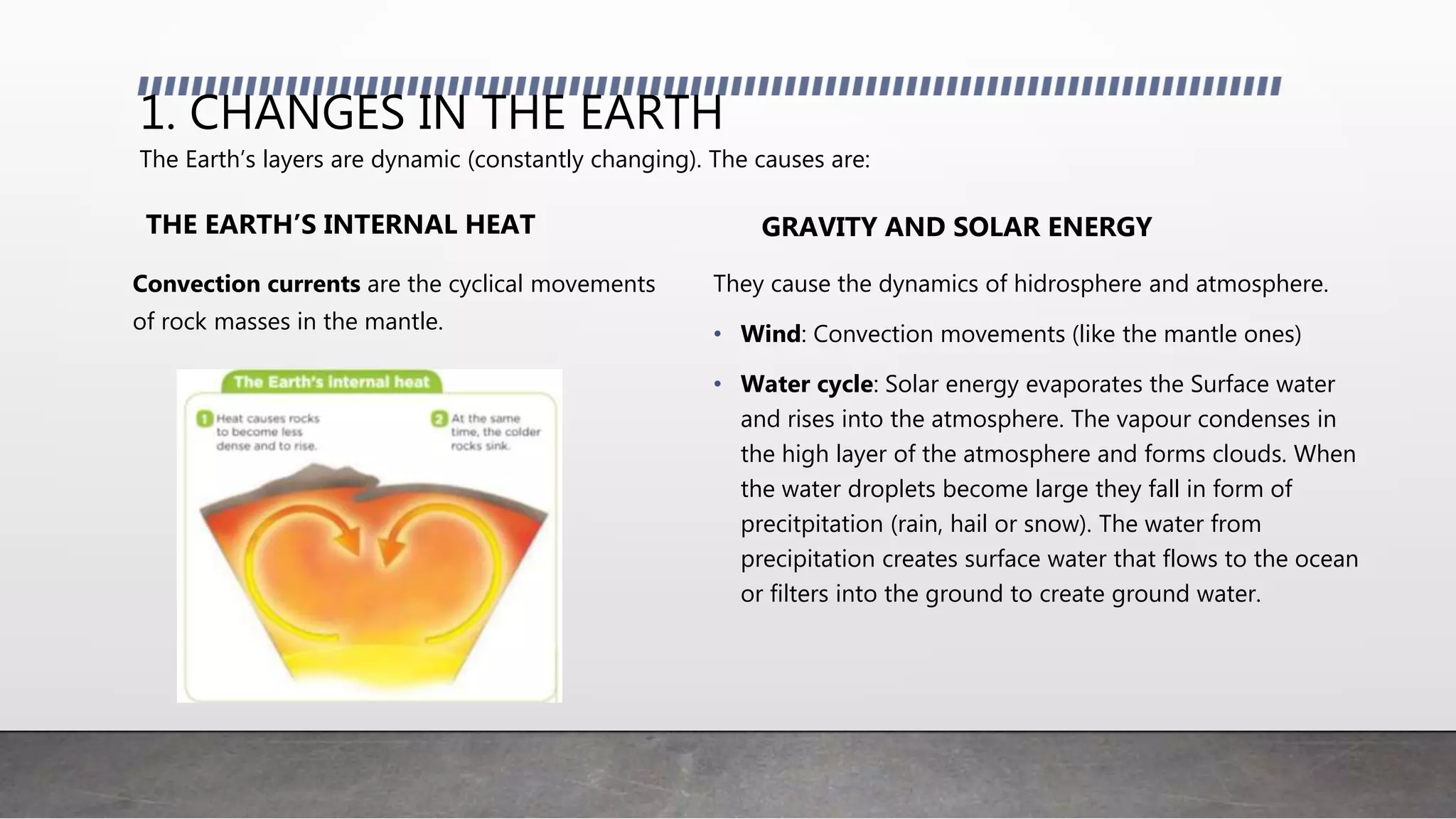
Convection currents are the cyclical movements
of rock masses in the mantle.
GRAVITY AND SOLAR ENERGY
They cause the dynamics of hidrosphere and atmosphere.
• Wind: Convection movements (like the mantle ones)
• Water cycle: Solar energy evaporates the Surface water
and rises into the atmosphere. The vapour condenses in
the high layer of the atmosphere and forms clouds. When
the water droplets become large they fall in form of
precitpitation (rain, hail or snow). The water from
precipitation creates surface water that flows to the ocean
or filters into the ground to create ground water.
2. THE DYNAMICS OF THE LITHOSPHERIC PLATES
The theory of plate tectonics affirms that lithospheric plates move and change shape very slowly
because of the convection currents inside the mantle causing geological processes. There are three types
of boundaries:
CONVERGENT
Both plates are moving towards
each other, normally one dips
under the other and sinks into
the mantle, so lithosphere is
destroyed. Usually a trench is
formed.
DIVERGENT
The plates are separating, a crack
appears between them and
molten material from the mantle,
solidifies and forms new
lithosphere. Usually coincide with
oceanic ridges.
CONSERVATIVE
Two plates rub together
moving in parallel but in
opposite directions.
EXAMPLES:
DIVERGENT BOUNDARIES CONVERGENT BOUNDARIES
CONSERVATIVE BOUNDARIES
Mid Atlantic Ridge
The Andes
San Andreas fault
Describe the water cycle represented in the picture:
3. THE EFFECTS OF PLATE DYNAMICS: ROCK FORMATION
IGNEOUS
Magma (hot mineral masses melted in
the interior of the Earth) rises to the
surface, cools and solidifies forming:
METAMORPHIC
Rocks crushed under high pressure and
temperature inside the Earth´s crust
(without melting) form:
SEDIMENTARY
They can contain fossils.
Wind and running water tear
fragments off the rocks, and transport
them to places where they are
accumulated and form:
- Volcanic rocks: If the
process occurs quickly
small crystals are
formed. Ex: basalt
- Plutonic rocks: If the
process occurs slowly
large crystals are
formed. Ex: granite
- Foliated rocks: Present
foliation (the grains are
forming parallel sheets).
Ex: slate
- Non foliated rocks:
Don´t present foliation
Ex: marble
- Detrital rocks:
Fragments of aother
rocks transported by
rivers. Ex: clay
- Non-detrital rocks:
Dissolved minerals
deposited. Ex: salt
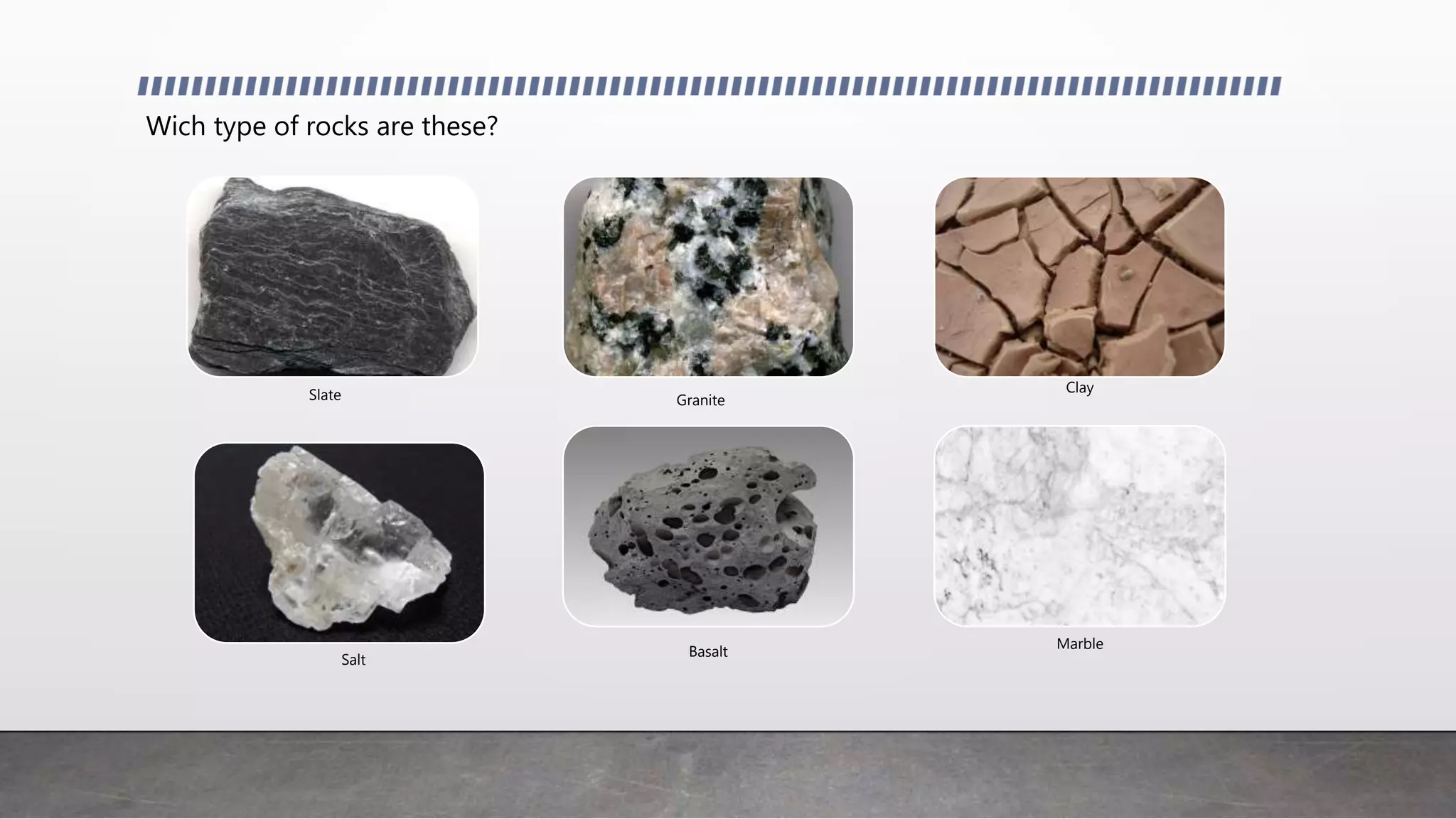
Wich type of rocks are these?
Slate Granite
Basalt
Salt
Clay
Marble
-Molten rock (magma), which cools and hardens to form
igneous rock.
- Exposure to weathering and erosion, break the original rock
into smaller pieces. The smaller material (sediment) is carried
away by rivers, wind, glaciers, and other means and is eventually
deposited elsewhere. These sediments can then be compacted
and cementated, forming sedimentary rock.
- Sedimentary rock can be deeply buried, subjected to heat and
pressure, which over time, cause it to change its structure into a
new rock, a metamorphic rock.
- Eventually, these metamorphic rocks may be melted to the
point where they again melt into magma.
Note that the rock cycle doesn't always have to work in this order;
sometimes igneous rocks can be buried and metamorphosed, skipping
the sedimentary rock phase, and sometimes sedimentary and
metamorphic rocks can be uplifted and eroded to form new sedimentary
rocks. It is also possible for rocks to remain unchanged in stable regions
for long periods of time.
ROCK CYCLE
4. THE EFFECTS OF PLATE DYNAMICS:
EARTHQUAKES
• Earthquakes are movements of the ground produced by
forces resulting from the dynamics of lithospheric plates.
Tectonic forces compress or pull plates in opposite
directions. Rocks accumulate tensión until they move or
break quickly at a point called hypocentre. The energy is
released in form of vibrations called seismic waves. The
seismic waves reach the Earth’s Surface at a point called
epicentre (located vertically above the hypocentre and
propagate through the Surface.
• They can break up the ground, produce landslides or
tsunamis.
Look at the picture and explain how an earthquake is produced.
4. THE EFFECTS OF PLATE DYNAMICS:
SEISMIC RISK
• Seismic risk: probability of economic and social damage
being produced as a result of earthquakes.
• Areas with seismic activity (more earthquakes) are located
near plate boundaries. In Spain the south-east part is the one
with more seismic activity.
• The magnitude (destructive capacity) of an earthquake is
measured by the Ritcher scale.
• As we can´t predict where or when an earthquake is going to
happen, the only way to reduce seismic risk is creating
seismic hazard maps and prepare the areas at risk.
Think about the people who live in places with a high seismic risk.
What measures can they take to minimise damage in the evento of an earthquake?
Which proffesionals would you ask to implement these measures?
5. THE EFFECTS OF PLATE DYNAMICS: VOLCANOES
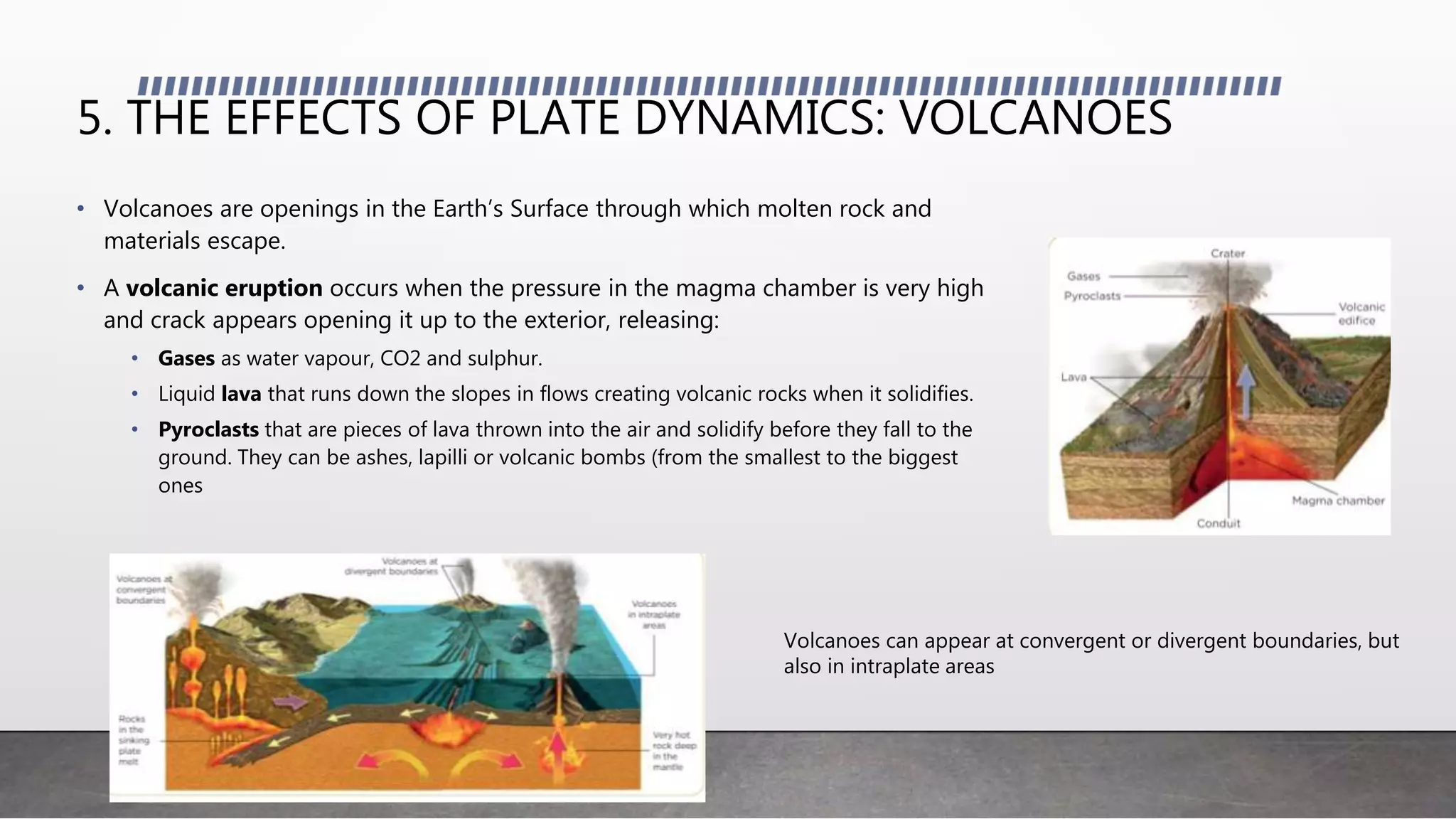
• Volcanoes are openings in the Earth’s Surface through which molten rock and
materials escape.
• A volcanic eruption occurs when the pressure in the magma chamber is very high
and crack appears opening it up to the exterior, releasing:
• Gases as water vapour, CO2 and sulphur.
• Liquid lava that runs down the slopes in flows creating volcanic rocks when it solidifies.
• Pyroclasts that are pieces of lava thrown into the air and solidify before they fall to the
ground. They can be ashes, lapilli or volcanic bombs (from the smallest to the biggest
ones
Volcanoes can appear at convergent or divergent boundaries, but
also in intraplate areas
Explain how volcanoes are formed in:
a) Convergent boundaries
b) Divergent boundaries
c) Intraplate áreas
Identify the types of pyroclasts shown in the images:
5. THE EFFECTS OF PLATE DYNAMICS: VOLCANIC RISK
• Volcanid risk: probability of economic and social damage being
produced as a result of volcanoes.
• Most of volcanic areas are near plate boundaries. In Spain there are
some remains of ancient volcanic activity in the peninsula, although the
only place with active volcanic activity are the Canary Islands.
• To reduce volcanic risk we can predict eruptions (tremors, gases or
changes in the temperatura can announce eruptions), create volcanic
hazard maps or prepare defenses (shelter, evacuations…)
• Volcanic eruptions can be:
• Explosive: Project enormous clouds of toxic gases and burning pyroclasts.
Very dangerous.
• Non-explosive: Expel a large amount of lava that flows gently downhill. Not
very dangerous.
Here you have a website where you can see the volcanic and earthquake risk areas all over
the world.
https://maps.ngdc.noaa.gov/viewers/hazards/
Looking at the map of Spain, is there any volcanic area in the peninsula?
6. HOW THE DYNAMICS OF THE EARTH AFFECT ITS
RELIEF
The Earth’s surface is the result of the geological processes that:
• Model the existing landforms (next unit)
• Renew landforms because of the internal energy (endogenous geological processes):
Volcanic and seismic activity
Opening and closing of oceans:
The divergent boundaries the ocean floor
expands and at convergent boundaries
the ocean floor disappears.
Formation of mountain ranges:
Convergent boundaries in continental
plates produce folds (rocks bend)and
faults (rocks break).
What is the difference between a fold and a fault? Identify which of the following images is a fold and a
fault.
Why do you think relief doesn´t evolve in the same way in all areas of the lithosphere?

U11. the dynamics of the earth

  • 1.
    The dynamics ofthe Earth GEOLOGY 3º ESO
  • 2.
    1. CHANGES INTHE EARTH The Earth’s layers are dynamic (constantly changing). The causes are: THE EARTH’S INTERNAL HEAT Convection currents are the cyclical movements of rock masses in the mantle. GRAVITY AND SOLAR ENERGY They cause the dynamics of hidrosphere and atmosphere. • Wind: Convection movements (like the mantle ones) • Water cycle: Solar energy evaporates the Surface water and rises into the atmosphere. The vapour condenses in the high layer of the atmosphere and forms clouds. When the water droplets become large they fall in form of precitpitation (rain, hail or snow). The water from precipitation creates surface water that flows to the ocean or filters into the ground to create ground water.
  • 3.
    2. THE DYNAMICSOF THE LITHOSPHERIC PLATES The theory of plate tectonics affirms that lithospheric plates move and change shape very slowly because of the convection currents inside the mantle causing geological processes. There are three types of boundaries: CONVERGENT Both plates are moving towards each other, normally one dips under the other and sinks into the mantle, so lithosphere is destroyed. Usually a trench is formed. DIVERGENT The plates are separating, a crack appears between them and molten material from the mantle, solidifies and forms new lithosphere. Usually coincide with oceanic ridges. CONSERVATIVE Two plates rub together moving in parallel but in opposite directions.
  • 4.
    EXAMPLES: DIVERGENT BOUNDARIES CONVERGENTBOUNDARIES CONSERVATIVE BOUNDARIES Mid Atlantic Ridge The Andes San Andreas fault
  • 5.
    Describe the watercycle represented in the picture:
  • 6.
    3. THE EFFECTSOF PLATE DYNAMICS: ROCK FORMATION IGNEOUS Magma (hot mineral masses melted in the interior of the Earth) rises to the surface, cools and solidifies forming: METAMORPHIC Rocks crushed under high pressure and temperature inside the Earth´s crust (without melting) form: SEDIMENTARY They can contain fossils. Wind and running water tear fragments off the rocks, and transport them to places where they are accumulated and form: - Volcanic rocks: If the process occurs quickly small crystals are formed. Ex: basalt - Plutonic rocks: If the process occurs slowly large crystals are formed. Ex: granite - Foliated rocks: Present foliation (the grains are forming parallel sheets). Ex: slate - Non foliated rocks: Don´t present foliation Ex: marble - Detrital rocks: Fragments of aother rocks transported by rivers. Ex: clay - Non-detrital rocks: Dissolved minerals deposited. Ex: salt
  • 7.
    Wich type ofrocks are these? Slate Granite Basalt Salt Clay Marble
  • 8.
    -Molten rock (magma),which cools and hardens to form igneous rock. - Exposure to weathering and erosion, break the original rock into smaller pieces. The smaller material (sediment) is carried away by rivers, wind, glaciers, and other means and is eventually deposited elsewhere. These sediments can then be compacted and cementated, forming sedimentary rock. - Sedimentary rock can be deeply buried, subjected to heat and pressure, which over time, cause it to change its structure into a new rock, a metamorphic rock. - Eventually, these metamorphic rocks may be melted to the point where they again melt into magma. Note that the rock cycle doesn't always have to work in this order; sometimes igneous rocks can be buried and metamorphosed, skipping the sedimentary rock phase, and sometimes sedimentary and metamorphic rocks can be uplifted and eroded to form new sedimentary rocks. It is also possible for rocks to remain unchanged in stable regions for long periods of time. ROCK CYCLE
  • 9.
    4. THE EFFECTSOF PLATE DYNAMICS: EARTHQUAKES • Earthquakes are movements of the ground produced by forces resulting from the dynamics of lithospheric plates. Tectonic forces compress or pull plates in opposite directions. Rocks accumulate tensión until they move or break quickly at a point called hypocentre. The energy is released in form of vibrations called seismic waves. The seismic waves reach the Earth’s Surface at a point called epicentre (located vertically above the hypocentre and propagate through the Surface. • They can break up the ground, produce landslides or tsunamis.
  • 10.
    Look at thepicture and explain how an earthquake is produced.
  • 11.
    4. THE EFFECTSOF PLATE DYNAMICS: SEISMIC RISK • Seismic risk: probability of economic and social damage being produced as a result of earthquakes. • Areas with seismic activity (more earthquakes) are located near plate boundaries. In Spain the south-east part is the one with more seismic activity. • The magnitude (destructive capacity) of an earthquake is measured by the Ritcher scale. • As we can´t predict where or when an earthquake is going to happen, the only way to reduce seismic risk is creating seismic hazard maps and prepare the areas at risk.
  • 12.
    Think about thepeople who live in places with a high seismic risk. What measures can they take to minimise damage in the evento of an earthquake? Which proffesionals would you ask to implement these measures?
  • 13.
    5. THE EFFECTSOF PLATE DYNAMICS: VOLCANOES • Volcanoes are openings in the Earth’s Surface through which molten rock and materials escape. • A volcanic eruption occurs when the pressure in the magma chamber is very high and crack appears opening it up to the exterior, releasing: • Gases as water vapour, CO2 and sulphur. • Liquid lava that runs down the slopes in flows creating volcanic rocks when it solidifies. • Pyroclasts that are pieces of lava thrown into the air and solidify before they fall to the ground. They can be ashes, lapilli or volcanic bombs (from the smallest to the biggest ones Volcanoes can appear at convergent or divergent boundaries, but also in intraplate areas
  • 14.
    Explain how volcanoesare formed in: a) Convergent boundaries b) Divergent boundaries c) Intraplate áreas Identify the types of pyroclasts shown in the images:
  • 15.
    5. THE EFFECTSOF PLATE DYNAMICS: VOLCANIC RISK • Volcanid risk: probability of economic and social damage being produced as a result of volcanoes. • Most of volcanic areas are near plate boundaries. In Spain there are some remains of ancient volcanic activity in the peninsula, although the only place with active volcanic activity are the Canary Islands. • To reduce volcanic risk we can predict eruptions (tremors, gases or changes in the temperatura can announce eruptions), create volcanic hazard maps or prepare defenses (shelter, evacuations…) • Volcanic eruptions can be: • Explosive: Project enormous clouds of toxic gases and burning pyroclasts. Very dangerous. • Non-explosive: Expel a large amount of lava that flows gently downhill. Not very dangerous.
  • 16.
    Here you havea website where you can see the volcanic and earthquake risk areas all over the world. https://maps.ngdc.noaa.gov/viewers/hazards/ Looking at the map of Spain, is there any volcanic area in the peninsula?
  • 17.
    6. HOW THEDYNAMICS OF THE EARTH AFFECT ITS RELIEF The Earth’s surface is the result of the geological processes that: • Model the existing landforms (next unit) • Renew landforms because of the internal energy (endogenous geological processes): Volcanic and seismic activity Opening and closing of oceans: The divergent boundaries the ocean floor expands and at convergent boundaries the ocean floor disappears. Formation of mountain ranges: Convergent boundaries in continental plates produce folds (rocks bend)and faults (rocks break).
  • 18.
    What is thedifference between a fold and a fault? Identify which of the following images is a fold and a fault. Why do you think relief doesn´t evolve in the same way in all areas of the lithosphere?