UNIT OVERVIEW
• UNITTITLE: Urban Spaces
• KEY CONCEPTS: Relationships
• RELATED CONCEPTS: Representation, Space
• GLOBAL CONTEXT: Globalization and sustainability Urban planning
• S.O.I: Planning requires understanding the relationship between
space and its representation.
• ATL SKILLS: Communication and Thinking Skills
NUMBER GRIDS
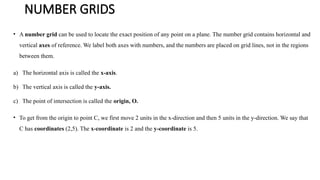
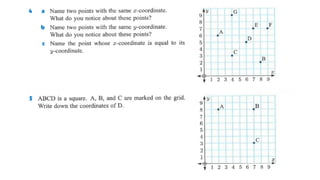
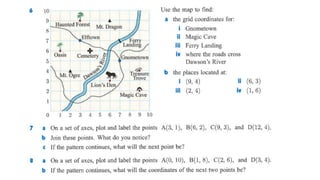
• Anumber grid can be used to locate the exact position of any point on a plane. The number grid contains horizontal and
vertical axes of reference. We label both axes with numbers, and the numbers are placed on grid lines, not in the regions
between them.
a) The horizontal axis is called the x-axis.
b) The vertical axis is called the y-axis.
c) The point of intersection is called the origin, O.
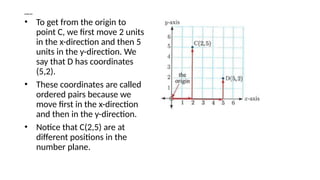
• To get from the origin to point C, we first move 2 units in the x-direction and then 5 units in the y-direction. We say that
C has coordinates (2,5). The x-coordinate is 2 and the y-coordinate is 5.
5.
NUMBER GRID
• Toget from the origin to
point C, we first move 2 units
in the x-direction and then 5
units in the y-direction. We
say that D has coordinates
(5,2).
• These coordinates are called
ordered pairs because we
move first in the x-direction
and then in the y-direction.
• Notice that C(2,5) are at
different positions in the
number plane.
6.
POINTS ON THEAXES
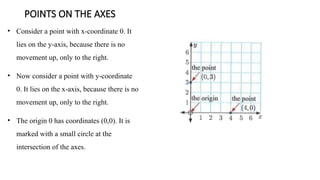
• Consider a point with x-coordinate 0. It
lies on the y-axis, because there is no
movement up, only to the right.
• Now consider a point with y-coordinate
0. It lies on the x-axis, because there is no
movement up, only to the right.
• The origin 0 has coordinates (0,0). It is
marked with a small circle at the
intersection of the axes.
POSITIVE AND NEGATIVE
COORDINATES
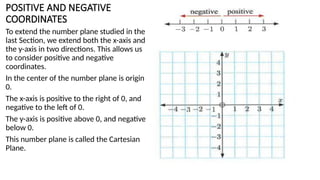
Toextend the number plane studied in the
last Section, we extend both the x-axis and
the y-axis in two directions. This allows us
to consider positive and negative
coordinates.
In the center of the number plane is origin
0.
The x-axis is positive to the right of 0, and
negative to the left of 0.
The y-axis is positive above 0, and negative
below 0.
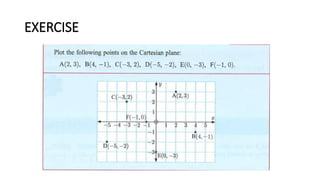
This number plane is called the Cartesian
Plane.
12.
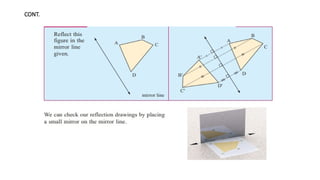
CONT.
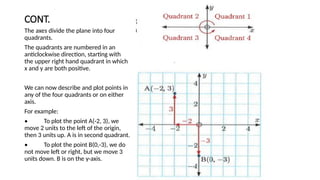
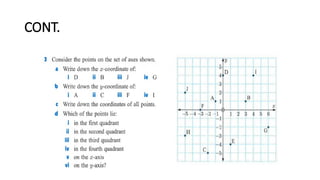
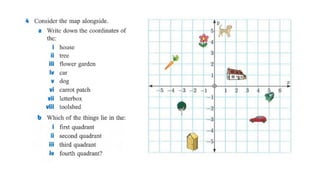
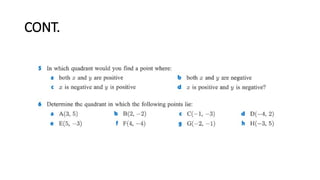
The axes dividethe plane into four
quadrants.
The quadrants are numbered in an
anticlockwise direction, starting with
the upper right hand quadrant in which
x and y are both positive.
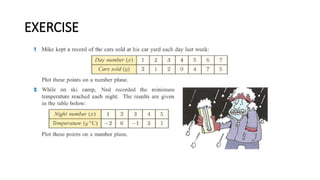
We can now describe and plot points in
any of the four quadrants or on either
axis.
For example:
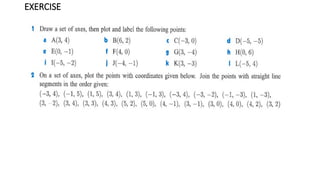
• To plot the point A(-2, 3), we
move 2 units to the left of the origin,
then 3 units up. A is in second quadrant.
• To plot the point B(0,-3), we do
not move left or right, but we move 3
units down. B is on the y-axis.
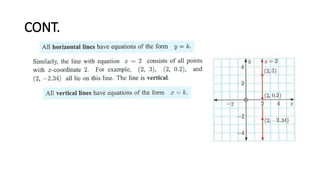
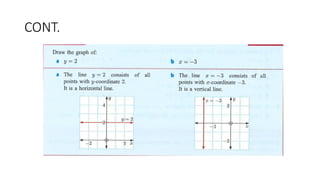
GRAPHING STRAIGHT LINES
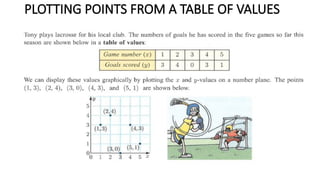
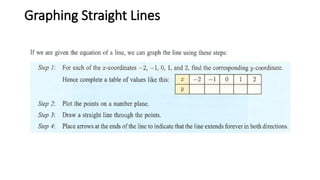
•A straight line consists of an infinite number of points in a particular direction. We
cannot list all of the points on a line in a table of values, but if we know some points
on the line then we can plot them and hence draw the line through them.
THE EQUATION OF A LINE
The equation of a line is a rule which connects the x and y-coordinates of all points on
the line.
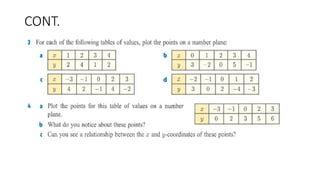
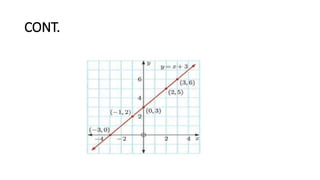
• In question 4 of the previous Exercise, you should have noticed that the plotted points
lie in a straight line. For each of the points, the y-coordinate is 3 more than the x-
coordinate.
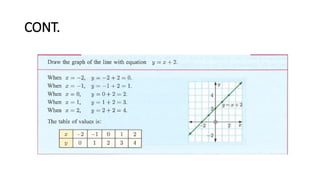
• The rule connecting the x and y-coordinates of each point on the line is y=x+3. We say
that y=x+3 is the equation of the line.
Example
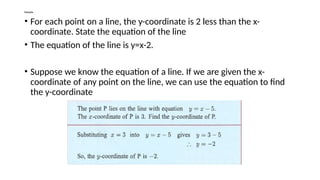
• For eachpoint on a line, the y-coordinate is 2 less than the x-
coordinate. State the equation of the line
• The equation of the line is y=x-2.
• Suppose we know the equation of a line. If we are given the x-
coordinate of any point on the line, we can use the equation to find
the y-coordinate
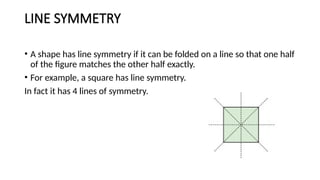
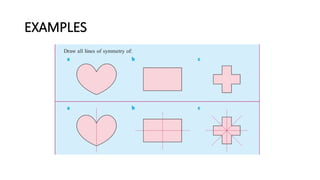
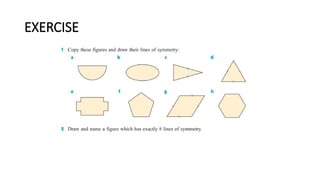
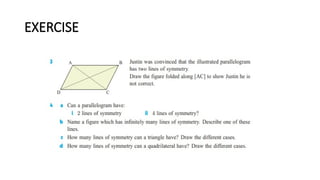
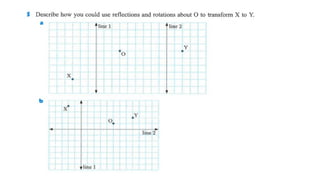
LINE SYMMETRY
• Ashape has line symmetry if it can be folded on a line so that one half
of the figure matches the other half exactly.
• For example, a square has line symmetry.
In fact it has 4 lines of symmetry.
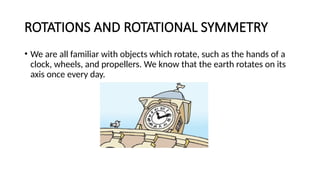
ROTATIONS AND ROTATIONALSYMMETRY
• We are all familiar with objects which rotate, such as the hands of a
clock, wheels, and propellers. We know that the earth rotates on its
axis once every day.
44.
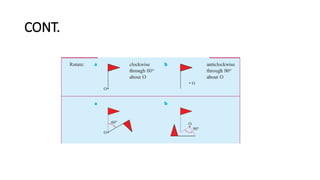
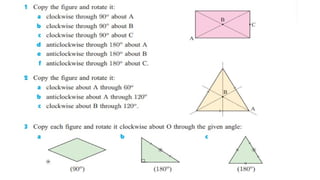
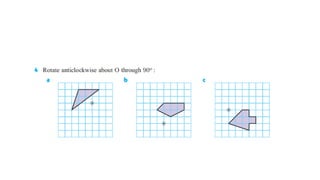
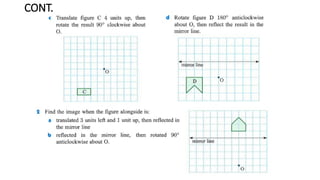
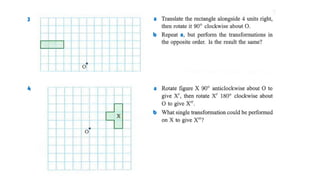
ROTATIONS
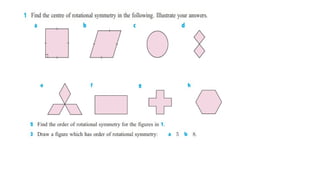
• A rotationturns a shape or figure about a point and through a given
angle.
• The point about which a figure rotates is called the centre of rotation.
We often label this point O.
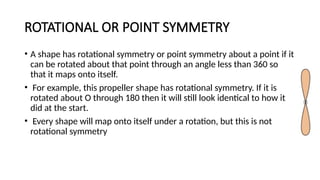
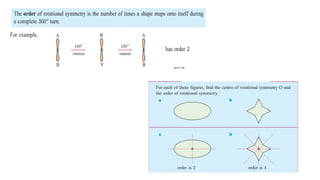
ROTATIONAL OR POINTSYMMETRY
• A shape has rotational symmetry or point symmetry about a point if it
can be rotated about that point through an angle less than 360 so
that it maps onto itself.
• For example, this propeller shape has rotational symmetry. If it is
rotated about O through 180 then it will still look identical to how it
did at the start.
• Every shape will map onto itself under a rotation, but this is not
rotational symmetry