Assembly Language Programming of 8051
Assembly Language Provides ‘English like’ words called ‘mnemonics’ for the machine codes. For e.g.  0010 1111  (2FH), is a 8-bit instruction in  Machine language  of 8051 to add two numbers ADD A, R7  is an  Assembly language  instruction of 8051 to add two numbers
High-level Languages These languages are  machine-independent Programmer may not know the internal details of the CPU For e.g.  Embedded C , Embedded Java etc. High-level language programs are translated to machine code using a program called ‘ Compiler ’
Programming using ‘Assembly’ A program called ‘ Assembler ’ is needed to translate an Assembly Language program to machine language Assembly language is ‘ machine dependent ’, i.e. a  low-level  programming language A programmer must know the Internal details of CPU Instruction set
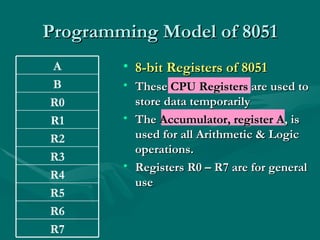
8-bit Registers of 8051 These  CPU Registers  are used to store data temporarily The  Accumulator, register A , is used for all Arithmetic & Logic operations. Registers R0 – R7 are for general use Programming Model of 8051 R7 R6 R5 R4 R3 R2 R1 R0 B A
Assembly Language program Consists of a series of Assembly language instructions Structure of Assembly Language Has four fields [label:] mnemonic [operands] [;comments] start: MOV R5, #25H ;load 25H in R5 MOV A, #5 ;load 5 in A ADD A, R5 ;add A & R5
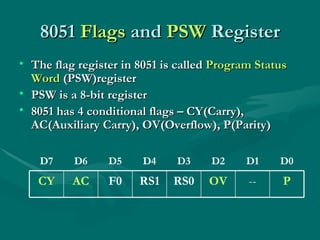
8051  Flags  and  PSW  Register The flag register in 8051 is called  Program Status Word  (PSW)register PSW is a 8-bit register 8051 has 4 conditional flags – CY(Carry), AC(Auxiliary Carry), OV(Overflow), P(Parity) P -- OV RS0 RS1 F0 AC CY D0 D1 D2 D3 D4 D5 D6 D7
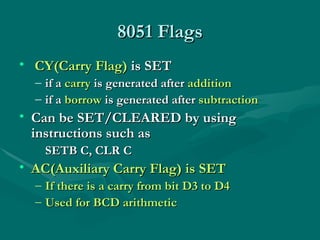
8051 Flags CY(Carry Flag)  is SET  if a  carry  is generated after  addition   if a  borrow  is generated after  subtraction Can be SET/CLEARED by using instructions such as SETB C, CLR C AC(Auxiliary Carry Flag) is SET If there is a carry from bit D3 to D4  Used for BCD arithmetic
8051 Flags P(Parity Flag)  reflects no. of 1’s in register A SET if ODD no. of 1’s RESET if EVEN no. of 1’s OV(Overflow Flag) Used with signed numbers Detects the overflow of the higher-order bit to the sign bit
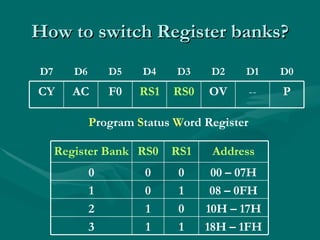
8051 Register Banks 8051 has 4 register banks Each bank has 8 registers named R0 to R7 Only one register bank can be accessed by 8051 at a time Bits  RS0  &  RS1  of  PSW  register are used to select any one of the four register banks
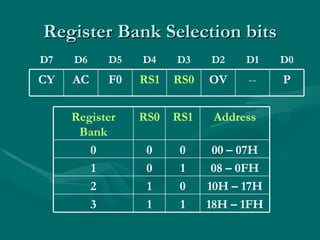
Register Bank Selection bits P -- OV RS0 RS1 F0 AC CY D0 D1 D2 D3 D4 D5 D6 D7 3 2 1 0 Register Bank 18H – 1FH 10H – 17H 08 – 0FH 00 – 07H Address 1 1 0 1 1 0 0 0 RS1 RS0
RAM space allocation in 8051 8051 has  128 bytes  of RAM RAM address space is  00H  to  7FH 8051 RAM is divided into 3 groups Register banks and Stack Bit-addressable memory Scratch Pad memory
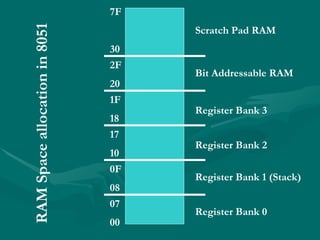
00 07 08 0F 10 17 18 1F 20 2F 30 7F Register Bank 0 Register Bank 1 (Stack) Register Bank 2 Register Bank 3 Bit Addressable RAM Scratch Pad RAM RAM Space allocation in 8051
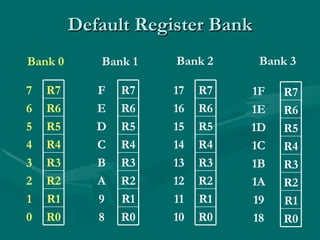
Default Register Bank Bank 0 Bank 1 Bank 2 Bank 3 0 1 2 3 4 5 6 7 R0 R1 R2 R3 R4 R5 R6 R7 R0 R1 R2 R3 R4 R5 R6 R7 R0 R1 R2 R3 R4 R5 R6 R7 18 19 1A 1B 1C 1D 1E 1F 10 11 12 13 14 15 16 17 8 9 A B C D E F R0 R1 R2 R3 R4 R5 R6 R7
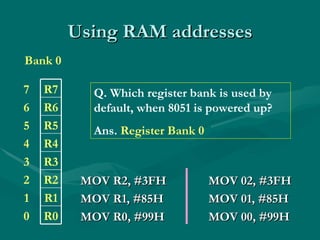
Using RAM addresses MOV R2, #3FH MOV 02, #3FH MOV R1, #85H MOV 01, #85H MOV R0, #99H MOV 00, #99H Bank 0 Q. Which register bank is used by default, when 8051 is powered up? Ans.  Register Bank 0 0 1 2 3 4 5 6 7 R0 R1 R2 R3 R4 R5 R6 R7
How to switch Register banks? P rogram  S tatus  W ord Register P -- OV RS0 RS1 F0 AC CY D0 D1 D2 D3 D4 D5 D6 D7 3 2 1 0 Register Bank 18H – 1FH 10H – 17H 08 – 0FH 00 – 07H Address 1 1 0 1 1 0 0 0 RS1 RS0
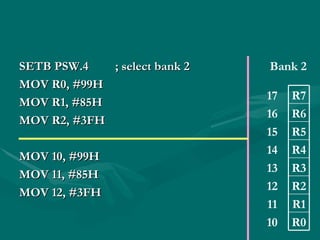
SETB PSW.4 ; select bank 2 MOV R0, #99H MOV R1, #85H MOV R2, #3FH MOV 10, #99H MOV 11, #85H MOV 12, #3FH Bank 2 R0 R1 R2 R3 R4 R5 R6 R7 10 11 12 13 14 15 16 17
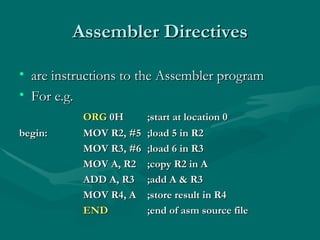
Assembler Directives are instructions to the Assembler program For e.g. ORG  0H ;start at location 0 begin: MOV R2, #5 ;load 5 in R2 MOV R3, #6 ;load 6 in R3 MOV A, R2 ;copy R2 in A ADD A, R3 ;add A & R3 MOV R4, A ;store result in R4 END ;end of asm source file
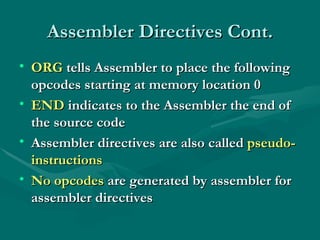
Assembler Directives Cont. ORG  tells Assembler to place the following opcodes starting at memory location 0 END  indicates to the Assembler the end of the source code Assembler directives are also called  pseudo-instructions No opcodes  are generated by assembler for assembler directives
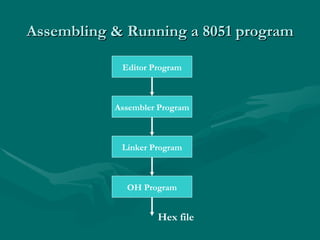
Assembling & Running a 8051 program Editor Program Assembler Program Linker Program OH Program Hex file

1347 Assembly Language Programming Of 8051

  • 1.
  • 2.
    Assembly Language Provides‘English like’ words called ‘mnemonics’ for the machine codes. For e.g. 0010 1111 (2FH), is a 8-bit instruction in Machine language of 8051 to add two numbers ADD A, R7 is an Assembly language instruction of 8051 to add two numbers
  • 3.
    High-level Languages Theselanguages are machine-independent Programmer may not know the internal details of the CPU For e.g. Embedded C , Embedded Java etc. High-level language programs are translated to machine code using a program called ‘ Compiler ’
  • 4.
    Programming using ‘Assembly’A program called ‘ Assembler ’ is needed to translate an Assembly Language program to machine language Assembly language is ‘ machine dependent ’, i.e. a low-level programming language A programmer must know the Internal details of CPU Instruction set
  • 5.
    8-bit Registers of8051 These CPU Registers are used to store data temporarily The Accumulator, register A , is used for all Arithmetic & Logic operations. Registers R0 – R7 are for general use Programming Model of 8051 R7 R6 R5 R4 R3 R2 R1 R0 B A
  • 6.
    Assembly Language programConsists of a series of Assembly language instructions Structure of Assembly Language Has four fields [label:] mnemonic [operands] [;comments] start: MOV R5, #25H ;load 25H in R5 MOV A, #5 ;load 5 in A ADD A, R5 ;add A & R5
  • 7.
    8051 Flags and PSW Register The flag register in 8051 is called Program Status Word (PSW)register PSW is a 8-bit register 8051 has 4 conditional flags – CY(Carry), AC(Auxiliary Carry), OV(Overflow), P(Parity) P -- OV RS0 RS1 F0 AC CY D0 D1 D2 D3 D4 D5 D6 D7
  • 8.
    8051 Flags CY(CarryFlag) is SET if a carry is generated after addition if a borrow is generated after subtraction Can be SET/CLEARED by using instructions such as SETB C, CLR C AC(Auxiliary Carry Flag) is SET If there is a carry from bit D3 to D4 Used for BCD arithmetic
  • 9.
    8051 Flags P(ParityFlag) reflects no. of 1’s in register A SET if ODD no. of 1’s RESET if EVEN no. of 1’s OV(Overflow Flag) Used with signed numbers Detects the overflow of the higher-order bit to the sign bit
  • 10.
    8051 Register Banks8051 has 4 register banks Each bank has 8 registers named R0 to R7 Only one register bank can be accessed by 8051 at a time Bits RS0 & RS1 of PSW register are used to select any one of the four register banks
  • 11.
    Register Bank Selectionbits P -- OV RS0 RS1 F0 AC CY D0 D1 D2 D3 D4 D5 D6 D7 3 2 1 0 Register Bank 18H – 1FH 10H – 17H 08 – 0FH 00 – 07H Address 1 1 0 1 1 0 0 0 RS1 RS0
  • 12.
    RAM space allocationin 8051 8051 has 128 bytes of RAM RAM address space is 00H to 7FH 8051 RAM is divided into 3 groups Register banks and Stack Bit-addressable memory Scratch Pad memory
  • 13.
    00 07 080F 10 17 18 1F 20 2F 30 7F Register Bank 0 Register Bank 1 (Stack) Register Bank 2 Register Bank 3 Bit Addressable RAM Scratch Pad RAM RAM Space allocation in 8051
  • 14.
    Default Register BankBank 0 Bank 1 Bank 2 Bank 3 0 1 2 3 4 5 6 7 R0 R1 R2 R3 R4 R5 R6 R7 R0 R1 R2 R3 R4 R5 R6 R7 R0 R1 R2 R3 R4 R5 R6 R7 18 19 1A 1B 1C 1D 1E 1F 10 11 12 13 14 15 16 17 8 9 A B C D E F R0 R1 R2 R3 R4 R5 R6 R7
  • 15.
    Using RAM addressesMOV R2, #3FH MOV 02, #3FH MOV R1, #85H MOV 01, #85H MOV R0, #99H MOV 00, #99H Bank 0 Q. Which register bank is used by default, when 8051 is powered up? Ans. Register Bank 0 0 1 2 3 4 5 6 7 R0 R1 R2 R3 R4 R5 R6 R7
  • 16.
    How to switchRegister banks? P rogram S tatus W ord Register P -- OV RS0 RS1 F0 AC CY D0 D1 D2 D3 D4 D5 D6 D7 3 2 1 0 Register Bank 18H – 1FH 10H – 17H 08 – 0FH 00 – 07H Address 1 1 0 1 1 0 0 0 RS1 RS0
  • 17.
    SETB PSW.4 ;select bank 2 MOV R0, #99H MOV R1, #85H MOV R2, #3FH MOV 10, #99H MOV 11, #85H MOV 12, #3FH Bank 2 R0 R1 R2 R3 R4 R5 R6 R7 10 11 12 13 14 15 16 17
  • 18.
    Assembler Directives areinstructions to the Assembler program For e.g. ORG 0H ;start at location 0 begin: MOV R2, #5 ;load 5 in R2 MOV R3, #6 ;load 6 in R3 MOV A, R2 ;copy R2 in A ADD A, R3 ;add A & R3 MOV R4, A ;store result in R4 END ;end of asm source file
  • 19.
    Assembler Directives Cont.ORG tells Assembler to place the following opcodes starting at memory location 0 END indicates to the Assembler the end of the source code Assembler directives are also called pseudo-instructions No opcodes are generated by assembler for assembler directives
  • 20.
    Assembling & Runninga 8051 program Editor Program Assembler Program Linker Program OH Program Hex file