REACTION KINETICS
8.1 REACTION RATE
LEARNING OUTCOMES:
• Define reaction rate

• Explain the graph of concentration against time in
relation to reaction rate
• Write differential rate equation
• Determine the reaction rate based on a differential
equation
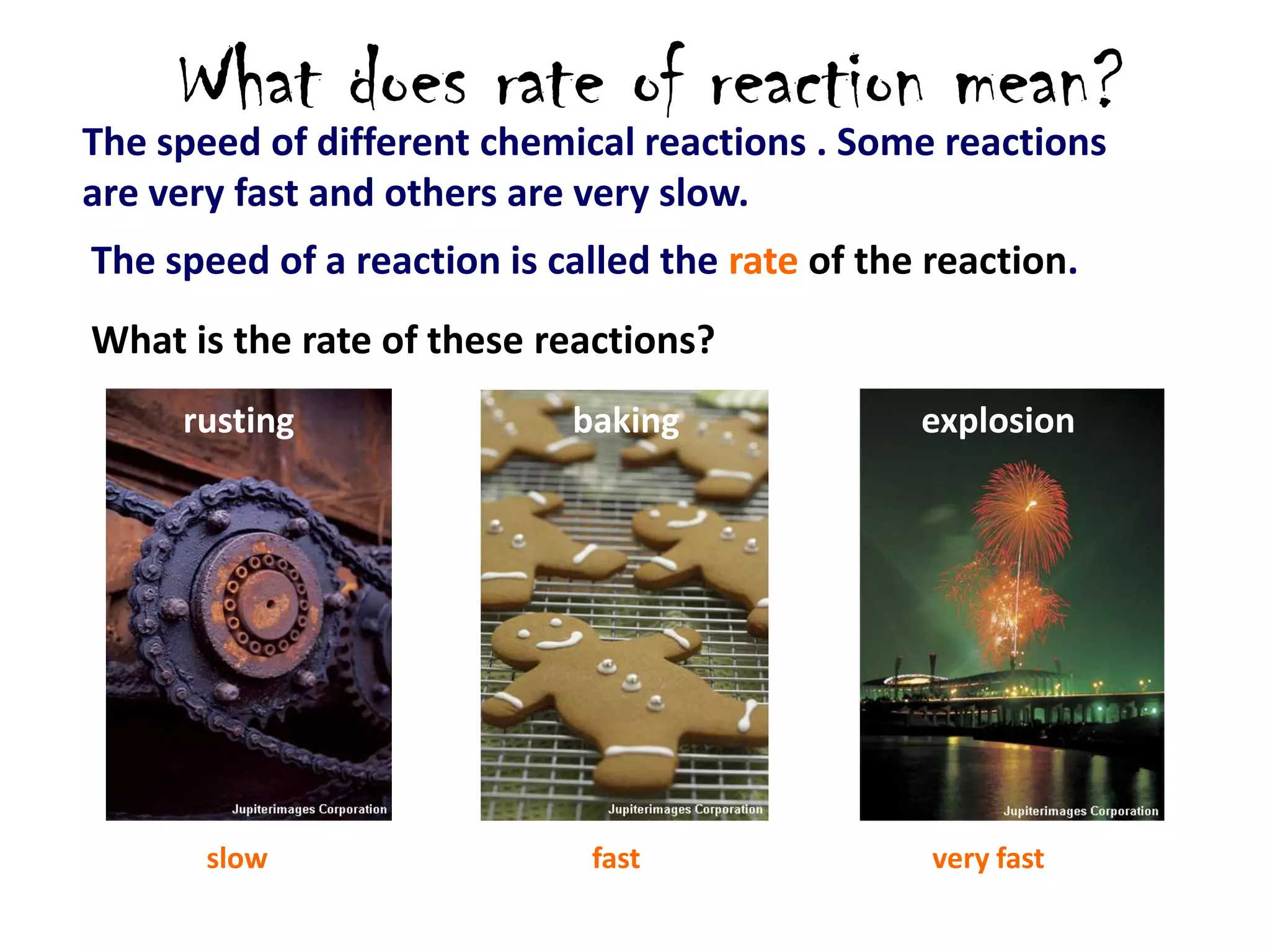
What does rate of reaction mean?

The speed of different chemical reactions . Some reactions
are very fast and others are very slow.

The speed of a reaction is called the rate of the reaction.
What is the rate of these reactions?
rusting

slow

baking

fast

explosion

very fast
A

B

?
rate = -

?
rate = +

?
[A]
t
[B]

t

?
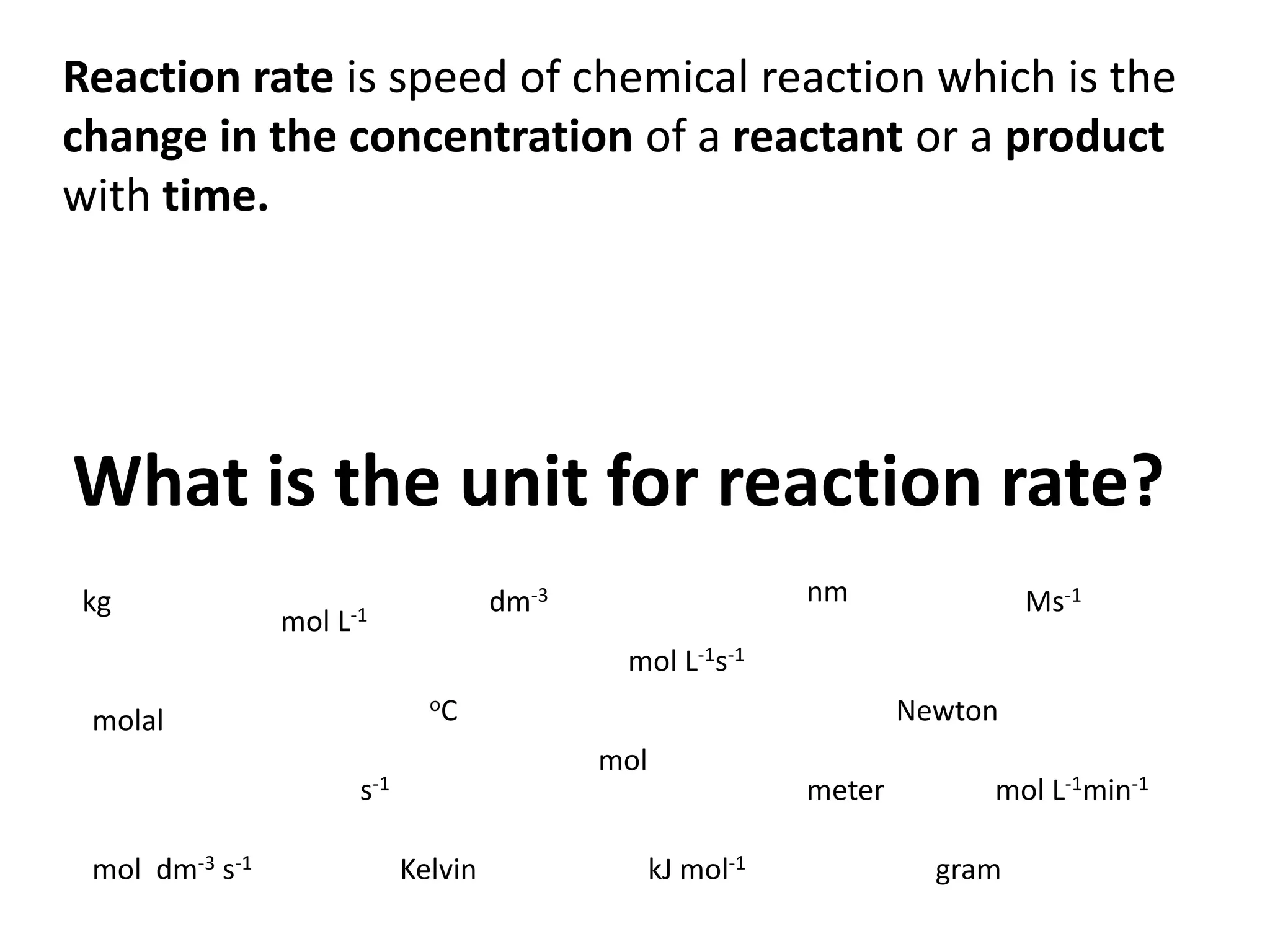
Reaction rate is speed of chemical reaction which is the
change in the concentration of a reactant or a product
with time.

What is the unit for reaction rate?
kg

mol

nm

dm-3

L-1

Ms-1

mol L-1s-1
oC

molal

mol

s-1
mol dm-3 s-1

Newton

Kelvin

meter
kJ mol-1

mol L-1min-1
gram
Differential rate equation / Rate expressions
aA+bB
rate =

cC+dD

-1 d[A] = -1 d[B] = +1 d[C]
a dt
b dt
c dt

= +1 d[D]
d dt

Differential Rate Equation Example1:

O3(g) + NO(g)

NO2(g) + O2(g)

d O3
d[NO]
d[ NO 2 ]
d[ O 2 ]
rate = ==+
=+
dt
dt
dt
dt
Differential Rate Equation Example2:

2 NOCl (g)

2 NO + Cl2 (g)

1 d NOCl
1 d[NO]
d[Cl2 ]
rate = =
=+
2
dt
2 dt
dt
2 moles of NOCl disappear for every 1 mole Cl2
formed.
Rate of disappearance of NOCl is twice as fast
as the rate of formation of Cl2
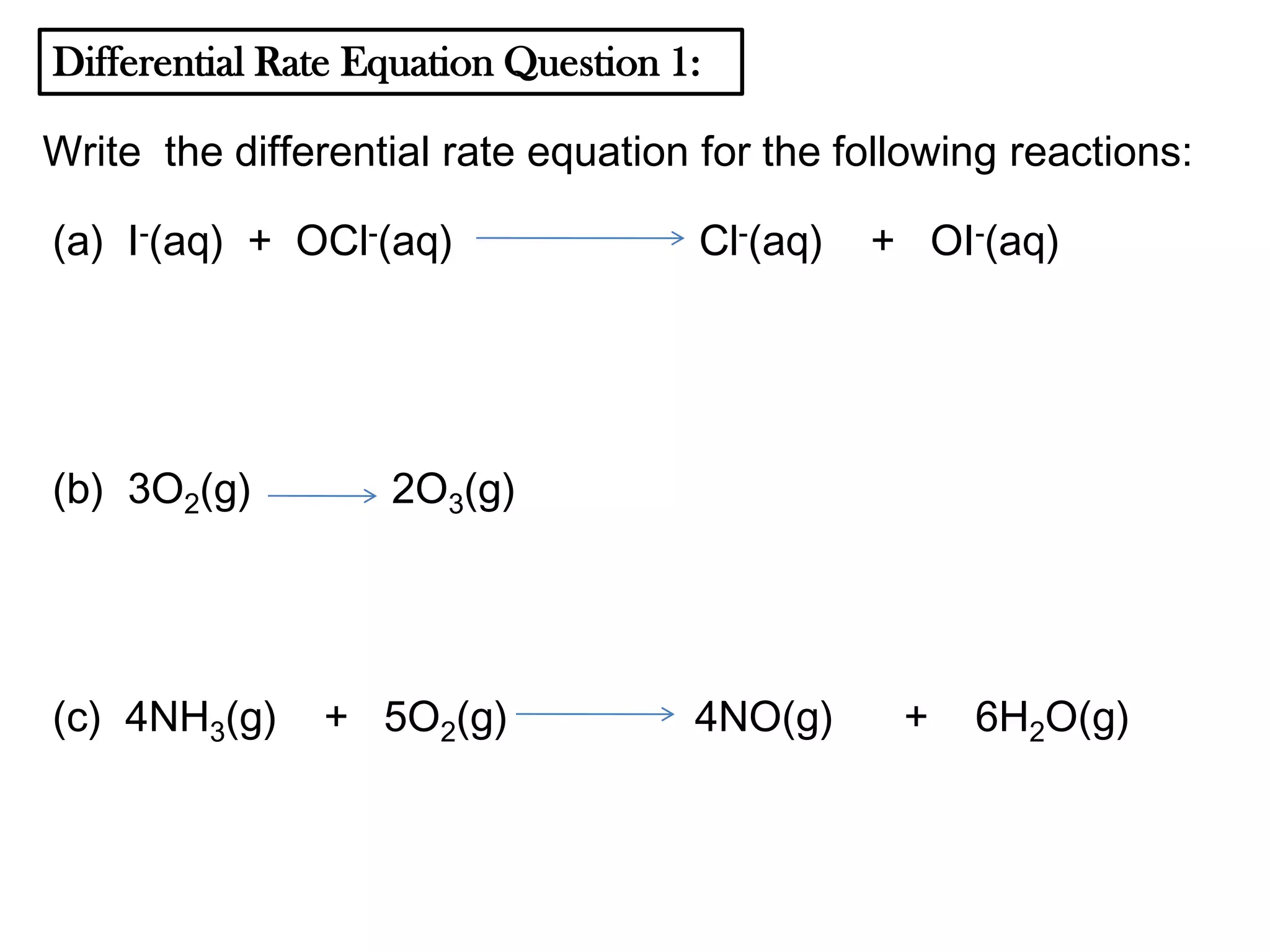
Differential Rate Equation Question 1:
Write the differential rate equation for the following reactions:
(a) I-(aq) + OCl-(aq)

(b) 3O2(g)

(c) 4NH3(g)

Cl-(aq)

+ OI-(aq)

2O3(g)

+ 5O2(g)

4NO(g)

+

6H2O(g)
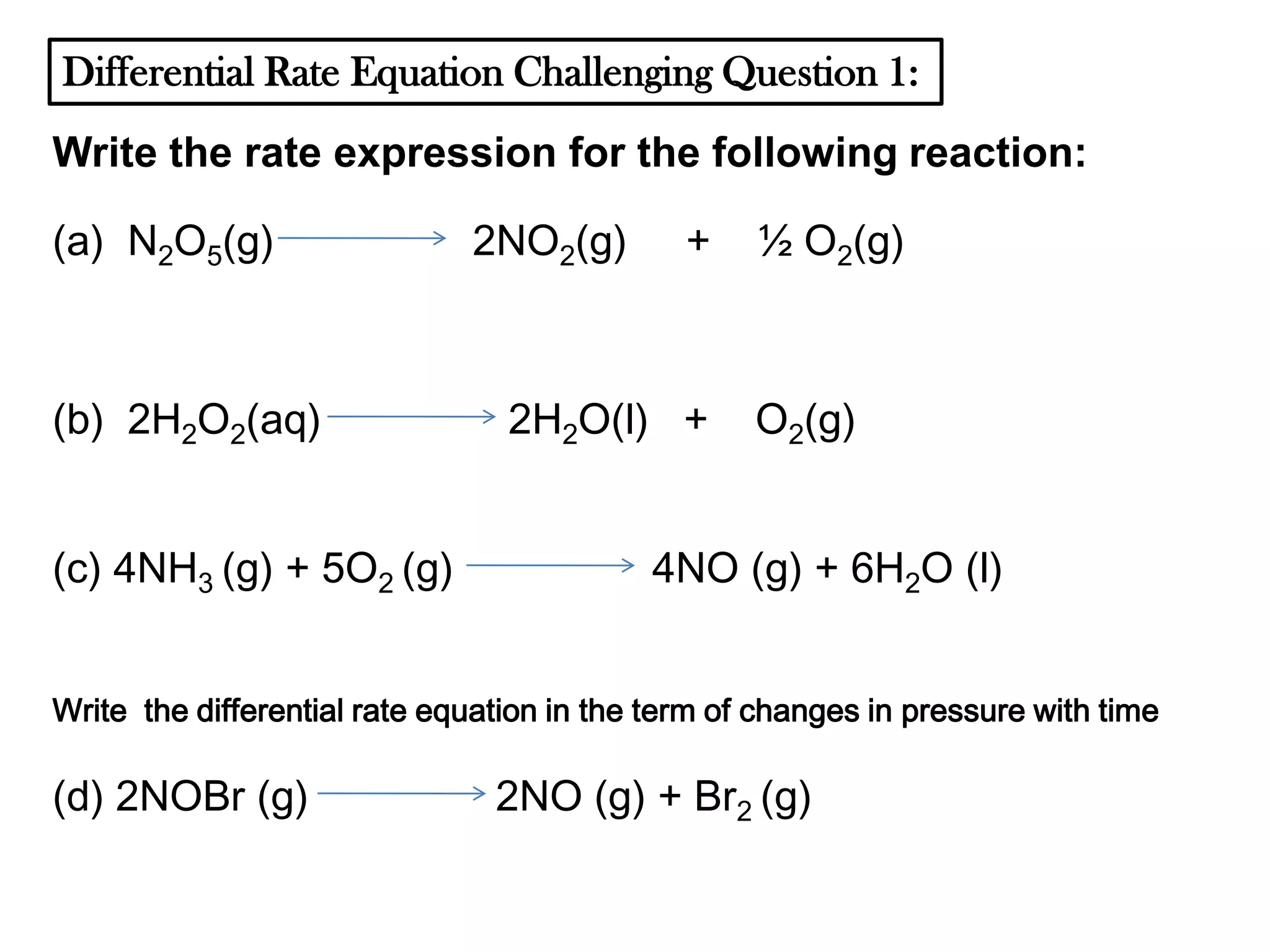
Differential Rate Equation Challenging Question 1:
Write the rate expression for the following reaction:
(a) N2O5(g)

(b) 2H2O2(aq)
(c) 4NH3 (g) + 5O2 (g)

2NO2(g)

+

2H2O(l) +

½ O2(g)

O2(g)

4NO (g) + 6H2O (l)

Write the differential rate equation in the term of changes in pressure with time

(d) 2NOBr (g)

2NO (g) + Br2 (g)
Differential Rate Equation Example 3:

C2H6(g) + 7O2(g)

4CO2(g) + 6H2O(g)

If the ethane, C2H6 is burning at the rate of 0.20 mol dm-3s-1. Calculate the rate of
formation of CO2

STEP 1: Write the differential rate equation for the
substances that related to the question
d [C 2 H 6]
dt

?

1 d [CO 2]
4
dt

STEP 2: Substitute the given information into the
differential equation
d [CO 2]
dt
d [CO 2]
dt

4(0.20moldm 3s 1 )
0.80moldm 3s

1

Rate of formation
of CO2 is
0.80 moldm-3s-1
C2H6(g) + 7O2(g)

4CO2(g) + 6H2O(g)

If the ethane, C2H6 is burning at the rate of 0.20 mol dm-3s-1. Calculate the rate of
formation of CO2

Student common mistakes:
d [C 2 H 6]
dt
1 d [CO 2]
4
dt
d [CO 2]
dt
d [CO 2]
dt
d [CO 2]
dt

1 d [CO 2]
4
dt
d [C 2 H 6]
dt
d [C 2 H 6]
4
dt
4(0.20moldm 3s 1 )
0.80moldm 3s

1
Differential Rate Equation Example 4:

C2H6(g) + 7O2(g)

4CO2(g) + 6H2O(g)

If the ethane, C2H6 is burning at the rate of 0.20 mol dm-3s-1. Calculate the rate of
disappearance of O2

STEP 1: Write the differential rate equation for the
substances that related to the question
d [C 2 H 6]
dt

?

1 d [O 2]
7 dt

STEP 2: Substitute the given information into the
differential equation
d [O 2]
7(0.20moldm 3s 1 )
dt
d [O 2]
1.40moldm 3s 1
dt

Rate of
disappearance of O2
is 1.40 moldm-3s-1
C2H6(g) + 7O2(g)

4CO2(g) + 6H2O(g)

If the ethane, C2H6 is burning at the rate of 0.20 mol dm-3s-1. Calculate the rate of
disappearance of O2

Student common mistakes:
d [C 2 H 6]
1 d [O 2]
dt
7 dt
1 d [O 2]
d [C 2 H 6]
7 dt
dt
d [O 2]
d [C 2 H 6]
7
dt
dt
d [O 2]
7(0.20moldm 3s 1 )
dt
d [O 2]
dt

1.40moldm 3s

1
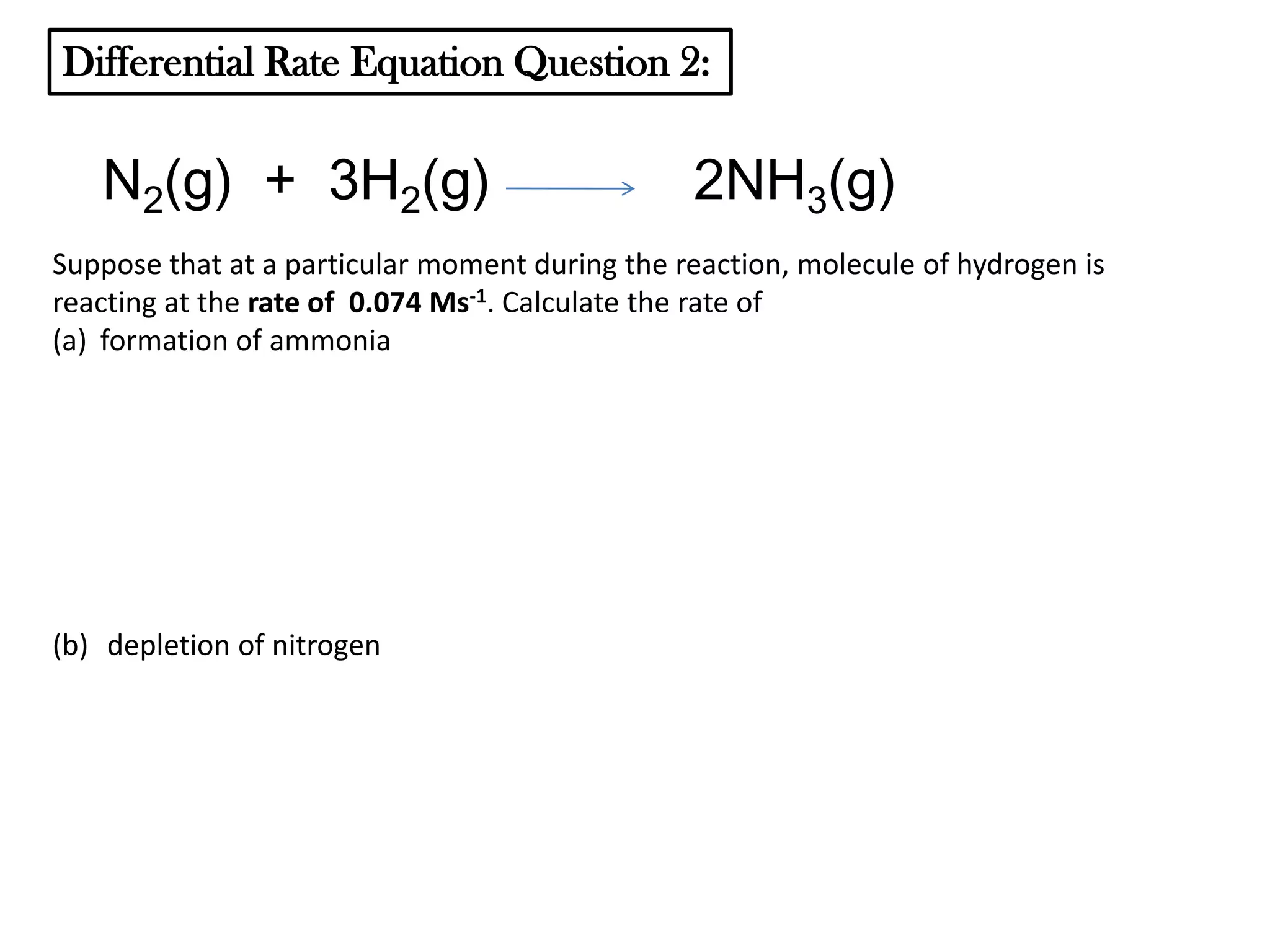
Differential Rate Equation Question 2:

N2(g) + 3H2(g)

2NH3(g)

Suppose that at a particular moment during the reaction, molecule of hydrogen is
reacting at the rate of 0.074 Ms-1. Calculate the rate of
(a) formation of ammonia

(b) depletion of nitrogen
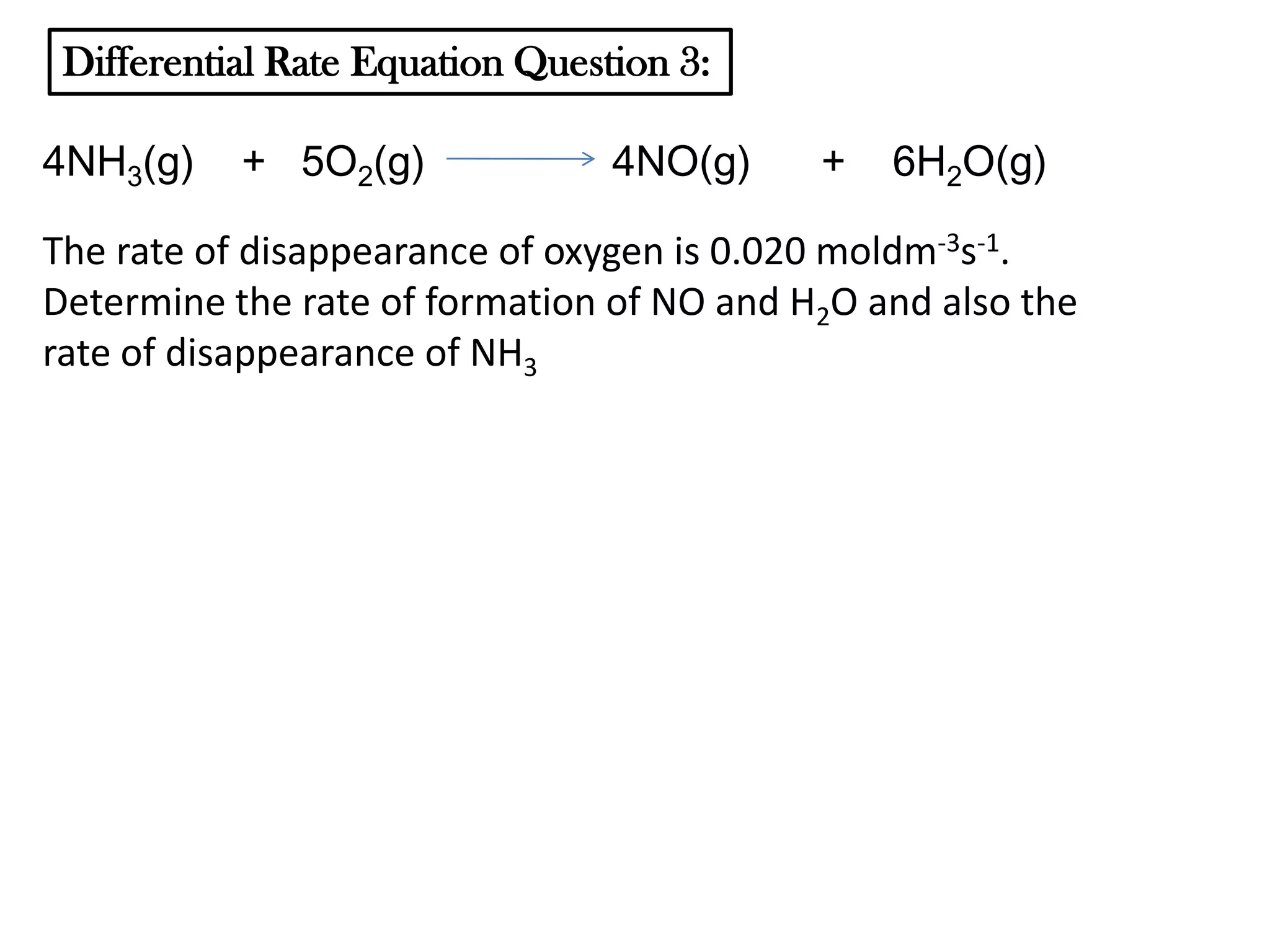
Differential Rate Equation Question 3:

4NH3(g)

+ 5O2(g)

4NO(g)

+

6H2O(g)

The rate of disappearance of oxygen is 0.020 moldm-3s-1.
Determine the rate of formation of NO and H2O and also the
rate of disappearance of NH3
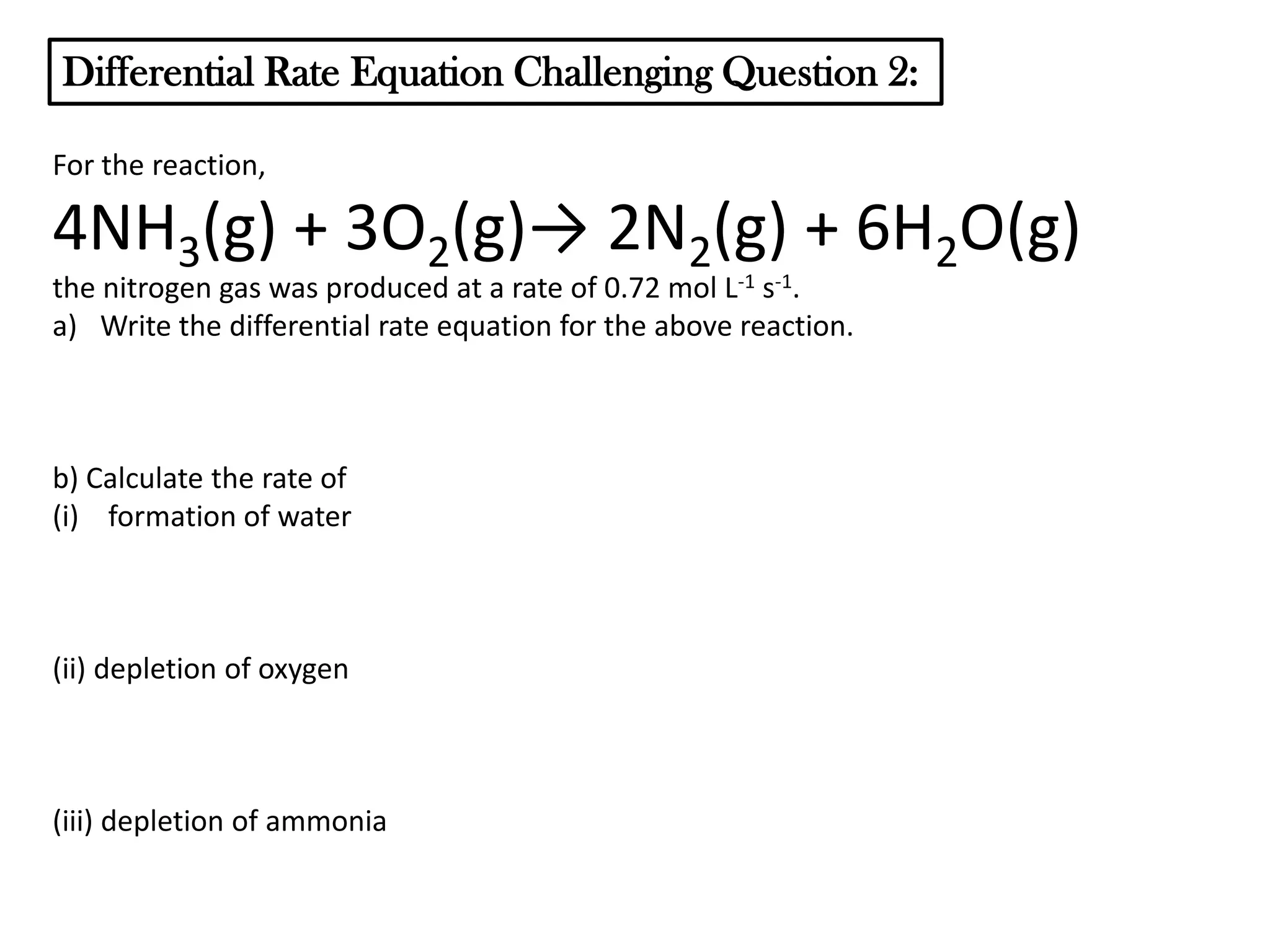
Differential Rate Equation Challenging Question 2:
For the reaction,

4NH3(g) + 3O2(g)→ 2N2(g) + 6H2O(g)
the nitrogen gas was produced at a rate of 0.72 mol L-1 s-1.
a) Write the differential rate equation for the above reaction.

b) Calculate the rate of
(i) formation of water

(ii) depletion of oxygen

(iii) depletion of ammonia
Differential Rate Equation Challenging Question 3:
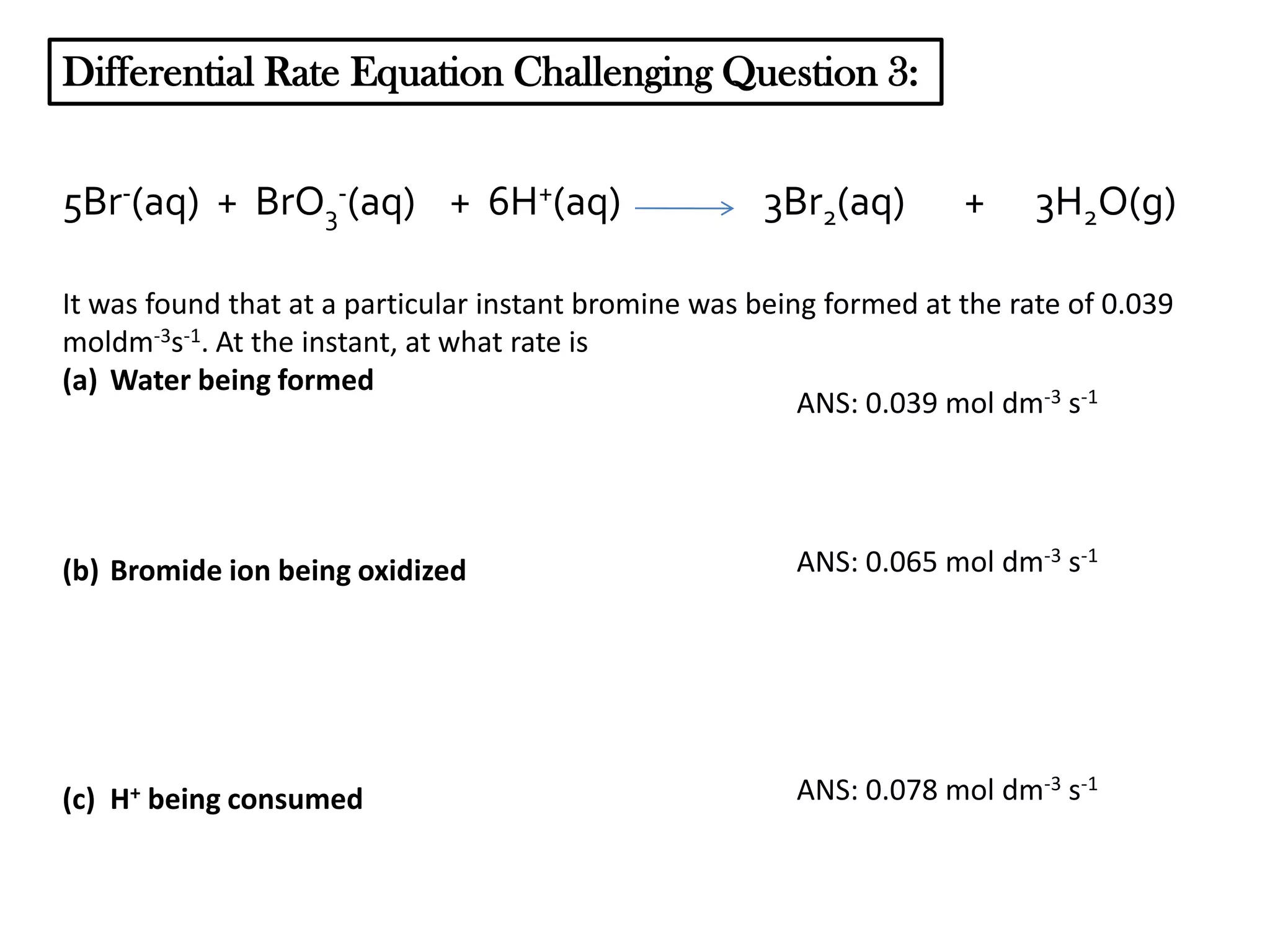
5Br-(aq) + BrO3-(aq) + 6H+(aq)

3Br2(aq)

+

3H2O(g)

It was found that at a particular instant bromine was being formed at the rate of 0.039
moldm-3s-1. At the instant, at what rate is
(a) Water being formed
ANS: 0.039 mol dm-3 s-1

(b) Bromide ion being oxidized

ANS: 0.065 mol dm-3 s-1

(c) H+ being consumed

ANS: 0.078 mol dm-3 s-1
Differential Rate Equation Challenging Question 4:
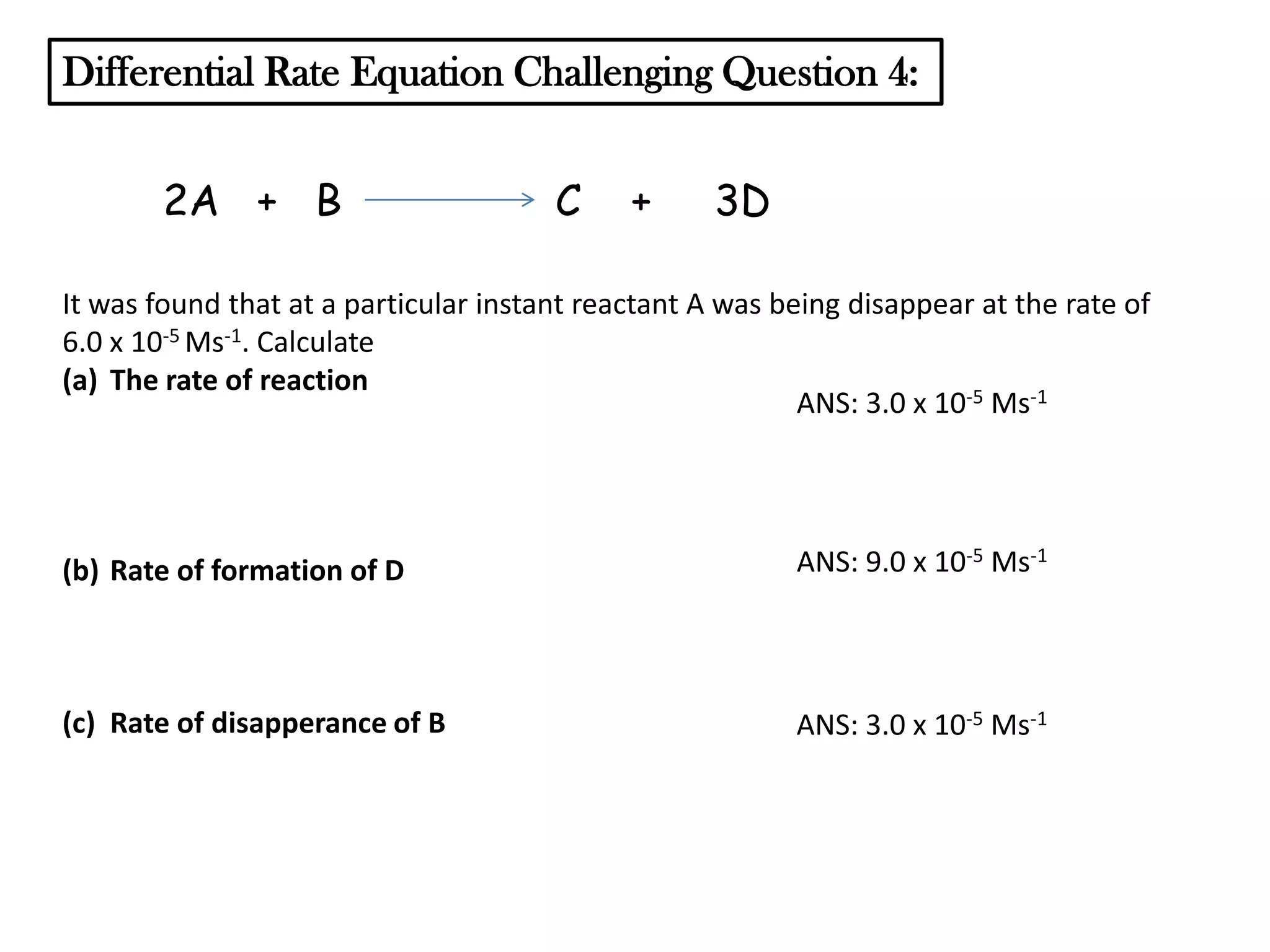
2A + B

C

+

3D

It was found that at a particular instant reactant A was being disappear at the rate of
6.0 x 10⁻⁵ Ms-1. Calculate
(a) The rate of reaction
ANS: 3.0 x 10⁻⁵ Ms-1

(b) Rate of formation of D

ANS: 9.0 x 10⁻⁵ Ms-1

(c) Rate of disapperance of B

ANS: 3.0 x 10⁻⁵ Ms-1
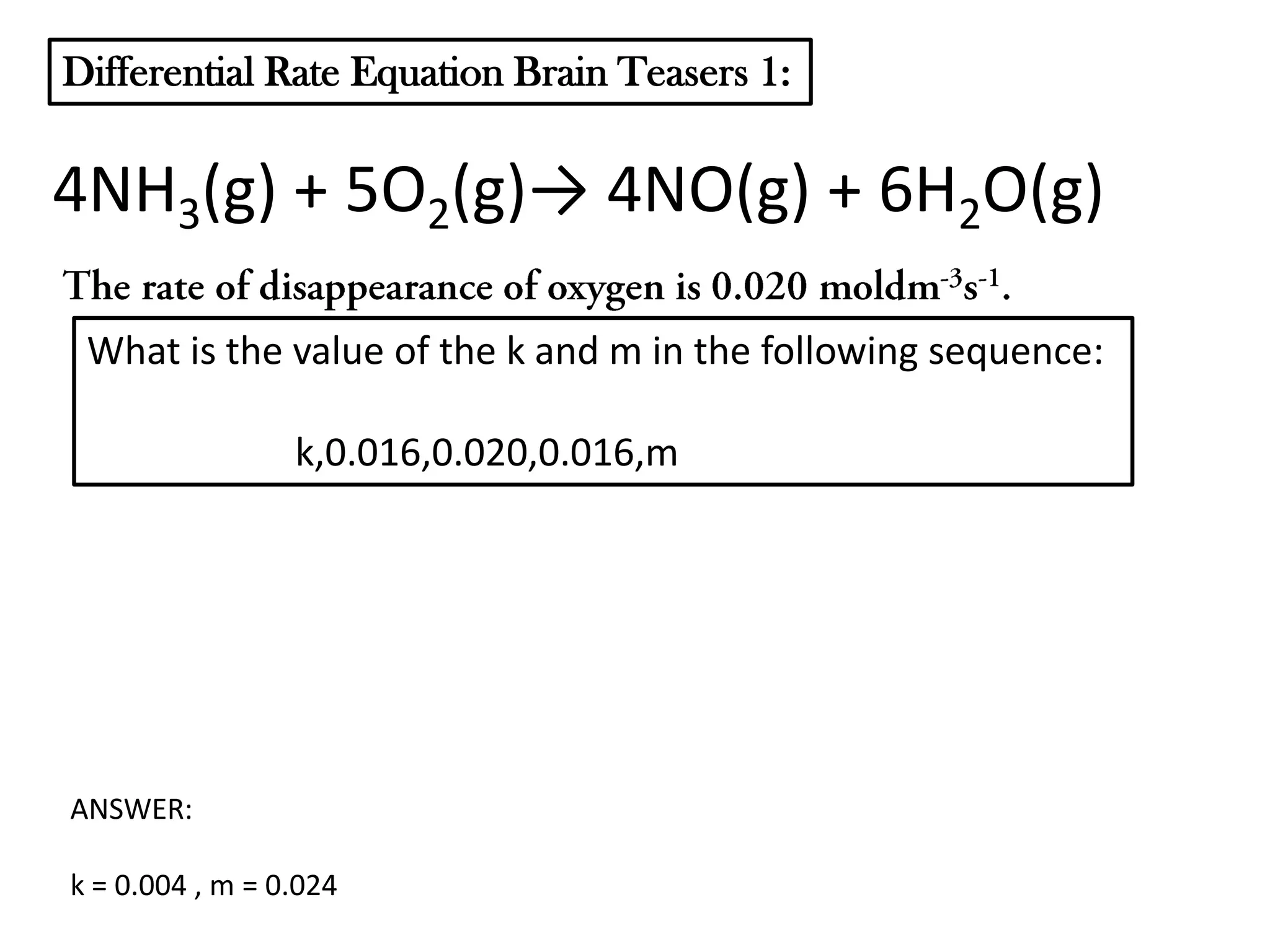
Differential Rate Equation Brain Teasers 1:

4NH3(g) + 5O2(g)→ 4NO(g) + 6H2O(g)
What is the value of the k and m in the following sequence:
k,0.016,0.020,0.016,m

ANSWER:
k = 0.004 , m = 0.024
Differential Rate Equation Revision 1:
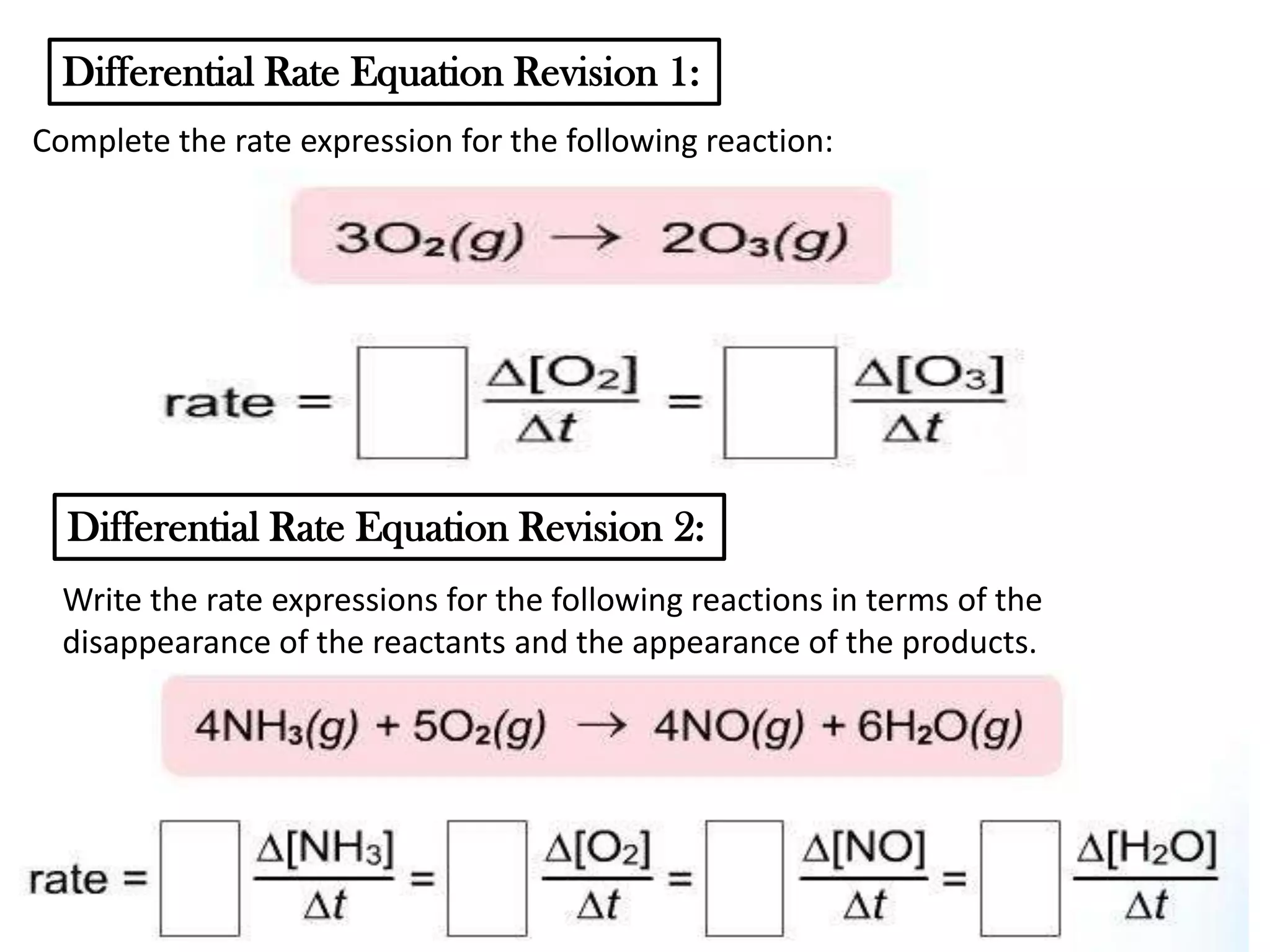
Complete the rate expression for the following reaction:

Differential Rate Equation Revision 2:
Write the rate expressions for the following reactions in terms of the
disappearance of the reactants and the appearance of the products.
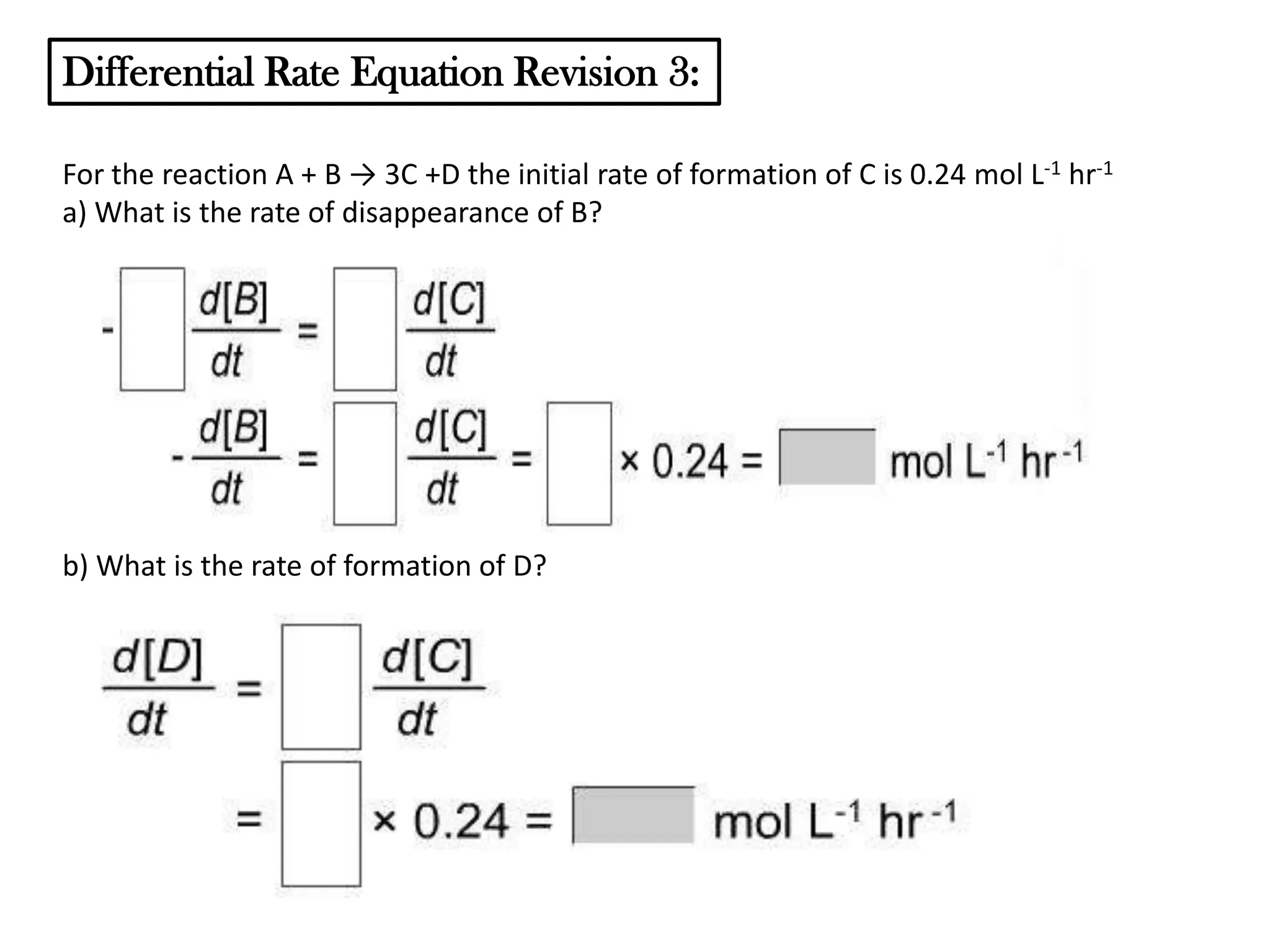
Differential Rate Equation Revision 3:
For the reaction A + B → 3C +D the initial rate of formation of C is 0.24 mol L-1 hr-1
a) What is the rate of disappearance of B?

b) What is the rate of formation of D?
Differential Rate Equation Revision 4:
For the reaction choose the correct phrase:
R
P
(R-reagents, P-products)
The rate of a chemical reaction is the measure of the rate at which
P _________, which is equal to the rate at which the R _________.
The rate of the reaction is the change in concentration over the
change of time and has units of __________. For the reaction,
reactant R gives product P, the rate is ________ divided by Δ of
_________, where Δ means change.The rate is always___________.
Answers:
is formed
is consumed
mol L-1 s-1
-Δ *R]
time
positive.

8.1 reaction rate

  • 1.
    REACTION KINETICS 8.1 REACTIONRATE LEARNING OUTCOMES: • Define reaction rate • Explain the graph of concentration against time in relation to reaction rate • Write differential rate equation • Determine the reaction rate based on a differential equation
  • 2.
    What does rateof reaction mean? The speed of different chemical reactions . Some reactions are very fast and others are very slow. The speed of a reaction is called the rate of the reaction. What is the rate of these reactions? rusting slow baking fast explosion very fast
  • 3.
    A B ? rate = - ? rate= + ? [A] t [B] t ?
  • 4.
    Reaction rate isspeed of chemical reaction which is the change in the concentration of a reactant or a product with time. What is the unit for reaction rate? kg mol nm dm-3 L-1 Ms-1 mol L-1s-1 oC molal mol s-1 mol dm-3 s-1 Newton Kelvin meter kJ mol-1 mol L-1min-1 gram
  • 5.
    Differential rate equation/ Rate expressions aA+bB rate = cC+dD -1 d[A] = -1 d[B] = +1 d[C] a dt b dt c dt = +1 d[D] d dt Differential Rate Equation Example1: O3(g) + NO(g) NO2(g) + O2(g) d O3 d[NO] d[ NO 2 ] d[ O 2 ] rate = ==+ =+ dt dt dt dt
  • 6.
    Differential Rate EquationExample2: 2 NOCl (g) 2 NO + Cl2 (g) 1 d NOCl 1 d[NO] d[Cl2 ] rate = = =+ 2 dt 2 dt dt 2 moles of NOCl disappear for every 1 mole Cl2 formed. Rate of disappearance of NOCl is twice as fast as the rate of formation of Cl2
  • 7.
    Differential Rate EquationQuestion 1: Write the differential rate equation for the following reactions: (a) I-(aq) + OCl-(aq) (b) 3O2(g) (c) 4NH3(g) Cl-(aq) + OI-(aq) 2O3(g) + 5O2(g) 4NO(g) + 6H2O(g)
  • 8.
    Differential Rate EquationChallenging Question 1: Write the rate expression for the following reaction: (a) N2O5(g) (b) 2H2O2(aq) (c) 4NH3 (g) + 5O2 (g) 2NO2(g) + 2H2O(l) + ½ O2(g) O2(g) 4NO (g) + 6H2O (l) Write the differential rate equation in the term of changes in pressure with time (d) 2NOBr (g) 2NO (g) + Br2 (g)
  • 9.
    Differential Rate EquationExample 3: C2H6(g) + 7O2(g) 4CO2(g) + 6H2O(g) If the ethane, C2H6 is burning at the rate of 0.20 mol dm-3s-1. Calculate the rate of formation of CO2 STEP 1: Write the differential rate equation for the substances that related to the question d [C 2 H 6] dt ? 1 d [CO 2] 4 dt STEP 2: Substitute the given information into the differential equation d [CO 2] dt d [CO 2] dt 4(0.20moldm 3s 1 ) 0.80moldm 3s 1 Rate of formation of CO2 is 0.80 moldm-3s-1
  • 10.
    C2H6(g) + 7O2(g) 4CO2(g)+ 6H2O(g) If the ethane, C2H6 is burning at the rate of 0.20 mol dm-3s-1. Calculate the rate of formation of CO2 Student common mistakes: d [C 2 H 6] dt 1 d [CO 2] 4 dt d [CO 2] dt d [CO 2] dt d [CO 2] dt 1 d [CO 2] 4 dt d [C 2 H 6] dt d [C 2 H 6] 4 dt 4(0.20moldm 3s 1 ) 0.80moldm 3s 1
  • 11.
    Differential Rate EquationExample 4: C2H6(g) + 7O2(g) 4CO2(g) + 6H2O(g) If the ethane, C2H6 is burning at the rate of 0.20 mol dm-3s-1. Calculate the rate of disappearance of O2 STEP 1: Write the differential rate equation for the substances that related to the question d [C 2 H 6] dt ? 1 d [O 2] 7 dt STEP 2: Substitute the given information into the differential equation d [O 2] 7(0.20moldm 3s 1 ) dt d [O 2] 1.40moldm 3s 1 dt Rate of disappearance of O2 is 1.40 moldm-3s-1
  • 12.
    C2H6(g) + 7O2(g) 4CO2(g)+ 6H2O(g) If the ethane, C2H6 is burning at the rate of 0.20 mol dm-3s-1. Calculate the rate of disappearance of O2 Student common mistakes: d [C 2 H 6] 1 d [O 2] dt 7 dt 1 d [O 2] d [C 2 H 6] 7 dt dt d [O 2] d [C 2 H 6] 7 dt dt d [O 2] 7(0.20moldm 3s 1 ) dt d [O 2] dt 1.40moldm 3s 1
  • 13.
    Differential Rate EquationQuestion 2: N2(g) + 3H2(g) 2NH3(g) Suppose that at a particular moment during the reaction, molecule of hydrogen is reacting at the rate of 0.074 Ms-1. Calculate the rate of (a) formation of ammonia (b) depletion of nitrogen
  • 14.
    Differential Rate EquationQuestion 3: 4NH3(g) + 5O2(g) 4NO(g) + 6H2O(g) The rate of disappearance of oxygen is 0.020 moldm-3s-1. Determine the rate of formation of NO and H2O and also the rate of disappearance of NH3
  • 15.
    Differential Rate EquationChallenging Question 2: For the reaction, 4NH3(g) + 3O2(g)→ 2N2(g) + 6H2O(g) the nitrogen gas was produced at a rate of 0.72 mol L-1 s-1. a) Write the differential rate equation for the above reaction. b) Calculate the rate of (i) formation of water (ii) depletion of oxygen (iii) depletion of ammonia
  • 16.
    Differential Rate EquationChallenging Question 3: 5Br-(aq) + BrO3-(aq) + 6H+(aq) 3Br2(aq) + 3H2O(g) It was found that at a particular instant bromine was being formed at the rate of 0.039 moldm-3s-1. At the instant, at what rate is (a) Water being formed ANS: 0.039 mol dm-3 s-1 (b) Bromide ion being oxidized ANS: 0.065 mol dm-3 s-1 (c) H+ being consumed ANS: 0.078 mol dm-3 s-1
  • 17.
    Differential Rate EquationChallenging Question 4: 2A + B C + 3D It was found that at a particular instant reactant A was being disappear at the rate of 6.0 x 10⁻⁵ Ms-1. Calculate (a) The rate of reaction ANS: 3.0 x 10⁻⁵ Ms-1 (b) Rate of formation of D ANS: 9.0 x 10⁻⁵ Ms-1 (c) Rate of disapperance of B ANS: 3.0 x 10⁻⁵ Ms-1
  • 18.
    Differential Rate EquationBrain Teasers 1: 4NH3(g) + 5O2(g)→ 4NO(g) + 6H2O(g) What is the value of the k and m in the following sequence: k,0.016,0.020,0.016,m ANSWER: k = 0.004 , m = 0.024
  • 19.
    Differential Rate EquationRevision 1: Complete the rate expression for the following reaction: Differential Rate Equation Revision 2: Write the rate expressions for the following reactions in terms of the disappearance of the reactants and the appearance of the products.
  • 20.
    Differential Rate EquationRevision 3: For the reaction A + B → 3C +D the initial rate of formation of C is 0.24 mol L-1 hr-1 a) What is the rate of disappearance of B? b) What is the rate of formation of D?
  • 21.
    Differential Rate EquationRevision 4: For the reaction choose the correct phrase: R P (R-reagents, P-products) The rate of a chemical reaction is the measure of the rate at which P _________, which is equal to the rate at which the R _________. The rate of the reaction is the change in concentration over the change of time and has units of __________. For the reaction, reactant R gives product P, the rate is ________ divided by Δ of _________, where Δ means change.The rate is always___________. Answers: is formed is consumed mol L-1 s-1 -Δ *R] time positive.