1
SOME BASIC CONCEPTS OF CHEMISTRY
KEY CONCEPTS FOR BOARD - JEE (MAIN) - NEET
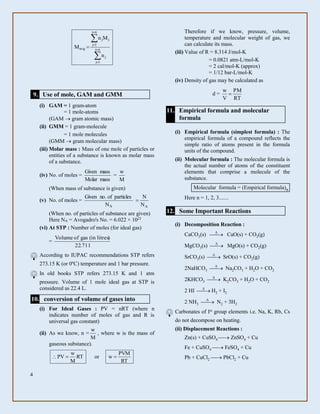
1. Matter may be defined as anything which has mass
and occupies space. eg. water, air, milk, salt, sand,
oxygen etc.
Matter may be classified into three states namely
solid, liquid and gas. At macroscopic level matter
can be classified as mixture or pure substance as :
Mixture Pure Substance
Matter
Heterogeneous Homogeneous
mixture
Element Compound
2. (a) CATIONS :
VALANCY – 1
Ammonium NH4
+
Sodium Na+
Potassium K+
Rubidium Rb+
Cesium Cs+
Silver Ag+
Copper (Cuprous) Cu+
Gold (Aurous) Au+
VALANCY – 2
Magnesium Mg2+
Calcium Ca2+
Stroncium Sr2+
Barium Ba2+
Zinc Zn2+
Cadmium Cd2+
Nickel Ni2+
Copper (Cupric) Cu2+
Mercury (Mercuric) Hg2+
Lead (Plumbus) Pb2+
Tin (Stannous) Sn2+
Iron (Ferrous) Fe2+
(b) ANIONS :
VALANCY – 1
Hydroxide OH¯
Nitrate NO3¯
Nitrite NO2¯
Permanganate MnO4¯
Bisulphite HSO3¯
Bisulphate HSO4¯
Bicarbonate
(Hydrogen carbonate)
HCO3¯
Dihydrogen phosphate H2PO4¯
Perchlorate ClO4¯
Chlorate ClO3¯
Chlorite ClO2
–
Hypochlorite ClO¯
Iodate IO3¯
Periodate IO4¯
Meta aluminate AlO2¯
Meta borate BO2¯
Cyanide [ CN ]–
••••CN–
Isocyanide [–
N 

C ]••••NC–
Cyanate [–
O–CN]••••
••
••CNO–
Isocyanate [O=C=N –
]
••
••
Thiocyanate SCN–
Formate HCOO–
Perhydroxyl ion HOO–
Hypophosphites H2PO2
–
Benzoate C6H5COO–
Salicylates C6H4(OH)COO–
Acetate CH3COO–
Metaphosphate PO3
–
2
VALANCY – 2
Carbonate CO3
2–
Sulphate SO4
2–
Sulphite SO3
2–
Sulphide S2–
Thiosulphate S2O3
2–
Tetrathionate S4O6
2–
Oxalate C2O4
2–
Silicate SiO3
2–
Hydrogen phosphate HPO4
2–
Manganate MnO4
2–
Chromate CrO4
2–
Dichromate Cr2O7
2–
Zincate ZnO2
2–
Stannate SnO3
2–
Hexaflurosilicate
(or silicofluorides)
SiF6
2–
Tartrates C4H4O6
2–
Phosphite HPO3
2–
Chromate CrO4
2–
Pyroborate B4O7
2–
Dithionite S2O4
2–
Peroxodisulphate S2O8
2–
Silicate SiO3
2–
Succinate C4H4O4
2–
VALANCY – 3
Hexacyano ferrate (III) or
Ferricynide
[Fe(CN)6]3–
Phosphate PO4
3–
Borate (orthoborate) BO3
3–
Arsenate AsO4
3–
Arsenite AsO3
3–
Nitride N3–
Phosphide P3–
VALANCY – 4
Pyrophosphate P2O7
4–
Hexacyano ferrate (II) or
Ferrocyanide
[Fe(CN)6]4–
3. Formula of simple compounds
Sr.
no.
Name of
Compound
Symbols with
Valancy
Formula
1. Calcium chloride Ca2 Cl1 CaCl2
2.
Magnesium
sulphate
Mg2 SO4
2
Mg2(SO4)2 ~
MgSO4
(Simple
Ratio)
3. Stannic Sulphide Sn4S2 SnS2
4.
Potassium
perchlorate
1
4
1
ClOK KClO4
5. Sodium Zincate Na1 2
2ZnO Na2ZnO2
6.
Magnesium
bicarbonate
1
3
2
HCOMg Mg(HCO3)2
7.
Sodium
carbonate
2
3
1
CONa Na2CO3
8.
Ammonium
Oxalate
2
42
1
4 OCNH (NH4)2C2O4
9.
Sodium
thiosulphate
2
32
1
OSNa Na2S2O3
10.
Potassium
permanganate
1
4
1
MnOK KMnO4
11. Sodium Iodate 1
3
1
IONa NaIO3
12.
Sodium
periodate
1
4
1
IONa NaIO4
4. Laws of chemical combination
(i) Law of conservation of mass - [Lavoisier, 1744]
Matter is neither created nor destroyed in the
course of chemical reaction although it may
change from one form to other
(ii) Law of definite proportion [Proust, 1799]
The composition of a compound always
remains constant (i.e. the ratio of weights of
different elements in a compound) no matter by
whatever method, it is prepared or obtained
from different sources.
(iii) Law of multiple proportion [John Dalton, 1804]
3
According to this law, when two elements A
and B combine to form more than one chemical
compound then different weights of A, which
combine with a fixed weight of B, are in a
proportion of simple whole number.
(iv) Law of reciprocal proportions [Ritche, 1792-94]
If two elements A and B combine separately
with third element C to form two different
compounds and if A and B also combine
together to form a compound then they do so in
a ratio of their masses equal or multiple or
submultiples of ratio of their masses which
combine with a definite mass of C.
(v) The law of Gaseous volume : [Gay Lussac 1808]
According to this law, when gases combine,
they do so in volume which bear a simple ratio
to each other and also to the product formed
provided all volumes are measured under
similar conditions.
5. Concept of mole
(i) Definition : One mole is amount of a substance
that contains as many particles or entities as
there are atoms in exactly 12 gram of the
carbon (12
C – isotope).
(ii) 1 mole  collection of 6.022 × 10²³ particles or
entities.
(iii) 1 mole atoms  1 gram-atom  gram atomic mass
(iv) 1 mole molecules  1 gram-molecule  gram
molecular mass
(v) 1 mole ions  1 gram-ion  gram ionic mass
6. Atomic weight and
atomic mass unit (amu)
(i) The atomic weight (or atomic mass) of an
element may be defined as the average relative
weight (or mass) of an atom of the element
with respect to the (1/12)th
mass of an atom of
carbon (mass number 12)
Thus, atomic weight =
12
)12.nomass(CofatomanofWeight
elementtheofatomanofWeight

(ii) If we express atomic weight in grams, it
becomes gram atomic weight (symbol gm-atom).
(iii) 1 gm-atom of any element contain NA number
of atoms.
(iv) The atomic mass unit (amu or u) is defined as
the (1/12)th
of the mass of single carbon atom
of mass number 12.
Thus, 1 amu or u = 1.667 × 10⁻²⁴ gm
= 1.667 × 10⁻²⁷ kg.
7. Molecular weight and formula weight
(i) Molecular weight is defined as the weight of a
molecule of a substance compared to the
(1/12)th
of the mass of a carbon atom (mass
number = 12).
(ii) In ionic compounds, as for example, NaCl,
CaCl2, etc. there are no existence of molecules.
For ionic compounds, instead of "molecular
weight" we use a new term known as "formula
weight". "Formula weight" is defined as the
total weights of atoms present in the formula of
the compound.
8. The average atomic mass and average
molecular mass
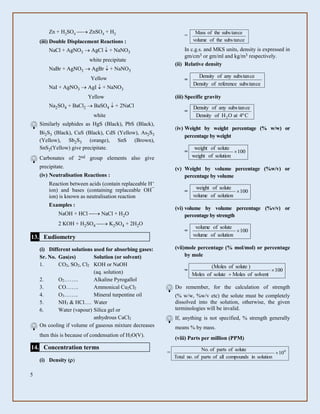
(i) Average atomic mass : Let us consider, an
element X, is available in the earth as isotopes
of 21 a
n
a
n X,X ,……, na
n X , the percentage
abundance of the given isotopes in earth are
x1 , x2, ........, xn respectively.

100
xa......xaxa
X
ofmassatomicaveragethe
nn2211 

(ii) Average molecular mass : Let us consider, in
a container,
n1 moles of substance X1 (mol. wt M1) present
n2 moles of substance X2 (mol. wt M2) present
........................................................................
nn moles of substance Xn (mol. wt Mn) present
hence, the total number of moles of substance
present in the container = n1 + n2 + ....... + nn
Total mass of the substance present in the
container = n1M1 + n2M2 + ……… + nnMn
4






 nj
1j
j
nj
1j
jj
avg
n
Mn
M
9. Use of mole, GAM and GMM
(i) GAM = 1 gram-atom
= 1 mole-atoms
(GAM  gram atomic mass)
(ii) GMM = 1 gram-molecule
= 1 mole molecules
(GMM  gram molecular mass)
(iii) Molar mass : Mass of one mole of particles or
entities of a substance is known as molar mass
of a substance.
(iv) No. of moles =
massMolar
massGiven
=
M
w
(When mass of substance is given)
(v) No. of moles =
AN
particlesof.noGiven
AN
N

(When no. of particles of substance are given)
Here NA = Avogadro's No. = 6.022 × 10²³
(vi) At STP : Number of moles (for ideal gas)
=
711.22
)litresin(gasofVolume
According to IUPAC recommendations STP refers
273.15 K (or 0ºC) temperature and 1 bar pressure.
In old books STP refers 273.15 K and 1 atm
pressure. Volume of 1 mole ideal gas at STP is
considered as 22.4 L.
10. conversion of volume of gases into
mass(i) For Ideal Gases : PV = nRT (where n
indicates number of moles of gas and R is
universal gas constant)
(ii) As we know, n =
M
w
, where w is the mass of
gaseous substance).
RT
M
w
PV  or
RT
PVM
w 
Therefore if we know, pressure, volume,
temperature and molecular weight of gas, we
can calculate its mass.
(iii) Value of R = 8.314 J/mol-K
= 0.0821 atm-L/mol-K
= 2 cal/mol-K (approx)
= 1/12 bar-L/mol-K
(iv) Density of gas may be calculated as
d =
RT
PM
V
w

11. Empirical formula and molecular
formula
(i) Empirical formula (simplest formula) : The
empirical formula of a compound reflects the
simple ratio of atoms present in the formula
units of the compound.
(ii) Molecular formula : The molecular formula is
the actual number of atoms of the constituent
elements that comprise a molecule of the
substance.
Molecular formula = (Empirical formula)n
Here n = 1, 2, 3.......
12. Some Important Reactions
(i) Decomposition Reaction :
CaCO3(s) 
CaO(s) + CO2(g)
MgCO3(s) 
MgO(s) + CO2(g)
SrCO3(s) 
SrO(s) + CO2(g)
2NaHCO3 
Na2CO3 + H2O + CO2
2KHCO3 
K2CO3 + H2O + CO2
2 HI 
H2 + I2
2 NH3 
N2 + 3H2
Carbonates of Ist group elements i.e. Na, K, Rb, Cs
do not decompose on heating.
(ii) Displacement Reactions :
Zn(s) + CuSO4  ZnSO4 + Cu
Fe + CuSO4  FeSO4 + Cu
Pb + CuCl2  PbCl2 + Cu
5
Zn + H2SO4  ZnSO4 + H2
(iii) Double Displacement Reactions :
NaCl + AgNO3  AgCl + NaNO3
white precipitate
NaBr + AgNO3  AgBr  + NaNO3
Yellow
NaI + AgNO3  AgI  + NaNO3
Yellow
Na2SO4 + BaCl2  BaSO4  + 2NaCl
white
Similarly sulphides as HgS (Black), PbS (Black),
Bi2S3 (Black), CuS (Black), CdS (Yellow), As2S3
(Yellow), Sb2S3 (orange), SnS (Brown),
SnS2(Yellow) give precipitate.
Carbonates of 2nd group elements also give
precipitate.
(iv) Neutralisation Reactions :
Reaction between acids (contain replaceable H+
ion) and bases (containing replaceable OH¯
ion) is known as neutralisation reaction
Examples :
NaOH + HCl  NaCl + H2O
2 KOH + H2SO4  K2SO4 + 2H2O
13. Eudiometry
(i) Different solutions used for absorbing gases:
Sr. No. Gas(es) Solution (or solvent)
1. CO2, SO2, Cl2 KOH or NaOH
(aq. solution)
2. O2…….. Alkaline Pyrogallol
3. CO……. Ammonical Cu2Cl2
4. O3…….. Mineral turpentine oil
5. NH3 & HCl…. Water
6. Water (vapour) Silica gel or
anhydrous CaCl2
On cooling if volume of gaseous mixture decreases
then this is because of condensation of H2O(V).
14. Concentration terms
(i) Density ()
=
cetansubstheofvolume
ceantsubstheofMass
In c.g.s. and MKS units, density is expressed in
gm/cm3 or gm/ml and kg/m3 respectively.
(ii) Relative density
=
cetansubsreferenceofDensity
cetansubsanyofDensity
(iii) Specific gravity
=
Cº4atOHofDensity
cetansubsanyofDensity
2
(iv) Weight by weight percentage (% w/w) or
percentage by weight
= 100
solutionofweight
soluteofweight

(v) Weight by volume percentage (%w/v) or
percentage by volume
= 100
solutionofvolume
soluteofweight

(vi) volume by volume percentage (%v/v) or
percentage by strength
= 100
solutionofvolume
soluteofvolume

(vii)mole percentage (% mol/mol) or percentage
by mole
= 100
solventofMolessoluteofMoles
)soluteofMoles(


Do remember, for the calculation of strength
(% w/w, %w/v etc) the solute must be completely
dissolved into the solution, otherwise, the given
terminologies will be invalid.
If, anything is not specified, % strength generally
means % by mass.
(viii) Parts per million (PPM)
= 6
10
solutionincompoundsallofpartsof.noTotal
soluteofpartsof.No

6
PPM is generally expressed as w/w (mass to mass)
PPM can also be expressed as w/v (mass to volume)
or V/V (volume to volume)
(ix) gram per litre (gm/lit): It is the amount of
solute in gm dissolved in 1 litre (1000 ml) of
solution.
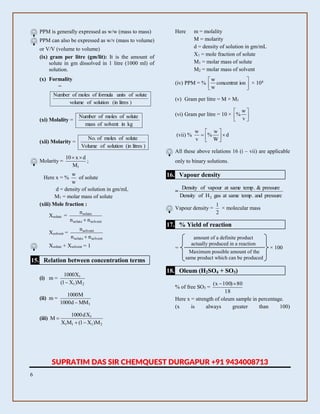
(x) Formality
=
)litresin(solutionofvolume
soluteofunitsformulaofmolesofNumber
(xi) Molality =
kginsolventofmass
soluteofmolesofNumber
(xii) Molarity =
)litresin(solutionofVolume
soluteofmolesof.No
Molarity =
1M
dx10 
;
Here x = %
w
w
of solute
d = density of solution in gm/mL
M1 = molar mass of solute
(xiii) Mole fraction :
Xsolute =
solventsolute
solute
nn
n

Xsolvent =
solventsolute
solvent
nn
n

Xsolute + Xsolvent = 1
15. Relation between concentration terms
(i) m =
21
1
M)X1(
X1000

(ii) m =
1MMd1000
M1000

(iii)
2111
1
M)X1(MX
Xd1000
M


Here m = molality
M = molarity
d = density of solution in gm/mL
X1 = mole fraction of solute
M1 = molar mass of solute
M2 = molar mass of solvent
(iv) PPM = % 





ionconcentrat
w
w
× 104
(v) Gram per litre = M × M1
(vi) Gram per litre = 10 × 





v
w
%
(vii) % d
W
w
%
v
w







All these above relations 16 (i – vii) are applicable
only to binary solutions.
16. Vapour density
=
pressureand.tempsameatgasHofDensity
pressure&.tempsameatvapourofDensity
2
Vapour density =
2
1
× molecular mass
17. % Yield of reaction
amount of a definite product
actually produced in a reaction
Maximum possible amount of the
same product which can be produced
× 100=
18. Oleum (H2SO4 + SO3)
% of free SO3 =
18
80)100x( 
Here x = strength of oleum sample in percentage.
(x is always greater than 100)
SUPRATIM DAS SIR CHEMQUEST DURGAPUR +91 9434008713

FORMULA PACK - SOME BASIC CONCEPTS OF CHEMISTRY

  • 1.
    1 SOME BASIC CONCEPTSOF CHEMISTRY KEY CONCEPTS FOR BOARD - JEE (MAIN) - NEET 1. Matter may be defined as anything which has mass and occupies space. eg. water, air, milk, salt, sand, oxygen etc. Matter may be classified into three states namely solid, liquid and gas. At macroscopic level matter can be classified as mixture or pure substance as : Mixture Pure Substance Matter Heterogeneous Homogeneous mixture Element Compound 2. (a) CATIONS : VALANCY – 1 Ammonium NH4 + Sodium Na+ Potassium K+ Rubidium Rb+ Cesium Cs+ Silver Ag+ Copper (Cuprous) Cu+ Gold (Aurous) Au+ VALANCY – 2 Magnesium Mg2+ Calcium Ca2+ Stroncium Sr2+ Barium Ba2+ Zinc Zn2+ Cadmium Cd2+ Nickel Ni2+ Copper (Cupric) Cu2+ Mercury (Mercuric) Hg2+ Lead (Plumbus) Pb2+ Tin (Stannous) Sn2+ Iron (Ferrous) Fe2+ (b) ANIONS : VALANCY – 1 Hydroxide OH¯ Nitrate NO3¯ Nitrite NO2¯ Permanganate MnO4¯ Bisulphite HSO3¯ Bisulphate HSO4¯ Bicarbonate (Hydrogen carbonate) HCO3¯ Dihydrogen phosphate H2PO4¯ Perchlorate ClO4¯ Chlorate ClO3¯ Chlorite ClO2 – Hypochlorite ClO¯ Iodate IO3¯ Periodate IO4¯ Meta aluminate AlO2¯ Meta borate BO2¯ Cyanide [ CN ]– ••••CN– Isocyanide [– N   C ]••••NC– Cyanate [– O–CN]•••• •• ••CNO– Isocyanate [O=C=N – ] •• •• Thiocyanate SCN– Formate HCOO– Perhydroxyl ion HOO– Hypophosphites H2PO2 – Benzoate C6H5COO– Salicylates C6H4(OH)COO– Acetate CH3COO– Metaphosphate PO3 –
  • 2.
    2 VALANCY – 2 CarbonateCO3 2– Sulphate SO4 2– Sulphite SO3 2– Sulphide S2– Thiosulphate S2O3 2– Tetrathionate S4O6 2– Oxalate C2O4 2– Silicate SiO3 2– Hydrogen phosphate HPO4 2– Manganate MnO4 2– Chromate CrO4 2– Dichromate Cr2O7 2– Zincate ZnO2 2– Stannate SnO3 2– Hexaflurosilicate (or silicofluorides) SiF6 2– Tartrates C4H4O6 2– Phosphite HPO3 2– Chromate CrO4 2– Pyroborate B4O7 2– Dithionite S2O4 2– Peroxodisulphate S2O8 2– Silicate SiO3 2– Succinate C4H4O4 2– VALANCY – 3 Hexacyano ferrate (III) or Ferricynide [Fe(CN)6]3– Phosphate PO4 3– Borate (orthoborate) BO3 3– Arsenate AsO4 3– Arsenite AsO3 3– Nitride N3– Phosphide P3– VALANCY – 4 Pyrophosphate P2O7 4– Hexacyano ferrate (II) or Ferrocyanide [Fe(CN)6]4– 3. Formula of simple compounds Sr. no. Name of Compound Symbols with Valancy Formula 1. Calcium chloride Ca2 Cl1 CaCl2 2. Magnesium sulphate Mg2 SO4 2 Mg2(SO4)2 ~ MgSO4 (Simple Ratio) 3. Stannic Sulphide Sn4S2 SnS2 4. Potassium perchlorate 1 4 1 ClOK KClO4 5. Sodium Zincate Na1 2 2ZnO Na2ZnO2 6. Magnesium bicarbonate 1 3 2 HCOMg Mg(HCO3)2 7. Sodium carbonate 2 3 1 CONa Na2CO3 8. Ammonium Oxalate 2 42 1 4 OCNH (NH4)2C2O4 9. Sodium thiosulphate 2 32 1 OSNa Na2S2O3 10. Potassium permanganate 1 4 1 MnOK KMnO4 11. Sodium Iodate 1 3 1 IONa NaIO3 12. Sodium periodate 1 4 1 IONa NaIO4 4. Laws of chemical combination (i) Law of conservation of mass - [Lavoisier, 1744] Matter is neither created nor destroyed in the course of chemical reaction although it may change from one form to other (ii) Law of definite proportion [Proust, 1799] The composition of a compound always remains constant (i.e. the ratio of weights of different elements in a compound) no matter by whatever method, it is prepared or obtained from different sources. (iii) Law of multiple proportion [John Dalton, 1804]
  • 3.
    3 According to thislaw, when two elements A and B combine to form more than one chemical compound then different weights of A, which combine with a fixed weight of B, are in a proportion of simple whole number. (iv) Law of reciprocal proportions [Ritche, 1792-94] If two elements A and B combine separately with third element C to form two different compounds and if A and B also combine together to form a compound then they do so in a ratio of their masses equal or multiple or submultiples of ratio of their masses which combine with a definite mass of C. (v) The law of Gaseous volume : [Gay Lussac 1808] According to this law, when gases combine, they do so in volume which bear a simple ratio to each other and also to the product formed provided all volumes are measured under similar conditions. 5. Concept of mole (i) Definition : One mole is amount of a substance that contains as many particles or entities as there are atoms in exactly 12 gram of the carbon (12 C – isotope). (ii) 1 mole  collection of 6.022 × 10²³ particles or entities. (iii) 1 mole atoms  1 gram-atom  gram atomic mass (iv) 1 mole molecules  1 gram-molecule  gram molecular mass (v) 1 mole ions  1 gram-ion  gram ionic mass 6. Atomic weight and atomic mass unit (amu) (i) The atomic weight (or atomic mass) of an element may be defined as the average relative weight (or mass) of an atom of the element with respect to the (1/12)th mass of an atom of carbon (mass number 12) Thus, atomic weight = 12 )12.nomass(CofatomanofWeight elementtheofatomanofWeight  (ii) If we express atomic weight in grams, it becomes gram atomic weight (symbol gm-atom). (iii) 1 gm-atom of any element contain NA number of atoms. (iv) The atomic mass unit (amu or u) is defined as the (1/12)th of the mass of single carbon atom of mass number 12. Thus, 1 amu or u = 1.667 × 10⁻²⁴ gm = 1.667 × 10⁻²⁷ kg. 7. Molecular weight and formula weight (i) Molecular weight is defined as the weight of a molecule of a substance compared to the (1/12)th of the mass of a carbon atom (mass number = 12). (ii) In ionic compounds, as for example, NaCl, CaCl2, etc. there are no existence of molecules. For ionic compounds, instead of "molecular weight" we use a new term known as "formula weight". "Formula weight" is defined as the total weights of atoms present in the formula of the compound. 8. The average atomic mass and average molecular mass (i) Average atomic mass : Let us consider, an element X, is available in the earth as isotopes of 21 a n a n X,X ,……, na n X , the percentage abundance of the given isotopes in earth are x1 , x2, ........, xn respectively.  100 xa......xaxa X ofmassatomicaveragethe nn2211   (ii) Average molecular mass : Let us consider, in a container, n1 moles of substance X1 (mol. wt M1) present n2 moles of substance X2 (mol. wt M2) present ........................................................................ nn moles of substance Xn (mol. wt Mn) present hence, the total number of moles of substance present in the container = n1 + n2 + ....... + nn Total mass of the substance present in the container = n1M1 + n2M2 + ……… + nnMn
  • 4.
    4        nj 1j j nj 1j jj avg n Mn M 9. Useof mole, GAM and GMM (i) GAM = 1 gram-atom = 1 mole-atoms (GAM  gram atomic mass) (ii) GMM = 1 gram-molecule = 1 mole molecules (GMM  gram molecular mass) (iii) Molar mass : Mass of one mole of particles or entities of a substance is known as molar mass of a substance. (iv) No. of moles = massMolar massGiven = M w (When mass of substance is given) (v) No. of moles = AN particlesof.noGiven AN N  (When no. of particles of substance are given) Here NA = Avogadro's No. = 6.022 × 10²³ (vi) At STP : Number of moles (for ideal gas) = 711.22 )litresin(gasofVolume According to IUPAC recommendations STP refers 273.15 K (or 0ºC) temperature and 1 bar pressure. In old books STP refers 273.15 K and 1 atm pressure. Volume of 1 mole ideal gas at STP is considered as 22.4 L. 10. conversion of volume of gases into mass(i) For Ideal Gases : PV = nRT (where n indicates number of moles of gas and R is universal gas constant) (ii) As we know, n = M w , where w is the mass of gaseous substance). RT M w PV  or RT PVM w  Therefore if we know, pressure, volume, temperature and molecular weight of gas, we can calculate its mass. (iii) Value of R = 8.314 J/mol-K = 0.0821 atm-L/mol-K = 2 cal/mol-K (approx) = 1/12 bar-L/mol-K (iv) Density of gas may be calculated as d = RT PM V w  11. Empirical formula and molecular formula (i) Empirical formula (simplest formula) : The empirical formula of a compound reflects the simple ratio of atoms present in the formula units of the compound. (ii) Molecular formula : The molecular formula is the actual number of atoms of the constituent elements that comprise a molecule of the substance. Molecular formula = (Empirical formula)n Here n = 1, 2, 3....... 12. Some Important Reactions (i) Decomposition Reaction : CaCO3(s)  CaO(s) + CO2(g) MgCO3(s)  MgO(s) + CO2(g) SrCO3(s)  SrO(s) + CO2(g) 2NaHCO3  Na2CO3 + H2O + CO2 2KHCO3  K2CO3 + H2O + CO2 2 HI  H2 + I2 2 NH3  N2 + 3H2 Carbonates of Ist group elements i.e. Na, K, Rb, Cs do not decompose on heating. (ii) Displacement Reactions : Zn(s) + CuSO4  ZnSO4 + Cu Fe + CuSO4  FeSO4 + Cu Pb + CuCl2  PbCl2 + Cu
  • 5.
    5 Zn + H2SO4 ZnSO4 + H2 (iii) Double Displacement Reactions : NaCl + AgNO3  AgCl + NaNO3 white precipitate NaBr + AgNO3  AgBr  + NaNO3 Yellow NaI + AgNO3  AgI  + NaNO3 Yellow Na2SO4 + BaCl2  BaSO4  + 2NaCl white Similarly sulphides as HgS (Black), PbS (Black), Bi2S3 (Black), CuS (Black), CdS (Yellow), As2S3 (Yellow), Sb2S3 (orange), SnS (Brown), SnS2(Yellow) give precipitate. Carbonates of 2nd group elements also give precipitate. (iv) Neutralisation Reactions : Reaction between acids (contain replaceable H+ ion) and bases (containing replaceable OH¯ ion) is known as neutralisation reaction Examples : NaOH + HCl  NaCl + H2O 2 KOH + H2SO4  K2SO4 + 2H2O 13. Eudiometry (i) Different solutions used for absorbing gases: Sr. No. Gas(es) Solution (or solvent) 1. CO2, SO2, Cl2 KOH or NaOH (aq. solution) 2. O2…….. Alkaline Pyrogallol 3. CO……. Ammonical Cu2Cl2 4. O3…….. Mineral turpentine oil 5. NH3 & HCl…. Water 6. Water (vapour) Silica gel or anhydrous CaCl2 On cooling if volume of gaseous mixture decreases then this is because of condensation of H2O(V). 14. Concentration terms (i) Density () = cetansubstheofvolume ceantsubstheofMass In c.g.s. and MKS units, density is expressed in gm/cm3 or gm/ml and kg/m3 respectively. (ii) Relative density = cetansubsreferenceofDensity cetansubsanyofDensity (iii) Specific gravity = Cº4atOHofDensity cetansubsanyofDensity 2 (iv) Weight by weight percentage (% w/w) or percentage by weight = 100 solutionofweight soluteofweight  (v) Weight by volume percentage (%w/v) or percentage by volume = 100 solutionofvolume soluteofweight  (vi) volume by volume percentage (%v/v) or percentage by strength = 100 solutionofvolume soluteofvolume  (vii)mole percentage (% mol/mol) or percentage by mole = 100 solventofMolessoluteofMoles )soluteofMoles(   Do remember, for the calculation of strength (% w/w, %w/v etc) the solute must be completely dissolved into the solution, otherwise, the given terminologies will be invalid. If, anything is not specified, % strength generally means % by mass. (viii) Parts per million (PPM) = 6 10 solutionincompoundsallofpartsof.noTotal soluteofpartsof.No 
  • 6.
    6 PPM is generallyexpressed as w/w (mass to mass) PPM can also be expressed as w/v (mass to volume) or V/V (volume to volume) (ix) gram per litre (gm/lit): It is the amount of solute in gm dissolved in 1 litre (1000 ml) of solution. (x) Formality = )litresin(solutionofvolume soluteofunitsformulaofmolesofNumber (xi) Molality = kginsolventofmass soluteofmolesofNumber (xii) Molarity = )litresin(solutionofVolume soluteofmolesof.No Molarity = 1M dx10  ; Here x = % w w of solute d = density of solution in gm/mL M1 = molar mass of solute (xiii) Mole fraction : Xsolute = solventsolute solute nn n  Xsolvent = solventsolute solvent nn n  Xsolute + Xsolvent = 1 15. Relation between concentration terms (i) m = 21 1 M)X1( X1000  (ii) m = 1MMd1000 M1000  (iii) 2111 1 M)X1(MX Xd1000 M   Here m = molality M = molarity d = density of solution in gm/mL X1 = mole fraction of solute M1 = molar mass of solute M2 = molar mass of solvent (iv) PPM = %       ionconcentrat w w × 104 (v) Gram per litre = M × M1 (vi) Gram per litre = 10 ×       v w % (vii) % d W w % v w        All these above relations 16 (i – vii) are applicable only to binary solutions. 16. Vapour density = pressureand.tempsameatgasHofDensity pressure&.tempsameatvapourofDensity 2 Vapour density = 2 1 × molecular mass 17. % Yield of reaction amount of a definite product actually produced in a reaction Maximum possible amount of the same product which can be produced × 100= 18. Oleum (H2SO4 + SO3) % of free SO3 = 18 80)100x(  Here x = strength of oleum sample in percentage. (x is always greater than 100) SUPRATIM DAS SIR CHEMQUEST DURGAPUR +91 9434008713