© 2004 IBM Corporation
IBM Systems and Technology Group
1 z/VM CP Storage Management Education Series
Dynamic Address Translation
An Introduction
Dan FitzGerald
Friday, October 16, 2009 (Revision 2)
IBM Systems and Technology Group
© 2004 IBM Corporation
04/27/15
z/VM CP Storage Management Education Series2
Outline
Concept Review
Background
Introducing the DAT Tables
The Translation Process
The Table Entries
Translation Lookaside Buffer
IBM Systems and Technology Group
© 2004 IBM Corporation
04/27/15
z/VM CP Storage Management Education Series3
Concept Review
In this portion of the presentation, we will introduce concepts
that will come up in our discussion on Dynamic Address
Translation.
Most of this information is available from the z/Architecture
Principles of Operation, Chapter 3.
We will present this information as a series of definitions.
This is intended to be a fast reference/review only, so please
consult the Principles of Operation or your Connections
Coach if you have any questions.
IBM Systems and Technology Group
© 2004 IBM Corporation
04/27/15
z/VM CP Storage Management Education Series4
Concept Review
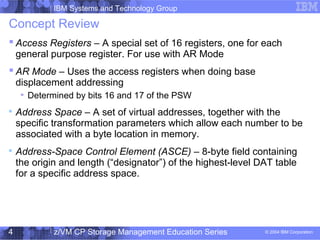
 Access Registers – A special set of 16 registers, one for each
general purpose register. For use with AR Mode
 AR Mode – Uses the access registers when doing base
displacement addressing
Determined by bits 16 and 17 of the PSW

Address Space – A set of virtual addresses, together with the
specific transformation parameters which allow each number to be
associated with a byte location in memory.

Address-Space Control Element (ASCE) – 8-byte field containing
the origin and length (“designator”) of the highest-level DAT table
for a specific address space.
IBM Systems and Technology Group
© 2004 IBM Corporation
04/27/15
z/VM CP Storage Management Education Series5
Concept Review

The real address formed by DAT and the absolute address
then formed by prefixing are both always 64 bits in length.

If the system is in the 24 or 31-bit addressing modes, then 40 or 33
zeros respectively are padded onto the address to make it 64-bit
IBM Systems and Technology Group
© 2004 IBM Corporation
04/27/15
z/VM CP Storage Management Education Series6
Concept Review
 There are four different types of addresses that we will encounter
in z/Architecture. They are known as “absolute”, “real”, “virtual” and
“logical.” Additionally, we will hear about “effective” addresses.
Absolute Address – The address assigned to a main storage
location
These are the unmodified, “actual” addresses of bytes in storage.
Real Address – Identifies a location in real storage
This is an address that we will use for an access to storage
As we will see, real addresses are converted by prefixing into absolute
addresses.
IBM Systems and Technology Group
© 2004 IBM Corporation
04/27/15
z/VM CP Storage Management Education Series7
Concept Review
Virtual Address – Identifies a location in virtual storage
– When a virtual address is used for an access to main storage, it is
translated by means of dynamic address translation (DAT) to a real
address, which is then prefixed to an absolute address.
Logical Address – Your addresses are translated within
whatever mode the architecture is set to
– In z/Architecture, a specific address mode can be set.
For example, your machine may be set to “real address mode”. In this
case, your logical addresses will be treated as real addresses.
Unless otherwise specified, the storage-operand addresses for most
instructions are logical addresses.
IBM Systems and Technology Group
© 2004 IBM Corporation
04/27/15
z/VM CP Storage Management Education Series8
Concept Review
Effective Address – The address which exists before any
transformation by dynamic address translation or any
prefixing is performed
Instruction Address – Addresses used to fetch instructions
from storage
IBM Systems and Technology Group
© 2004 IBM Corporation
04/27/15
z/VM CP Storage Management Education Series9
Background

What is Dynamic Address Translation and what does it mean
to me?

Dynamic Address Translation, or DAT, is the process by
which the z/Architecture handles virtual memory.

The Principles of Operation defines DAT as “the process of translating
a virtual address during a storage reference into the corresponding
real address”

DAT itself consists of the mechanisms used by a
z/Architecture-based OS to implement virtual memory, such
as a hierarchy of lookup tables.

By utilizing the DAT facility, the operating system can provide
to a user a system that appears to have more memory,
“storage” in System/z terms, than it actually does.
IBM Systems and Technology Group
© 2004 IBM Corporation
04/27/15
z/VM CP Storage Management Education Series10
Background

Another use of the DAT facility would be to provide security
on a multi-user system.

In this scheme, a number of address spaces are created

In VM, this means that each user has a completely different address
space. A general user (as opposed to a privileged user) cannot
interfere with the operations of another user.

For more details on address spaces, please see the guide “Address
Spaces: An Introduction”, available as part of the CP Storage
Management Education Series

Dynamic Address Translation may be specified for
addresses generated by the CPU. It cannot be used for the
addressing of data in many I/O operations.
IBM Systems and Technology Group
© 2004 IBM Corporation
04/27/15
z/VM CP Storage Management Education Series11
Background

Addresses generated through Dynamic Address Translation
are always 64 bits in length.

When your machine is operating in 31-bit mode, 33 high-order zeroes
are appended to the address to make it 64-bit

Recall that DAT is used for translating virtual addresses to
real addresses. This translation is accomplished through the
use of an ASCE

The ASCE will point to the uppermost DAT table for a given user's
address space

If the ASCE doesn't point to a translation table, then the address
space is considered to be “real” and the address is used without
translation.

There are four types of ASCEs: primary, secondary, home and AR-
specified (specified by an access register)
IBM Systems and Technology Group
© 2004 IBM Corporation
04/27/15
z/VM CP Storage Management Education Series12
Introducing the DAT Tables

Once the appropriate ASCE has been selected, translation is
to be performed by a means of the DAT tables

The exception, of course, being a real-space ASCE, in which case we
don't bother to translate anything at all.

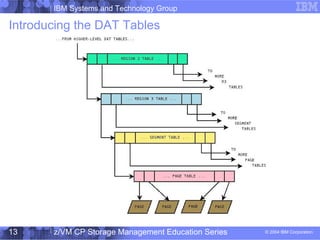
The DAT tables are hierarchical. That is, the entries within a
higher-level DAT table point to lower-level DAT tables

In the world of DAT tables, there are three units recognized:
regions, segments and pages.

A region is a block of sequential virtual addresses spanning 2GB and
starting on a 2GB boundary. These are the uppermost tables in the
hierarchy.

Similarly, A segment is a block of sequential virtual addresses
spanning 1MB and starting on a 1MB boundary and a page spans
4KB and starts on a 4KB boundary
IBM Systems and Technology Group
© 2004 IBM Corporation
04/27/15
z/VM CP Storage Management Education Series13
Introducing the DAT Tables
IBM Systems and Technology Group
© 2004 IBM Corporation
04/27/15
z/VM CP Storage Management Education Series14
Introducing the DAT Tables

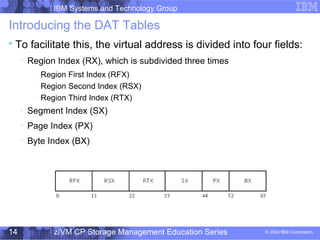
To facilitate this, the virtual address is divided into four fields:

Region Index (RX), which is subdivided three times
−
Region First Index (RFX)
−
Region Second Index (RSX)
−
Region Third Index (RTX)

Segment Index (SX)

Page Index (PX)

Byte Index (BX)
IBM Systems and Technology Group
© 2004 IBM Corporation
04/27/15
z/VM CP Storage Management Education Series15
The Translation Process

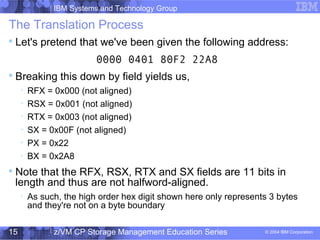
Let's pretend that we've been given the following address:
0000 0401 80F2 22A8

Breaking this down by field yields us,

RFX = 0x000 (not aligned)

RSX = 0x001 (not aligned)

RTX = 0x003 (not aligned)

SX = 0x00F (not aligned)

PX = 0x22

BX = 0x2A8

Note that the RFX, RSX, RTX and SX fields are 11 bits in
length and thus are not halfword-aligned.

As such, the high order hex digit shown here only represents 3 bytes
and they're not on a byte boundary
IBM Systems and Technology Group
© 2004 IBM Corporation
04/27/15
z/VM CP Storage Management Education Series16
The Translation Process

Let's translate the address in a process similar to what the
computer would use.

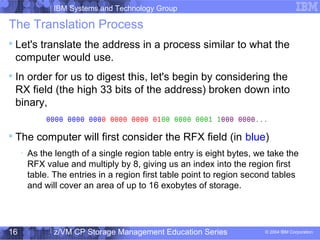
In order for us to digest this, let's begin by considering the
RX field (the high 33 bits of the address) broken down into
binary,
0000 0000 0000 0000 0000 0100 0000 0001 1000 0000...

The computer will first consider the RFX field (in blue)

As the length of a single region table entry is eight bytes, we take the
RFX value and multiply by 8, giving us an index into the region first
table. The entries in a region first table point to region second tables
and will cover an area of up to 16 exobytes of storage.
IBM Systems and Technology Group
© 2004 IBM Corporation
04/27/15
z/VM CP Storage Management Education Series17
The Translation Process

The computer will first consider the RFX field (cont'd)

In this case the value is zero, so if we had a region 1 table we
would index 0 bytes and use the first entry. Assume for this
example that our address space size is at least 16EB, so that we
have an R1 table.

If our address space size was less than 16EB, then we wouldn't
even have a region 1 table.
IBM Systems and Technology Group
© 2004 IBM Corporation
04/27/15
z/VM CP Storage Management Education Series18
The Translation Process

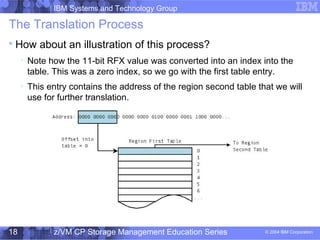
How about an illustration of this process?

Note how the 11-bit RFX value was converted into an index into the
table. This was a zero index, so we go with the first table entry.

This entry contains the address of the region second table that we will
use for further translation.
IBM Systems and Technology Group
© 2004 IBM Corporation
04/27/15
z/VM CP Storage Management Education Series19
The Translation Process

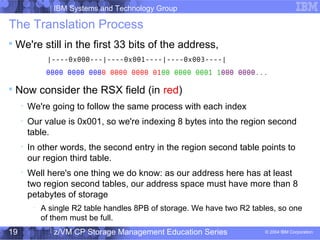
We're still in the first 33 bits of the address,
|----0x000---|----0x001----|----0x003----|
0000 0000 0000 0000 0000 0100 0000 0001 1000 0000...

Now consider the RSX field (in red)

We're going to follow the same process with each index

Our value is 0x001, so we're indexing 8 bytes into the region second
table.

In other words, the second entry in the region second table points to
our region third table.

Well here's one thing we do know: as our address here has at least
two region second tables, our address space must have more than 8
petabytes of storage
−
A single R2 table handles 8PB of storage. We have two R2 tables, so one
of them must be full.
IBM Systems and Technology Group
© 2004 IBM Corporation
04/27/15
z/VM CP Storage Management Education Series20
The Translation Process

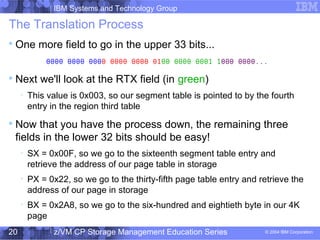
One more field to go in the upper 33 bits...
0000 0000 0000 0000 0000 0100 0000 0001 1000 0000...

Next we'll look at the RTX field (in green)

This value is 0x003, so our segment table is pointed to by the fourth
entry in the region third table

Now that you have the process down, the remaining three
fields in the lower 32 bits should be easy!

SX = 0x00F, so we go to the sixteenth segment table entry and
retrieve the address of our page table in storage

PX = 0x22, so we go to the thirty-fifth page table entry and retrieve the
address of our page in storage

BX = 0x2A8, so we go to the six-hundred and eightieth byte in our 4K
page
IBM Systems and Technology Group
© 2004 IBM Corporation
04/27/15
z/VM CP Storage Management Education Series21
The Translation Process

Remember before how we were talking about the ASCE?
Well, here's one way in which we use it...

Let's say that your machine only has 2 GB of storage. Then we're not
going to want to bother checking the R1 and R2 tables if they're
empty.

The solution is to have an ASCE that points to the R3 table as the
uppermost DAT table. As translation always begins at the table
pointed to by the ASCE, we'll skip those empty R1 and R2 tables and
start translating right at R3.

We call the ASCE used for a particular address translation the
effective ASCE
IBM Systems and Technology Group
© 2004 IBM Corporation
04/27/15
z/VM CP Storage Management Education Series22
The Translation Process

Of course, this was just the basic translation process. We left
out some of the virtual-memory specific details

For example, this machine may not really have upwards of 8 PB of
storage. Rather, it may just think that it does.

During the translation process, pages of virtual storage have to be
reconciled with frames of real storage.
−
In other words, our page may not be resident in the system.
IBM Systems and Technology Group
© 2004 IBM Corporation
04/27/15
z/VM CP Storage Management Education Series23
The Table Entries

In our description of the translation process, we simplified
some of the details about the entries in the DAT tables

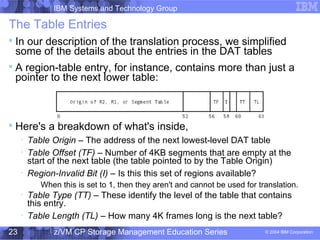
A region-table entry, for instance, contains more than just a
pointer to the next lower table:

Here's a breakdown of what's inside,

Table Origin – The address of the next lowest-level DAT table

Table Offset (TF) – Number of 4KB segments that are empty at the
start of the next table (the table pointed to by the Table Origin)

Region-Invalid Bit (I) – Is this this set of regions available?
−
When this is set to 1, then they aren't and cannot be used for translation.

Table Type (TT) – These identify the level of the table that contains
this entry.

Table Length (TL) – How many 4K frames long is the next table?
IBM Systems and Technology Group
© 2004 IBM Corporation
04/27/15
z/VM CP Storage Management Education Series24
The Table Entries

A word on reading Table Type bits,

The two TT bits are read in four combinations, denoting a R1, R2, R3
or segment table

If bits 60 and 61 read 1 1, then the table is a R1 table

If bits 60 and 61 read 1 0, then the table is a R2 table

If bits 60 and 61 read 0 1, then the table is a R3 table

If bits 60 and 61 read 0 0, then the table is a segment table
IBM Systems and Technology Group
© 2004 IBM Corporation
04/27/15
z/VM CP Storage Management Education Series25
The Table Entries

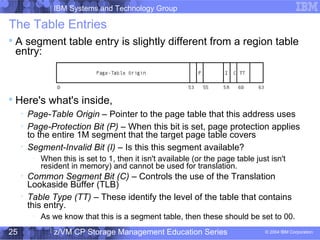
A segment table entry is slightly different from a region table
entry:

Here's what's inside,

Page-Table Origin – Pointer to the page table that this address uses

Page-Protection Bit (P) – When this bit is set, page protection applies
to the entire 1M segment that the target page table covers

Segment-Invalid Bit (I) – Is this this segment available?
−
When this is set to 1, then it isn't available (or the page table just isn't
resident in memory) and cannot be used for translation.

Common Segment Bit (C) – Controls the use of the Translation
Lookaside Buffer (TLB)

Table Type (TT) – These identify the level of the table that contains
this entry.
−
As we know that this is a segment table, then these should be set to 00.
IBM Systems and Technology Group
© 2004 IBM Corporation
04/27/15
z/VM CP Storage Management Education Series26
The Table Entries

How is the Common-Segment Bit used?

The TLB is a buffer of high-speed memory that contains copies of the
DAT tables

The Common-Segment Bit controls the use of the TLB copies of the
segment-table entry and of the page table which it designates

When this bit is set to zero, then it is identifying a private segment.
The segment-table entry and the page table it designates may be
used only in association with the segment-table origin that designates
the segment table in which the segment table entry resides.
−
In other words, this segment-table entry and its associated target page
table can only be referenced from the TLB by the current segment table

When this bit is set to one, then it is identifying a common segment.
Then, this segment-table entry and its target page table may be used
even if the referencing segment table isn't the “owner” of the entry.
IBM Systems and Technology Group
© 2004 IBM Corporation
04/27/15
z/VM CP Storage Management Education Series27
The Table Entries

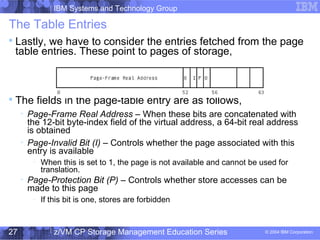
Lastly, we have to consider the entries fetched from the page
table entries. These point to pages of storage,

The fields in the page-table entry are as follows,

Page-Frame Real Address – When these bits are concatenated with
the 12-bit byte-index field of the virtual address, a 64-bit real address
is obtained

Page-Invalid Bit (I) – Controls whether the page associated with this
entry is available
−
When this is set to 1, the page is not available and cannot be used for
translation.

Page-Protection Bit (P) – Controls whether store accesses can be
made to this page
−
If this bit is one, stores are forbidden
IBM Systems and Technology Group
© 2004 IBM Corporation
04/27/15
z/VM CP Storage Management Education Series28
Translation Lookaside Buffer

Recall how earlier we mentioned the Translation Lookaside
Buffer, or TLB

Some of the information specified in the region, segment and page
tables are kept in the TLB to enhance performance

The TLB itself is composed of special, high-speed storage

When the CPU references a DAT-table entry, it only needs to
access it in real or absolute storage on its initial access

By placing a copy of this data into the TLB, we can perform
subsequent operations without having to look up or bring in the data
again. It is in this manner that we improve performance.

And in case you were wondering about translating a real-space
address, this is also performed by information in the TLB so as to
provide consistency with virtual addressing.
IBM Systems and Technology Group
© 2004 IBM Corporation
04/27/15
z/VM CP Storage Management Education Series29
Translation Lookaside Buffer

A TLB entry may be one of three types,

TLB combined region-and-segment table entry

TLB page-table entry

TLB real-space entry

A TLB region/segment-table entry and a TLB page-table
entry will contain both the information information obtained
from the entries in storage as well as the attributes needed to
fetch them from storage

A TLB real-space entry contains a page-frame real address
and the real-space token origin and region segment, in
addition to the page indexes used to form the entry
IBM Systems and Technology Group
© 2004 IBM Corporation
04/27/15
z/VM CP Storage Management Education Series30
Translation Lookaside Buffer

The details of the TLB don't affect CP all that much, but
when it does it becomes quite important. Therefore, it is
something that you need to be aware of.

Keep in mind that as we're working on the DAT structures
themselves, that TLB entries may need to be purged

For instance, say that we page out a page table. Any references in the
TLB would need to be cleaned out to reflect this change in state

DAT Education

  • 1.
    © 2004 IBMCorporation IBM Systems and Technology Group 1 z/VM CP Storage Management Education Series Dynamic Address Translation An Introduction Dan FitzGerald Friday, October 16, 2009 (Revision 2)
  • 2.
    IBM Systems andTechnology Group © 2004 IBM Corporation 04/27/15 z/VM CP Storage Management Education Series2 Outline Concept Review Background Introducing the DAT Tables The Translation Process The Table Entries Translation Lookaside Buffer
  • 3.
    IBM Systems andTechnology Group © 2004 IBM Corporation 04/27/15 z/VM CP Storage Management Education Series3 Concept Review In this portion of the presentation, we will introduce concepts that will come up in our discussion on Dynamic Address Translation. Most of this information is available from the z/Architecture Principles of Operation, Chapter 3. We will present this information as a series of definitions. This is intended to be a fast reference/review only, so please consult the Principles of Operation or your Connections Coach if you have any questions.
  • 4.
    IBM Systems andTechnology Group © 2004 IBM Corporation 04/27/15 z/VM CP Storage Management Education Series4 Concept Review  Access Registers – A special set of 16 registers, one for each general purpose register. For use with AR Mode  AR Mode – Uses the access registers when doing base displacement addressing Determined by bits 16 and 17 of the PSW  Address Space – A set of virtual addresses, together with the specific transformation parameters which allow each number to be associated with a byte location in memory.  Address-Space Control Element (ASCE) – 8-byte field containing the origin and length (“designator”) of the highest-level DAT table for a specific address space.
  • 5.
    IBM Systems andTechnology Group © 2004 IBM Corporation 04/27/15 z/VM CP Storage Management Education Series5 Concept Review  The real address formed by DAT and the absolute address then formed by prefixing are both always 64 bits in length.  If the system is in the 24 or 31-bit addressing modes, then 40 or 33 zeros respectively are padded onto the address to make it 64-bit
  • 6.
    IBM Systems andTechnology Group © 2004 IBM Corporation 04/27/15 z/VM CP Storage Management Education Series6 Concept Review  There are four different types of addresses that we will encounter in z/Architecture. They are known as “absolute”, “real”, “virtual” and “logical.” Additionally, we will hear about “effective” addresses. Absolute Address – The address assigned to a main storage location These are the unmodified, “actual” addresses of bytes in storage. Real Address – Identifies a location in real storage This is an address that we will use for an access to storage As we will see, real addresses are converted by prefixing into absolute addresses.
  • 7.
    IBM Systems andTechnology Group © 2004 IBM Corporation 04/27/15 z/VM CP Storage Management Education Series7 Concept Review Virtual Address – Identifies a location in virtual storage – When a virtual address is used for an access to main storage, it is translated by means of dynamic address translation (DAT) to a real address, which is then prefixed to an absolute address. Logical Address – Your addresses are translated within whatever mode the architecture is set to – In z/Architecture, a specific address mode can be set. For example, your machine may be set to “real address mode”. In this case, your logical addresses will be treated as real addresses. Unless otherwise specified, the storage-operand addresses for most instructions are logical addresses.
  • 8.
    IBM Systems andTechnology Group © 2004 IBM Corporation 04/27/15 z/VM CP Storage Management Education Series8 Concept Review Effective Address – The address which exists before any transformation by dynamic address translation or any prefixing is performed Instruction Address – Addresses used to fetch instructions from storage
  • 9.
    IBM Systems andTechnology Group © 2004 IBM Corporation 04/27/15 z/VM CP Storage Management Education Series9 Background  What is Dynamic Address Translation and what does it mean to me?  Dynamic Address Translation, or DAT, is the process by which the z/Architecture handles virtual memory.  The Principles of Operation defines DAT as “the process of translating a virtual address during a storage reference into the corresponding real address”  DAT itself consists of the mechanisms used by a z/Architecture-based OS to implement virtual memory, such as a hierarchy of lookup tables.  By utilizing the DAT facility, the operating system can provide to a user a system that appears to have more memory, “storage” in System/z terms, than it actually does.
  • 10.
    IBM Systems andTechnology Group © 2004 IBM Corporation 04/27/15 z/VM CP Storage Management Education Series10 Background  Another use of the DAT facility would be to provide security on a multi-user system.  In this scheme, a number of address spaces are created  In VM, this means that each user has a completely different address space. A general user (as opposed to a privileged user) cannot interfere with the operations of another user.  For more details on address spaces, please see the guide “Address Spaces: An Introduction”, available as part of the CP Storage Management Education Series  Dynamic Address Translation may be specified for addresses generated by the CPU. It cannot be used for the addressing of data in many I/O operations.
  • 11.
    IBM Systems andTechnology Group © 2004 IBM Corporation 04/27/15 z/VM CP Storage Management Education Series11 Background  Addresses generated through Dynamic Address Translation are always 64 bits in length.  When your machine is operating in 31-bit mode, 33 high-order zeroes are appended to the address to make it 64-bit  Recall that DAT is used for translating virtual addresses to real addresses. This translation is accomplished through the use of an ASCE  The ASCE will point to the uppermost DAT table for a given user's address space  If the ASCE doesn't point to a translation table, then the address space is considered to be “real” and the address is used without translation.  There are four types of ASCEs: primary, secondary, home and AR- specified (specified by an access register)
  • 12.
    IBM Systems andTechnology Group © 2004 IBM Corporation 04/27/15 z/VM CP Storage Management Education Series12 Introducing the DAT Tables  Once the appropriate ASCE has been selected, translation is to be performed by a means of the DAT tables  The exception, of course, being a real-space ASCE, in which case we don't bother to translate anything at all.  The DAT tables are hierarchical. That is, the entries within a higher-level DAT table point to lower-level DAT tables  In the world of DAT tables, there are three units recognized: regions, segments and pages.  A region is a block of sequential virtual addresses spanning 2GB and starting on a 2GB boundary. These are the uppermost tables in the hierarchy.  Similarly, A segment is a block of sequential virtual addresses spanning 1MB and starting on a 1MB boundary and a page spans 4KB and starts on a 4KB boundary
  • 13.
    IBM Systems andTechnology Group © 2004 IBM Corporation 04/27/15 z/VM CP Storage Management Education Series13 Introducing the DAT Tables
  • 14.
    IBM Systems andTechnology Group © 2004 IBM Corporation 04/27/15 z/VM CP Storage Management Education Series14 Introducing the DAT Tables  To facilitate this, the virtual address is divided into four fields:  Region Index (RX), which is subdivided three times − Region First Index (RFX) − Region Second Index (RSX) − Region Third Index (RTX)  Segment Index (SX)  Page Index (PX)  Byte Index (BX)
  • 15.
    IBM Systems andTechnology Group © 2004 IBM Corporation 04/27/15 z/VM CP Storage Management Education Series15 The Translation Process  Let's pretend that we've been given the following address: 0000 0401 80F2 22A8  Breaking this down by field yields us,  RFX = 0x000 (not aligned)  RSX = 0x001 (not aligned)  RTX = 0x003 (not aligned)  SX = 0x00F (not aligned)  PX = 0x22  BX = 0x2A8  Note that the RFX, RSX, RTX and SX fields are 11 bits in length and thus are not halfword-aligned.  As such, the high order hex digit shown here only represents 3 bytes and they're not on a byte boundary
  • 16.
    IBM Systems andTechnology Group © 2004 IBM Corporation 04/27/15 z/VM CP Storage Management Education Series16 The Translation Process  Let's translate the address in a process similar to what the computer would use.  In order for us to digest this, let's begin by considering the RX field (the high 33 bits of the address) broken down into binary, 0000 0000 0000 0000 0000 0100 0000 0001 1000 0000...  The computer will first consider the RFX field (in blue)  As the length of a single region table entry is eight bytes, we take the RFX value and multiply by 8, giving us an index into the region first table. The entries in a region first table point to region second tables and will cover an area of up to 16 exobytes of storage.
  • 17.
    IBM Systems andTechnology Group © 2004 IBM Corporation 04/27/15 z/VM CP Storage Management Education Series17 The Translation Process  The computer will first consider the RFX field (cont'd)  In this case the value is zero, so if we had a region 1 table we would index 0 bytes and use the first entry. Assume for this example that our address space size is at least 16EB, so that we have an R1 table.  If our address space size was less than 16EB, then we wouldn't even have a region 1 table.
  • 18.
    IBM Systems andTechnology Group © 2004 IBM Corporation 04/27/15 z/VM CP Storage Management Education Series18 The Translation Process  How about an illustration of this process?  Note how the 11-bit RFX value was converted into an index into the table. This was a zero index, so we go with the first table entry.  This entry contains the address of the region second table that we will use for further translation.
  • 19.
    IBM Systems andTechnology Group © 2004 IBM Corporation 04/27/15 z/VM CP Storage Management Education Series19 The Translation Process  We're still in the first 33 bits of the address, |----0x000---|----0x001----|----0x003----| 0000 0000 0000 0000 0000 0100 0000 0001 1000 0000...  Now consider the RSX field (in red)  We're going to follow the same process with each index  Our value is 0x001, so we're indexing 8 bytes into the region second table.  In other words, the second entry in the region second table points to our region third table.  Well here's one thing we do know: as our address here has at least two region second tables, our address space must have more than 8 petabytes of storage − A single R2 table handles 8PB of storage. We have two R2 tables, so one of them must be full.
  • 20.
    IBM Systems andTechnology Group © 2004 IBM Corporation 04/27/15 z/VM CP Storage Management Education Series20 The Translation Process  One more field to go in the upper 33 bits... 0000 0000 0000 0000 0000 0100 0000 0001 1000 0000...  Next we'll look at the RTX field (in green)  This value is 0x003, so our segment table is pointed to by the fourth entry in the region third table  Now that you have the process down, the remaining three fields in the lower 32 bits should be easy!  SX = 0x00F, so we go to the sixteenth segment table entry and retrieve the address of our page table in storage  PX = 0x22, so we go to the thirty-fifth page table entry and retrieve the address of our page in storage  BX = 0x2A8, so we go to the six-hundred and eightieth byte in our 4K page
  • 21.
    IBM Systems andTechnology Group © 2004 IBM Corporation 04/27/15 z/VM CP Storage Management Education Series21 The Translation Process  Remember before how we were talking about the ASCE? Well, here's one way in which we use it...  Let's say that your machine only has 2 GB of storage. Then we're not going to want to bother checking the R1 and R2 tables if they're empty.  The solution is to have an ASCE that points to the R3 table as the uppermost DAT table. As translation always begins at the table pointed to by the ASCE, we'll skip those empty R1 and R2 tables and start translating right at R3.  We call the ASCE used for a particular address translation the effective ASCE
  • 22.
    IBM Systems andTechnology Group © 2004 IBM Corporation 04/27/15 z/VM CP Storage Management Education Series22 The Translation Process  Of course, this was just the basic translation process. We left out some of the virtual-memory specific details  For example, this machine may not really have upwards of 8 PB of storage. Rather, it may just think that it does.  During the translation process, pages of virtual storage have to be reconciled with frames of real storage. − In other words, our page may not be resident in the system.
  • 23.
    IBM Systems andTechnology Group © 2004 IBM Corporation 04/27/15 z/VM CP Storage Management Education Series23 The Table Entries  In our description of the translation process, we simplified some of the details about the entries in the DAT tables  A region-table entry, for instance, contains more than just a pointer to the next lower table:  Here's a breakdown of what's inside,  Table Origin – The address of the next lowest-level DAT table  Table Offset (TF) – Number of 4KB segments that are empty at the start of the next table (the table pointed to by the Table Origin)  Region-Invalid Bit (I) – Is this this set of regions available? − When this is set to 1, then they aren't and cannot be used for translation.  Table Type (TT) – These identify the level of the table that contains this entry.  Table Length (TL) – How many 4K frames long is the next table?
  • 24.
    IBM Systems andTechnology Group © 2004 IBM Corporation 04/27/15 z/VM CP Storage Management Education Series24 The Table Entries  A word on reading Table Type bits,  The two TT bits are read in four combinations, denoting a R1, R2, R3 or segment table  If bits 60 and 61 read 1 1, then the table is a R1 table  If bits 60 and 61 read 1 0, then the table is a R2 table  If bits 60 and 61 read 0 1, then the table is a R3 table  If bits 60 and 61 read 0 0, then the table is a segment table
  • 25.
    IBM Systems andTechnology Group © 2004 IBM Corporation 04/27/15 z/VM CP Storage Management Education Series25 The Table Entries  A segment table entry is slightly different from a region table entry:  Here's what's inside,  Page-Table Origin – Pointer to the page table that this address uses  Page-Protection Bit (P) – When this bit is set, page protection applies to the entire 1M segment that the target page table covers  Segment-Invalid Bit (I) – Is this this segment available? − When this is set to 1, then it isn't available (or the page table just isn't resident in memory) and cannot be used for translation.  Common Segment Bit (C) – Controls the use of the Translation Lookaside Buffer (TLB)  Table Type (TT) – These identify the level of the table that contains this entry. − As we know that this is a segment table, then these should be set to 00.
  • 26.
    IBM Systems andTechnology Group © 2004 IBM Corporation 04/27/15 z/VM CP Storage Management Education Series26 The Table Entries  How is the Common-Segment Bit used?  The TLB is a buffer of high-speed memory that contains copies of the DAT tables  The Common-Segment Bit controls the use of the TLB copies of the segment-table entry and of the page table which it designates  When this bit is set to zero, then it is identifying a private segment. The segment-table entry and the page table it designates may be used only in association with the segment-table origin that designates the segment table in which the segment table entry resides. − In other words, this segment-table entry and its associated target page table can only be referenced from the TLB by the current segment table  When this bit is set to one, then it is identifying a common segment. Then, this segment-table entry and its target page table may be used even if the referencing segment table isn't the “owner” of the entry.
  • 27.
    IBM Systems andTechnology Group © 2004 IBM Corporation 04/27/15 z/VM CP Storage Management Education Series27 The Table Entries  Lastly, we have to consider the entries fetched from the page table entries. These point to pages of storage,  The fields in the page-table entry are as follows,  Page-Frame Real Address – When these bits are concatenated with the 12-bit byte-index field of the virtual address, a 64-bit real address is obtained  Page-Invalid Bit (I) – Controls whether the page associated with this entry is available − When this is set to 1, the page is not available and cannot be used for translation.  Page-Protection Bit (P) – Controls whether store accesses can be made to this page − If this bit is one, stores are forbidden
  • 28.
    IBM Systems andTechnology Group © 2004 IBM Corporation 04/27/15 z/VM CP Storage Management Education Series28 Translation Lookaside Buffer  Recall how earlier we mentioned the Translation Lookaside Buffer, or TLB  Some of the information specified in the region, segment and page tables are kept in the TLB to enhance performance  The TLB itself is composed of special, high-speed storage  When the CPU references a DAT-table entry, it only needs to access it in real or absolute storage on its initial access  By placing a copy of this data into the TLB, we can perform subsequent operations without having to look up or bring in the data again. It is in this manner that we improve performance.  And in case you were wondering about translating a real-space address, this is also performed by information in the TLB so as to provide consistency with virtual addressing.
  • 29.
    IBM Systems andTechnology Group © 2004 IBM Corporation 04/27/15 z/VM CP Storage Management Education Series29 Translation Lookaside Buffer  A TLB entry may be one of three types,  TLB combined region-and-segment table entry  TLB page-table entry  TLB real-space entry  A TLB region/segment-table entry and a TLB page-table entry will contain both the information information obtained from the entries in storage as well as the attributes needed to fetch them from storage  A TLB real-space entry contains a page-frame real address and the real-space token origin and region segment, in addition to the page indexes used to form the entry
  • 30.
    IBM Systems andTechnology Group © 2004 IBM Corporation 04/27/15 z/VM CP Storage Management Education Series30 Translation Lookaside Buffer  The details of the TLB don't affect CP all that much, but when it does it becomes quite important. Therefore, it is something that you need to be aware of.  Keep in mind that as we're working on the DAT structures themselves, that TLB entries may need to be purged  For instance, say that we page out a page table. Any references in the TLB would need to be cleaned out to reflect this change in state