


 Central Processing Unit
 Execution Unit
 Instruction Unit
 Memory Management Unit
 Bus Interface Unit
Architecture & Signal desc. Of 8086
• map out your table(s) on paper first
• figure out how many rows and columns
• determine the width (600 pixels is standard)
• keeping your table simple at first helps
• look for ideas on the internet (sample), save
the page, and then view it in Dreamweaver.
Creating Tables:
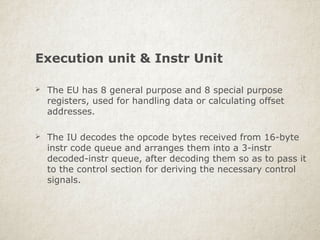
Execution unit & Instr Unit
 The EU has 8 general purpose and 8 special purpose
registers, used for handling data or calculating offset
addresses.
 The IU decodes the opcode bytes received from 16-byte
instr code queue and arranges them into a 3-instr
decoded-instr queue, after decoding them so as to pass it
to the control section for deriving the necessary control
signals.
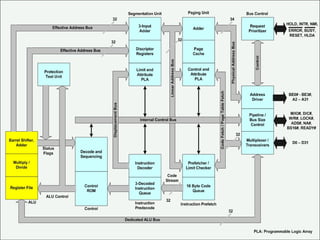
The Memory Management unit (MMU)
 Segmentation Unit
 It allows the use of two address components, Segment and Offset
for relocability and sharing of code and data
 Max. 4 Gb segments
 Paging Unit
 It organizes the phy. Memory in terms of pages of 4 Kb size each.
 It works under the control of segmentation unit
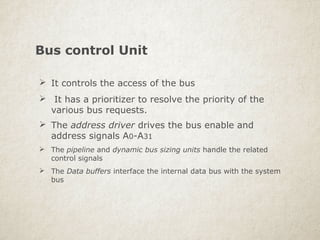
Bus control Unit
 It controls the access of the bus
 It has a prioritizer to resolve the priority of the
various bus requests.
 The address driver drives the bus enable and
address signals A0-A31
 The pipeline and dynamic bus sizing units handle the related
control signals
 The Data buffers interface the internal data bus with the system
bus
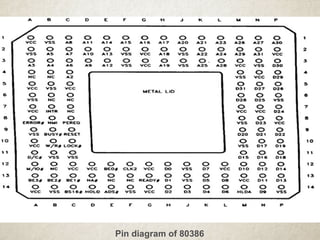
Pin diagram of 80386
 NA – Next address input pin, if activated, allows
address pipeling, during 80386 bus cycles
 Busy – The busy input signal indicates to the
CPU that the coprocessor is busy with the
alloted task.
 PEREQ – The processor extension request
output indicates to the cpu to fetch a data word
for the coprocessor
 11 addressing modes to facilitate efficient execution of
higher level language programs.
 In case of all those modes, the 80386 can now have 32-
bit immediate or 32- bit register operands or
displacements.
 It has a family of scaled modes. In case of scaled modes,
any of the index register values can be multiplied by a
valid scale factor to obtain the displacement
 The valid scale factor are 1, 2, 4 and 8.
ADDRESSING MODES
 The different scaled modes are as follows.
•Scaled Indexed Mode: Contents of the an index
register are multiplied by a scale factor that may be
added further to get the operand offset.
•Based Scaled Indexed Mode: Contents of the an
index register are multiplied by a scale factor and then
added to base register to obtain the offset.
•Based Scaled Indexed Mode with
Displacement: The Contents of the an index
register are multiplied by a scaling factor and the
result is added to a base register and a displacement
to get the offset of an operand.
Reference :
 Advanced Microprocessors and
Peripherals– A K Ray | K M Bhurchandi

80386 microprocessor

  • 2.
     Central ProcessingUnit  Execution Unit  Instruction Unit  Memory Management Unit  Bus Interface Unit Architecture & Signal desc. Of 8086
  • 3.
    • map outyour table(s) on paper first • figure out how many rows and columns • determine the width (600 pixels is standard) • keeping your table simple at first helps • look for ideas on the internet (sample), save the page, and then view it in Dreamweaver. Creating Tables:
  • 4.
    Execution unit &Instr Unit  The EU has 8 general purpose and 8 special purpose registers, used for handling data or calculating offset addresses.  The IU decodes the opcode bytes received from 16-byte instr code queue and arranges them into a 3-instr decoded-instr queue, after decoding them so as to pass it to the control section for deriving the necessary control signals.
  • 5.
    The Memory Managementunit (MMU)  Segmentation Unit  It allows the use of two address components, Segment and Offset for relocability and sharing of code and data  Max. 4 Gb segments  Paging Unit  It organizes the phy. Memory in terms of pages of 4 Kb size each.  It works under the control of segmentation unit
  • 6.
    Bus control Unit It controls the access of the bus  It has a prioritizer to resolve the priority of the various bus requests.  The address driver drives the bus enable and address signals A0-A31  The pipeline and dynamic bus sizing units handle the related control signals  The Data buffers interface the internal data bus with the system bus
  • 7.
  • 8.
     NA –Next address input pin, if activated, allows address pipeling, during 80386 bus cycles  Busy – The busy input signal indicates to the CPU that the coprocessor is busy with the alloted task.  PEREQ – The processor extension request output indicates to the cpu to fetch a data word for the coprocessor
  • 9.
     11 addressingmodes to facilitate efficient execution of higher level language programs.  In case of all those modes, the 80386 can now have 32- bit immediate or 32- bit register operands or displacements.  It has a family of scaled modes. In case of scaled modes, any of the index register values can be multiplied by a valid scale factor to obtain the displacement  The valid scale factor are 1, 2, 4 and 8. ADDRESSING MODES
  • 10.
     The differentscaled modes are as follows. •Scaled Indexed Mode: Contents of the an index register are multiplied by a scale factor that may be added further to get the operand offset. •Based Scaled Indexed Mode: Contents of the an index register are multiplied by a scale factor and then added to base register to obtain the offset. •Based Scaled Indexed Mode with Displacement: The Contents of the an index register are multiplied by a scaling factor and the result is added to a base register and a displacement to get the offset of an operand.
  • 11.
    Reference :  AdvancedMicroprocessors and Peripherals– A K Ray | K M Bhurchandi