The document discusses the registers of the 80386 microprocessor. It describes:
1) The 80386 has eight 32-bit general purpose registers (EAX, EBX, ECX, EDX, EBP, ESP, ESI, EDI) that can be used as either 8-bit or 16-bit registers. It also has six segment registers (CS, SS, DS, ES, FS, GS).
2) The 80386 has additional registers compared to the 8086, including a 32-bit instruction pointer (EIP), status flags register (EFLAGS), and two additional segment registers (FS and GS).
3) The document provides details on the various status flags in
In this document
Powered by AI
Introduces the EAX, EBX, ECX, EDX, ESP, EBP, EDI, ESI registers in 80386 CPU, detailing their functionalities.
Discusses the register organization in 80386, highlighting the general-purpose registers and their extended 32-bit counterparts.
Enumerates different flags (C, P, A, Z, T, S, I, VM, RF, NT, IOPL) used for controlling operations and interrupt handling.
Compares 8086 and 80386 processors on parameters like number of pins, clock rates, modes, registers, architecture, data and address buses.
1
EAX AH AXAL ACCUMULATOR
EBX BH BX BL BASE INDEX
ECX CH CX CL COUNT
EDX DH DX DL DATA
ESP SP STACK POINTER
EBP BP BASE POINTER
EDI DI DESTINATION INDEX
ESI SI SOURCE INDEX
32 BIT NAMES
16 bit
names
8 bit
names
Registers of 80386
Fig1:Registers of 80386
Registers of 80386Friday, August 22, 2014
2.
2
EIP IP ACCUMULATOR
EFLAGSFLAGS FLAGS
CS CODE
DS DATA
ES EXTRA
SS STACK
FS
GS
• FS and GS registers have no special names.
Registers of 80386Friday, August 22, 2014
Register Organization
Eight 32- bit general purpose registers which may be used
as either 8 bit or 16 bit registers.
A 32 - bit register known as an extended register, is
represented by the register name with prefix E.
Example : A 32 bit register corresponding to AX is EAX,
similarly BX is EBX etc.
The 16 bit registers BP, SP, SI and DI in 8086 are now
available with their extended size of 32 bit and are names as
EBP,ESP,ESI and EDI.
4Registers of 80386Friday, August 22, 2014
5.
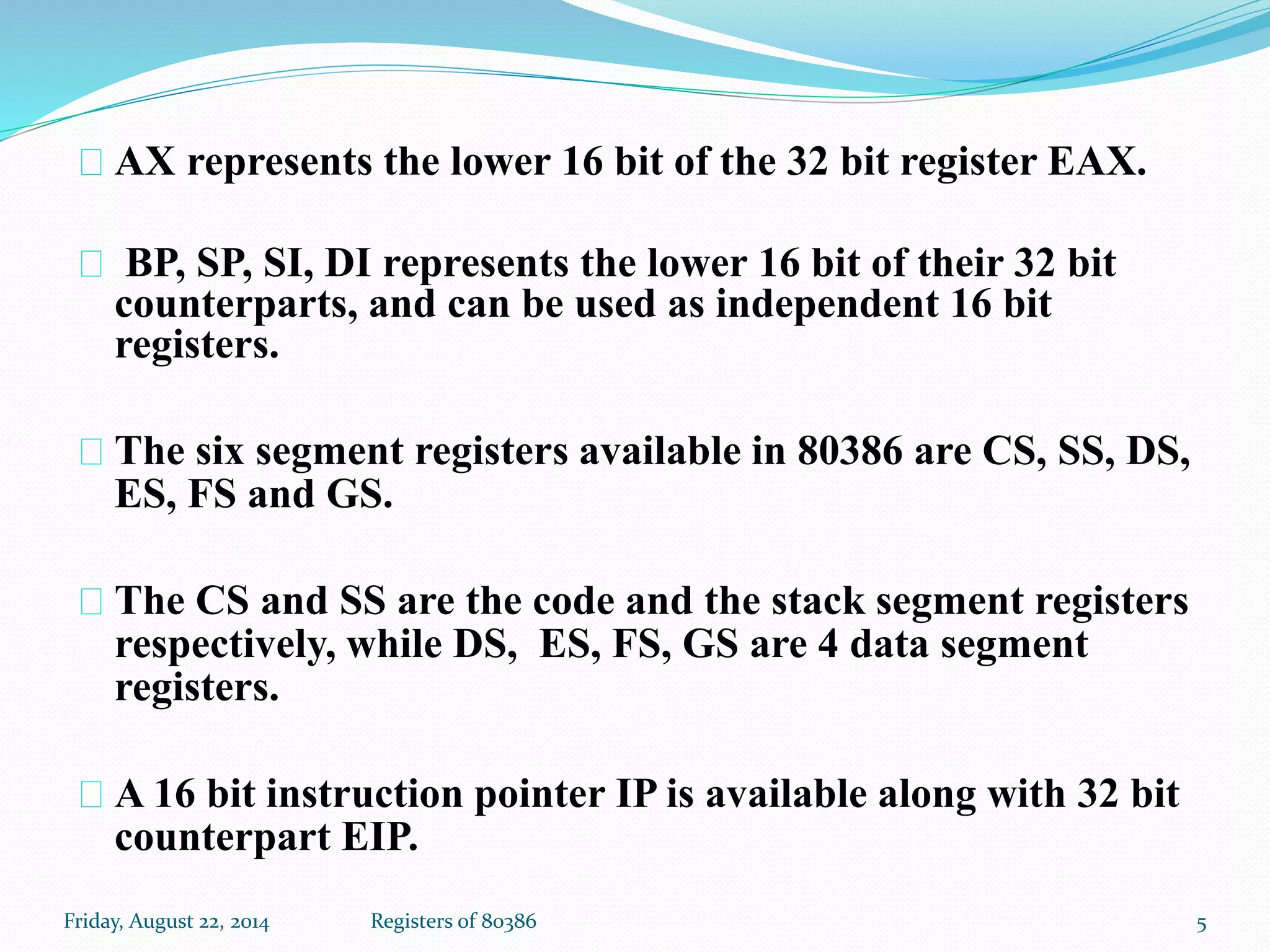
AX represents thelower 16 bit of the 32 bit register EAX.
BP, SP, SI, DI represents the lower 16 bit of their 32 bit
counterparts, and can be used as independent 16 bit
registers.
The six segment registers available in 80386 are CS, SS, DS,
ES, FS and GS.
The CS and SS are the code and the stack segment registers
respectively, while DS, ES, FS, GS are 4 data segment
registers.
A 16 bit instruction pointer IP is available along with 32 bit
counterpart EIP.
5Registers of 80386Friday, August 22, 2014
7
Flags
1. C (Carry)–It holds the carry after calculations.
2. P (Parity) –Parity is a logic 0 for odd parity and a logic 1 for even parity.
Parity is a count of ones in a number expressed as even or odd.
3. A (Auxiliary carry) –Carry occurs bits positions 3 and 5 of the results.
4. Z (Zero) – The zero flag shows that the result of an arithmetic or logical
operation is zero. When Z = 1, the result is zero. When Z = 0, the result was
non-zero.
5. T (Trap) – Enables trapping through an on-chip debugging facility.
Registers of 80386Friday, August 22, 2014
8.
8
Cont’d. . .
6.S (Sign) – The sign flag holds the arithmetic sign after an arithmetic or a
logical operation. If S =1 the sign bit is set and the result is negative. If S =
0, the sign bit is not set and the result is positive.
7. I (Interrupt) – The interrupt flag controls the operations of the
INTR(Interrupt request) input pint. If I =1, the INTR pin is enabled; if I =0,
the INTR pin is disabled.
8. VM (virtual mode) – If this flag set, the 80386 enters the virtual mode
within the protected mode. In this mode, if any privileged instruction is
executed, an exception 13 is generated.
Registers of 80386Friday, August 22, 2014
9.
Cont’d. . .
Registersof 80386 9
9. RF(resume) – The resume flag is used with debugging to control the
resumption of execution after the next instruction.
10. NT (nested task) – The nested task flag is used to indicated that the
current task is nested within another task in protected mode operation.
This flag is when the task I nested by software.
11. IOPL (I/O Privilege level) – IOPL is used in protected mode operation
to select the privilege level for I./O devices. IF the current privilege level is
higher or more trusted than the IOPL, I/O executed without hindrance. If
the IOPL is lower than the current privilege level, an interrupt occurs.
Friday, August 22, 2014
10.
10Registers of 80386
S.N.Parameter 8086 80386
1 Number of Pins 40 132
2 Pin Nature DIP No DIP
3 Clock rate Supports 5,8 & 10Mhz 16 & 20 MHz
4 Operating Mode 2(viz. minimum &
Maximum)
3(viz. real, protected
& virtual)
5 Signal Category 3 2
6 Number of Registers 14, 16bit 16, 32 bit
7 Architecture(Processor) 16bit 32bit
8 Architecture Composition in unit 2 (viz. EU, BIU) 3(CPU,MMU & BCU)
9 Data Bus 16 bit 32 bit
10 Address Bus 20 bit 32 bit
11 Memory Access Up to 1 MB Up to 4 Gb
12 Power Consumption High Low
13 Cost High Low
Friday, August 22, 2014