09/04/2016
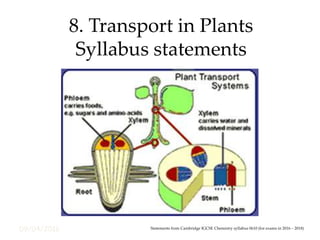
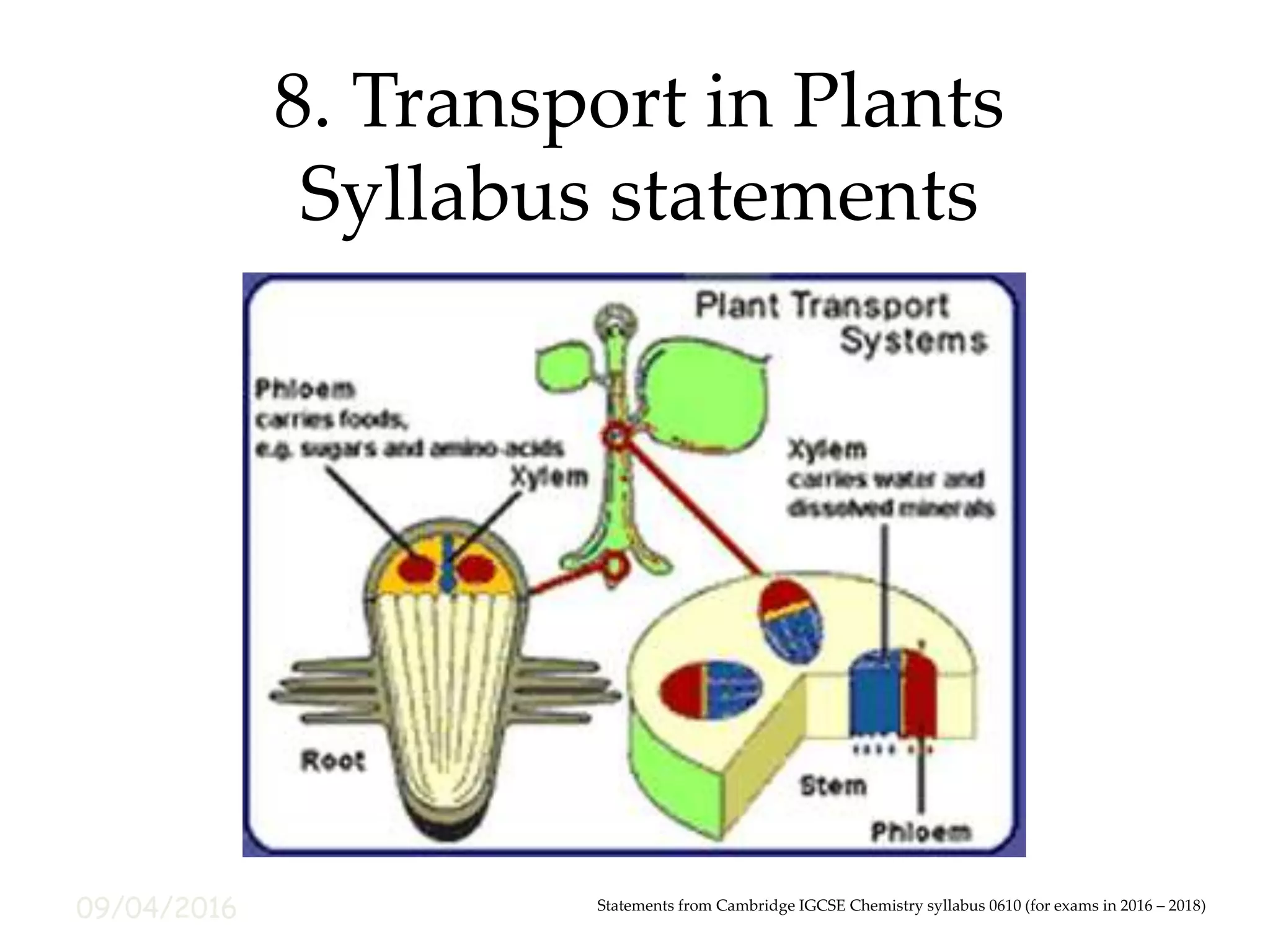
8. Transport in Plants
Syllabus statements
Statements from Cambridge IGCSE Chemistry syllabus 0610 (for exams in 2016 – 2018)
8.1 Transport in Plants
• State the functions of xylem and phloem
• Identify the position of xylem and phloem as seen
in sections of roots, stems and leaves, limited to
non-woody dicotyledonous plants
8.2 Water uptake
• Identify root hair cells, as seen under the light
microscope, and state their functions
• State the pathway taken by water through root,
stem and leaf as root hair cell, root cortex cells,
xylem and mesophyll cells
• Investigate, using a suitable stain, the pathway of
water through the above ground parts of a plant
• Explain that the large surface area of root hairs
increases the rate of the absorption of water by
osmosis and ions by active transport
8.3 Transpiration
• State that water is transported from the roots to
leaves through the xylem vessels
• Define transpiration as loss of water vapour from
plant leaves by evaporation of water at the
surfaces of the mesophyll cells followed by
diffusion of water vapour through the stomata
• Explain how water vapour loss is related to the
large surface area of cell surfaces, interconnecting
air spaces and stomata
8.3 Transpiration
• Explain the mechanism by which water moves
upwards in the xylem in terms of a transpiration
pull that draws up a column of water molecules,
held together by cohesion
• Explain how and why wilting occurs
• Explain the effects of variation of temperature and
humidity on transpiration rate
• Investigate and describe the effects of variation of
temperature and humidity on transpiration rate
8.4 Translocation
• Define translocation in terms of the movement of
sucrose and amino acids in phloem:
– from regions of production (source)
– to regions of storage OR to regions where they
are used in respiration or growth (sink)
• Explain that some parts of a plant may act as a
source and a sink at different times during the life
of a plant

8 syllabus statements

  • 1.
    09/04/2016 8. Transport inPlants Syllabus statements Statements from Cambridge IGCSE Chemistry syllabus 0610 (for exams in 2016 – 2018)
  • 2.
    8.1 Transport inPlants • State the functions of xylem and phloem • Identify the position of xylem and phloem as seen in sections of roots, stems and leaves, limited to non-woody dicotyledonous plants
  • 3.
    8.2 Water uptake •Identify root hair cells, as seen under the light microscope, and state their functions • State the pathway taken by water through root, stem and leaf as root hair cell, root cortex cells, xylem and mesophyll cells • Investigate, using a suitable stain, the pathway of water through the above ground parts of a plant • Explain that the large surface area of root hairs increases the rate of the absorption of water by osmosis and ions by active transport
  • 4.
    8.3 Transpiration • Statethat water is transported from the roots to leaves through the xylem vessels • Define transpiration as loss of water vapour from plant leaves by evaporation of water at the surfaces of the mesophyll cells followed by diffusion of water vapour through the stomata • Explain how water vapour loss is related to the large surface area of cell surfaces, interconnecting air spaces and stomata
  • 5.
    8.3 Transpiration • Explainthe mechanism by which water moves upwards in the xylem in terms of a transpiration pull that draws up a column of water molecules, held together by cohesion • Explain how and why wilting occurs • Explain the effects of variation of temperature and humidity on transpiration rate • Investigate and describe the effects of variation of temperature and humidity on transpiration rate
  • 6.
    8.4 Translocation • Definetranslocation in terms of the movement of sucrose and amino acids in phloem: – from regions of production (source) – to regions of storage OR to regions where they are used in respiration or growth (sink) • Explain that some parts of a plant may act as a source and a sink at different times during the life of a plant