Class - XI
1. Plants need a transport system so that cells deep within the
plants tissues can receive the nutrients they need for cell
processes.
2. The problem in plants is that roots can obtain water, but not
sugar, and leaves can produce sugar, but can’t get water from
the air
3. Plants do not have circulatory system like animals.
4. Over small distances substances move by diffusion and by
cytoplasmic streaming supplemented by active transport.
5. Transport over longer distances proceeds through the
transport system which is called vascular tissue
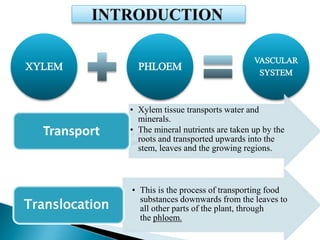
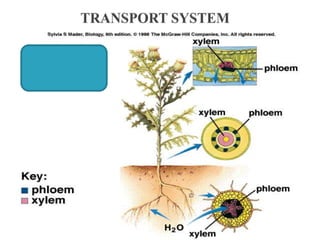
XYLEM PHLOEM
VASCULAR
SYSTEM
Xylem tissue transports water and soluble minerals
Phloem tissue transports sugars
• Xylem tissue transports water and
minerals.
• The mineral nutrients are taken up by the
roots and transported upwards into the
stem, leaves and the growing regions.
Transport
• This is the process of transporting food
substances downwards from the leaves to
all other parts of the plant, through
the phloem.
Translocation
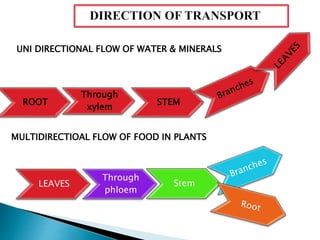
STEM
Through
xylem
ROOT
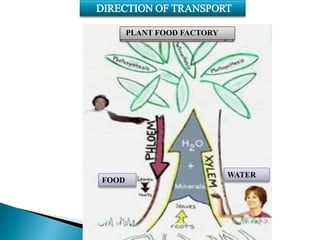
UNI DIRECTIONAL FLOW OF WATER & MINERALS
MULTIDIRECTIOAL FLOW OF FOOD IN PLANTS
LEAVES
Through
phloem
Stem
DIRECTION OF TRANSPORT
PLANT FOOD FACTORY
FOOD
WATER
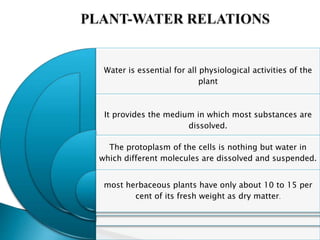
Water is essential for all physiological activities of the
plant
It provides the medium in which most substances are
dissolved.
The protoplasm of the cells is nothing but water in
which different molecules are dissolved and suspended.
most herbaceous plants have only about 10 to 15 per
cent of its fresh weight as dry matter.
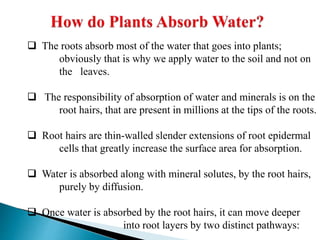
 The roots absorb most of the water that goes into plants;
obviously that is why we apply water to the soil and not on
the leaves.
 The responsibility of absorption of water and minerals is on the
root hairs, that are present in millions at the tips of the roots.
 Root hairs are thin-walled slender extensions of root epidermal
cells that greatly increase the surface area for absorption.
 Water is absorbed along with mineral solutes, by the root hairs,
purely by diffusion.
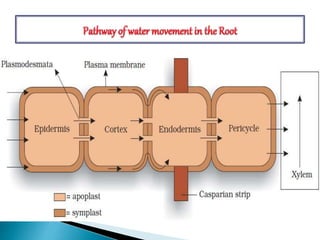
 Once water is absorbed by the root hairs, it can move deeper
into root layers by two distinct pathways:
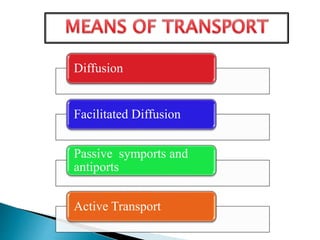
Diffusion
Facilitated Diffusion
Passive symports and
antiports
Active Transport
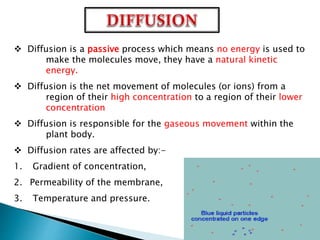
 Diffusion is a passive process which means no energy is used to
make the molecules move, they have a natural kinetic
energy.
 Diffusion is the net movement of molecules (or ions) from a
region of their high concentration to a region of their lower
concentration
 Diffusion is responsible for the gaseous movement within the
plant body.
 Diffusion rates are affected by:-
1. Gradient of concentration,
2. Permeability of the membrane,
3. Temperature and pressure.
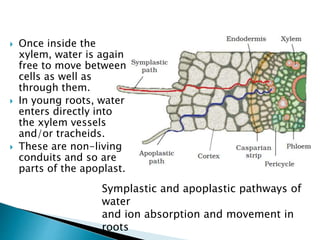
Symplastic and apoplastic pathways of
water
and ion absorption and movement in
roots
 Once inside the
xylem, water is again
free to move between
cells as well as
through them.
 In young roots, water
enters directly into
the xylem vessels
and/or tracheids.
 These are non-living
conduits and so are
parts of the apoplast.
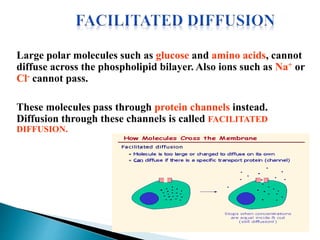
Large polar molecules such as glucose and amino acids, cannot
diffuse across the phospholipid bilayer. Also ions such as Na+ or
Cl- cannot pass.
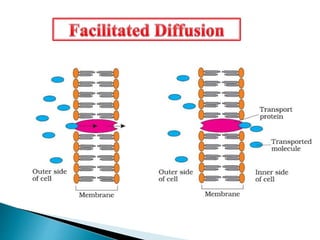
These molecules pass through protein channels instead.
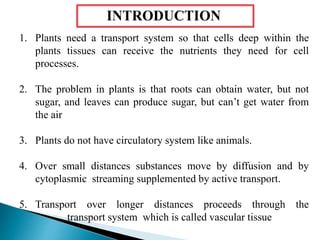
Diffusion through these channels is called FACILITATED
DIFFUSION.
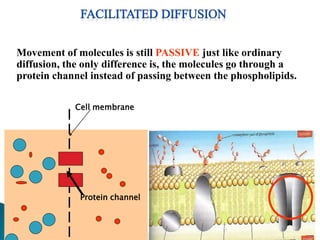
Movement of molecules is still PASSIVE just like ordinary
diffusion, the only difference is, the molecules go through a
protein channel instead of passing between the phospholipids.
Protein channel
Cell membrane
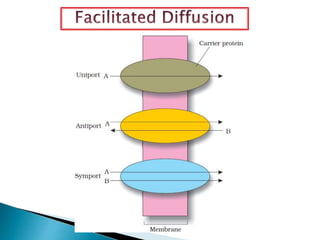
 Some carrier or transport proteins allow diffusion only if
two types of molecules move together.
 Symport – When both molecules cross the membrane in
the same direction
 Antiport - When both molecules cross the membrane in
opposite directions
 Uniport - When a molecule moves across a membrane
independent of other molecule
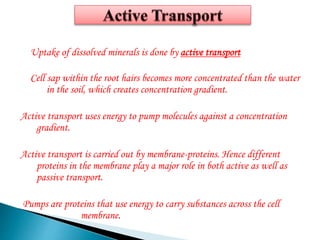
Uptake of dissolved minerals is done by active transport
Cell sap within the root hairs becomes more concentrated than the water
in the soil, which creates concentration gradient.
Active transport uses energy to pump molecules against a concentration
gradient.
Active transport is carried out by membrane-proteins. Hence different
proteins in the membrane play a major role in both active as well as
passive transport.
Pumps are proteins that use energy to carry substances across the cell
membrane.
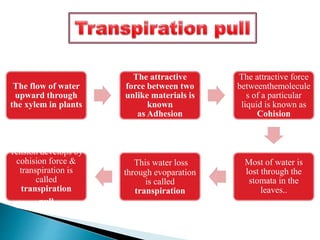
The flow of water
upward through
the xylem in plants
The attractive
force between two
unlike materials is
known
as Adhesion
The attractive force
betweenthemolecule
s of a particular
liquid is known as
Cohision
Most of water is
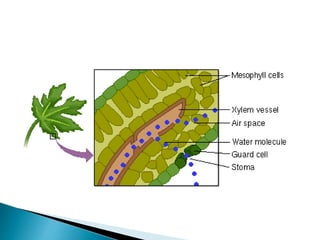
lost through the
stomata in the
leaves..
This water loss
through evoparation
is called
transpiration
Tension develops by
cohision force &
transpiration is
called
transpiration
pull
 The bulk movement of substances through the
conducting or vascular tissues of plants is called
translocation.
 The higher plants have highly specialised vascular
tissues – xylem and phloem.
 Xylem is associated with translocation of mainly water,
mineral salts, some organic nitrogen and hormones,
from roots to the aerial parts of the plants.
 The phloem translocates a variety of organic and
inorganic solutes, mainly from the leaves to other parts
of the plants.
TRANSLOCATION
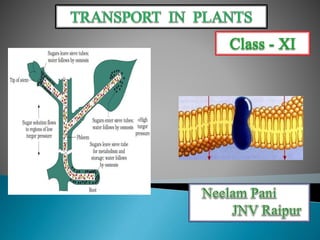
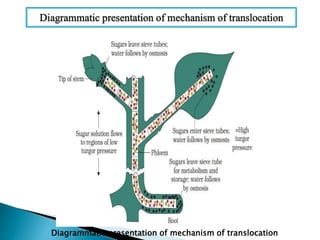
Diagrammatic presentation of mechanism of translocation
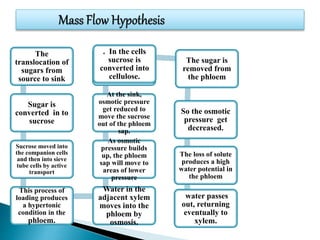
The
translocation of
sugars from
source to sink
Sugar is
converted in to
sucrose
Sucrose moved into
the companion cells
and then into sieve
tube cells by active
transport
This process of
loading produces
a hypertonic
condition in the
phloem.
Water in the
adjacent xylem
moves into the
phloem by
osmosis.
As osmotic
pressure builds
up, the phloem
sap will move to
areas of lower
pressure
At the sink,
osmotic pressure
get reduced to
move the sucrose
out of the phloem
sap.
. In the cells
sucrose is
converted into
cellulose.
The sugar is
removed from
the phloem
So the osmotic
pressure get
decreased.
.
The loss of solute
produces a high
water potential in
the phloem
water passes
out, returning
eventually to
xylem.
 THANK YOU

Ch 11. transport in plants (2)

  • 1.
  • 2.
    1. Plants needa transport system so that cells deep within the plants tissues can receive the nutrients they need for cell processes. 2. The problem in plants is that roots can obtain water, but not sugar, and leaves can produce sugar, but can’t get water from the air 3. Plants do not have circulatory system like animals. 4. Over small distances substances move by diffusion and by cytoplasmic streaming supplemented by active transport. 5. Transport over longer distances proceeds through the transport system which is called vascular tissue
  • 3.
    XYLEM PHLOEM VASCULAR SYSTEM Xylem tissuetransports water and soluble minerals Phloem tissue transports sugars • Xylem tissue transports water and minerals. • The mineral nutrients are taken up by the roots and transported upwards into the stem, leaves and the growing regions. Transport • This is the process of transporting food substances downwards from the leaves to all other parts of the plant, through the phloem. Translocation
  • 4.
    STEM Through xylem ROOT UNI DIRECTIONAL FLOWOF WATER & MINERALS MULTIDIRECTIOAL FLOW OF FOOD IN PLANTS LEAVES Through phloem Stem
  • 5.
    DIRECTION OF TRANSPORT PLANTFOOD FACTORY FOOD WATER
  • 7.
    Water is essentialfor all physiological activities of the plant It provides the medium in which most substances are dissolved. The protoplasm of the cells is nothing but water in which different molecules are dissolved and suspended. most herbaceous plants have only about 10 to 15 per cent of its fresh weight as dry matter.
  • 8.
     The rootsabsorb most of the water that goes into plants; obviously that is why we apply water to the soil and not on the leaves.  The responsibility of absorption of water and minerals is on the root hairs, that are present in millions at the tips of the roots.  Root hairs are thin-walled slender extensions of root epidermal cells that greatly increase the surface area for absorption.  Water is absorbed along with mineral solutes, by the root hairs, purely by diffusion.  Once water is absorbed by the root hairs, it can move deeper into root layers by two distinct pathways:
  • 10.
  • 11.
     Diffusion isa passive process which means no energy is used to make the molecules move, they have a natural kinetic energy.  Diffusion is the net movement of molecules (or ions) from a region of their high concentration to a region of their lower concentration  Diffusion is responsible for the gaseous movement within the plant body.  Diffusion rates are affected by:- 1. Gradient of concentration, 2. Permeability of the membrane, 3. Temperature and pressure.
  • 12.
    Symplastic and apoplasticpathways of water and ion absorption and movement in roots  Once inside the xylem, water is again free to move between cells as well as through them.  In young roots, water enters directly into the xylem vessels and/or tracheids.  These are non-living conduits and so are parts of the apoplast.
  • 13.
    Large polar moleculessuch as glucose and amino acids, cannot diffuse across the phospholipid bilayer. Also ions such as Na+ or Cl- cannot pass. These molecules pass through protein channels instead. Diffusion through these channels is called FACILITATED DIFFUSION.
  • 14.
    Movement of moleculesis still PASSIVE just like ordinary diffusion, the only difference is, the molecules go through a protein channel instead of passing between the phospholipids. Protein channel Cell membrane
  • 16.
     Some carrieror transport proteins allow diffusion only if two types of molecules move together.  Symport – When both molecules cross the membrane in the same direction  Antiport - When both molecules cross the membrane in opposite directions  Uniport - When a molecule moves across a membrane independent of other molecule
  • 18.
    Uptake of dissolvedminerals is done by active transport Cell sap within the root hairs becomes more concentrated than the water in the soil, which creates concentration gradient. Active transport uses energy to pump molecules against a concentration gradient. Active transport is carried out by membrane-proteins. Hence different proteins in the membrane play a major role in both active as well as passive transport. Pumps are proteins that use energy to carry substances across the cell membrane.
  • 19.
    The flow ofwater upward through the xylem in plants The attractive force between two unlike materials is known as Adhesion The attractive force betweenthemolecule s of a particular liquid is known as Cohision Most of water is lost through the stomata in the leaves.. This water loss through evoparation is called transpiration Tension develops by cohision force & transpiration is called transpiration pull
  • 22.
     The bulkmovement of substances through the conducting or vascular tissues of plants is called translocation.  The higher plants have highly specialised vascular tissues – xylem and phloem.  Xylem is associated with translocation of mainly water, mineral salts, some organic nitrogen and hormones, from roots to the aerial parts of the plants.  The phloem translocates a variety of organic and inorganic solutes, mainly from the leaves to other parts of the plants. TRANSLOCATION
  • 23.
    Diagrammatic presentation ofmechanism of translocation
  • 24.
    The translocation of sugars from sourceto sink Sugar is converted in to sucrose Sucrose moved into the companion cells and then into sieve tube cells by active transport This process of loading produces a hypertonic condition in the phloem. Water in the adjacent xylem moves into the phloem by osmosis. As osmotic pressure builds up, the phloem sap will move to areas of lower pressure At the sink, osmotic pressure get reduced to move the sucrose out of the phloem sap. . In the cells sucrose is converted into cellulose. The sugar is removed from the phloem So the osmotic pressure get decreased. . The loss of solute produces a high water potential in the phloem water passes out, returning eventually to xylem.
  • 25.

Editor's Notes