Slope Stability

                updated June 7, 2007


Haryo Dwito Armono, M.Eng, Ph.D
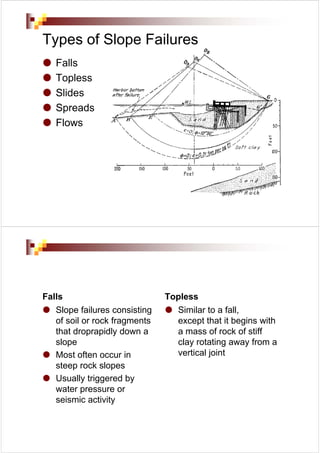
Types of Slope Failures
   Falls
   Topless
   Slides
   Spreads
   Flows


Falls                          Topless
   Slope failures consisting
       p                   g     Similar to a fall,
   of soil or rock fragments     except that it begins with
   that droprapidly down a       a mass of rock of stiff
   slope
     l                           clay rotating away from a
                                   l    t ti         f
   Most often occur in           vertical joint
   steep rock slopes
   Usually triggered by
   water pressure or
   seismic activity
Slides                        Spreads
   Slope failures that
      p                          Similar to translational
   involve one ore more          slides except that the
   blocks of earth that          block separate and
   move ddownslope b
                l    by          move apart as they also
                                             t   th    l
   shearing along well           move outward
   defined surfaces or thin      Can be very destructive
   shear zones


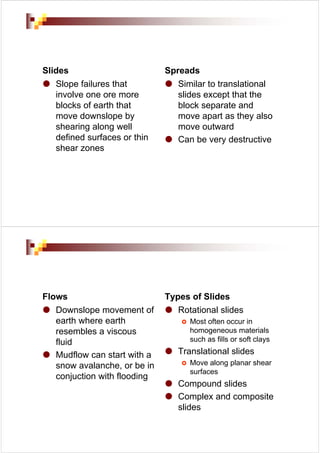
Flows                         Types of Slides
   Downslope movement of
            p                    Rotational slides
   earth where earth                Most often occur in
   resembles a viscous              homogeneous materials
   fluid
   fl id                            such as fills or soft clays

   Mudflow can start with a      Translational slides
   snow avalanche, or be in
         avalanche                  Move along planar shear
                                    surfaces
   conjuction with flooding
                                 Compound slides
                                 Complex and composite
                                 slides
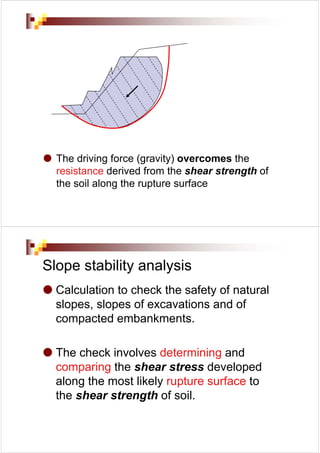
The driving force (g
             g       (gravity) overcomes the
                            y)
  resistance derived from the shear strength of
  the soil along the rupture surface
               g       p


Slope stability analysis
  Calculation to check the safety of natural
  slopes, slopes of excavations and of
  compacted embankments.
          t d    b k      t

  The check involves determining and
  comparing the shear stress de eloped
                                developed
  along the most likely rupture surface to
  the shear strength of soil.
Factor of Safety
       τf
Fs =
       τd
Fs = factor of safety with respect to strength
τ f = average shear strength of the soil
τ d = average s ea st ess de e oped a o g t e potential failure su ace
      a e age shear stress developed along the pote t a a u e surface


τ f = c + σ tan φ
c = cohesion
φ = angle of friction
σ = average normal stress on the potential failure surface

similarly
τ d = cd + σ tan φd
subscript 'd' refer to p
       p               potential failure surface


        c + σ tan φ
Fs =
       cd + σ tan φd
when Fs = 1, the slope is in a state of impending of failure.
In general Fs > 1.5 is acceptable


Stability of Slope
       Infinite slope without seepage
       Infinite slope with seepage
       Finite slope with Plane Failure Surface
       (Cullman s
       (Cullman's Method)
       Finite slope with Circular Failure Surface
       (Method of Slices)
Infinite slope
                              L
                                                                                      c                  tan φ
                                                 β                  Fs =                             +
                                                                           γ H cos2 β tan β              tan β
                                        d
                     a                      F
                              W
                         Na
                                                       B                  For granular soils, c=0 Fs is independent
                                                                                        soils c 0,
             F                     Ta
                                        c                                 of height H, and the slope is stable as
         H
                                                                          long as β < φ
                     b Tr
                              β N
         A                        r
                              R


                              L

                                        d
                                                     Direction of


                                                                                                 γ ' tan φ
                     a                               seepage
                              W                                                      c
                         Na
                                                                    F =
                                                                    Fs                         +
                                                                           γ sat H cos2 β tan β γ sat tan β
                                                       B
                                   Ta
                                        c
         H
                    T
                 β b r        β N
         A                        r
                              R


    Finite slope with Plane Failure Surface

                                            B                         C

                                            W                                               β + φd
                                       Na
                                                                                    θcr =
                                                       Ta                                     2
                                                 τ f = c + σ tan φ
H                                                unit weight of soil = γ

                                                                                            4c ⎡ sin β cos φ ⎤
                                  Tr            Nr
                                        R
                                                                                    Hcr =
     A
                 β    θ                                                                     γ ⎢ 1 − cos( β − φ ) ⎥
                                                                                               ⎣       (         ⎦
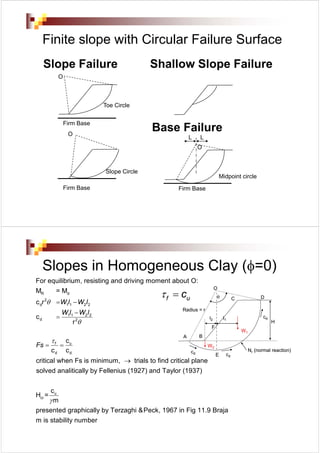
Finite slope with Circular Failure Surface
     Slope Failure                          Shallow Slope Failure
             O


                             Toe Circle


                 Firm Base
                  O
                                            Base Failure
                                                       L     L
                                                             O


                             Slope Circle
                                                                          Midpoint circle
                 Firm Base                       Firm Base


     Slopes in Homogeneous Clay (φ=0)
For equilibrium, resisting and driving moment about O:

                                             τ f = cu
                                                                      O
MR    = Md
                                                                      θ          C             D
c dr 2θ = W1l1 − W2 l 2
                                                   Radius = r
              W l −W l
cd           = 11 2 2 2                                          l2        l1                    cd
                 rθ                                                                                   H
                                                                  F
                                                                                     W1
                                                   A         B
        τf        cu
Fs =          =                                                  W2
        cd        cd                                    cd                                Nr (normal reaction)
                                                                      E     cd
critical when Fs is minimum, → trials to find critical plane
solved analitically by Fellenius (1927) and Taylor (1937)

     cu
Hcr =
     γm
presented graphically by Terzaghi &Peck, 1967 in Fig 11.9 Braja
m is stability number
Swedish Slip Circle Method


Slopes in Homogeneous Clay (φ>0)
                                  τ f = c + σ tan φ


                c d = γ H ⎡f (α , β ,θ ,φ ) ⎤
                          ⎣                 ⎦

                  c
                      = f (α , β ,θ ,φ ) = m
                γ Hcr
                where m is stability number
Method of Slices

For equilibrium
Nr = Wn cos α n

       n=p

       ∑ ( c ΔL        n   + Wn cos α n tan φ )
Fs =   n =1
                      n=p

                      ∑W
                       n =1
                                  n   sin α n

          bn
ΔLn ≈           where b is the width of nth slice
        cos α n


 Bishop Method
   Bishop (1955) refine solution to the previous
   method of slices.
   In his method, the effect of forces on the sides
   of each slice are accounted for some degree .

           n=p
                                          1
           ∑ ( cb
           n =1
                  n   + Wn tan φ )
                                         mα ( n )
    Fs =          n=p

                  ∑Wn =1
                           n   sin α n

    where
                           tan φ sin α n
    mα ( n ) = cos α n +
                                Fs

  The ordinary method of slices is presented as
  learning tools. It is rarely used because is too
           tools
  conservative
Computer Programs
   STABL
   GEO-SLOPE
   etc


                                           Bibliography
Holtz, R.D and Kovacs, W.D., “An Introduction to Geotechnical
                              An
    Engineering”
Das, B.M., “Soil Mechanics”
Das, B.M., “Advanced Soil Mechanics”

8 slope stability

  • 1.
    Slope Stability updated June 7, 2007 Haryo Dwito Armono, M.Eng, Ph.D
  • 2.
    Types of SlopeFailures Falls Topless Slides Spreads Flows Falls Topless Slope failures consisting p g Similar to a fall, of soil or rock fragments except that it begins with that droprapidly down a a mass of rock of stiff slope l clay rotating away from a l t ti f Most often occur in vertical joint steep rock slopes Usually triggered by water pressure or seismic activity
  • 3.
    Slides Spreads Slope failures that p Similar to translational involve one ore more slides except that the blocks of earth that block separate and move ddownslope b l by move apart as they also t th l shearing along well move outward defined surfaces or thin Can be very destructive shear zones Flows Types of Slides Downslope movement of p Rotational slides earth where earth Most often occur in resembles a viscous homogeneous materials fluid fl id such as fills or soft clays Mudflow can start with a Translational slides snow avalanche, or be in avalanche Move along planar shear surfaces conjuction with flooding Compound slides Complex and composite slides
  • 4.
    The driving force(g g (gravity) overcomes the y) resistance derived from the shear strength of the soil along the rupture surface g p Slope stability analysis Calculation to check the safety of natural slopes, slopes of excavations and of compacted embankments. t d b k t The check involves determining and comparing the shear stress de eloped developed along the most likely rupture surface to the shear strength of soil.
  • 5.
    Factor of Safety τf Fs = τd Fs = factor of safety with respect to strength τ f = average shear strength of the soil τ d = average s ea st ess de e oped a o g t e potential failure su ace a e age shear stress developed along the pote t a a u e surface τ f = c + σ tan φ c = cohesion φ = angle of friction σ = average normal stress on the potential failure surface similarly τ d = cd + σ tan φd subscript 'd' refer to p p potential failure surface c + σ tan φ Fs = cd + σ tan φd when Fs = 1, the slope is in a state of impending of failure. In general Fs > 1.5 is acceptable Stability of Slope Infinite slope without seepage Infinite slope with seepage Finite slope with Plane Failure Surface (Cullman s (Cullman's Method) Finite slope with Circular Failure Surface (Method of Slices)
  • 6.
    Infinite slope L c tan φ β Fs = + γ H cos2 β tan β tan β d a F W Na B For granular soils, c=0 Fs is independent soils c 0, F Ta c of height H, and the slope is stable as H long as β < φ b Tr β N A r R L d Direction of γ ' tan φ a seepage W c Na F = Fs + γ sat H cos2 β tan β γ sat tan β B Ta c H T β b r β N A r R Finite slope with Plane Failure Surface B C W β + φd Na θcr = Ta 2 τ f = c + σ tan φ H unit weight of soil = γ 4c ⎡ sin β cos φ ⎤ Tr Nr R Hcr = A β θ γ ⎢ 1 − cos( β − φ ) ⎥ ⎣ ( ⎦
  • 7.
    Finite slope withCircular Failure Surface Slope Failure Shallow Slope Failure O Toe Circle Firm Base O Base Failure L L O Slope Circle Midpoint circle Firm Base Firm Base Slopes in Homogeneous Clay (φ=0) For equilibrium, resisting and driving moment about O: τ f = cu O MR = Md θ C D c dr 2θ = W1l1 − W2 l 2 Radius = r W l −W l cd = 11 2 2 2 l2 l1 cd rθ H F W1 A B τf cu Fs = = W2 cd cd cd Nr (normal reaction) E cd critical when Fs is minimum, → trials to find critical plane solved analitically by Fellenius (1927) and Taylor (1937) cu Hcr = γm presented graphically by Terzaghi &Peck, 1967 in Fig 11.9 Braja m is stability number
  • 8.
    Swedish Slip CircleMethod Slopes in Homogeneous Clay (φ>0) τ f = c + σ tan φ c d = γ H ⎡f (α , β ,θ ,φ ) ⎤ ⎣ ⎦ c = f (α , β ,θ ,φ ) = m γ Hcr where m is stability number
  • 9.
    Method of Slices Forequilibrium Nr = Wn cos α n n=p ∑ ( c ΔL n + Wn cos α n tan φ ) Fs = n =1 n=p ∑W n =1 n sin α n bn ΔLn ≈ where b is the width of nth slice cos α n Bishop Method Bishop (1955) refine solution to the previous method of slices. In his method, the effect of forces on the sides of each slice are accounted for some degree . n=p 1 ∑ ( cb n =1 n + Wn tan φ ) mα ( n ) Fs = n=p ∑Wn =1 n sin α n where tan φ sin α n mα ( n ) = cos α n + Fs The ordinary method of slices is presented as learning tools. It is rarely used because is too tools conservative
  • 10.
    Computer Programs STABL GEO-SLOPE etc Bibliography Holtz, R.D and Kovacs, W.D., “An Introduction to Geotechnical An Engineering” Das, B.M., “Soil Mechanics” Das, B.M., “Advanced Soil Mechanics”