Mam Tor Fieldclass
• Thursday 17th March
  – depart from Department at 8.45am
  – return approx. 6pm (depending on traffic)

• You will need:
  – standard field gear
     •   mapping board
     •   notebook
     •   compass-clinometer
     •   ruler
     •   stationary
     •   camera?
     •   LUNCH
Slope stability II

EOSC316 Engineering
   Geoscience
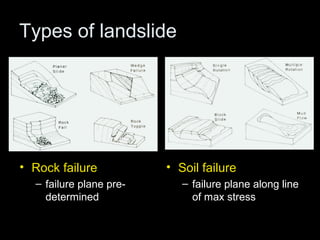
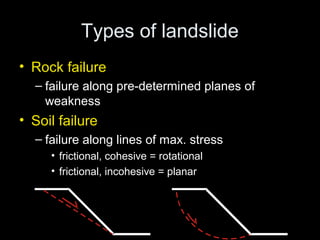
Types of landslide


• Rock failure           • Soil failure
  – failure plane pre-      – failure plane along line
    determined                of max stress
Types of landslide
• Rock failure
  – failure along pre-determined planes of
    weakness
• Soil failure
  – failure along lines of max. stress
     • frictional, cohesive = rotational
     • frictional, incohesive = planar
Rotational landslip analysis
• For undrained frictionless failure
  – total stress analysis
• For cohesive and frictional failure
  – method of slices
  – Bishop’s conventional method (can take into
    account pore water pressure)
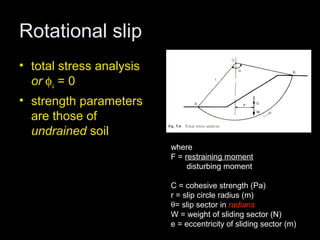
Rotational slip
• total stress analysis
  or φu = 0
• strength parameters
  are those of
  undrained soil
                          where
                          F = restraining moment
                               disturbing moment
        Cr θ   2
     F=                   C = cohesive strength (Pa)
                          r = slip circle radius (m)
         We               θ= slip sector in radians
                          W = weight of sliding sector (N)
                          e = eccentricity of sliding sector (m)
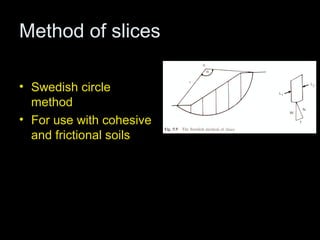
Method of slices

• Swedish circle
  method
• For use with cohesive
  and frictional soils
                               Crθ + ∑1 N n tan φ
                                        n

                          F=
                                     ∑T
                                        n
                                       1 n
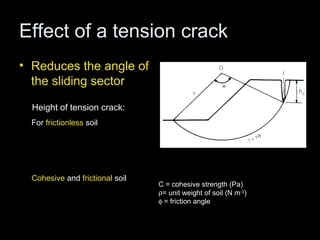
Effect of a tension crack
• Reduces the angle of
  the sliding sector

  Height of tension crack:
  For frictionless soil

       2C
  hc =
        ρ
  Cohesive and frictional soil
                                 C = cohesive strength (Pa)
                                 ρ= unit weight of soil (N m-3)
       2C          φ           φ = friction angle
  hc =    tan  45 + 
        ρ          2
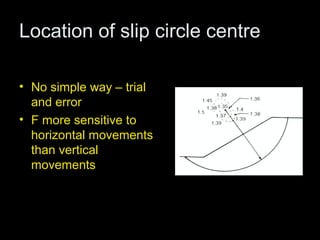
Location of slip circle centre

• No simple way – trial
  and error
• F more sensitive to
  horizontal movements
  than vertical
  movements
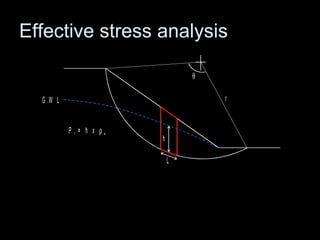
Effective stress analysis

                                                     θ

  G W L                                                  r


          P f = h x ρw
                                       h

                                           L


                         Crθ + ∑1 ( N n − Pf Ln ) tan φ
                                   n

                   F=
                                       ∑T
                                               n
                                               1 n
Other methods of analysis
• Taylor’s stability analysis
  – used for frictional and cohesive soils
  – uses a dimensionless number to iterate
    towards a solution
• Bishop’s method
  – effect of forces on each side of slice
    considered
  – iterative method
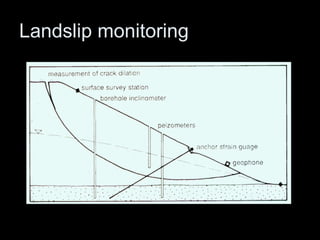
Landslip monitoring
Flowslides
• Soil, clay, rock debris may behave like
  liquid; water content is > liquid limit
  – flowslide


• Flowslides are extremely mobile
  – e.g. Yungay, Peru, 1970
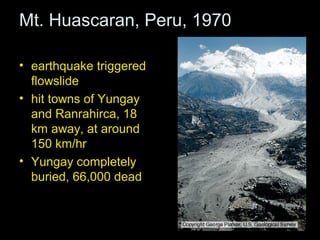
Mt. Huascaran, Peru, 1970

• earthquake triggered
  flowslide
• hit towns of Yungay
  and Ranrahirca, 18
  km away, at around
  150 km/hr
• Yungay completely
  buried, 66,000 dead
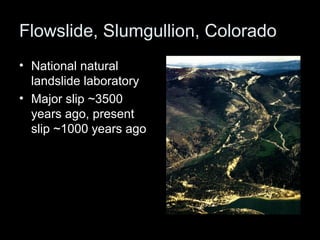
Flowslide, Slumgullion, Colorado
• National natural
  landslide laboratory
• Major slip ~3500
  years ago, present
  slip ~1000 years ago
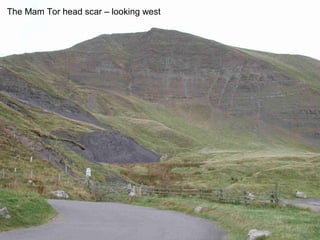
The Mam Tor head scar – looking west
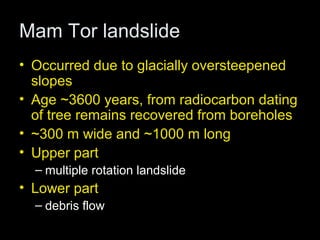
Mam Tor landslide
• Occurred due to glacially oversteepened
  slopes
• Age ~3600 years, from radiocarbon dating
  of tree remains recovered from boreholes
• ~300 m wide and ~1000 m long
• Upper part
  – multiple rotation landslide
• Lower part
  – debris flow
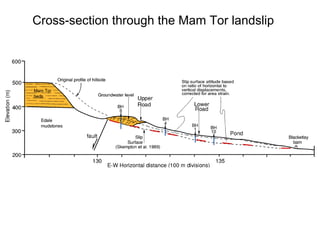
Cross-section through the Mam Tor landslip
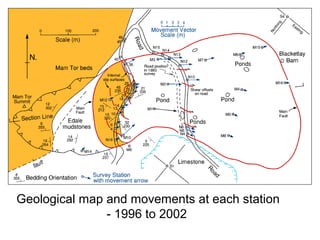
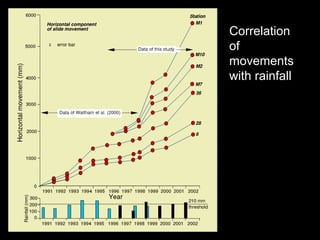
Geological map and movements at each station
               - 1996 to 2002
Correlation
of
movements
with rainfall
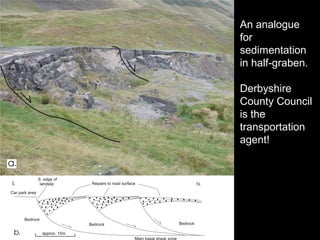
An analogue
for
sedimentation
in half-graben.

Derbyshire
County Council
is the
transportation
agent!
Mam Tor references
• Skempton, A.W. et al., 1989, The Mam
  Tor landslide, North Derbyshire, Phil.
  Trans. Royal Soc. Lond. 329, 503-547

• Rutter, E.H. et al., 2003, Strain
  displacements in the Mam Tor landslip,
  Derbyshire, England, J. Geol. Soc. Lond.
  160, 735-744.

Slope stability ii 2

  • 1.
    Mam Tor Fieldclass •Thursday 17th March – depart from Department at 8.45am – return approx. 6pm (depending on traffic) • You will need: – standard field gear • mapping board • notebook • compass-clinometer • ruler • stationary • camera? • LUNCH
  • 2.
    Slope stability II EOSC316Engineering Geoscience
  • 3.
    Types of landslide •Rock failure • Soil failure – failure plane pre- – failure plane along line determined of max stress
  • 4.
    Types of landslide •Rock failure – failure along pre-determined planes of weakness • Soil failure – failure along lines of max. stress • frictional, cohesive = rotational • frictional, incohesive = planar
  • 5.
    Rotational landslip analysis •For undrained frictionless failure – total stress analysis • For cohesive and frictional failure – method of slices – Bishop’s conventional method (can take into account pore water pressure)
  • 6.
    Rotational slip • totalstress analysis or φu = 0 • strength parameters are those of undrained soil where F = restraining moment disturbing moment Cr θ 2 F= C = cohesive strength (Pa) r = slip circle radius (m) We θ= slip sector in radians W = weight of sliding sector (N) e = eccentricity of sliding sector (m)
  • 7.
    Method of slices •Swedish circle method • For use with cohesive and frictional soils Crθ + ∑1 N n tan φ n F= ∑T n 1 n
  • 8.
    Effect of atension crack • Reduces the angle of the sliding sector Height of tension crack: For frictionless soil 2C hc = ρ Cohesive and frictional soil C = cohesive strength (Pa) ρ= unit weight of soil (N m-3) 2C  φ φ = friction angle hc = tan  45 +  ρ  2
  • 9.
    Location of slipcircle centre • No simple way – trial and error • F more sensitive to horizontal movements than vertical movements
  • 10.
    Effective stress analysis θ G W L r P f = h x ρw h L Crθ + ∑1 ( N n − Pf Ln ) tan φ n F= ∑T n 1 n
  • 11.
    Other methods ofanalysis • Taylor’s stability analysis – used for frictional and cohesive soils – uses a dimensionless number to iterate towards a solution • Bishop’s method – effect of forces on each side of slice considered – iterative method
  • 12.
  • 13.
    Flowslides • Soil, clay,rock debris may behave like liquid; water content is > liquid limit – flowslide • Flowslides are extremely mobile – e.g. Yungay, Peru, 1970
  • 14.
    Mt. Huascaran, Peru,1970 • earthquake triggered flowslide • hit towns of Yungay and Ranrahirca, 18 km away, at around 150 km/hr • Yungay completely buried, 66,000 dead
  • 15.
    Flowslide, Slumgullion, Colorado •National natural landslide laboratory • Major slip ~3500 years ago, present slip ~1000 years ago
  • 16.
    The Mam Torhead scar – looking west
  • 17.
    Mam Tor landslide •Occurred due to glacially oversteepened slopes • Age ~3600 years, from radiocarbon dating of tree remains recovered from boreholes • ~300 m wide and ~1000 m long • Upper part – multiple rotation landslide • Lower part – debris flow
  • 18.
    Cross-section through theMam Tor landslip
  • 19.
    Geological map andmovements at each station - 1996 to 2002
  • 20.
  • 21.
  • 22.
    Mam Tor references •Skempton, A.W. et al., 1989, The Mam Tor landslide, North Derbyshire, Phil. Trans. Royal Soc. Lond. 329, 503-547 • Rutter, E.H. et al., 2003, Strain displacements in the Mam Tor landslip, Derbyshire, England, J. Geol. Soc. Lond. 160, 735-744.