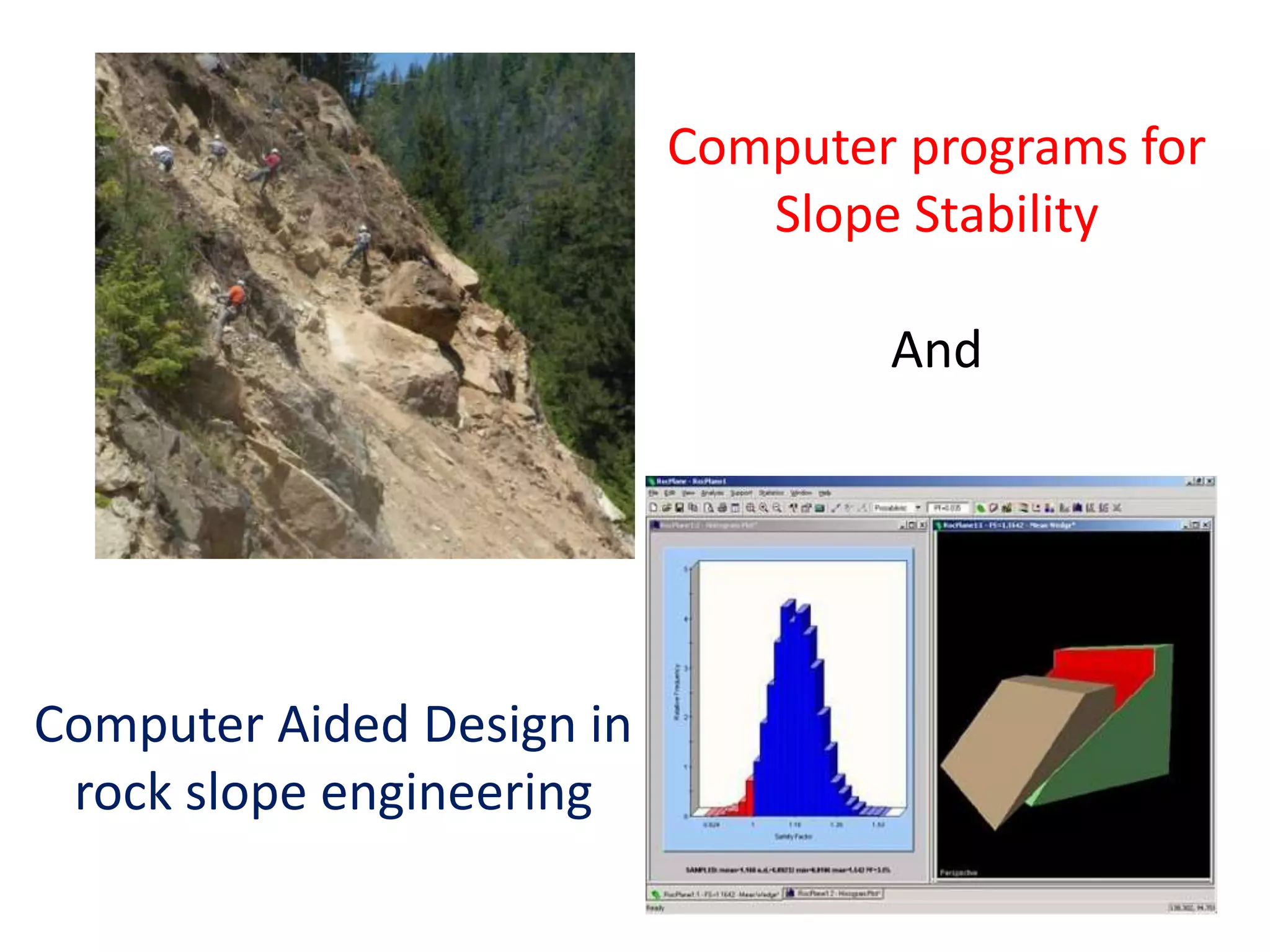
Computer programs for
Slope Stability
And
Computer Aided Design in
rock slope engineering
Slope & Slope stability analysis:
an overview
Slope
•An exposed ground surface that stands at an angle with the
horizontal is called slope.
•Either occur naturally or are engineered by humans.
•Constantly moving down slope in response to gravity.
•Can either be rock slope or soil slope or both.
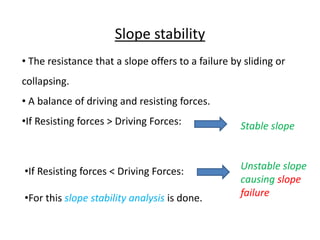
Slope stability
• The resistance that a slope offers to a failure by sliding or
collapsing.
• A balance of driving and resisting forces.
•If Resisting forces > Driving Forces: Stable slope
•If Resisting forces < Driving Forces:
•For this slope stability analysis is done.
Unstable slope
causing slope
failure
Slope stability analysis
•is routinely performed to assess the safe design of a human made
or natural slopes (e.g. embankments, road cuts, open pit mining,
excavations, landfills etc.) and the equilibrium conditions.
•A careful approach is required for consideration of various stress,
weaknesses and limitations inherent for each methodology.
•The analysis technique depends on both the site condition and
potential mode of failure.
Contd…..
•Successful design of the slope requires geological information and
site characteristics,( e.g. properties of soil/rock mass, slope
geometry, groundwater conditions, alternation of materials by
faulting, joint or discontinuity systems, movements and tension in
joints, earthquake activity etc).
• The presence of water has a detrimental effect on slope stability.
Water pressure acting in the pore spaces, fractures or other
discontinuities in the materials that make up the pit slope will
reduce the strength of those materials.
 Objectives:
•To find the vulnerable areas for slope stability investigation.
•To investigate potential failure mechanism.
•To determine the slopes sensitivity/ susceptibility to different
triggering mechanisms.
•To generate optimal slopes designing with regard to safety.
•To test and compare different stabilization and support options.
Methods of analysis:
•Broadly categorized into two:
Conventional methods
Numerical methods
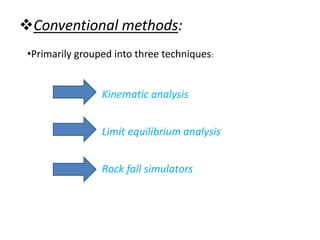
Conventional methods:
•Primarily grouped into three techniques:
Limit equilibrium analysis
Rock fall simulators
Kinematic analysis
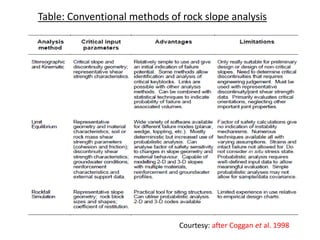
Courtesy: after Coggan et al. 1998
Table: Conventional methods of rock slope analysis
Computer programs and Computer-
Aided approach in slope stability:
application and limitation
Computer programs in slope stability
•Computer program is written in basic language on a
microcomputer to carrying out different analysis of slope
stability.
•The programs are capable of handling plane sliding, wedge
sliding and toppling of rock slopes.
•Applications of the program can be demonstrated by examples
on opencast mine excavations and highway cuts etc.
•As microcomputers are readily available nowadays.
Computer programs and its applications in:-
1. Kinematic analysis:
• Examines which modes of failure can possibly occur in the
rock mass.
• Concentrates on the feasibility of translational failures due to
the formation of “daylighting” wedges or planes.
• Assessment are done using stereonet plots for which
Specialized computer programs is used.
• Program viz; DIPS, DipAnalyst 2.0 etc.
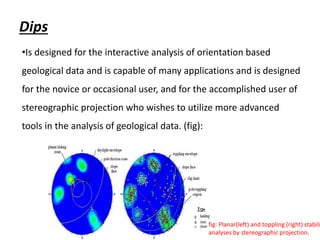
Dips
•Is designed for the interactive analysis of orientation based
geological data and is capable of many applications and is designed
for the novice or occasional user, and for the accomplished user of
stereographic projection who wishes to utilize more advanced
tools in the analysis of geological data. (fig):
fig: Planar(left) and toppling (right) stabili
analyses by stereographic projection.
Contd…..
•Allows the user to analyze and visualize structural data following
the same techniques used in manual stereo nets.
•In addition, it has many computational features, such as statistical
contouring of orientation clustering, mean orientation and
confidence calculation, cluster variability, and qualitative and
quantitative feature attribute analysis.
•Very popular ROCSCIENCE program .
DipAnalyst 2.0
•Perform quantitative kinematic analysis based on not just
representative discontinuity values, but all discontinuities and
their possible intersections.
•The calculated ratios are known as failure indices, and the
method is termed as the quantitative approach for kinematic
analysis.
•Also capable of performing the traditional stereonet-based
method.
2. Limit equilibrium analysis:
•A very common analysis techniques used today.
•Routinely used in the analysis of landslides where translational or
rotational movements occurs on distinct failure surfaces.
•Significant to simple block failure along distinct discontinuities.
•A considerable advances in commercially available limit
equilibrium codes have taken place .
Software's prominently used viz; SLIDE, SWEDGE, ROCPLANE,
SLOPE/W, SIGMA/W etc.
SLIDE
•Very popular 2D slope stability analysis program, which uses
conventional 2D limit equilibrium methods, to analyze slope
stability.
•The important features include:
Bishop, Spencer, Janbu, GLE (General Limit Equilibrium) and
other analysis methods.
 Circular, composite or non-circular surfaces can be
analyzed.
 Several search methods and search refinement options are
available, which allow the user to quickly determine the
critical slip surfaces with the lowest factor of safety.
Contd…
Loading: external, seismic, support.
Several different ways to model pore pressure.
•Much improved modeling of support. Explicitly model the effects of
geotextiles, grouted tiebacks, soil nails, micro piles or end anchored
support. User defined support allows any support force diagram to
be defined.
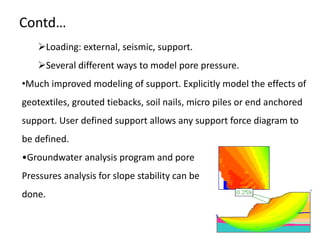
•Groundwater analysis program and pore
Pressures analysis for slope stability can be
done.
SWEDGE
•Program for evaluating the stability of surface wedges formed in
rock slopes, defined by two intersecting discontinuity planes, the
slope surface, and an optional tension crack.
•Provides a comprehensive stability analysis of tetrahedral surface
wedges in slopes, for both DETERMINISTIC (safety factor) and
PROBABILISTIC (probability of failure) types of analysis
•Statistical distributions can be defined, all input parameters and a
probability of for failure can be determined .
Contd…
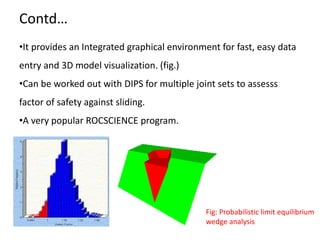
•It provides an Integrated graphical environment for fast, easy data
entry and 3D model visualization. (fig.)
•Can be worked out with DIPS for multiple joint sets to assesss
factor of safety against sliding.
•A very popular ROCSCIENCE program.
Fig: Probabilistic limit equilibrium
wedge analysis
ROCPLANE
•Very similar program to SWEDGE, except that it is applicable to 2D
planar failure in rock slopes, rather than 3D wedge failure.
•In addition, it allows the user to easily carry out a sensitivity
analysis, to determine which input parameters have the greatest
effect on the safety factor.
•It is both a useful analysis tool for professional engineers, and also
an instructive program for civil and geotechnical engineering
students.
3. Rockfall simulators
•Slope stability analysis may design protective measures near or
around structures endangered by the falling blocks.
•It determine travel paths and trajectories of unstable blocks
separated from a rock slope face.
•Assumes rock block as a point with mass and velocity moving on a
ballistic trajectory with regard to potential contact with slope
surface.
ROCFALL
•A 2D rockfall simulation program.
•Does not model the overall failure of a slope, but performs a risk
analysis of rockfalls (ie. rocks which break free of the slope
surface, and travel down the slope), using Monte Carlo sampling
of probabilistic input parameters.
•The statistical input parameters may include the rock mass and
initial velocity, the coefficient of restitution of each slope
segment, and other slope surface properties.
Contd…
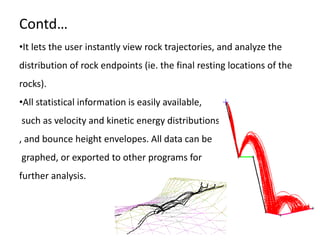
•It lets the user instantly view rock trajectories, and analyze the
distribution of rock endpoints (ie. the final resting locations of the
rocks).
•All statistical information is easily available,
such as velocity and kinetic energy distributions
, and bounce height envelopes. All data can be
graphed, or exported to other programs for
further analysis.
Numerical methods:
•Are mathematical models that use some sort of numerical time-
stepping procedure to obtain the models behavior over time.
•These are computer programs that represent the mechanical
response of a rock mass subjected to a set of initial conditions such
as in-situ stresses and water levels, boundary conditions and induced
changes such as slope excavation.
•The result can be extrapolated confidently outside its database in
comparison to empirical methods in which the failure mode is
explicitly defined.
•It can also incorporate geologic features such as faults and
ground water, providing more realistic approximations of behavior
of real slopes than analytical models.
•These techniques have been widely used to solve complex slope
problems, which otherwise, could not have been possible using
conventional techniques.
•These models are used to simulate rock slope as well soil slope
with complex conditions.
•The result of a numerical model can be extrapolated confidently
outside its database in comparison to empirical methods in which
the failure mode is explicitly defined.
Contd…
Contd…
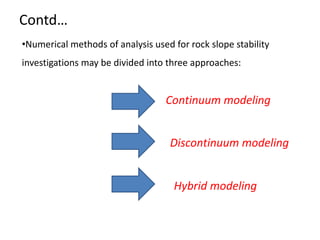
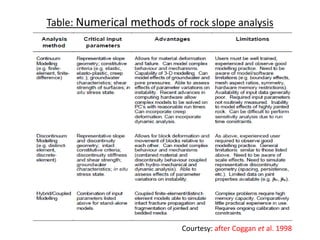
•Numerical methods of analysis used for rock slope stability
investigations may be divided into three approaches:
Continuum modeling
Discontinuum modeling
Hybrid modeling
Table: Numerical methods of rock slope analysis
Courtesy: after Coggan et al. 1998
Computer programs and its applications in:-
1. Continuum modeling
•is best suited for the analysis of slopes that are comprised of
massive, intact rock, weak rocks, and soil-like or heavily fractured
rock masses.
• fundamental importance to continuum 2 models in discrete
element models is representation of the rock mass behaviour
•Discrete fractures such as faults and bedding planes can be
incorporated.
•Finite difference, finite element and boundary element
methods are based on this modeling theory.
•The problem domain is discretized into a set of sub-domains or
elements.
•Important feature is complex behaviour of slope can be modeled
using continuum codes.
•Groundwater, pore pressures and dynamic interaction can also be
simulated.
•Some softwares based on continuum modeling like Phase2
(rocscience), FLAC2D, FLAC3D (Itasca 1997) and VISAGE (VIPS,
2001), PLAXIS .
Contd…
Phase2
•A 2D elasto-plastic finite element program, for the analysis of
stresses and displacements, as well as support analysis, for
underground or surface excavations.
•Can be used for the analysis of slope stability.
• No assumptions need to be made about the shape or location of
slip surfaces.
•The many assumptions which are inherent in conventional limit
equilibrium analyses (for example, the orientation of interslice
forces), are not necessary or applicable to the finite element
approach.
Contd…
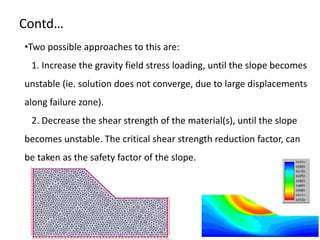
•Two possible approaches to this are:
1. Increase the gravity field stress loading, until the slope becomes
unstable (ie. solution does not converge, due to large displacements
along failure zone).
2. Decrease the shear strength of the material(s), until the slope
becomes unstable. The critical shear strength reduction factor, can
be taken as the safety factor of the slope.
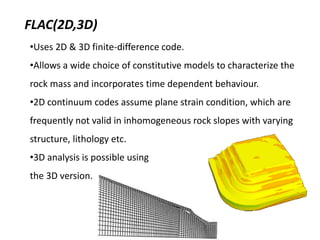
FLAC(2D,3D)
•Uses 2D & 3D finite-difference code.
•Allows a wide choice of constitutive models to characterize the
rock mass and incorporates time dependent behaviour.
•2D continuum codes assume plane strain condition, which are
frequently not valid in inhomogeneous rock slopes with varying
structure, lithology etc.
•3D analysis is possible using
the 3D version.
PLAXIS
•The geometry of the model can be easily defined in the soil and
structures modes.
•Allows for simulation of construction and excavation processes
by activating and deactivating soil clusters and structural objects.
•Applications include: assessing street level displacements during
the tunnel construction, consolidation analysis of embankments,
soil displacements around an excavation pit, dam stability during
different water levels.
2. Discontinuum modeling
•Treat the rock slope as a discontinuous rock mass by considering
it as an assemblage of rigid or deformable blocks.
•The analysis includes sliding and opening of rock discontinuities
controlled by the normal and shear stiffness of joints.
•It allows the deformation and movement of blocks relative to
each other so it can model complex behaviour and mechanisms.
•Limitation is that it requires representative discontinuity
geometry (spacing, persistence, etc.) along with joint data and
properties of each block.
Contd…
•Discontinuities divide the problem domain into blocks that may be
either rigid or deformable while continuum behavior is assumed
within deformable blocks.
•The most widely used discrete element codes for slope stability
studies are UDEC (Universal Distinct Element Code) and 3DEC (3-
Dimensional Distinct Element Code).
UDEC
•UDEC (Universal Distinct Element Code) a two-dimensional
numerical software that simulates the quasi-static or dynamic
response to loading of media containing multiple, intersecting joint
structures.
•Utilizes an explicit solution scheme that can model complex, non-
linear behaviors.
•Joint models and properties can be assigned separately to
individual, or sets of, discontinuities.
•Is capable of simulating and is used for a wide range of engineering
and scientific analyzes.
Contd…
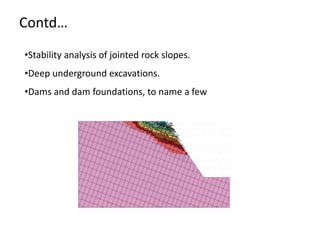
•Stability analysis of jointed rock slopes.
•Deep underground excavations.
•Dams and dam foundations, to name a few
3DEC
•Is a numerical modeling code for advanced geotechnical analysis
of soil, rock, and structural support in three dimensions.
•Simulates the response of discontinuous media (such as jointed
rock) that is subject to either static or dynamic loading.
•Discontinuous medium modeled as an assemblage of convex
polyhedra or concave polyhedra.
•Motion governing law same as that of UDEC.
•Material models include: elastic, anisotropic, Mohr-Coulomb,
Drucker Prager, bilinear plasticity, strain softening, creep, and user-
defined
3. Hybrid modeling
•Include combined analyses using limit equilibrium stability
analysis and finite-element groundwater flow.
•Coupled finite/distinct-element codes are now available which
incorporate adaptive remeshing.
•This uses finite-element mesh which represents either risk slope
or joint bounded block that is coupled with discrete-element
model able to model deformation involving joints.
•Specialized software viz; GEO-SLOPE used for groundwater flow
and stress analysis.
•FLAC3D and PFC , ELFEN are used as coupled software.
Conclusion
• Understanding the slope stability parameters is very important
for which different analyses is done.
• Use of computer programs for analyzing and simulation has
become a common mode for different analysis.
• Easy availability of microcomputers and software has made it vey
useful and effective tool.
• SLIDE, SWEDGE, ROCPLANE and ROCFALL are dedicated slope
stability software others can be used for slope stability analysis
(ie. DIPS and PHASE2).
• A program specific for rock slope analysis is AutoBlock, an add on
to the popular program "AutoCAD“.
Thank you

slope stability and computers

  • 1.
    Computer programs for SlopeStability And Computer Aided Design in rock slope engineering
  • 2.
    Slope & Slopestability analysis: an overview
  • 3.
    Slope •An exposed groundsurface that stands at an angle with the horizontal is called slope. •Either occur naturally or are engineered by humans. •Constantly moving down slope in response to gravity. •Can either be rock slope or soil slope or both.
  • 4.
    Slope stability • Theresistance that a slope offers to a failure by sliding or collapsing. • A balance of driving and resisting forces. •If Resisting forces > Driving Forces: Stable slope •If Resisting forces < Driving Forces: •For this slope stability analysis is done. Unstable slope causing slope failure
  • 5.
    Slope stability analysis •isroutinely performed to assess the safe design of a human made or natural slopes (e.g. embankments, road cuts, open pit mining, excavations, landfills etc.) and the equilibrium conditions. •A careful approach is required for consideration of various stress, weaknesses and limitations inherent for each methodology. •The analysis technique depends on both the site condition and potential mode of failure.
  • 6.
    Contd….. •Successful design ofthe slope requires geological information and site characteristics,( e.g. properties of soil/rock mass, slope geometry, groundwater conditions, alternation of materials by faulting, joint or discontinuity systems, movements and tension in joints, earthquake activity etc). • The presence of water has a detrimental effect on slope stability. Water pressure acting in the pore spaces, fractures or other discontinuities in the materials that make up the pit slope will reduce the strength of those materials.
  • 7.
     Objectives: •To findthe vulnerable areas for slope stability investigation. •To investigate potential failure mechanism. •To determine the slopes sensitivity/ susceptibility to different triggering mechanisms. •To generate optimal slopes designing with regard to safety. •To test and compare different stabilization and support options.
  • 8.
    Methods of analysis: •Broadlycategorized into two: Conventional methods Numerical methods
  • 9.
    Conventional methods: •Primarily groupedinto three techniques: Limit equilibrium analysis Rock fall simulators Kinematic analysis
  • 10.
    Courtesy: after Cogganet al. 1998 Table: Conventional methods of rock slope analysis
  • 11.
    Computer programs andComputer- Aided approach in slope stability: application and limitation
  • 12.
    Computer programs inslope stability •Computer program is written in basic language on a microcomputer to carrying out different analysis of slope stability. •The programs are capable of handling plane sliding, wedge sliding and toppling of rock slopes. •Applications of the program can be demonstrated by examples on opencast mine excavations and highway cuts etc. •As microcomputers are readily available nowadays.
  • 13.
    Computer programs andits applications in:- 1. Kinematic analysis: • Examines which modes of failure can possibly occur in the rock mass. • Concentrates on the feasibility of translational failures due to the formation of “daylighting” wedges or planes. • Assessment are done using stereonet plots for which Specialized computer programs is used. • Program viz; DIPS, DipAnalyst 2.0 etc.
  • 14.
    Dips •Is designed forthe interactive analysis of orientation based geological data and is capable of many applications and is designed for the novice or occasional user, and for the accomplished user of stereographic projection who wishes to utilize more advanced tools in the analysis of geological data. (fig): fig: Planar(left) and toppling (right) stabili analyses by stereographic projection.
  • 15.
    Contd….. •Allows the userto analyze and visualize structural data following the same techniques used in manual stereo nets. •In addition, it has many computational features, such as statistical contouring of orientation clustering, mean orientation and confidence calculation, cluster variability, and qualitative and quantitative feature attribute analysis. •Very popular ROCSCIENCE program .
  • 16.
    DipAnalyst 2.0 •Perform quantitativekinematic analysis based on not just representative discontinuity values, but all discontinuities and their possible intersections. •The calculated ratios are known as failure indices, and the method is termed as the quantitative approach for kinematic analysis. •Also capable of performing the traditional stereonet-based method.
  • 17.
    2. Limit equilibriumanalysis: •A very common analysis techniques used today. •Routinely used in the analysis of landslides where translational or rotational movements occurs on distinct failure surfaces. •Significant to simple block failure along distinct discontinuities. •A considerable advances in commercially available limit equilibrium codes have taken place . Software's prominently used viz; SLIDE, SWEDGE, ROCPLANE, SLOPE/W, SIGMA/W etc.
  • 18.
    SLIDE •Very popular 2Dslope stability analysis program, which uses conventional 2D limit equilibrium methods, to analyze slope stability. •The important features include: Bishop, Spencer, Janbu, GLE (General Limit Equilibrium) and other analysis methods.  Circular, composite or non-circular surfaces can be analyzed.  Several search methods and search refinement options are available, which allow the user to quickly determine the critical slip surfaces with the lowest factor of safety.
  • 19.
    Contd… Loading: external, seismic,support. Several different ways to model pore pressure. •Much improved modeling of support. Explicitly model the effects of geotextiles, grouted tiebacks, soil nails, micro piles or end anchored support. User defined support allows any support force diagram to be defined. •Groundwater analysis program and pore Pressures analysis for slope stability can be done.
  • 20.
    SWEDGE •Program for evaluatingthe stability of surface wedges formed in rock slopes, defined by two intersecting discontinuity planes, the slope surface, and an optional tension crack. •Provides a comprehensive stability analysis of tetrahedral surface wedges in slopes, for both DETERMINISTIC (safety factor) and PROBABILISTIC (probability of failure) types of analysis •Statistical distributions can be defined, all input parameters and a probability of for failure can be determined .
  • 21.
    Contd… •It provides anIntegrated graphical environment for fast, easy data entry and 3D model visualization. (fig.) •Can be worked out with DIPS for multiple joint sets to assesss factor of safety against sliding. •A very popular ROCSCIENCE program. Fig: Probabilistic limit equilibrium wedge analysis
  • 22.
    ROCPLANE •Very similar programto SWEDGE, except that it is applicable to 2D planar failure in rock slopes, rather than 3D wedge failure. •In addition, it allows the user to easily carry out a sensitivity analysis, to determine which input parameters have the greatest effect on the safety factor. •It is both a useful analysis tool for professional engineers, and also an instructive program for civil and geotechnical engineering students.
  • 23.
    3. Rockfall simulators •Slopestability analysis may design protective measures near or around structures endangered by the falling blocks. •It determine travel paths and trajectories of unstable blocks separated from a rock slope face. •Assumes rock block as a point with mass and velocity moving on a ballistic trajectory with regard to potential contact with slope surface.
  • 24.
    ROCFALL •A 2D rockfallsimulation program. •Does not model the overall failure of a slope, but performs a risk analysis of rockfalls (ie. rocks which break free of the slope surface, and travel down the slope), using Monte Carlo sampling of probabilistic input parameters. •The statistical input parameters may include the rock mass and initial velocity, the coefficient of restitution of each slope segment, and other slope surface properties.
  • 25.
    Contd… •It lets theuser instantly view rock trajectories, and analyze the distribution of rock endpoints (ie. the final resting locations of the rocks). •All statistical information is easily available, such as velocity and kinetic energy distributions , and bounce height envelopes. All data can be graphed, or exported to other programs for further analysis.
  • 26.
    Numerical methods: •Are mathematicalmodels that use some sort of numerical time- stepping procedure to obtain the models behavior over time. •These are computer programs that represent the mechanical response of a rock mass subjected to a set of initial conditions such as in-situ stresses and water levels, boundary conditions and induced changes such as slope excavation. •The result can be extrapolated confidently outside its database in comparison to empirical methods in which the failure mode is explicitly defined.
  • 27.
    •It can alsoincorporate geologic features such as faults and ground water, providing more realistic approximations of behavior of real slopes than analytical models. •These techniques have been widely used to solve complex slope problems, which otherwise, could not have been possible using conventional techniques. •These models are used to simulate rock slope as well soil slope with complex conditions. •The result of a numerical model can be extrapolated confidently outside its database in comparison to empirical methods in which the failure mode is explicitly defined. Contd…
  • 28.
    Contd… •Numerical methods ofanalysis used for rock slope stability investigations may be divided into three approaches: Continuum modeling Discontinuum modeling Hybrid modeling
  • 29.
    Table: Numerical methodsof rock slope analysis Courtesy: after Coggan et al. 1998
  • 30.
    Computer programs andits applications in:- 1. Continuum modeling •is best suited for the analysis of slopes that are comprised of massive, intact rock, weak rocks, and soil-like or heavily fractured rock masses. • fundamental importance to continuum 2 models in discrete element models is representation of the rock mass behaviour •Discrete fractures such as faults and bedding planes can be incorporated. •Finite difference, finite element and boundary element methods are based on this modeling theory.
  • 31.
    •The problem domainis discretized into a set of sub-domains or elements. •Important feature is complex behaviour of slope can be modeled using continuum codes. •Groundwater, pore pressures and dynamic interaction can also be simulated. •Some softwares based on continuum modeling like Phase2 (rocscience), FLAC2D, FLAC3D (Itasca 1997) and VISAGE (VIPS, 2001), PLAXIS . Contd…
  • 32.
    Phase2 •A 2D elasto-plasticfinite element program, for the analysis of stresses and displacements, as well as support analysis, for underground or surface excavations. •Can be used for the analysis of slope stability. • No assumptions need to be made about the shape or location of slip surfaces. •The many assumptions which are inherent in conventional limit equilibrium analyses (for example, the orientation of interslice forces), are not necessary or applicable to the finite element approach.
  • 33.
    Contd… •Two possible approachesto this are: 1. Increase the gravity field stress loading, until the slope becomes unstable (ie. solution does not converge, due to large displacements along failure zone). 2. Decrease the shear strength of the material(s), until the slope becomes unstable. The critical shear strength reduction factor, can be taken as the safety factor of the slope.
  • 34.
    FLAC(2D,3D) •Uses 2D &3D finite-difference code. •Allows a wide choice of constitutive models to characterize the rock mass and incorporates time dependent behaviour. •2D continuum codes assume plane strain condition, which are frequently not valid in inhomogeneous rock slopes with varying structure, lithology etc. •3D analysis is possible using the 3D version.
  • 35.
    PLAXIS •The geometry ofthe model can be easily defined in the soil and structures modes. •Allows for simulation of construction and excavation processes by activating and deactivating soil clusters and structural objects. •Applications include: assessing street level displacements during the tunnel construction, consolidation analysis of embankments, soil displacements around an excavation pit, dam stability during different water levels.
  • 36.
    2. Discontinuum modeling •Treatthe rock slope as a discontinuous rock mass by considering it as an assemblage of rigid or deformable blocks. •The analysis includes sliding and opening of rock discontinuities controlled by the normal and shear stiffness of joints. •It allows the deformation and movement of blocks relative to each other so it can model complex behaviour and mechanisms. •Limitation is that it requires representative discontinuity geometry (spacing, persistence, etc.) along with joint data and properties of each block.
  • 37.
    Contd… •Discontinuities divide theproblem domain into blocks that may be either rigid or deformable while continuum behavior is assumed within deformable blocks. •The most widely used discrete element codes for slope stability studies are UDEC (Universal Distinct Element Code) and 3DEC (3- Dimensional Distinct Element Code).
  • 38.
    UDEC •UDEC (Universal DistinctElement Code) a two-dimensional numerical software that simulates the quasi-static or dynamic response to loading of media containing multiple, intersecting joint structures. •Utilizes an explicit solution scheme that can model complex, non- linear behaviors. •Joint models and properties can be assigned separately to individual, or sets of, discontinuities. •Is capable of simulating and is used for a wide range of engineering and scientific analyzes.
  • 39.
    Contd… •Stability analysis ofjointed rock slopes. •Deep underground excavations. •Dams and dam foundations, to name a few
  • 40.
    3DEC •Is a numericalmodeling code for advanced geotechnical analysis of soil, rock, and structural support in three dimensions. •Simulates the response of discontinuous media (such as jointed rock) that is subject to either static or dynamic loading. •Discontinuous medium modeled as an assemblage of convex polyhedra or concave polyhedra. •Motion governing law same as that of UDEC. •Material models include: elastic, anisotropic, Mohr-Coulomb, Drucker Prager, bilinear plasticity, strain softening, creep, and user- defined
  • 41.
    3. Hybrid modeling •Includecombined analyses using limit equilibrium stability analysis and finite-element groundwater flow. •Coupled finite/distinct-element codes are now available which incorporate adaptive remeshing. •This uses finite-element mesh which represents either risk slope or joint bounded block that is coupled with discrete-element model able to model deformation involving joints. •Specialized software viz; GEO-SLOPE used for groundwater flow and stress analysis. •FLAC3D and PFC , ELFEN are used as coupled software.
  • 42.
    Conclusion • Understanding theslope stability parameters is very important for which different analyses is done. • Use of computer programs for analyzing and simulation has become a common mode for different analysis. • Easy availability of microcomputers and software has made it vey useful and effective tool. • SLIDE, SWEDGE, ROCPLANE and ROCFALL are dedicated slope stability software others can be used for slope stability analysis (ie. DIPS and PHASE2). • A program specific for rock slope analysis is AutoBlock, an add on to the popular program "AutoCAD“.
  • 43.