LEADERSHIP
PRESENT BY-
PRANAB SARKAR
DEFINITION OF LEADERSHIP
“A process of social influence in
which one person can enlist the aid
and support of others in the
accomplishment of a common
task”.
WHO ARE LEADERS AND WHAT IS
LEADERSHIP
 Leader – Someone who can influence others
and who has managerial authority
 Leadership – What leaders do; the process of
influencing a group to achieve goals
 Ideally, all managers should be leaders
 Although groups may have informal leaders
who emerge, those are not the leaders we’re
studying
CHARACTERISTICS OF LEADERSHIP
 Leadership implies the existence of
followers.
 Develops the interest between the leader
& followers.
 Distribution of authority among the
followers.
 The leadership is the process of infancy
 Leadership faction of stimulating
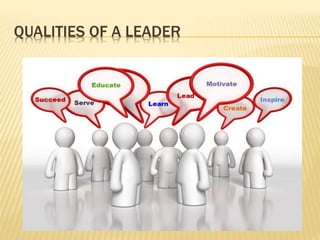
QUALITIES OF A LEADER
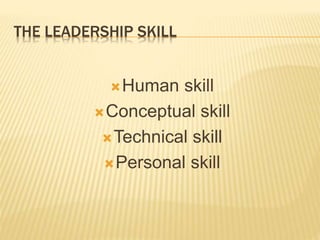
THE LEADERSHIP SKILL
Human skill
Conceptual skill
Technical skill
Personal skill
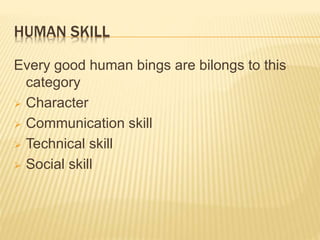
HUMAN SKILL
Every good human bings are bilongs to this
category
 Character
 Communication skill
 Technical skill
 Social skill
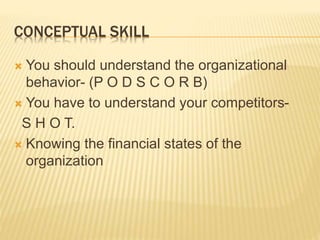
CONCEPTUAL SKILL
 You should understand the organizational
behavior- (P O D S C O R B)
 You have to understand your competitors-
S H O T.
 Knowing the financial states of the
organization
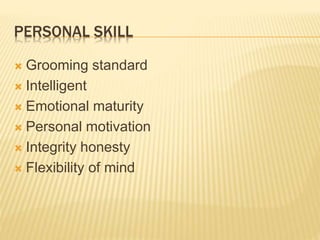
PERSONAL SKILL
 Grooming standard
 Intelligent
 Emotional maturity
 Personal motivation
 Integrity honesty
 Flexibility of mind
THE LEADERSHIP THEORIES
 Trait theory of leadership
 Behavioral theory of leadership.
 Situational theory of leadership.
 Great man theory of leadership
TRAIT THEORY OF LEADERSHIP
 Good personality
 Intelligence
 Maturity
 Self Confidence
 flexibility
 Responsibility
BEHAVIORAL THEORY OF LEADERSHIP
Human behavior make him/her leader
The good behavior will influence other.
 Behavioural:
 Imply that leaders can be trained – focus on the
way of doing things
 Structure based behavioural theories – focus on the
leader instituting structures – task orientated
 Relationship based behavioural theories – focus on the
development and maintenance of relationships – process
orientated
GREAT MAN THEORY OF LEADERSHIP
 Leader quality can not be acquired.
 Ordinary people can not be a leader.
 In born quality are sufficient to became a
leader.

4.leader ship

  • 1.
  • 2.
    DEFINITION OF LEADERSHIP “Aprocess of social influence in which one person can enlist the aid and support of others in the accomplishment of a common task”.
  • 3.
    WHO ARE LEADERSAND WHAT IS LEADERSHIP  Leader – Someone who can influence others and who has managerial authority  Leadership – What leaders do; the process of influencing a group to achieve goals  Ideally, all managers should be leaders  Although groups may have informal leaders who emerge, those are not the leaders we’re studying
  • 4.
    CHARACTERISTICS OF LEADERSHIP Leadership implies the existence of followers.  Develops the interest between the leader & followers.  Distribution of authority among the followers.  The leadership is the process of infancy  Leadership faction of stimulating
  • 5.
  • 6.
    THE LEADERSHIP SKILL Humanskill Conceptual skill Technical skill Personal skill
  • 7.
    HUMAN SKILL Every goodhuman bings are bilongs to this category  Character  Communication skill  Technical skill  Social skill
  • 8.
    CONCEPTUAL SKILL  Youshould understand the organizational behavior- (P O D S C O R B)  You have to understand your competitors- S H O T.  Knowing the financial states of the organization
  • 9.
    PERSONAL SKILL  Groomingstandard  Intelligent  Emotional maturity  Personal motivation  Integrity honesty  Flexibility of mind
  • 10.
    THE LEADERSHIP THEORIES Trait theory of leadership  Behavioral theory of leadership.  Situational theory of leadership.  Great man theory of leadership
  • 11.
    TRAIT THEORY OFLEADERSHIP  Good personality  Intelligence  Maturity  Self Confidence  flexibility  Responsibility
  • 12.
    BEHAVIORAL THEORY OFLEADERSHIP Human behavior make him/her leader The good behavior will influence other.  Behavioural:  Imply that leaders can be trained – focus on the way of doing things  Structure based behavioural theories – focus on the leader instituting structures – task orientated  Relationship based behavioural theories – focus on the development and maintenance of relationships – process orientated
  • 13.
    GREAT MAN THEORYOF LEADERSHIP  Leader quality can not be acquired.  Ordinary people can not be a leader.  In born quality are sufficient to became a leader.