PLANNING


PLANNING PROCESS



STRATEGIC PLANNING



OPERATIONAL PLANNING



STRATEGIC Vs. OPERATIONAL PLAN



1

DEFINITION OF PLANNING

TYPES OF PLANNING

joubertdias


DEFINITON
Planning has been defined by management expert Peter
Drucker as “the management function that includes
decisions and actions to insure future results."
joubertdias

Perspective:
 forecasting and budgeting
 long range planning
 Strategic planning
 Strategic management
-

2
BENEFITS AND LIMITATIONS OF PLANNING
Benefits
1.

3.

4.
5.
6.

1.
2.
3.
4.
5.
6.

Uncertain future
Time investment
Inflexible
Corporate inertia
Centrally focused
Implementation

joubertdias

2.

Establishes direction
Sets priorities and focuses
action
Facilitates resource
allocation
Increases motivation
Reduces cost & risk
Improves communication

Limitations

3
PLANNING PROCESS
o

o
o
o

o
o

joubertdias

o

Establishing objectives or goals
Seeking necessary Information
Establishing the planning premises
Identifying the alternative course of action.
Evaluating the alternatives.
Selecting the best alternative
Follow up

4
STRATEGIC PLANNING

-

Peter Drucker

-

In short, strategic planning is a disciplined effort to produce fundamental
decisions and actions that shape and guide what an organization is, what it
does, and why it does it, with a focus on the future.

5

joubertdias

“… the continuous process of making present entrepreneurial (risk-taking)
decisions systematically and with the greatest knowledge of their futurity;
organizing systematically the efforts needed to carry out these decisions; and
measuring the results of these decisions against the expectations through
organized, systematic feedback”.
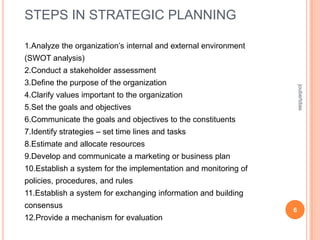
STEPS IN STRATEGIC PLANNING
1.Analyze the organization’s internal and external environment
(SWOT analysis)
2.Conduct a stakeholder assessment
joubertdias

3.Define the purpose of the organization
4.Clarify values important to the organization
5.Set the goals and objectives
6.Communicate the goals and objectives to the constituents
7.Identify strategies – set time lines and tasks
8.Estimate and allocate resources
9.Develop and communicate a marketing or business plan
10.Establish a system for the implementation and monitoring of
policies, procedures, and rules

11.Establish a system for exchanging information and building
consensus
12.Provide a mechanism for evaluation

6
OPERATIONAL PLANNING

short-range planning that deals with day-to-day
maintenance activities


performed at a unit or departmental level



joubertdias



done as part of the overall strategic planning

7
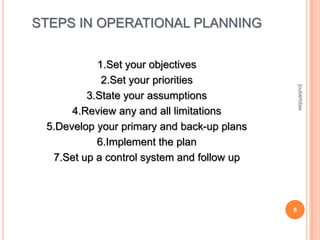
STEPS IN OPERATIONAL PLANNING

joubertdias

1.Set your objectives
2.Set your priorities
3.State your assumptions
4.Review any and all limitations
5.Develop your primary and back-up plans
6.Implement the plan
7.Set up a control system and follow up

8
OPERATIONAL PLAN VS. STRATEGIC PLAN
Strategic plan

Operational plan

Time

Several years of decades

1 year or 3 yrs

Degree of
details

General and non specific

Fine details of day-to-day work

Scope

extensive

Constricted

Mgmt level

Top level

Middle of lower level

implementation

Top level

Lower level

9

joubertdias

Base
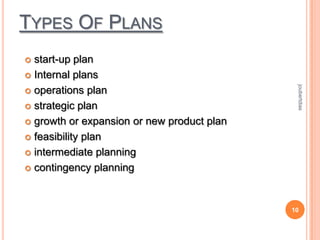
TYPES OF PLANS
start-up plan
 Internal plans
 operations plan
 strategic plan
 growth or expansion or new product plan
 feasibility plan
 intermediate planning
 contingency planning


joubertdias

10
joubertdias

11
Hope it helped
joubertdias

12

Planning

  • 1.
    PLANNING  PLANNING PROCESS  STRATEGIC PLANNING  OPERATIONALPLANNING  STRATEGIC Vs. OPERATIONAL PLAN  1 DEFINITION OF PLANNING TYPES OF PLANNING joubertdias 
  • 2.
    DEFINITON Planning has beendefined by management expert Peter Drucker as “the management function that includes decisions and actions to insure future results." joubertdias Perspective:  forecasting and budgeting  long range planning  Strategic planning  Strategic management - 2
  • 3.
    BENEFITS AND LIMITATIONSOF PLANNING Benefits 1. 3. 4. 5. 6. 1. 2. 3. 4. 5. 6. Uncertain future Time investment Inflexible Corporate inertia Centrally focused Implementation joubertdias 2. Establishes direction Sets priorities and focuses action Facilitates resource allocation Increases motivation Reduces cost & risk Improves communication Limitations 3
  • 4.
    PLANNING PROCESS o o o o o o joubertdias o Establishing objectivesor goals Seeking necessary Information Establishing the planning premises Identifying the alternative course of action. Evaluating the alternatives. Selecting the best alternative Follow up 4
  • 5.
    STRATEGIC PLANNING - Peter Drucker - Inshort, strategic planning is a disciplined effort to produce fundamental decisions and actions that shape and guide what an organization is, what it does, and why it does it, with a focus on the future. 5 joubertdias “… the continuous process of making present entrepreneurial (risk-taking) decisions systematically and with the greatest knowledge of their futurity; organizing systematically the efforts needed to carry out these decisions; and measuring the results of these decisions against the expectations through organized, systematic feedback”.
  • 6.
    STEPS IN STRATEGICPLANNING 1.Analyze the organization’s internal and external environment (SWOT analysis) 2.Conduct a stakeholder assessment joubertdias 3.Define the purpose of the organization 4.Clarify values important to the organization 5.Set the goals and objectives 6.Communicate the goals and objectives to the constituents 7.Identify strategies – set time lines and tasks 8.Estimate and allocate resources 9.Develop and communicate a marketing or business plan 10.Establish a system for the implementation and monitoring of policies, procedures, and rules 11.Establish a system for exchanging information and building consensus 12.Provide a mechanism for evaluation 6
  • 7.
    OPERATIONAL PLANNING short-range planningthat deals with day-to-day maintenance activities  performed at a unit or departmental level  joubertdias  done as part of the overall strategic planning 7
  • 8.
    STEPS IN OPERATIONALPLANNING joubertdias 1.Set your objectives 2.Set your priorities 3.State your assumptions 4.Review any and all limitations 5.Develop your primary and back-up plans 6.Implement the plan 7.Set up a control system and follow up 8
  • 9.
    OPERATIONAL PLAN VS.STRATEGIC PLAN Strategic plan Operational plan Time Several years of decades 1 year or 3 yrs Degree of details General and non specific Fine details of day-to-day work Scope extensive Constricted Mgmt level Top level Middle of lower level implementation Top level Lower level 9 joubertdias Base
  • 10.
    TYPES OF PLANS start-upplan  Internal plans  operations plan  strategic plan  growth or expansion or new product plan  feasibility plan  intermediate planning  contingency planning  joubertdias 10
  • 11.
  • 12.