PLANNING
Karthik.K 14bme069
Manobalaa .R 14bme079
Palanisamy.K 14bme094
Pradeep.A 14bme100
Deepak anandh.M.B 14bme222
Sri Prasanth.S 14bme227
PLANNING
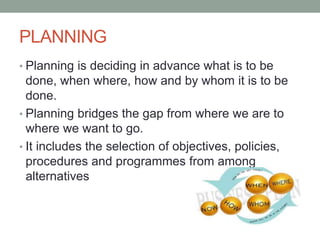
• Planning is deciding in advance what is to be
done, when where, how and by whom it is to be
done.
• Planning bridges the gap from where we are to
where we want to go.
• It includes the selection of objectives, policies,
procedures and programmes from among
alternatives
ACCORDING TO MANAGEMENT
THEORIST:
• According to Koontz O'Donnel - "Planning is an
intellectual process, the conscious determination
of courses of action, the basing of decisions on
purpose, acts and considered estimates".
• “Planning is deciding in advance what is to be
done”
-W H Newman
NATURE OF PLANNING
1.Planning is goal oriented
2.Primacy of planning
3.Pervasiveness of planning
4.Efficiency,Economy and Accuracy
5.Co ordination
6.Limiting factors
7.Flexibility
8.Planning is an intellectual process
PURPOSE OF PLANNING
1.To manage by objectives
2.To offset uncertainty and change
3.To secure economy in operation
4.To help in coordination
5.To make control effective
6.To increase organisational effectiveness
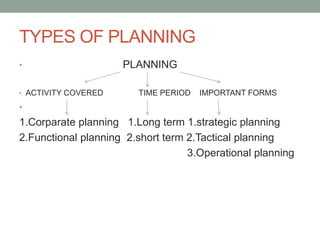
TYPES OF PLANNING
• PLANNING
• ACTIVITY COVERED TIME PERIOD IMPORTANT FORMS
•
1.Corparate planning 1.Long term 1.strategic planning
2.Functional planning 2.short term 2.Tactical planning
3.Operational planning
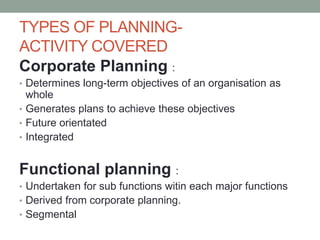
TYPES OF PLANNING-
ACTIVITY COVERED
Corporate Planning :
• Determines long-term objectives of an organisation as
whole
• Generates plans to achieve these objectives
• Future orientated
• Integrated
Functional planning :
• Undertaken for sub functions witin each major functions
• Derived from corporate planning.
• Segmental
TIME PERIOD
LONG TERM :
• Strategic in nature.
• Involves generally 3-5 years.
• It relates to matters like new product ,product
diversification .
SHORT TERM:
• Short term planning typically covers time frames of less
than one year in order to assist their company in moving
gradually toward its longer term.
• Examples are the skills of the employees and their
attitudes. The condition of production equipment or
product quality problems are also short-term concerns.
IMPORTANT FORMS
STRATEGIC :
• It sets future directions of the
organization in which it wants to proceed in future.
• It involves a time horizon of more than
one year and for most of the organization it
ranges between 3 and 5 years.
• Strategic plans are generally developed by top level
management.
• Eg. diversification of business into new lines, planned
grown rate in sales.
Operational plans are developed to determine
the steps necessary for achieving tactical goals..
They are used as a guide for day to day
operation by department managers.
These plans may cover a time frame of few
months, weeks or even a few days.
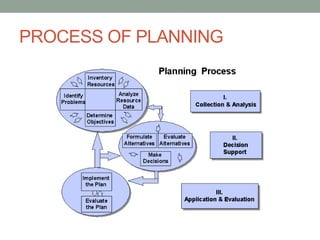
PROCESS OF PLANNING
ADVANTAGES OF PLANNING
Planning minimizes uncertainties
Planning facilitates co-ordination
Planning improves employee’s moral
Planning helps in achieving economies
Planning facilitates controlling
Planning provides competitive edge
Planning encourages innovations

Planning

  • 1.
    PLANNING Karthik.K 14bme069 Manobalaa .R14bme079 Palanisamy.K 14bme094 Pradeep.A 14bme100 Deepak anandh.M.B 14bme222 Sri Prasanth.S 14bme227
  • 2.
    PLANNING • Planning isdeciding in advance what is to be done, when where, how and by whom it is to be done. • Planning bridges the gap from where we are to where we want to go. • It includes the selection of objectives, policies, procedures and programmes from among alternatives
  • 3.
    ACCORDING TO MANAGEMENT THEORIST: •According to Koontz O'Donnel - "Planning is an intellectual process, the conscious determination of courses of action, the basing of decisions on purpose, acts and considered estimates". • “Planning is deciding in advance what is to be done” -W H Newman
  • 4.
    NATURE OF PLANNING 1.Planningis goal oriented 2.Primacy of planning 3.Pervasiveness of planning 4.Efficiency,Economy and Accuracy 5.Co ordination 6.Limiting factors 7.Flexibility 8.Planning is an intellectual process
  • 5.
    PURPOSE OF PLANNING 1.Tomanage by objectives 2.To offset uncertainty and change 3.To secure economy in operation 4.To help in coordination 5.To make control effective 6.To increase organisational effectiveness
  • 6.
    TYPES OF PLANNING •PLANNING • ACTIVITY COVERED TIME PERIOD IMPORTANT FORMS • 1.Corparate planning 1.Long term 1.strategic planning 2.Functional planning 2.short term 2.Tactical planning 3.Operational planning
  • 7.
    TYPES OF PLANNING- ACTIVITYCOVERED Corporate Planning : • Determines long-term objectives of an organisation as whole • Generates plans to achieve these objectives • Future orientated • Integrated Functional planning : • Undertaken for sub functions witin each major functions • Derived from corporate planning. • Segmental
  • 8.
    TIME PERIOD LONG TERM: • Strategic in nature. • Involves generally 3-5 years. • It relates to matters like new product ,product diversification . SHORT TERM: • Short term planning typically covers time frames of less than one year in order to assist their company in moving gradually toward its longer term. • Examples are the skills of the employees and their attitudes. The condition of production equipment or product quality problems are also short-term concerns.
  • 9.
    IMPORTANT FORMS STRATEGIC : •It sets future directions of the organization in which it wants to proceed in future. • It involves a time horizon of more than one year and for most of the organization it ranges between 3 and 5 years. • Strategic plans are generally developed by top level management. • Eg. diversification of business into new lines, planned grown rate in sales.
  • 10.
    Operational plans aredeveloped to determine the steps necessary for achieving tactical goals.. They are used as a guide for day to day operation by department managers. These plans may cover a time frame of few months, weeks or even a few days.
  • 11.
  • 12.
    ADVANTAGES OF PLANNING Planningminimizes uncertainties Planning facilitates co-ordination Planning improves employee’s moral Planning helps in achieving economies Planning facilitates controlling Planning provides competitive edge Planning encourages innovations