STRATEGIC PLANNING, CONCEPTS,
OPERATIONAL PLANNING ETC.
Introduction
What is PLANNING?
TYPES OF PLANNING
Advantages
Limitations
“PLANNING”
Planning is deciding in advance what is to be
done, when where, how and by whom it is to
be done.
Planning bridges the gap from where we are to
where we want to go.
It includes the selection of
objectives, policies, procedures and
programmes from among alternatives
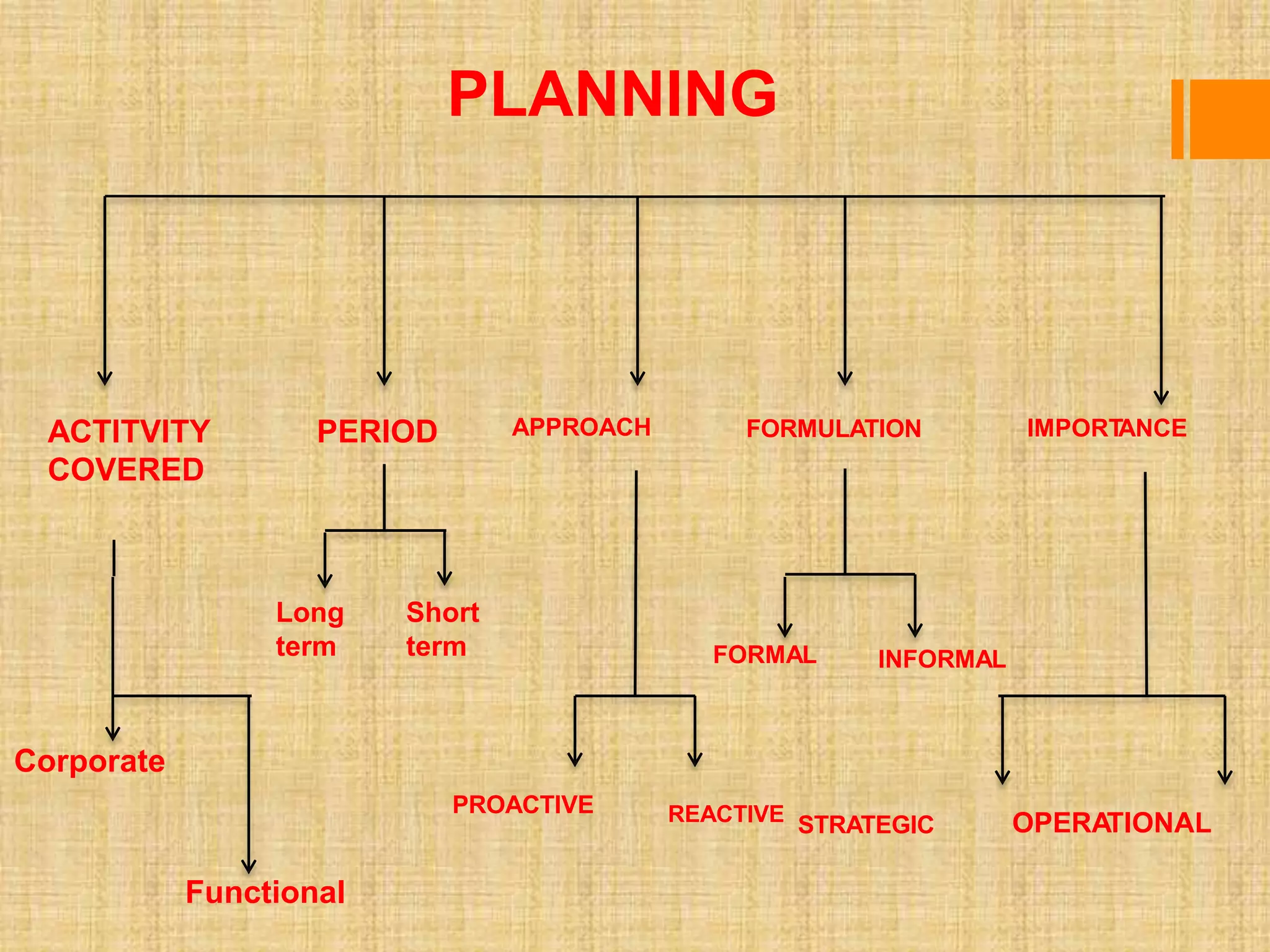
TYPES OF PLANNING
ACTITVITY
COVERED
Corporate
Functional
PERIOD
Long
term
Short
term
APPROACH
PROACTIVE
FORMULATION
FORMAL INFORMAL
IMPORTANCE
REACTIVE STRATEGIC OPERATIONAL
PLANNING
ACTIVITY COVERED
Corporate Planning :
Determines long-term objectives of an organisation as
whole
Generates plans to achieve these objectives
Future orientated
Integrated
Functional planning :
Undertaken for sub functions witin each major functions
Derived from corporate planning.
Segmental
TIME-PERIOD
Depends on the type of the buisness and structure of
the organisation.
LONG TERM :
Strategic in nature.
Involves generally 3-5 years.
It relates to matters like new product ,product
diversification .
SHORT
TERM :
• Short term planning typically covers time
frames of less than one year in order to assist
the company in moving gradually toward its
longer term.
• Examples are the skills of the employees and
their attitudes. The condition of production
equipment or product quality problems are also
short-term concerns.
APPROACH
• PROACTIVE PLANNING :
 Designing suitable course of action in anticipation of
likely
• changes in relevant environment.
 To take decision in advance.
 Eg : Emergency organisations
• REACTIVE PLANNING :
 Reactive planning is the process whereby future action
is dictated as a response to whatever has already, or is
now occurring.
 Eg. Hotel Manager.
DEGREE OF FORMALISATION
FORMAL PLANNING :
 It is a structured plan.
 It has some procedure to follow.
 Written record is followed in formal plan.
 Eg. Five year plan of a country.
INFORMAL PLANNING
 It is unstructured plan.
 It does not have any procedure to follow.
 No record is maintained for future purpose.
IMPORTANCE OF CONTENTS
STRATEGIC :
It sets future directions of the
organization in which it wants to proceed in future.
It involves a time horizon of more than one year and for most
of the organization it ranges between 3 and 5 years.
 Strategic plans are generally developed by top level
management.
Eg. diversification of business into new lines, planned
grown rate in sales.
OPERATIONA
L
Operational plans are developed to determine
the steps necessary for achieving tactical goals..
They are used as a guide for day to day
operation by department managers.
These plans may cover a time frame of few
months, weeks or even a few days.
ADVANTAGES
Planning facilitates management by
objectives
Planning minimizes uncertainties
Planning facilitates co-ordination
Planning improves employee’s morale
Planning helps in achieving economies
Planning facilitates controlling
Planning provides competitive edge
Planning encourages innovations
Planning facilitates management by
objectives
Planning begins with determination of objectives.
It highlights the purposes for which various activities are
to be undertaken.
In fact, it makes objectives more clear and specific.
Planning helps in focusing the attention of employees on
the objectives or goals of enterprise.
Without planning an organization has no guide.
Planning compels manager to prepare a Blue-print of
the courses of action to be followed for accomplishment
of objectives.
Therefore, planning brings order and rationality into the
organization.
Planning minimize uncertainties
Business is full of uncertainties.
There are risks of various types due to uncertainties.
Planning helps in reducing uncertainties of future as it
involves anticipation of future events.
Although future cannot be predicted with cent percent
accuracy but planning helps management to anticipate
future and prepare for risks by necessary provisions to
meet unexpected turn of events.
Therefore with the help of planning, uncertainties can
be forecasted which helps in preparing standbys as a
result, uncertainties are minimized to a great extent.
Planning facilitates coordination
Planning revolves around organizational goals.
All activities are directed towards common goals.
There is an integrated effort throughout the
enterprise in various departments and groups.
It avoids duplication of efforts. In other words, it
leads to better co-ordination.
It helps in finding out problems of work
performance and aims at rectifying the same.
Planning improves employee’s
morale.
Planning creates an atmosphere of order
and discipline in organization.
Employees know in advance what is
expected of them and therefore conformity
can be achieved easily.
This encourages employees to show their
best and also earn reward for the same.
Planning creates a healthy attitude towards
work environment which helps in boosting
employees morale and efficiency
Planning helps in achieving
economies
Effective planning secures economy since it leads to
orderly allocation ofresources to various operations.
It also facilitates optimum utilization of resources which
brings economy in operations.
It also avoids wastage of resources by selecting most
appropriate use that will contribute to the objective of
enterprise. For example, raw materials can be purchased
in bulk and transportation cost can be minimized. At the
same time it ensures regular supply for the production
department, that is, overall efficiency
Planning facilitates controlling
Planning facilitates existence of certain planned
goals and standard of performance.
It provides basis of controlling.
We cannot think of an effective system of controlling
without existence of well thought out plans.
Planning provides pre-determined goals against
which actual performance is compared.
In fact, planning and controlling are the two sides of
a same coin. If planning is root, controlling is the fruit.
Planning provides competitive
edge.
Planning provides competitive edge to the enterprise over
the others which do not have effective planning. This is
because of the fact that planning may involve changing in
work methods, quality, quantity designs, extension of
work, redefining of goals, etc.
With the help of forecasting not only the enterprise
secures its future but at the same time it is able to
estimate the future motives of it’s competitor which helps
in facing future challenges.
Therefore, planning leads to best utilization of possible
resources, improves quality of production and thus the
competitive strength of the enterprise is improved
Planning encourages
innovations.
In the process of planning, managers have the
opportunities of suggesting ways and means of
improving performance.
Planning is basically a decision making function
which involves creative thinking and imagination
that ultimately leads to innovation of methods
and operations for growth and prosperity of the
enterprise
Limitations of
Planning
Costly process
 Planning involves too much expenditure. Money
and effort both are required in planning.
Planning includes collecting information, data
forecasting and evaluation of alternatives. It
requires salary and allowances to the experts in
the process of providing services.
So, planning has been accepted as costly
process by small and medium size organization
Time consuming
Planning is the time consuming process. It
delays the business activity to come in action.
In the process of planning following the
procedures of planning takes a lot of time which
may create problem to the organization where
immediate action has to be made. So in such
situation planning is not suitable.
False sense of
security
Planning encourages false sense of
security against future risk and uncertainty.
As future is uncertain, it is unpredictable.
Therefore, planning cannot give accurate
and reliable results.
RAPID CHANGE
Rapid changes in technology ,consumer
tastes and prefernces are further limitations
to planning.
Eg.: Planning in aircraft
,chemical,electronic and information
industries is specially complicated due to
acceptionally complex and rapidly changing
production technology.
PREMIUM ON PRESENT
Present is always more real than the future , and
present problems seem to be more urgent than
the future problems.
Many of us are inclined to take care of today
and hope that tomorrow will take care
of itself . This is normal human tendency but in
fact we have to take take care of today as well
as tommorow.
Advantages and
Disadvantages of
Strategic
Management
Strategic Management vs.
Strategic Planning
I have deliberately used the words strategic management and NOT strategic
planning. Webster's defines planning as "a proposed or intended course of
action, or a formulated scheme setting out stages of procedure". Oxford
defines planning as a "formulated or organized method by which a thing is to
be done". Yet, when we think of management we tend to think of a systems
approach to the optimization of the organization.
Strategic planning still has the connotation of a process that is discrete,
separate, and independent from the business of an organization. While
strategic management connotes the planning, implementation, evaluation, on-
going maintenance, and adjustment of the organization's strategy. Because I
believe that strategic management is an integral aspect of an organization's
business and not just a once per every three-year retreat, I have used the term
strategic management.
The Advantages of Strategic Management
Discharges Board Responsibility
The first reason that most organizations state for having a
strategic management process is that it discharges the
responsibility of the Board of Directors.
Forces An Objective Assessment
Strategic management provides a discipline that enables the
board and senior management to actually take a step back from
the day-to-day business to think about the future of the
organization. Without this discipline, the organization can
become solely consumed with working through the next issue or
problem without consideration of the larger picture.
The Advantages of Strategic Management
Provides a Framework For Decision-Making
Strategy provides a framework within which all staff can make day-to-day
operational decisions and understand that those decisions are all moving the
organization in a single direction. It is not possible (nor realistic or appropriate)
for the board to know all the decisions the executive director will have to
make, nor is it possible (nor realistic or practical) for the executive director to
know all the decisions the staff will make.
Strategy provides a vision of the future, confirms the purpose and values of an
organization, sets objectives, clarifies threats and opportunities, determines
methods to leverage strengths, and mitigate weaknesses (at a minimum). As
such, it sets a framework and clear boundaries within which decisions can be
made.
The cumulative effect of these decisions (which can add up to thousands over
the year) can have a significant impact on the success of the organization.
Providing a framework within which the executive director and staff can make
these decisions helps them better focus their efforts on those things that will
best support the organization's success.
The Advantages of Strategic Management
Supports Understanding & Buy-In
Allowing the board and staff participation in the strategic
discussion enables them to better understand the direction, why
that direction was chosen, and the associated benefits. For some
people simply knowing is enough; for many people, to gain their
full support requires them to understand.
Enables Measurement of Progress
A strategic management process forces an organization to set
objectives and measures of success. The setting of measures of
success requires that the organization first determine what is
critical to its ongoing success and then forces the establishment
of objectives and keeps these critical measures in front of the
board and senior management.
The Advantages of Strategic Management
Provides an Organizational Perspective
Addressing operational issues rarely looks at the whole
organization and the interrelatedness of its varying components.
Strategic management takes an organizational perspective and
looks at all the components and the interrelationship between
those components in order to develop a strategy that is optimal
for the whole organization and not a single component.
The Disadvantages of Strategic Management
The Future Doesn't Unfold As Anticipated
One of the major criticisms of strategic management is that it
requires the organization to anticipate the future environment in
order to develop plans, and as we all know, predicting the future
is not an easy undertaking. The belief being that if the future does
not unfold as anticipated then it may invalidate the strategy
taken.
Recent research conducted in the private sector has
demonstrated that organizations that use planning process
achieve better performance than those organizations who don't
plan - regardless of whether they actually achieved their intended
objective. In addition, there are a variety of approaches to
strategic planning that are not as dependent upon the prediction
of the future.
The Disadvantages of Strategic Management
It Can Be Expensive
There is no doubt that in the not-for-profit sector there are many
organizations that cannot afford to hire an external consultant to
help them develop their strategy. Today there are many
volunteers that can help smaller organizations and also funding
agencies that will support the cost of hiring external consultants
in developing a strategy.
Regardless, it is important to ensure that the implementation of a
strategic management process is consistent with the needs of the
organization, and that appropriate controls are implemented to
allow the cost/benefit discussion to be undertaken, prior to the
implementation of a strategic management process.
The Disadvantages of Strategic Management
Long Term Benefit vs. Immediate Results
Strategic management processes are designed to provide an
organization with long-term benefits. If you are looking at the
strategic management process to address an immediate crisis
within your organization, it won't. It always makes sense to
address the immediate crises prior to allocating resources (time,
money, people, opportunity, cost) to the strategic management
process.
The Disadvantages of Strategic Management
Impedes Flexibility
When you undertake a strategic management process, it will result in the
organization saying "no" to some of the opportunities that may be available. This
inability to choose all of the opportunities presented to an organization is
sometimes frustrating. In addition, some organizations develop a strategic
management process that become excessively formal. Processes that become this
"established" lack innovation and creativity and can stifle the ability of the
organization to develop creative strategies. In this scenario, the strategic
management process has become the very tool that now inhibits the organization's
ability to change and adapt.
A third way that flexibility can be impeded is through a well-executed alignment
and integration of the strategy within the organization. An organization that is well
aligned with its strategy has addressed its a structure, board, staffing, and
performance and reward systems. This alignment ensures that the whole
organization is pulling in the right direction, but can inhibit the organization's
adaptability. Again, there are a variety of newer approaches to strategy
development used in the private sector (they haven't been widely accepted in the
not-for-profit sector yet) that build strategy and address the issues of
organizational adaptability.
Strategic and Operational
Planning
XFL
A great idea does not guarantee success. In fact,
for every ten products introduced, eight fail. The
reason for this high rate of failure? Poor planning.
A prime example is the now-defunct XFL, which
was the World Wrestling Federation’s attempt at
developing a new professional football league.
In strategic planning, management develops a
mission and long-term objectives and determines
in advance how they will be accomplished.
In operational planning, management sets short-
term objectives and determines in advance how
they will be accomplished.
Strategic vs. Operational Planning
The Strategic Process
• Develop mission
• Analyze environment
• Set objectives
• Develop strategies
• Implement and control strategies
Three Levels of Strategies
• Corporate
• Business
• Functional
Situation Analysis
Draws out those features in a company’s
environment that most directly frame its strategic
window of options and opportunities.
Situation Analysis: Three Parts
• Analysis of the company’s industry and its
competition
• Analysis of the company’s particular situation
• Analysis of the company’s competitive advantage
(or lack thereof)
Five Competitive Forces
• Rivalry among competing firms
• Potential development of substitute products and
services
• Potential entry of new competitors
• Bargaining power of suppliers
• Bargaining power of consumers
• Step 1: Assess present strategy
• Step 2: Analyze SWOTs
• Step 3: Assess competitive strength
• Step 4: Make conclusions
• Step 5: Decide what issues to address
Company Analysis: Five Steps
Competitive Advantage
Specifies how the organization offers unique
customer value.
• What makes us different from our competition?
• Why should a person buy our product or service
over the competition’s?
• Goals state general targets to be accomplished.
• Objectives state what is to be accomplished in
specific and measurable terms by a certain target
date.
Goals and Objectives
Management by Objectives
MBO is the process by which managers and their
teams jointly set objectives, periodically evaluate
performance, and reward according to the results.
Grand Strategies
• Growth
• Stability
• Turnaround and Retrenchment
• Or a combination thereof
Corporate Growth Strategies
• Concentration
• Backward integration
• Forward integration
• Related and unrelated diversification
• Mergers
• Acquisitions
Business Portfolio Analysis
• Corporations determine which lines of business
they will be in and how they will allocate resources
among the different lines.
• A business line—also called a strategic business
unit (SBU)—is a distinct business with its own
customers that is managed reasonably and
independently of the corporation’s other
businesses.
BCG Growth-Share Matrix
• Cash cows
• Question marks
• Stars
• Dogs
Business-Level Strategy
• Adaptive Strategies: prospecting, defending, and
analyzing.
• Competitive Strategies: Michael Porter identifies
three effective business-level : differentiation, cost
leadership, and focus.
Product Life Cycle
• Introduction
• Growth
• Maturity
• Decline
Functional-Level Strategies
Operational strategies are used by every functional-
level department—marketing, operations, human
resources, finance—to achieve corporate- and
business-level objectives.

L 3 strategic planning, concepts, operational planning etc

  • 1.
  • 2.
    Introduction What is PLANNING? TYPESOF PLANNING Advantages Limitations
  • 3.
    “PLANNING” Planning is decidingin advance what is to be done, when where, how and by whom it is to be done. Planning bridges the gap from where we are to where we want to go. It includes the selection of objectives, policies, procedures and programmes from among alternatives
  • 4.
  • 5.
  • 6.
    ACTIVITY COVERED Corporate Planning: Determines long-term objectives of an organisation as whole Generates plans to achieve these objectives Future orientated Integrated Functional planning : Undertaken for sub functions witin each major functions Derived from corporate planning. Segmental
  • 7.
    TIME-PERIOD Depends on thetype of the buisness and structure of the organisation. LONG TERM : Strategic in nature. Involves generally 3-5 years. It relates to matters like new product ,product diversification .
  • 8.
    SHORT TERM : • Shortterm planning typically covers time frames of less than one year in order to assist the company in moving gradually toward its longer term. • Examples are the skills of the employees and their attitudes. The condition of production equipment or product quality problems are also short-term concerns.
  • 9.
    APPROACH • PROACTIVE PLANNING:  Designing suitable course of action in anticipation of likely • changes in relevant environment.  To take decision in advance.  Eg : Emergency organisations • REACTIVE PLANNING :  Reactive planning is the process whereby future action is dictated as a response to whatever has already, or is now occurring.  Eg. Hotel Manager.
  • 10.
    DEGREE OF FORMALISATION FORMALPLANNING :  It is a structured plan.  It has some procedure to follow.  Written record is followed in formal plan.  Eg. Five year plan of a country. INFORMAL PLANNING  It is unstructured plan.  It does not have any procedure to follow.  No record is maintained for future purpose.
  • 11.
    IMPORTANCE OF CONTENTS STRATEGIC: It sets future directions of the organization in which it wants to proceed in future. It involves a time horizon of more than one year and for most of the organization it ranges between 3 and 5 years.  Strategic plans are generally developed by top level management. Eg. diversification of business into new lines, planned grown rate in sales.
  • 12.
    OPERATIONA L Operational plans aredeveloped to determine the steps necessary for achieving tactical goals.. They are used as a guide for day to day operation by department managers. These plans may cover a time frame of few months, weeks or even a few days.
  • 13.
    ADVANTAGES Planning facilitates managementby objectives Planning minimizes uncertainties Planning facilitates co-ordination Planning improves employee’s morale Planning helps in achieving economies Planning facilitates controlling Planning provides competitive edge Planning encourages innovations
  • 14.
    Planning facilitates managementby objectives Planning begins with determination of objectives. It highlights the purposes for which various activities are to be undertaken. In fact, it makes objectives more clear and specific. Planning helps in focusing the attention of employees on the objectives or goals of enterprise. Without planning an organization has no guide. Planning compels manager to prepare a Blue-print of the courses of action to be followed for accomplishment of objectives. Therefore, planning brings order and rationality into the organization.
  • 15.
    Planning minimize uncertainties Businessis full of uncertainties. There are risks of various types due to uncertainties. Planning helps in reducing uncertainties of future as it involves anticipation of future events. Although future cannot be predicted with cent percent accuracy but planning helps management to anticipate future and prepare for risks by necessary provisions to meet unexpected turn of events. Therefore with the help of planning, uncertainties can be forecasted which helps in preparing standbys as a result, uncertainties are minimized to a great extent.
  • 16.
    Planning facilitates coordination Planningrevolves around organizational goals. All activities are directed towards common goals. There is an integrated effort throughout the enterprise in various departments and groups. It avoids duplication of efforts. In other words, it leads to better co-ordination. It helps in finding out problems of work performance and aims at rectifying the same.
  • 17.
    Planning improves employee’s morale. Planningcreates an atmosphere of order and discipline in organization. Employees know in advance what is expected of them and therefore conformity can be achieved easily. This encourages employees to show their best and also earn reward for the same. Planning creates a healthy attitude towards work environment which helps in boosting employees morale and efficiency
  • 18.
    Planning helps inachieving economies Effective planning secures economy since it leads to orderly allocation ofresources to various operations. It also facilitates optimum utilization of resources which brings economy in operations. It also avoids wastage of resources by selecting most appropriate use that will contribute to the objective of enterprise. For example, raw materials can be purchased in bulk and transportation cost can be minimized. At the same time it ensures regular supply for the production department, that is, overall efficiency
  • 19.
    Planning facilitates controlling Planningfacilitates existence of certain planned goals and standard of performance. It provides basis of controlling. We cannot think of an effective system of controlling without existence of well thought out plans. Planning provides pre-determined goals against which actual performance is compared. In fact, planning and controlling are the two sides of a same coin. If planning is root, controlling is the fruit.
  • 20.
    Planning provides competitive edge. Planningprovides competitive edge to the enterprise over the others which do not have effective planning. This is because of the fact that planning may involve changing in work methods, quality, quantity designs, extension of work, redefining of goals, etc. With the help of forecasting not only the enterprise secures its future but at the same time it is able to estimate the future motives of it’s competitor which helps in facing future challenges. Therefore, planning leads to best utilization of possible resources, improves quality of production and thus the competitive strength of the enterprise is improved
  • 21.
    Planning encourages innovations. In theprocess of planning, managers have the opportunities of suggesting ways and means of improving performance. Planning is basically a decision making function which involves creative thinking and imagination that ultimately leads to innovation of methods and operations for growth and prosperity of the enterprise
  • 22.
  • 23.
    Costly process  Planninginvolves too much expenditure. Money and effort both are required in planning. Planning includes collecting information, data forecasting and evaluation of alternatives. It requires salary and allowances to the experts in the process of providing services. So, planning has been accepted as costly process by small and medium size organization
  • 24.
    Time consuming Planning isthe time consuming process. It delays the business activity to come in action. In the process of planning following the procedures of planning takes a lot of time which may create problem to the organization where immediate action has to be made. So in such situation planning is not suitable.
  • 25.
    False sense of security Planningencourages false sense of security against future risk and uncertainty. As future is uncertain, it is unpredictable. Therefore, planning cannot give accurate and reliable results.
  • 26.
    RAPID CHANGE Rapid changesin technology ,consumer tastes and prefernces are further limitations to planning. Eg.: Planning in aircraft ,chemical,electronic and information industries is specially complicated due to acceptionally complex and rapidly changing production technology.
  • 27.
    PREMIUM ON PRESENT Presentis always more real than the future , and present problems seem to be more urgent than the future problems. Many of us are inclined to take care of today and hope that tomorrow will take care of itself . This is normal human tendency but in fact we have to take take care of today as well as tommorow.
  • 28.
  • 29.
    Strategic Management vs. StrategicPlanning I have deliberately used the words strategic management and NOT strategic planning. Webster's defines planning as "a proposed or intended course of action, or a formulated scheme setting out stages of procedure". Oxford defines planning as a "formulated or organized method by which a thing is to be done". Yet, when we think of management we tend to think of a systems approach to the optimization of the organization. Strategic planning still has the connotation of a process that is discrete, separate, and independent from the business of an organization. While strategic management connotes the planning, implementation, evaluation, on- going maintenance, and adjustment of the organization's strategy. Because I believe that strategic management is an integral aspect of an organization's business and not just a once per every three-year retreat, I have used the term strategic management.
  • 30.
    The Advantages ofStrategic Management Discharges Board Responsibility The first reason that most organizations state for having a strategic management process is that it discharges the responsibility of the Board of Directors. Forces An Objective Assessment Strategic management provides a discipline that enables the board and senior management to actually take a step back from the day-to-day business to think about the future of the organization. Without this discipline, the organization can become solely consumed with working through the next issue or problem without consideration of the larger picture.
  • 31.
    The Advantages ofStrategic Management Provides a Framework For Decision-Making Strategy provides a framework within which all staff can make day-to-day operational decisions and understand that those decisions are all moving the organization in a single direction. It is not possible (nor realistic or appropriate) for the board to know all the decisions the executive director will have to make, nor is it possible (nor realistic or practical) for the executive director to know all the decisions the staff will make. Strategy provides a vision of the future, confirms the purpose and values of an organization, sets objectives, clarifies threats and opportunities, determines methods to leverage strengths, and mitigate weaknesses (at a minimum). As such, it sets a framework and clear boundaries within which decisions can be made. The cumulative effect of these decisions (which can add up to thousands over the year) can have a significant impact on the success of the organization. Providing a framework within which the executive director and staff can make these decisions helps them better focus their efforts on those things that will best support the organization's success.
  • 32.
    The Advantages ofStrategic Management Supports Understanding & Buy-In Allowing the board and staff participation in the strategic discussion enables them to better understand the direction, why that direction was chosen, and the associated benefits. For some people simply knowing is enough; for many people, to gain their full support requires them to understand. Enables Measurement of Progress A strategic management process forces an organization to set objectives and measures of success. The setting of measures of success requires that the organization first determine what is critical to its ongoing success and then forces the establishment of objectives and keeps these critical measures in front of the board and senior management.
  • 33.
    The Advantages ofStrategic Management Provides an Organizational Perspective Addressing operational issues rarely looks at the whole organization and the interrelatedness of its varying components. Strategic management takes an organizational perspective and looks at all the components and the interrelationship between those components in order to develop a strategy that is optimal for the whole organization and not a single component.
  • 34.
    The Disadvantages ofStrategic Management The Future Doesn't Unfold As Anticipated One of the major criticisms of strategic management is that it requires the organization to anticipate the future environment in order to develop plans, and as we all know, predicting the future is not an easy undertaking. The belief being that if the future does not unfold as anticipated then it may invalidate the strategy taken. Recent research conducted in the private sector has demonstrated that organizations that use planning process achieve better performance than those organizations who don't plan - regardless of whether they actually achieved their intended objective. In addition, there are a variety of approaches to strategic planning that are not as dependent upon the prediction of the future.
  • 35.
    The Disadvantages ofStrategic Management It Can Be Expensive There is no doubt that in the not-for-profit sector there are many organizations that cannot afford to hire an external consultant to help them develop their strategy. Today there are many volunteers that can help smaller organizations and also funding agencies that will support the cost of hiring external consultants in developing a strategy. Regardless, it is important to ensure that the implementation of a strategic management process is consistent with the needs of the organization, and that appropriate controls are implemented to allow the cost/benefit discussion to be undertaken, prior to the implementation of a strategic management process.
  • 36.
    The Disadvantages ofStrategic Management Long Term Benefit vs. Immediate Results Strategic management processes are designed to provide an organization with long-term benefits. If you are looking at the strategic management process to address an immediate crisis within your organization, it won't. It always makes sense to address the immediate crises prior to allocating resources (time, money, people, opportunity, cost) to the strategic management process.
  • 37.
    The Disadvantages ofStrategic Management Impedes Flexibility When you undertake a strategic management process, it will result in the organization saying "no" to some of the opportunities that may be available. This inability to choose all of the opportunities presented to an organization is sometimes frustrating. In addition, some organizations develop a strategic management process that become excessively formal. Processes that become this "established" lack innovation and creativity and can stifle the ability of the organization to develop creative strategies. In this scenario, the strategic management process has become the very tool that now inhibits the organization's ability to change and adapt. A third way that flexibility can be impeded is through a well-executed alignment and integration of the strategy within the organization. An organization that is well aligned with its strategy has addressed its a structure, board, staffing, and performance and reward systems. This alignment ensures that the whole organization is pulling in the right direction, but can inhibit the organization's adaptability. Again, there are a variety of newer approaches to strategy development used in the private sector (they haven't been widely accepted in the not-for-profit sector yet) that build strategy and address the issues of organizational adaptability.
  • 38.
  • 39.
    XFL A great ideadoes not guarantee success. In fact, for every ten products introduced, eight fail. The reason for this high rate of failure? Poor planning. A prime example is the now-defunct XFL, which was the World Wrestling Federation’s attempt at developing a new professional football league.
  • 40.
    In strategic planning,management develops a mission and long-term objectives and determines in advance how they will be accomplished. In operational planning, management sets short- term objectives and determines in advance how they will be accomplished. Strategic vs. Operational Planning
  • 41.
    The Strategic Process •Develop mission • Analyze environment • Set objectives • Develop strategies • Implement and control strategies
  • 42.
    Three Levels ofStrategies • Corporate • Business • Functional
  • 43.
    Situation Analysis Draws outthose features in a company’s environment that most directly frame its strategic window of options and opportunities.
  • 44.
    Situation Analysis: ThreeParts • Analysis of the company’s industry and its competition • Analysis of the company’s particular situation • Analysis of the company’s competitive advantage (or lack thereof)
  • 45.
    Five Competitive Forces •Rivalry among competing firms • Potential development of substitute products and services • Potential entry of new competitors • Bargaining power of suppliers • Bargaining power of consumers
  • 46.
    • Step 1:Assess present strategy • Step 2: Analyze SWOTs • Step 3: Assess competitive strength • Step 4: Make conclusions • Step 5: Decide what issues to address Company Analysis: Five Steps
  • 47.
    Competitive Advantage Specifies howthe organization offers unique customer value. • What makes us different from our competition? • Why should a person buy our product or service over the competition’s?
  • 48.
    • Goals stategeneral targets to be accomplished. • Objectives state what is to be accomplished in specific and measurable terms by a certain target date. Goals and Objectives
  • 49.
    Management by Objectives MBOis the process by which managers and their teams jointly set objectives, periodically evaluate performance, and reward according to the results.
  • 50.
    Grand Strategies • Growth •Stability • Turnaround and Retrenchment • Or a combination thereof
  • 51.
    Corporate Growth Strategies •Concentration • Backward integration • Forward integration • Related and unrelated diversification • Mergers • Acquisitions
  • 52.
    Business Portfolio Analysis •Corporations determine which lines of business they will be in and how they will allocate resources among the different lines. • A business line—also called a strategic business unit (SBU)—is a distinct business with its own customers that is managed reasonably and independently of the corporation’s other businesses.
  • 53.
    BCG Growth-Share Matrix •Cash cows • Question marks • Stars • Dogs
  • 54.
    Business-Level Strategy • AdaptiveStrategies: prospecting, defending, and analyzing. • Competitive Strategies: Michael Porter identifies three effective business-level : differentiation, cost leadership, and focus.
  • 55.
    Product Life Cycle •Introduction • Growth • Maturity • Decline
  • 56.
    Functional-Level Strategies Operational strategiesare used by every functional- level department—marketing, operations, human resources, finance—to achieve corporate- and business-level objectives.