


Controlling
Madan Kumar
M.A.,M.A.,B.Ed.,M.Phil.,M.B.A.,

 Controlling refers to the process of measurement of
performance according to standards, measuring
deviations and taking corrective action to achieve
predetermined goals. In order to seek results,
manager must exercise effective control over the
workers
Madan Kumar
M.A.,M.A.,B.Ed.,M.Phil.,M.B.A.,
Concept of controlling

 “Managerial control implies the measurement of
accomplishment against the standard and the
correction of deviations to assure attainment of
objectives according to plans.”—Koontz and
O’Donnell
Madan Kumar
M.A.,M.A.,B.Ed.,M.Phil.,M.B.A.,
Definition

Madan Kumar
M.A.,M.A.,B.Ed.,M.Phil.,M.B.A.,

 Goal – oriented process
 Pervasive
 Continuous
 Both a backward looking as well as a forward
looking function
Madan Kumar
M.A.,M.A.,B.Ed.,M.Phil.,M.B.A.,
Nature of controlling

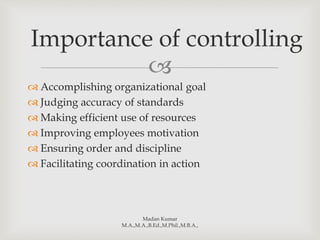
 Accomplishing organizational goal
 Judging accuracy of standards
 Making efficient use of resources
 Improving employees motivation
 Ensuring order and discipline
 Facilitating coordination in action
Madan Kumar
M.A.,M.A.,B.Ed.,M.Phil.,M.B.A.,
Importance of controlling

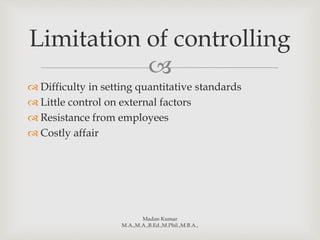
 Difficulty in setting quantitative standards
 Little control on external factors
 Resistance from employees
 Costly affair
Madan Kumar
M.A.,M.A.,B.Ed.,M.Phil.,M.B.A.,
Limitation of controlling

Madan Kumar
M.A.,M.A.,B.Ed.,M.Phil.,M.B.A.,

Madan Kumar
M.A.,M.A.,B.Ed.,M.Phil.,M.B.A.,
Relationship between
Planning and Controlling
and Process of Controlling

 Planning and controlling are inseparable twins of
management
 They are interrelated and interdependent function of
management
 Without planning there lies no basis for controlling and
vice versa
 Planning is the base of controlling functions
 Planning without controlling is meaningless
 Planning is a thinking process while controlling is an
executive function
Madan Kumar
M.A.,M.A.,B.Ed.,M.Phil.,M.B.A.,
Planning and Controlling are interrelated and
interdependent

 Planning based on facts makes controlling easier and
effective
 Controlling improves future planning by providing
information derived past experiences
Madan Kumar
M.A.,M.A.,B.Ed.,M.Phil.,M.B.A.,
Planning and Controlling are interrelated
and interdependent

 Planning is a forward-looking function
 Controlling is a backward- looking function
 Planning is a backward looing function
 Controlling is a forward-looking function
Madan Kumar
M.A.,M.A.,B.Ed.,M.Phil.,M.B.A.,
Both are forward-looking and
backward-looking functions

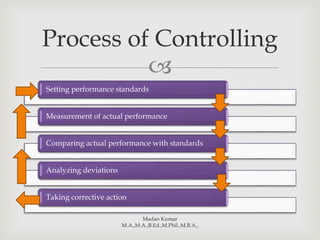
Setting performance standards
Measurement of actual performance
Comparing actual performance with standards
Analyzing deviations
Taking corrective action
Madan Kumar
M.A.,M.A.,B.Ed.,M.Phil.,M.B.A.,
Process of Controlling
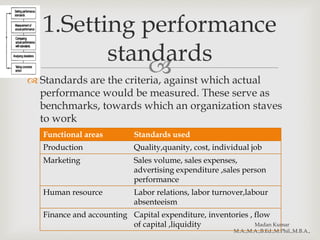
 Standards are the criteria, against which actual
performance would be measured. These serve as
benchmarks, towards which an organization staves
to work
Madan Kumar
M.A.,M.A.,B.Ed.,M.Phil.,M.B.A.,
1.Setting performance
standards
Functional areas Standards used
Production Quality,quanity, cost, individual job
Marketing Sales volume, sales expenses,
advertising expenditure ,sales person
performance
Human resource Labor relations, labor turnover,labour
absenteeism
Finance and accounting Capital expenditure, inventories , flow
of capital ,liquidity

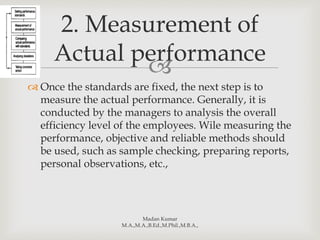
 Once the standards are fixed, the next step is to
measure the actual performance. Generally, it is
conducted by the managers to analysis the overall
efficiency level of the employees. Wile measuring the
performance, objective and reliable methods should
be used, such as sample checking, preparing reports,
personal observations, etc.,
Madan Kumar
M.A.,M.A.,B.Ed.,M.Phil.,M.B.A.,
2. Measurement of
Actual performance

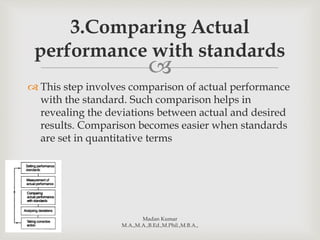
 This step involves comparison of actual performance
with the standard. Such comparison helps in
revealing the deviations between actual and desired
results. Comparison becomes easier when standards
are set in quantitative terms
Madan Kumar
M.A.,M.A.,B.Ed.,M.Phil.,M.B.A.,
3.Comparing Actual
performance with standards

 Under this step, deviations in key areas of business
need to be attended on urgent basis as compared to
deviations in certain insignificant areas. There is
need to determine the acceptable range of deviations
in all operational areas. Following points should be
kept in mind , while analyzing deviations ….
Madan Kumar
M.A.,M.A.,B.Ed.,M.Phil.,M.B.A.,
4.Analyzing deviations

 Critical point control
 According to this principle , control system should
first focus on Key Result Areas KRAs, which are
critical to the success of the organization. It is
because, it is not possible to keep a check on all the
activities of the enterprise. Therefore , if anything
goes wrong at the critical points or key areas,
immediate action should be taken.
Madan Kumar
M.A.,M.A.,B.Ed.,M.Phil.,M.B.A.,

 Management/ control by exception
It suggests that, if manager tries
to control everything, he may end up in controlling
nothing.
Madan Kumar
M.A.,M.A.,B.Ed.,M.Phil.,M.B.A.,

 It saves time and effort of the managers as they deal
with major deviations only .
 There is better utilization of managerial talents
 It facilitates delegation of authority and increases
morale, when routine problems are left to the
subordinates
 Timely action help to keep the organization on the
right track.
Madan Kumar
M.A.,M.A.,B.Ed.,M.Phil.,M.B.A.,
Advantages of Critical Point
Control and Management by
Exception

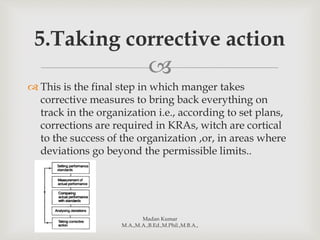
 This is the final step in which manger takes
corrective measures to bring back everything on
track in the organization i.e., according to set plans,
corrections are required in KRAs, witch are cortical
to the success of the organization ,or, in areas where
deviations go beyond the permissible limits..
Madan Kumar
M.A.,M.A.,B.Ed.,M.Phil.,M.B.A.,
5.Taking corrective action

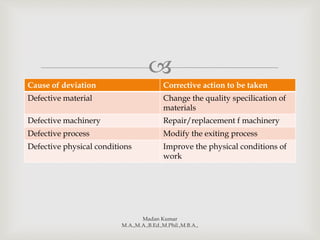
Cause of deviation Corrective action to be taken
Defective material Change the quality specilication of
materials
Defective machinery Repair/replacement f machinery
Defective process Modify the exiting process
Defective physical conditions Improve the physical conditions of
work
Madan Kumar
M.A.,M.A.,B.Ed.,M.Phil.,M.B.A.,

Madan Kumar
M.A.,M.A.,B.Ed.,M.Phil.,M.B.A.,

 https://youtu.be/Xaf4iNOKRyU
 https://youtu.be/J_TqI2PqF8g
Madan Kumar
M.A.,M.A.,B.Ed.,M.Phil.,M.B.A.,
Video presentation

Controlling

  • 1.
  • 2.
      Controlling refersto the process of measurement of performance according to standards, measuring deviations and taking corrective action to achieve predetermined goals. In order to seek results, manager must exercise effective control over the workers Madan Kumar M.A.,M.A.,B.Ed.,M.Phil.,M.B.A., Concept of controlling
  • 3.
      “Managerial controlimplies the measurement of accomplishment against the standard and the correction of deviations to assure attainment of objectives according to plans.”—Koontz and O’Donnell Madan Kumar M.A.,M.A.,B.Ed.,M.Phil.,M.B.A., Definition
  • 4.
  • 5.
      Goal –oriented process  Pervasive  Continuous  Both a backward looking as well as a forward looking function Madan Kumar M.A.,M.A.,B.Ed.,M.Phil.,M.B.A., Nature of controlling
  • 6.
      Accomplishing organizationalgoal  Judging accuracy of standards  Making efficient use of resources  Improving employees motivation  Ensuring order and discipline  Facilitating coordination in action Madan Kumar M.A.,M.A.,B.Ed.,M.Phil.,M.B.A., Importance of controlling
  • 7.
      Difficulty insetting quantitative standards  Little control on external factors  Resistance from employees  Costly affair Madan Kumar M.A.,M.A.,B.Ed.,M.Phil.,M.B.A., Limitation of controlling
  • 8.
  • 9.
  • 10.
      Planning andcontrolling are inseparable twins of management  They are interrelated and interdependent function of management  Without planning there lies no basis for controlling and vice versa  Planning is the base of controlling functions  Planning without controlling is meaningless  Planning is a thinking process while controlling is an executive function Madan Kumar M.A.,M.A.,B.Ed.,M.Phil.,M.B.A., Planning and Controlling are interrelated and interdependent
  • 11.
      Planning basedon facts makes controlling easier and effective  Controlling improves future planning by providing information derived past experiences Madan Kumar M.A.,M.A.,B.Ed.,M.Phil.,M.B.A., Planning and Controlling are interrelated and interdependent
  • 12.
      Planning isa forward-looking function  Controlling is a backward- looking function  Planning is a backward looing function  Controlling is a forward-looking function Madan Kumar M.A.,M.A.,B.Ed.,M.Phil.,M.B.A., Both are forward-looking and backward-looking functions
  • 13.
     Setting performance standards Measurementof actual performance Comparing actual performance with standards Analyzing deviations Taking corrective action Madan Kumar M.A.,M.A.,B.Ed.,M.Phil.,M.B.A., Process of Controlling
  • 14.
     Standards arethe criteria, against which actual performance would be measured. These serve as benchmarks, towards which an organization staves to work Madan Kumar M.A.,M.A.,B.Ed.,M.Phil.,M.B.A., 1.Setting performance standards Functional areas Standards used Production Quality,quanity, cost, individual job Marketing Sales volume, sales expenses, advertising expenditure ,sales person performance Human resource Labor relations, labor turnover,labour absenteeism Finance and accounting Capital expenditure, inventories , flow of capital ,liquidity
  • 15.
      Once thestandards are fixed, the next step is to measure the actual performance. Generally, it is conducted by the managers to analysis the overall efficiency level of the employees. Wile measuring the performance, objective and reliable methods should be used, such as sample checking, preparing reports, personal observations, etc., Madan Kumar M.A.,M.A.,B.Ed.,M.Phil.,M.B.A., 2. Measurement of Actual performance
  • 16.
      This stepinvolves comparison of actual performance with the standard. Such comparison helps in revealing the deviations between actual and desired results. Comparison becomes easier when standards are set in quantitative terms Madan Kumar M.A.,M.A.,B.Ed.,M.Phil.,M.B.A., 3.Comparing Actual performance with standards
  • 17.
      Under thisstep, deviations in key areas of business need to be attended on urgent basis as compared to deviations in certain insignificant areas. There is need to determine the acceptable range of deviations in all operational areas. Following points should be kept in mind , while analyzing deviations …. Madan Kumar M.A.,M.A.,B.Ed.,M.Phil.,M.B.A., 4.Analyzing deviations
  • 18.
      Critical pointcontrol  According to this principle , control system should first focus on Key Result Areas KRAs, which are critical to the success of the organization. It is because, it is not possible to keep a check on all the activities of the enterprise. Therefore , if anything goes wrong at the critical points or key areas, immediate action should be taken. Madan Kumar M.A.,M.A.,B.Ed.,M.Phil.,M.B.A.,
  • 19.
      Management/ controlby exception It suggests that, if manager tries to control everything, he may end up in controlling nothing. Madan Kumar M.A.,M.A.,B.Ed.,M.Phil.,M.B.A.,
  • 20.
      It savestime and effort of the managers as they deal with major deviations only .  There is better utilization of managerial talents  It facilitates delegation of authority and increases morale, when routine problems are left to the subordinates  Timely action help to keep the organization on the right track. Madan Kumar M.A.,M.A.,B.Ed.,M.Phil.,M.B.A., Advantages of Critical Point Control and Management by Exception
  • 21.
      This isthe final step in which manger takes corrective measures to bring back everything on track in the organization i.e., according to set plans, corrections are required in KRAs, witch are cortical to the success of the organization ,or, in areas where deviations go beyond the permissible limits.. Madan Kumar M.A.,M.A.,B.Ed.,M.Phil.,M.B.A., 5.Taking corrective action
  • 22.
     Cause of deviationCorrective action to be taken Defective material Change the quality specilication of materials Defective machinery Repair/replacement f machinery Defective process Modify the exiting process Defective physical conditions Improve the physical conditions of work Madan Kumar M.A.,M.A.,B.Ed.,M.Phil.,M.B.A.,
  • 23.
  • 24.
      https://youtu.be/Xaf4iNOKRyU  https://youtu.be/J_TqI2PqF8g MadanKumar M.A.,M.A.,B.Ed.,M.Phil.,M.B.A., Video presentation