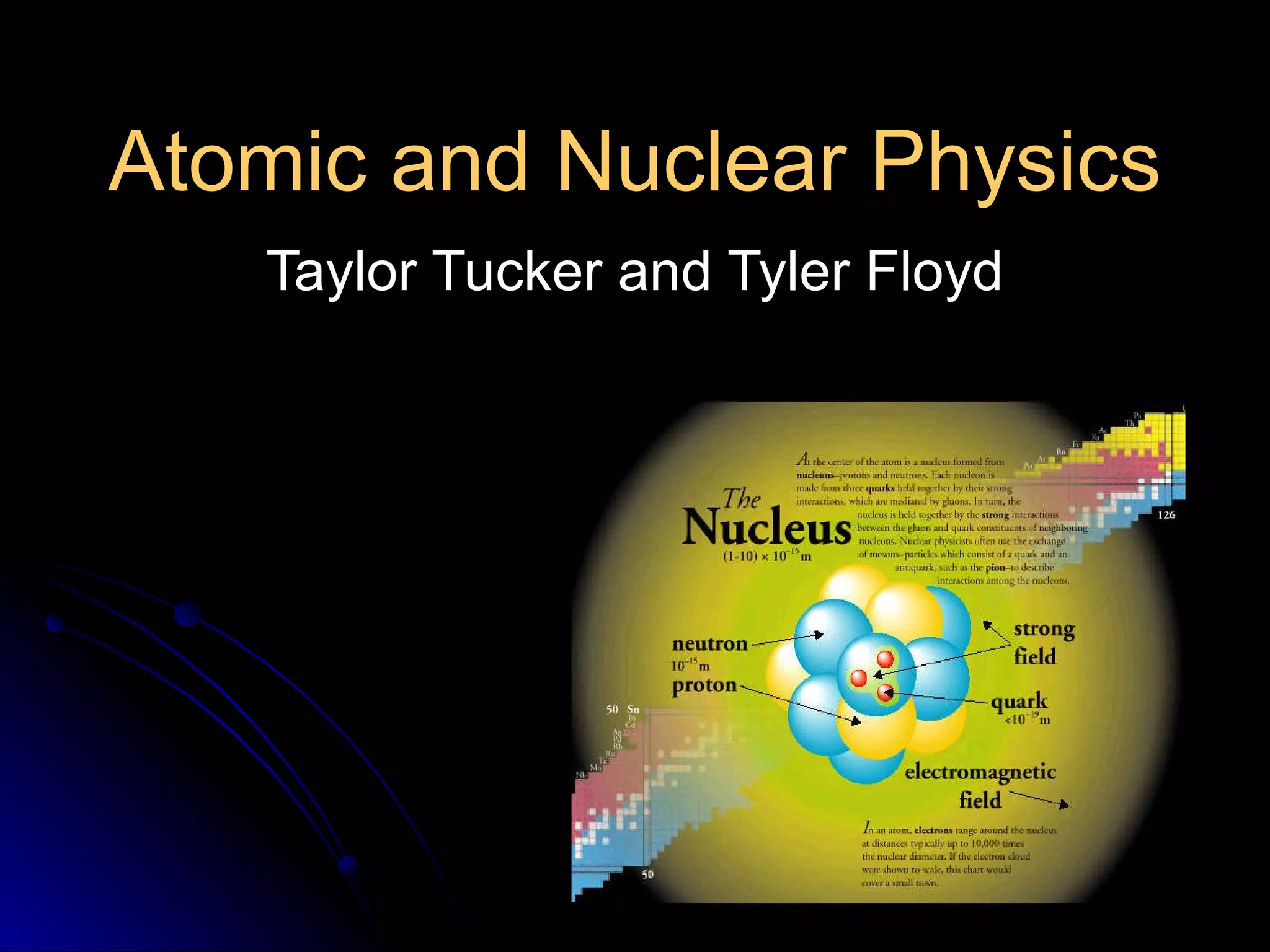
Atomic and Nuclear Physics Taylor Tucker and Tyler Floyd
Photons and the Photoelectric effect Light is transmitted by tiny particles or photons.  The photoelectric effect is the phenomenon that when light shines on a metal surface, electrons are emitted from the surface. A metal plate p and a smaller electrode c are placed inside an evacuated glass tube, called a photocell.
Compton Scattering and X-rays The compton effect was named after its discoverer, A. H. Compton (1892-1962). He scattered short-wavelength light (actually X-rays) from various materials He found that scattered light had a slightly lower frequency than  did the incident light, indicating a loss of energy
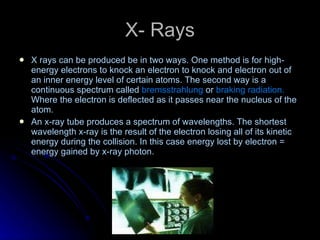
X- Rays X   rays can be produced be in two ways. One method is for high-energy electrons to knock an electron to knock and electron out of an inner energy level of certain atoms. The second way is a continuous spectrum called  bremsstrahlung  or  braking radiation.  Where the electron is deflected as it passes near the nucleus of the atom. An x-ray tube produces a spectrum of wavelengths. The shortest wavelength x-ray is the result of the electron losing all of its kinetic energy during the collision. In this case energy lost by electron = energy gained by x-ray photon.
Wave Particle Duality Experiments such as the Young’s interference experiment, polarization, and single slit diffraction indicate that light is a wave. The photoelectric effect and Compton effect indicate that light is a particle. Light is a phenomena which exhibits both the properties of waves and the properties of particle, which is  Wave Particle Duality.
Atomic Energy Levels If an electron falls from one orbit, also known as  energy level , to another, it loses energy in the form of a photon of light.  The energy of the the photon equals the difference between the energy of orbits.
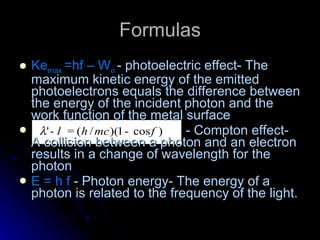
Formulas Ke max  =hf – W o  - photoelectric effect- The maximum kinetic energy of the emitted photoelectrons equals the difference between the energy of the incident photon and the work function of the metal surface - Compton effect- A collision between a photon and an electron results in a change of wavelength for the photon E = h f  - Photon energy- The energy of a photon is related to the frequency of the light.
Nuclear Reactions Transmutation - the process by which an element transforms during nuclear reactions or when a nucleus undergoes a or b decay. This occurs when a given nucleus is struck by another nucleus or by a simpler particle such a a y ray or neutron. Through nuclear reactions, mass number is conserved because the number of the element that was hit added to the particle that hit it will equal the numbers of the resulting elements.  Mass number works the same way.
Mass–Energy equivalence The concept that the mass of a body is a measure of its energy content. Both the total mass and the total energy inside a totally closed system remains constant over time. Energy cannot be created or destroyed, and energy, in all of its forms, has mass. Mass also cannot be created or destroyed, and in all of its forms, has energy.  According to the theory of relativity, mass and energy as commonly understood, are two names for the same thing, and neither one is changed or transformed into the other. Rather, neither one appears without the other. Rather than mass being changed into energy, the view of relativity is that rest mass has been changed to a more mobile form of mass, but remains mass. In this process, neither the amount of mass nor the amount of energy changes.  Thus, if energy changes type and leaves a system, it simply takes its mass with it. If either mass or energy disappears from a system, it will always be found that both have simply moved off to another place. E=mc 2  or E=m 0 c 2  + KE  Total energy of the particle equals mass times the speed of light squared.
Lots of great examples will follow starting with this slide Fortunately this is not the final presentation. So for now the end.  

Atomic and nuclear physics

  • 1.
    Atomic and NuclearPhysics Taylor Tucker and Tyler Floyd
  • 2.
    Photons and thePhotoelectric effect Light is transmitted by tiny particles or photons. The photoelectric effect is the phenomenon that when light shines on a metal surface, electrons are emitted from the surface. A metal plate p and a smaller electrode c are placed inside an evacuated glass tube, called a photocell.
  • 3.
    Compton Scattering andX-rays The compton effect was named after its discoverer, A. H. Compton (1892-1962). He scattered short-wavelength light (actually X-rays) from various materials He found that scattered light had a slightly lower frequency than did the incident light, indicating a loss of energy
  • 4.
    X- Rays X rays can be produced be in two ways. One method is for high-energy electrons to knock an electron to knock and electron out of an inner energy level of certain atoms. The second way is a continuous spectrum called bremsstrahlung or braking radiation. Where the electron is deflected as it passes near the nucleus of the atom. An x-ray tube produces a spectrum of wavelengths. The shortest wavelength x-ray is the result of the electron losing all of its kinetic energy during the collision. In this case energy lost by electron = energy gained by x-ray photon.
  • 5.
    Wave Particle DualityExperiments such as the Young’s interference experiment, polarization, and single slit diffraction indicate that light is a wave. The photoelectric effect and Compton effect indicate that light is a particle. Light is a phenomena which exhibits both the properties of waves and the properties of particle, which is Wave Particle Duality.
  • 6.
    Atomic Energy LevelsIf an electron falls from one orbit, also known as energy level , to another, it loses energy in the form of a photon of light. The energy of the the photon equals the difference between the energy of orbits.
  • 7.
    Formulas Ke max =hf – W o - photoelectric effect- The maximum kinetic energy of the emitted photoelectrons equals the difference between the energy of the incident photon and the work function of the metal surface - Compton effect- A collision between a photon and an electron results in a change of wavelength for the photon E = h f - Photon energy- The energy of a photon is related to the frequency of the light.
  • 8.
    Nuclear Reactions Transmutation- the process by which an element transforms during nuclear reactions or when a nucleus undergoes a or b decay. This occurs when a given nucleus is struck by another nucleus or by a simpler particle such a a y ray or neutron. Through nuclear reactions, mass number is conserved because the number of the element that was hit added to the particle that hit it will equal the numbers of the resulting elements. Mass number works the same way.
  • 9.
    Mass–Energy equivalence Theconcept that the mass of a body is a measure of its energy content. Both the total mass and the total energy inside a totally closed system remains constant over time. Energy cannot be created or destroyed, and energy, in all of its forms, has mass. Mass also cannot be created or destroyed, and in all of its forms, has energy. According to the theory of relativity, mass and energy as commonly understood, are two names for the same thing, and neither one is changed or transformed into the other. Rather, neither one appears without the other. Rather than mass being changed into energy, the view of relativity is that rest mass has been changed to a more mobile form of mass, but remains mass. In this process, neither the amount of mass nor the amount of energy changes. Thus, if energy changes type and leaves a system, it simply takes its mass with it. If either mass or energy disappears from a system, it will always be found that both have simply moved off to another place. E=mc 2 or E=m 0 c 2 + KE Total energy of the particle equals mass times the speed of light squared.
  • 10.
    Lots of greatexamples will follow starting with this slide Fortunately this is not the final presentation. So for now the end. 