0.6 Rational Exponents
Chapter 0 Review of Basic Concepts
Concepts & Objectives
⚫ Rational Exponents
⚫ Review negative exponents and the quotient rule
⚫ Review rational exponents and simplify expressions
⚫ Factor expressions with negative or fractional
exponents
Negative Exponents
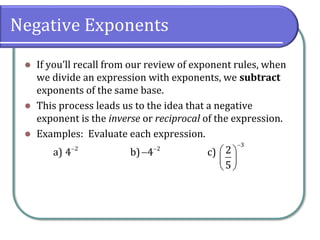
⚫ If you’ll recall from our review of exponent rules, when
we divide an expression with exponents, we subtract
exponents of the same base.
⚫ This process leads us to the idea that a negative
exponent is the inverse or reciprocal of the expression.
⚫ Examples: Evaluate each expression.
a) b) c)2
4− 2
4−
−
3
2
5
−
 
 
 
Negative Exponents
⚫ If you’ll recall from our review of exponent rules, when
we divide an expression with exponents, we subtract
exponents of the same base.
⚫ This process leads us to the idea that a negative
exponent is the inverse or reciprocal of the expression.
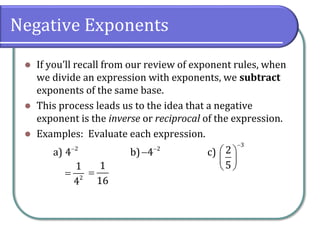
⚫ Examples: Evaluate each expression.
a) b) c)2
4− 2
4−
−
3
2
5
−
 
 
 
2
1
4
=
1
16
=
Negative Exponents
⚫ If you’ll recall from our review of exponent rules, when
we divide an expression with exponents, we subtract
exponents of the same base.
⚫ This process leads us to the idea that a negative
exponent is the inverse or reciprocal of the expression.
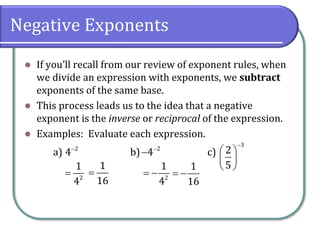
⚫ Examples: Evaluate each expression.
a) b) c)2
4− 2
4−
−
3
2
5
−
 
 
 
2
1
4
=
1
16
= 2
1
4
= −
1
16
= −
Negative Exponents
⚫ If you’ll recall from our review of exponent rules, when
we divide an expression with exponents, we subtract
exponents of the same base.
⚫ This process leads us to the idea that a negative
exponent is the inverse or reciprocal of the expression.
⚫ Examples: Evaluate each expression.
a) b) c)2
4− 2
4−
−
3
2
5
−
 
 
 
2
1
4
=
1
16
= 2
1
4
= −
1
16
= − 3
5
2
 
=  
 
125
8
=
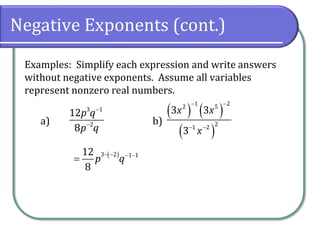
Negative Exponents (cont.)
Examples: Simplify each expression and write answers
without negative exponents. Assume all variables
represent nonzero real numbers.
a) b)
3 1
2
12
8
p q
p q
−
−
( ) ( )
( )
1 2
2 5
2
1 2
3 3
3
x x
x
− −
− −
Negative Exponents (cont.)
Examples: Simplify each expression and write answers
without negative exponents. Assume all variables
represent nonzero real numbers.
a) b)
3 1
2
12
8
p q
p q
−
−
( ) ( )
( )
1 2
2 5
2
1 2
3 3
3
x x
x
− −
− −
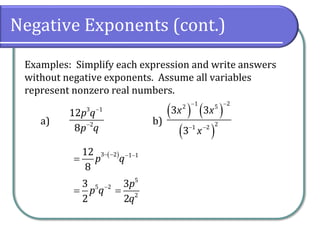
( )3 2 1 112
8
p q
− − − −
=
Negative Exponents (cont.)
Examples: Simplify each expression and write answers
without negative exponents. Assume all variables
represent nonzero real numbers.
a) b)
3 1
2
12
8
p q
p q
−
−
( ) ( )
( )
1 2
2 5
2
1 2
3 3
3
x x
x
− −
− −
( )3 2 1 112
8
p q
− − − −
=
5 23
2
p q−
=
5
2
3
2
p
q
=
Negative Exponents (cont.)
Examples: Simplify each expression and write answers
without negative exponents. Assume all variables
represent nonzero real numbers.
a) b)
3 1
2
12
8
p q
p q
−
−
( ) ( )
( )
1 2
2 5
2
1 2
3 3
3
x x
x
− −
− −
( )3 2 1 112
8
p q
− − − −
=
5 23
2
p q−
=
5
2
3
2
p
q
=
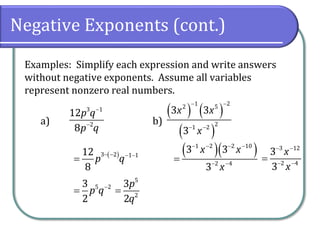
( )( )1 2 2 10
2 4
3 3
3
x x
x
− − − −
− −
=
3 12
2 4
3
3
x
x
− −
− −
=
Negative Exponents (cont.)
Examples: Simplify each expression and write answers
without negative exponents. Assume all variables
represent nonzero real numbers.
a) b)
3 1
2
12
8
p q
p q
−
−
( ) ( )
( )
1 2
2 5
2
1 2
3 3
3
x x
x
− −
− −
( )3 2 1 112
8
p q
− − − −
=
5 23
2
p q−
=
5
2
3
2
p
q
=
( )( )1 2 2 10
2 4
3 3
3
x x
x
− − − −
− −
=
3 12
2 4
3
3
x
x
− −
− −
=
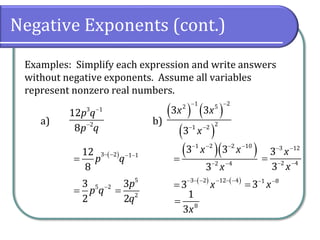
( ) ( )3 2 12 4
3 x
− − − − − −
= 1 8
3 x− −
=
Negative Exponents (cont.)
Examples: Simplify each expression and write answers
without negative exponents. Assume all variables
represent nonzero real numbers.
a) b)
3 1
2
12
8
p q
p q
−
−
( ) ( )
( )
1 2
2 5
2
1 2
3 3
3
x x
x
− −
− −
( )3 2 1 112
8
p q
− − − −
=
5 23
2
p q−
=
5
2
3
2
p
q
=
( )( )1 2 2 10
2 4
3 3
3
x x
x
− − − −
− −
=
3 12
2 4
3
3
x
x
− −
− −
=
( ) ( )3 2 12 4
3 x
− − − − − −
= 1 8
3 x− −
=
8
1
3x
=
Rational Exponents
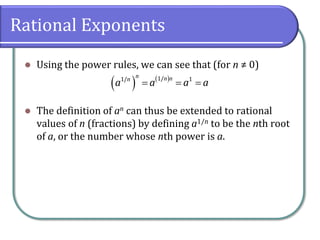
⚫ Using the power rules, we can see that (for n ≠ 0)
⚫ The definition of an can thus be extended to rational
values of n (fractions) by defining a1/n to be the nth root
of a, or the number whose nth power is a.
( ) ( )1/1/ 1
n n nn
a a a a= = =
Rational Exponents (cont.)
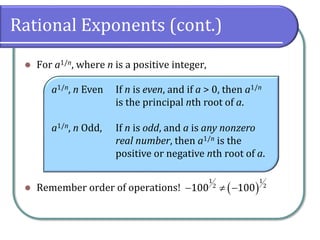
⚫ For a1/n, where n is a positive integer,
⚫ Remember order of operations!
a1/n, n Even If n is even, and if a > 0, then a1/n
is the principal nth root of a.
a1/n, n Odd, If n is odd, and a is any nonzero
real number, then a1/n is the
positive or negative nth root of a.
( )
11
22
100 100−  −
Rational Exponents (cont.)
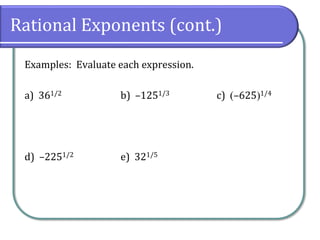
Examples: Evaluate each expression.
a) 361/2 b) –1251/3 c) (–625)1/4
d) –2251/2 e) 321/5
Rational Exponents (cont.)
Examples: Evaluate each expression.
a) 361/2 b) –1251/3 c) (–625)1/4
d) –2251/2 e) 321/5
6= 5= −
not a real number
Rational Exponents (cont.)
Examples: Evaluate each expression.
a) 361/2 b) –1251/3 c) (–625)1/4
d) –2251/2 e) 321/5
6= 5= −
not a real number
15= − 2=
Rational Exponents (cont.)
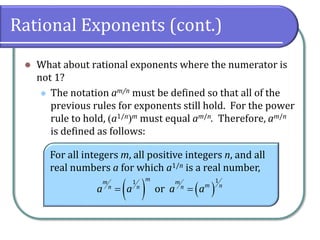
⚫ What about rational exponents where the numerator is
not 1?
⚫ The notation am/n must be defined so that all of the
previous rules for exponents still hold. For the power
rule to hold, (a1/n)m must equal am/n. Therefore, am/n
is defined as follows:
For all integers m, all positive integers n, and all
real numbers a for which a1/n is a real number,
( ) ( )
11
or
mm m
m nn n n
a a a a= =
Rational Exponents (cont.)
⚫ There are two ways you can evaluate an am/n expression:
⚫ Mentally: am/n means the nth root of the mth power,
so 323/5 would mean the 5th root of 32, which is 2,
raised to the 3rd power: 23 = 8.
⚫ Calculator: Most calculators have either a ^ or a xy
button. Unless you are using something like Desmos
that formats it for you correctly, make sure you put
parentheses around the fraction. See next slide for
examples.
Rational Exponents and Calculators
⚫ Without parentheses ⚫ With parentheses
 ✓
Rational Exponents (cont.)
Examples: Evaluate each expression.
a) 1252/3
b) (–64)2/3
c) –813/2
d) (–4)5/2
Rational Exponents (cont.)
Examples: Evaluate each expression.
a) 1252/3
b) (–64)2/3
c) –813/2
d) (–4)5/2
2
5 25= =
( )
2
4 16= − =
3
9 729= − = −
( )
1/2
not a real number because 4 is not real−
Simplifying Rational Exponents
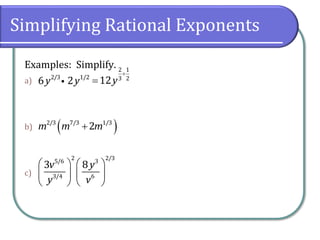
Examples: Simplify.
a)
b)
c)
2/3 1/2
6 2y y
( )2/3 7/3 1/3
2m m m+
2 2/35/6 3
3/4 6
3 8v y
y v
   
   
   
2 1
3 2
12y
+
=
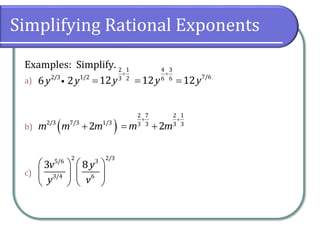
Simplifying Rational Exponents
Examples: Simplify.
a)
b)
c)
2/3 1/2
6 2y y
( )2/3 7/3 1/3
2m m m+
2 2/35/6 3
3/4 6
3 8v y
y v
   
   
   
2 1
3 2
12y
+
=
4 3
7/66 6
12 12y y
+
= =
Simplifying Rational Exponents
Examples: Simplify.
a)
b)
c)
2/3 1/2
6 2y y
( )2/3 7/3 1/3
2m m m+
2 2/35/6 3
3/4 6
3 8v y
y v
   
   
   
2 1
3 2
12y
+
=
4 3
7/66 6
12 12y y
+
= =
2 7 2 1
3 3 3 3
2m m
+ +
= +
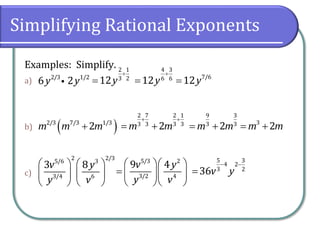
Simplifying Rational Exponents
Examples: Simplify.
a)
b)
c)
2/3 1/2
6 2y y
( )2/3 7/3 1/3
2m m m+
2 2/35/6 3
3/4 6
3 8v y
y v
   
   
   
2 1
3 2
12y
+
=
4 3
7/66 6
12 12y y
+
= =
2 7 2 1
3 3 3 3
2m m
+ +
= +
9 3
33 3
2 2m m m m= + = +
Simplifying Rational Exponents
Examples: Simplify.
a)
b)
c)
2/3 1/2
6 2y y
( )2/3 7/3 1/3
2m m m+
2 2/35/6 3
3/4 6
3 8v y
y v
   
   
   
2 1
3 2
12y
+
=
4 3
7/66 6
12 12y y
+
= =
2 7 2 1
3 3 3 3
2m m
+ +
= +
9 3
33 3
2 2m m m m= + = +
5/3 2
3/2 4
9 4v y
y v
  
=   
  
5 3
4 2
3 2
36v y
− −
=
Simplifying Rational Exponents
Examples: Simplify.
a)
b)
c)
2/3 1/2
6 2y y
( )2/3 7/3 1/3
2m m m+
2 2/35/6 3
3/4 6
3 8v y
y v
   
   
   
2 1
3 2
12y
+
=
4 3
7/66 6
12 12y y
+
= =
2 7 2 1
3 3 3 3
2m m
+ +
= +
9 3
33 3
2 2m m m m= + = +
5/3 2
3/2 4
9 4v y
y v
  
=   
  
5 3
4 2
3 2
36v y
− −
=
5 12 4 3
3 3 2 2
36v y
− −
=
1/2
7/3 1/2
7/3
36
36
y
v y
v
−
= =
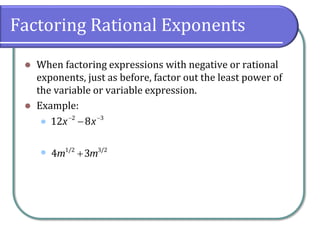
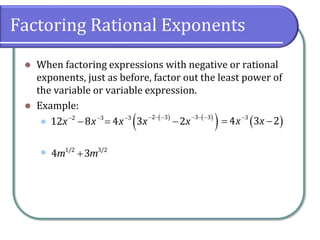
Factoring Rational Exponents
⚫ When factoring expressions with negative or rational
exponents, just as before, factor out the least power of
the variable or variable expression.
⚫ Example:
⚫
⚫
2 3
12 8x x− −
−
1/2 3/2
4 3m m+
Factoring Rational Exponents
⚫ When factoring expressions with negative or rational
exponents, just as before, factor out the least power of
the variable or variable expression.
⚫ Example:
⚫
⚫
2 3
12 8x x− −
−
1/2 3/2
4 3m m+
( ) ( )
( )2 3 3 33
4 3 2x x x
− − − − − −−
= − ( )3
4 3 2x x−
= −
Factoring Rational Exponents
⚫ When factoring expressions with negative or rational
exponents, just as before, factor out the least power of
the variable or variable expression.
⚫ Examples:
⚫
⚫
2 3
12 8x x− −
−
1/2 3/2
4 3m m+
( ) ( )
( )2 3 3 33
4 3 2x x x
− − − − − −−
= − ( )3
4 3 2x x−
= −
( )1/2 1/2 1/2 3/2 1/2
4 3m m m− −
= + ( )1/2
4 3m m= +
Classwork
⚫ 0.6 Assignment - Pg. 59: 4-36 (even); pg. 51: 40-58
(even); pg. 42: 80-104 (×4)
⚫ 0.6 Classwork Check (due 9/14)
⚫ Quiz 0.5 (due 9/14)

0.6 Rational Exponents

  • 1.
    0.6 Rational Exponents Chapter0 Review of Basic Concepts
  • 2.
    Concepts & Objectives ⚫Rational Exponents ⚫ Review negative exponents and the quotient rule ⚫ Review rational exponents and simplify expressions ⚫ Factor expressions with negative or fractional exponents
  • 3.
    Negative Exponents ⚫ Ifyou’ll recall from our review of exponent rules, when we divide an expression with exponents, we subtract exponents of the same base. ⚫ This process leads us to the idea that a negative exponent is the inverse or reciprocal of the expression. ⚫ Examples: Evaluate each expression. a) b) c)2 4− 2 4− − 3 2 5 −      
  • 4.
    Negative Exponents ⚫ Ifyou’ll recall from our review of exponent rules, when we divide an expression with exponents, we subtract exponents of the same base. ⚫ This process leads us to the idea that a negative exponent is the inverse or reciprocal of the expression. ⚫ Examples: Evaluate each expression. a) b) c)2 4− 2 4− − 3 2 5 −       2 1 4 = 1 16 =
  • 5.
    Negative Exponents ⚫ Ifyou’ll recall from our review of exponent rules, when we divide an expression with exponents, we subtract exponents of the same base. ⚫ This process leads us to the idea that a negative exponent is the inverse or reciprocal of the expression. ⚫ Examples: Evaluate each expression. a) b) c)2 4− 2 4− − 3 2 5 −       2 1 4 = 1 16 = 2 1 4 = − 1 16 = −
  • 6.
    Negative Exponents ⚫ Ifyou’ll recall from our review of exponent rules, when we divide an expression with exponents, we subtract exponents of the same base. ⚫ This process leads us to the idea that a negative exponent is the inverse or reciprocal of the expression. ⚫ Examples: Evaluate each expression. a) b) c)2 4− 2 4− − 3 2 5 −       2 1 4 = 1 16 = 2 1 4 = − 1 16 = − 3 5 2   =     125 8 =
  • 7.
    Negative Exponents (cont.) Examples:Simplify each expression and write answers without negative exponents. Assume all variables represent nonzero real numbers. a) b) 3 1 2 12 8 p q p q − − ( ) ( ) ( ) 1 2 2 5 2 1 2 3 3 3 x x x − − − −
  • 8.
    Negative Exponents (cont.) Examples:Simplify each expression and write answers without negative exponents. Assume all variables represent nonzero real numbers. a) b) 3 1 2 12 8 p q p q − − ( ) ( ) ( ) 1 2 2 5 2 1 2 3 3 3 x x x − − − − ( )3 2 1 112 8 p q − − − − =
  • 9.
    Negative Exponents (cont.) Examples:Simplify each expression and write answers without negative exponents. Assume all variables represent nonzero real numbers. a) b) 3 1 2 12 8 p q p q − − ( ) ( ) ( ) 1 2 2 5 2 1 2 3 3 3 x x x − − − − ( )3 2 1 112 8 p q − − − − = 5 23 2 p q− = 5 2 3 2 p q =
  • 10.
    Negative Exponents (cont.) Examples:Simplify each expression and write answers without negative exponents. Assume all variables represent nonzero real numbers. a) b) 3 1 2 12 8 p q p q − − ( ) ( ) ( ) 1 2 2 5 2 1 2 3 3 3 x x x − − − − ( )3 2 1 112 8 p q − − − − = 5 23 2 p q− = 5 2 3 2 p q = ( )( )1 2 2 10 2 4 3 3 3 x x x − − − − − − = 3 12 2 4 3 3 x x − − − − =
  • 11.
    Negative Exponents (cont.) Examples:Simplify each expression and write answers without negative exponents. Assume all variables represent nonzero real numbers. a) b) 3 1 2 12 8 p q p q − − ( ) ( ) ( ) 1 2 2 5 2 1 2 3 3 3 x x x − − − − ( )3 2 1 112 8 p q − − − − = 5 23 2 p q− = 5 2 3 2 p q = ( )( )1 2 2 10 2 4 3 3 3 x x x − − − − − − = 3 12 2 4 3 3 x x − − − − = ( ) ( )3 2 12 4 3 x − − − − − − = 1 8 3 x− − =
  • 12.
    Negative Exponents (cont.) Examples:Simplify each expression and write answers without negative exponents. Assume all variables represent nonzero real numbers. a) b) 3 1 2 12 8 p q p q − − ( ) ( ) ( ) 1 2 2 5 2 1 2 3 3 3 x x x − − − − ( )3 2 1 112 8 p q − − − − = 5 23 2 p q− = 5 2 3 2 p q = ( )( )1 2 2 10 2 4 3 3 3 x x x − − − − − − = 3 12 2 4 3 3 x x − − − − = ( ) ( )3 2 12 4 3 x − − − − − − = 1 8 3 x− − = 8 1 3x =
  • 13.
    Rational Exponents ⚫ Usingthe power rules, we can see that (for n ≠ 0) ⚫ The definition of an can thus be extended to rational values of n (fractions) by defining a1/n to be the nth root of a, or the number whose nth power is a. ( ) ( )1/1/ 1 n n nn a a a a= = =
  • 14.
    Rational Exponents (cont.) ⚫For a1/n, where n is a positive integer, ⚫ Remember order of operations! a1/n, n Even If n is even, and if a > 0, then a1/n is the principal nth root of a. a1/n, n Odd, If n is odd, and a is any nonzero real number, then a1/n is the positive or negative nth root of a. ( ) 11 22 100 100−  −
  • 15.
    Rational Exponents (cont.) Examples:Evaluate each expression. a) 361/2 b) –1251/3 c) (–625)1/4 d) –2251/2 e) 321/5
  • 16.
    Rational Exponents (cont.) Examples:Evaluate each expression. a) 361/2 b) –1251/3 c) (–625)1/4 d) –2251/2 e) 321/5 6= 5= − not a real number
  • 17.
    Rational Exponents (cont.) Examples:Evaluate each expression. a) 361/2 b) –1251/3 c) (–625)1/4 d) –2251/2 e) 321/5 6= 5= − not a real number 15= − 2=
  • 18.
    Rational Exponents (cont.) ⚫What about rational exponents where the numerator is not 1? ⚫ The notation am/n must be defined so that all of the previous rules for exponents still hold. For the power rule to hold, (a1/n)m must equal am/n. Therefore, am/n is defined as follows: For all integers m, all positive integers n, and all real numbers a for which a1/n is a real number, ( ) ( ) 11 or mm m m nn n n a a a a= =
  • 19.
    Rational Exponents (cont.) ⚫There are two ways you can evaluate an am/n expression: ⚫ Mentally: am/n means the nth root of the mth power, so 323/5 would mean the 5th root of 32, which is 2, raised to the 3rd power: 23 = 8. ⚫ Calculator: Most calculators have either a ^ or a xy button. Unless you are using something like Desmos that formats it for you correctly, make sure you put parentheses around the fraction. See next slide for examples.
  • 20.
    Rational Exponents andCalculators ⚫ Without parentheses ⚫ With parentheses  ✓
  • 21.
    Rational Exponents (cont.) Examples:Evaluate each expression. a) 1252/3 b) (–64)2/3 c) –813/2 d) (–4)5/2
  • 22.
    Rational Exponents (cont.) Examples:Evaluate each expression. a) 1252/3 b) (–64)2/3 c) –813/2 d) (–4)5/2 2 5 25= = ( ) 2 4 16= − = 3 9 729= − = − ( ) 1/2 not a real number because 4 is not real−
  • 23.
    Simplifying Rational Exponents Examples:Simplify. a) b) c) 2/3 1/2 6 2y y ( )2/3 7/3 1/3 2m m m+ 2 2/35/6 3 3/4 6 3 8v y y v             2 1 3 2 12y + =
  • 24.
    Simplifying Rational Exponents Examples:Simplify. a) b) c) 2/3 1/2 6 2y y ( )2/3 7/3 1/3 2m m m+ 2 2/35/6 3 3/4 6 3 8v y y v             2 1 3 2 12y + = 4 3 7/66 6 12 12y y + = =
  • 25.
    Simplifying Rational Exponents Examples:Simplify. a) b) c) 2/3 1/2 6 2y y ( )2/3 7/3 1/3 2m m m+ 2 2/35/6 3 3/4 6 3 8v y y v             2 1 3 2 12y + = 4 3 7/66 6 12 12y y + = = 2 7 2 1 3 3 3 3 2m m + + = +
  • 26.
    Simplifying Rational Exponents Examples:Simplify. a) b) c) 2/3 1/2 6 2y y ( )2/3 7/3 1/3 2m m m+ 2 2/35/6 3 3/4 6 3 8v y y v             2 1 3 2 12y + = 4 3 7/66 6 12 12y y + = = 2 7 2 1 3 3 3 3 2m m + + = + 9 3 33 3 2 2m m m m= + = +
  • 27.
    Simplifying Rational Exponents Examples:Simplify. a) b) c) 2/3 1/2 6 2y y ( )2/3 7/3 1/3 2m m m+ 2 2/35/6 3 3/4 6 3 8v y y v             2 1 3 2 12y + = 4 3 7/66 6 12 12y y + = = 2 7 2 1 3 3 3 3 2m m + + = + 9 3 33 3 2 2m m m m= + = + 5/3 2 3/2 4 9 4v y y v    =       5 3 4 2 3 2 36v y − − =
  • 28.
    Simplifying Rational Exponents Examples:Simplify. a) b) c) 2/3 1/2 6 2y y ( )2/3 7/3 1/3 2m m m+ 2 2/35/6 3 3/4 6 3 8v y y v             2 1 3 2 12y + = 4 3 7/66 6 12 12y y + = = 2 7 2 1 3 3 3 3 2m m + + = + 9 3 33 3 2 2m m m m= + = + 5/3 2 3/2 4 9 4v y y v    =       5 3 4 2 3 2 36v y − − = 5 12 4 3 3 3 2 2 36v y − − = 1/2 7/3 1/2 7/3 36 36 y v y v − = =
  • 29.
    Factoring Rational Exponents ⚫When factoring expressions with negative or rational exponents, just as before, factor out the least power of the variable or variable expression. ⚫ Example: ⚫ ⚫ 2 3 12 8x x− − − 1/2 3/2 4 3m m+
  • 30.
    Factoring Rational Exponents ⚫When factoring expressions with negative or rational exponents, just as before, factor out the least power of the variable or variable expression. ⚫ Example: ⚫ ⚫ 2 3 12 8x x− − − 1/2 3/2 4 3m m+ ( ) ( ) ( )2 3 3 33 4 3 2x x x − − − − − −− = − ( )3 4 3 2x x− = −
  • 31.
    Factoring Rational Exponents ⚫When factoring expressions with negative or rational exponents, just as before, factor out the least power of the variable or variable expression. ⚫ Examples: ⚫ ⚫ 2 3 12 8x x− − − 1/2 3/2 4 3m m+ ( ) ( ) ( )2 3 3 33 4 3 2x x x − − − − − −− = − ( )3 4 3 2x x− = − ( )1/2 1/2 1/2 3/2 1/2 4 3m m m− − = + ( )1/2 4 3m m= +
  • 32.
    Classwork ⚫ 0.6 Assignment- Pg. 59: 4-36 (even); pg. 51: 40-58 (even); pg. 42: 80-104 (×4) ⚫ 0.6 Classwork Check (due 9/14) ⚫ Quiz 0.5 (due 9/14)