GCSE: Surds
Types of numbers
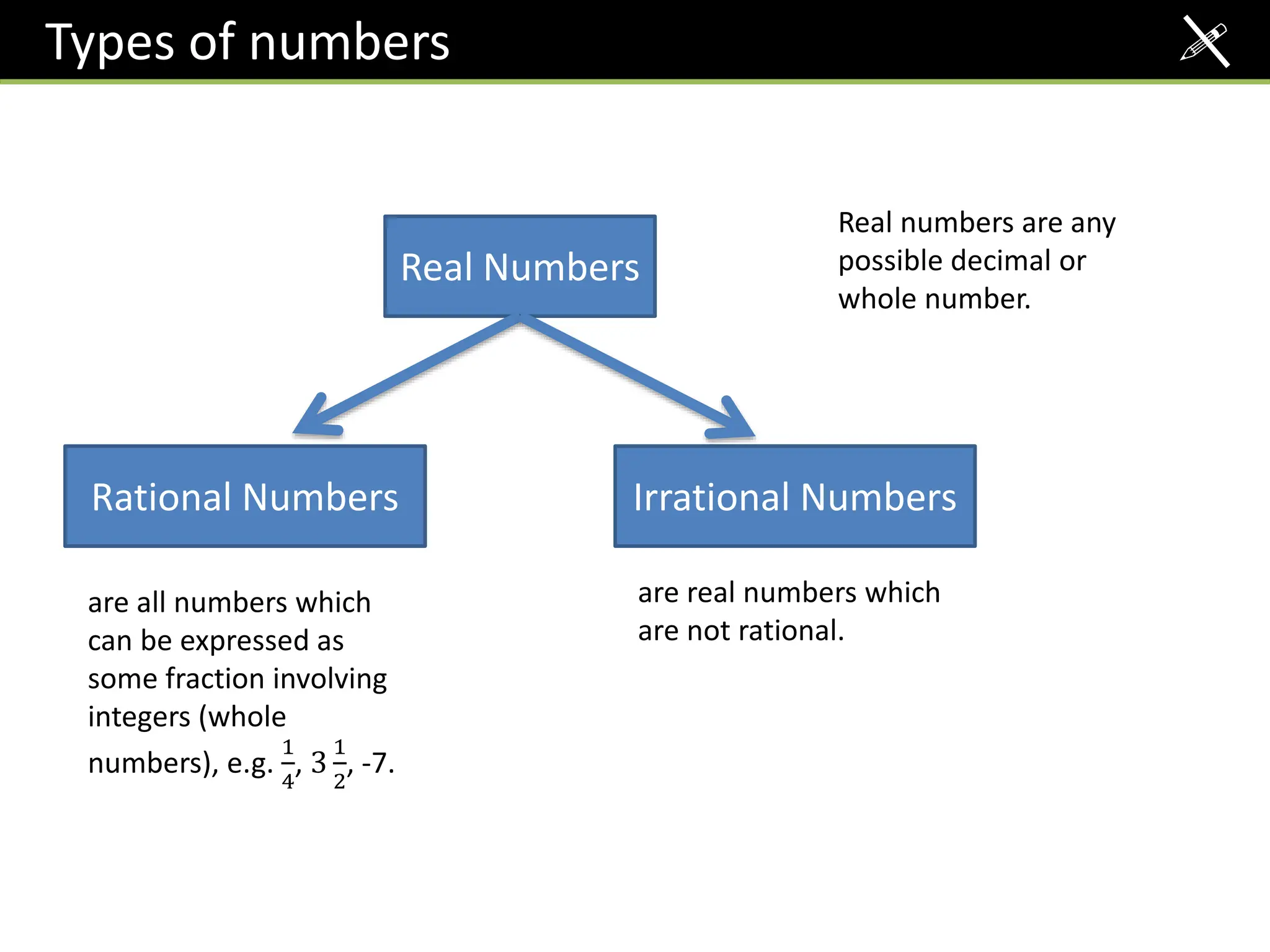
Real Numbers
Real numbers are any
possible decimal or
whole number.
Rational Numbers Irrational Numbers
are all numbers which
can be expressed as
some fraction involving
integers (whole
numbers), e.g.
1
4
, 3
1
2
, -7.
are real numbers which
are not rational.
!
Types of numbers
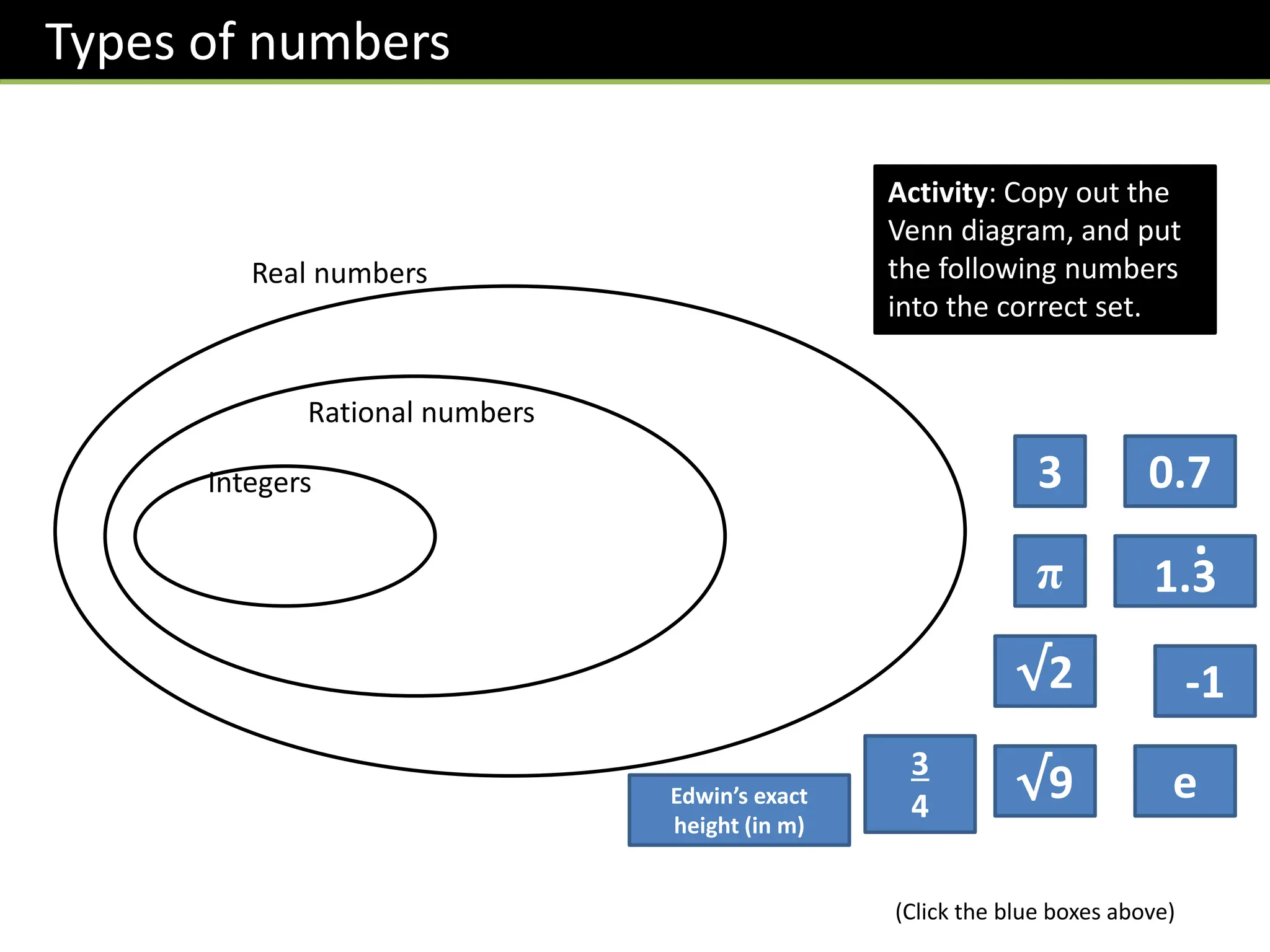
Activity: Copy out the
Venn diagram, and put
the following numbers
into the correct set.
3 0.7
π
.
1.3
√2 -1
3
4
√9 e
Edwin’s exact
height (in m)
Integers
Rational numbers
Real numbers
(Click the blue boxes above)
What is a surd?
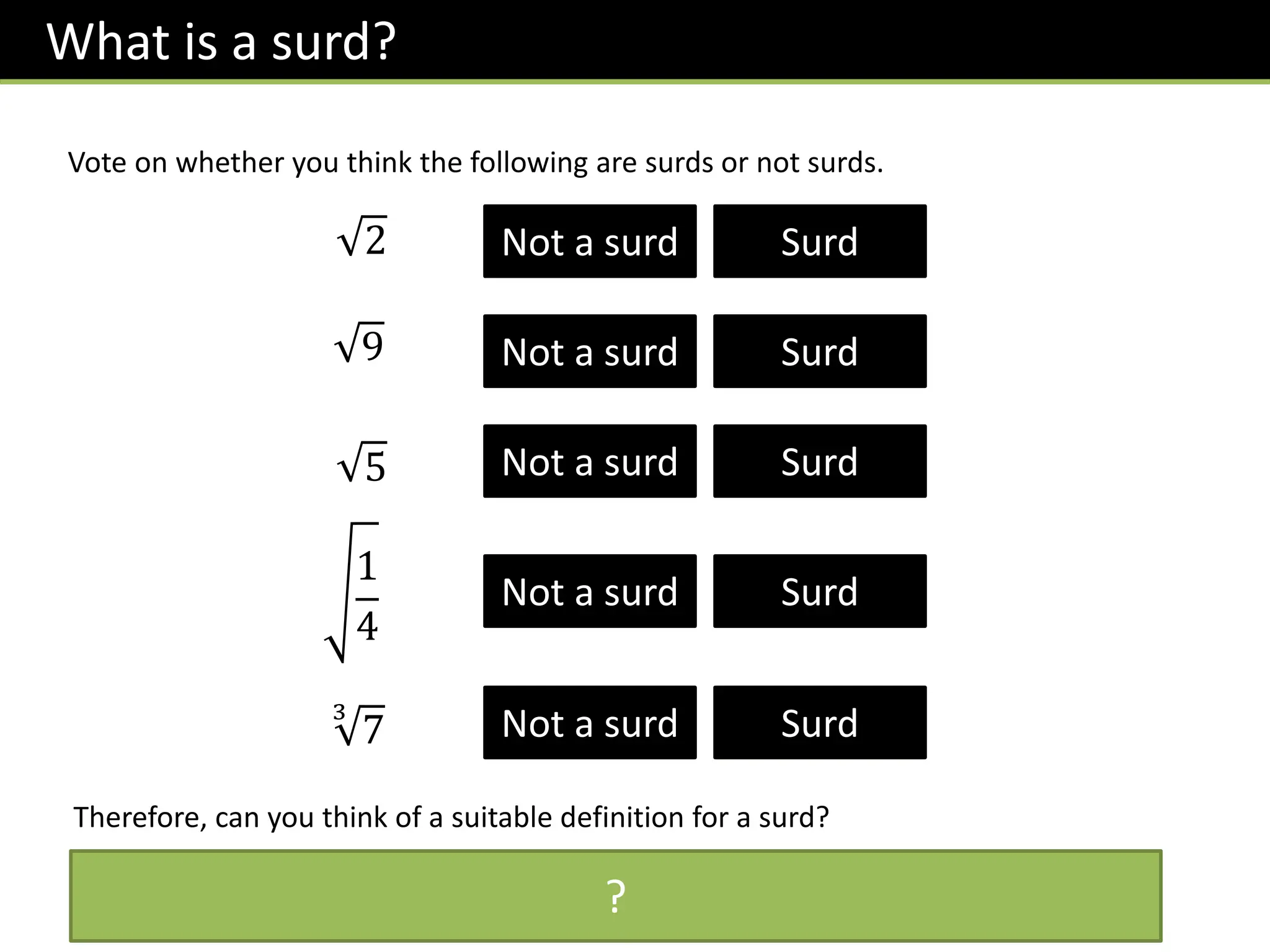
Vote on whether you think the following are surds or not surds.
Therefore, can you think of a suitable definition for a surd?
A surd is a root of a number that cannot be simplified to a rational number.


Not a surd Surd
 
Not a surd Surd


Not a surd Surd
 
Not a surd Surd
?
3
7 

Not a surd Surd
2
9
5
1
4
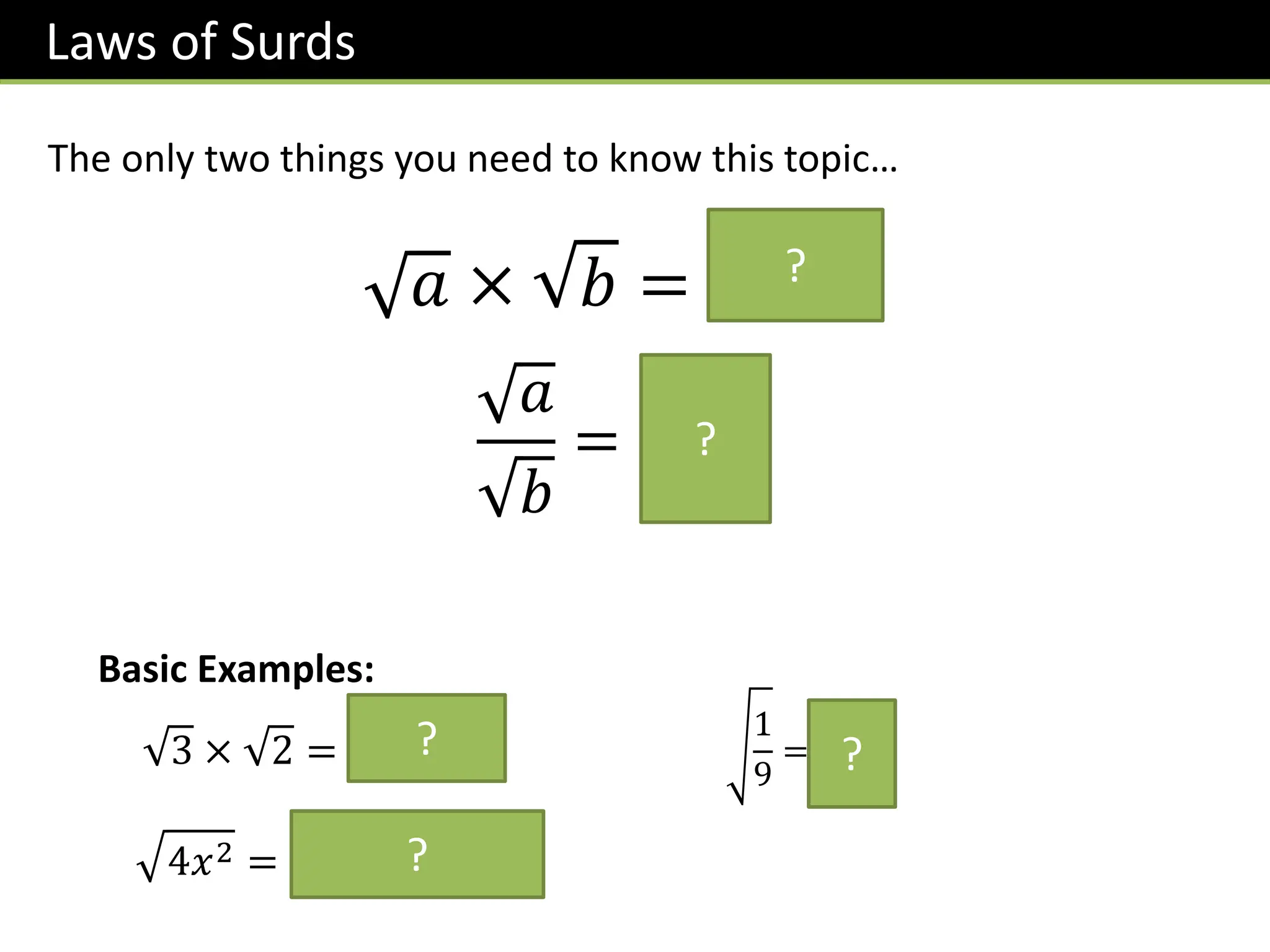
Laws of Surds
𝑎 × 𝑏 = 𝒂𝒃
𝑎
𝑏
=
𝒂
𝒃
?
?
The only two things you need to know this topic…
Basic Examples:
4𝑥2 = 𝟒 𝒙𝟐 = 𝟐𝒙
1
9
=
𝟏
𝟑
?
?
3 × 2 = 𝟔 ?
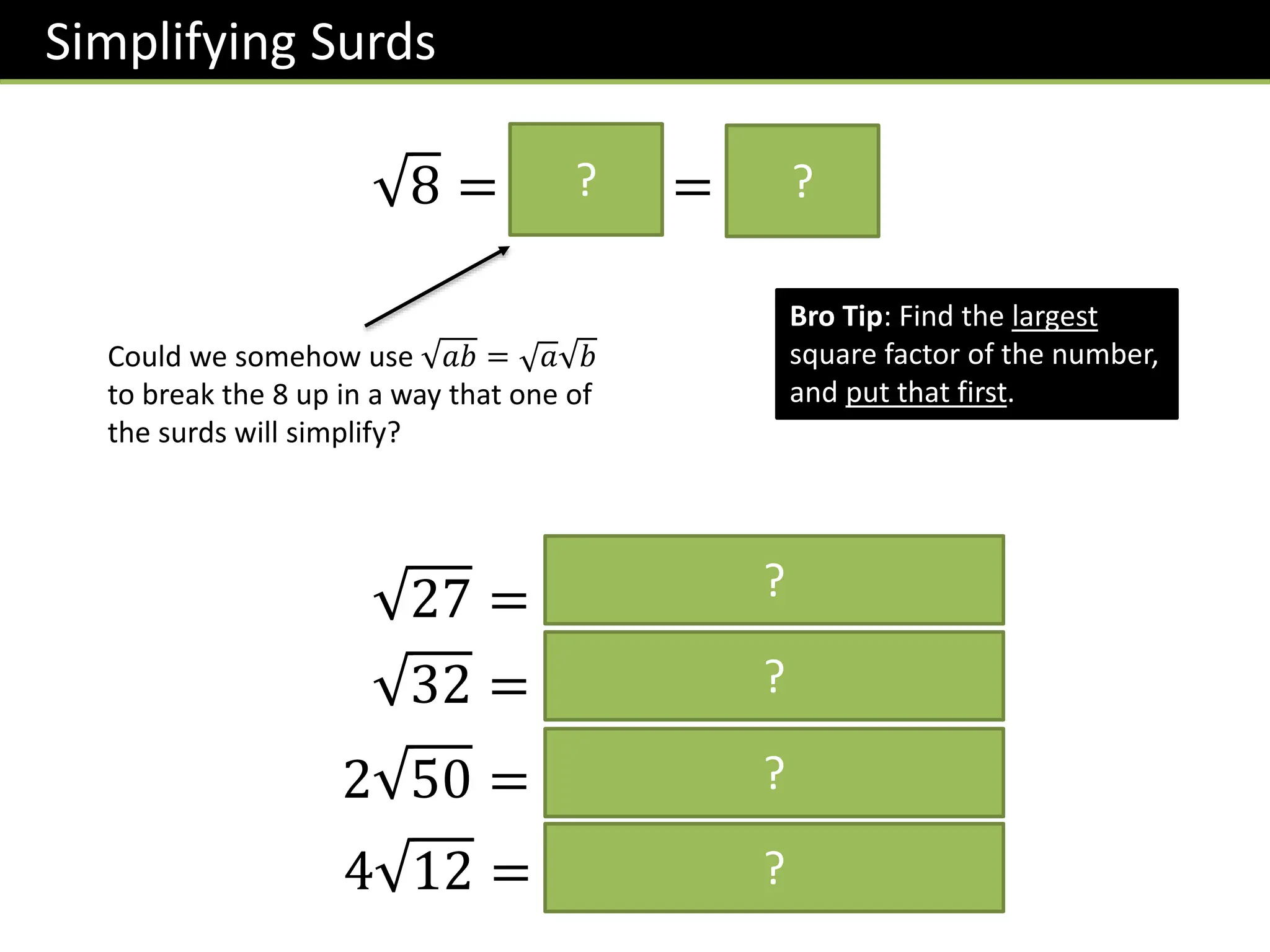
Simplifying Surds
8 = 𝟒 𝟐 = 𝟐 𝟐
?
Could we somehow use 𝑎𝑏 = 𝑎 𝑏
to break the 8 up in a way that one of
the surds will simplify?
Bro Tip: Find the largest
square factor of the number,
and put that first.
?
27 = 𝟗 𝟑 = 𝟑 𝟑
32 = 𝟏𝟔 𝟐 = 𝟒 𝟐
2 50 = 𝟐 𝟐𝟓 𝟐 = 𝟏𝟎 𝟐
4 12 = 𝟒 𝟒 𝟑 = 𝟖 𝟑
?
?
?
?
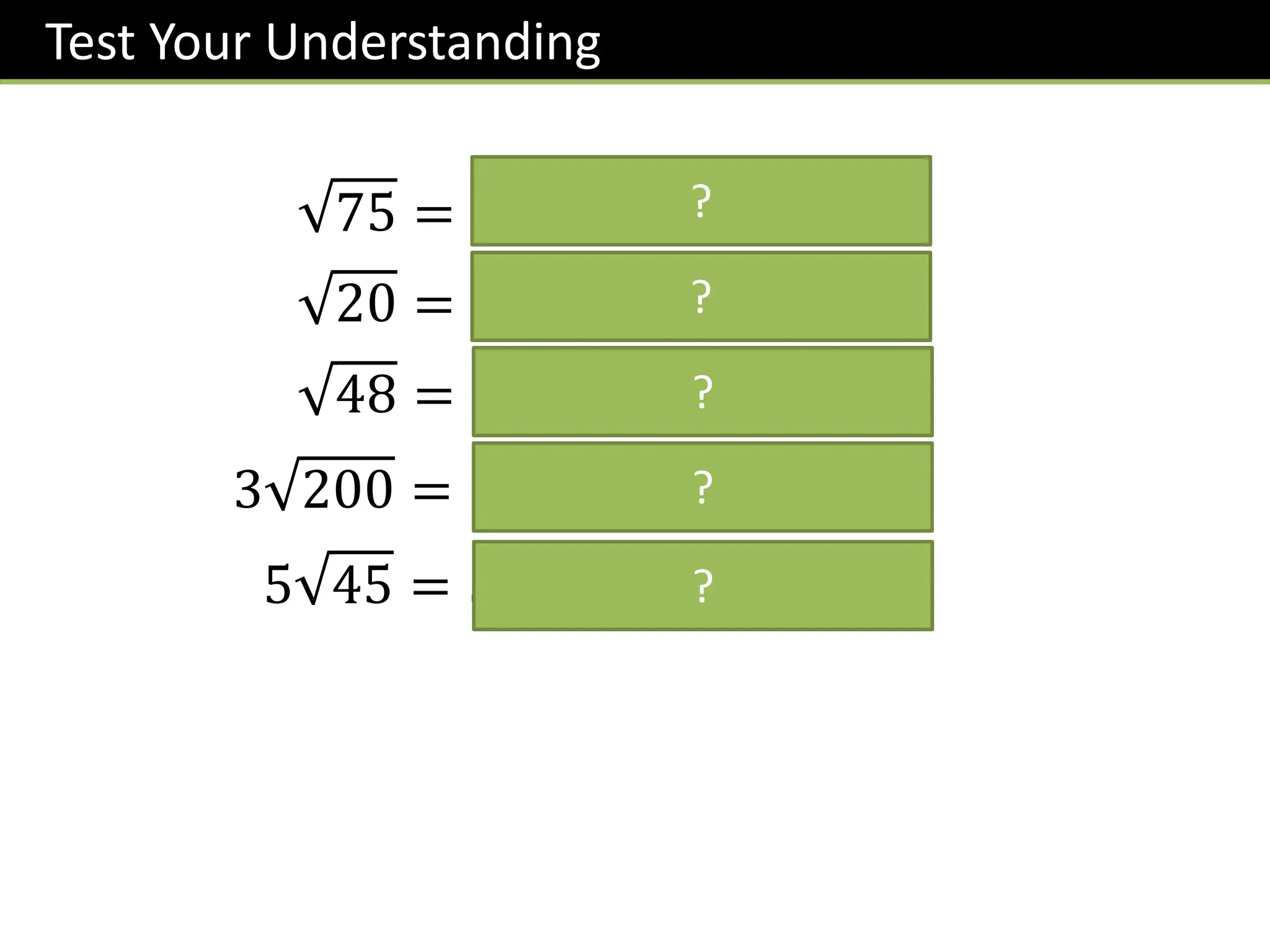
Test Your Understanding
75 = 𝟐𝟓 𝟑 = 𝟓 𝟑
20 = 𝟒 𝟓 = 𝟐 𝟓
48 = 𝟏𝟔 𝟑 = 𝟒 𝟑
3 200 = 𝟑 𝟏𝟎𝟎 𝟐 = 𝟑𝟎 𝟐
5 45 = 𝟓 𝟗 𝟓 = 𝟏𝟓 𝟓
?
?
?
?
?
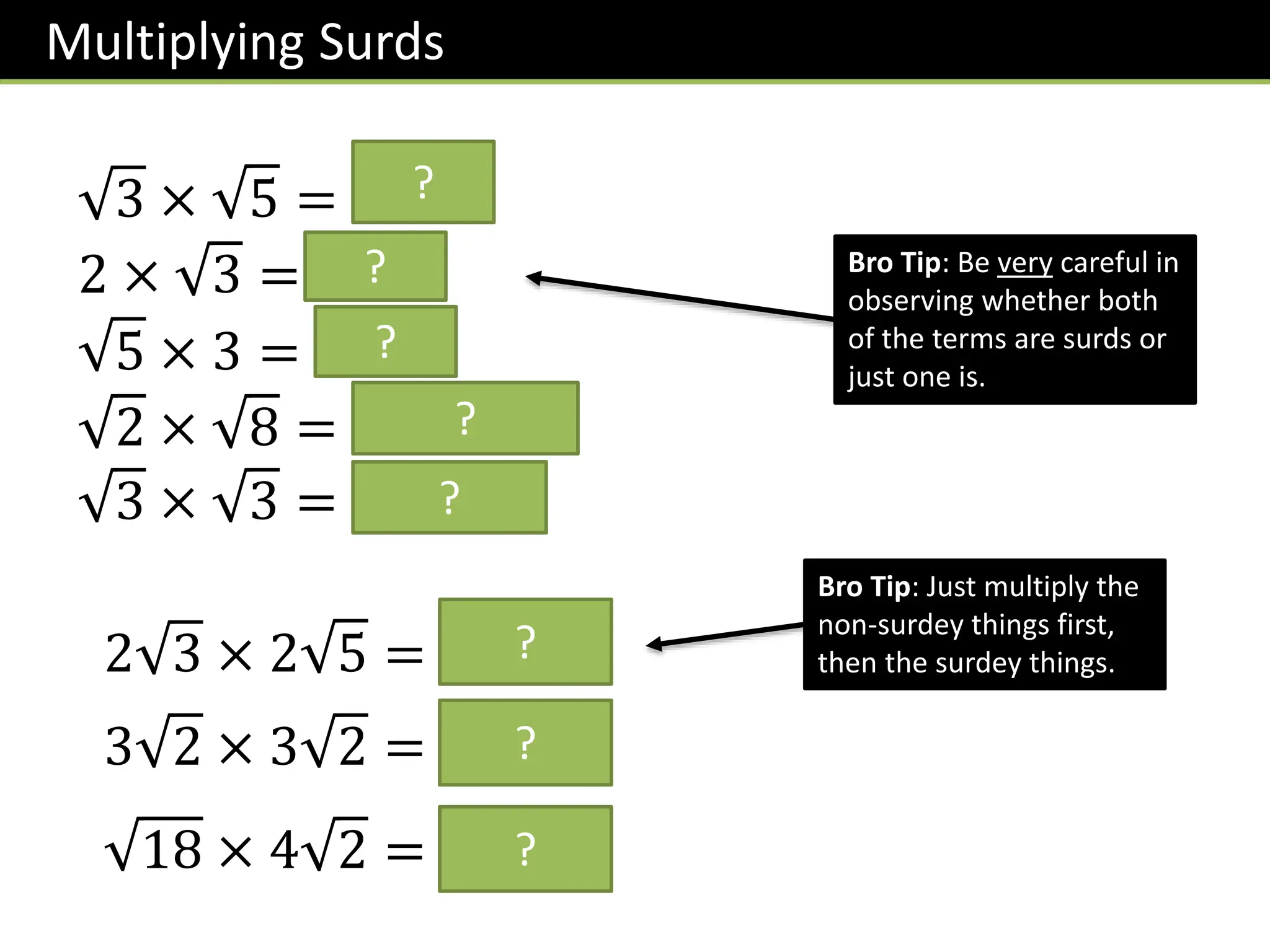
Multiplying Surds
3 × 5 = 𝟏𝟓
2 × 3 = 𝟐 𝟑
5 × 3 = 𝟑 𝟓
2 × 8 = 𝟏𝟔 = 𝟒
3 × 3 = 𝟗 = 𝟑
Bro Tip: Be very careful in
observing whether both
of the terms are surds or
just one is.
?
?
?
?
?
2 3 × 2 5 = 𝟒 𝟏𝟓
Bro Tip: Just multiply the
non-surdey things first,
then the surdey things.
?
3 2 × 3 2 = 𝟏𝟖?
18 × 4 2 = 𝟐𝟒?
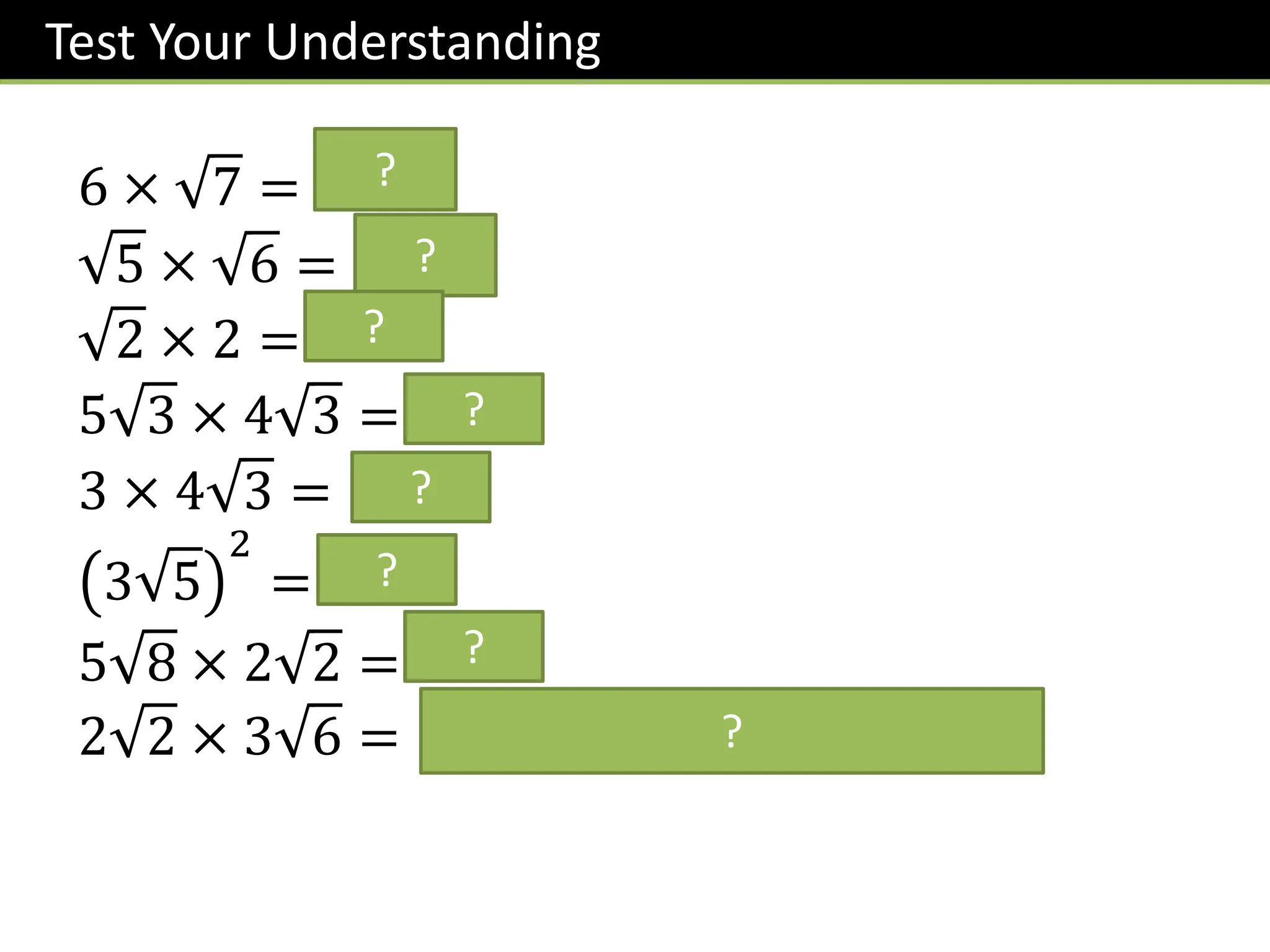
Test Your Understanding
6 × 7 = 𝟔 𝟕
5 × 6 = 𝟑𝟎
2 × 2 = 𝟐 𝟐
5 3 × 4 3 = 𝟔𝟎
3 × 4 3 = 𝟏𝟐 𝟑
3 5
2
= 𝟒𝟓
5 8 × 2 2 = 𝟒𝟎
2 2 × 3 6 = 𝟔 𝟏𝟐 = 𝟔 𝟒 𝟑 = 𝟏𝟐 𝟑
?
?
?
?
?
?
?
?
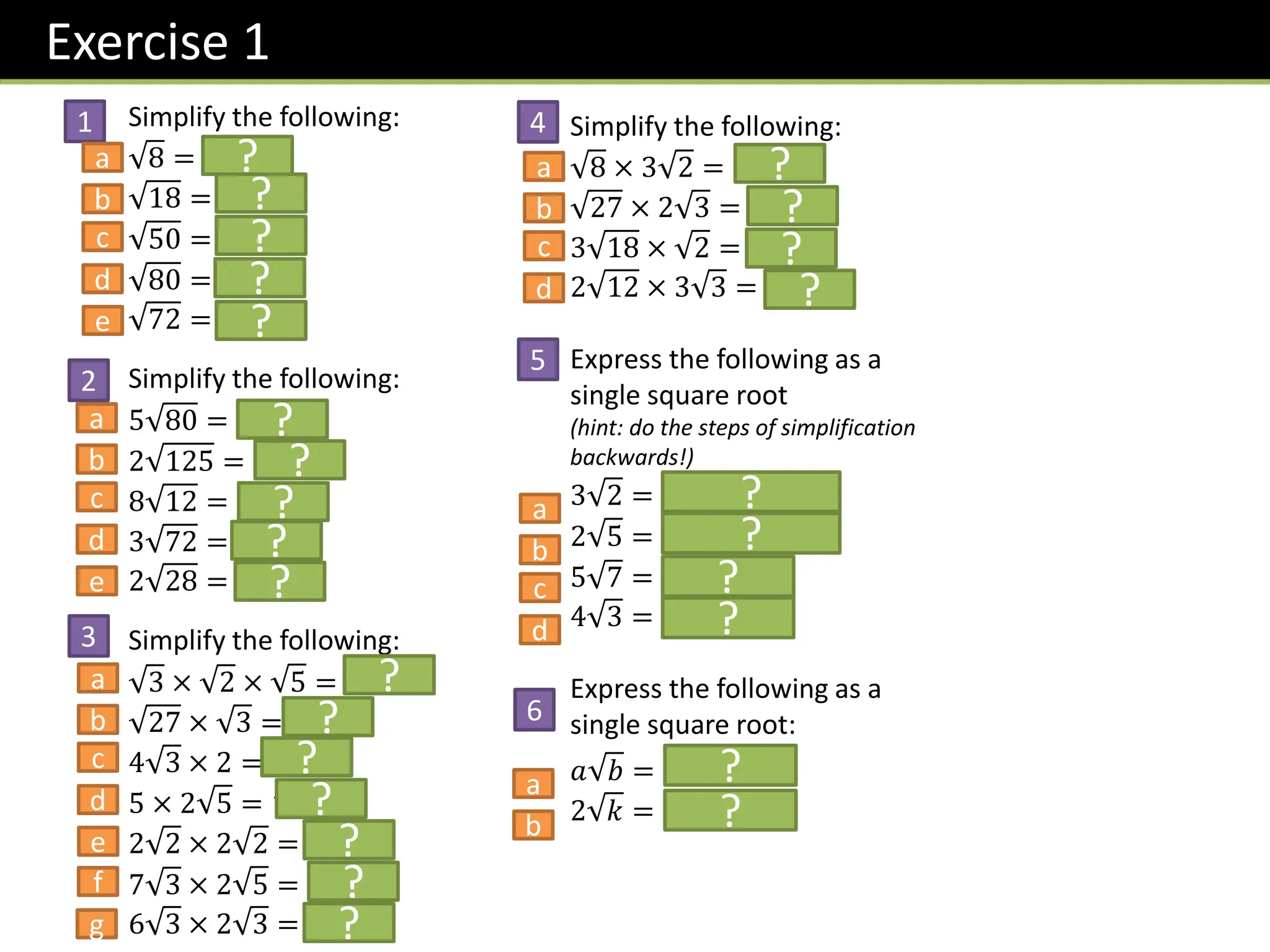
Exercise 1
Simplify the following:
8 = 𝟐 𝟐
18 = 𝟑 𝟐
50 = 𝟓 𝟐
80 = 𝟒 𝟓
72 = 𝟔 𝟐
Simplify the following:
5 80 = 𝟐𝟎 𝟓
2 125 = 𝟏𝟎 𝟓
8 12 = 𝟏𝟔 𝟑
3 72 = 𝟏𝟖 𝟐
2 28 = 𝟒 𝟕
Simplify the following:
3 × 2 × 5 = 𝟑𝟎
27 × 3 = 𝟗
4 3 × 2 = 𝟖 𝟑
5 × 2 5 = 𝟏𝟎 𝟓
2 2 × 2 2 = 𝟖
7 3 × 2 5 = 𝟏𝟒 𝟏𝟓
6 3 × 2 3 = 𝟑𝟔
Simplify the following:
8 × 3 2 = 𝟏𝟐
27 × 2 3 = 𝟏𝟖
3 18 × 2 = 𝟏𝟖
2 12 × 3 3 = 𝟑𝟔
Express the following as a
single square root
(hint: do the steps of simplification
backwards!)
3 2 = 𝟗 𝟐 = 𝟏𝟖
2 5 = 𝟒 𝟓 = 𝟐𝟎
5 7 = 𝟏𝟕𝟓
4 3 = 𝟒𝟖
Express the following as a
single square root:
𝑎 𝑏 = 𝒂𝟐𝒃
2 𝑘 = 𝟒𝒌
?
?
?
?
?
?
?
?
?
?
?
?
?
?
?
?
?
?
?
?
?
?
?
?
?
?
?
1
2
3
4
5
6
a
b
c
d
e
a
b
c
d
e
a
b
c
d
e
f
g
a
b
c
d
a
b
c
d
a
b
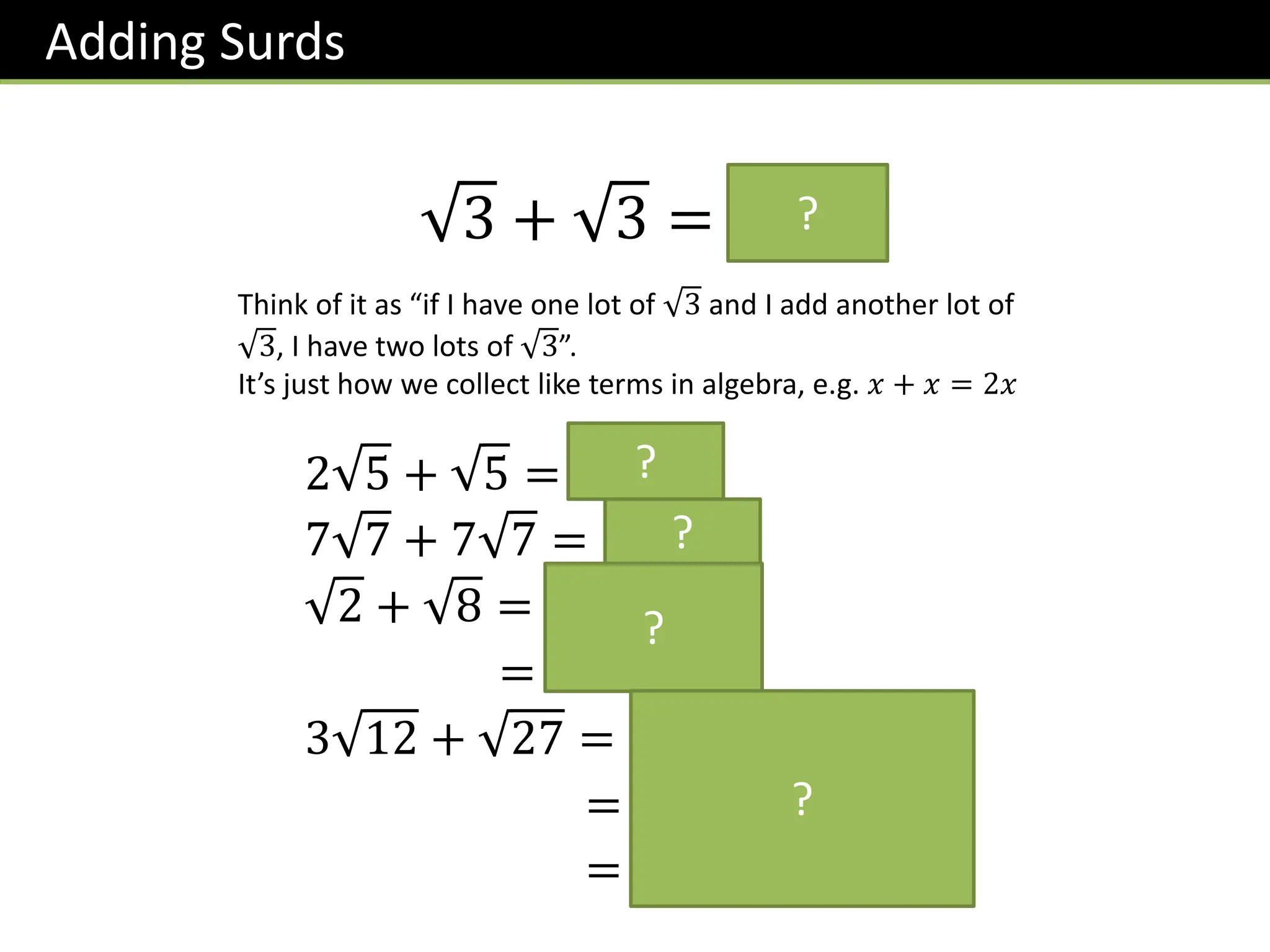
Adding Surds
3 + 3 = 𝟐 𝟑
Think of it as “if I have one lot of 3 and I add another lot of
3, I have two lots of 3”.
It’s just how we collect like terms in algebra, e.g. 𝑥 + 𝑥 = 2𝑥
?
2 5 + 5 = 𝟑 𝟓
7 7 + 7 7 = 𝟏𝟒 𝟕
2 + 8 = 𝟐 + 𝟐 𝟐
= 𝟑 𝟐
3 12 + 27 = 𝟑 𝟒 𝟑 + 𝟗 𝟑
= 𝟔 𝟑 + 𝟑 𝟑
= 𝟗 𝟑
?
?
?
?
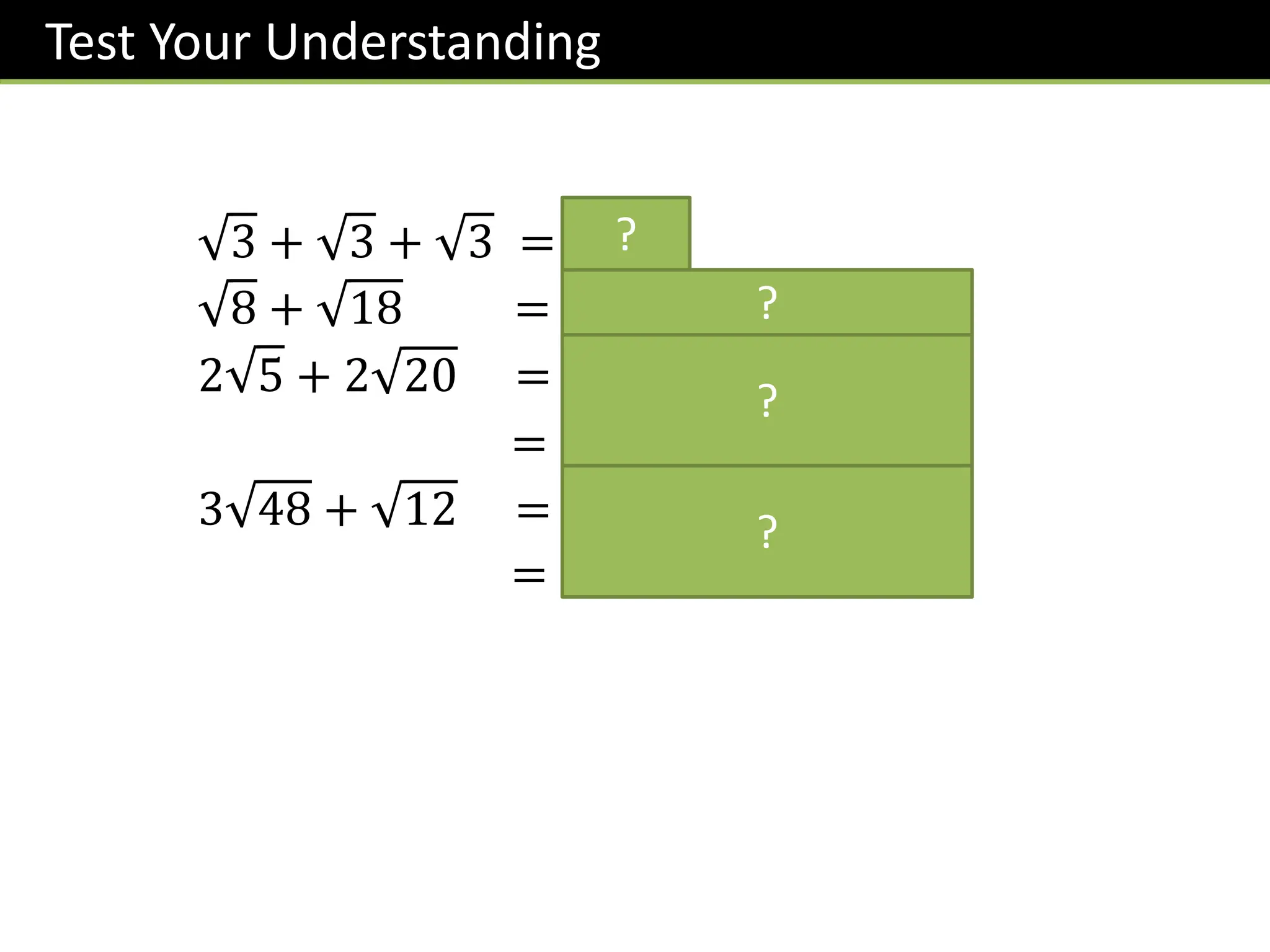
Test Your Understanding
3 + 3 + 3 = 𝟑 𝟑
8 + 18 = 𝟐 𝟐 + 𝟑 𝟐 = 𝟓 𝟐
2 5 + 2 20 = 𝟐 𝟓 + 𝟒 𝟓
= 𝟔 𝟓
3 48 + 12 = 𝟏𝟐 𝟑 + 𝟐 𝟑
= 𝟏𝟒 𝟑
?
?
?
?
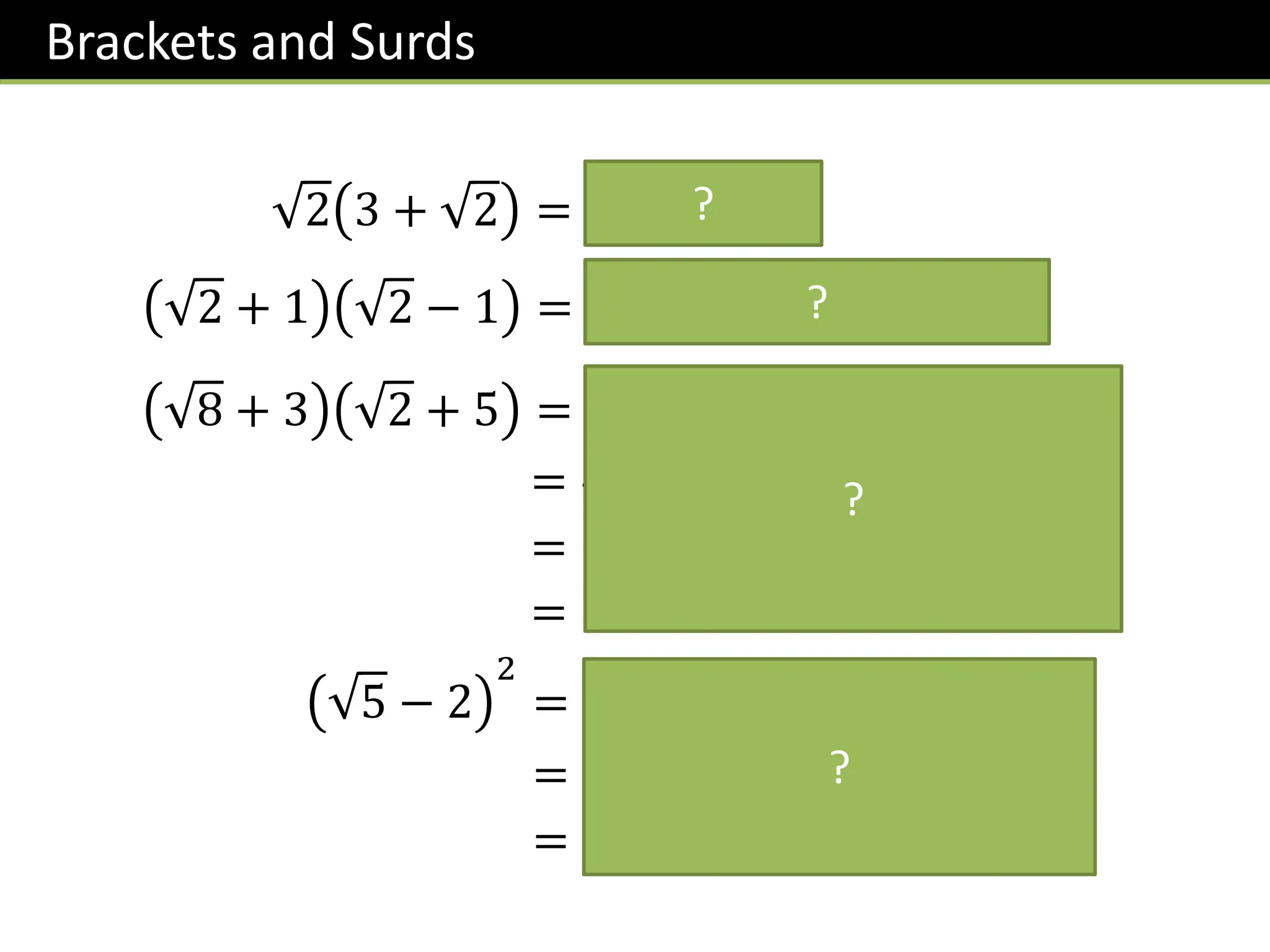
Brackets and Surds
2 3 + 2 = 𝟑 𝟐 + 𝟐
2 + 1 2 − 1 = 𝟐 + 𝟐 − 𝟐 − 𝟏 = 𝟏
8 + 3 2 + 5 = 𝟏𝟔 + 𝟓 𝟖 + 𝟑 𝟐 + 𝟏𝟓
= 𝟒 + 𝟓 𝟒 𝟐 + 𝟑 𝟐 + 𝟏𝟓
= 𝟏𝟗 + 𝟏𝟎 𝟐 + 𝟑 𝟐
= 𝟏𝟗 + 𝟏𝟑 𝟐
5 − 2
2
= 𝟓 − 𝟐 𝟓 − 𝟐
= 𝟓 − 𝟐 𝟓 − 𝟐 𝟓 + 𝟒
= 𝟗 − 𝟒 𝟓
?
?
?
?
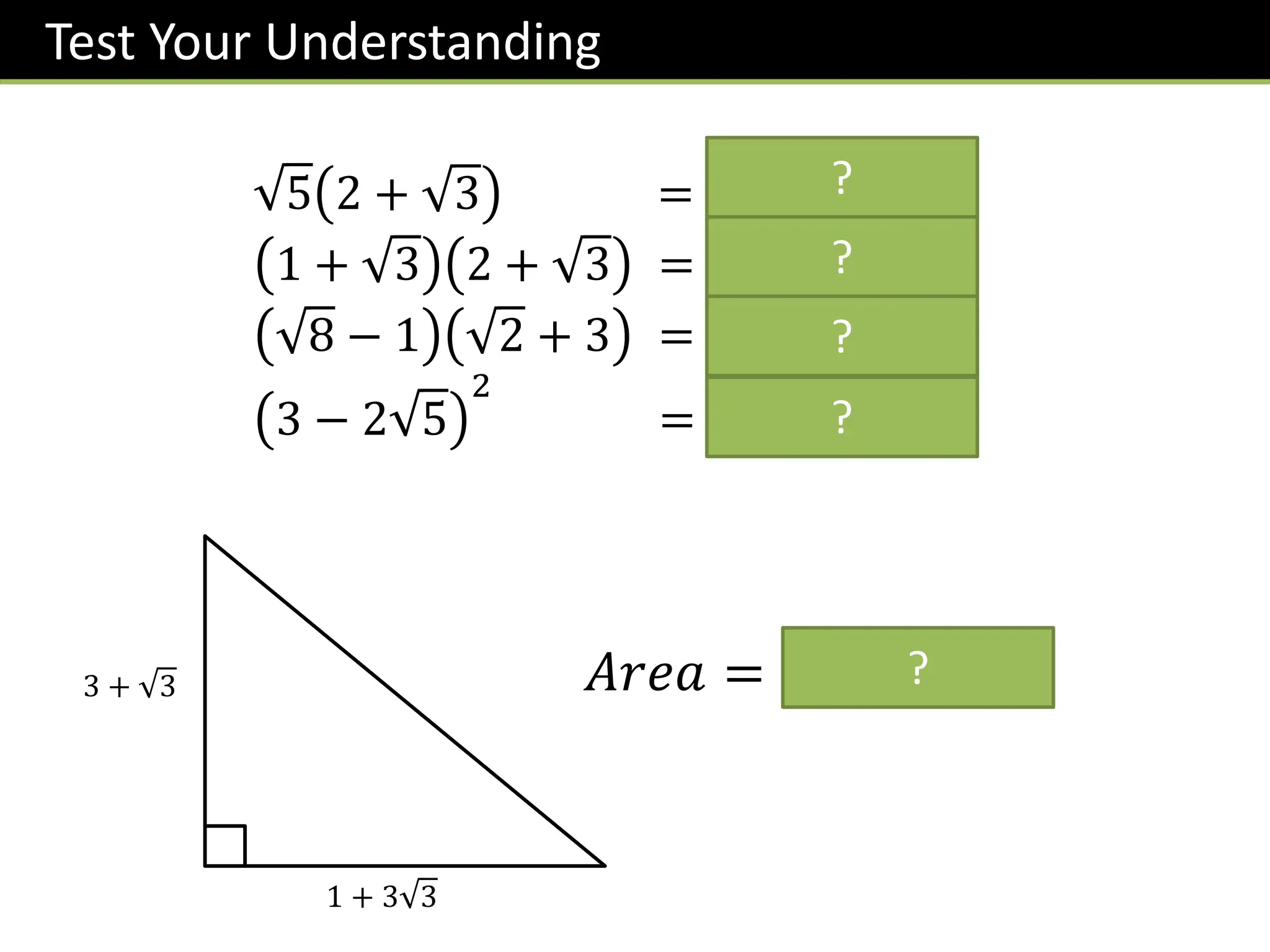
Test Your Understanding
5 2 + 3 = 𝟐 𝟓 + 𝟏𝟓
1 + 3 2 + 3 = 𝟓 + 𝟑 𝟑
8 − 1 2 + 3 = 𝟏 + 𝟓 𝟐
3 − 2 5
2
= 𝟐𝟗 − 𝟏𝟐 𝟓
3 + 3
1 + 3 3
𝐴𝑟𝑒𝑎 = 𝟔 + 𝟓 𝟑
?
?
?
?
?
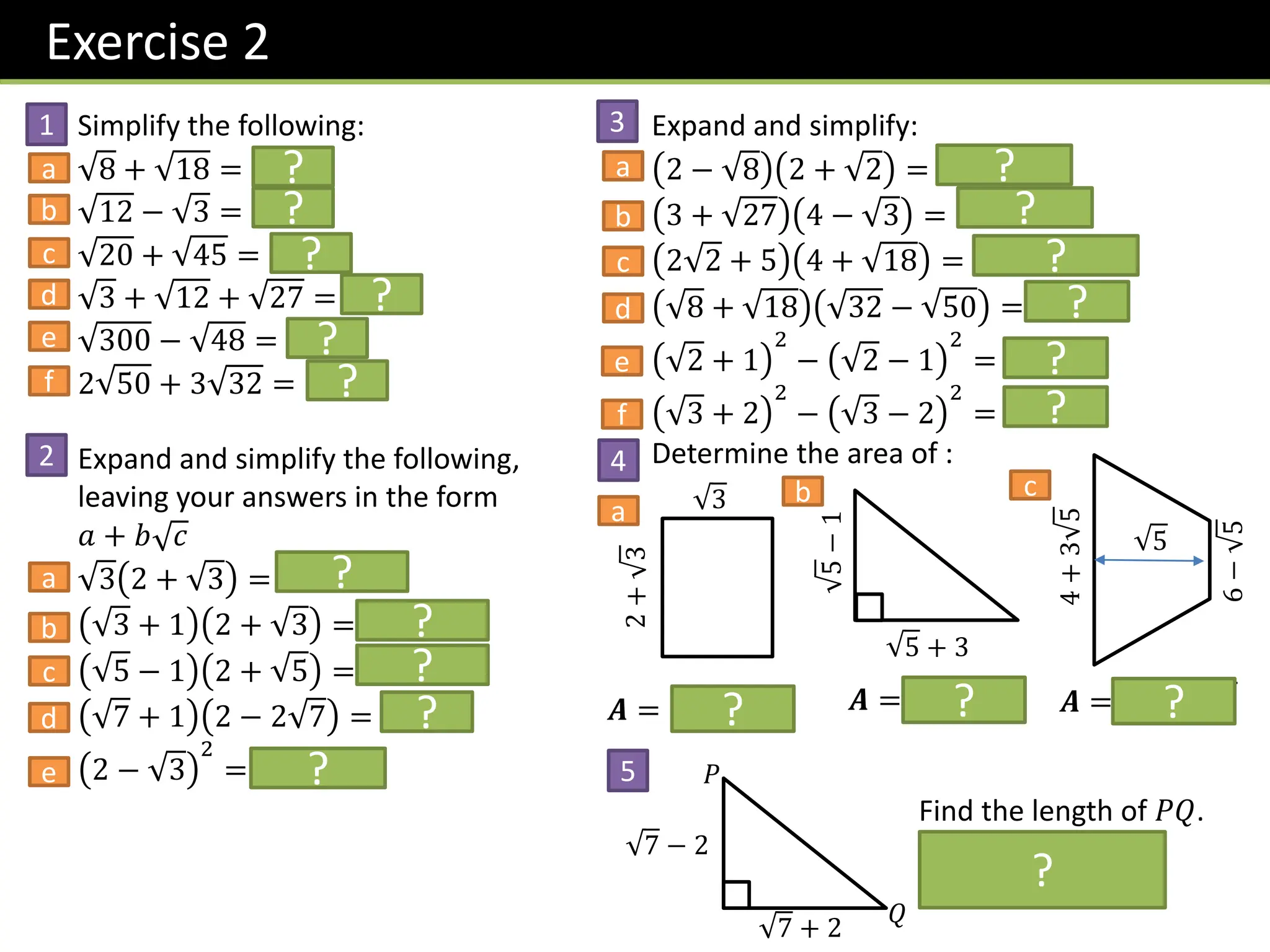
Exercise 2
Simplify the following:
8 + 18 = 𝟓 𝟐
12 − 3 = 𝟑
20 + 45 = 𝟓 𝟓
3 + 12 + 27 = 𝟔 𝟑
300 − 48 = 𝟔 𝟑
2 50 + 3 32 = 𝟐𝟐 𝟐
Expand and simplify the following,
leaving your answers in the form
𝑎 + 𝑏 𝑐
3 2 + 3 = 𝟐 𝟑 + 𝟑
3 + 1 2 + 3 = 𝟓 + 𝟑 𝟑
5 − 1 2 + 5 = 𝟑 + 𝟓
7 + 1 2 − 2 7 = −𝟏𝟐
2 − 3
2
= 𝟕 − 𝟒 𝟑
Expand and simplify:
2 − 8 2 + 2 = −𝟐 𝟐
3 + 27 4 − 3 = 𝟑 + 𝟗 𝟑
2 2 + 5 4 + 18 = 𝟑𝟐 + 𝟐𝟑 𝟐
8 + 18 32 − 50 = −𝟏𝟎
2 + 1
2
− 2 − 1
2
= 𝟒 𝟐
3 + 2
2
− 3 − 2
2
= 𝟖 𝟑
Determine the area of :
2
+
3
3
5 + 3
5
−
1
4
+
3
5
6
−
5
5
𝑨 = 𝟐 𝟑 + 𝟑 𝑨 = 𝟏 + 𝟓 𝑨 = 𝟓 + 𝟓 𝟓
7 + 2
7 − 2
𝑃
𝑄
Find the length of 𝑃𝑄.
(Using Pythagoras)
𝑷𝑸 = 𝟐𝟐
?
?
?
?
?
?
?
?
?
?
?
?
?
?
?
?
?
? ? ?
?
1
a
b
c
d
e
f
2
a
b
c
d
e
3
a
b
c
d
e
f
4
a
b c
5
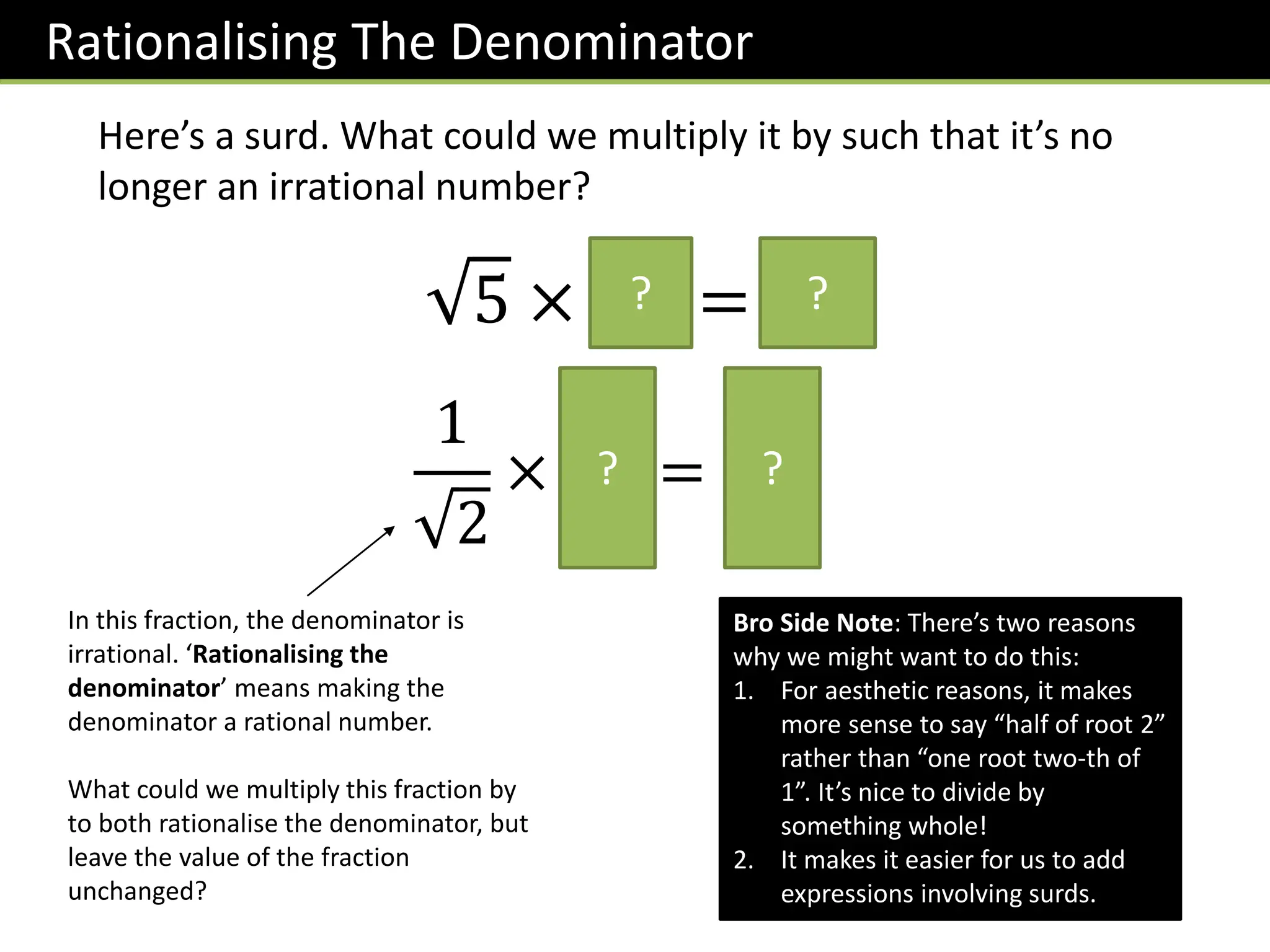
Here’s a surd. What could we multiply it by such that it’s no
longer an irrational number?
Rationalising The Denominator
5 × 5 = 5
? ?
In this fraction, the denominator is
irrational. ‘Rationalising the
denominator’ means making the
denominator a rational number.
What could we multiply this fraction by
to both rationalise the denominator, but
leave the value of the fraction
unchanged?
1
2
×
2
2
=
2
2
? ?
Bro Side Note: There’s two reasons
why we might want to do this:
1. For aesthetic reasons, it makes
more sense to say “half of root 2”
rather than “one root two-th of
1”. It’s nice to divide by
something whole!
2. It makes it easier for us to add
expressions involving surds.
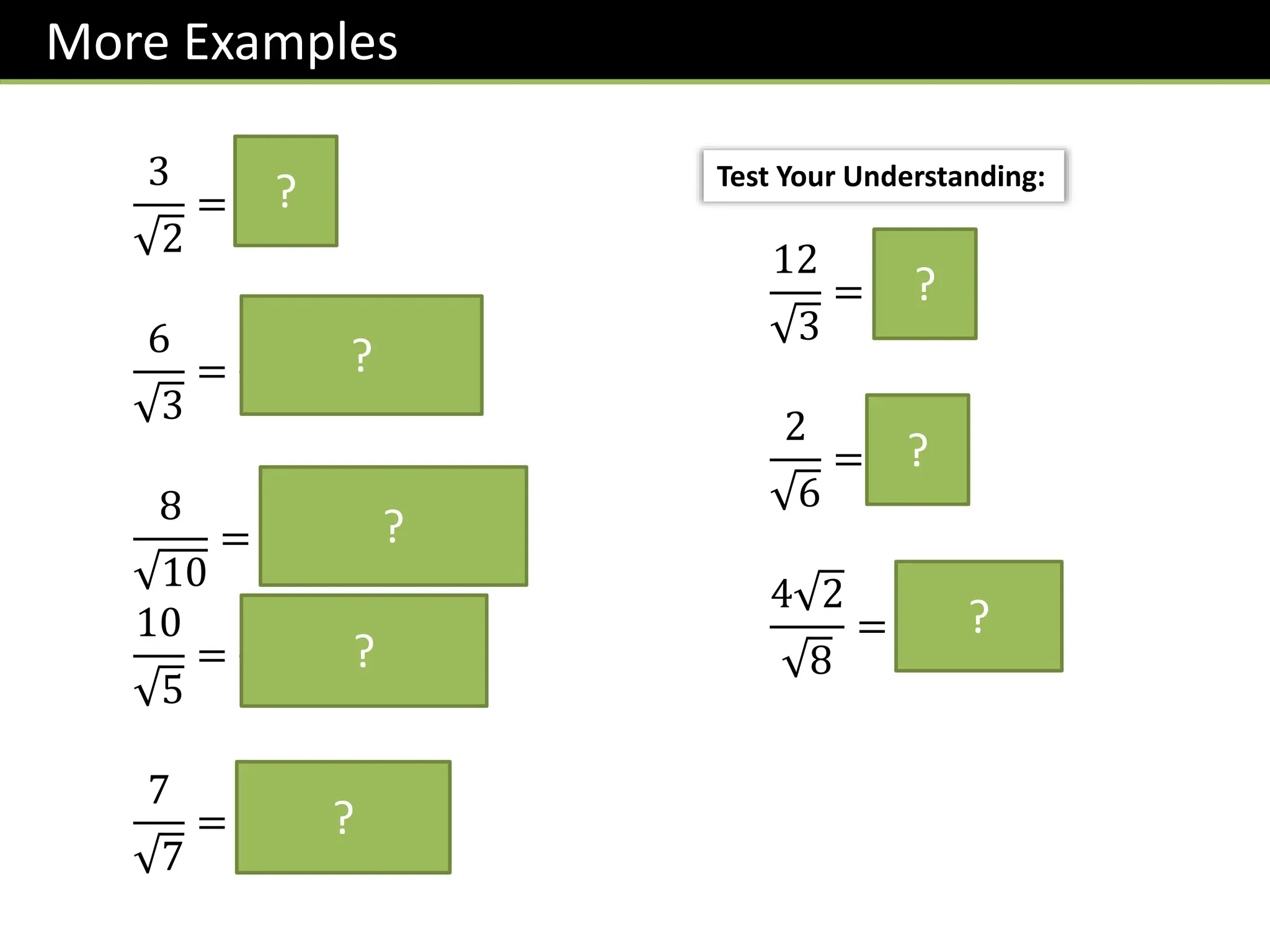
3
2
=
𝟑 𝟐
𝟐
6
3
=
𝟔 𝟑
𝟑
= 𝟐 𝟑
8
10
=
𝟖 𝟏𝟎
𝟏𝟎
=
𝟒 𝟏𝟎
𝟓
10
5
=
𝟏𝟎 𝟓
𝟓
= 𝟐 𝟓
7
7
=
𝟕 𝟕
𝟕
= 𝟕
More Examples
?
?
?
?
?
12
3
= 𝟒 𝟑
2
6
=
𝟔
𝟑
4 2
8
=
𝟏𝟔
𝟖
= 𝟐
?
?
?
Test Your Understanding:
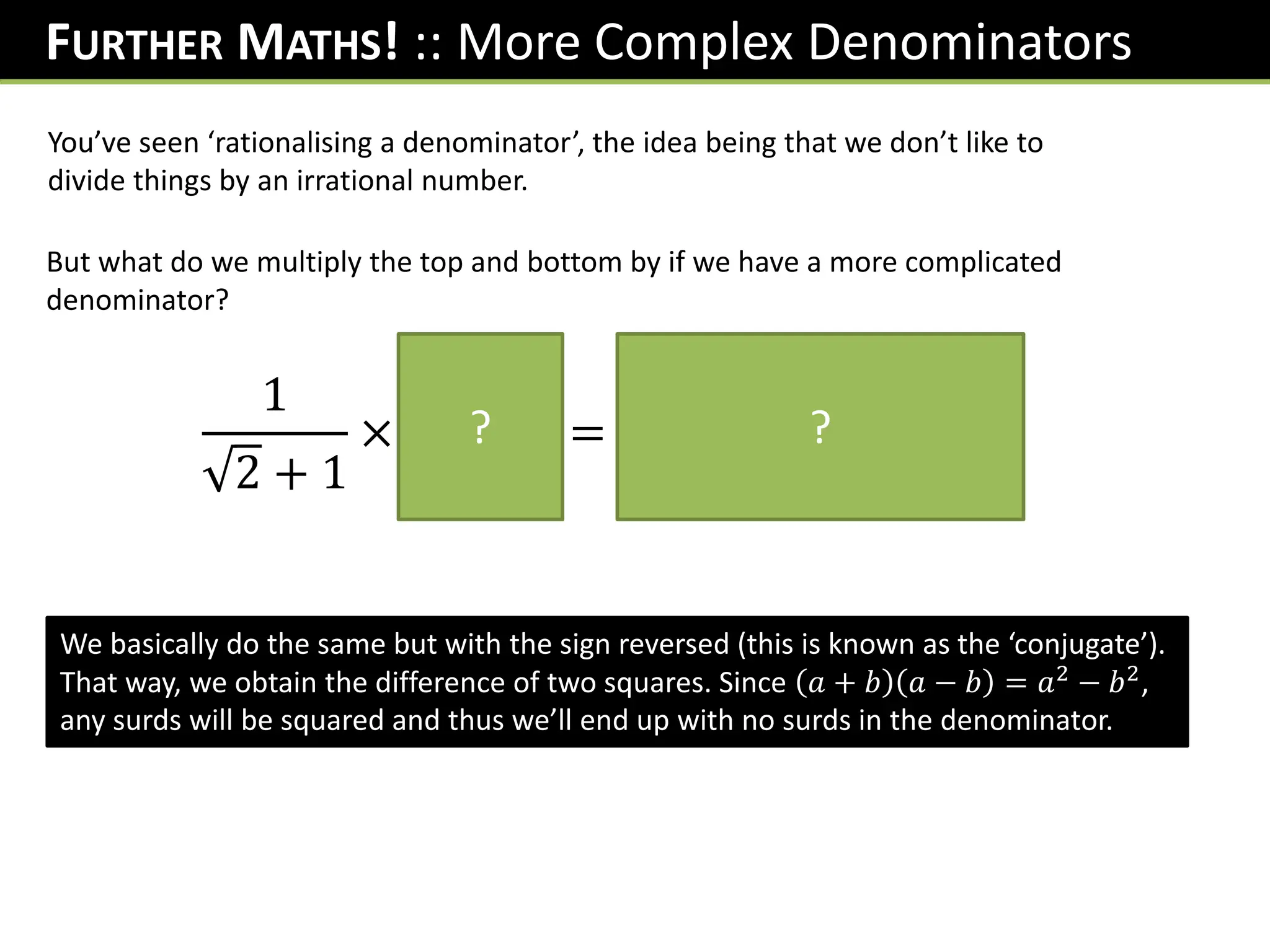
FURTHER MATHS! :: More Complex Denominators
You’ve seen ‘rationalising a denominator’, the idea being that we don’t like to
divide things by an irrational number.
But what do we multiply the top and bottom by if we have a more complicated
denominator?
1
2 + 1
×
𝟐 − 𝟏
𝟐 − 𝟏
=
𝟐 − 𝟏
𝟏
= 𝟐 − 𝟏
? ?
We basically do the same but with the sign reversed (this is known as the ‘conjugate’).
That way, we obtain the difference of two squares. Since 𝑎 + 𝑏 𝑎 − 𝑏 = 𝑎2
− 𝑏2
,
any surds will be squared and thus we’ll end up with no surds in the denominator.
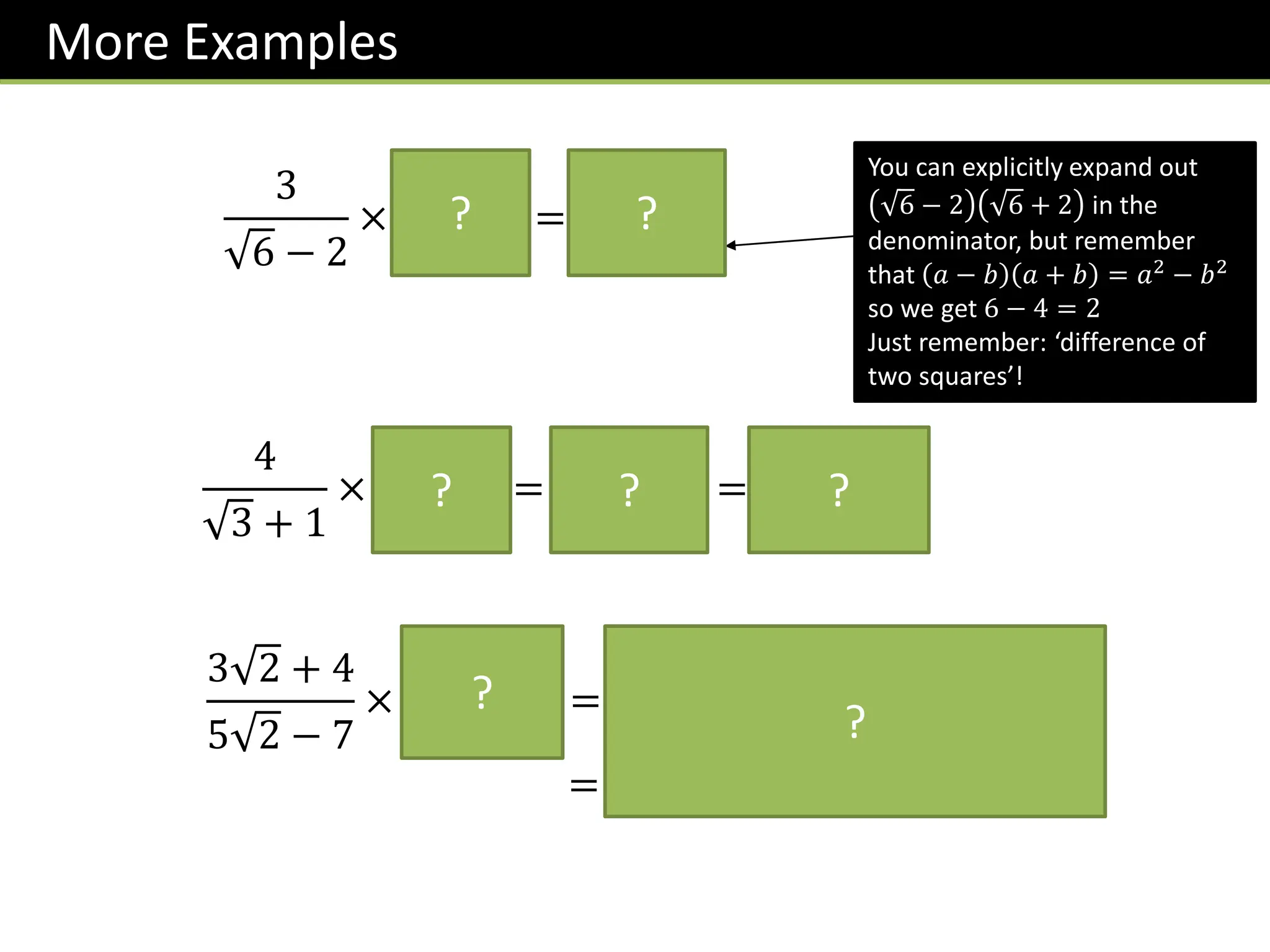
More Examples
3
6 − 2
×
6 + 2
6 + 2
=
3 6 + 6
2
You can explicitly expand out
6 − 2 6 + 2 in the
denominator, but remember
that 𝑎 − 𝑏 𝑎 + 𝑏 = 𝑎2
− 𝑏2
so we get 6 − 4 = 2
Just remember: ‘difference of
two squares’!
?
3 2 + 4
5 2 − 7
×
𝟓 𝟐 + 𝟕
𝟓 𝟐 + 𝟕
=
𝟑𝟎 + 𝟐𝟏 𝟐 + 𝟐𝟎 𝟐 + 𝟐𝟖
𝟏
= 𝟓𝟖 + 𝟒𝟏 𝟐
?
?
?
4
3 + 1
×
3 − 1
3 − 1
=
4 3 − 4
2
= 2 3 − 2
?
? ?
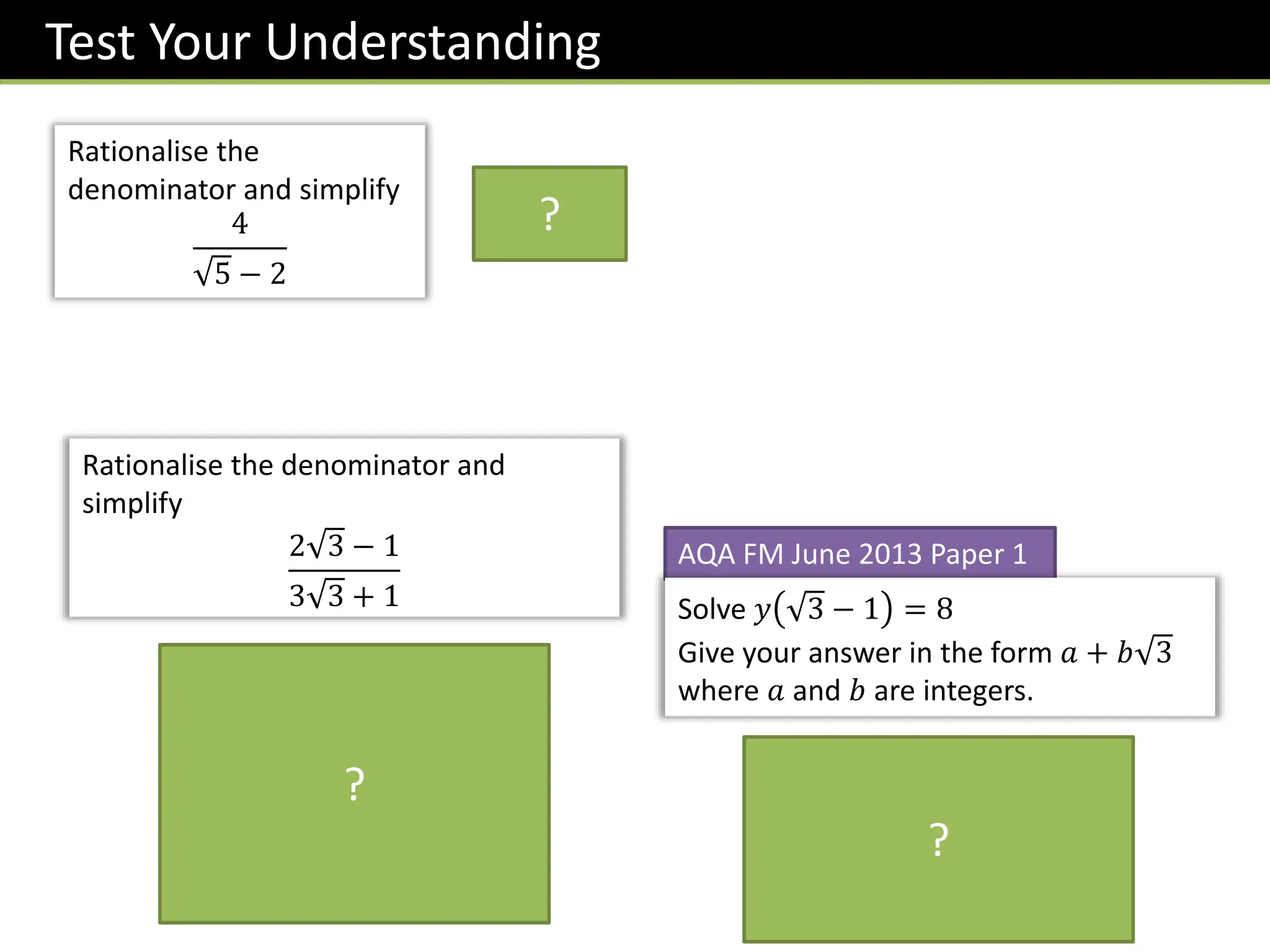
Test Your Understanding
AQA FM June 2013 Paper 1
Solve 𝑦 3 − 1 = 8
Give your answer in the form 𝑎 + 𝑏 3
where 𝑎 and 𝑏 are integers.
𝒚 =
𝟖
𝟑 − 𝟏
×
𝟑 + 𝟏
𝟑 + 𝟏
=
𝟖 𝟑 + 𝟖
𝟐
= 𝟒 + 𝟒 𝟑
Rationalise the denominator and
simplify
2 3 − 1
3 3 + 1
𝟐 𝟑 − 𝟏
𝟑 𝟑 + 𝟏
×
𝟑 𝟑 − 𝟏
𝟑 𝟑 − 𝟏
=
𝟏𝟖 − 𝟐 𝟑 − 𝟑 𝟑 + 𝟏
𝟐𝟕 − 𝟏
=
𝟏𝟗 − 𝟓 𝟑
𝟐𝟔
?
?
Rationalise the
denominator and simplify
4
5 − 2
𝟖 + 𝟒 𝟓
?
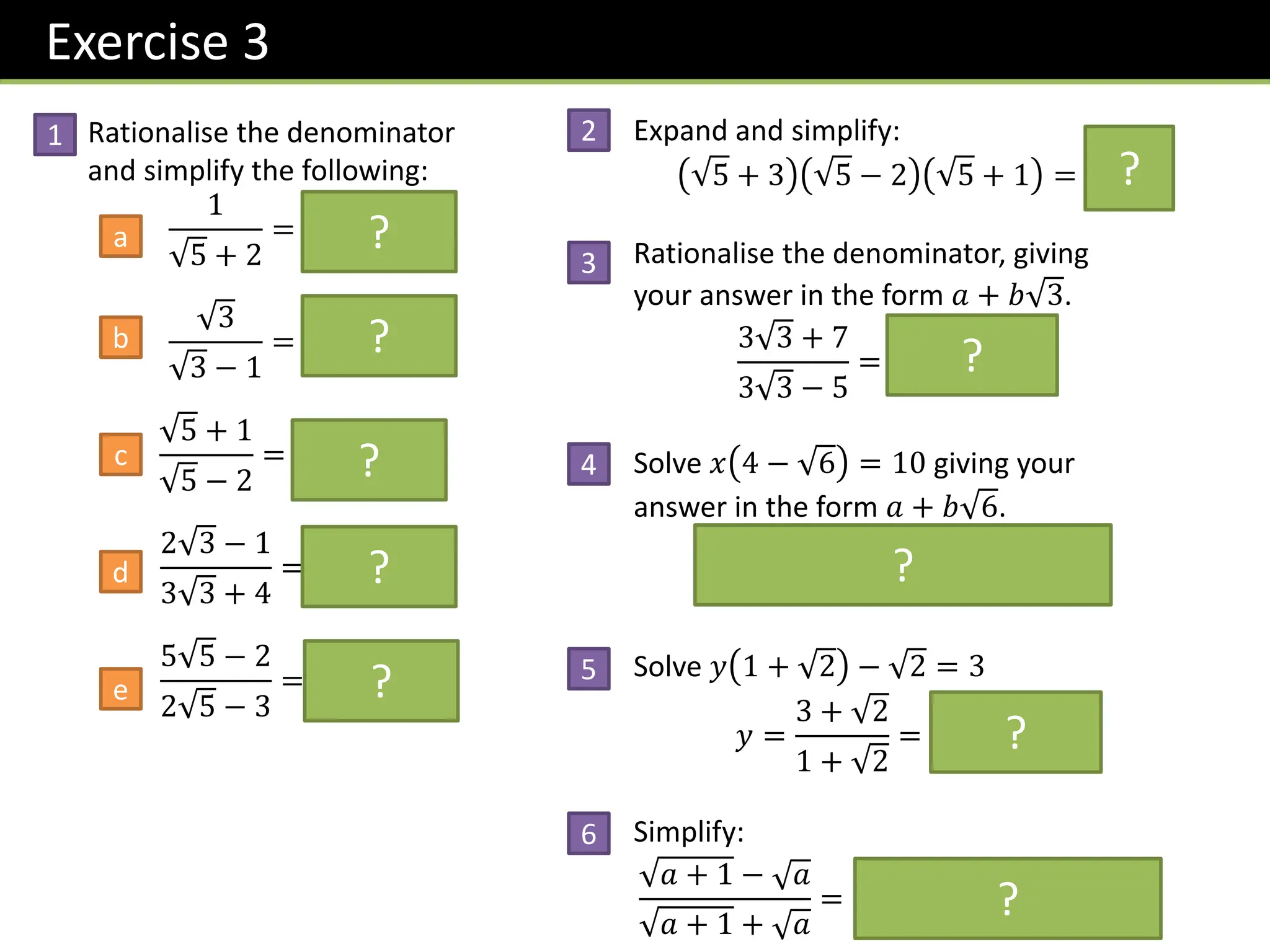
Exercise 3
Rationalise the denominator
and simplify the following:
1
5 + 2
= 𝟓 − 𝟐
3
3 − 1
=
𝟑 + 𝟑
𝟐
5 + 1
5 − 2
= 𝟕 + 𝟑 𝟓
2 3 − 1
3 3 + 4
= 𝟐 − 𝟑
5 5 − 2
2 5 − 3
= 𝟒 + 𝟓
Expand and simplify:
5 + 3 5 − 2 5 + 1 = 𝟒
Rationalise the denominator, giving
your answer in the form 𝑎 + 𝑏 3.
3 3 + 7
3 3 − 5
= 𝟑𝟏 + 𝟏𝟖 𝟑
Solve 𝑥 4 − 6 = 10 giving your
answer in the form 𝑎 + 𝑏 6.
𝑥 =
10
4 − 6
= 𝟒 + 𝟔
Solve 𝑦 1 + 2 − 2 = 3
𝑦 =
3 + 2
1 + 2
= 𝟐 𝟐 − 𝟏
Simplify:
𝑎 + 1 − 𝑎
𝑎 + 1 + 𝑎
= 𝟐𝒂 + 𝟏 − 𝟐 𝒂 𝒂 + 𝟏
?
?
?
?
?
?
?
?
?
1 2
3
4
5
a
b
c
d
e
?
6
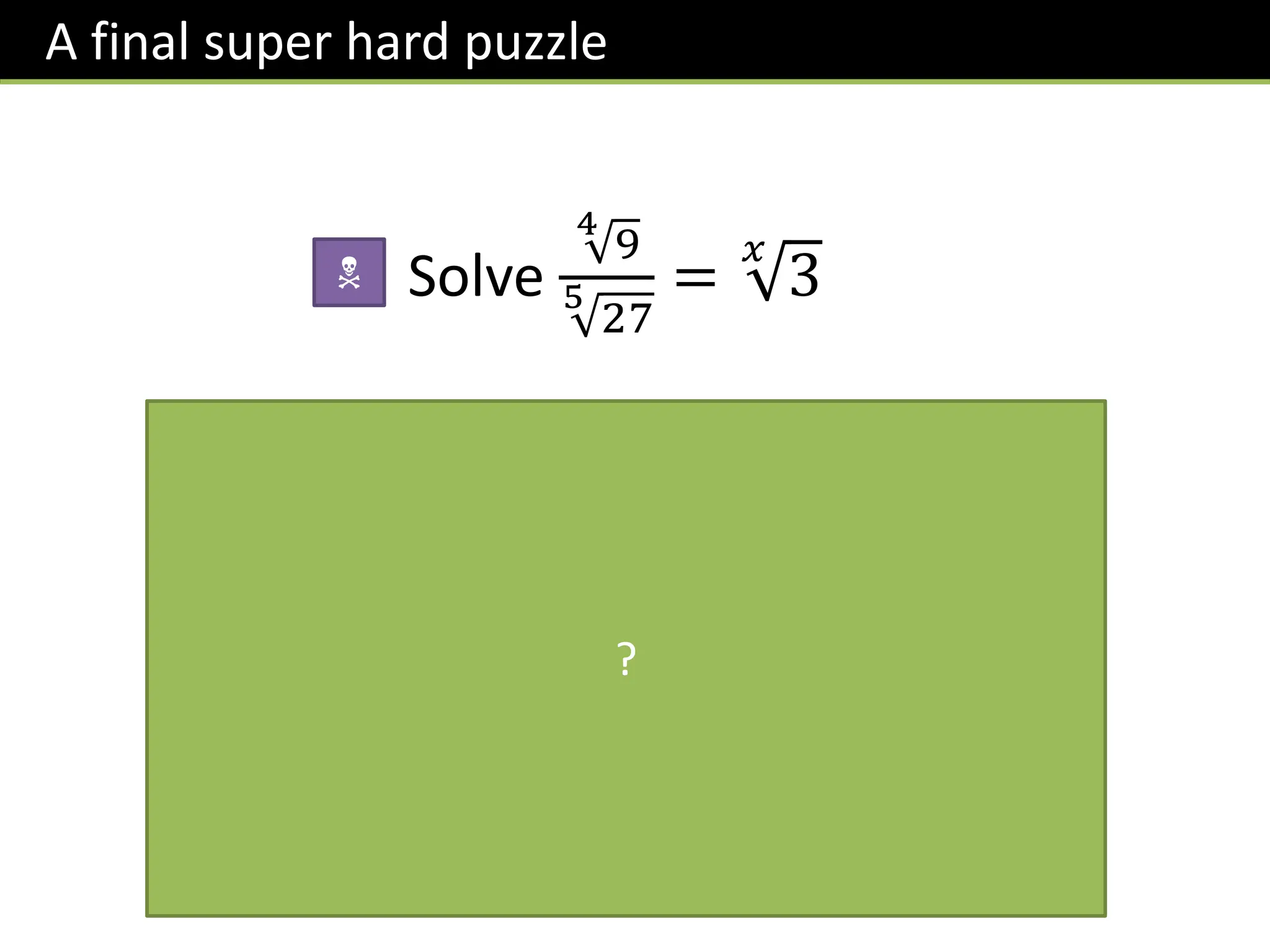
A final super hard puzzle
Solve
4
9
5
27
=
𝑥
3
N
𝟒
𝟑𝟐
𝟓
𝟑𝟑
=
𝟑𝟐
𝟏
𝟒
𝟑𝟑
𝟏
𝟓
=
𝟑
𝟏
𝟐
𝟑
𝟑
𝟓
= 𝟑−
𝟏
𝟏𝟎
But
𝒙
𝟑 = 𝟑
𝟏
𝒙
∴
𝟏
𝒙
= −
𝟏
𝟏𝟎
→ 𝒙 = −𝟏𝟎
?

GCSE-Surds.pptx for IGCSE grade 9 and 10

  • 1.
  • 2.
    Types of numbers RealNumbers Real numbers are any possible decimal or whole number. Rational Numbers Irrational Numbers are all numbers which can be expressed as some fraction involving integers (whole numbers), e.g. 1 4 , 3 1 2 , -7. are real numbers which are not rational. !
  • 3.
    Types of numbers Activity:Copy out the Venn diagram, and put the following numbers into the correct set. 3 0.7 π . 1.3 √2 -1 3 4 √9 e Edwin’s exact height (in m) Integers Rational numbers Real numbers (Click the blue boxes above)
  • 4.
    What is asurd? Vote on whether you think the following are surds or not surds. Therefore, can you think of a suitable definition for a surd? A surd is a root of a number that cannot be simplified to a rational number.   Not a surd Surd   Not a surd Surd   Not a surd Surd   Not a surd Surd ? 3 7   Not a surd Surd 2 9 5 1 4
  • 5.
    Laws of Surds 𝑎× 𝑏 = 𝒂𝒃 𝑎 𝑏 = 𝒂 𝒃 ? ? The only two things you need to know this topic… Basic Examples: 4𝑥2 = 𝟒 𝒙𝟐 = 𝟐𝒙 1 9 = 𝟏 𝟑 ? ? 3 × 2 = 𝟔 ?
  • 6.
    Simplifying Surds 8 =𝟒 𝟐 = 𝟐 𝟐 ? Could we somehow use 𝑎𝑏 = 𝑎 𝑏 to break the 8 up in a way that one of the surds will simplify? Bro Tip: Find the largest square factor of the number, and put that first. ? 27 = 𝟗 𝟑 = 𝟑 𝟑 32 = 𝟏𝟔 𝟐 = 𝟒 𝟐 2 50 = 𝟐 𝟐𝟓 𝟐 = 𝟏𝟎 𝟐 4 12 = 𝟒 𝟒 𝟑 = 𝟖 𝟑 ? ? ? ?
  • 7.
    Test Your Understanding 75= 𝟐𝟓 𝟑 = 𝟓 𝟑 20 = 𝟒 𝟓 = 𝟐 𝟓 48 = 𝟏𝟔 𝟑 = 𝟒 𝟑 3 200 = 𝟑 𝟏𝟎𝟎 𝟐 = 𝟑𝟎 𝟐 5 45 = 𝟓 𝟗 𝟓 = 𝟏𝟓 𝟓 ? ? ? ? ?
  • 8.
    Multiplying Surds 3 ×5 = 𝟏𝟓 2 × 3 = 𝟐 𝟑 5 × 3 = 𝟑 𝟓 2 × 8 = 𝟏𝟔 = 𝟒 3 × 3 = 𝟗 = 𝟑 Bro Tip: Be very careful in observing whether both of the terms are surds or just one is. ? ? ? ? ? 2 3 × 2 5 = 𝟒 𝟏𝟓 Bro Tip: Just multiply the non-surdey things first, then the surdey things. ? 3 2 × 3 2 = 𝟏𝟖? 18 × 4 2 = 𝟐𝟒?
  • 9.
    Test Your Understanding 6× 7 = 𝟔 𝟕 5 × 6 = 𝟑𝟎 2 × 2 = 𝟐 𝟐 5 3 × 4 3 = 𝟔𝟎 3 × 4 3 = 𝟏𝟐 𝟑 3 5 2 = 𝟒𝟓 5 8 × 2 2 = 𝟒𝟎 2 2 × 3 6 = 𝟔 𝟏𝟐 = 𝟔 𝟒 𝟑 = 𝟏𝟐 𝟑 ? ? ? ? ? ? ? ?
  • 10.
    Exercise 1 Simplify thefollowing: 8 = 𝟐 𝟐 18 = 𝟑 𝟐 50 = 𝟓 𝟐 80 = 𝟒 𝟓 72 = 𝟔 𝟐 Simplify the following: 5 80 = 𝟐𝟎 𝟓 2 125 = 𝟏𝟎 𝟓 8 12 = 𝟏𝟔 𝟑 3 72 = 𝟏𝟖 𝟐 2 28 = 𝟒 𝟕 Simplify the following: 3 × 2 × 5 = 𝟑𝟎 27 × 3 = 𝟗 4 3 × 2 = 𝟖 𝟑 5 × 2 5 = 𝟏𝟎 𝟓 2 2 × 2 2 = 𝟖 7 3 × 2 5 = 𝟏𝟒 𝟏𝟓 6 3 × 2 3 = 𝟑𝟔 Simplify the following: 8 × 3 2 = 𝟏𝟐 27 × 2 3 = 𝟏𝟖 3 18 × 2 = 𝟏𝟖 2 12 × 3 3 = 𝟑𝟔 Express the following as a single square root (hint: do the steps of simplification backwards!) 3 2 = 𝟗 𝟐 = 𝟏𝟖 2 5 = 𝟒 𝟓 = 𝟐𝟎 5 7 = 𝟏𝟕𝟓 4 3 = 𝟒𝟖 Express the following as a single square root: 𝑎 𝑏 = 𝒂𝟐𝒃 2 𝑘 = 𝟒𝒌 ? ? ? ? ? ? ? ? ? ? ? ? ? ? ? ? ? ? ? ? ? ? ? ? ? ? ? 1 2 3 4 5 6 a b c d e a b c d e a b c d e f g a b c d a b c d a b
  • 11.
    Adding Surds 3 +3 = 𝟐 𝟑 Think of it as “if I have one lot of 3 and I add another lot of 3, I have two lots of 3”. It’s just how we collect like terms in algebra, e.g. 𝑥 + 𝑥 = 2𝑥 ? 2 5 + 5 = 𝟑 𝟓 7 7 + 7 7 = 𝟏𝟒 𝟕 2 + 8 = 𝟐 + 𝟐 𝟐 = 𝟑 𝟐 3 12 + 27 = 𝟑 𝟒 𝟑 + 𝟗 𝟑 = 𝟔 𝟑 + 𝟑 𝟑 = 𝟗 𝟑 ? ? ? ?
  • 12.
    Test Your Understanding 3+ 3 + 3 = 𝟑 𝟑 8 + 18 = 𝟐 𝟐 + 𝟑 𝟐 = 𝟓 𝟐 2 5 + 2 20 = 𝟐 𝟓 + 𝟒 𝟓 = 𝟔 𝟓 3 48 + 12 = 𝟏𝟐 𝟑 + 𝟐 𝟑 = 𝟏𝟒 𝟑 ? ? ? ?
  • 13.
    Brackets and Surds 23 + 2 = 𝟑 𝟐 + 𝟐 2 + 1 2 − 1 = 𝟐 + 𝟐 − 𝟐 − 𝟏 = 𝟏 8 + 3 2 + 5 = 𝟏𝟔 + 𝟓 𝟖 + 𝟑 𝟐 + 𝟏𝟓 = 𝟒 + 𝟓 𝟒 𝟐 + 𝟑 𝟐 + 𝟏𝟓 = 𝟏𝟗 + 𝟏𝟎 𝟐 + 𝟑 𝟐 = 𝟏𝟗 + 𝟏𝟑 𝟐 5 − 2 2 = 𝟓 − 𝟐 𝟓 − 𝟐 = 𝟓 − 𝟐 𝟓 − 𝟐 𝟓 + 𝟒 = 𝟗 − 𝟒 𝟓 ? ? ? ?
  • 14.
    Test Your Understanding 52 + 3 = 𝟐 𝟓 + 𝟏𝟓 1 + 3 2 + 3 = 𝟓 + 𝟑 𝟑 8 − 1 2 + 3 = 𝟏 + 𝟓 𝟐 3 − 2 5 2 = 𝟐𝟗 − 𝟏𝟐 𝟓 3 + 3 1 + 3 3 𝐴𝑟𝑒𝑎 = 𝟔 + 𝟓 𝟑 ? ? ? ? ?
  • 16.
    Exercise 2 Simplify thefollowing: 8 + 18 = 𝟓 𝟐 12 − 3 = 𝟑 20 + 45 = 𝟓 𝟓 3 + 12 + 27 = 𝟔 𝟑 300 − 48 = 𝟔 𝟑 2 50 + 3 32 = 𝟐𝟐 𝟐 Expand and simplify the following, leaving your answers in the form 𝑎 + 𝑏 𝑐 3 2 + 3 = 𝟐 𝟑 + 𝟑 3 + 1 2 + 3 = 𝟓 + 𝟑 𝟑 5 − 1 2 + 5 = 𝟑 + 𝟓 7 + 1 2 − 2 7 = −𝟏𝟐 2 − 3 2 = 𝟕 − 𝟒 𝟑 Expand and simplify: 2 − 8 2 + 2 = −𝟐 𝟐 3 + 27 4 − 3 = 𝟑 + 𝟗 𝟑 2 2 + 5 4 + 18 = 𝟑𝟐 + 𝟐𝟑 𝟐 8 + 18 32 − 50 = −𝟏𝟎 2 + 1 2 − 2 − 1 2 = 𝟒 𝟐 3 + 2 2 − 3 − 2 2 = 𝟖 𝟑 Determine the area of : 2 + 3 3 5 + 3 5 − 1 4 + 3 5 6 − 5 5 𝑨 = 𝟐 𝟑 + 𝟑 𝑨 = 𝟏 + 𝟓 𝑨 = 𝟓 + 𝟓 𝟓 7 + 2 7 − 2 𝑃 𝑄 Find the length of 𝑃𝑄. (Using Pythagoras) 𝑷𝑸 = 𝟐𝟐 ? ? ? ? ? ? ? ? ? ? ? ? ? ? ? ? ? ? ? ? ? 1 a b c d e f 2 a b c d e 3 a b c d e f 4 a b c 5
  • 17.
    Here’s a surd.What could we multiply it by such that it’s no longer an irrational number? Rationalising The Denominator 5 × 5 = 5 ? ? In this fraction, the denominator is irrational. ‘Rationalising the denominator’ means making the denominator a rational number. What could we multiply this fraction by to both rationalise the denominator, but leave the value of the fraction unchanged? 1 2 × 2 2 = 2 2 ? ? Bro Side Note: There’s two reasons why we might want to do this: 1. For aesthetic reasons, it makes more sense to say “half of root 2” rather than “one root two-th of 1”. It’s nice to divide by something whole! 2. It makes it easier for us to add expressions involving surds.
  • 18.
    3 2 = 𝟑 𝟐 𝟐 6 3 = 𝟔 𝟑 𝟑 =𝟐 𝟑 8 10 = 𝟖 𝟏𝟎 𝟏𝟎 = 𝟒 𝟏𝟎 𝟓 10 5 = 𝟏𝟎 𝟓 𝟓 = 𝟐 𝟓 7 7 = 𝟕 𝟕 𝟕 = 𝟕 More Examples ? ? ? ? ? 12 3 = 𝟒 𝟑 2 6 = 𝟔 𝟑 4 2 8 = 𝟏𝟔 𝟖 = 𝟐 ? ? ? Test Your Understanding:
  • 19.
    FURTHER MATHS! ::More Complex Denominators You’ve seen ‘rationalising a denominator’, the idea being that we don’t like to divide things by an irrational number. But what do we multiply the top and bottom by if we have a more complicated denominator? 1 2 + 1 × 𝟐 − 𝟏 𝟐 − 𝟏 = 𝟐 − 𝟏 𝟏 = 𝟐 − 𝟏 ? ? We basically do the same but with the sign reversed (this is known as the ‘conjugate’). That way, we obtain the difference of two squares. Since 𝑎 + 𝑏 𝑎 − 𝑏 = 𝑎2 − 𝑏2 , any surds will be squared and thus we’ll end up with no surds in the denominator.
  • 20.
    More Examples 3 6 −2 × 6 + 2 6 + 2 = 3 6 + 6 2 You can explicitly expand out 6 − 2 6 + 2 in the denominator, but remember that 𝑎 − 𝑏 𝑎 + 𝑏 = 𝑎2 − 𝑏2 so we get 6 − 4 = 2 Just remember: ‘difference of two squares’! ? 3 2 + 4 5 2 − 7 × 𝟓 𝟐 + 𝟕 𝟓 𝟐 + 𝟕 = 𝟑𝟎 + 𝟐𝟏 𝟐 + 𝟐𝟎 𝟐 + 𝟐𝟖 𝟏 = 𝟓𝟖 + 𝟒𝟏 𝟐 ? ? ? 4 3 + 1 × 3 − 1 3 − 1 = 4 3 − 4 2 = 2 3 − 2 ? ? ?
  • 21.
    Test Your Understanding AQAFM June 2013 Paper 1 Solve 𝑦 3 − 1 = 8 Give your answer in the form 𝑎 + 𝑏 3 where 𝑎 and 𝑏 are integers. 𝒚 = 𝟖 𝟑 − 𝟏 × 𝟑 + 𝟏 𝟑 + 𝟏 = 𝟖 𝟑 + 𝟖 𝟐 = 𝟒 + 𝟒 𝟑 Rationalise the denominator and simplify 2 3 − 1 3 3 + 1 𝟐 𝟑 − 𝟏 𝟑 𝟑 + 𝟏 × 𝟑 𝟑 − 𝟏 𝟑 𝟑 − 𝟏 = 𝟏𝟖 − 𝟐 𝟑 − 𝟑 𝟑 + 𝟏 𝟐𝟕 − 𝟏 = 𝟏𝟗 − 𝟓 𝟑 𝟐𝟔 ? ? Rationalise the denominator and simplify 4 5 − 2 𝟖 + 𝟒 𝟓 ?
  • 22.
    Exercise 3 Rationalise thedenominator and simplify the following: 1 5 + 2 = 𝟓 − 𝟐 3 3 − 1 = 𝟑 + 𝟑 𝟐 5 + 1 5 − 2 = 𝟕 + 𝟑 𝟓 2 3 − 1 3 3 + 4 = 𝟐 − 𝟑 5 5 − 2 2 5 − 3 = 𝟒 + 𝟓 Expand and simplify: 5 + 3 5 − 2 5 + 1 = 𝟒 Rationalise the denominator, giving your answer in the form 𝑎 + 𝑏 3. 3 3 + 7 3 3 − 5 = 𝟑𝟏 + 𝟏𝟖 𝟑 Solve 𝑥 4 − 6 = 10 giving your answer in the form 𝑎 + 𝑏 6. 𝑥 = 10 4 − 6 = 𝟒 + 𝟔 Solve 𝑦 1 + 2 − 2 = 3 𝑦 = 3 + 2 1 + 2 = 𝟐 𝟐 − 𝟏 Simplify: 𝑎 + 1 − 𝑎 𝑎 + 1 + 𝑎 = 𝟐𝒂 + 𝟏 − 𝟐 𝒂 𝒂 + 𝟏 ? ? ? ? ? ? ? ? ? 1 2 3 4 5 a b c d e ? 6
  • 23.
    A final superhard puzzle Solve 4 9 5 27 = 𝑥 3 N 𝟒 𝟑𝟐 𝟓 𝟑𝟑 = 𝟑𝟐 𝟏 𝟒 𝟑𝟑 𝟏 𝟓 = 𝟑 𝟏 𝟐 𝟑 𝟑 𝟓 = 𝟑− 𝟏 𝟏𝟎 But 𝒙 𝟑 = 𝟑 𝟏 𝒙 ∴ 𝟏 𝒙 = − 𝟏 𝟏𝟎 → 𝒙 = −𝟏𝟎 ?