Prepared By :-
Simarpreet Singh
Asst. Prof.
Department of Civil Engineering
ACET, Amritsar
Simarpreet_batra@yahoo.com
ABOUT COURSE
AS PER PUNJAB TECHNICAL UNIVERSITY
SCHEME OF SYLLABUS
Sessional exam will consist of 50% syllabus related to
different forces and their effect on materials (Concepts of
Equilibrium, Simple Stress & Strain, Complex Stress & Strain
and Shear Force and Bending Moment diagrams)
 There will be 3 assignments out of which 2 assignment based
tests will be conducted from first 30% syllabus and next 30%
syllabus consecutively.
 Book to be preferred is Strength of Materials by
S. Ramamrutham, Dhanpat Rai Publications Pvt. Ltd.
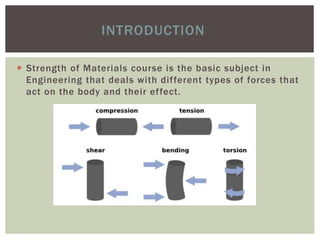
 Strength of Materials course is the basic subject in
Engineering that deals with different types of forces that
act on the body and their effect.
INTRODUCTION
 In this subject we will study the basic concepts of
stresses that are induced in the body on the application
of force.
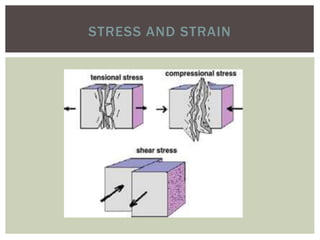
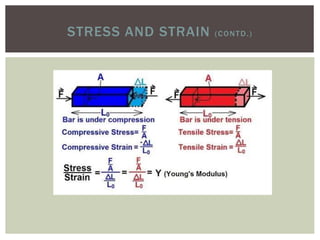
 Different types of stresses like Normal stress, Shear
stress and Bending stress will be discussed in detail.
 In this course we will study about concepts of equilibrium
and the importance of free body diagram in analyzing the
stresses induced in the body.
 In this course we will discuss about different types of
supports like Hinged, Fixed and Roller supports that are
there in Civil engineering structures.
INTRODUCTION (CONTD.)
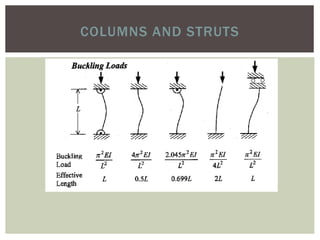
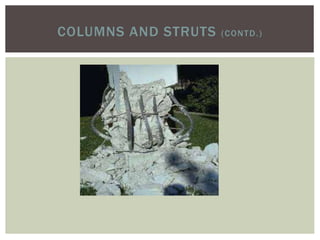
 During the classes you will be able to analyze different
members of the building like columns, beams etc. under
different combination of loadings.
 Strength of Materials will help you in making Bending
Moment and Shear Force Diagrams which is helpful in
determining Maximum Bending Moment that is used in
designing of structures.
 We will discuss the analysis and design of Hollow and
Solid shafts based on the strength and stiffness of
material
INTRODUCTION (CONTD.)
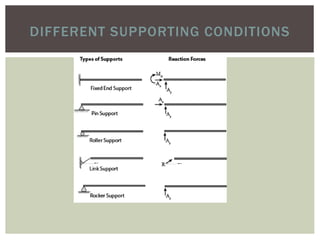
DIFFERENT SUPPORTING CONDITIONS
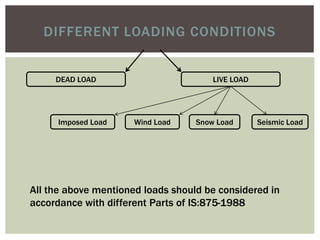
DIFFERENT LOADING CONDITIONS
DEAD LOAD LIVE LOAD
Wind Load Snow Load Seismic LoadImposed Load
All the above mentioned loads should be considered in
accordance with different Parts of IS:875-1988
STRESS AND STRAIN
STRESS AND STRAIN (CONTD.)
COLUMNS AND STRUTS
COLUMNS AND STRUTS (CONTD.)
 As we have seen that in this course various members of
building are analyzed, checked for their stability etc.
under different loading and supporting conditions, it
forms the basic subject in Civil Engineering
 Strength of Materials course forms the foundation for
other core Civil Engineering subjects like Structural
Analysis, Design of Concrete Structures and Design of
Steel Structures etc.
 Once the concepts of Strength of Material are clear then
there will be no problem in analysis, designing of
structures.
CONCLUSION
Strength of materials

Strength of materials

  • 1.
    Prepared By :- SimarpreetSingh Asst. Prof. Department of Civil Engineering ACET, Amritsar Simarpreet_batra@yahoo.com
  • 2.
    ABOUT COURSE AS PERPUNJAB TECHNICAL UNIVERSITY
  • 3.
    SCHEME OF SYLLABUS Sessionalexam will consist of 50% syllabus related to different forces and their effect on materials (Concepts of Equilibrium, Simple Stress & Strain, Complex Stress & Strain and Shear Force and Bending Moment diagrams)  There will be 3 assignments out of which 2 assignment based tests will be conducted from first 30% syllabus and next 30% syllabus consecutively.  Book to be preferred is Strength of Materials by S. Ramamrutham, Dhanpat Rai Publications Pvt. Ltd.
  • 4.
     Strength ofMaterials course is the basic subject in Engineering that deals with different types of forces that act on the body and their effect. INTRODUCTION
  • 5.
     In thissubject we will study the basic concepts of stresses that are induced in the body on the application of force.  Different types of stresses like Normal stress, Shear stress and Bending stress will be discussed in detail.  In this course we will study about concepts of equilibrium and the importance of free body diagram in analyzing the stresses induced in the body.  In this course we will discuss about different types of supports like Hinged, Fixed and Roller supports that are there in Civil engineering structures. INTRODUCTION (CONTD.)
  • 6.
     During theclasses you will be able to analyze different members of the building like columns, beams etc. under different combination of loadings.  Strength of Materials will help you in making Bending Moment and Shear Force Diagrams which is helpful in determining Maximum Bending Moment that is used in designing of structures.  We will discuss the analysis and design of Hollow and Solid shafts based on the strength and stiffness of material INTRODUCTION (CONTD.)
  • 7.
  • 8.
    DIFFERENT LOADING CONDITIONS DEADLOAD LIVE LOAD Wind Load Snow Load Seismic LoadImposed Load All the above mentioned loads should be considered in accordance with different Parts of IS:875-1988
  • 9.
  • 10.
  • 11.
  • 12.
  • 13.
     As wehave seen that in this course various members of building are analyzed, checked for their stability etc. under different loading and supporting conditions, it forms the basic subject in Civil Engineering  Strength of Materials course forms the foundation for other core Civil Engineering subjects like Structural Analysis, Design of Concrete Structures and Design of Steel Structures etc.  Once the concepts of Strength of Material are clear then there will be no problem in analysis, designing of structures. CONCLUSION