Disease Changes the function of an individual in some way Genetic – passed on by one or both parents Nutritional deficiency – lacking particular vitamin / mineral  Infectious – caused by pathogen Non cellular agent (virus / prion) Unicellular  agent (microorganism- fungi/bacteria) Multicellular  agent (worm / arthropod)
Some terminology Infection = pathogen in host Not all infections cause harm to host Pathogenic = infection  is  causing harm Epidemic – large number of infections in a short space of time Pandemic – widespread outbreak of infections in a short space of time
A timeline of infectious brain diseases 1920-21 CJD (Creutzfeld-Jacob Disease)  described (Germany) 1957  Kuru discovered (Papua New Guinea) 1960s  CJD contracted from hHG (human  Growth Hormone) 1985 Scrapie in sheep discovered to be  transferrable to cows 1987 BSE (Mad Cow Disease) discovered 1993 Two English farmers die of suspected  CJD 1996 BSE identified as being transferrable  from cows to humans
Prions Identified as the causative agents of CJD, Kuru & BSE Are essentially abnormal or defective proteins Cannot be killed like a virus, can only be denatured in the way that a protein would Prion diseases are untreatable, only way to destroy a prion is to autoclave at a temp. of 134°C at a pressure of 138 Kpa
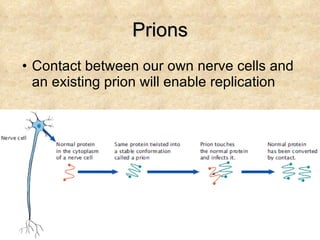
Prions Contact between our own nerve cells and an existing prion will enable replication
Viruses Obligate intracellular parasites – this means that they must infect a host cell in order to be able to reproduce. Have DNA / RNA but no ribosomes Can infect any type of organism including bacteria (bacteriophages) Viruses are usually host specific eg.s of diseases: common cold, influenza, poliomyelitis, measels, chickenpox,  AIDS
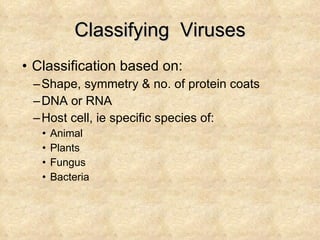
Classifying  Viruses Classification based on: Shape, symmetry & no. of protein coats DNA or RNA Host cell, ie specific species of: Animal Plants Fungus Bacteria
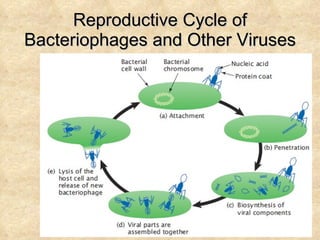
Reproductive Cycle of Bacteriophages and Other Viruses
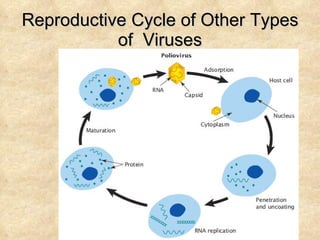
Reproductive Cycle of Other Types of  Viruses
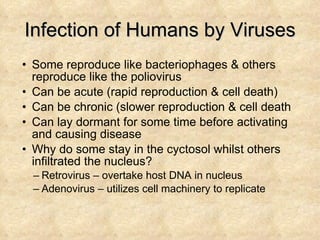
Infection of Humans by Viruses Some reproduce like bacteriophages & others reproduce like the poliovirus Can be acute (rapid reproduction & cell death) Can be chronic (slower reproduction & cell death Can lay dormant for some time before activating and causing disease Why do some stay in the cyctosol whilst others infiltrated the nucleus? Retrovirus – overtake host DNA in nucleus Adenovirus – utilizes cell machinery to replicate
Diseases Caused by Viruses Rubella (German Measles) Causes a mild fever Can create serious complications to pregnancy Transmitted through bodily secretions Polio (Poliomyelitis) Kills motor neurones Results in muscle wasting and paralysis Transmitted through contaminated food & water
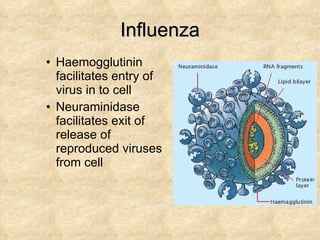
Influenza Haemogglutinin facilitates entry of virus in to cell Neuraminidase facilitates exit of release of reproduced viruses from cell
Antiviral Drugs Difficult to develop a drug that will only target the virus and not the host One strategy is to target the enzymes required by viruses – in this case, treatment will be applied locally rather than via bloodstream Another strategy is to inhibit the DNA or protein synthesis of the virus Relenza – blocked the active site of Neuraminidase (see previous slide)
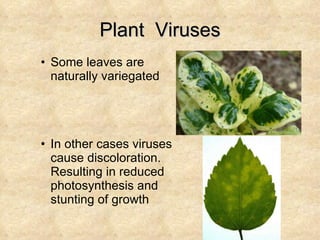
Plant  Viruses Some leaves are naturally variegated In other cases viruses cause discoloration.  Resulting in reduced photosynthesis and stunting of growth
Viroids Very little is known Only appear to occur in plants Small fragments of naked RNA that infiltrate the host cell Smallest known infectious agent
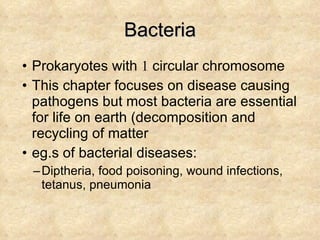
Bacteria Prokaryotes with  1  circular chromosome This chapter focuses on disease causing pathogens but most bacteria are essential for life on earth (decomposition and recycling of matter eg.s of bacterial diseases: Diptheria, food poisoning, wound infections, tetanus, pneumonia
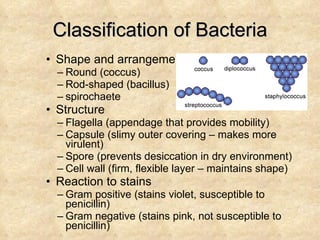
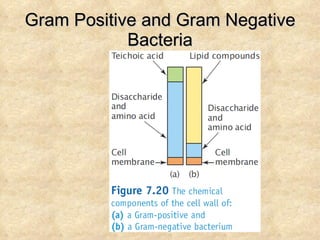
Classification of Bacteria Shape and arrangement Round (coccus) Rod-shaped (bacillus) spirochaete Structure Flagella (appendage that provides mobility) Capsule (slimy outer covering – makes more virulent) Spore (prevents desiccation in dry environment)  Cell wall (firm, flexible layer – maintains shape) Reaction to stains Gram positive (stains violet, susceptible to penicillin) Gram negative (stains pink, not susceptible to penicillin)
Gram Positive and Gram Negative Bacteria
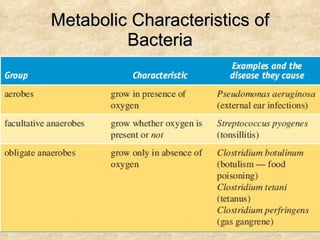
Metabolic Characteristics of Bacteria
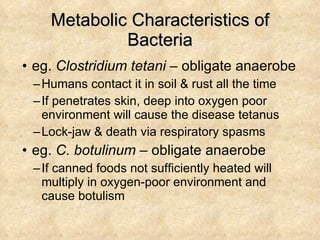
Metabolic Characteristics of Bacteria eg.  Clostridium tetani  – obligate anaerobe Humans contact it in soil & rust all the time If penetrates skin, deep into oxygen poor environment will cause the disease tetanus Lock-jaw & death via respiratory spasms eg.  C. botulinum  – obligate anaerobe If canned foods not sufficiently heated will multiply in oxygen-poor environment and cause botulism
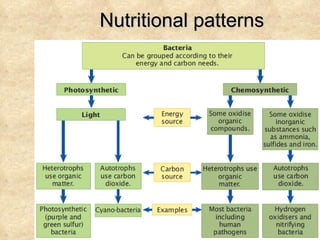
Nutritional patterns
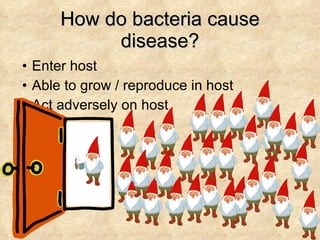
How do bacteria cause disease? Enter host Able to grow / reproduce in host Act adversely on host
 
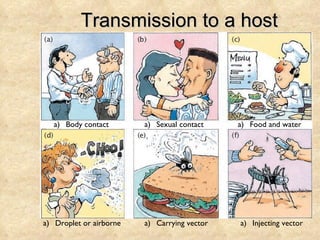
Transmission to a host Body contact Sexual contact Food and water Droplet or airborne Carrying vector Injecting vector
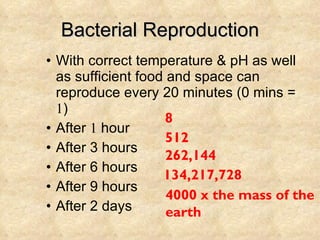
Bacterial Reproduction With correct temperature & pH as well as sufficient food and space can reproduce every 20 minutes (0 mins =  1 ) After  1  hour After 3 hours After 6 hours After 9 hours After 2 days 8 512 262,144 134,217,728 4000 x the mass of the  earth
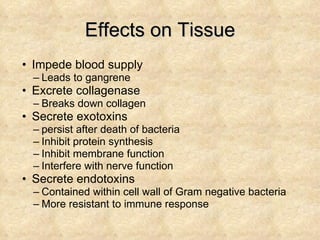
Effects on Tissue Impede blood supply Leads to gangrene Excrete collagenase Breaks down collagen Secrete exotoxins persist after death of bacteria Inhibit protein synthesis Inhibit membrane function Interfere with nerve function Secrete endotoxins Contained within cell wall of Gram negative bacteria More resistant to immune response
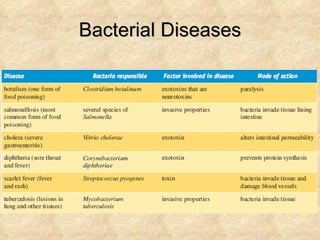
Bacterial Diseases
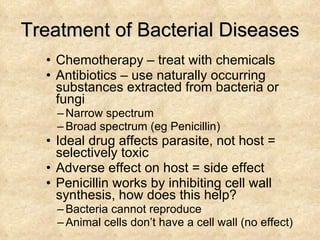
Treatment of Bacterial Diseases Chemotherapy – treat with chemicals Antibiotics – use naturally occurring substances extracted from bacteria or fungi Narrow spectrum Broad spectrum (eg Penicillin) Ideal drug affects parasite, not host = selectively toxic Adverse effect on host = side effect Penicillin works by inhibiting cell wall synthesis, how does this help? Bacteria cannot reproduce Animal cells don’t have a cell wall (no effect)
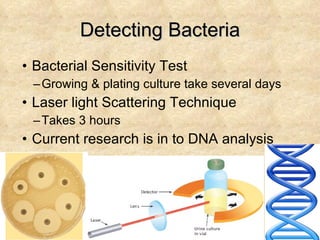
Detecting Bacteria Bacterial Sensitivity Test Growing & plating culture take several days Laser light Scattering Technique Takes 3 hours Current research is in to DNA analysis
Bacteria & Plants Very few bacteria infect plants, far less than viruses & fungi Possibly because bacteria generally like an alkaline environment and the intracellular environment of plants is usually acidic The few bacterial plant pathogens are all rod-shaped (some have spores)
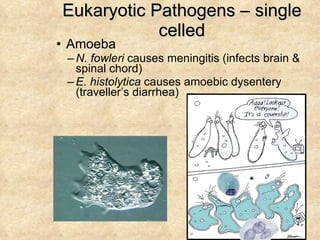
Eukaryotic Pathogens – single celled Amoeba N. fowleri  causes meningitis (infects brain & spinal chord) E. histolytica  causes amoebic dysentery (traveller’s diarrhea)
Eukaryotic Pathogens – single celled Giardia 4 pairs of flagella (mobile) Can be harmless until pH change Produce toxins Abdominal pain, diarrhea, weight loss Malaria Refer to chapter 4 for details
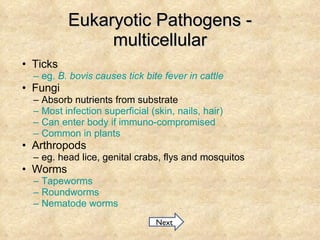
Eukaryotic Pathogens - multicellular Ticks eg.  B. bovis  causes tick bite fever in cattle Fungi Absorb nutrients from substrate Most infection superficial (skin, nails, hair) Can enter body if immuno-compromised Common in plants Arthropods eg. head lice, genital crabs, flys and mosquitos Worms Tapeworms Roundworms Nematode worms Next
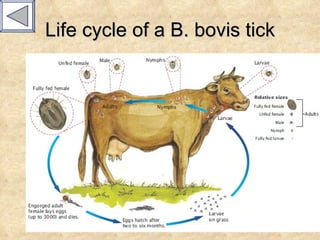
Life cycle of a B. bovis tick
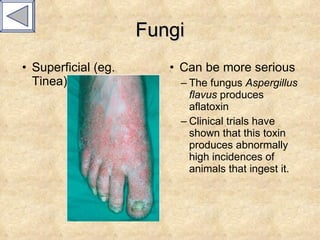
Fungi Superficial (eg. Tinea) Can be more serious The fungus  Aspergillus flavus  produces aflatoxin Clinical trials have shown that this toxin produces abnormally high incidences of animals that ingest it.
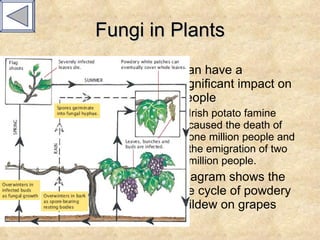
Fungi in Plants Can have a significant impact on people Irish potato famine caused the death of one million people and the emigration of two million people. Diagram shows the life cycle of powdery mildew on grapes
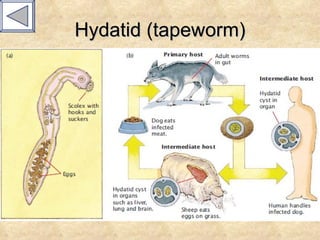
Hydatid (tapeworm)
Worms Roundworms Live in small intestine Migrate to anus to lay eggs on mist skin Life cycle able to continue when transferred back to mouth via hand, clothes or both. Nematode worms Frequently found in plants Damage plants by secreting toxins / enzymes to brek down cells Consume broken down cell material
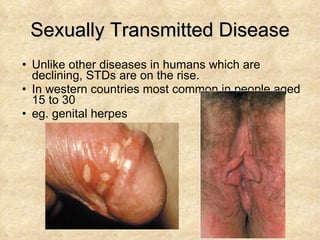
Sexually Transmitted Disease Unlike other diseases in humans which are declining, STDs are on the rise. In western countries most common in people aged 15 to 30 eg. genital herpes
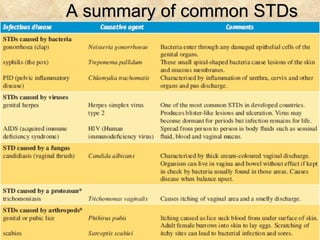
A summary of common STDs
Homework Chapter review questions – 3 & 6-11 Biozones –  Anatidaephobia:  The fear that somewhere, somehow,  a duck is watching you

7 - Infection & disease

  • 1.
  • 2.
    Disease Changes thefunction of an individual in some way Genetic – passed on by one or both parents Nutritional deficiency – lacking particular vitamin / mineral Infectious – caused by pathogen Non cellular agent (virus / prion) Unicellular agent (microorganism- fungi/bacteria) Multicellular agent (worm / arthropod)
  • 3.
    Some terminology Infection= pathogen in host Not all infections cause harm to host Pathogenic = infection is causing harm Epidemic – large number of infections in a short space of time Pandemic – widespread outbreak of infections in a short space of time
  • 4.
    A timeline ofinfectious brain diseases 1920-21 CJD (Creutzfeld-Jacob Disease) described (Germany) 1957 Kuru discovered (Papua New Guinea) 1960s CJD contracted from hHG (human Growth Hormone) 1985 Scrapie in sheep discovered to be transferrable to cows 1987 BSE (Mad Cow Disease) discovered 1993 Two English farmers die of suspected CJD 1996 BSE identified as being transferrable from cows to humans
  • 5.
    Prions Identified asthe causative agents of CJD, Kuru & BSE Are essentially abnormal or defective proteins Cannot be killed like a virus, can only be denatured in the way that a protein would Prion diseases are untreatable, only way to destroy a prion is to autoclave at a temp. of 134°C at a pressure of 138 Kpa
  • 6.
    Prions Contact betweenour own nerve cells and an existing prion will enable replication
  • 7.
    Viruses Obligate intracellularparasites – this means that they must infect a host cell in order to be able to reproduce. Have DNA / RNA but no ribosomes Can infect any type of organism including bacteria (bacteriophages) Viruses are usually host specific eg.s of diseases: common cold, influenza, poliomyelitis, measels, chickenpox, AIDS
  • 8.
    Classifying VirusesClassification based on: Shape, symmetry & no. of protein coats DNA or RNA Host cell, ie specific species of: Animal Plants Fungus Bacteria
  • 9.
    Reproductive Cycle ofBacteriophages and Other Viruses
  • 10.
    Reproductive Cycle ofOther Types of Viruses
  • 11.
    Infection of Humansby Viruses Some reproduce like bacteriophages & others reproduce like the poliovirus Can be acute (rapid reproduction & cell death) Can be chronic (slower reproduction & cell death Can lay dormant for some time before activating and causing disease Why do some stay in the cyctosol whilst others infiltrated the nucleus? Retrovirus – overtake host DNA in nucleus Adenovirus – utilizes cell machinery to replicate
  • 12.
    Diseases Caused byViruses Rubella (German Measles) Causes a mild fever Can create serious complications to pregnancy Transmitted through bodily secretions Polio (Poliomyelitis) Kills motor neurones Results in muscle wasting and paralysis Transmitted through contaminated food & water
  • 13.
    Influenza Haemogglutinin facilitatesentry of virus in to cell Neuraminidase facilitates exit of release of reproduced viruses from cell
  • 14.
    Antiviral Drugs Difficultto develop a drug that will only target the virus and not the host One strategy is to target the enzymes required by viruses – in this case, treatment will be applied locally rather than via bloodstream Another strategy is to inhibit the DNA or protein synthesis of the virus Relenza – blocked the active site of Neuraminidase (see previous slide)
  • 15.
    Plant VirusesSome leaves are naturally variegated In other cases viruses cause discoloration. Resulting in reduced photosynthesis and stunting of growth
  • 16.
    Viroids Very littleis known Only appear to occur in plants Small fragments of naked RNA that infiltrate the host cell Smallest known infectious agent
  • 17.
    Bacteria Prokaryotes with 1 circular chromosome This chapter focuses on disease causing pathogens but most bacteria are essential for life on earth (decomposition and recycling of matter eg.s of bacterial diseases: Diptheria, food poisoning, wound infections, tetanus, pneumonia
  • 18.
    Classification of BacteriaShape and arrangement Round (coccus) Rod-shaped (bacillus) spirochaete Structure Flagella (appendage that provides mobility) Capsule (slimy outer covering – makes more virulent) Spore (prevents desiccation in dry environment) Cell wall (firm, flexible layer – maintains shape) Reaction to stains Gram positive (stains violet, susceptible to penicillin) Gram negative (stains pink, not susceptible to penicillin)
  • 19.
    Gram Positive andGram Negative Bacteria
  • 20.
  • 21.
    Metabolic Characteristics ofBacteria eg. Clostridium tetani – obligate anaerobe Humans contact it in soil & rust all the time If penetrates skin, deep into oxygen poor environment will cause the disease tetanus Lock-jaw & death via respiratory spasms eg. C. botulinum – obligate anaerobe If canned foods not sufficiently heated will multiply in oxygen-poor environment and cause botulism
  • 22.
  • 23.
    How do bacteriacause disease? Enter host Able to grow / reproduce in host Act adversely on host
  • 24.
  • 25.
    Transmission to ahost Body contact Sexual contact Food and water Droplet or airborne Carrying vector Injecting vector
  • 26.
    Bacterial Reproduction Withcorrect temperature & pH as well as sufficient food and space can reproduce every 20 minutes (0 mins = 1 ) After 1 hour After 3 hours After 6 hours After 9 hours After 2 days 8 512 262,144 134,217,728 4000 x the mass of the earth
  • 27.
    Effects on TissueImpede blood supply Leads to gangrene Excrete collagenase Breaks down collagen Secrete exotoxins persist after death of bacteria Inhibit protein synthesis Inhibit membrane function Interfere with nerve function Secrete endotoxins Contained within cell wall of Gram negative bacteria More resistant to immune response
  • 28.
  • 29.
    Treatment of BacterialDiseases Chemotherapy – treat with chemicals Antibiotics – use naturally occurring substances extracted from bacteria or fungi Narrow spectrum Broad spectrum (eg Penicillin) Ideal drug affects parasite, not host = selectively toxic Adverse effect on host = side effect Penicillin works by inhibiting cell wall synthesis, how does this help? Bacteria cannot reproduce Animal cells don’t have a cell wall (no effect)
  • 30.
    Detecting Bacteria BacterialSensitivity Test Growing & plating culture take several days Laser light Scattering Technique Takes 3 hours Current research is in to DNA analysis
  • 31.
    Bacteria & PlantsVery few bacteria infect plants, far less than viruses & fungi Possibly because bacteria generally like an alkaline environment and the intracellular environment of plants is usually acidic The few bacterial plant pathogens are all rod-shaped (some have spores)
  • 32.
    Eukaryotic Pathogens –single celled Amoeba N. fowleri causes meningitis (infects brain & spinal chord) E. histolytica causes amoebic dysentery (traveller’s diarrhea)
  • 33.
    Eukaryotic Pathogens –single celled Giardia 4 pairs of flagella (mobile) Can be harmless until pH change Produce toxins Abdominal pain, diarrhea, weight loss Malaria Refer to chapter 4 for details
  • 34.
    Eukaryotic Pathogens -multicellular Ticks eg. B. bovis causes tick bite fever in cattle Fungi Absorb nutrients from substrate Most infection superficial (skin, nails, hair) Can enter body if immuno-compromised Common in plants Arthropods eg. head lice, genital crabs, flys and mosquitos Worms Tapeworms Roundworms Nematode worms Next
  • 35.
    Life cycle ofa B. bovis tick
  • 36.
    Fungi Superficial (eg.Tinea) Can be more serious The fungus Aspergillus flavus produces aflatoxin Clinical trials have shown that this toxin produces abnormally high incidences of animals that ingest it.
  • 37.
    Fungi in PlantsCan have a significant impact on people Irish potato famine caused the death of one million people and the emigration of two million people. Diagram shows the life cycle of powdery mildew on grapes
  • 38.
  • 39.
    Worms Roundworms Livein small intestine Migrate to anus to lay eggs on mist skin Life cycle able to continue when transferred back to mouth via hand, clothes or both. Nematode worms Frequently found in plants Damage plants by secreting toxins / enzymes to brek down cells Consume broken down cell material
  • 40.
    Sexually Transmitted DiseaseUnlike other diseases in humans which are declining, STDs are on the rise. In western countries most common in people aged 15 to 30 eg. genital herpes
  • 41.
    A summary ofcommon STDs
  • 42.
    Homework Chapter reviewquestions – 3 & 6-11 Biozones – Anatidaephobia: The fear that somewhere, somehow, a duck is watching you