Downloaded 1,174 times
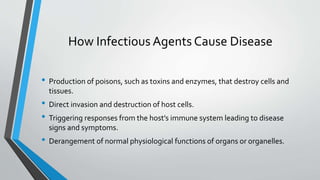
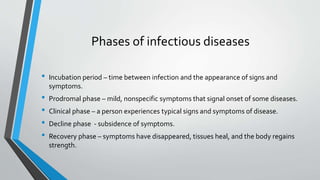
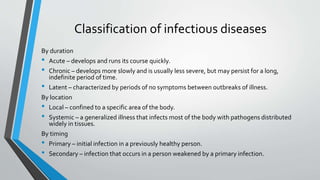
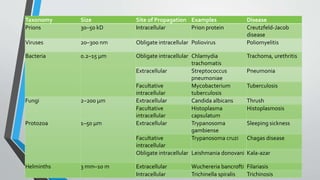
![Viruses
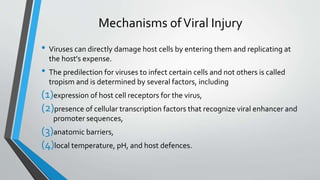
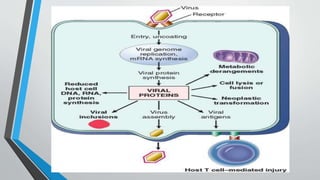
• Viruses are obligate intracellular parasites that depend on the host cell's metabolic
machinery for their replication.
• They consist of a nucleic acid genome surrounded by a protein coat (called a capsid) that is
sometimes encased in a lipid membrane.
• Viruses are classified by their nucleic acid genome (DNA or RNA but not both), the shape of
the capsid (icosahedral or helical), the presence or absence of a lipid envelope, their mode
of replication, the preferred cell type for replication (called tropism), or the type of
pathology.
• Because viruses are only 20 to 300 nm in size, they are best visualized with the electron
microscope.
• Some viral particles aggregate within the cells they infect and form characteristic inclusion
bodies, which may be seen with the light microscope and are useful for diagnosis.
• Cytomegalovirus (CMV)-infected cells are enlarged and show a large eosinophilic nuclear
inclusion and smaller basophilic cytoplasmic inclusions; herpes viruses form a large nuclear
inclusion surrounded by a clear halo; and both smallpox and rabies viruses form
characteristic cytoplasmic inclusions. Many viruses do not produce inclusions (e.g., Epstein-
Barr virus [EBV]).](https://image.slidesharecdn.com/infectiousdiseases-introduction-140903123949-phpapp01/85/Infectious-diseases-an-introduction-13-320.jpg)
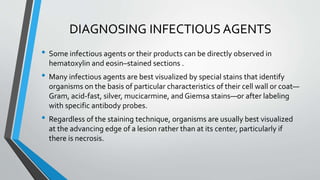
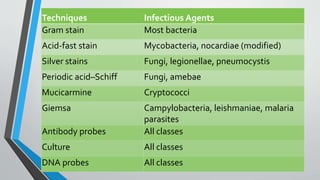
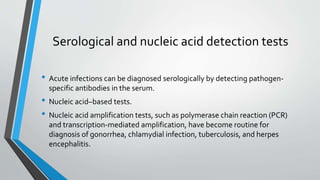
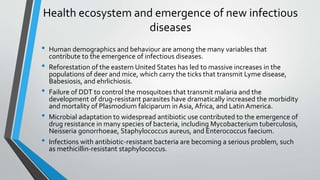
![AGENTS OF BIOTERRORISM
Category A Diseases/Agents
Anthrax (Bacillus anthracis)
Botulism (Clostridium
botulinum toxin)
Plague (Yersinia pestis)
Smallpox (Variola major
virus)
Tularemia (Francisella
tularensis)
Viral hemorrhagic fevers
(filoviruses [e.g., Ebola,
Marburg] and arenaviruses
[e.g., Lassa, Machupo])
Category C Diseases/Agents
Emerging infectious disease
threats such as Nipah virus and
Hantavirus](https://image.slidesharecdn.com/infectiousdiseases-introduction-140903123949-phpapp01/85/Infectious-diseases-an-introduction-31-320.jpg)
![Category B Diseases/Agents
Brucellosis (Brucella sp.)
Epsilon toxin of Clostridium perfringens
Food safety threats (e.g., Salmonella sp.,
Escherichia coli O157:H7, Shigella)
Glanders (Burkholderia mallei)
Melioidosis (Burkholderia pseudomallei)
Psittacosis (Chlamydia psittaci)
Q fever (Coxiella burnetti)
Ricin toxin from Ricinus communis (castor
beans)
Staphylococcal enterotoxin B
Typhus fever (Rickettsia prowazekii)
Viral encephalitis (alphaviruses [e.g.,
Venezuelan equine encephalitis, eastern
equine encephalitis, western equine
encephalitis])
Water safety threats (e.g., Vibrio cholerae,
Cryptosporidium parvum)](https://image.slidesharecdn.com/infectiousdiseases-introduction-140903123949-phpapp01/85/Infectious-diseases-an-introduction-32-320.jpg)


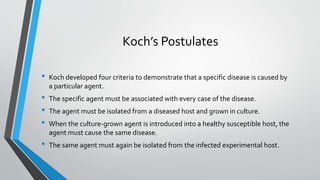
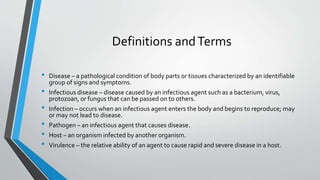
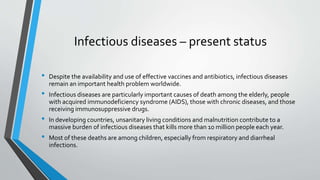
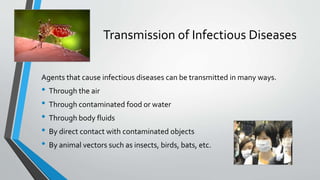
This document provides an overview of infectious diseases and the agents that cause them. It discusses the historical perspective of major infectious diseases like smallpox, plague, and influenza. It describes Robert Koch's pioneering work in the late 19th century that established the germ theory of disease and his criteria (known as Koch's postulates) for identifying disease-causing agents. The document then covers viruses, bacteria, fungi, protozoa, helminths, prions, and ectoparasites as causes of infectious disease, describing their characteristics, life cycles, modes of transmission, and examples of diseases they cause.


