Infection control Concepts.
Introduction:
• As hospital are gathering places for the sick, they are also focal point
for the transmission of disease.
• Infection control key aspect in patient care.
• As a member of health care system it is a professional duty to follow
established infection control policies.
• This will promote the safety of patients, yourself and other members
of health care system.
Micro-organisms :
• Living organisms that are too small to be seen with naked eyes.
• Includes- bacteria , viruses , protozoa , prions and fungi.
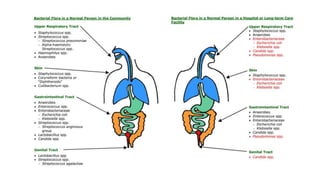
• Normal flora – lives inside body without causing infections.
• Investigation for underlying abnormalities in specific areas of the body
when bacteria are isolated from normally sterile sites e.g. Escherichia
coli isolation from blood cultures indicates probable intra-abdominal
pathology because Escherichia coli is part of the normal gastrointestinal
flora, or isolation of a Viridans Streptococcus in blood cultures may
indicate infective endocarditis as a result of poor dentition as
Viridans Streptococcus are part of the normal mouth flora
Bacteria
• Bacteria are very small , single- celled organisms with a cell wall and
an atypical nucleus , that lacks a membrane .
• Cell wall is essential for survival of the bacterium , making it target for
destruction by some antibiotics.
• Bacteria grow independently and can replicate without a host cell.
• Three distinct shapes : spherical (cocci ),rod- shaped (bacilli),
and spiral (twisted).
• Can be gram positive or gram negative.
• Gram positive if they retain the color after being treated by alcohol .
• Can also be acid-fast or nonacid-fast.
Cont..
• Streptococci and staphylococci are gram positive. Escherichia coli is
gram negative and mycobacterium tuberculosis is acid-fast.
• Bacteria are also grouped by their oxygen requirement.
• Obligate Aerobes and anaerobes
• Bacteria that can grow in both condition either aerobic or anaerobic
are called facultative organisms .
• Some type of bacteria can generate endospores.
• Generally endospores are resistant to destruction.
Rickettsiae:
• Are also consider bacteria but are atypical , smaller than bacteria and
barely visible in an ordinary light microscope.
• They only grow inside animal cells (e.g. rats, rabbit)
• Do not survive in environment.
• They are transmitted among animal when they are bitten by infected
arthropods such as ticks , lice, fleas and mites.
• Human are only accidental host.
• These cause rocky mountain spotted fever and typhus fever.
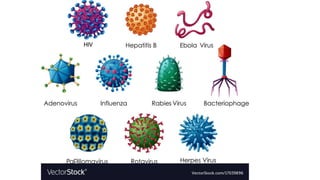
Viruses :
• Smallest known disease – causing organisms. Must be viewed in
electronic microscope.
• A fully developed viral particle is called as virion, is made up of either
DNA or RNA.
• Is covered by protein coating called the capsid.
• Capsid may be covered by a lipoprotein envelop that has projecting
spikes .
• Enveloped viruses such as influenza , HIV , hepatitis B uses these
spike to attach to the host cell.
• Rhino virus does not posses spikes .Capsid helps in attachment.
Cont..
• Viruses can not survive independently.
• They invade the host cell and stimulate it to participate in the
formation of additional virus particles.
• It has been difficult to create antiviral drugs that are not also harmful
to host cell.
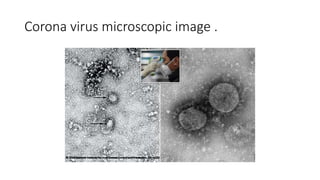
Corona virus microscopic image .
Fungi :
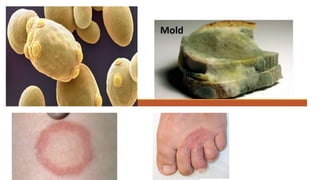
• Fungi occurs as single celled yeasts or as long, branched filament like
structures called molds (many cells).
• Yeast reproduce by forming buds, whereas mold reproduces by
spores.
• Many fungi serves for useful purpose.
• Antibiotic penicillin .
• Helps in decomposition of dead animals and plants.
• In humans fungi causes skin infections , such as athlete's foot and ring
worm.
• Respiratory infections , pharyngeal and esophageal candidiasis.
Prions:
• The smallest and least understood among all pathogens.
• Scientists believe that it might be a infectious protein.
• They don’t posses DNA or RNA , their method of replications are also
not fully understood.
• They affect the nerve cells and are resistant to body’s natural defense
system.
• They were first identified as the cause of scrapie, a degenerative
disease affecting the nervous system of sheep.
• Prions are the cause of bovine spongiform encephalopathy (mad cow
disease.)and both classic and variant creutzfeldt –jakob disease in
humans. Causes neurological problems and dementia.
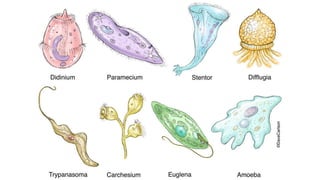
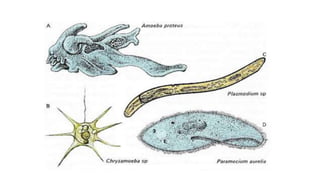
Protozoa :
• They are complex single-celled animals that generally exist as free-
living organisms.
• Few are parasite and live within human body.
• May be classified as motile and non- motile.
• They locomot using pseudopods / cilia / flagella.
• Most protozoa produces some type of resistant form , such as cyst to
survive in the environment outside of host.
• Other protozoa have complex life cycles involving alternate residence
in the human body and insect vector . Like malaria.
• They can infect gastrointestinal , genitourinary , circulatory and
respiratory systems.
Cont..
• Amebiasis and giardiasis – causes diarrhea.
• Trichomoniasis – affects genitourinary tract. Causes yellow-greenish
discharge from male and female urethra and vagina.
• Toxoplasmosis – affects the blood and lymphatic system .
Cycle of Infection:
• The factor involved in the spread of disease are sometimes called the
cycle of infection.
• For infection to be transmitted , there must be an infectious organism
, a reservoir of infection , a portal of exit , a susceptible host, a portal
of entry , and a means of transporting the organism from the
reservoir to the susceptible individual .
Infectious Organisms:
• Microorganisms capable of causing disease are called pathogenic
organisms or pathogens.
• They posses certain properties called virulence factors.
• These factors enable bacteria to destroy or damage host cells and
resist destruction by the host’s cellular defense.
• Each bacterial pathogens has an affinity for a certain type of cell in
the body.
• They attach to this cell and excrete protein substance called toxins.
• Virulence factor assist the pathogens to avoid recognition by the host
cells .
Reservoir Of Infection:
• The reservoir or source of infection may be any place where
pathogens can thrive in sufficient numbers to pose a threat.
• Such environments must provide moisture, nutrients , and a suitable
temperature , all of which are found in human body.
• A reservoir of infection might be a patient with hepatitis , a
radiographer with an upper respiratory infection or a visitor with
staphylococcal boils.
• Animals , the reservoir for salmonella.
• Soil , the reservoir for tetanus.
• Food, the reservoir for botulinum.
• Water, the reservoir for typhus.
Portal of Exit:
• The portal or exit from the human body may be any route through
which blood, body fluid , excretions, or secretions.
• Example includes the respiratory , urinary and gastrointestinal tracts ,
an infected wound and the bloodstream .
Susceptible host :
• Patient who have a reduced natural resistance to infection.
• May develop nosocomial infection.
• For health care workers – occupationally acquired infections.-
hepatitis B and C viruses are the biggest concern.
• Hospital workers , mainly radiographer are exposed to many
pathogens.
Portal of Entry:
• It is the route by which microorganisms gain access into the
susceptible host.
• Example: respiratory , urinary and GI tracts, open wound or break in
skin , mucous membranes of eyes, nose and mouth and the blood
stream .
Transmission of Disease.
• Direct contact
• Indirect contact
a) Fomites- object that has been in contact with pathogenic organisms
is called a fomite. A contaminated urinary catheter is a typical
example. X-ray table , vertical Bucky , sponges etc.
b) Vectors – vector is an arthropod / insect (infected by infectious
organisms ). Eg: malaria , dengue , plague etc.
c) Vehicles – any medium that transport microorganisms like food,
water , drugs, blood etc.
d) Droplet contamination – Large droplet containing microorganism
and measuring more than 5 micrometer. Does not last in air form
long time and travel short distance around 3 feet . Eg: Influenza,
meningitis , diphtheria , pertussis , streptococcal pneumonia etc.
Cont..
e) Airborne Transmission – occurs from dust that contains spores or
droplet nuclei.
- Droplet nuclei are defined as particle of evaporated droplets
containing microorganisms.
- They can remain suspended in air for longer period of time.
- Eg: Tuberculosis , rubeola (Measles), Varicella viruses.
Body’s defense against Infections:
• Natural Resistance- intact skin and mucous membranes , cilia of
respiratory tract , lysozyme in tears , acid in stomach , vagina and skin
. 2nd line of defense is inflammatory response and phagocytosis .
Viruses infected cells produce interferons , a small protein molecule
that protects the uninfected cells from invasion by the original virus
as well as others. Produced in labs. for treatment of hepatitis B and C.
Acquired Immunity :
• Humans are born with a certain amount of immunity , but most
humans become resistant to disease by becoming infected with a
specific organism.
• Immunity can also be conferred from vaccines made from dead or
weakened strains of microorganisms for a specific infection. –
Acquired Immunity .
• Antibodies are produced against antigens .
• Acquired immunity is long term .
Passive Immunity:
• Passive immunity occurs when an individual receives preformed
antibodies from others to provide temporary immunity .
• Eg: immunoglobulin injections to prevent infection after exposure to
certain viruses and the immunity that is passed to infants from their
mothers at birth and in breast milk .
• Reference: Patient care in Radiography , 9th edition , Ruth Ann Ehrlich
.
• Online sources.
Thank you !!

Infection control concepts

  • 1.
  • 2.
    Introduction: • As hospitalare gathering places for the sick, they are also focal point for the transmission of disease. • Infection control key aspect in patient care. • As a member of health care system it is a professional duty to follow established infection control policies. • This will promote the safety of patients, yourself and other members of health care system.
  • 3.
    Micro-organisms : • Livingorganisms that are too small to be seen with naked eyes. • Includes- bacteria , viruses , protozoa , prions and fungi. • Normal flora – lives inside body without causing infections. • Investigation for underlying abnormalities in specific areas of the body when bacteria are isolated from normally sterile sites e.g. Escherichia coli isolation from blood cultures indicates probable intra-abdominal pathology because Escherichia coli is part of the normal gastrointestinal flora, or isolation of a Viridans Streptococcus in blood cultures may indicate infective endocarditis as a result of poor dentition as Viridans Streptococcus are part of the normal mouth flora
  • 5.
    Bacteria • Bacteria arevery small , single- celled organisms with a cell wall and an atypical nucleus , that lacks a membrane . • Cell wall is essential for survival of the bacterium , making it target for destruction by some antibiotics. • Bacteria grow independently and can replicate without a host cell. • Three distinct shapes : spherical (cocci ),rod- shaped (bacilli), and spiral (twisted). • Can be gram positive or gram negative. • Gram positive if they retain the color after being treated by alcohol . • Can also be acid-fast or nonacid-fast.
  • 6.
    Cont.. • Streptococci andstaphylococci are gram positive. Escherichia coli is gram negative and mycobacterium tuberculosis is acid-fast. • Bacteria are also grouped by their oxygen requirement. • Obligate Aerobes and anaerobes • Bacteria that can grow in both condition either aerobic or anaerobic are called facultative organisms . • Some type of bacteria can generate endospores. • Generally endospores are resistant to destruction.
  • 7.
    Rickettsiae: • Are alsoconsider bacteria but are atypical , smaller than bacteria and barely visible in an ordinary light microscope. • They only grow inside animal cells (e.g. rats, rabbit) • Do not survive in environment. • They are transmitted among animal when they are bitten by infected arthropods such as ticks , lice, fleas and mites. • Human are only accidental host. • These cause rocky mountain spotted fever and typhus fever.
  • 8.
    Viruses : • Smallestknown disease – causing organisms. Must be viewed in electronic microscope. • A fully developed viral particle is called as virion, is made up of either DNA or RNA. • Is covered by protein coating called the capsid. • Capsid may be covered by a lipoprotein envelop that has projecting spikes . • Enveloped viruses such as influenza , HIV , hepatitis B uses these spike to attach to the host cell. • Rhino virus does not posses spikes .Capsid helps in attachment.
  • 9.
    Cont.. • Viruses cannot survive independently. • They invade the host cell and stimulate it to participate in the formation of additional virus particles. • It has been difficult to create antiviral drugs that are not also harmful to host cell.
  • 11.
  • 12.
    Fungi : • Fungioccurs as single celled yeasts or as long, branched filament like structures called molds (many cells). • Yeast reproduce by forming buds, whereas mold reproduces by spores. • Many fungi serves for useful purpose. • Antibiotic penicillin . • Helps in decomposition of dead animals and plants. • In humans fungi causes skin infections , such as athlete's foot and ring worm. • Respiratory infections , pharyngeal and esophageal candidiasis.
  • 14.
    Prions: • The smallestand least understood among all pathogens. • Scientists believe that it might be a infectious protein. • They don’t posses DNA or RNA , their method of replications are also not fully understood. • They affect the nerve cells and are resistant to body’s natural defense system. • They were first identified as the cause of scrapie, a degenerative disease affecting the nervous system of sheep. • Prions are the cause of bovine spongiform encephalopathy (mad cow disease.)and both classic and variant creutzfeldt –jakob disease in humans. Causes neurological problems and dementia.
  • 15.
    Protozoa : • Theyare complex single-celled animals that generally exist as free- living organisms. • Few are parasite and live within human body. • May be classified as motile and non- motile. • They locomot using pseudopods / cilia / flagella. • Most protozoa produces some type of resistant form , such as cyst to survive in the environment outside of host. • Other protozoa have complex life cycles involving alternate residence in the human body and insect vector . Like malaria. • They can infect gastrointestinal , genitourinary , circulatory and respiratory systems.
  • 16.
    Cont.. • Amebiasis andgiardiasis – causes diarrhea. • Trichomoniasis – affects genitourinary tract. Causes yellow-greenish discharge from male and female urethra and vagina. • Toxoplasmosis – affects the blood and lymphatic system .
  • 19.
    Cycle of Infection: •The factor involved in the spread of disease are sometimes called the cycle of infection. • For infection to be transmitted , there must be an infectious organism , a reservoir of infection , a portal of exit , a susceptible host, a portal of entry , and a means of transporting the organism from the reservoir to the susceptible individual .
  • 20.
    Infectious Organisms: • Microorganismscapable of causing disease are called pathogenic organisms or pathogens. • They posses certain properties called virulence factors. • These factors enable bacteria to destroy or damage host cells and resist destruction by the host’s cellular defense. • Each bacterial pathogens has an affinity for a certain type of cell in the body. • They attach to this cell and excrete protein substance called toxins. • Virulence factor assist the pathogens to avoid recognition by the host cells .
  • 21.
    Reservoir Of Infection: •The reservoir or source of infection may be any place where pathogens can thrive in sufficient numbers to pose a threat. • Such environments must provide moisture, nutrients , and a suitable temperature , all of which are found in human body. • A reservoir of infection might be a patient with hepatitis , a radiographer with an upper respiratory infection or a visitor with staphylococcal boils. • Animals , the reservoir for salmonella. • Soil , the reservoir for tetanus. • Food, the reservoir for botulinum. • Water, the reservoir for typhus.
  • 22.
    Portal of Exit: •The portal or exit from the human body may be any route through which blood, body fluid , excretions, or secretions. • Example includes the respiratory , urinary and gastrointestinal tracts , an infected wound and the bloodstream .
  • 23.
    Susceptible host : •Patient who have a reduced natural resistance to infection. • May develop nosocomial infection. • For health care workers – occupationally acquired infections.- hepatitis B and C viruses are the biggest concern. • Hospital workers , mainly radiographer are exposed to many pathogens.
  • 24.
    Portal of Entry: •It is the route by which microorganisms gain access into the susceptible host. • Example: respiratory , urinary and GI tracts, open wound or break in skin , mucous membranes of eyes, nose and mouth and the blood stream .
  • 25.
    Transmission of Disease. •Direct contact • Indirect contact a) Fomites- object that has been in contact with pathogenic organisms is called a fomite. A contaminated urinary catheter is a typical example. X-ray table , vertical Bucky , sponges etc. b) Vectors – vector is an arthropod / insect (infected by infectious organisms ). Eg: malaria , dengue , plague etc. c) Vehicles – any medium that transport microorganisms like food, water , drugs, blood etc. d) Droplet contamination – Large droplet containing microorganism and measuring more than 5 micrometer. Does not last in air form long time and travel short distance around 3 feet . Eg: Influenza, meningitis , diphtheria , pertussis , streptococcal pneumonia etc.
  • 26.
    Cont.. e) Airborne Transmission– occurs from dust that contains spores or droplet nuclei. - Droplet nuclei are defined as particle of evaporated droplets containing microorganisms. - They can remain suspended in air for longer period of time. - Eg: Tuberculosis , rubeola (Measles), Varicella viruses.
  • 27.
    Body’s defense againstInfections: • Natural Resistance- intact skin and mucous membranes , cilia of respiratory tract , lysozyme in tears , acid in stomach , vagina and skin . 2nd line of defense is inflammatory response and phagocytosis . Viruses infected cells produce interferons , a small protein molecule that protects the uninfected cells from invasion by the original virus as well as others. Produced in labs. for treatment of hepatitis B and C.
  • 28.
    Acquired Immunity : •Humans are born with a certain amount of immunity , but most humans become resistant to disease by becoming infected with a specific organism. • Immunity can also be conferred from vaccines made from dead or weakened strains of microorganisms for a specific infection. – Acquired Immunity . • Antibodies are produced against antigens . • Acquired immunity is long term .
  • 29.
    Passive Immunity: • Passiveimmunity occurs when an individual receives preformed antibodies from others to provide temporary immunity . • Eg: immunoglobulin injections to prevent infection after exposure to certain viruses and the immunity that is passed to infants from their mothers at birth and in breast milk .
  • 30.
    • Reference: Patientcare in Radiography , 9th edition , Ruth Ann Ehrlich . • Online sources. Thank you !!