ACL 
(Access 
Control List)
Access Control List:- 
• It is layer 3 (network) security which 
controls flow of traffic from one router to 
another router. 
• It is also called as packet filtering 
firewall. 
• Generally ACL implements on 
Distribution layer Routers.
Rules of ACL:- 
• All deny statements have to be given first. 
• There should be at least one permit 
statement. 
• An implicit deny block all traffic by default 
when there no match. 
• We can configure one access-list per 
interface per direction I.e. two access-list-per 
interface. One in inbound direction and one in 
outbound direction. 
• ACL works in sequential order. 
• Editing of access-list is not possible 
I.e.selecting, adding or removing access-list 
statement is not possible.
Types of ACL:- 
• Standard Access list. 
• Extended Access list. 
• Named Access list.
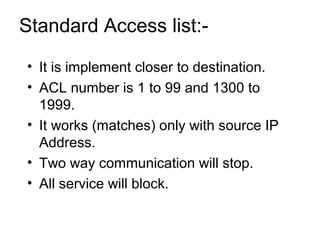
Standard Access list:- 
• It is implement closer to destination. 
• ACL number is 1 to 99 and 1300 to 
1999. 
• It works (matches) only with source IP 
Address. 
• Two way communication will stop. 
• All service will block.
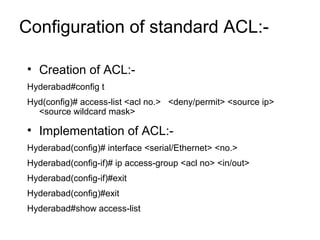
Configuration of standard ACL:- 
• Creation of ACL:- 
Hyderabad#config t 
Hyd(config)# access-list <acl no.> <deny/permit> <source ip> 
<source wildcard mask> 
• Implementation of ACL:- 
Hyderabad(config)# interface <serial/Ethernet> <no.> 
Hyderabad(config-if)# ip access-group <acl no> <in/out> 
Hyderabad(config-if)#exit 
Hyderabad(config)#exit 
Hyderabad#show access-list
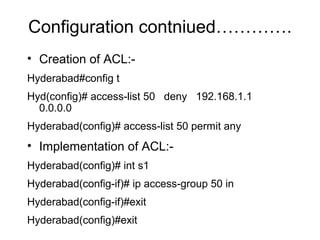
Configuration contniued…………. 
• Creation of ACL:- 
Hyderabad#config t 
Hyd(config)# access-list 50 deny 192.168.1.1 
0.0.0.0 
Hyderabad(config)# access-list 50 permit any 
• Implementation of ACL:- 
Hyderabad(config)# int s1 
Hyderabad(config-if)# ip access-group 50 in 
Hyderabad(config-if)#exit 
Hyderabad(config)#exit
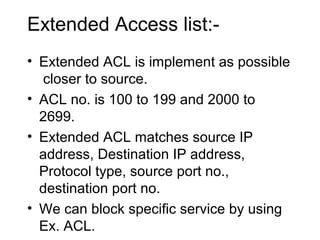
Extended Access list:- 
• Extended ACL is implement as possible 
closer to source. 
• ACL no. is 100 to 199 and 2000 to 
2699. 
• Extended ACL matches source IP 
address, Destination IP address, 
Protocol type, source port no., 
destination port no. 
• We can block specific service by using 
Ex. ACL.
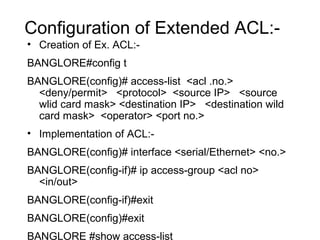
Configuration of Extended ACL:- 
• Creation of Ex. ACL:- 
BANGLORE#config t 
BANGLORE(config)# access-list <acl .no.> 
<deny/permit> <protocol> <source IP> <source 
wlid card mask> <destination IP> <destination wild 
card mask> <operator> <port no.> 
• Implementation of ACL:- 
BANGLORE(config)# interface <serial/Ethernet> <no.> 
BANGLORE(config-if)# ip access-group <acl no> 
<in/out> 
BANGLORE(config-if)#exit 
BANGLORE(config)#exit 
BANGLORE #show access-list
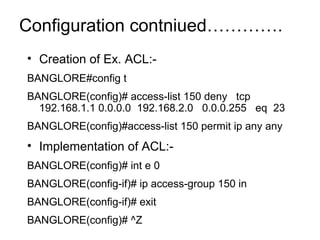
Configuration contniued…………. 
• Creation of Ex. ACL:- 
BANGLORE#config t 
BANGLORE(config)# access-list 150 deny tcp 
192.168.1.1 0.0.0.0 192.168.2.0 0.0.0.255 eq 23 
BANGLORE(config)#access-list 150 permit ip any any 
• Implementation of ACL:- 
BANGLORE(config)# int e 0 
BANGLORE(config-if)# ip access-group 150 in 
BANGLORE(config-if)# exit 
BANGLORE(config)# ^Z
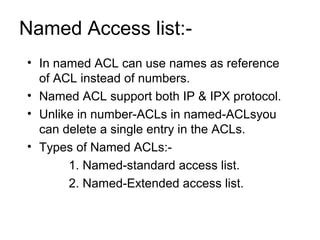
Named Access list:- 
• In named ACL can use names as reference 
of ACL instead of numbers. 
• Named ACL support both IP & IPX protocol. 
• Unlike in number-ACLs in named-ACLsyou 
can delete a single entry in the ACLs. 
• Types of Named ACLs:- 
1. Named-standard access list. 
2. Named-Extended access list.
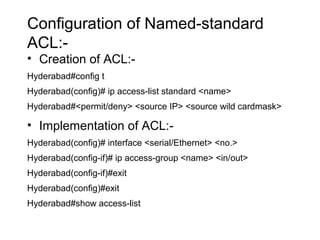
Configuration of Named-standard 
ACL:- 
• Creation of ACL:- 
Hyderabad#config t 
Hyderabad(config)# ip access-list standard <name> 
Hyderabad#<permit/deny> <source IP> <source wild cardmask> 
• Implementation of ACL:- 
Hyderabad(config)# interface <serial/Ethernet> <no.> 
Hyderabad(config-if)# ip access-group <name> <in/out> 
Hyderabad(config-if)#exit 
Hyderabad(config)#exit 
Hyderabad#show access-list
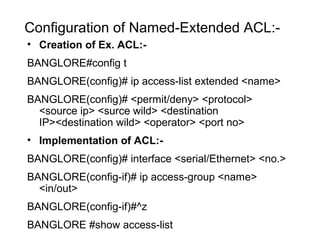
Configuration of Named-Extended ACL:- 
• Creation of Ex. ACL:- 
BANGLORE#config t 
BANGLORE(config)# ip access-list extended <name> 
BANGLORE(config)# <permit/deny> <protocol> 
<source ip> <surce wild> <destination 
IP><destination wild> <operator> <port no> 
• Implementation of ACL:- 
BANGLORE(config)# interface <serial/Ethernet> <no.> 
BANGLORE(config-if)# ip access-group <name> 
<in/out> 
BANGLORE(config-if)#^z 
BANGLORE #show access-list

CCNA part 7 acl

  • 1.
  • 2.
    Access Control List:- • It is layer 3 (network) security which controls flow of traffic from one router to another router. • It is also called as packet filtering firewall. • Generally ACL implements on Distribution layer Routers.
  • 3.
    Rules of ACL:- • All deny statements have to be given first. • There should be at least one permit statement. • An implicit deny block all traffic by default when there no match. • We can configure one access-list per interface per direction I.e. two access-list-per interface. One in inbound direction and one in outbound direction. • ACL works in sequential order. • Editing of access-list is not possible I.e.selecting, adding or removing access-list statement is not possible.
  • 4.
    Types of ACL:- • Standard Access list. • Extended Access list. • Named Access list.
  • 5.
    Standard Access list:- • It is implement closer to destination. • ACL number is 1 to 99 and 1300 to 1999. • It works (matches) only with source IP Address. • Two way communication will stop. • All service will block.
  • 6.
    Configuration of standardACL:- • Creation of ACL:- Hyderabad#config t Hyd(config)# access-list <acl no.> <deny/permit> <source ip> <source wildcard mask> • Implementation of ACL:- Hyderabad(config)# interface <serial/Ethernet> <no.> Hyderabad(config-if)# ip access-group <acl no> <in/out> Hyderabad(config-if)#exit Hyderabad(config)#exit Hyderabad#show access-list
  • 7.
    Configuration contniued…………. •Creation of ACL:- Hyderabad#config t Hyd(config)# access-list 50 deny 192.168.1.1 0.0.0.0 Hyderabad(config)# access-list 50 permit any • Implementation of ACL:- Hyderabad(config)# int s1 Hyderabad(config-if)# ip access-group 50 in Hyderabad(config-if)#exit Hyderabad(config)#exit
  • 8.
    Extended Access list:- • Extended ACL is implement as possible closer to source. • ACL no. is 100 to 199 and 2000 to 2699. • Extended ACL matches source IP address, Destination IP address, Protocol type, source port no., destination port no. • We can block specific service by using Ex. ACL.
  • 9.
    Configuration of ExtendedACL:- • Creation of Ex. ACL:- BANGLORE#config t BANGLORE(config)# access-list <acl .no.> <deny/permit> <protocol> <source IP> <source wlid card mask> <destination IP> <destination wild card mask> <operator> <port no.> • Implementation of ACL:- BANGLORE(config)# interface <serial/Ethernet> <no.> BANGLORE(config-if)# ip access-group <acl no> <in/out> BANGLORE(config-if)#exit BANGLORE(config)#exit BANGLORE #show access-list
  • 10.
    Configuration contniued…………. •Creation of Ex. ACL:- BANGLORE#config t BANGLORE(config)# access-list 150 deny tcp 192.168.1.1 0.0.0.0 192.168.2.0 0.0.0.255 eq 23 BANGLORE(config)#access-list 150 permit ip any any • Implementation of ACL:- BANGLORE(config)# int e 0 BANGLORE(config-if)# ip access-group 150 in BANGLORE(config-if)# exit BANGLORE(config)# ^Z
  • 11.
    Named Access list:- • In named ACL can use names as reference of ACL instead of numbers. • Named ACL support both IP & IPX protocol. • Unlike in number-ACLs in named-ACLsyou can delete a single entry in the ACLs. • Types of Named ACLs:- 1. Named-standard access list. 2. Named-Extended access list.
  • 12.
    Configuration of Named-standard ACL:- • Creation of ACL:- Hyderabad#config t Hyderabad(config)# ip access-list standard <name> Hyderabad#<permit/deny> <source IP> <source wild cardmask> • Implementation of ACL:- Hyderabad(config)# interface <serial/Ethernet> <no.> Hyderabad(config-if)# ip access-group <name> <in/out> Hyderabad(config-if)#exit Hyderabad(config)#exit Hyderabad#show access-list
  • 13.
    Configuration of Named-ExtendedACL:- • Creation of Ex. ACL:- BANGLORE#config t BANGLORE(config)# ip access-list extended <name> BANGLORE(config)# <permit/deny> <protocol> <source ip> <surce wild> <destination IP><destination wild> <operator> <port no> • Implementation of ACL:- BANGLORE(config)# interface <serial/Ethernet> <no.> BANGLORE(config-if)# ip access-group <name> <in/out> BANGLORE(config-if)#^z BANGLORE #show access-list