SUMMER TRAINING PRESENTATION
ON
CISCO CERTIFIED NETWORK ASSOCIATE
08/13/13BASED ON CCNA
1
ABOUT CCNA
 This certification builds a
foundation in and apprentice
knowledge of networking.
 CCNA certified professionals can install, configure,
and operate LAN, WAN and daily access services
for small networks (100 modes or fewer), including
but not limited to use of these protocols: IP, IGRP,
SERIAL FRAME-RELAY, IP RIP, VLANs, RIP
ETHERNET, ACCESS-LISTS.
08/13/13BASED ON CCNA
2
08/13/13BASED ON CCNA
3
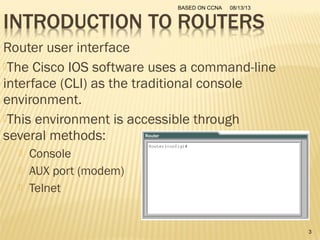
Router user interface
The Cisco IOS software uses a command-line
interface (CLI) as the traditional console
environment.
This environment is accessible through
several methods:
 Console
 AUX port (modem)
 Telnet
Establishing a HyperTerminal session
08/13/13BASED ON CCNA
4
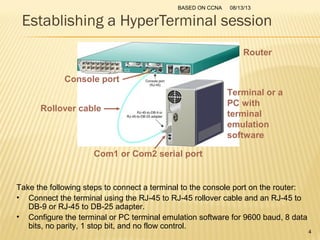
Take the following steps to connect a terminal to the console port on the router:
• Connect the terminal using the RJ-45 to RJ-45 rollover cable and an RJ-45 to
DB-9 or RJ-45 to DB-25 adapter.
• Configure the terminal or PC terminal emulation software for 9600 baud, 8 data
bits, no parity, 1 stop bit, and no flow control.
Rollover cable
Console port
Com1 or Com2 serial port
Terminal or a
PC with
terminal
emulation
software
Router
08/13/13BASED ON CCNA
5
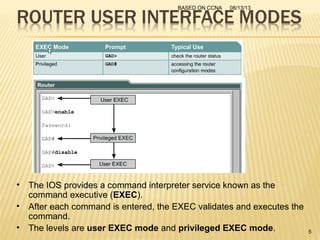
• The IOS provides a command interpreter service known as the
command executive (EXEC).
• After each command is entered, the EXEC validates and executes the
command.
• The levels are user EXEC mode and privileged EXEC mode.
08/13/13BASED ON CCNA
6
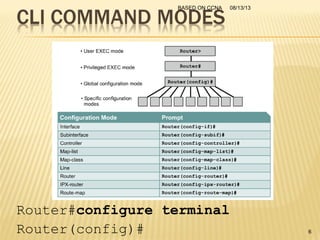
Router#configure terminal
Router(config)#
08/13/13BASED ON CCNA
7
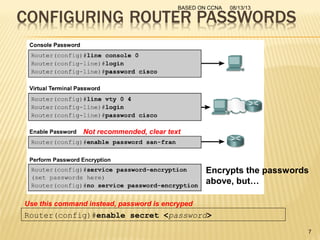
Not recommended, clear text
Router(config)#enable secret <password>
Use this command instead, password is encryped
Encrypts the passwords
above, but…
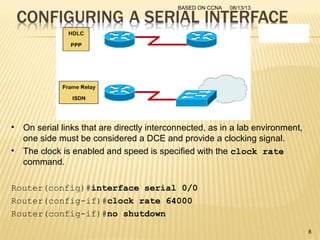
• On serial links that are directly interconnected, as in a lab environment,
one side must be considered a DCE and provide a clocking signal.
• The clock is enabled and speed is specified with the clock rate
command.
Router(config)#interface serial 0/0
Router(config-if)#clock rate 64000
Router(config-if)#no shutdown
08/13/13BASED ON CCNA
8
08/13/13BASED ON CCNA
9
It is also called Network Traffic Control
Management (NTCM). We can provide restrictions to
individual users, subnets and services etc.
ACL
Standard ACL Extended ACL
Any access list is identified by its number.
S. A. L 1 – 99
Ex. A. L 100 - 199
08/13/13BASED ON CCNA
10
Rules for creating and implementing
Access List
1. Access list must begin with the Deny Statements (If
exists) then Permit Statements must follow.
2. There must be at least one Permit Statement as an
Implicit “Deny All” always exists.
3. While Implementation of Access list, There must be
only one Access list per Interface, per direction and
per protocol.
08/13/13BASED ON CCNA
11
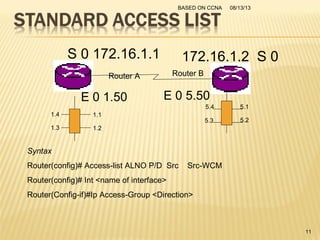
Router A Router B
S 0 172.16.1.1 172.16.1.2 S 0
E 0 5.50
1.1
1.21.3
1.4
5.1
5.2
5.4
5.3
E 0 1.50
Syntax
Router(config)# Access-list ALNO P/D Src Src-WCM
Router(config)# Int <name of interface>
Router(Config-if)#Ip Access-Group <Direction>
Layer 2 switching is the process of
using the hardware address of devices
on LAN to segment a network.
In multiple links between switches we
face multi looping problems. To solve
this problem switches run Spanning
Tree Protocol (STP).
08/13/13BASED ON CCNA
12
A VLAN is a logical grouping of network
users and resources connected to
administratively defined ports on a switched.
A group of users that need an unusually
high level of security can be put into its own
VLAN so that users outside of the VLAN
can’t communicate with them. So it provide
security.
08/13/13BASED ON CCNA
13
Switch>show vlan
Switch>enable
Switch#vlan database
Switch(vlan)#vlan vlan-id name vlan-name
Switch(vlan)#exit or ^z.
08/13/13BASED ON CCNA
14
08/13/13BASED ON CCNA
15
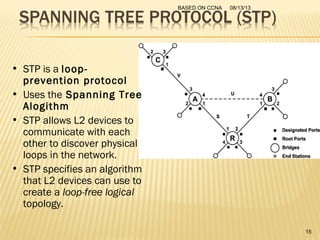
• STP is a loop-
prevention protocol
• Uses the Spanning Tree
Alogithm
• STP allows L2 devices to
communicate with each
other to discover physical
loops in the network.
• STP specifies an algorithm
that L2 devices can use to
create a loop-free logical
topology.
08/13/13BASED ON CCNA
16
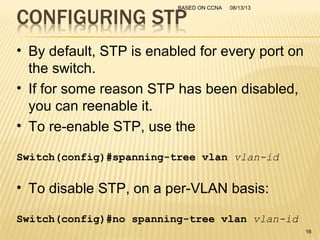
• By default, STP is enabled for every port on
the switch.
• If for some reason STP has been disabled,
you can reenable it.
• To re-enable STP, use the
Switch(config)#spanning-tree vlan vlan-id
• To disable STP, on a per-VLAN basis:
Switch(config)#no spanning-tree vlan vlan-id
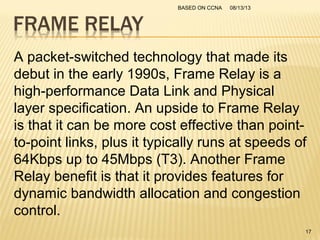
A packet-switched technology that made its
debut in the early 1990s, Frame Relay is a
high-performance Data Link and Physical
layer specification. An upside to Frame Relay
is that it can be more cost effective than point-
to-point links, plus it typically runs at speeds of
64Kbps up to 45Mbps (T3). Another Frame
Relay benefit is that it provides features for
dynamic bandwidth allocation and congestion
control.
08/13/13BASED ON CCNA
17
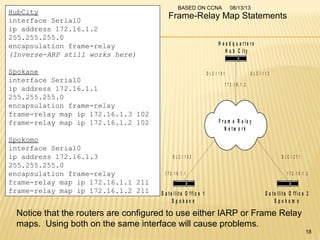
F r a m e R e la y
N e t w o r k
H e a d q u a r t e r s
H u b C it y
S a t e llit e O f f ic e 1
S p o k a n e
S a t e llit e O f f ic e 2
S p o k o m o
1 7 2 .1 6 .1 .1 1 7 2 .1 6 . 1 . 3
1 7 2 .1 6 . 1 . 2
D L C I 1 0 1
D L C I 1 0 2
D L C I 1 1 2
D L C I 2 1 1
HubCity
interface Serial0
ip address 172.16.1.2
255.255.255.0
encapsulation frame-relay
(Inverse-ARP still works here)
Spokane
interface Serial0
ip address 172.16.1.1
255.255.255.0
encapsulation frame-relay
frame-relay map ip 172.16.1.3 102
frame-relay map ip 172.16.1.2 102
Spokomo
interface Serial0
ip address 172.16.1.3
255.255.255.0
encapsulation frame-relay
frame-relay map ip 172.16.1.1 211
frame-relay map ip 172.16.1.2 211
Frame-Relay Map Statements
Notice that the routers are configured to use either IARP or Frame Relay
maps. Using both on the same interface will cause problems.
08/13/13BASED ON CCNA
18
THANK YOUTHANK YOU
08/13/13BASED ON CCNA
19

CCNA 2

  • 1.
    SUMMER TRAINING PRESENTATION ON CISCOCERTIFIED NETWORK ASSOCIATE 08/13/13BASED ON CCNA 1
  • 2.
    ABOUT CCNA  Thiscertification builds a foundation in and apprentice knowledge of networking.  CCNA certified professionals can install, configure, and operate LAN, WAN and daily access services for small networks (100 modes or fewer), including but not limited to use of these protocols: IP, IGRP, SERIAL FRAME-RELAY, IP RIP, VLANs, RIP ETHERNET, ACCESS-LISTS. 08/13/13BASED ON CCNA 2
  • 3.
    08/13/13BASED ON CCNA 3 Routeruser interface The Cisco IOS software uses a command-line interface (CLI) as the traditional console environment. This environment is accessible through several methods:  Console  AUX port (modem)  Telnet
  • 4.
    Establishing a HyperTerminalsession 08/13/13BASED ON CCNA 4 Take the following steps to connect a terminal to the console port on the router: • Connect the terminal using the RJ-45 to RJ-45 rollover cable and an RJ-45 to DB-9 or RJ-45 to DB-25 adapter. • Configure the terminal or PC terminal emulation software for 9600 baud, 8 data bits, no parity, 1 stop bit, and no flow control. Rollover cable Console port Com1 or Com2 serial port Terminal or a PC with terminal emulation software Router
  • 5.
    08/13/13BASED ON CCNA 5 •The IOS provides a command interpreter service known as the command executive (EXEC). • After each command is entered, the EXEC validates and executes the command. • The levels are user EXEC mode and privileged EXEC mode.
  • 6.
  • 7.
    08/13/13BASED ON CCNA 7 Notrecommended, clear text Router(config)#enable secret <password> Use this command instead, password is encryped Encrypts the passwords above, but…
  • 8.
    • On seriallinks that are directly interconnected, as in a lab environment, one side must be considered a DCE and provide a clocking signal. • The clock is enabled and speed is specified with the clock rate command. Router(config)#interface serial 0/0 Router(config-if)#clock rate 64000 Router(config-if)#no shutdown 08/13/13BASED ON CCNA 8
  • 9.
    08/13/13BASED ON CCNA 9 Itis also called Network Traffic Control Management (NTCM). We can provide restrictions to individual users, subnets and services etc. ACL Standard ACL Extended ACL Any access list is identified by its number. S. A. L 1 – 99 Ex. A. L 100 - 199
  • 10.
    08/13/13BASED ON CCNA 10 Rulesfor creating and implementing Access List 1. Access list must begin with the Deny Statements (If exists) then Permit Statements must follow. 2. There must be at least one Permit Statement as an Implicit “Deny All” always exists. 3. While Implementation of Access list, There must be only one Access list per Interface, per direction and per protocol.
  • 11.
    08/13/13BASED ON CCNA 11 RouterA Router B S 0 172.16.1.1 172.16.1.2 S 0 E 0 5.50 1.1 1.21.3 1.4 5.1 5.2 5.4 5.3 E 0 1.50 Syntax Router(config)# Access-list ALNO P/D Src Src-WCM Router(config)# Int <name of interface> Router(Config-if)#Ip Access-Group <Direction>
  • 12.
    Layer 2 switchingis the process of using the hardware address of devices on LAN to segment a network. In multiple links between switches we face multi looping problems. To solve this problem switches run Spanning Tree Protocol (STP). 08/13/13BASED ON CCNA 12
  • 13.
    A VLAN isa logical grouping of network users and resources connected to administratively defined ports on a switched. A group of users that need an unusually high level of security can be put into its own VLAN so that users outside of the VLAN can’t communicate with them. So it provide security. 08/13/13BASED ON CCNA 13
  • 14.
    Switch>show vlan Switch>enable Switch#vlan database Switch(vlan)#vlanvlan-id name vlan-name Switch(vlan)#exit or ^z. 08/13/13BASED ON CCNA 14
  • 15.
    08/13/13BASED ON CCNA 15 •STP is a loop- prevention protocol • Uses the Spanning Tree Alogithm • STP allows L2 devices to communicate with each other to discover physical loops in the network. • STP specifies an algorithm that L2 devices can use to create a loop-free logical topology.
  • 16.
    08/13/13BASED ON CCNA 16 •By default, STP is enabled for every port on the switch. • If for some reason STP has been disabled, you can reenable it. • To re-enable STP, use the Switch(config)#spanning-tree vlan vlan-id • To disable STP, on a per-VLAN basis: Switch(config)#no spanning-tree vlan vlan-id
  • 17.
    A packet-switched technologythat made its debut in the early 1990s, Frame Relay is a high-performance Data Link and Physical layer specification. An upside to Frame Relay is that it can be more cost effective than point- to-point links, plus it typically runs at speeds of 64Kbps up to 45Mbps (T3). Another Frame Relay benefit is that it provides features for dynamic bandwidth allocation and congestion control. 08/13/13BASED ON CCNA 17
  • 18.
    F r am e R e la y N e t w o r k H e a d q u a r t e r s H u b C it y S a t e llit e O f f ic e 1 S p o k a n e S a t e llit e O f f ic e 2 S p o k o m o 1 7 2 .1 6 .1 .1 1 7 2 .1 6 . 1 . 3 1 7 2 .1 6 . 1 . 2 D L C I 1 0 1 D L C I 1 0 2 D L C I 1 1 2 D L C I 2 1 1 HubCity interface Serial0 ip address 172.16.1.2 255.255.255.0 encapsulation frame-relay (Inverse-ARP still works here) Spokane interface Serial0 ip address 172.16.1.1 255.255.255.0 encapsulation frame-relay frame-relay map ip 172.16.1.3 102 frame-relay map ip 172.16.1.2 102 Spokomo interface Serial0 ip address 172.16.1.3 255.255.255.0 encapsulation frame-relay frame-relay map ip 172.16.1.1 211 frame-relay map ip 172.16.1.2 211 Frame-Relay Map Statements Notice that the routers are configured to use either IARP or Frame Relay maps. Using both on the same interface will cause problems. 08/13/13BASED ON CCNA 18
  • 19.