Strengths
• Can assess multiple health outcomes (and do
not have to make binary as in case-control)
• Possible to examine multiple exposures
– May not be possible with double-cohort design (i.e.,
one cohort exposed, one cohort unexposed within the
study)
• Participants can move between exposure groups
over time (with incidence density as measure of
disease)
Strengths
• Exposures assessed before outcomes (for
prospective) ensuring temporality
• Direct measurement of disease rates, risks
• Capture changing exposures and outcomes in
time
Challenges
• Loss to follow-up
• Expense, feasibility and participant burden of
repeated data collection
• Time to conduct (for concurrent)
• Inefficient for rare outcome (rare in the study
population)
• Non-concurrent relies on availability and quality
of historical data
Challenges
• Have to assure assessment of outcomes is not
differential with respect to exposure
– Blinding may be possible
• Exposure classification may be challenging
Challenges
• Exposure(s) of interest must to have sufficient
variation in the population chosen
– Example: cannot study effect of lead paint exposure
on child development if all children in the population
live in housing built after 1978
– Example: NHS II established because women were
taking oral contraceptives from much younger ages
(compared to NHS I)
Challenges
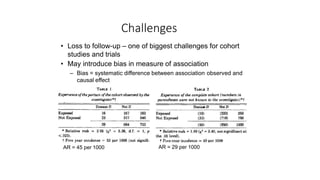
• Loss to follow-up – one of biggest challenges for cohort
studies and trials
• May introduce bias in measure of association
– Bias = systematic difference between association observed and
causal effect
AR = 45 per 1000 AR = 29 per 1000
Challenges
• If loss of participants is associated with outcome,
measurement of rates/risks will be inaccurate (e.
g., more likely to lose people shortly before they
develop the outcome of interest)
• If loss of participants is also associated with
exposure will introduce bias (e.g., more likely to
lose people in the exposed group shortly before
they develop the outcome of interest)

5.4 strengths and challenges

  • 1.
    Strengths • Can assessmultiple health outcomes (and do not have to make binary as in case-control) • Possible to examine multiple exposures – May not be possible with double-cohort design (i.e., one cohort exposed, one cohort unexposed within the study) • Participants can move between exposure groups over time (with incidence density as measure of disease)
  • 2.
    Strengths • Exposures assessedbefore outcomes (for prospective) ensuring temporality • Direct measurement of disease rates, risks • Capture changing exposures and outcomes in time
  • 3.
    Challenges • Loss tofollow-up • Expense, feasibility and participant burden of repeated data collection • Time to conduct (for concurrent) • Inefficient for rare outcome (rare in the study population) • Non-concurrent relies on availability and quality of historical data
  • 4.
    Challenges • Have toassure assessment of outcomes is not differential with respect to exposure – Blinding may be possible • Exposure classification may be challenging
  • 5.
    Challenges • Exposure(s) ofinterest must to have sufficient variation in the population chosen – Example: cannot study effect of lead paint exposure on child development if all children in the population live in housing built after 1978 – Example: NHS II established because women were taking oral contraceptives from much younger ages (compared to NHS I)
  • 6.
    Challenges • Loss tofollow-up – one of biggest challenges for cohort studies and trials • May introduce bias in measure of association – Bias = systematic difference between association observed and causal effect AR = 45 per 1000 AR = 29 per 1000
  • 7.
    Challenges • If lossof participants is associated with outcome, measurement of rates/risks will be inaccurate (e. g., more likely to lose people shortly before they develop the outcome of interest) • If loss of participants is also associated with exposure will introduce bias (e.g., more likely to lose people in the exposed group shortly before they develop the outcome of interest)