Analyzing Randomized Control
Trial: ITT vs. PP vs. AT
Proceedings from Journal club…..
Vikash
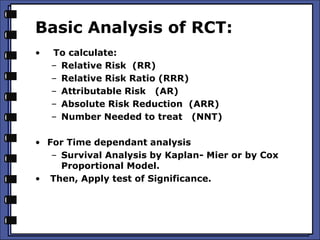
Basic Analysis of RCT:
• To calculate:
– Relative Risk (RR)
– Relative Risk Ratio (RRR)
– Attributable Risk (AR)
– Absolute Risk Reduction (ARR)
– Number Needed to treat (NNT)
• For Time dependant analysis
– Survival Analysis by Kaplan- Mier or by Cox
Proportional Model.
• Then, Apply test of Significance.
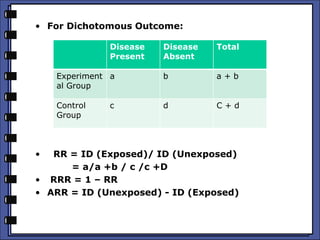
• For Dichotomous Outcome:
• RR = ID (Exposed)/ ID (Unexposed)
= a/a +b / c /c +D
• RRR = 1 – RR
• ARR = ID (Unexposed) - ID (Exposed)
Disease
Present
Disease
Absent
Total
Experiment
al Group
a b a + b
Control
Group
c d C + d
• Attributable Risk
= (OR – 1) PE / 1+ [ (OR-1) PE] x 100
• Where OR = Odds Ratio = ad / bc
• Number Needed to treat (NNT) = 1/ARR
• RR = 0. 4 /0.5 = 0.8
• RRR = 0.2
• ARR = 0.2 – 0.25 = - 0.05
• NNT = 1/ARR = 20
TB No TB Total
Cont.
Isoniazid
40 160 200
Isoniazid 6
month
50 150 200
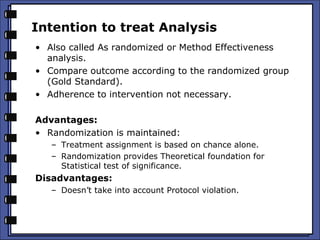
Intention to treat Analysis
• Also called As randomized or Method Effectiveness
analysis.
• Compare outcome according to the randomized group
(Gold Standard).
• Adherence to intervention not necessary.
Advantages:
• Randomization is maintained:
– Treatment assignment is based on chance alone.
– Randomization provides Theoretical foundation for
Statistical test of significance.
Disadvantages:
– Doesn’t take into account Protocol violation.
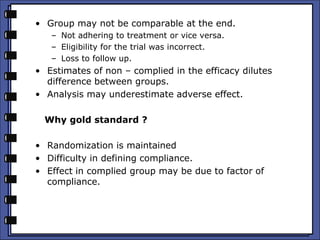
• Group may not be comparable at the end.
– Not adhering to treatment or vice versa.
– Eligibility for the trial was incorrect.
– Loss to follow up.
• Estimates of non – complied in the efficacy dilutes
difference between groups.
• Analysis may underestimate adverse effect.
Why gold standard ?
• Randomization is maintained
• Difficulty in defining compliance.
• Effect in complied group may be due to factor of
compliance.
Per Protocol Analysis:
• Analyze only those who fully complied to protocol.
• Doesn’t included cross- over in final analysis.
• Provides fair idea of efficacy for treatment.
• May be Biased (randomization compromised)
As treated Analysis:
• Subject analyzed according to treatment taken or not.
(no relation with randomization).
• Non compliant from treatment and vice versa analyzed
accordingly.
• AT is shown if ITT shows no effect ( why trial done).
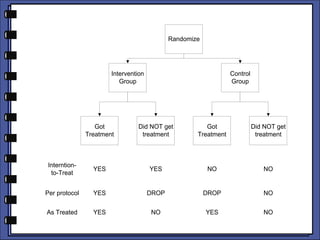
Intervention
Group
Control
Group
Randomize
Got
Treatment
Did NOT get
treatment
Got
Treatment
Did NOT get
treatment
YESYES NO NO
Interntion-
to-Treat
YES
YES
DROP
NO
DROP
YES
NO
NO
Per protocol
As Treated
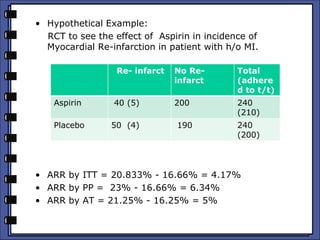
• Hypothetical Example:
RCT to see the effect of Aspirin in incidence of
Myocardial Re-infarction in patient with h/o MI.
• ARR by ITT = 20.833% - 16.66% = 4.17%
• ARR by PP = 23% - 16.66% = 6.34%
• ARR by AT = 21.25% - 16.25% = 5%
Re- infarct No Re-
infarct
Total
(adhere
d to t/t)
Aspirin 40 (5) 200 240
(210)
Placebo 50 (4) 190 240
(200)
References:
• Redmond C, Armitage P editors. Biostatics in Clinical
Trials. 1st ed. Sussex. John Wiley & Sons ltd. 2001.
p243- 6.
• Haynes RB, Sacket DL, Guyat GH, Tugwell P. Clinical
Epidemiology. 3rd ed. Baltimore. Lippincott Williams &
Wilkins.2006. p 95 & 116.
• Fletcher RW, Fletcher SW. Clinical Epidemiology: the
essential. 4th ed. Baltimore. Lippincott Williams &
Wilkins. 2005. p 136-9.

Analyzing the randomised control trial (rct)

  • 1.
    Analyzing Randomized Control Trial:ITT vs. PP vs. AT Proceedings from Journal club….. Vikash
  • 2.
    Basic Analysis ofRCT: • To calculate: – Relative Risk (RR) – Relative Risk Ratio (RRR) – Attributable Risk (AR) – Absolute Risk Reduction (ARR) – Number Needed to treat (NNT) • For Time dependant analysis – Survival Analysis by Kaplan- Mier or by Cox Proportional Model. • Then, Apply test of Significance.
  • 3.
    • For DichotomousOutcome: • RR = ID (Exposed)/ ID (Unexposed) = a/a +b / c /c +D • RRR = 1 – RR • ARR = ID (Unexposed) - ID (Exposed) Disease Present Disease Absent Total Experiment al Group a b a + b Control Group c d C + d
  • 4.
    • Attributable Risk =(OR – 1) PE / 1+ [ (OR-1) PE] x 100 • Where OR = Odds Ratio = ad / bc • Number Needed to treat (NNT) = 1/ARR • RR = 0. 4 /0.5 = 0.8 • RRR = 0.2 • ARR = 0.2 – 0.25 = - 0.05 • NNT = 1/ARR = 20 TB No TB Total Cont. Isoniazid 40 160 200 Isoniazid 6 month 50 150 200
  • 5.
    Intention to treatAnalysis • Also called As randomized or Method Effectiveness analysis. • Compare outcome according to the randomized group (Gold Standard). • Adherence to intervention not necessary. Advantages: • Randomization is maintained: – Treatment assignment is based on chance alone. – Randomization provides Theoretical foundation for Statistical test of significance. Disadvantages: – Doesn’t take into account Protocol violation.
  • 6.
    • Group maynot be comparable at the end. – Not adhering to treatment or vice versa. – Eligibility for the trial was incorrect. – Loss to follow up. • Estimates of non – complied in the efficacy dilutes difference between groups. • Analysis may underestimate adverse effect. Why gold standard ? • Randomization is maintained • Difficulty in defining compliance. • Effect in complied group may be due to factor of compliance.
  • 7.
    Per Protocol Analysis: •Analyze only those who fully complied to protocol. • Doesn’t included cross- over in final analysis. • Provides fair idea of efficacy for treatment. • May be Biased (randomization compromised) As treated Analysis: • Subject analyzed according to treatment taken or not. (no relation with randomization). • Non compliant from treatment and vice versa analyzed accordingly. • AT is shown if ITT shows no effect ( why trial done).
  • 8.
    Intervention Group Control Group Randomize Got Treatment Did NOT get treatment Got Treatment DidNOT get treatment YESYES NO NO Interntion- to-Treat YES YES DROP NO DROP YES NO NO Per protocol As Treated
  • 9.
    • Hypothetical Example: RCTto see the effect of Aspirin in incidence of Myocardial Re-infarction in patient with h/o MI. • ARR by ITT = 20.833% - 16.66% = 4.17% • ARR by PP = 23% - 16.66% = 6.34% • ARR by AT = 21.25% - 16.25% = 5% Re- infarct No Re- infarct Total (adhere d to t/t) Aspirin 40 (5) 200 240 (210) Placebo 50 (4) 190 240 (200)
  • 10.
    References: • Redmond C,Armitage P editors. Biostatics in Clinical Trials. 1st ed. Sussex. John Wiley & Sons ltd. 2001. p243- 6. • Haynes RB, Sacket DL, Guyat GH, Tugwell P. Clinical Epidemiology. 3rd ed. Baltimore. Lippincott Williams & Wilkins.2006. p 95 & 116. • Fletcher RW, Fletcher SW. Clinical Epidemiology: the essential. 4th ed. Baltimore. Lippincott Williams & Wilkins. 2005. p 136-9.