Studies designs in
epidemiology
Muhammed Shaffi
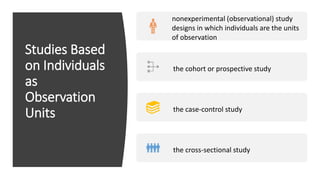
Studies Based
on Individuals
as
Observation
Units
nonexperimental (observational) study
designs in which individuals are the units
of observation
the cohort or prospective study
the case-control study
the cross-sectional study
Cohort studies or prospective studies
• Cohort data, if unbiased, reflect the “real-life” cause–effect temporal
sequence of events, a sine qua non criterion to establish causality
• The usual objective of a cohort study is to investigate whether the
incidence of an event is related to a suspected exposure.
• a sample of the general population - Framingham Study
• an occupational cohort
• a group of people who, because of certain characteristics- the cohort of
homosexual men who are followed in the Multicenter AIDS Cohort Study
• convenience samples-Nurses Health Study cohort, Health Professionals
Study cohort
•
Basic components
In the cohort study’s
most representative
format, a defined
population is identified.
Its subjects are classified
according to exposure
status, and the incidence
of the disease (or any
other health outcome of
interest) is ascertained
and compared across
exposure categories
Basic analytical approach
• An important
assumption for the
calculation of
incidence in a cohort
study is that
individuals who are
lost to follow-up are
like those who
remain under
observation
regarding
characteristics
affecting the
outcome of interest
Types of
cohort studies
Case-Control Study
• Compares cases (usually diseased individuals)
and controls (e.g., non diseased individuals)
with respect to their level of exposure to a
suspected risk factor.
• When the risk factor of interest is a categorical
characteristic (e.g., former, current, and never
smokers), the typical analytical approach in
case-control studies is to compare the odds of
exposure in cases with that in controls by
calculating the exposure odds ratio
• An appropriate estimate of the relative
• When the exposure of interest is a continuous
trait, its mean levels (e.g., mean blood
pressure) can be compared between cases and
controls.
case-based case-control study
• If exposure data are obtained
through interviews, it is
necessary to assume no recall or
other biases
• If only living cases are included,
then its assumed that cases who
survive through the time when
the study is done are
representative of all cases about
the exposure experience
• assume that they originate from
the same reference population,
that is, from a explicitly identified
cohort
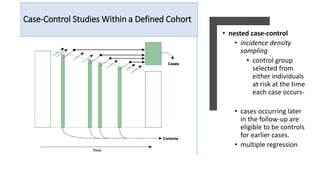
Case-Control Studies Within a Defined Cohort
• nested case-control
• incidence density
sampling
• control group
selected from
either individuals
at risk at the time
each case occurs-
• cases occurring later
in the follow-up are
eligible to be controls
for earlier cases.
• multiple regression
• Both these designs are
fundamentally efficient
when additional
information that was not
obtained or measured for
the whole cohort is
needed.
• samples are collected at
baseline and stored in
freezers
• samples for cases and
for a sample of
controls can be taken
and analyzed.
• labor-intensive data
collection activities, such
as data from records.
case-cohort designs
control group selected from the baseline cohort
Cross-Sectional Studies
• sample of the (or the total)
reference population is examined at
a given point in time.
• conceptualized to analyze cohort
data, albeit a “snap- shot” of a
cohort by recording information on
disease outcomes and exposures at
a single point
• the analytical approach
• comparing point prevalence
rates
• prevalent cases and non cases
are compared with regard to
odds of exposure
Case-Crossover Design
• case-crossover study design consists of comparing the exposure status of a case
immediately before its occurrence with that of the same case at some other prior
time (e.g., the average level of exposure during the previous year).
• It is especially appropriate to study acute (brief) exposures that vary over time
and that produce a transient change in risk of an acute condition after a short
latency (incubation) period.
• For example, this design has been used to study acute triggers of intracranial
aneurysms, such as vigorous physical exercise, and of asthma such as traffic
pollution
• individuals serve as their own controls
• the analytical unit is time.
• The time just preceding the acute event (“case” time) is compared with some other time
(“control” time)
Matching
• Groups may not be comparable regarding features which may affect
outcome, when spurious factors (confounding variables) influence the
direction and magnitude of the association of interest.
• For example, if a case-control study shows an association between
hypertension (exposure) and coronary disease (outcome), it can be
argued that this association may (at least in part) be because
coronary disease cases tend to be older than controls. Because
hypertension is more frequently seen in older people, the difference
in age between cases and controls may produce the observed
association (or exaggerate its magnitude).

study designs.pptx

  • 1.
  • 2.
    Studies Based on Individuals as Observation Units nonexperimental(observational) study designs in which individuals are the units of observation the cohort or prospective study the case-control study the cross-sectional study
  • 3.
    Cohort studies orprospective studies • Cohort data, if unbiased, reflect the “real-life” cause–effect temporal sequence of events, a sine qua non criterion to establish causality • The usual objective of a cohort study is to investigate whether the incidence of an event is related to a suspected exposure. • a sample of the general population - Framingham Study • an occupational cohort • a group of people who, because of certain characteristics- the cohort of homosexual men who are followed in the Multicenter AIDS Cohort Study • convenience samples-Nurses Health Study cohort, Health Professionals Study cohort •
  • 4.
    Basic components In thecohort study’s most representative format, a defined population is identified. Its subjects are classified according to exposure status, and the incidence of the disease (or any other health outcome of interest) is ascertained and compared across exposure categories
  • 5.
  • 6.
    • An important assumptionfor the calculation of incidence in a cohort study is that individuals who are lost to follow-up are like those who remain under observation regarding characteristics affecting the outcome of interest
  • 7.
  • 8.
    Case-Control Study • Comparescases (usually diseased individuals) and controls (e.g., non diseased individuals) with respect to their level of exposure to a suspected risk factor. • When the risk factor of interest is a categorical characteristic (e.g., former, current, and never smokers), the typical analytical approach in case-control studies is to compare the odds of exposure in cases with that in controls by calculating the exposure odds ratio • An appropriate estimate of the relative • When the exposure of interest is a continuous trait, its mean levels (e.g., mean blood pressure) can be compared between cases and controls.
  • 9.
    case-based case-control study •If exposure data are obtained through interviews, it is necessary to assume no recall or other biases • If only living cases are included, then its assumed that cases who survive through the time when the study is done are representative of all cases about the exposure experience • assume that they originate from the same reference population, that is, from a explicitly identified cohort
  • 10.
    Case-Control Studies Withina Defined Cohort • nested case-control • incidence density sampling • control group selected from either individuals at risk at the time each case occurs- • cases occurring later in the follow-up are eligible to be controls for earlier cases. • multiple regression
  • 11.
    • Both thesedesigns are fundamentally efficient when additional information that was not obtained or measured for the whole cohort is needed. • samples are collected at baseline and stored in freezers • samples for cases and for a sample of controls can be taken and analyzed. • labor-intensive data collection activities, such as data from records. case-cohort designs control group selected from the baseline cohort
  • 12.
    Cross-Sectional Studies • sampleof the (or the total) reference population is examined at a given point in time. • conceptualized to analyze cohort data, albeit a “snap- shot” of a cohort by recording information on disease outcomes and exposures at a single point • the analytical approach • comparing point prevalence rates • prevalent cases and non cases are compared with regard to odds of exposure
  • 13.
    Case-Crossover Design • case-crossoverstudy design consists of comparing the exposure status of a case immediately before its occurrence with that of the same case at some other prior time (e.g., the average level of exposure during the previous year). • It is especially appropriate to study acute (brief) exposures that vary over time and that produce a transient change in risk of an acute condition after a short latency (incubation) period. • For example, this design has been used to study acute triggers of intracranial aneurysms, such as vigorous physical exercise, and of asthma such as traffic pollution • individuals serve as their own controls • the analytical unit is time. • The time just preceding the acute event (“case” time) is compared with some other time (“control” time)
  • 14.
    Matching • Groups maynot be comparable regarding features which may affect outcome, when spurious factors (confounding variables) influence the direction and magnitude of the association of interest. • For example, if a case-control study shows an association between hypertension (exposure) and coronary disease (outcome), it can be argued that this association may (at least in part) be because coronary disease cases tend to be older than controls. Because hypertension is more frequently seen in older people, the difference in age between cases and controls may produce the observed association (or exaggerate its magnitude).

Editor's Notes

  • #10 Internal validity
  • #11 A study was conducted to examine the relationship of military rank and radiation exposure to brain tumor risk within a cohort of male members of the U.S. Air Force who had had at least one 43 year of service between 1970 and 1989. For the 230 cases, identified in that 20-year period, four race- and year-of-birth–matched controls (non-cases) were randomly selected among Air Force employees who were active at the time the case was diagnosed (for a total of 920 controls).- labor-intensive abstraction of occupational records was required to obtain accurate data on electromagnetic radiation exposure as well as other relevant information on potentially confounding variables.