2016-10-17		|		UC	Berkeley	 Alasdair	Cohen		|		Lecture	for	Publich	Health	250B	 81	
Addi(onal Slides
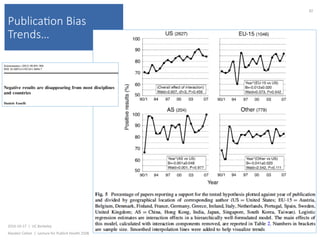
Publica(on Bias
Trends…
2016-10-17		|		UC	Berkeley	
Alasdair	Cohen		|		Lecture	for	Publich	Health	250B	
82
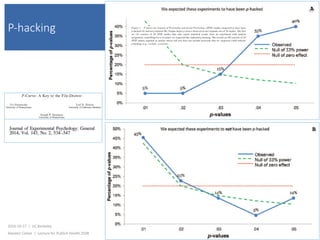
P-hacking
2016-10-17		|		UC	Berkeley	
Alasdair	Cohen		|		Lecture	for	Publich	Health	250B	
83
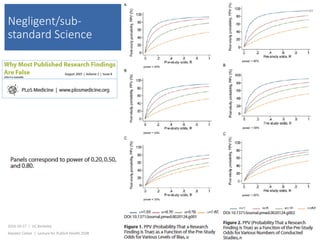
Negligent/sub-
standard Science
2016-10-17		|		UC	Berkeley	
Alasdair	Cohen		|		Lecture	for	Publich	Health	250B	
84
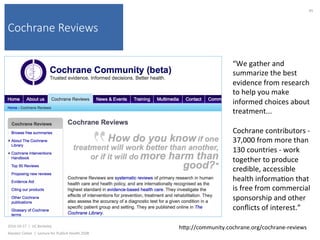
Cochrane Reviews
2016-10-17		|		UC	Berkeley	
Alasdair	Cohen		|		Lecture	for	Publich	Health	250B	
85	
hkp://community.cochrane.org/cochrane-reviews	
“We	gather	and	
summarize	the	best	
evidence	from	research	
to	help	you	make	
informed	choices	about	
treatment...	
	
Cochrane	contributors	-	
37,000	from	more	than	
130	countries	-	work	
together	to	produce	
credible,	accessible	
health	informa)on	that	
is	free	from	commercial	
sponsorship	and	other	
conflicts	of	interest.”
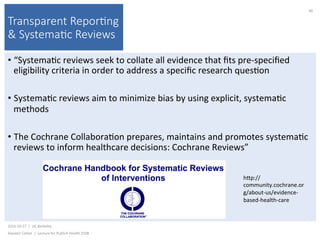
Transparent Repor(ng
& Systema(c Reviews
• “Systema)c	reviews	seek	to	collate	all	evidence	that	fits	pre-specified	
eligibility	criteria	in	order	to	address	a	specific	research	ques)on	
• Systema)c	reviews	aim	to	minimize	bias	by	using	explicit,	systema)c	
methods	
• The	Cochrane	Collabora)on	prepares,	maintains	and	promotes	systema)c	
reviews	to	inform	healthcare	decisions:	Cochrane	Reviews”	
2016-10-17		|		UC	Berkeley	
Alasdair	Cohen		|		Lecture	for	Publich	Health	250B	
86	
hkp://
community.cochrane.or
g/about-us/evidence-
based-health-care
2016-10-17		|		UC	Berkeley	 Alasdair	Cohen		|		Lecture	for	Publich	Health	250B	 87	
Details on CONSORT Checklist
CONSORT Checklist
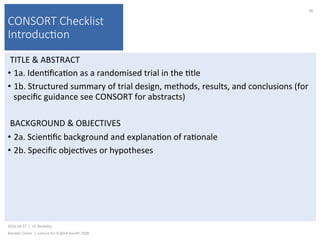
Introduc(on
TITLE	&	ABSTRACT	
•  1a.	Iden)fica)on	as	a	randomised	trial	in	the	)tle	
•  1b.	Structured	summary	of	trial	design,	methods,	results,	and	conclusions	(for	
specific	guidance	see	CONSORT	for	abstracts)	
BACKGROUND	&	OBJECTIVES	
•  2a.	Scien)fic	background	and	explana)on	of	ra)onale	
•  2b.	Specific	objec)ves	or	hypotheses	
2016-10-17		|		UC	Berkeley	
Alasdair	Cohen		|		Lecture	for	Publich	Health	250B	
88
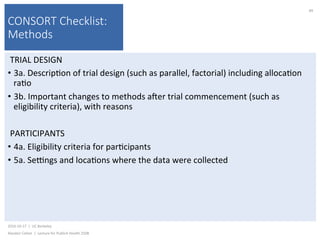
CONSORT Checklist:
Methods
TRIAL	DESIGN	
•  3a.	Descrip)on	of	trial	design	(such	as	parallel,	factorial)	including	alloca)on	
ra)o	
•  3b.	Important	changes	to	methods	ajer	trial	commencement	(such	as	
eligibility	criteria),	with	reasons	
PARTICIPANTS	
•  4a.	Eligibility	criteria	for	par)cipants	
•  5a.	Se{ngs	and	loca)ons	where	the	data	were	collected	
2016-10-17		|		UC	Berkeley	
Alasdair	Cohen		|		Lecture	for	Publich	Health	250B	
89
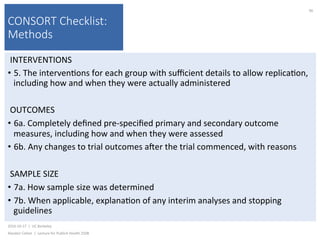
CONSORT Checklist:
Methods
INTERVENTIONS	
•  5.	The	interven)ons	for	each	group	with	sufficient	details	to	allow	replica)on,	
including	how	and	when	they	were	actually	administered		
OUTCOMES	
•  6a.	Completely	defined	pre-specified	primary	and	secondary	outcome	
measures,	including	how	and	when	they	were	assessed	
•  6b.	Any	changes	to	trial	outcomes	ajer	the	trial	commenced,	with	reasons	
SAMPLE	SIZE	
•  7a.	How	sample	size	was	determined	
•  7b.	When	applicable,	explana)on	of	any	interim	analyses	and	stopping	
guidelines	
2016-10-17		|		UC	Berkeley	
Alasdair	Cohen		|		Lecture	for	Publich	Health	250B	
90
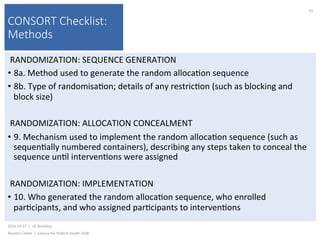
CONSORT Checklist:
Methods
RANDOMIZATION:	SEQUENCE	GENERATION	
•  8a.	Method	used	to	generate	the	random	alloca)on	sequence	
•  8b.	Type	of	randomisa)on;	details	of	any	restric)on	(such	as	blocking	and	
block	size)	
RANDOMIZATION:	ALLOCATION	CONCEALMENT	
•  9.	Mechanism	used	to	implement	the	random	alloca)on	sequence	(such	as	
sequen)ally	numbered	containers),	describing	any	steps	taken	to	conceal	the	
sequence	un)l	interven)ons	were	assigned		
RANDOMIZATION:	IMPLEMENTATION	
•  10.	Who	generated	the	random	alloca)on	sequence,	who	enrolled	
par)cipants,	and	who	assigned	par)cipants	to	interven)ons		
2016-10-17		|		UC	Berkeley	
Alasdair	Cohen		|		Lecture	for	Publich	Health	250B	
91
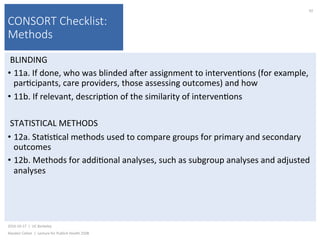
CONSORT Checklist:
Methods
BLINDING	
•  11a.	If	done,	who	was	blinded	ajer	assignment	to	interven)ons	(for	example,	
par)cipants,	care	providers,	those	assessing	outcomes)	and	how	
•  11b.	If	relevant,	descrip)on	of	the	similarity	of	interven)ons	
STATISTICAL	METHODS	
•  12a.	Sta)s)cal	methods	used	to	compare	groups	for	primary	and	secondary	
outcomes	
•  12b.	Methods	for	addi)onal	analyses,	such	as	subgroup	analyses	and	adjusted	
analyses	
2016-10-17		|		UC	Berkeley	
Alasdair	Cohen		|		Lecture	for	Publich	Health	250B	
92
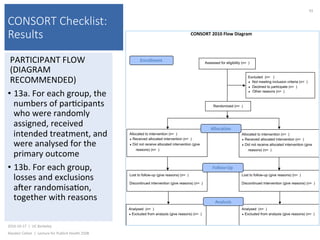
CONSORT Checklist:
Results
PARTICIPANT	FLOW	
(DIAGRAM	
RECOMMENDED)	
•  13a.	For	each	group,	the	
numbers	of	par)cipants	
who	were	randomly	
assigned,	received	
intended	treatment,	and	
were	analysed	for	the	
primary	outcome	
•  13b.	For	each	group,	
losses	and	exclusions	
ajer	randomisa)on,	
together	with	reasons	
2016-10-17		|		UC	Berkeley	
Alasdair	Cohen		|		Lecture	for	Publich	Health	250B	
93	
CONSORT	2010	Flow	Diagram	
Assessed for eligibility (n= )
Excluded (n= )
¨			Not meeting inclusion criteria (n= )
¨			Declined to participate (n= )
¨			Other reasons (n= )
Analysed (n= )
¨	Excluded from analysis (give reasons) (n= )	
Lost to follow-up (give reasons) (n= )
Discontinued intervention (give reasons) (n= )
Allocated to intervention (n= )
¨	Received allocated intervention (n= )	
¨	Did not receive allocated intervention (give
reasons) (n= )	
Lost to follow-up (give reasons) (n= )
Discontinued intervention (give reasons) (n= )
Allocated to intervention (n= )
¨	Received allocated intervention (n= )	
¨	Did not receive allocated intervention (give
reasons) (n= )	
Analysed (n= )
¨	Excluded from analysis (give reasons) (n= )	
	
Allocation
Analysis
Follow-Up
Randomized (n= )
Enrollment
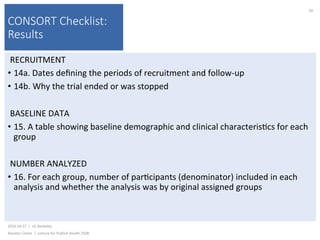
CONSORT Checklist:
Results
RECRUITMENT	
•  14a.	Dates	defining	the	periods	of	recruitment	and	follow-up	
•  14b.	Why	the	trial	ended	or	was	stopped	
	
BASELINE	DATA	
•  15.	A	table	showing	baseline	demographic	and	clinical	characteris)cs	for	each	
group	
NUMBER	ANALYZED	
•  16.	For	each	group,	number	of	par)cipants	(denominator)	included	in	each	
analysis	and	whether	the	analysis	was	by	original	assigned	groups	
2016-10-17		|		UC	Berkeley	
Alasdair	Cohen		|		Lecture	for	Publich	Health	250B	
94
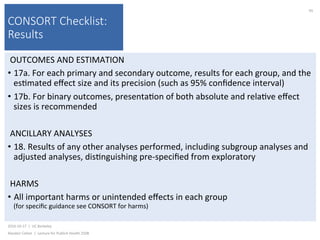
CONSORT Checklist:
Results
OUTCOMES	AND	ESTIMATION	
•  17a.	For	each	primary	and	secondary	outcome,	results	for	each	group,	and	the	
es)mated	effect	size	and	its	precision	(such	as	95%	confidence	interval)	
•  17b.	For	binary	outcomes,	presenta)on	of	both	absolute	and	rela)ve	effect	
sizes	is	recommended	
ANCILLARY	ANALYSES	
•  18.	Results	of	any	other	analyses	performed,	including	subgroup	analyses	and	
adjusted	analyses,	dis)nguishing	pre-specified	from	exploratory	
HARMS	
•  All	important	harms	or	unintended	effects	in	each	group		
(for	specific	guidance	see	CONSORT	for	harms)	
2016-10-17		|		UC	Berkeley	
Alasdair	Cohen		|		Lecture	for	Publich	Health	250B	
95
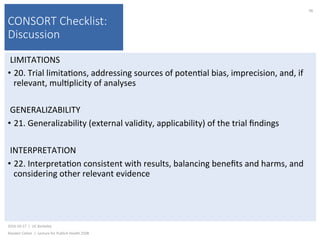
CONSORT Checklist:
Discussion
LIMITATIONS	
•  20.	Trial	limita)ons,	addressing	sources	of	poten)al	bias,	imprecision,	and,	if	
relevant,	mul)plicity	of	analyses	
GENERALIZABILITY	
•  21.	Generalizability	(external	validity,	applicability)	of	the	trial	findings	
INTERPRETATION	
•  22.	Interpreta)on	consistent	with	results,	balancing	benefits	and	harms,	and	
considering	other	relevant	evidence	
2016-10-17		|		UC	Berkeley	
Alasdair	Cohen		|		Lecture	for	Publich	Health	250B	
96
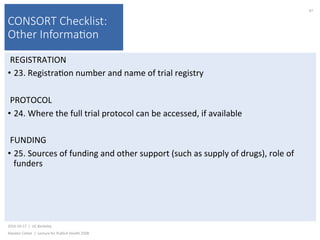
CONSORT Checklist:
Other Informa(on
REGISTRATION	
•  23.	Registra)on	number	and	name	of	trial	registry	
PROTOCOL	
•  24.	Where	the	full	trial	protocol	can	be	accessed,	if	available	
FUNDING	
•  25.	Sources	of	funding	and	other	support	(such	as	supply	of	drugs),	role	of	
funders	
2016-10-17		|		UC	Berkeley	
Alasdair	Cohen		|		Lecture	for	Publich	Health	250B	
97

Transparency7