Transfer Pricing
Chapter 6
A transfer price is the price one subunit charges
for a product or service supplied to another
subunit of the same organization.
Transfer price is a value at which goods and
Services are Transferred between divisions in a
decentralized organizations .
Intermediate products are the products
transferred between subunits of an organization.
Transfer Pricing
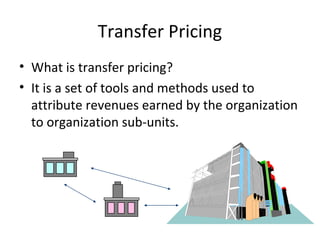
• What is transfer pricing?
• It is a set of tools and methods used to
attribute revenues earned by the organization
to organization sub-units.
Objectives of Transfer Prices
• It should provide each Business Unit with
relevant information so that Trade-off
between company cost and revenue
• Decision that improve business unit profit will
improve company profit so It should induce Goal
Congruence decision

• Measure the economic performance of
business unit
• Simple to understand, easy to administer
Fundamental Principle
• The Transfer price should be similar to the
price that would be charged if the product
were sold to outside customers or purchased
from outside vendors
• Two decisions must be made periodically
– Sourcing decision
– Transfer price decision
Approaches to Transfer Pricing
•
–
–
–
–

There are four approaches to transfer pricing:
Market-Based
Cost-Based
Negotiated
Administered
Approaches to Transfer Pricing
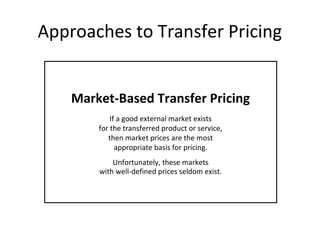
Market-Based Transfer Pricing
If a good external market exists
for the transferred product or service,
then market prices are the most
appropriate basis for pricing.
Unfortunately, these markets
with well-defined prices seldom exist.
Approaches to Transfer Pricing
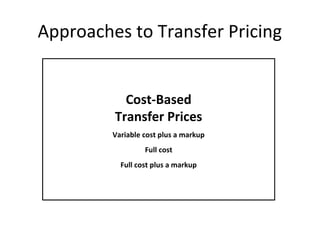
Cost-Based
Transfer Prices
Variable cost plus a markup
Full cost
Full cost plus a markup
The Ideal Situation
•
•
•
•
•
•

Competent people
Good Atmosphere
A Market price
Freedom to Source
Full information
Negotiation
Constraints on Sourcing
• Limited Markets
– Existence of Internal capacity
– Sole producer of Differentiated products
– Company’s investment in Fixed cost

Excess or shortage of Industry capacity
Cost based Transfer price
• Two decision must be made
– How to define cost
– How to calculate Profit Markup
Cost based Transfer price
1. The Cost Basis
•

Standard cost is the base

2.The Profit Markup
•What the profit markup is based on
•The level of profit allowed
•Agreement among Business Unit

• Two Step Pricing
– Transfer price includes two charges
• Standard variable cost per unit
• Fixed cost associated with unit
“Take or pay” pricing
• Profit sharing
– The product is transferred to the Marketing Unit
at Unit Variable cost
– After the product is sold, the Business units share
the contribution

• Two sets of pricing
– Manufacturing unit’s revenue is credited at
outside sales price and buying unit is charged total
standard cost
– The difference is charged to head quarters
account and eliminated when Business unit
statements are consolidated
Approaches to Transfer Pricing
Negotiated
Transfer Prices
Supplying and receiving responsibility
centers negotiate prices.
Prices reflect both negotiating skills
and economic considerations.
Optimal transfer price is the
the net realizable value of the last unit
supplied for all units supplied.
Approaches to Transfer Pricing
Negotiated
Transfer Prices

Reflect the accountability and controllability
principles underlying responsibility centers
Can easily lead to decisions that
do not provide the greatest economic benefits
Approaches to Transfer Pricing
Administered
Transfer Prices
Prices set by a rule, policy, or an arbitrator
Easy to administer
Arbitrary
Tend to violate the spirit of
the responsibility approach
How does company set TP
•PUBLISHED MARKET PRICE
•BIDS
•SIMILAR PRODUCT OUT SIDE MARKET

6. transfer pricing

  • 1.
  • 2.
    A transfer priceis the price one subunit charges for a product or service supplied to another subunit of the same organization. Transfer price is a value at which goods and Services are Transferred between divisions in a decentralized organizations . Intermediate products are the products transferred between subunits of an organization.
  • 3.
    Transfer Pricing • Whatis transfer pricing? • It is a set of tools and methods used to attribute revenues earned by the organization to organization sub-units.
  • 4.
    Objectives of TransferPrices • It should provide each Business Unit with relevant information so that Trade-off between company cost and revenue • Decision that improve business unit profit will improve company profit so It should induce Goal Congruence decision • Measure the economic performance of business unit • Simple to understand, easy to administer
  • 5.
    Fundamental Principle • TheTransfer price should be similar to the price that would be charged if the product were sold to outside customers or purchased from outside vendors • Two decisions must be made periodically – Sourcing decision – Transfer price decision
  • 6.
    Approaches to TransferPricing • – – – – There are four approaches to transfer pricing: Market-Based Cost-Based Negotiated Administered
  • 7.
    Approaches to TransferPricing Market-Based Transfer Pricing If a good external market exists for the transferred product or service, then market prices are the most appropriate basis for pricing. Unfortunately, these markets with well-defined prices seldom exist.
  • 8.
    Approaches to TransferPricing Cost-Based Transfer Prices Variable cost plus a markup Full cost Full cost plus a markup
  • 9.
    The Ideal Situation • • • • • • Competentpeople Good Atmosphere A Market price Freedom to Source Full information Negotiation
  • 10.
    Constraints on Sourcing •Limited Markets – Existence of Internal capacity – Sole producer of Differentiated products – Company’s investment in Fixed cost Excess or shortage of Industry capacity
  • 11.
    Cost based Transferprice • Two decision must be made – How to define cost – How to calculate Profit Markup
  • 12.
    Cost based Transferprice 1. The Cost Basis • Standard cost is the base 2.The Profit Markup •What the profit markup is based on •The level of profit allowed
  • 13.
    •Agreement among BusinessUnit • Two Step Pricing – Transfer price includes two charges • Standard variable cost per unit • Fixed cost associated with unit “Take or pay” pricing
  • 14.
    • Profit sharing –The product is transferred to the Marketing Unit at Unit Variable cost – After the product is sold, the Business units share the contribution • Two sets of pricing – Manufacturing unit’s revenue is credited at outside sales price and buying unit is charged total standard cost – The difference is charged to head quarters account and eliminated when Business unit statements are consolidated
  • 15.
    Approaches to TransferPricing Negotiated Transfer Prices Supplying and receiving responsibility centers negotiate prices. Prices reflect both negotiating skills and economic considerations. Optimal transfer price is the the net realizable value of the last unit supplied for all units supplied.
  • 16.
    Approaches to TransferPricing Negotiated Transfer Prices Reflect the accountability and controllability principles underlying responsibility centers Can easily lead to decisions that do not provide the greatest economic benefits
  • 17.
    Approaches to TransferPricing Administered Transfer Prices Prices set by a rule, policy, or an arbitrator Easy to administer Arbitrary Tend to violate the spirit of the responsibility approach
  • 18.
    How does companyset TP •PUBLISHED MARKET PRICE •BIDS •SIMILAR PRODUCT OUT SIDE MARKET