TRANSFER PRICING
Presentation by
SMBA 24 Batch
Reshma
Gaikwad
INTRODUCTION–TRANSFER PRICE
The price at which divisions of a company
transact with each other. Transactions may
includes the trade of supplies or labour
between departments. Transfer prices are
used when Individual entities of a larger multi
entry firm are treated and measured as
separately run entities.
DEFINITION-TRANSFER PRICING
Transfer pricing is the setting of the price for
goods and services sold between related
legal entities with an enterprise.
E.g.: If a Subsidiary Company sells goods to
a parent company , the cost of those goods
is the transfer price.
KEY ISSUES-TRANSFER PRICING
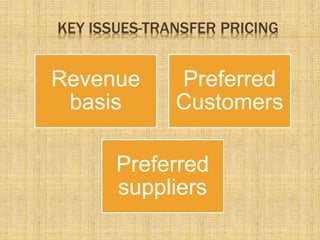
Revenue
basis
Preferred
Customers
Preferred
suppliers
 Revenue Basis : The Manager of a subsidiary
treats its same manner that he would price of a
product sold outside of the company. It forms part of
the revenue of his subsidiary, and is therefore
crucial to the financial performance on which he is
judged .
 Preferred Customers : If the Manager of a
subsidiary is given the choice of selling either to a
downstream subsidiary or to outside customers,
then an excessively low transfer price will lead the
manager to sell exclusively to outside customers,
and to refuse orders originating from the
downstream subsidiary.
 Preferred Suppliers : If the manager of
a downstream subsidiary is given the choice of
buying either from an upstream subsidiary or an
outside supplier, then an excessively high transfer
price will cause the manager to buy exclusively from
outside suppliers. As a result, the upstream
subsidiary may have too much unused capacity, and
will have to cut back on its expenses in order to
remain profitable.
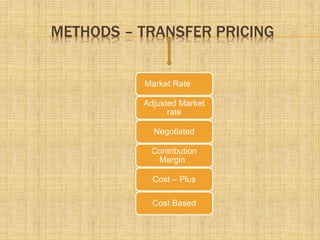
METHODS – TRANSFER PRICING
Market Rate
Adjusted Market
rate
Negotiated
Contribution
Margin
Cost – Plus
Cost Based
 Market Rate Transfer pricing : The simplest
and most elegant transfer price is to use the market
price. By doing so, the upstream subsidiary can sell
either internally or externally and earn the same profit
with either option. It can also earn the highest possible
profit, rather than being subject to the odd profit vagaries
that can occur under mandated pricing schemes.
 Adjusted Market Rate Transfer Pricing : If
it is not possible to use the market pricing technique just
noted, then consider using the general concept, but
incorporating some adjustments to the price. For
example, you can reduce the market price to account for
the presumed absence of bad debts, since corporate
management will likely intervene and force a payment if
there is a risk of non-payment
 Negotiated Transfer Pricing : It may be
necessary to negotiate a transfer price between subsidiaries,
without using any market price as a baseline. This situation
arises when there is no discernible market price because the
market is very small or the goods are highly customized. This
results in prices that are based on the relative negotiating
skills of the parties.
 Contribution margin Transfer Pricing : If there
is no market price at all from which to derive a transfer price,
then an alternative is to create a price based on a
component’s contribution Margin.
Cost plus Transfer Pricing: If there is no market
price at all on which to base a transfer price, you could
consider using a system that creates a transfer price based
on the cost of the components being transferred. The best
way to do this is to add a margin onto the cost, where you
compile the standard cost of a component, add a standard
profit margin, and use the result as the transfer price.
Cost Based Transfer Pricing : You can have each
subsidiary transfer its products to other subsidiaries at cost,
after which successive subsidiaries add their costs to the
product. This means that the final subsidiary that sells the
completed goods to a third party will recognize the entire
profit associated with the product.
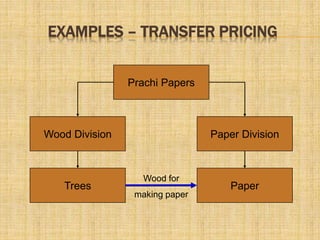
EXAMPLES – TRANSFER PRICING
Prachi Papers
Wood Division Paper Division
Trees Paper
Wood for
making paper
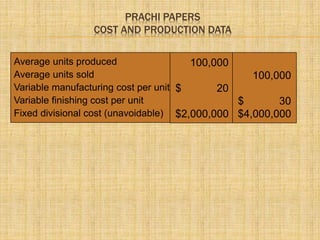
PRACHI PAPERS
COST AND PRODUCTION DATA
Average units produced
Average units sold
Variable manufacturing cost per unit
Variable finishing cost per unit
Fixed divisional cost (unavoidable)
100,000
$ 20
$2,000,000
100,000
$ 30
$4,000,000
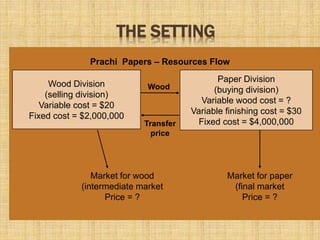
Prachi Papers – Resources Flow
Wood Division
(selling division)
Variable cost = $20
Fixed cost = $2,000,000
Paper Division
(buying division)
Variable wood cost = ?
Variable finishing cost = $30
Fixed cost = $4,000,000
Wood
Transfer
price
Market for wood
(intermediate market
Price = ?
Market for paper
(final market
Price = ?
THE SETTING
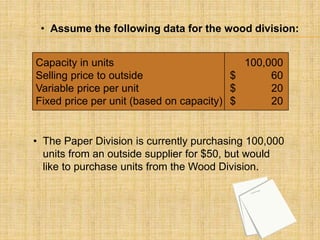
• Assume the following data for the wood division:
Capacity in units
Selling price to outside
Variable price per unit
Fixed price per unit (based on capacity)
100,000
$ 60
$ 20
$ 20
• The Paper Division is currently purchasing 100,000
units from an outside supplier for $50, but would
like to purchase units from the Wood Division.
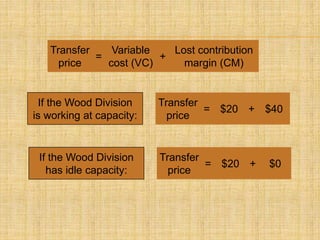
Transfer
price
Variable
cost (VC)
Lost contribution
margin (CM)
= +
If the Wood Division
is working at capacity:
Transfer
price
$20 $40
= +
If the Wood Division
has idle capacity:
Transfer
price
$20 $0
= +
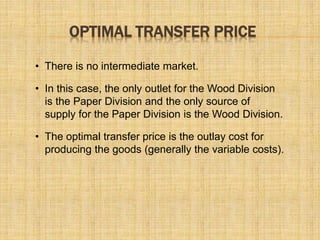
OPTIMAL TRANSFER PRICE
• There is no intermediate market.
• In this case, the only outlet for the Wood Division
is the Paper Division and the only source of
supply for the Paper Division is the Wood Division.
• The optimal transfer price is the outlay cost for
producing the goods (generally the variable costs).
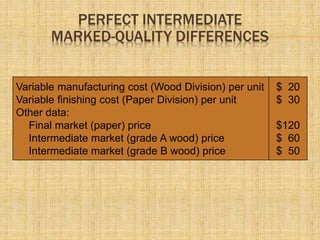
PERFECT INTERMEDIATE
MARKED-QUALITY DIFFERENCES
Variable manufacturing cost (Wood Division) per unit
Variable finishing cost (Paper Division) per unit
Other data:
Final market (paper) price
Intermediate market (grade A wood) price
Intermediate market (grade B wood) price
$ 20
$ 30
$120
$ 60
$ 50
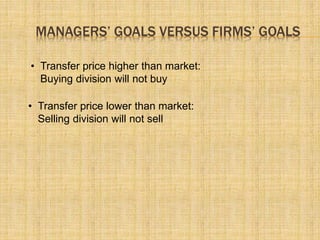
MANAGERS’ GOALS VERSUS FIRMS’ GOALS
• Transfer price lower than market:
Selling division will not sell
• Transfer price higher than market:
Buying division will not buy
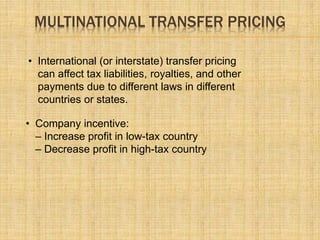
MULTINATIONAL TRANSFER PRICING
• International (or interstate) transfer pricing
can affect tax liabilities, royalties, and other
payments due to different laws in different
countries or states.
• Company incentive:
– Increase profit in low-tax country
– Decrease profit in high-tax country
THANK
YOU

transferpricing-160127071547.pdf

  • 1.
  • 2.
    INTRODUCTION–TRANSFER PRICE The priceat which divisions of a company transact with each other. Transactions may includes the trade of supplies or labour between departments. Transfer prices are used when Individual entities of a larger multi entry firm are treated and measured as separately run entities.
  • 3.
    DEFINITION-TRANSFER PRICING Transfer pricingis the setting of the price for goods and services sold between related legal entities with an enterprise. E.g.: If a Subsidiary Company sells goods to a parent company , the cost of those goods is the transfer price.
  • 4.
  • 5.
     Revenue Basis: The Manager of a subsidiary treats its same manner that he would price of a product sold outside of the company. It forms part of the revenue of his subsidiary, and is therefore crucial to the financial performance on which he is judged .  Preferred Customers : If the Manager of a subsidiary is given the choice of selling either to a downstream subsidiary or to outside customers, then an excessively low transfer price will lead the manager to sell exclusively to outside customers, and to refuse orders originating from the downstream subsidiary.
  • 6.
     Preferred Suppliers: If the manager of a downstream subsidiary is given the choice of buying either from an upstream subsidiary or an outside supplier, then an excessively high transfer price will cause the manager to buy exclusively from outside suppliers. As a result, the upstream subsidiary may have too much unused capacity, and will have to cut back on its expenses in order to remain profitable.
  • 7.
    METHODS – TRANSFERPRICING Market Rate Adjusted Market rate Negotiated Contribution Margin Cost – Plus Cost Based
  • 8.
     Market RateTransfer pricing : The simplest and most elegant transfer price is to use the market price. By doing so, the upstream subsidiary can sell either internally or externally and earn the same profit with either option. It can also earn the highest possible profit, rather than being subject to the odd profit vagaries that can occur under mandated pricing schemes.  Adjusted Market Rate Transfer Pricing : If it is not possible to use the market pricing technique just noted, then consider using the general concept, but incorporating some adjustments to the price. For example, you can reduce the market price to account for the presumed absence of bad debts, since corporate management will likely intervene and force a payment if there is a risk of non-payment
  • 9.
     Negotiated TransferPricing : It may be necessary to negotiate a transfer price between subsidiaries, without using any market price as a baseline. This situation arises when there is no discernible market price because the market is very small or the goods are highly customized. This results in prices that are based on the relative negotiating skills of the parties.  Contribution margin Transfer Pricing : If there is no market price at all from which to derive a transfer price, then an alternative is to create a price based on a component’s contribution Margin.
  • 10.
    Cost plus TransferPricing: If there is no market price at all on which to base a transfer price, you could consider using a system that creates a transfer price based on the cost of the components being transferred. The best way to do this is to add a margin onto the cost, where you compile the standard cost of a component, add a standard profit margin, and use the result as the transfer price. Cost Based Transfer Pricing : You can have each subsidiary transfer its products to other subsidiaries at cost, after which successive subsidiaries add their costs to the product. This means that the final subsidiary that sells the completed goods to a third party will recognize the entire profit associated with the product.
  • 11.
    EXAMPLES – TRANSFERPRICING Prachi Papers Wood Division Paper Division Trees Paper Wood for making paper
  • 12.
    PRACHI PAPERS COST ANDPRODUCTION DATA Average units produced Average units sold Variable manufacturing cost per unit Variable finishing cost per unit Fixed divisional cost (unavoidable) 100,000 $ 20 $2,000,000 100,000 $ 30 $4,000,000
  • 13.
    Prachi Papers –Resources Flow Wood Division (selling division) Variable cost = $20 Fixed cost = $2,000,000 Paper Division (buying division) Variable wood cost = ? Variable finishing cost = $30 Fixed cost = $4,000,000 Wood Transfer price Market for wood (intermediate market Price = ? Market for paper (final market Price = ? THE SETTING
  • 14.
    • Assume thefollowing data for the wood division: Capacity in units Selling price to outside Variable price per unit Fixed price per unit (based on capacity) 100,000 $ 60 $ 20 $ 20 • The Paper Division is currently purchasing 100,000 units from an outside supplier for $50, but would like to purchase units from the Wood Division.
  • 15.
    Transfer price Variable cost (VC) Lost contribution margin(CM) = + If the Wood Division is working at capacity: Transfer price $20 $40 = + If the Wood Division has idle capacity: Transfer price $20 $0 = +
  • 16.
    OPTIMAL TRANSFER PRICE •There is no intermediate market. • In this case, the only outlet for the Wood Division is the Paper Division and the only source of supply for the Paper Division is the Wood Division. • The optimal transfer price is the outlay cost for producing the goods (generally the variable costs).
  • 17.
    PERFECT INTERMEDIATE MARKED-QUALITY DIFFERENCES Variablemanufacturing cost (Wood Division) per unit Variable finishing cost (Paper Division) per unit Other data: Final market (paper) price Intermediate market (grade A wood) price Intermediate market (grade B wood) price $ 20 $ 30 $120 $ 60 $ 50
  • 18.
    MANAGERS’ GOALS VERSUSFIRMS’ GOALS • Transfer price lower than market: Selling division will not sell • Transfer price higher than market: Buying division will not buy
  • 19.
    MULTINATIONAL TRANSFER PRICING •International (or interstate) transfer pricing can affect tax liabilities, royalties, and other payments due to different laws in different countries or states. • Company incentive: – Increase profit in low-tax country – Decrease profit in high-tax country
  • 20.