1

International Business
Rakesh Mohan Joshi
Professor & Chairperson, IIFT New Delhi

Copyright @ Oxford University Press
International Business
R. M. Joshi

Chapter 9: Policy Framework for
International Trade
Chapter 9

POLICY FRAMEWORK
FOR
INTERNATIONAL TRADE

Copyright @ Oxford University Press
International Business
R. M. Joshi

Chapter 9: Policy Framework for
International Trade
Learning Objectives













To explain the significance of foreign trade
policy in international business
To elucidate trade policy options for developing
countries
To discuss instruments of trade policy
To provide an overview of India’s foreign trade
policy
To explicate policy measures for trade
promotion
To explain policy initiatives and incentives by
state governments
To examine India’s trade promotion measures
in context of the WTO

Copyright @ Oxford University Press
International Business
R. M. Joshi

Chapter 9: Policy Framework for
International Trade
Significance of Foreign Trade
Policy
 International business operations at firm
level are considerably influenced by various
policy

measures

employed

to

regulate

trade, both by home and host countries.
 Exportability and importability of a firm’s
goods

are

often

determined

by

trade

policies of the countries involved.
 Price-competitiveness of traded goods is
affected by import and export tariffs.
Copyright @ Oxford University Press
International Business
R. M. Joshi

Chapter 9: Policy Framework for
International Trade


Policy incentives help exporters increase
their profitability through foreign sales



The

host

country’s

trade

and

FDI

policies often influence entry decisions
in international markets.

Copyright @ Oxford University Press
International Business
R. M. Joshi

Chapter 9: Policy Framework for
International Trade
Strategic Options for Trade Policy
Inward

looking

strategy

(import

substitution):
Laying emphasis is laid on extensive use
of trade barriers to protect domestic
industries

from

import

competition.

Domestic production is encouraged so as
to achieve self-sufficiency and imports are
discouraged.
Copyright @ Oxford University Press
International Business
R. M. Joshi

Chapter 9: Policy Framework for
International Trade
Outward looking strategy (export-led
growth):
Linking the domestic economy to the
world economy and promoting economic
growth through exports. The strategy
involves incentives to promote exports
rather than restrictions to imports.
Copyright @ Oxford University Press
International Business
R. M. Joshi

Chapter 9: Policy Framework for
International Trade
Demand vs. Supply Side Policy
Measures

Demand
side
initiatives:
Export
promotion include programs to alert
companies to the opportunities present in
international markets and to strengthen the
commitment and skills of those already
involved.
Supply side initiatives: Initiatives for
creating and expanding export production,
developing transportation networks, port
facilities, tax and investment systems.
Copyright @ Oxford University Press
International Business
R. M. Joshi

Chapter 9: Policy Framework for
International Trade
Instruments of Trade Policy

Various methods employed to regulate
trade

which

include

tariffs,

non-tariff

measures, and financial controls.

Copyright @ Oxford University Press
International Business
R. M. Joshi

Chapter 9: Policy Framework for
International Trade
Tariffs

Official constraints on import of certain
goods and services levied in the form of
customs duties or tax on products moving
across borders.

Copyright @ Oxford University Press
International Business
R. M. Joshi

Chapter 9: Policy Framework for
International Trade
Classification of Tariff Instruments










On the basis of direction of trade: import vs.
exports tariffs
On the basis of purpose: protective vs. revenue
tariffs
On the basis of time length : tariff surcharge vs.
countervailing duty
On the basis of tariff rates : specific, ad-valorem,
and combined
On the basis of production and distribution points:
•
•
•
•



Single stage sales tax:
Value added tax (VAT)
Cascade tax
Excise tax

Turnover tax

Copyright @ Oxford University Press
International Business
R. M. Joshi

Chapter 9: Policy Framework for
International Trade
Non-Tariff Measures

Contrary to tariffs, which are straightforward,
non-tariff measures are non-transparent and
obstruct trade on discriminatory basis.

Copyright @ Oxford University Press
International Business
R. M. Joshi

Chapter 9: Policy Framework for
International Trade
Major Non-tariff Policy Instruments


Government participation in trade



Customs and entry procedure



Quotas



Tariff quotas





Absolute quota
Voluntary quotas

Other trade restrictions

Copyright @ Oxford University Press
International Business
R. M. Joshi

Chapter 9: Policy Framework for
International Trade
India’s Foreign Trade Policy
India’s

foreign trade policy is formulated and

implemented mainly by the Ministry of Commerce and
Industry,

but

also

in

consultation

with

other

concerned ministries, such as Finance, Agriculture,
and Textiles, and the RBI.
DGFT

under

the

Department

of

Commerce

is

responsible for the execution of the Foreign Trade
Policy.
Copyright @ Oxford University Press
International Business
R. M. Joshi

Chapter 9: Policy Framework for
International Trade
India’s Foreign Trade Policy
It is published in four volumes:


Foreign Trade Policy



Handbook of Procedures Volume I



Handbook of Procedures Volume II
(Schedule of DEPB Rates)



ITC (HS) Classification of Export and Import
Items

Copyright @ Oxford University Press
International Business
R. M. Joshi

Chapter 9: Policy Framework for
International Trade
Export Prohibitions and Restrictions
Under

the

foreign

trade

policy,

export

prohibitions are maintained for environmental,
food security, marketing, pricing and domestic
supply reasons, and to comply with international
treaties.
Restrictions on exports on account of security
concern

through

multilateral

agreements

are

contained in the SCOMET list.
Copyright @ Oxford University Press
International Business
R. M. Joshi

Chapter 9: Policy Framework for
International Trade
Schemes for Duty-free and Concessional
Imports
In order to reduce or remove the anti-export
bias inherent in the system of indirect taxation
and to encourage exports, several schemes
allows
importers

to

benefit

from

tariff

exemptions, especially on inputs.

Copyright @ Oxford University Press
International Business
R. M. Joshi

Chapter 9: Policy Framework for
International Trade
EPCG Scheme
The scheme aims to reduce the incidence of high
capital cost on export prices so as to make
exports competitive in the international markets
by way of reduced import duty on capital goods.
It enables import of capital goods at concessional
rate of duty subject to an appropriate export
obligation accepted by the exporter.
Copyright @ Oxford University Press
International Business
R. M. Joshi

Chapter 9: Policy Framework for
International Trade
Duty Exemption Schemes
Such schemes enables duty-free import of inputs required
for export production.

Advance Authorisation:

It allows duty-free import
of physical inputs incorporated in exports products after making
normal allowance in wastage. In addition, consumables, such
as fuel, oil, energy, catalysts, etc., are also allowed under the
scheme.
Advance authorization can be issued for:
• Physical exports (including exports to SEZs)
• Intermediate supplies, and
• Deemed exports

Copyright @ Oxford University Press
International Business
R. M. Joshi

Chapter 9: Policy Framework for
International Trade
Input Output and Value Addition Norms

The

Standard

Input

Output

Norms

(SION)

published in volume II of the Handbook of
Procedures

are

used

for

determination

of

proportion of various inputs which are physically
used and consumed for export production and
the packaging material.

Copyright @ Oxford University Press
International Business
R. M. Joshi

Chapter 9: Policy Framework for
International Trade
Duty Free Import Authorization (DFIA) Scheme
Launched on May 1, 2006, it replaced the Duty Free
Replenishment

Certificate

(DFRC)

Scheme

which

allows duty free import of inputs, for production of
export

products

to

manufacturer

exporters

or

merchant exporters tied up with the manufacturer for
the import of inputs used in the manufacture of
exports.
It offers exemptions in respect of customs duty,
additional duty, education cess, and anti-dumping or
safeguard duties in force for inputs used in export
production.

Copyright @ Oxford University Press
International Business
R. M. Joshi

Chapter 9: Policy Framework for
International Trade
Duty Remission Schemes

These

schemes

enable

post-export

replenishment of duty on inputs used for export
production under various schemes, such as duty
entitlement passbook scheme, duty drawback,
incentives for deemed exports, and the gems
and jewellery sector.

Copyright @ Oxford University Press
International Business
R. M. Joshi

Chapter 9: Policy Framework for
International Trade
Duty Entitlement Passbook (DEPB) Scheme

Under the scheme, merchant or manufacturer
exporters are entitled to duty-free import (basic
customs duty component only) of inputs used in
manufacture of goods, as a specified percentage
of f.o.b. value of exports made in freely
convertible currency.
Copyright @ Oxford University Press
International Business
R. M. Joshi

Chapter 9: Policy Framework for
International Trade
Promotional Measures for Deemed Exports
Deemed Exports:
Transactions in which goods supplied do not leave the country
and payments for such supplies is received either in Indian
rupees or in free foreign exchange as specified in the trade
policy, which are eligible for a number of benefits such as:
• Supply of goods against advance authorization or DFIA
• Deemed export drawback
• Exemption from terminal excise duty where supplies are
made against International Competitive Bidding (ICB).
Copyright @ Oxford University Press
International Business
R. M. Joshi

Chapter 9: Policy Framework for
International Trade
Duty Drawback
The rebate of duty chargeable on any imported
or excisable material used in the manufacture of
goods exported from India.
Duty Drawback

is admissible under Customs

Act, 1962 for re-exports of goods on which
import duty has paid and for imported material
used in the manufacture of exports .
Copyright @ Oxford University Press
International Business
R. M. Joshi

Chapter 9: Policy Framework for
International Trade
Schemes for Concessional Imports for
Gems and Jewellery
The
Gems
and
Jewellery
Sector
is
characterised by import of goods in rough or
raw form of diamonds and semi-precious
stones and gold and silver for value addition
and conversion to finished products. Schemes
for concessional imports from gems and
jewellery sector include:







Replenishment authorization
Schemes for duty-free procurement of precious
metal etc.
Advance authorization for import / procurement for
precious metal, mountings etc.
Diamond imprest authorization

Copyright @ Oxford University Press
International Business
R. M. Joshi

Chapter 9: Policy Framework for
International Trade
Schemes to Augment Export
Production
The schemes aim at creating and strengthening
of enclaves for export production so as to
‘immunize’

the

production

from

firms

engaged

constraints,

in

export

such

as

infrastructural and administrative, from the rest
of the economy.
These schemes attempt to reduce the burden of
import duty and indirect taxation on capital
goods and consumables and reduce operations
hassles for export production.
Copyright @ Oxford University Press
International Business
R. M. Joshi

Chapter 9: Policy Framework for
International Trade
Export Oriented Units (EOUs)

Introduced in 1981, the EOU scheme is
complementary to EPZ scheme.

It offers

the same production regime but an EOU can
be located anywhere in India.

Copyright @ Oxford University Press
International Business
R. M. Joshi

Chapter 9: Policy Framework for
International Trade
Software Technology Parks (STPs) /
Electronic Hardware Technology Parks (EHTPs)
In

order

to

facilitate

production

of

computer

export-oriented
software

and

hardware, units can be set up under the
STPs/ EHTPs schemes, respectively.

Copyright @ Oxford University Press
International Business
R. M. Joshi

Chapter 9: Policy Framework for
International Trade
Bio-Technology Parks (BTPs)

In order to promote bio-technology exports,
the DGFT notifies Bio-Technology Parks on
the recommendation of the Department of
Biotechnology.

Copyright @ Oxford University Press
International Business
R. M. Joshi

Chapter 9: Policy Framework for
International Trade
Assistance to States for Developing Export
Infrastructure and Other Allied Activities (ASIDE)
The

ASIDE

scheme

launched

in

April

2000

as

a

comprehensive scheme to involve states in export promotion
efforts by providing assistance to state governments for
creating infrastructure for development and growth of
exports.
Under the scheme, assistance is given for setting up new
export promotion parks and zones and complementary
infrastructure, such as road links to ports, container depots,
and power supply.
Copyright @ Oxford University Press
International Business
R. M. Joshi

Chapter 9: Policy Framework for
International Trade
Free Trade Zones (FTZ) and
Export Processing Zones (EPZs)
The FTZs and EPZs, set up as special enclaves,
separated from the Domestic Tariff Areas (DTA)
by fiscal barriers, are intended to provide an
internationally competitive duty-free environment
for export production, at low costs which enables
their

products

to

be

competitive

in

the

international market.
Since May 1994, the government has permitted
development of EPZs by private, state or the joint
sector.

Copyright @ Oxford University Press
International Business
R. M. Joshi

Chapter 9: Policy Framework for
International Trade
Special Economic Zones (SEZs)

Introduced in April, 2000, the scheme aims to
provide an internationally competitive and hasslefree trade environment for export production. An
SEZ is designated duty-free enclave to be treated
as foreign territory for trade operations and duties
and tariffs. Units for manufacture of goods and
rendering of services may be set up in SEZs.
Copyright @ Oxford University Press
International Business
R. M. Joshi

Chapter 9: Policy Framework for
International Trade
Agri-export Zones (AEZs)
The concept of the AEZs was floated with a
view to promote agricultural exports from
India and providing remunerative returns to
the farming community in a sustained
manner. State governments are required to
identify
AEZs
and
also
evolve
a
comprehensive package of services provided
by all state government agencies, state
agriculture universities and all institutions
and agencies of the Union Government for
intensive delivery in these zones.
Copyright @ Oxford University Press
International Business
R. M. Joshi

Chapter 9: Policy Framework for
International Trade
Other Export Promotion Measures
Marketing
assistance
promotion:




for

export

Market
Development
Assistance
(MDA): In order to facilitate exporters to explore

the overseas markets and to promote their
exports, the MDA Scheme provides assistance to
exporters for participation in export promotion
seminars, trade fairs, and buyer-seller meets in
India and abroad.
Market Access Initiative (MAI): The
Scheme provide financing assistance to public and
private sector organizations to finance their
marketing activities for the thrust products in the
pre-identified markets.

Copyright @ Oxford University Press
International Business
R. M. Joshi

Chapter 9: Policy Framework for
International Trade
Served for India Scheme:
Under the scheme, all service providers are entitled to duty
credit scrip equivalent to 10 per cent of free foreign exchange
earned during the preceding year.

Copyright @ Oxford University Press
International Business
R. M. Joshi

Chapter 9: Policy Framework for
International Trade
Towns of Export Excellence (TEE)

The scheme aims at recognizing towns that
have come up as industrial clusters with
considerable exports so as to maximize their
potential

and

assist

them

to

promote

exports.

Copyright @ Oxford University Press
International Business
R. M. Joshi

Chapter 9: Policy Framework for
International Trade
Vishesh Krishi and Gram Udyog Yojana
(Special Agriculture and Village Industry
Scheme)
The scheme aims to promote the agricultural
produce,

minor

industries’

forest

products,

produce,
and

village

forest-based

products by way of providing duty credit
scrips so as to compensate high transport
costs.

Copyright @ Oxford University Press
International Business
R. M. Joshi

Chapter 9: Policy Framework for
International Trade
Focus Market Scheme (FMS)

This scheme aims to offset high freight cost
and other externalities by allowing duty
credit scrips for strategic markets.

Copyright @ Oxford University Press
International Business
R. M. Joshi

Chapter 9: Policy Framework for
International Trade
Focus Product Scheme (FPS)
In order to promote incentives for export of
select products that have highly employment
potential in rural and urban areas, the scheme
allows duty credit scrips for

notified product

categories such as value added leather products
and

leather

footwear,

handicrafts

items,

handloom products, value added fish and coir
products and some additional focus products.
Copyright @ Oxford University Press
International Business
R. M. Joshi

Chapter 9: Policy Framework for
International Trade
High Tech Products Export Promotion
Scheme

In order to promote exports of High-tech
products from India, the scheme provides
Duty Credit scrips.

Copyright @ Oxford University Press
International Business
R. M. Joshi

Chapter 9: Policy Framework for
International Trade
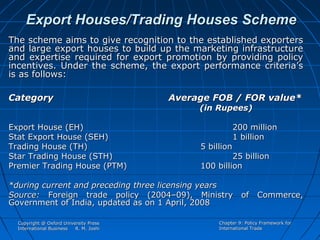
Export Houses/Trading Houses Scheme
The scheme aims to give recognition to the established exporters
and large export houses to build up the marketing infrastructure
and expertise required for export promotion by providing policy
incentives. Under the scheme, the export performance criteria’s
is as follows:
Category
Export House (EH)
Stat Export House (SEH)
Trading House (TH)
Star Trading House (STH)
Premier Trading House (PTM)

Average FOB / FOR value*
(in Rupees)

200 million
1 billion
5 billion
25 billion
100 billion

*during current and preceding three licensing years
Source: Foreign trade policy (2004–09), Ministry of Commerce,
Government of India, updated as on 1 April, 2008
Copyright @ Oxford University Press
International Business
R. M. Joshi

Chapter 9: Policy Framework for
International Trade
Policy Initiatives and Incentives by the
State Governments


Providing information on export opportunities



Preference in land allotment for starting an
EOU



Exempting

from

entry-tax,

sales

tax

or

turnover tax on supplies to EOU / EPZ / SEZ
units.
Copyright @ Oxford University Press
International Business
R. M. Joshi

Chapter 9: Policy Framework for
International Trade
WTO and Export Promotion
Measures
The multilateral trading system under the WTO
trade regime provides a rule based framework as
to which subsidies are prohibited, which can face
countervailing measures, and which are allowed.

Copyright @ Oxford University Press
International Business
R. M. Joshi

Chapter 9: Policy Framework for
International Trade
The WTO’s Trade Policy Review
Mechanism (TPRM)
In order to enhance transparency of member’s
trade policies and facilitate smooth functioning of
the

multilateral

trading

system,

the

WTO

members established the TPRM to review trade
policies of member countries at regular intervals.

Copyright @ Oxford University Press
International Business
R. M. Joshi

Chapter 9: Policy Framework for
International Trade

288 33 powerpoint-slides_chapter-9-policy-framework-international-trade

  • 1.
    1 International Business Rakesh MohanJoshi Professor & Chairperson, IIFT New Delhi Copyright @ Oxford University Press International Business R. M. Joshi Chapter 9: Policy Framework for International Trade
  • 2.
    Chapter 9 POLICY FRAMEWORK FOR INTERNATIONALTRADE Copyright @ Oxford University Press International Business R. M. Joshi Chapter 9: Policy Framework for International Trade
  • 3.
    Learning Objectives        To explainthe significance of foreign trade policy in international business To elucidate trade policy options for developing countries To discuss instruments of trade policy To provide an overview of India’s foreign trade policy To explicate policy measures for trade promotion To explain policy initiatives and incentives by state governments To examine India’s trade promotion measures in context of the WTO Copyright @ Oxford University Press International Business R. M. Joshi Chapter 9: Policy Framework for International Trade
  • 4.
    Significance of ForeignTrade Policy  International business operations at firm level are considerably influenced by various policy measures employed to regulate trade, both by home and host countries.  Exportability and importability of a firm’s goods are often determined by trade policies of the countries involved.  Price-competitiveness of traded goods is affected by import and export tariffs. Copyright @ Oxford University Press International Business R. M. Joshi Chapter 9: Policy Framework for International Trade
  • 5.
     Policy incentives helpexporters increase their profitability through foreign sales  The host country’s trade and FDI policies often influence entry decisions in international markets. Copyright @ Oxford University Press International Business R. M. Joshi Chapter 9: Policy Framework for International Trade
  • 6.
    Strategic Options forTrade Policy Inward looking strategy (import substitution): Laying emphasis is laid on extensive use of trade barriers to protect domestic industries from import competition. Domestic production is encouraged so as to achieve self-sufficiency and imports are discouraged. Copyright @ Oxford University Press International Business R. M. Joshi Chapter 9: Policy Framework for International Trade
  • 7.
    Outward looking strategy(export-led growth): Linking the domestic economy to the world economy and promoting economic growth through exports. The strategy involves incentives to promote exports rather than restrictions to imports. Copyright @ Oxford University Press International Business R. M. Joshi Chapter 9: Policy Framework for International Trade
  • 8.
    Demand vs. SupplySide Policy Measures Demand side initiatives: Export promotion include programs to alert companies to the opportunities present in international markets and to strengthen the commitment and skills of those already involved. Supply side initiatives: Initiatives for creating and expanding export production, developing transportation networks, port facilities, tax and investment systems. Copyright @ Oxford University Press International Business R. M. Joshi Chapter 9: Policy Framework for International Trade
  • 9.
    Instruments of TradePolicy Various methods employed to regulate trade which include tariffs, non-tariff measures, and financial controls. Copyright @ Oxford University Press International Business R. M. Joshi Chapter 9: Policy Framework for International Trade
  • 10.
    Tariffs Official constraints onimport of certain goods and services levied in the form of customs duties or tax on products moving across borders. Copyright @ Oxford University Press International Business R. M. Joshi Chapter 9: Policy Framework for International Trade
  • 11.
    Classification of TariffInstruments      On the basis of direction of trade: import vs. exports tariffs On the basis of purpose: protective vs. revenue tariffs On the basis of time length : tariff surcharge vs. countervailing duty On the basis of tariff rates : specific, ad-valorem, and combined On the basis of production and distribution points: • • • •  Single stage sales tax: Value added tax (VAT) Cascade tax Excise tax Turnover tax Copyright @ Oxford University Press International Business R. M. Joshi Chapter 9: Policy Framework for International Trade
  • 12.
    Non-Tariff Measures Contrary totariffs, which are straightforward, non-tariff measures are non-transparent and obstruct trade on discriminatory basis. Copyright @ Oxford University Press International Business R. M. Joshi Chapter 9: Policy Framework for International Trade
  • 13.
    Major Non-tariff PolicyInstruments  Government participation in trade  Customs and entry procedure  Quotas   Tariff quotas   Absolute quota Voluntary quotas Other trade restrictions Copyright @ Oxford University Press International Business R. M. Joshi Chapter 9: Policy Framework for International Trade
  • 14.
    India’s Foreign TradePolicy India’s foreign trade policy is formulated and implemented mainly by the Ministry of Commerce and Industry, but also in consultation with other concerned ministries, such as Finance, Agriculture, and Textiles, and the RBI. DGFT under the Department of Commerce is responsible for the execution of the Foreign Trade Policy. Copyright @ Oxford University Press International Business R. M. Joshi Chapter 9: Policy Framework for International Trade
  • 15.
    India’s Foreign TradePolicy It is published in four volumes:  Foreign Trade Policy  Handbook of Procedures Volume I  Handbook of Procedures Volume II (Schedule of DEPB Rates)  ITC (HS) Classification of Export and Import Items Copyright @ Oxford University Press International Business R. M. Joshi Chapter 9: Policy Framework for International Trade
  • 16.
    Export Prohibitions andRestrictions Under the foreign trade policy, export prohibitions are maintained for environmental, food security, marketing, pricing and domestic supply reasons, and to comply with international treaties. Restrictions on exports on account of security concern through multilateral agreements are contained in the SCOMET list. Copyright @ Oxford University Press International Business R. M. Joshi Chapter 9: Policy Framework for International Trade
  • 17.
    Schemes for Duty-freeand Concessional Imports In order to reduce or remove the anti-export bias inherent in the system of indirect taxation and to encourage exports, several schemes allows importers to benefit from tariff exemptions, especially on inputs. Copyright @ Oxford University Press International Business R. M. Joshi Chapter 9: Policy Framework for International Trade
  • 18.
    EPCG Scheme The schemeaims to reduce the incidence of high capital cost on export prices so as to make exports competitive in the international markets by way of reduced import duty on capital goods. It enables import of capital goods at concessional rate of duty subject to an appropriate export obligation accepted by the exporter. Copyright @ Oxford University Press International Business R. M. Joshi Chapter 9: Policy Framework for International Trade
  • 19.
    Duty Exemption Schemes Suchschemes enables duty-free import of inputs required for export production. Advance Authorisation: It allows duty-free import of physical inputs incorporated in exports products after making normal allowance in wastage. In addition, consumables, such as fuel, oil, energy, catalysts, etc., are also allowed under the scheme. Advance authorization can be issued for: • Physical exports (including exports to SEZs) • Intermediate supplies, and • Deemed exports Copyright @ Oxford University Press International Business R. M. Joshi Chapter 9: Policy Framework for International Trade
  • 20.
    Input Output andValue Addition Norms The Standard Input Output Norms (SION) published in volume II of the Handbook of Procedures are used for determination of proportion of various inputs which are physically used and consumed for export production and the packaging material. Copyright @ Oxford University Press International Business R. M. Joshi Chapter 9: Policy Framework for International Trade
  • 21.
    Duty Free ImportAuthorization (DFIA) Scheme Launched on May 1, 2006, it replaced the Duty Free Replenishment Certificate (DFRC) Scheme which allows duty free import of inputs, for production of export products to manufacturer exporters or merchant exporters tied up with the manufacturer for the import of inputs used in the manufacture of exports. It offers exemptions in respect of customs duty, additional duty, education cess, and anti-dumping or safeguard duties in force for inputs used in export production. Copyright @ Oxford University Press International Business R. M. Joshi Chapter 9: Policy Framework for International Trade
  • 22.
    Duty Remission Schemes These schemes enable post-export replenishmentof duty on inputs used for export production under various schemes, such as duty entitlement passbook scheme, duty drawback, incentives for deemed exports, and the gems and jewellery sector. Copyright @ Oxford University Press International Business R. M. Joshi Chapter 9: Policy Framework for International Trade
  • 23.
    Duty Entitlement Passbook(DEPB) Scheme Under the scheme, merchant or manufacturer exporters are entitled to duty-free import (basic customs duty component only) of inputs used in manufacture of goods, as a specified percentage of f.o.b. value of exports made in freely convertible currency. Copyright @ Oxford University Press International Business R. M. Joshi Chapter 9: Policy Framework for International Trade
  • 24.
    Promotional Measures forDeemed Exports Deemed Exports: Transactions in which goods supplied do not leave the country and payments for such supplies is received either in Indian rupees or in free foreign exchange as specified in the trade policy, which are eligible for a number of benefits such as: • Supply of goods against advance authorization or DFIA • Deemed export drawback • Exemption from terminal excise duty where supplies are made against International Competitive Bidding (ICB). Copyright @ Oxford University Press International Business R. M. Joshi Chapter 9: Policy Framework for International Trade
  • 25.
    Duty Drawback The rebateof duty chargeable on any imported or excisable material used in the manufacture of goods exported from India. Duty Drawback is admissible under Customs Act, 1962 for re-exports of goods on which import duty has paid and for imported material used in the manufacture of exports . Copyright @ Oxford University Press International Business R. M. Joshi Chapter 9: Policy Framework for International Trade
  • 26.
    Schemes for ConcessionalImports for Gems and Jewellery The Gems and Jewellery Sector is characterised by import of goods in rough or raw form of diamonds and semi-precious stones and gold and silver for value addition and conversion to finished products. Schemes for concessional imports from gems and jewellery sector include:     Replenishment authorization Schemes for duty-free procurement of precious metal etc. Advance authorization for import / procurement for precious metal, mountings etc. Diamond imprest authorization Copyright @ Oxford University Press International Business R. M. Joshi Chapter 9: Policy Framework for International Trade
  • 27.
    Schemes to AugmentExport Production The schemes aim at creating and strengthening of enclaves for export production so as to ‘immunize’ the production from firms engaged constraints, in export such as infrastructural and administrative, from the rest of the economy. These schemes attempt to reduce the burden of import duty and indirect taxation on capital goods and consumables and reduce operations hassles for export production. Copyright @ Oxford University Press International Business R. M. Joshi Chapter 9: Policy Framework for International Trade
  • 28.
    Export Oriented Units(EOUs) Introduced in 1981, the EOU scheme is complementary to EPZ scheme. It offers the same production regime but an EOU can be located anywhere in India. Copyright @ Oxford University Press International Business R. M. Joshi Chapter 9: Policy Framework for International Trade
  • 29.
    Software Technology Parks(STPs) / Electronic Hardware Technology Parks (EHTPs) In order to facilitate production of computer export-oriented software and hardware, units can be set up under the STPs/ EHTPs schemes, respectively. Copyright @ Oxford University Press International Business R. M. Joshi Chapter 9: Policy Framework for International Trade
  • 30.
    Bio-Technology Parks (BTPs) Inorder to promote bio-technology exports, the DGFT notifies Bio-Technology Parks on the recommendation of the Department of Biotechnology. Copyright @ Oxford University Press International Business R. M. Joshi Chapter 9: Policy Framework for International Trade
  • 31.
    Assistance to Statesfor Developing Export Infrastructure and Other Allied Activities (ASIDE) The ASIDE scheme launched in April 2000 as a comprehensive scheme to involve states in export promotion efforts by providing assistance to state governments for creating infrastructure for development and growth of exports. Under the scheme, assistance is given for setting up new export promotion parks and zones and complementary infrastructure, such as road links to ports, container depots, and power supply. Copyright @ Oxford University Press International Business R. M. Joshi Chapter 9: Policy Framework for International Trade
  • 32.
    Free Trade Zones(FTZ) and Export Processing Zones (EPZs) The FTZs and EPZs, set up as special enclaves, separated from the Domestic Tariff Areas (DTA) by fiscal barriers, are intended to provide an internationally competitive duty-free environment for export production, at low costs which enables their products to be competitive in the international market. Since May 1994, the government has permitted development of EPZs by private, state or the joint sector. Copyright @ Oxford University Press International Business R. M. Joshi Chapter 9: Policy Framework for International Trade
  • 33.
    Special Economic Zones(SEZs) Introduced in April, 2000, the scheme aims to provide an internationally competitive and hasslefree trade environment for export production. An SEZ is designated duty-free enclave to be treated as foreign territory for trade operations and duties and tariffs. Units for manufacture of goods and rendering of services may be set up in SEZs. Copyright @ Oxford University Press International Business R. M. Joshi Chapter 9: Policy Framework for International Trade
  • 34.
    Agri-export Zones (AEZs) Theconcept of the AEZs was floated with a view to promote agricultural exports from India and providing remunerative returns to the farming community in a sustained manner. State governments are required to identify AEZs and also evolve a comprehensive package of services provided by all state government agencies, state agriculture universities and all institutions and agencies of the Union Government for intensive delivery in these zones. Copyright @ Oxford University Press International Business R. M. Joshi Chapter 9: Policy Framework for International Trade
  • 35.
    Other Export PromotionMeasures Marketing assistance promotion:   for export Market Development Assistance (MDA): In order to facilitate exporters to explore the overseas markets and to promote their exports, the MDA Scheme provides assistance to exporters for participation in export promotion seminars, trade fairs, and buyer-seller meets in India and abroad. Market Access Initiative (MAI): The Scheme provide financing assistance to public and private sector organizations to finance their marketing activities for the thrust products in the pre-identified markets. Copyright @ Oxford University Press International Business R. M. Joshi Chapter 9: Policy Framework for International Trade
  • 36.
    Served for IndiaScheme: Under the scheme, all service providers are entitled to duty credit scrip equivalent to 10 per cent of free foreign exchange earned during the preceding year. Copyright @ Oxford University Press International Business R. M. Joshi Chapter 9: Policy Framework for International Trade
  • 37.
    Towns of ExportExcellence (TEE) The scheme aims at recognizing towns that have come up as industrial clusters with considerable exports so as to maximize their potential and assist them to promote exports. Copyright @ Oxford University Press International Business R. M. Joshi Chapter 9: Policy Framework for International Trade
  • 38.
    Vishesh Krishi andGram Udyog Yojana (Special Agriculture and Village Industry Scheme) The scheme aims to promote the agricultural produce, minor industries’ forest products, produce, and village forest-based products by way of providing duty credit scrips so as to compensate high transport costs. Copyright @ Oxford University Press International Business R. M. Joshi Chapter 9: Policy Framework for International Trade
  • 39.
    Focus Market Scheme(FMS) This scheme aims to offset high freight cost and other externalities by allowing duty credit scrips for strategic markets. Copyright @ Oxford University Press International Business R. M. Joshi Chapter 9: Policy Framework for International Trade
  • 40.
    Focus Product Scheme(FPS) In order to promote incentives for export of select products that have highly employment potential in rural and urban areas, the scheme allows duty credit scrips for notified product categories such as value added leather products and leather footwear, handicrafts items, handloom products, value added fish and coir products and some additional focus products. Copyright @ Oxford University Press International Business R. M. Joshi Chapter 9: Policy Framework for International Trade
  • 41.
    High Tech ProductsExport Promotion Scheme In order to promote exports of High-tech products from India, the scheme provides Duty Credit scrips. Copyright @ Oxford University Press International Business R. M. Joshi Chapter 9: Policy Framework for International Trade
  • 42.
    Export Houses/Trading HousesScheme The scheme aims to give recognition to the established exporters and large export houses to build up the marketing infrastructure and expertise required for export promotion by providing policy incentives. Under the scheme, the export performance criteria’s is as follows: Category Export House (EH) Stat Export House (SEH) Trading House (TH) Star Trading House (STH) Premier Trading House (PTM) Average FOB / FOR value* (in Rupees) 200 million 1 billion 5 billion 25 billion 100 billion *during current and preceding three licensing years Source: Foreign trade policy (2004–09), Ministry of Commerce, Government of India, updated as on 1 April, 2008 Copyright @ Oxford University Press International Business R. M. Joshi Chapter 9: Policy Framework for International Trade
  • 43.
    Policy Initiatives andIncentives by the State Governments  Providing information on export opportunities  Preference in land allotment for starting an EOU  Exempting from entry-tax, sales tax or turnover tax on supplies to EOU / EPZ / SEZ units. Copyright @ Oxford University Press International Business R. M. Joshi Chapter 9: Policy Framework for International Trade
  • 44.
    WTO and ExportPromotion Measures The multilateral trading system under the WTO trade regime provides a rule based framework as to which subsidies are prohibited, which can face countervailing measures, and which are allowed. Copyright @ Oxford University Press International Business R. M. Joshi Chapter 9: Policy Framework for International Trade
  • 45.
    The WTO’s TradePolicy Review Mechanism (TPRM) In order to enhance transparency of member’s trade policies and facilitate smooth functioning of the multilateral trading system, the WTO members established the TPRM to review trade policies of member countries at regular intervals. Copyright @ Oxford University Press International Business R. M. Joshi Chapter 9: Policy Framework for International Trade