Transfer Price:
Exploring Methods and
Calculations
Muhammad Talha
Muhammad Faisal
Salman
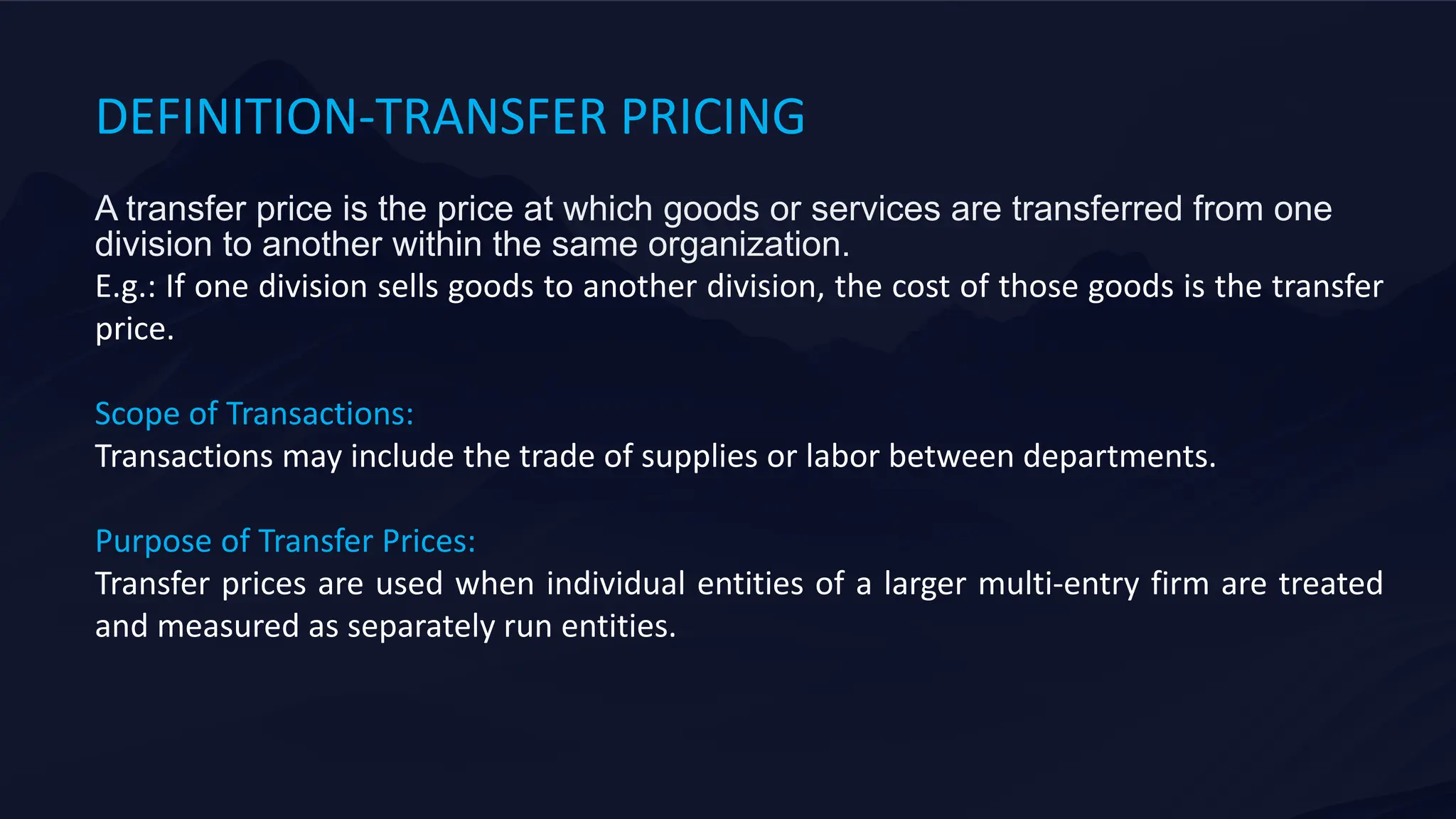
DEFINITION-TRANSFER PRICING
A transfer price is the price at which goods or services are transferred from one
division to another within the same organization.
E.g.: If one division sells goods to another division, the cost of those goods is the transfer
price.
Scope of Transactions:
Transactions may include the trade of supplies or labor between departments.
Purpose of Transfer Prices:
Transfer prices are used when individual entities of a larger multi-entry firm are treated
and measured as separately run entities.
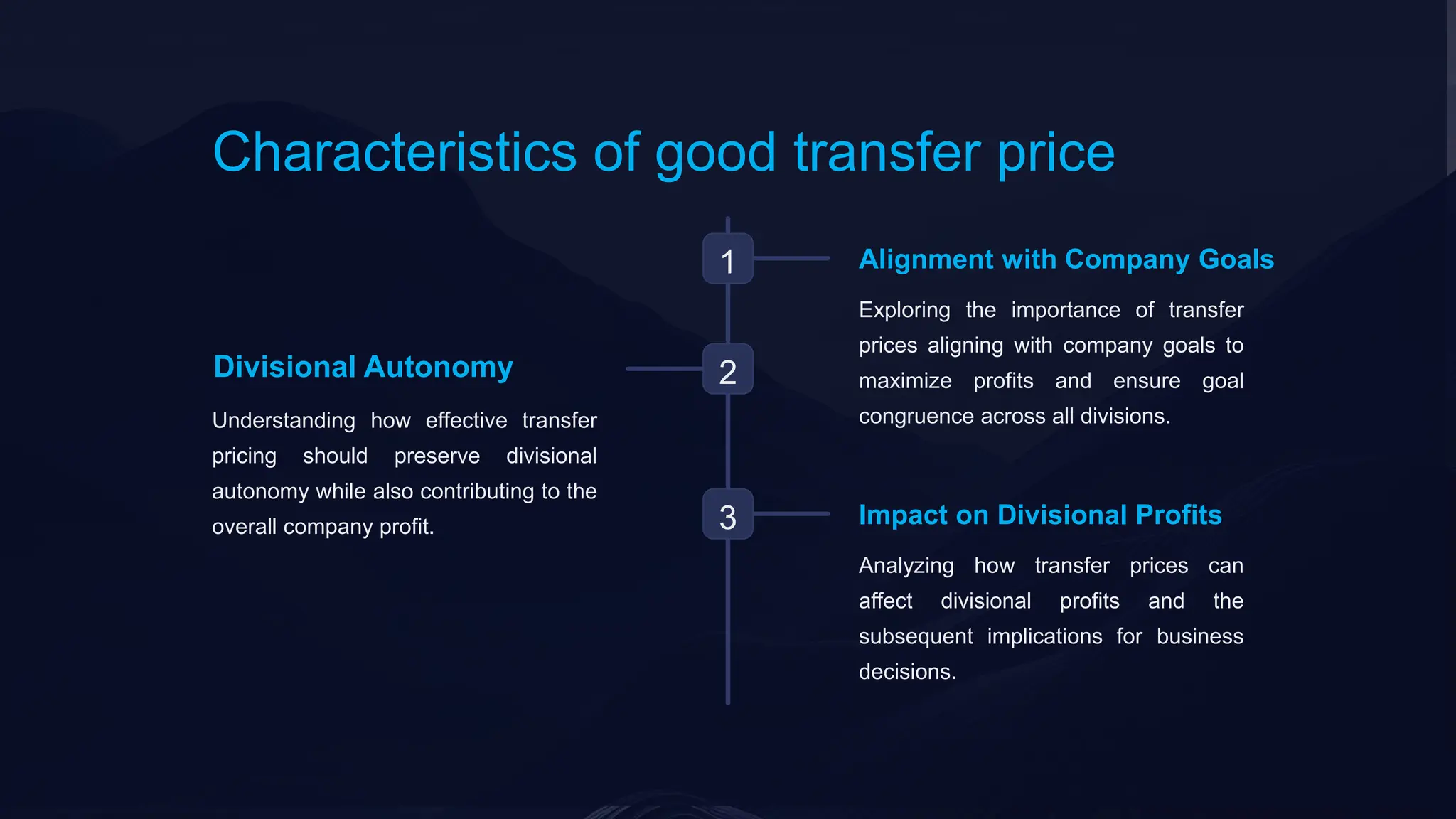
Characteristics of good transfer price
1 Alignment with Company Goals
Exploring the importance of transfer
prices aligning with company goals to
maximize profits and ensure goal
congruence across all divisions.
2
Divisional Autonomy
Understanding how effective transfer
pricing should preserve divisional
autonomy while also contributing to the
overall company profit. 3 Impact on Divisional Profits
Analyzing how transfer prices can
affect divisional profits and the
subsequent implications for business
decisions.
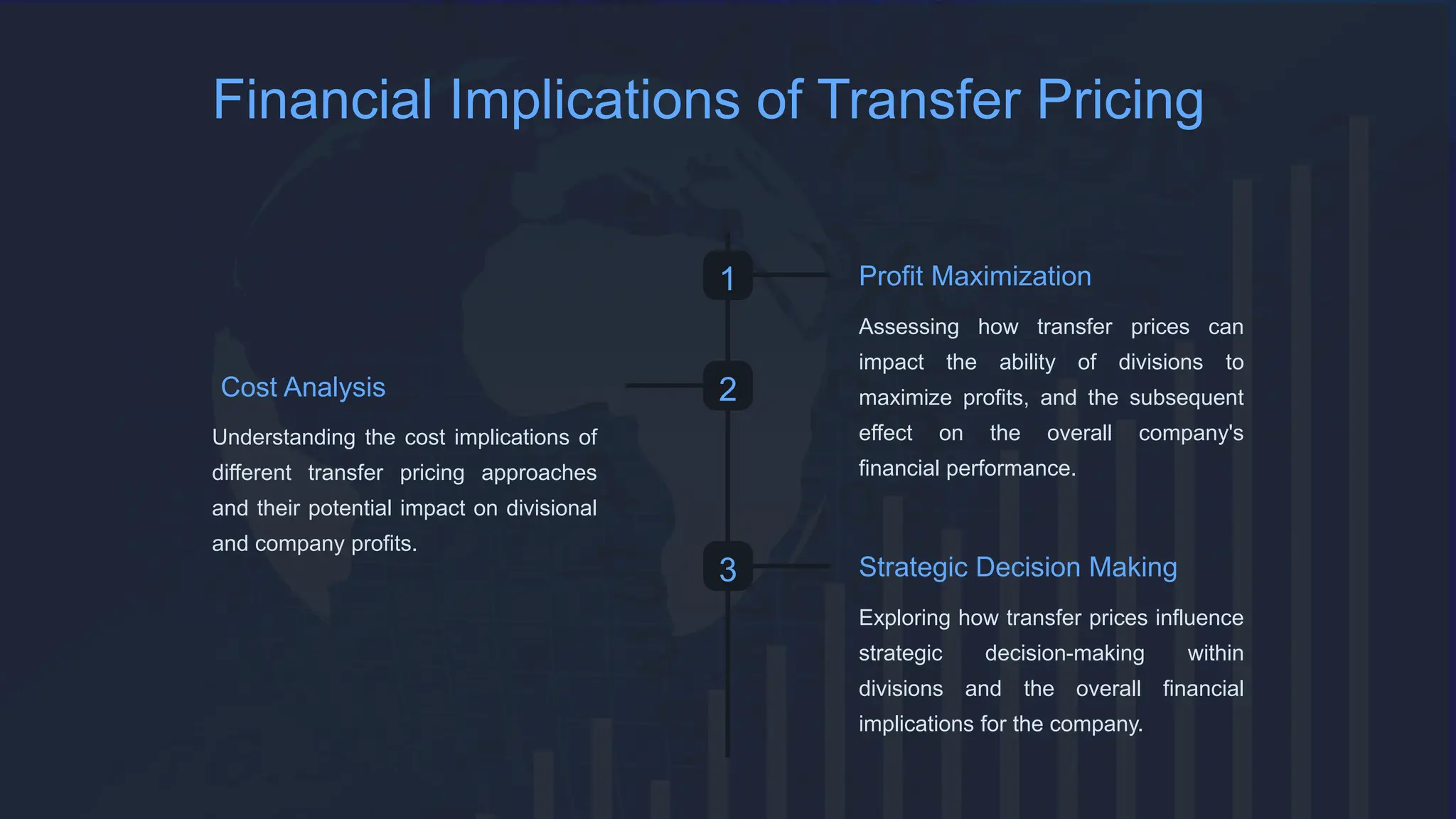
Financial Implications of Transfer Pricing
1 Profit Maximization
Assessing how transfer prices can
impact the ability of divisions to
maximize profits, and the subsequent
effect on the overall company's
financial performance.
2
Cost Analysis
Understanding the cost implications of
different transfer pricing approaches
and their potential impact on divisional
and company profits.
3 Strategic Decision Making
Exploring how transfer prices influence
strategic decision-making within
divisions and the overall financial
implications for the company.
The Business Impact of Transfer Pricing
Performance
Assessment
Understanding how transfer
pricing impacts the
assessment of divisional
performance and the
subsequent decisions
made by the management.
Employee Motivation
Analyzing how transfer
prices can affect the
motivation of divisional
managers and employees,
thereby influencing the
overall performance of the
division.
Decision Making
Exploring the potential
impact of transfer prices on
the decision-making
process within the divisions
and the subsequent effect
on company profits.
The Importance of Transfer Prices
Impact on Divisional
Performance
Motivation of Divisional
Managers
1 2
The transfer price has a direct
impact on the profit of each
division, thereby influencing their
reported performance. This affects
the assessment of divisional
performance and could lead to
potentially poor decisions by the
management.
Transfer prices affect the
remuneration of employees in each
division, impacting their motivation
as profits change. Poor
performance due to high transfer
prices can lead to demotivation,
affecting the real performance of
the division.
Decision Making
3
The influence of transfer prices on divisional profits can lead to different decisions
made by each division, which in turn affects the overall company profits.
Methods of Determining Transfer Price
Cost-Based Method
This method sets the transfer
price based on the cost of
producing or acquiring the
goods or services, ensuring a
fair allocation of expenses.
Example: Cost-Based Method
1 Scenario
Division A produces a component at a cost of $10 per unit and transfers it to
Division B for further processing.
2 Calculation
The transfer price using the cost-based method would be set at $10 to cover
Division A's production cost and ensure no profit or loss is incurred.
3 Result
Division B receives the component at a fair price, accounting for Division A's
costs without any additional charges.
Methods of Determining Transfer Price
negotiated price:
the transfer price may be
fixed through negotiation
between the selling and
buying divisions.
Methods of Determining Transfer Price
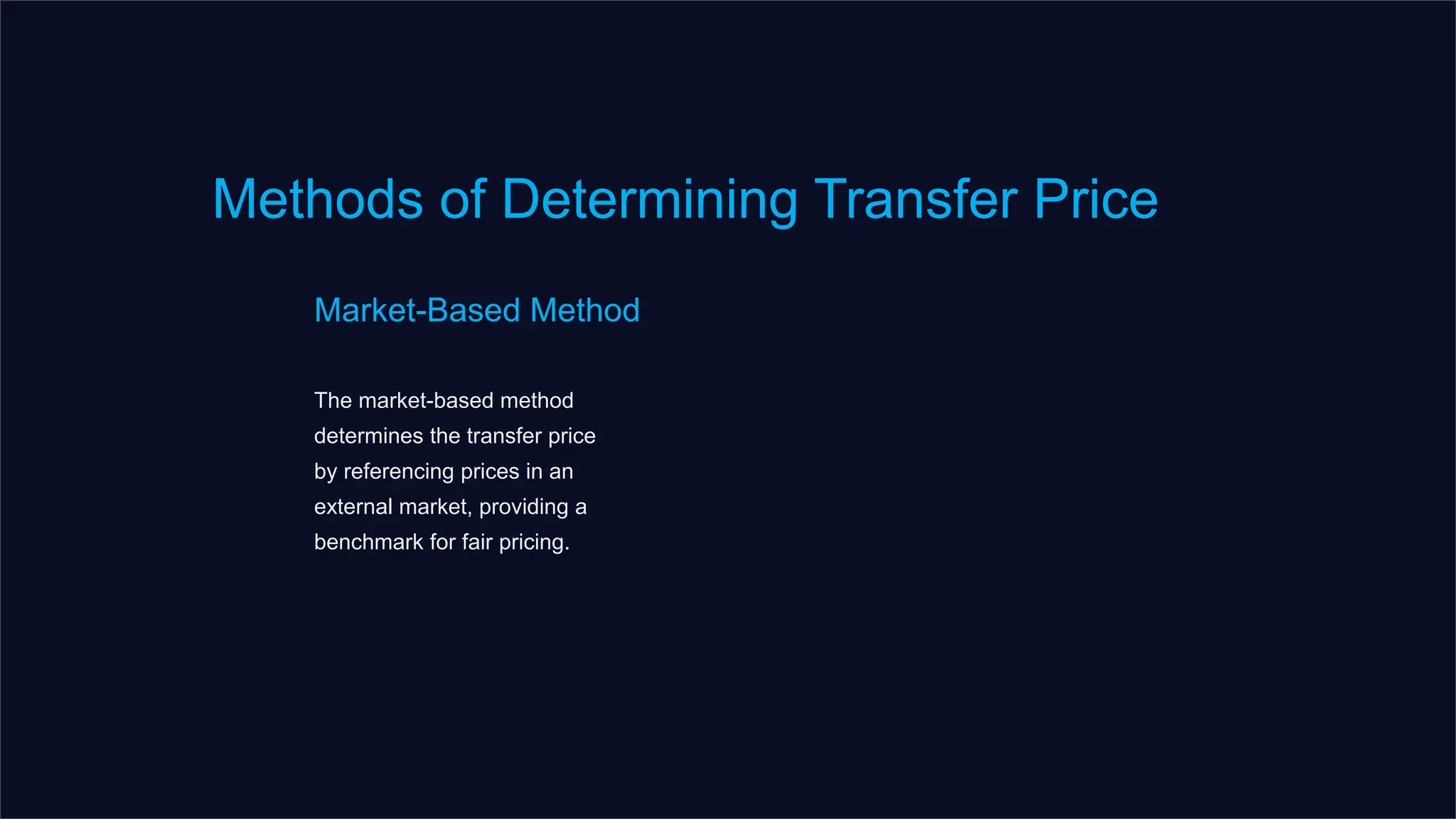
Market-Based Method
The market-based method
determines the transfer price
by referencing prices in an
external market, providing a
benchmark for fair pricing.
Example: Market-Based Method
1 Scenario
Division A transfers a product to
Division B. Similar products are sold in
the external market at a price of $50
per unit.
2
Calculation
Using the market-based method, the
transfer price would be set at $50 to
align with the prevailing market rates
and ensure fairness. 3 Result
Division B receives the product at a
price that reflects its true market value,
promoting transparency and avoiding
distortions.
Methods of Determining Transfer Price
Profit-Based
Method
Using this method, the
transfer price is derived by
considering the profit margins
off the selling division,
ensuring profitability and
shared success.
Example: Profit-Based Method
1 Scenario
Division A produces a specialized
service that requires expertise and
generates a profit margin of 15% for
the company.
2
Calculation
The transfer price determined using
the profit-based method would include
a 15% profit margin to ensure Division
A profitability and incentivize quality
performance.
3 Result
By considering the desired profit
margin, the transfer price aligns the
interests of both divisions and rewards
Division A contribution to overall
profitability.
Methods of Determining Transfer Price
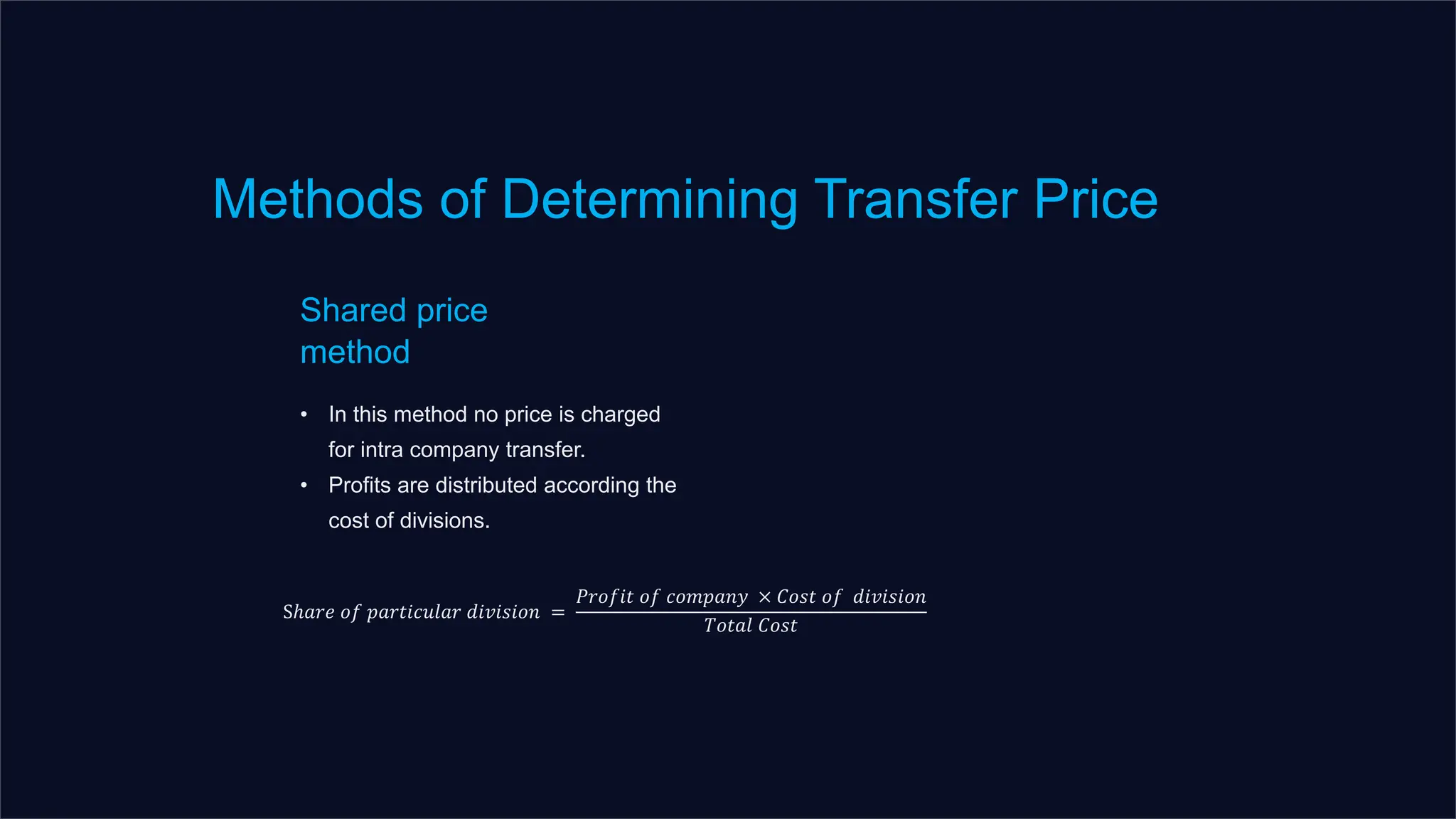
Shared price
method
• In this method no price is charged
for intra company transfer.
• Profits are distributed according the
cost of divisions.
Sℎ𝑎𝑟𝑒 𝑜𝑓 𝑝𝑎𝑟𝑡𝑖𝑐𝑢𝑙𝑎𝑟 𝑑𝑖𝑣𝑖𝑠𝑖𝑜𝑛 =
𝑃𝑟𝑜𝑓𝑖𝑡 𝑜𝑓 𝑐𝑜𝑚𝑝𝑎𝑛𝑦 × 𝐶𝑜𝑠𝑡 𝑜𝑓 𝑑𝑖𝑣𝑖𝑠𝑖𝑜𝑛
𝑇𝑜𝑡𝑎𝑙 𝐶𝑜𝑠𝑡
Example
Division A Division B
Division (B) =
100000 ×40000
100000
Division (B) = 40000
Total Sales
Cost Of Division (A)
Cost of Division (B)
Total Cost
Total Profit
200000
60000
40000
100000
100000
Division (A) =
100000 ×60000
100000
Division (A) = 60000
INTERNATIONAL TRANSFER PRICING
“Transfer price refers to amount that one division of the company pays to other division
of the same company”.
• Divisions are in different countries.
• It is significant because it affects the allocation of profits and tax liabilities among
different countries.
• Multinational companies get the tax advantage.
• It’s a critical area of focus for multinational corporations and tax authorities alike.
Example
Division A Division B Company
100000
50000
(70000)
-----
_______________
80000
40000
120000
-----
(40000)
(50000)
_______________
30000
24000
220000
50000
(110000)
(50000)
_______________
110000
64000
External Sales
Internal transfer to division B
Fixed & Variable Cost
Transfer cost from division A
Profit before Tax
Profit after tax
XYZ is a multinational company. Division is based in USA with a tax rate of 50%.Division B is based in Canada with a tax rate of 20%.
Division A transfer goods to division B at a cost of $50000 per annum. Based on $50000 transfer the profit of the divisions and company
are as follows:
Division A Division B Company
100000
20000
(70000)
-----
_______________
50000
25000
120000
-----
(40000)
(20000)
_______________
60000
48000
220000
20000
(110000)
(20000)
_______________
110000
73000
External Sales
Internal transfer to division B
Fixed & Variable Cost
Transfer cost from division A
Profit before Tax
Profit after tax
• The decrease in the transfer price has increased the company profits from $64000 to 73000.
Example
The XYZ company want to take the advantage of the difference in the tax rates and decided to reduce the transfer price from 50000 to
20000. This will result in the following revised profit figures:
Division A Division B Company
100000
80000
(70000)
-----
_______________
110000
55000
120000
-----
(40000)
(80000)
_______________
0
0
220000
80000
(110000)
(80000)
_______________
110000
55000
External Sales
Internal transfer to division B
Fixed & Variable Cost
Transfer cost from division A
Profit before Tax
Profit after tax
Example
If the company increase the transfer price from $50000 to $80000.
• The Increase in the transfer price has decrease the company profits from $64000 to 55000.
• If the selling division has lower tax rates than buying division, then increasing the transfer price will increase the profit of the company
and vice versa.
Importance
Tax Saving
We can save tax through transfer
pricing by getting the advantage of tax
difference of difference countries.
Profits Maximization
Multinational companies increase their
profits legally by saving taxes.
Making Smart Investments:
For big companies, it helps them figure out the best ways to invest their money in
different parts of the world.
THANK YOU!

Managerial Accounting Presentation transfer pricing.pptx

  • 1.
    Transfer Price: Exploring Methodsand Calculations Muhammad Talha Muhammad Faisal Salman
  • 2.
    DEFINITION-TRANSFER PRICING A transferprice is the price at which goods or services are transferred from one division to another within the same organization. E.g.: If one division sells goods to another division, the cost of those goods is the transfer price. Scope of Transactions: Transactions may include the trade of supplies or labor between departments. Purpose of Transfer Prices: Transfer prices are used when individual entities of a larger multi-entry firm are treated and measured as separately run entities.
  • 3.
    Characteristics of goodtransfer price 1 Alignment with Company Goals Exploring the importance of transfer prices aligning with company goals to maximize profits and ensure goal congruence across all divisions. 2 Divisional Autonomy Understanding how effective transfer pricing should preserve divisional autonomy while also contributing to the overall company profit. 3 Impact on Divisional Profits Analyzing how transfer prices can affect divisional profits and the subsequent implications for business decisions.
  • 4.
    Financial Implications ofTransfer Pricing 1 Profit Maximization Assessing how transfer prices can impact the ability of divisions to maximize profits, and the subsequent effect on the overall company's financial performance. 2 Cost Analysis Understanding the cost implications of different transfer pricing approaches and their potential impact on divisional and company profits. 3 Strategic Decision Making Exploring how transfer prices influence strategic decision-making within divisions and the overall financial implications for the company.
  • 5.
    The Business Impactof Transfer Pricing Performance Assessment Understanding how transfer pricing impacts the assessment of divisional performance and the subsequent decisions made by the management. Employee Motivation Analyzing how transfer prices can affect the motivation of divisional managers and employees, thereby influencing the overall performance of the division. Decision Making Exploring the potential impact of transfer prices on the decision-making process within the divisions and the subsequent effect on company profits.
  • 6.
    The Importance ofTransfer Prices Impact on Divisional Performance Motivation of Divisional Managers 1 2 The transfer price has a direct impact on the profit of each division, thereby influencing their reported performance. This affects the assessment of divisional performance and could lead to potentially poor decisions by the management. Transfer prices affect the remuneration of employees in each division, impacting their motivation as profits change. Poor performance due to high transfer prices can lead to demotivation, affecting the real performance of the division. Decision Making 3 The influence of transfer prices on divisional profits can lead to different decisions made by each division, which in turn affects the overall company profits.
  • 7.
    Methods of DeterminingTransfer Price Cost-Based Method This method sets the transfer price based on the cost of producing or acquiring the goods or services, ensuring a fair allocation of expenses.
  • 8.
    Example: Cost-Based Method 1Scenario Division A produces a component at a cost of $10 per unit and transfers it to Division B for further processing. 2 Calculation The transfer price using the cost-based method would be set at $10 to cover Division A's production cost and ensure no profit or loss is incurred. 3 Result Division B receives the component at a fair price, accounting for Division A's costs without any additional charges.
  • 9.
    Methods of DeterminingTransfer Price negotiated price: the transfer price may be fixed through negotiation between the selling and buying divisions.
  • 10.
    Methods of DeterminingTransfer Price Market-Based Method The market-based method determines the transfer price by referencing prices in an external market, providing a benchmark for fair pricing.
  • 11.
    Example: Market-Based Method 1Scenario Division A transfers a product to Division B. Similar products are sold in the external market at a price of $50 per unit. 2 Calculation Using the market-based method, the transfer price would be set at $50 to align with the prevailing market rates and ensure fairness. 3 Result Division B receives the product at a price that reflects its true market value, promoting transparency and avoiding distortions.
  • 12.
    Methods of DeterminingTransfer Price Profit-Based Method Using this method, the transfer price is derived by considering the profit margins off the selling division, ensuring profitability and shared success.
  • 13.
    Example: Profit-Based Method 1Scenario Division A produces a specialized service that requires expertise and generates a profit margin of 15% for the company. 2 Calculation The transfer price determined using the profit-based method would include a 15% profit margin to ensure Division A profitability and incentivize quality performance. 3 Result By considering the desired profit margin, the transfer price aligns the interests of both divisions and rewards Division A contribution to overall profitability.
  • 14.
    Methods of DeterminingTransfer Price Shared price method • In this method no price is charged for intra company transfer. • Profits are distributed according the cost of divisions. Sℎ𝑎𝑟𝑒 𝑜𝑓 𝑝𝑎𝑟𝑡𝑖𝑐𝑢𝑙𝑎𝑟 𝑑𝑖𝑣𝑖𝑠𝑖𝑜𝑛 = 𝑃𝑟𝑜𝑓𝑖𝑡 𝑜𝑓 𝑐𝑜𝑚𝑝𝑎𝑛𝑦 × 𝐶𝑜𝑠𝑡 𝑜𝑓 𝑑𝑖𝑣𝑖𝑠𝑖𝑜𝑛 𝑇𝑜𝑡𝑎𝑙 𝐶𝑜𝑠𝑡
  • 15.
    Example Division A DivisionB Division (B) = 100000 ×40000 100000 Division (B) = 40000 Total Sales Cost Of Division (A) Cost of Division (B) Total Cost Total Profit 200000 60000 40000 100000 100000 Division (A) = 100000 ×60000 100000 Division (A) = 60000
  • 16.
    INTERNATIONAL TRANSFER PRICING “Transferprice refers to amount that one division of the company pays to other division of the same company”. • Divisions are in different countries. • It is significant because it affects the allocation of profits and tax liabilities among different countries. • Multinational companies get the tax advantage. • It’s a critical area of focus for multinational corporations and tax authorities alike.
  • 17.
    Example Division A DivisionB Company 100000 50000 (70000) ----- _______________ 80000 40000 120000 ----- (40000) (50000) _______________ 30000 24000 220000 50000 (110000) (50000) _______________ 110000 64000 External Sales Internal transfer to division B Fixed & Variable Cost Transfer cost from division A Profit before Tax Profit after tax XYZ is a multinational company. Division is based in USA with a tax rate of 50%.Division B is based in Canada with a tax rate of 20%. Division A transfer goods to division B at a cost of $50000 per annum. Based on $50000 transfer the profit of the divisions and company are as follows:
  • 18.
    Division A DivisionB Company 100000 20000 (70000) ----- _______________ 50000 25000 120000 ----- (40000) (20000) _______________ 60000 48000 220000 20000 (110000) (20000) _______________ 110000 73000 External Sales Internal transfer to division B Fixed & Variable Cost Transfer cost from division A Profit before Tax Profit after tax • The decrease in the transfer price has increased the company profits from $64000 to 73000. Example The XYZ company want to take the advantage of the difference in the tax rates and decided to reduce the transfer price from 50000 to 20000. This will result in the following revised profit figures:
  • 19.
    Division A DivisionB Company 100000 80000 (70000) ----- _______________ 110000 55000 120000 ----- (40000) (80000) _______________ 0 0 220000 80000 (110000) (80000) _______________ 110000 55000 External Sales Internal transfer to division B Fixed & Variable Cost Transfer cost from division A Profit before Tax Profit after tax Example If the company increase the transfer price from $50000 to $80000. • The Increase in the transfer price has decrease the company profits from $64000 to 55000. • If the selling division has lower tax rates than buying division, then increasing the transfer price will increase the profit of the company and vice versa.
  • 20.
    Importance Tax Saving We cansave tax through transfer pricing by getting the advantage of tax difference of difference countries. Profits Maximization Multinational companies increase their profits legally by saving taxes. Making Smart Investments: For big companies, it helps them figure out the best ways to invest their money in different parts of the world.
  • 21.