Introduction:
The rapid rise of modern large-scale enterprises
has been accompanied by decentralization and
the establishment of semiautonomous profit
centres.
This semiautonomous profit centres need to
determine the price of intermediate products
sold by one semiautonomous division of a large
scale enterprise and purchased by another
semiautonomous division of the same enterprise
Meaning:
 transfer pricing refers to the rules and
methods for pricing transactions within and
between enterprises under common
ownership or control.
Explanations:
We assume that the firm has two divisions, a
production division and a marketing division.
The production division sells the intermediate
product to the marketing division, as well as to
outsiders.
The marketing division purchases the
intermediate product from the production
division, completes the production process.
 we will assume that 1 unit of the transfer or
intermediate product is required to produce
each unit of the final product sold by the
marketing division.
Transfer Prising with no External Market
for the Intermediate Product:
 when there is no external demand for the
intermediate product, the production
division can sell the intermediate product only
internally to the marketing division of the
firm, and the marketing division can
purchase the intermediate product only from
the production division of the firm.
Let us graphically (figure 1)represent the
transfer price of the intermediate product is
determined when there is no external market
for the intermediate product.
Graphically Representation:
0
2 -
6 -
4 -
10 -
14 -
18 -
20 40 60 80 Q
₹
Pm
Em
Ep
MRm
MCp
MCm
Dp = MRp = Pt
MC = MCp + MCm
Dm
Figure-1
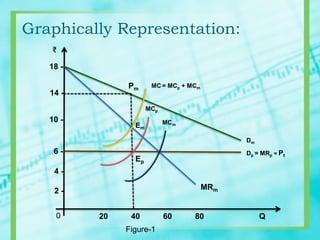
MCp and MCm are the marginal cost curves of the
production and marketing divisions of the firm,
respectively, while MC is the vertical summation of
MCp and MCm, and it represents the total marginal
cost curve for the firm has the whole.
The figure also shows the external demand curve
for the final product sold by the marketing
division(Dm) and its corresponding marginal
revenue curve (MRm).
The firm’s best or profit maximizing level of the
output of the final product is 40 units and is given
by point Em, at which MRm = MC.
Therefore, Pm= ₹14. since 40 units of the
intermediate product are required, the transfer price
for the intermediate product(Pt) is set equal to the
marginal cost of the intermediate product (MCp) at
Qp = 40. Thus, Pt = ₹6 and is given by point Ep at
which Qp = 40.
The demand and marginal revenue curves
faced by the production division of the firm are
then equal to the transfer price.
Qp = 40 is the best level of output of the
intermediate product by the production division
of the firm because
at Qp=40, Dp=MRp=Pt=MCp=₹6.
Transfer pricing with a perfectly
competitive market for the intermediate
product:
 When an external market for the intermediate product
does exist, the output of the production division
need not to be equal to the output of the final
product.
 If the optimal output of the production division
exceeds the quantity of the intermediate product
demanded by the marketing division. The excess
product can be sold on the external market.
On the other hand, if the marketing division
of the firm demands more than the best level
of output of the production division, the
excess demand can be covered by
purchases of the intermediate product in the
external market.
The determination of the transfer price when
the external market is perfectly competitive
is shown in figure.
Graphically Representation:
0
2 -
6 -
4 -
10 -
14 -
18 -
20 40 50 60 80 Q
₹
Pm
Em
Ep’
MRm
MCp’
MCm
Dp = MRp + Pt
MCt = MCm + Pt
Dm
Figure-2
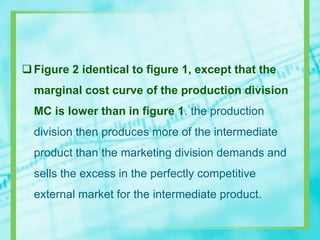
Figure 2 identical to figure 1, except that the
marginal cost curve of the production division
MC is lower than in figure 1. the production
division then produces more of the intermediate
product than the marketing division demands and
sells the excess in the perfectly competitive
external market for the intermediate product.
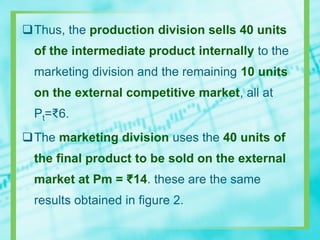
Thus, the production division sells 40 units
of the intermediate product internally to the
marketing division and the remaining 10 units
on the external competitive market, all at
Pt=₹6.
The marketing division uses the 40 units of
the final product to be sold on the external
market at Pm = ₹14. these are the same
results obtained in figure 2.
Transfer Pricing with an Imperfectly
Competitive Market for the Intermediate
Product:
When an imperfectly competitive external
market for the intermediate product exists, the
transfer price of the intermediate product for
intrafirm sales will differ from the price of the
intermediate product for on the imperfectly
competitive external market .
The determination of the internal and external
prices of the intermediate product by the
production division of the firm becomes one
of third-degree price discrimination.
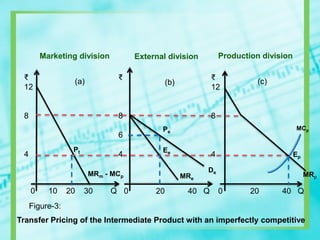
This is shown in figure 3
0 10 20 30 Q
₹
12
8
4
0 20 40 Q
₹
8
6
4
₹
12
8
4
0 20 40 Q
Marketing division External division Production division
MRm - MCp MRe
De
Pe
Ee
MCp
Ep
MRp
Transfer Pricing of the Intermediate Product with an imperfectly competitive
(a) (b) (c)
Pt
Figure-3:
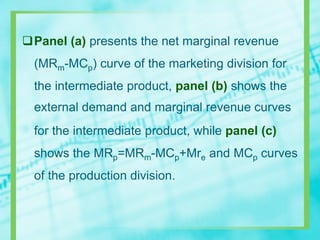
Panel (a) presents the net marginal revenue
(MRm-MCp) curve of the marketing division for
the intermediate product, panel (b) shows the
external demand and marginal revenue curves
for the intermediate product, while panel (c)
shows the MRp=MRm-MCp+Mre and MCp curves
of the production division.
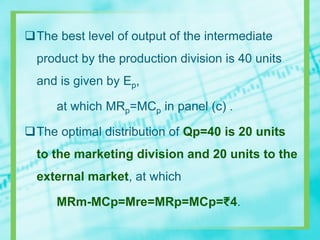
The best level of output of the intermediate
product by the production division is 40 units
and is given by Ep,
at which MRp=MCp in panel (c) .
The optimal distribution of Qp=40 is 20 units
to the marketing division and 20 units to the
external market, at which
MRm-MCp=Mre=MRp=MCp=₹4.
The transfer price to the marketing division is
then Pt = MCp = ₹4, and the price of the
intermediate product sales on the external
market is Pe = ₹6.
• Example: Multinational corporations use
transfer pricing to avoid paying taxes.
References:
1. Managerial Economics, principles and worldwide
applications, eighth edition(2019) , Dominick salvatore,
siddhartha K.Rastogi.
2. Modern Microeconomics,second edition(2017)
A.Koutsoyiannis.
3. Advanced economic theory: Microeconomic analysis,
Nineteenth edition, H.L.Ahuja.
4. Various Online sources.
Pricing Strategies;Transfer pricing- managerial economics

Pricing Strategies;Transfer pricing- managerial economics

  • 2.
    Introduction: The rapid riseof modern large-scale enterprises has been accompanied by decentralization and the establishment of semiautonomous profit centres. This semiautonomous profit centres need to determine the price of intermediate products sold by one semiautonomous division of a large scale enterprise and purchased by another semiautonomous division of the same enterprise
  • 3.
    Meaning:  transfer pricingrefers to the rules and methods for pricing transactions within and between enterprises under common ownership or control.
  • 4.
    Explanations: We assume thatthe firm has two divisions, a production division and a marketing division. The production division sells the intermediate product to the marketing division, as well as to outsiders. The marketing division purchases the intermediate product from the production division, completes the production process.
  • 5.
     we willassume that 1 unit of the transfer or intermediate product is required to produce each unit of the final product sold by the marketing division.
  • 6.
    Transfer Prising withno External Market for the Intermediate Product:  when there is no external demand for the intermediate product, the production division can sell the intermediate product only internally to the marketing division of the firm, and the marketing division can purchase the intermediate product only from the production division of the firm.
  • 7.
    Let us graphically(figure 1)represent the transfer price of the intermediate product is determined when there is no external market for the intermediate product.
  • 8.
    Graphically Representation: 0 2 - 6- 4 - 10 - 14 - 18 - 20 40 60 80 Q ₹ Pm Em Ep MRm MCp MCm Dp = MRp = Pt MC = MCp + MCm Dm Figure-1
  • 9.
    MCp and MCmare the marginal cost curves of the production and marketing divisions of the firm, respectively, while MC is the vertical summation of MCp and MCm, and it represents the total marginal cost curve for the firm has the whole. The figure also shows the external demand curve for the final product sold by the marketing division(Dm) and its corresponding marginal revenue curve (MRm).
  • 10.
    The firm’s bestor profit maximizing level of the output of the final product is 40 units and is given by point Em, at which MRm = MC. Therefore, Pm= ₹14. since 40 units of the intermediate product are required, the transfer price for the intermediate product(Pt) is set equal to the marginal cost of the intermediate product (MCp) at Qp = 40. Thus, Pt = ₹6 and is given by point Ep at which Qp = 40.
  • 11.
    The demand andmarginal revenue curves faced by the production division of the firm are then equal to the transfer price. Qp = 40 is the best level of output of the intermediate product by the production division of the firm because at Qp=40, Dp=MRp=Pt=MCp=₹6.
  • 12.
    Transfer pricing witha perfectly competitive market for the intermediate product:  When an external market for the intermediate product does exist, the output of the production division need not to be equal to the output of the final product.  If the optimal output of the production division exceeds the quantity of the intermediate product demanded by the marketing division. The excess product can be sold on the external market.
  • 13.
    On the otherhand, if the marketing division of the firm demands more than the best level of output of the production division, the excess demand can be covered by purchases of the intermediate product in the external market. The determination of the transfer price when the external market is perfectly competitive is shown in figure.
  • 14.
    Graphically Representation: 0 2 - 6- 4 - 10 - 14 - 18 - 20 40 50 60 80 Q ₹ Pm Em Ep’ MRm MCp’ MCm Dp = MRp + Pt MCt = MCm + Pt Dm Figure-2
  • 15.
    Figure 2 identicalto figure 1, except that the marginal cost curve of the production division MC is lower than in figure 1. the production division then produces more of the intermediate product than the marketing division demands and sells the excess in the perfectly competitive external market for the intermediate product.
  • 16.
    Thus, the productiondivision sells 40 units of the intermediate product internally to the marketing division and the remaining 10 units on the external competitive market, all at Pt=₹6. The marketing division uses the 40 units of the final product to be sold on the external market at Pm = ₹14. these are the same results obtained in figure 2.
  • 17.
    Transfer Pricing withan Imperfectly Competitive Market for the Intermediate Product: When an imperfectly competitive external market for the intermediate product exists, the transfer price of the intermediate product for intrafirm sales will differ from the price of the intermediate product for on the imperfectly competitive external market .
  • 18.
    The determination ofthe internal and external prices of the intermediate product by the production division of the firm becomes one of third-degree price discrimination. This is shown in figure 3
  • 19.
    0 10 2030 Q ₹ 12 8 4 0 20 40 Q ₹ 8 6 4 ₹ 12 8 4 0 20 40 Q Marketing division External division Production division MRm - MCp MRe De Pe Ee MCp Ep MRp Transfer Pricing of the Intermediate Product with an imperfectly competitive (a) (b) (c) Pt Figure-3:
  • 20.
    Panel (a) presentsthe net marginal revenue (MRm-MCp) curve of the marketing division for the intermediate product, panel (b) shows the external demand and marginal revenue curves for the intermediate product, while panel (c) shows the MRp=MRm-MCp+Mre and MCp curves of the production division.
  • 21.
    The best levelof output of the intermediate product by the production division is 40 units and is given by Ep, at which MRp=MCp in panel (c) . The optimal distribution of Qp=40 is 20 units to the marketing division and 20 units to the external market, at which MRm-MCp=Mre=MRp=MCp=₹4.
  • 22.
    The transfer priceto the marketing division is then Pt = MCp = ₹4, and the price of the intermediate product sales on the external market is Pe = ₹6. • Example: Multinational corporations use transfer pricing to avoid paying taxes.
  • 23.
    References: 1. Managerial Economics,principles and worldwide applications, eighth edition(2019) , Dominick salvatore, siddhartha K.Rastogi. 2. Modern Microeconomics,second edition(2017) A.Koutsoyiannis. 3. Advanced economic theory: Microeconomic analysis, Nineteenth edition, H.L.Ahuja. 4. Various Online sources.