Hepatic Encephalopathy
Dr Arun George
Definition
Hepatic encephalopathy (HE) is a complex metabolic
mental state disorder with a spectrum of potentially
reversible neuropsychiatric abnormalities seen in
patients with severe acute or chronic liver
dysfunction after exclusion of other brain diseases
Characterized by
 Disturbances in consciousness & behaviour
 Personality changes
 Fluctuating neurologic signs, asterixis or flapping tremor
 Distinctive EEG changes
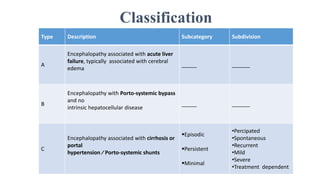
Type Description Subcategory Subdivision
A
Encephalopathy associated with acute liver
failure, typically associated with cerebral
edema
_____ ______
B
Encephalopathy with Porto-systemic bypass
and no
intrinsic hepatocellular disease
_____ ______
C
Encephalopathy associated with cirrhosis or
portal
hypertension ⁄ Porto-systemic shunts
Episodic
Persistent
Minimal
•Percipated
•Spontaneous
•Recurrent
•Mild
•Severe
•Treatment dependent
Classification
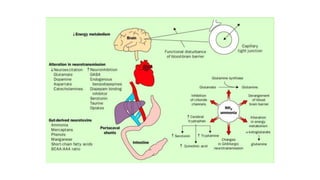
• Ammonia hypothesis
• False neurotransmitters & AA imbalance
• Increase permeability of BBB
• GABA hypothesis
• Others
Pathogenesis Theories
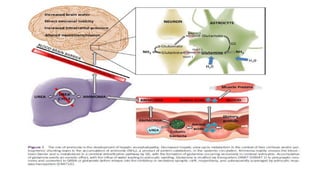
• Readily crosses blood-brain barrier
• Ammonia reacts with α-ketoglutatrate to produce glutamate
and glutamine
• Consumption of α-ketoglutatrate, NADH and ATP, inhibition
of pyruvate decarboxylase decrease TCA cycle activity
which is vital for brain metabolism
• Increased glutamine formation depletes glutamate stores
which are needed by neural tissue leading to irreparable cell
damage and neural cell death ensue.
• Directly depress the cerebral blood flow & glucose
metabolism
• Direct toxic effect on the neuronal membrane
Neurotoxic Action of Ammonia
• BCAA/AAA decreases (N= 3-3.5, In hepatic coma=0.6-
1.2)
Increase FNTs
Decrease normal neurotransmitters
Increase inhibitory neurotransmitters
False neurotransmitters & Aminoacid imbalance
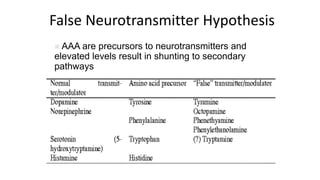
 AAA are precursors to neurotransmitters and
elevated levels result in shunting to secondary
pathways
False Neurotransmitter Hypothesis
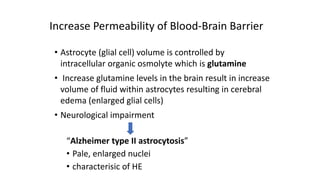
• Astrocyte (glial cell) volume is controlled by
intracellular organic osmolyte which is glutamine
• Increase glutamine levels in the brain result in increase
volume of fluid within astrocytes resulting in cerebral
edema (enlarged glial cells)
• Neurological impairment
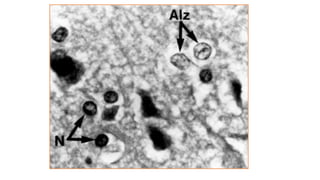
“Alzheimer type II astrocytosis”
• Pale, enlarged nuclei
• characterisic of HE
Increase Permeability of Blood-Brain Barrier
• Major inhibitory neurotransmitter.
• Evidence: increased GABAergic tone & Flumazenil
improves clinical outcome
• Cause
- Decrease hepatic metabolism
- Increase gut wall permeability
GABA hypothesis
• Dysregulation of serotonergic system (inversion of
sleep rhythm)
• Depletion of zinc & accumulation of Mn in globus
pallidus.
• Action of cytokines and bacterial LPS on astrocytes
which are formed d/t inflmm. elsewhere in the body.
• Neuronal NO synthase may increase c/t the altered
cerebral perfusion.
Some other theories
• Mercaptans: Inhibit Na+-K+ ATPase
• Short & medium chain fatty acids: inhibit Na+-K+
ATPase & Urea synthase
• Phenol: a neurotoxin
Other neurotoxins
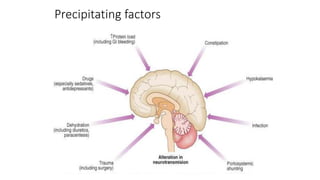
Precipitating factors
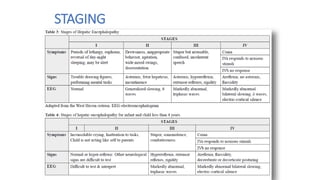
STAGING
Management
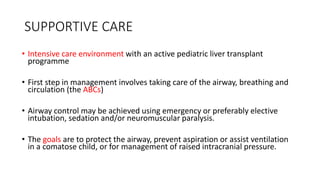
SUPPORTIVE CARE
• Intensive care environment with an active pediatric liver transplant
programme
• First step in management involves taking care of the airway, breathing and
circulation (the ABCs)
• Airway control may be achieved using emergency or preferably elective
intubation, sedation and/or neuromuscular paralysis.
• The goals are to protect the airway, prevent aspiration or assist ventilation
in a comatose child, or for management of raised intracranial pressure.
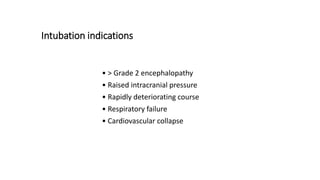
Intubation indications
• > Grade 2 encephalopathy
• Raised intracranial pressure
• Rapidly deteriorating course
• Respiratory failure
• Cardiovascular collapse
FLUIDS
• The aim is to maintain hydration and renal function, while not causing
cerebral edema and fluid overload.
• Start at roughly 70% of maintenance requirements and adjust
frequently as needed.
• Hydration status- monitored by central venous pressure, Weight
chart, Urine output monitoring.
SUGAR
• GRBS Q2H
• Hypoglycaemia can worsen hepatic encephalopathy and cause rapid
neurological deterioration
• Intravenous glucose infusion (6- 8mg/kg/min) is recommended in
patients who develop hypoglycaemia.
ELECTROLYTES
• Frequent monitoring and correction of metabolic derangements are
critical.
• Hypokalaemia- induced by diuretics, vomiting or diarrhoea + strong
kaliuretic drive of secondary hyperaldosteronism.
• Hypokalemia and the accompanying alkalosis impair ammonia
detoxification, increase renal ammonia production, and lead to increased
diffusion of ammonia across the blood brain barrier.
• Sodium- Total sodium intake of 1 mEq/kg/day is usually adequate to
prevent development of ascites.
• Despite hyponatraemia, these patients usually have total body
sodium overload. Commonly, inappropriate secretion of antidiuretic
hormone results in dilutional hyponatraemia which is best managed
by fluid restriction.
• If free water clearance needs to be increased,
diuretics should preferably be combined with salt-poor albumin.
• Use of hypertonic saline may be considered in case of serum
sodium <120 mEq/l and/or falling rapidly.
• Supplementation of calcium, phosphorus or magnesium may
be required, depending on their serum concentrations.
Ventilation strategies
• Aim to oxygenate (SpO2 >90 %) and maintain normocarbia
(PaCO2 35-45 mmHg)
• Excessive hyperventilation is avoided
• Protective lung strategy is the gold standard to manage acute
lung injuries, but with a careful balancing act as high PEEP with
low tidal volume can adversely affect cerebral edema.
• Effective sedation before tracheal suction is essential to
prevent ICP surges
Reducing nitrogen load
• Cleaning the gut
• A nasogastric tube- remove any blood, and to institute continuous
gravity drainage.
• Bowel wash or enema with 50% solution of magnesium sulphate.
• Acidification of colonic lumen
• Uribe et al conducted a randomised controlled trial
comparing acidifying enemas (lactitol and lactose) versus tap
water in acute porto-systemic encephalopathy and found water
enemas to be ineffective.
Antibiotics
• For ‘cleansing’ the intestines.
• Ampicillin, metronidazole, vancomycin or rifamixin (a synthetic analogue of
rifamycin).
• Rifaximin- displays a wide spectrum of antibacterial activity against Gram-
negative and Gram-positive bacteria, both aerobic and anaerobic, and a very low
rate of systemic absorption. Highest benefit/risk ratio in the overall treatment
of HE and should be the agent of first choice, but availability is a limiting factor.
“The administration of oral non-absorbable antibacterials for
selective decontamination of the gut does not appear to improve
survival in patients already receiving prophylactic systemic
antibacterials”
Leber B, Spindelboeck W, Stadlbauer V. Infectious complications of acute and chronic liver disease.
Semin Respir Crit Care Med. 2012; 33:80-95
Proteins
• Early introduction of proteins starting at 0.5 g/kg/day with a gradual
increase to 1.5 g/kg/day over the next few weeks as the liver
recovers.
• Vegetable proteins are tolerated better and are safer compared to
animal proteins because they are less ammoniagenic due to relatively
poor methionine and aromatic amino acid content.
Lactulose
• Lactulose is a disaccharide (b-galactosidofructose)- split by the intestinal flora
into component sugars galactose and fructose  further metabolised to the
organic acids including lactic, formic and acetic acids, decreasing the lumen pH to
<5.5.
• It results in the preferential formation of the less absorbable ammonium ion over
ammonia.
• Lactulose also promotes the growth of lactose forming bacteria in the intestine
and suppresses ammoniagenic organisms such as bacterioides.
• Colonic bacteria preferentially metabolise lactulose over blood when both are
present. This is of value in HE precipitated by gastrointestinal haemorrhage.
Probiotics
Theoretically, populating the intestine with ‘friendly’ non urease
producing bacteria may decrease enteral ammonia load
Increasing ammonia metabolism
Ornithine-aspartate
• Infusion of L-ornithine and L-aspartate attempts to reduce serum ammonia
by increasing its tissue metabolism to urea and glutamine, respectively.
• In the periportal hepatocytes L-ornithine acts as a substrate for ureagenesis
and activates urea cycle enzymes ornithine transcarbamylase and carbamoyl
phosphate synthetase. This ‘forward kinetics’ of urea cycle probably
consumes ammonia and decreases its concentration in the blood.
• In the hepatic perivenous scavenger cells, which lack enzymes of urea cycle,
aspartate (and other decarboxylates) stimulate glutamine synthesis and
provide alternate pathway for ammonia detoxification. Unfortunately, there
are no standard paediatric dosing guidelines.
Benzoate and phenyl acetate
• They react with glycine to form hippurate and with glutamine to form
phenacetylglutamine, respectively.
• Studies, including one from India, have supported the use of these
compounds in patients with HE, and sodium benzoate was
found to be as effective as lactulose.
Grade I and II encephalopathy
Lowering endogenous nitrogen intake (by limiting bleeding
and controlling infection ) or exogenous nitrogen intake
(avoiding unjustified fresh frozen plasma administration)
Lactulose was recommended by some groups in early stages of
encephalopathy but there is presently insufficient evidence to
support the use of non-absorbable disaccharides (Lactulose and
Lactitol) for HE in ALF.
Neomycin is not recommended.
Ornithine aspartate and sodium benzoate have been proposed to
decrease serum ammonia, in Reye syndrome and in urea cycle
defects, but hemofiltration remains the main treatment of acute
hyperammonemia.
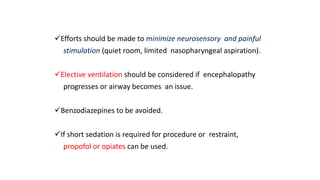
Efforts should be made to minimize neurosensory and painful
stimulation (quiet room, limited nasopharyngeal aspiration).
Elective ventilation should be considered if encephalopathy
progresses or airway becomes an issue.
Benzodiazepines to be avoided.
If short sedation is required for procedure or restraint,
propofol or opiates can be used.
Osmotic therapy: Mannitol can be used as first line therapy provided
serial serum osmolality is below 320 mOsm/L.
Its use is limited once patients develop significant kidney injury or
patient is in shock.
In contrast to mannitol, hypertonic saline can be used as a prophylactic
measure with few adverse effects, with a goal of achieving sodium
of 145 to 155 mEq/L provided serum osmolality remains below 360
mOsm/L.
 Raising the head end of bed to 20-30 degree, provided there is no
shock.
Avoidance of neck rotation
Grade III and IV encephalopathy
1)Intubation and ventilation:
Adequate analgesia and sedation are required.
Propofol and fentanyl are suggested combination.
Propofol has 2 advantages: it can decrease cerebral
blood flow and thereby lower ICP and secondly it can
decrease the risk of seizure activity, which can be sub
clinical.
But due to the risk of propofol infusion syndrome, its
use beyond 24 hours is controversial in children.
2)If osmotic therapies fail to adequately control ICP, other
adjunctive measures to reduce ICP include:
 Transient hyperventilation
 Moderate hypothermia (32C-33C)
 Barbiturate coma
 Hepatectomy
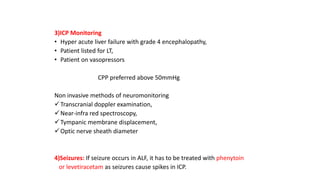
3)ICP Monitoring
• Hyper acute liver failure with grade 4 encephalopathy,
• Patient listed for LT,
• Patient on vasopressors
CPP preferred above 50mmHg
Non invasive methods of neuromonitoring
Transcranial doppler examination,
Near-infra red spectroscopy,
Tympanic membrane displacement,
Optic nerve sheath diameter
4)Seizures: If seizure occurs in ALF, it has to be treated with phenytoin
or levetiracetam as seizures cause spikes in ICP.
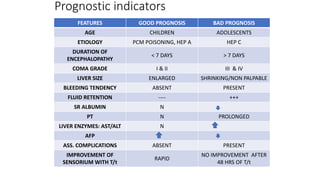
Prognostic indicators
FEATURES GOOD PROGNOSIS BAD PROGNOSIS
AGE CHILDREN ADOLESCENTS
ETIOLOGY PCM POISONING, HEP A HEP C
DURATION OF
ENCEPHALOPATHY
< 7 DAYS > 7 DAYS
COMA GRADE I & II III & IV
LIVER SIZE ENLARGED SHRINKING/NON PALPABLE
BLEEDING TENDENCY ABSENT PRESENT
FLUID RETENTION ---- +++
SR ALBUMIN N
PT N PROLONGED
LIVER ENZYMES: AST/ALT N
AFP
ASS. COMPLICATIONS ABSENT PRESENT
IMPROVEMENT OF
SENSORIUM WITH T/t
RAPID
NO IMPROVEMENT AFTER
48 HRS OF T/t
References
• Nelson textbook of Paediatrics
• Uptodate
• Management of hepatic encephalopathy in children- Ravindra Arya,1
Sheffali Gulati,1 Satish Deopujari2
• NEJM ALF 2013
• Pathophysiology of hepatic encephalopathy by Fredrick 2011

Hepatic encephalopathy

  • 1.
  • 2.
    Definition Hepatic encephalopathy (HE)is a complex metabolic mental state disorder with a spectrum of potentially reversible neuropsychiatric abnormalities seen in patients with severe acute or chronic liver dysfunction after exclusion of other brain diseases
  • 3.
    Characterized by  Disturbancesin consciousness & behaviour  Personality changes  Fluctuating neurologic signs, asterixis or flapping tremor  Distinctive EEG changes
  • 4.
    Type Description SubcategorySubdivision A Encephalopathy associated with acute liver failure, typically associated with cerebral edema _____ ______ B Encephalopathy with Porto-systemic bypass and no intrinsic hepatocellular disease _____ ______ C Encephalopathy associated with cirrhosis or portal hypertension ⁄ Porto-systemic shunts Episodic Persistent Minimal •Percipated •Spontaneous •Recurrent •Mild •Severe •Treatment dependent Classification
  • 5.
    • Ammonia hypothesis •False neurotransmitters & AA imbalance • Increase permeability of BBB • GABA hypothesis • Others Pathogenesis Theories
  • 6.
    • Readily crossesblood-brain barrier • Ammonia reacts with α-ketoglutatrate to produce glutamate and glutamine • Consumption of α-ketoglutatrate, NADH and ATP, inhibition of pyruvate decarboxylase decrease TCA cycle activity which is vital for brain metabolism • Increased glutamine formation depletes glutamate stores which are needed by neural tissue leading to irreparable cell damage and neural cell death ensue. • Directly depress the cerebral blood flow & glucose metabolism • Direct toxic effect on the neuronal membrane Neurotoxic Action of Ammonia
  • 8.
    • BCAA/AAA decreases(N= 3-3.5, In hepatic coma=0.6- 1.2) Increase FNTs Decrease normal neurotransmitters Increase inhibitory neurotransmitters False neurotransmitters & Aminoacid imbalance
  • 9.
     AAA areprecursors to neurotransmitters and elevated levels result in shunting to secondary pathways False Neurotransmitter Hypothesis
  • 10.
    • Astrocyte (glialcell) volume is controlled by intracellular organic osmolyte which is glutamine • Increase glutamine levels in the brain result in increase volume of fluid within astrocytes resulting in cerebral edema (enlarged glial cells) • Neurological impairment “Alzheimer type II astrocytosis” • Pale, enlarged nuclei • characterisic of HE Increase Permeability of Blood-Brain Barrier
  • 12.
    • Major inhibitoryneurotransmitter. • Evidence: increased GABAergic tone & Flumazenil improves clinical outcome • Cause - Decrease hepatic metabolism - Increase gut wall permeability GABA hypothesis
  • 13.
    • Dysregulation ofserotonergic system (inversion of sleep rhythm) • Depletion of zinc & accumulation of Mn in globus pallidus. • Action of cytokines and bacterial LPS on astrocytes which are formed d/t inflmm. elsewhere in the body. • Neuronal NO synthase may increase c/t the altered cerebral perfusion. Some other theories
  • 14.
    • Mercaptans: InhibitNa+-K+ ATPase • Short & medium chain fatty acids: inhibit Na+-K+ ATPase & Urea synthase • Phenol: a neurotoxin Other neurotoxins
  • 16.
  • 17.
  • 18.
  • 19.
    SUPPORTIVE CARE • Intensivecare environment with an active pediatric liver transplant programme • First step in management involves taking care of the airway, breathing and circulation (the ABCs) • Airway control may be achieved using emergency or preferably elective intubation, sedation and/or neuromuscular paralysis. • The goals are to protect the airway, prevent aspiration or assist ventilation in a comatose child, or for management of raised intracranial pressure.
  • 20.
    Intubation indications • >Grade 2 encephalopathy • Raised intracranial pressure • Rapidly deteriorating course • Respiratory failure • Cardiovascular collapse
  • 21.
    FLUIDS • The aimis to maintain hydration and renal function, while not causing cerebral edema and fluid overload. • Start at roughly 70% of maintenance requirements and adjust frequently as needed. • Hydration status- monitored by central venous pressure, Weight chart, Urine output monitoring.
  • 22.
    SUGAR • GRBS Q2H •Hypoglycaemia can worsen hepatic encephalopathy and cause rapid neurological deterioration • Intravenous glucose infusion (6- 8mg/kg/min) is recommended in patients who develop hypoglycaemia.
  • 23.
    ELECTROLYTES • Frequent monitoringand correction of metabolic derangements are critical. • Hypokalaemia- induced by diuretics, vomiting or diarrhoea + strong kaliuretic drive of secondary hyperaldosteronism. • Hypokalemia and the accompanying alkalosis impair ammonia detoxification, increase renal ammonia production, and lead to increased diffusion of ammonia across the blood brain barrier.
  • 24.
    • Sodium- Totalsodium intake of 1 mEq/kg/day is usually adequate to prevent development of ascites. • Despite hyponatraemia, these patients usually have total body sodium overload. Commonly, inappropriate secretion of antidiuretic hormone results in dilutional hyponatraemia which is best managed by fluid restriction.
  • 25.
    • If freewater clearance needs to be increased, diuretics should preferably be combined with salt-poor albumin. • Use of hypertonic saline may be considered in case of serum sodium <120 mEq/l and/or falling rapidly. • Supplementation of calcium, phosphorus or magnesium may be required, depending on their serum concentrations.
  • 26.
    Ventilation strategies • Aimto oxygenate (SpO2 >90 %) and maintain normocarbia (PaCO2 35-45 mmHg) • Excessive hyperventilation is avoided • Protective lung strategy is the gold standard to manage acute lung injuries, but with a careful balancing act as high PEEP with low tidal volume can adversely affect cerebral edema. • Effective sedation before tracheal suction is essential to prevent ICP surges
  • 27.
    Reducing nitrogen load •Cleaning the gut • A nasogastric tube- remove any blood, and to institute continuous gravity drainage. • Bowel wash or enema with 50% solution of magnesium sulphate. • Acidification of colonic lumen • Uribe et al conducted a randomised controlled trial comparing acidifying enemas (lactitol and lactose) versus tap water in acute porto-systemic encephalopathy and found water enemas to be ineffective.
  • 28.
    Antibiotics • For ‘cleansing’the intestines. • Ampicillin, metronidazole, vancomycin or rifamixin (a synthetic analogue of rifamycin). • Rifaximin- displays a wide spectrum of antibacterial activity against Gram- negative and Gram-positive bacteria, both aerobic and anaerobic, and a very low rate of systemic absorption. Highest benefit/risk ratio in the overall treatment of HE and should be the agent of first choice, but availability is a limiting factor.
  • 29.
    “The administration oforal non-absorbable antibacterials for selective decontamination of the gut does not appear to improve survival in patients already receiving prophylactic systemic antibacterials” Leber B, Spindelboeck W, Stadlbauer V. Infectious complications of acute and chronic liver disease. Semin Respir Crit Care Med. 2012; 33:80-95
  • 30.
    Proteins • Early introductionof proteins starting at 0.5 g/kg/day with a gradual increase to 1.5 g/kg/day over the next few weeks as the liver recovers. • Vegetable proteins are tolerated better and are safer compared to animal proteins because they are less ammoniagenic due to relatively poor methionine and aromatic amino acid content.
  • 31.
    Lactulose • Lactulose isa disaccharide (b-galactosidofructose)- split by the intestinal flora into component sugars galactose and fructose  further metabolised to the organic acids including lactic, formic and acetic acids, decreasing the lumen pH to <5.5. • It results in the preferential formation of the less absorbable ammonium ion over ammonia. • Lactulose also promotes the growth of lactose forming bacteria in the intestine and suppresses ammoniagenic organisms such as bacterioides. • Colonic bacteria preferentially metabolise lactulose over blood when both are present. This is of value in HE precipitated by gastrointestinal haemorrhage.
  • 32.
    Probiotics Theoretically, populating theintestine with ‘friendly’ non urease producing bacteria may decrease enteral ammonia load
  • 33.
    Increasing ammonia metabolism Ornithine-aspartate •Infusion of L-ornithine and L-aspartate attempts to reduce serum ammonia by increasing its tissue metabolism to urea and glutamine, respectively. • In the periportal hepatocytes L-ornithine acts as a substrate for ureagenesis and activates urea cycle enzymes ornithine transcarbamylase and carbamoyl phosphate synthetase. This ‘forward kinetics’ of urea cycle probably consumes ammonia and decreases its concentration in the blood. • In the hepatic perivenous scavenger cells, which lack enzymes of urea cycle, aspartate (and other decarboxylates) stimulate glutamine synthesis and provide alternate pathway for ammonia detoxification. Unfortunately, there are no standard paediatric dosing guidelines.
  • 34.
    Benzoate and phenylacetate • They react with glycine to form hippurate and with glutamine to form phenacetylglutamine, respectively. • Studies, including one from India, have supported the use of these compounds in patients with HE, and sodium benzoate was found to be as effective as lactulose.
  • 35.
    Grade I andII encephalopathy Lowering endogenous nitrogen intake (by limiting bleeding and controlling infection ) or exogenous nitrogen intake (avoiding unjustified fresh frozen plasma administration) Lactulose was recommended by some groups in early stages of encephalopathy but there is presently insufficient evidence to support the use of non-absorbable disaccharides (Lactulose and Lactitol) for HE in ALF. Neomycin is not recommended. Ornithine aspartate and sodium benzoate have been proposed to decrease serum ammonia, in Reye syndrome and in urea cycle defects, but hemofiltration remains the main treatment of acute hyperammonemia.
  • 36.
    Efforts should bemade to minimize neurosensory and painful stimulation (quiet room, limited nasopharyngeal aspiration). Elective ventilation should be considered if encephalopathy progresses or airway becomes an issue. Benzodiazepines to be avoided. If short sedation is required for procedure or restraint, propofol or opiates can be used.
  • 37.
    Osmotic therapy: Mannitolcan be used as first line therapy provided serial serum osmolality is below 320 mOsm/L. Its use is limited once patients develop significant kidney injury or patient is in shock.
  • 38.
    In contrast tomannitol, hypertonic saline can be used as a prophylactic measure with few adverse effects, with a goal of achieving sodium of 145 to 155 mEq/L provided serum osmolality remains below 360 mOsm/L.  Raising the head end of bed to 20-30 degree, provided there is no shock. Avoidance of neck rotation
  • 39.
    Grade III andIV encephalopathy 1)Intubation and ventilation: Adequate analgesia and sedation are required. Propofol and fentanyl are suggested combination. Propofol has 2 advantages: it can decrease cerebral blood flow and thereby lower ICP and secondly it can decrease the risk of seizure activity, which can be sub clinical. But due to the risk of propofol infusion syndrome, its use beyond 24 hours is controversial in children.
  • 40.
    2)If osmotic therapiesfail to adequately control ICP, other adjunctive measures to reduce ICP include:  Transient hyperventilation  Moderate hypothermia (32C-33C)  Barbiturate coma  Hepatectomy
  • 41.
    3)ICP Monitoring • Hyperacute liver failure with grade 4 encephalopathy, • Patient listed for LT, • Patient on vasopressors CPP preferred above 50mmHg Non invasive methods of neuromonitoring Transcranial doppler examination, Near-infra red spectroscopy, Tympanic membrane displacement, Optic nerve sheath diameter 4)Seizures: If seizure occurs in ALF, it has to be treated with phenytoin or levetiracetam as seizures cause spikes in ICP.
  • 42.
    Prognostic indicators FEATURES GOODPROGNOSIS BAD PROGNOSIS AGE CHILDREN ADOLESCENTS ETIOLOGY PCM POISONING, HEP A HEP C DURATION OF ENCEPHALOPATHY < 7 DAYS > 7 DAYS COMA GRADE I & II III & IV LIVER SIZE ENLARGED SHRINKING/NON PALPABLE BLEEDING TENDENCY ABSENT PRESENT FLUID RETENTION ---- +++ SR ALBUMIN N PT N PROLONGED LIVER ENZYMES: AST/ALT N AFP ASS. COMPLICATIONS ABSENT PRESENT IMPROVEMENT OF SENSORIUM WITH T/t RAPID NO IMPROVEMENT AFTER 48 HRS OF T/t
  • 43.
    References • Nelson textbookof Paediatrics • Uptodate • Management of hepatic encephalopathy in children- Ravindra Arya,1 Sheffali Gulati,1 Satish Deopujari2 • NEJM ALF 2013 • Pathophysiology of hepatic encephalopathy by Fredrick 2011

Editor's Notes

  • #36 Neomycin precipitates renal failure