Traction
Splinting
Plaster of Paris
Prepared by
Dr.Poh & Dr.Wong
June ‘14
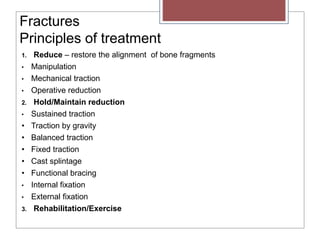
Fractures
Principles of treatment
1. Reduce – restore the alignment of bone fragments
• Manipulation
• Mechanical traction
• Operative reduction
2. Hold/Maintain reduction
• Sustained traction
• Traction by gravity
• Balanced traction
• Fixed traction
• Cast splintage
• Functional bracing
• Internal fixation
• External fixation
3. Rehabilitation/Exercise
Outline
• Introduction
• Functions
• Methods in Tractions
-skin traction (indications/contraindications/complications)
-skeletal traction (indications/application technique/pins/common
sites/traction and site of fracture/contraindications/complications)
• Types of traction
• Post traction care
TRACTION
-Traction is a method of restoring alignment to a fracture through
gradual neutralisation of muscular forces
-Traction is applied to the limb distal to the fracture, so as to exert a
continuous pull in the long axis of the bone
Functions
• Reduction of fractures and dislocations.
• Reduce / relieve pain
• Preventing deformities.
• Correction of soft tissue contractures
• Ensure immobilisation
• Minimize muscle spasms
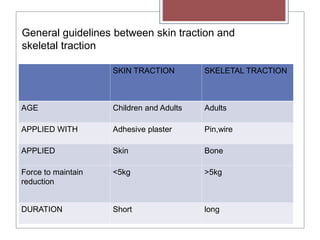
General guidelines between skin traction and
skeletal traction
SKIN TRACTION SKELETAL TRACTION
AGE Children and Adults Adults
APPLIED WITH Adhesive plaster Pin,wire
APPLIED Skin Bone
Force to maintain
reduction
<5kg >5kg
DURATION Short long
Skin traction indications
• Temporary management of # of NOF and IT #
• Management of femoral shaft fracture
• Undisplaced # of acetabulum
• After reduction of dislocation of hip
• To correct minor fixed flexion deformity of hip and knee
Skin traction contraindications
• Abrasion and lacerations of skin in the area to which traction
is to be applied
• Disturbance in blood circulation such as varicose vein or
impending gangrene
• Dermatitis
Skin traction complications
• Allergic reactions
• Excoriation of skin
• Pressure sores
• Common peroneal nerve palsy
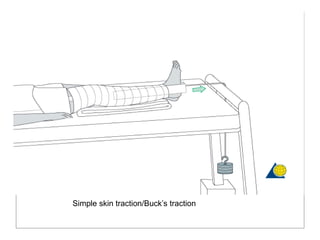
Simple skin traction/Buck’s traction
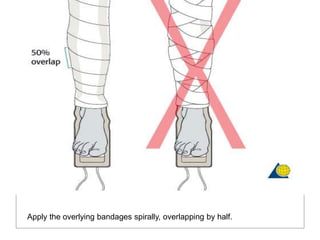
Apply the overlying bandages spirally, overlapping by half.
Skeletal traction
Indications
• For those cases in which skin traction is
contraindicated
• Patients with external fixator in situ
• Weight required for traction is more than 5kg
Skeletal traction application
• Under GA or LA
• Area cleaned and draped
• Mount the pin/wire on the hand drill
• Identify the site of insertion and make a stab wound
• Hold pin horizontally at right angles to the long axis of limb
• Apply small cotton woolen pads soaked with povidone around the pins to
seal the wound
• Pin should pass only through skin, SC tissue and bone avoiding muscles
and tendons
Pins used
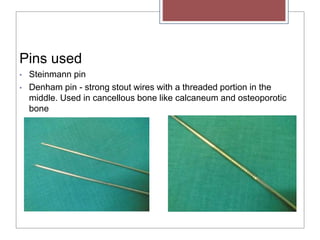
• Steinmann pin
• Denham pin - strong stout wires with a threaded portion in the
middle. Used in cancellous bone like calcaneum and osteoporotic
bone
COMMON SITES FOR SKELETAL
TRACTION
• Olecranon
• Greater trochanter
• Lower end of femur
• Upper end of tibia
• Lower end of tibia
• Calcaneum
Tractions and site of
fracture
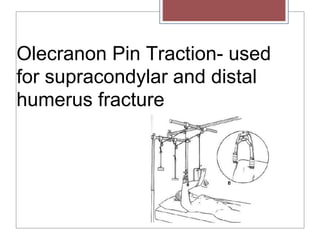
Olecranon Pin Traction- used
for supracondylar and distal
humerus fracture
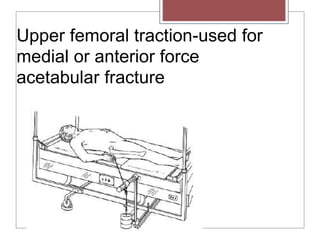
Upper femoral traction-used for
medial or anterior force
acetabular fracture
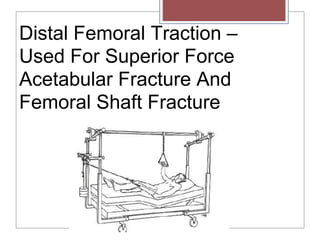
Distal Femoral Traction –
Used For Superior Force
Acetabular Fracture And
Femoral Shaft Fracture
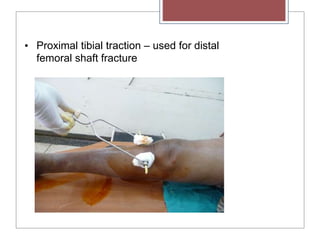
• Proximal tibial traction – used for distal
femoral shaft fracture
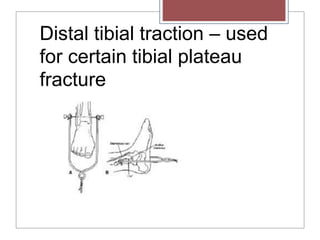
Distal tibial traction – used
for certain tibial plateau
fracture
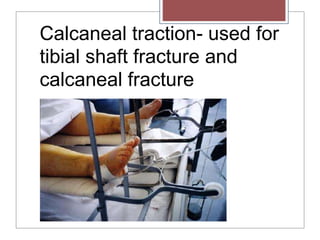
Calcaneal traction- used for
tibial shaft fracture and
calcaneal fracture
Skeletal traction complications
• Mal union
• Deformities
• Ligamentous damage
• Introduction of Infection into bone
• Damage to epiphyseal growth plates
• Nerve injuries
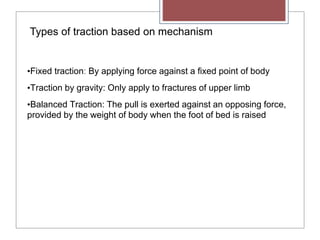
•Fixed traction: By applying force against a fixed point of body
•Traction by gravity: Only apply to fractures of upper limb
•Balanced Traction: The pull is exerted against an opposing force,
provided by the weight of body when the foot of bed is raised
Types of traction based on mechanism
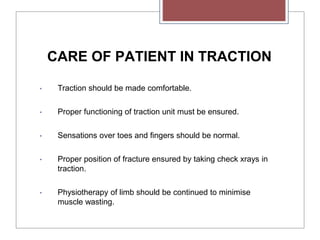
CARE OF PATIENT IN TRACTION
• Traction should be made comfortable.
• Proper functioning of traction unit must be ensured.
• Sensations over toes and fingers should be normal.
• Proper position of fracture ensured by taking check xrays in
traction.
• Physiotherapy of limb should be continued to minimise
muscle wasting.
SPLINT - a device used for support or immobilization
of a limb or the spine.
• Any material used to support a fracture is known as splint.
• Unconventional.
• Conventional.
Outlines
• Functions
• Indications
• Complications
• Preparation
• Types
• Care of patient on splinting
• POP
Functions:
• Temporary immobilization of sprains, fractures, and reduced
dislocations
• Control of pain
• Facilitates patient transportation
• Prevention of further soft tissue or neurovascular injuries
• Decreases risk of converting a minor injury to a major injury
Indications for Splinting
• Not just for fractures
• Sprains
• Joint Infections
• Tenosynovitis
• Lacerations over joints
• Puncture wounds and animal bites of the hands and feet
Complications of splinting
• Rarely occur if applied correctly
• Most common are sores, abrasions, and secondary infections from
loose or ill-fitting splints.
• Less common-neurovascular compromise from tight fitting splints,
contact dermatitis, and thermal burns from heating of plaster.
Preparation
• Define injury and what splint is required
• Splint in position of function
• Clean and repair skin lesions prior to splint application
• Document neurovascular examination before splint
application
• Anticipate ability for child to remove clothes after splint is
applied
What kind of splints?
• Fiberglass splints
• Prefabricated splints
• Air splints
•Plaster splints(POP)
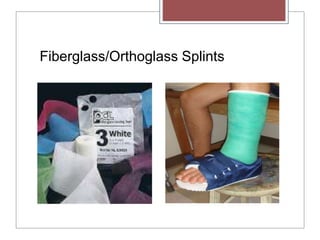
Fiberglass/Orthoglass Splints
Fiberglass Splints
Advantage
• Easier to apply
• Set more quickly
• Lighter
• Water resistant
Disadvantage
• More expensive
• More difficult to mold
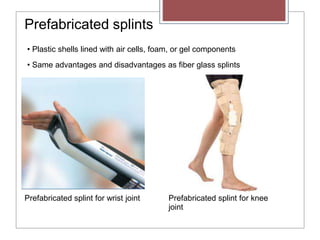
Prefabricated splints
• Plastic shells lined with air cells, foam, or gel components
• Same advantages and disadvantages as fiber glass splints
Prefabricated splint for wrist joint Prefabricated splint for knee
joint
Air/Pneumatic splint
• An air splint is used to immobilize a fracture using an inflatable
support.
• They are plastic structures preformed in a factory to fit a specific part
of the body.
• Typically, an air splint wraps around an arm or leg and holds the bones
still while the patient is moved to hospital.
• This type of splint is not generally used for longterm support of a
fracture as it is less secure and provides less structural support than
plaster splints or fiberglass splints.
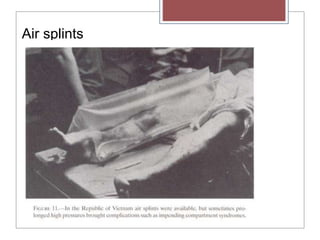
Air splints
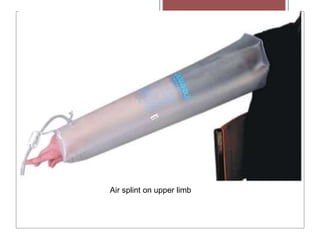
Air splint on upper limb
Specific Splints and Orthoses
Upper Extremity
• Elbow/Forearm
– Long Arm Posterior
– Double Sugar - Tong
• Forearm/Wrist
– Volar Forearm / Cockup
– Sugar - Tong
• Hand/Fingers
– Ulnar Gutter
– Radial Gutter
– Thumb Spica
– Finger Splints
Lower Extremity
• Knee
– Knee Immobilizer
– Posterior Knee Splint
• Ankle
– Posterior Ankle
– Stirrup
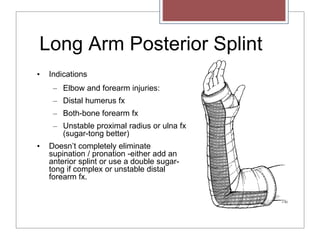
Long Arm Posterior Splint
• Indications
– Elbow and forearm injuries:
– Distal humerus fx
– Both-bone forearm fx
– Unstable proximal radius or ulna fx
(sugar-tong better)
• Doesn’t completely eliminate
supination / pronation -either add an
anterior splint or use a double sugar-
tong if complex or unstable distal
forearm fx.
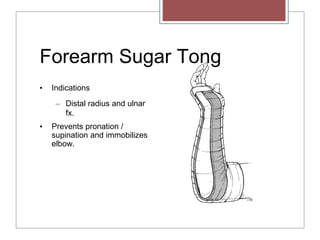
Forearm Sugar Tong
• Indications
– Distal radius and ulnar
fx.
• Prevents pronation /
supination and immobilizes
elbow.
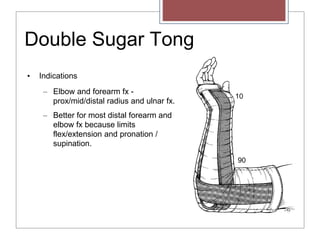
Double Sugar Tong
• Indications
– Elbow and forearm fx -
prox/mid/distal radius and ulnar fx.
– Better for most distal forearm and
elbow fx because limits
flex/extension and pronation /
supination.
10
90
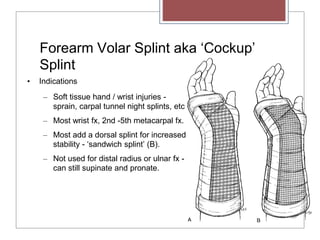
Forearm Volar Splint aka ‘Cockup’
Splint
• Indications
– Soft tissue hand / wrist injuries -
sprain, carpal tunnel night splints, etc
– Most wrist fx, 2nd -5th metacarpal fx.
– Most add a dorsal splint for increased
stability - ‘sandwich splint’ (B).
– Not used for distal radius or ulnar fx -
can still supinate and pronate.
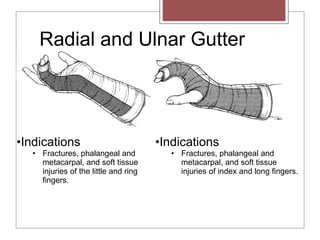
Radial and Ulnar Gutter
•Indications
• Fractures, phalangeal and
metacarpal, and soft tissue
injuries of the little and ring
fingers.
•Indications
• Fractures, phalangeal and
metacarpal, and soft tissue
injuries of index and long fingers.
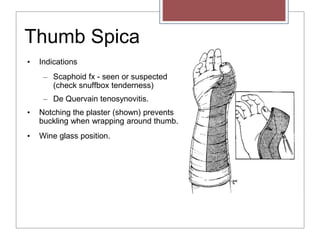
Thumb Spica
• Indications
– Scaphoid fx - seen or suspected
(check snuffbox tenderness)
– De Quervain tenosynovitis.
• Notching the plaster (shown) prevents
buckling when wrapping around thumb.
• Wine glass position.
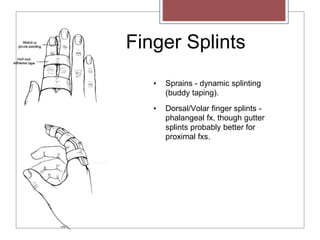
Finger Splints
• Sprains - dynamic splinting
(buddy taping).
• Dorsal/Volar finger splints -
phalangeal fx, though gutter
splints probably better for
proximal fxs.
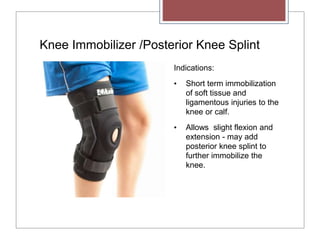
Knee Immobilizer /Posterior Knee Splint
Indications:
• Short term immobilization
of soft tissue and
ligamentous injuries to the
knee or calf.
• Allows slight flexion and
extension - may add
posterior knee splint to
further immobilize the
knee.
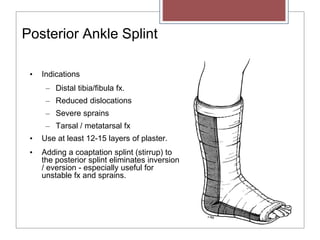
Posterior Ankle Splint
• Indications
– Distal tibia/fibula fx.
– Reduced dislocations
– Severe sprains
– Tarsal / metatarsal fx
• Use at least 12-15 layers of plaster.
• Adding a coaptation splint (stirrup) to
the posterior splint eliminates inversion
/ eversion - especially useful for
unstable fx and sprains.
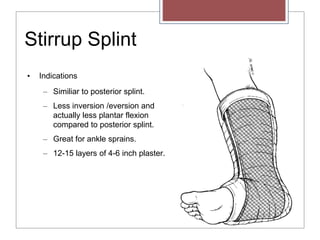
Stirrup Splint
• Indications
– Similiar to posterior splint.
– Less inversion /eversion and
actually less plantar flexion
compared to posterior splint.
– Great for ankle sprains.
– 12-15 layers of 4-6 inch plaster.
Complications
• Burns
– Thermal injury as plaster dries
– Hot water, Increased number of
layers, extra fast-drying, poor padding
- all increase risk
– If significant pain - remove splint to
cool
• Ischemia
– Reduced risk compared to casting but
still a possibility
– Do not apply Webril and ace wraps
tightly
– Instruct to ice and elevate extremity
– Close follow up if high risk for swelling,
ischemia.
– When in doubt, cut it off and look
– Remember - pulses lost late.
• Pressure sores
– Smooth Webril and plaster well
• Infection
– Clean, debride and dress all wounds
before splint application
– Recheck if significant wound or
increasing pain
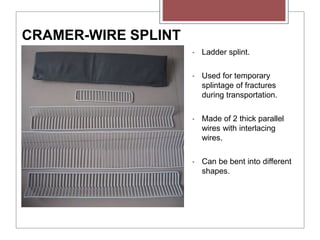
CRAMER-WIRE SPLINT
• Ladder splint.
• Used for temporary
splintage of fractures
during transportation.
• Made of 2 thick parallel
wires with interlacing
wires.
• Can be bent into different
shapes.
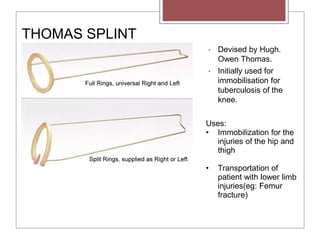
THOMAS SPLINT
Uses:
• Immobilization for the
injuries of the hip and
thigh
• Transportation of
patient with lower limb
injuries(eg: Femur
fracture)
• Devised by Hugh.
Owen Thomas.
• Initially used for
immobilisation for
tuberculosis of the
knee.
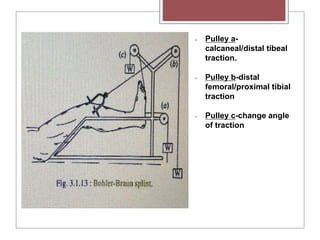
• Pulley a-
calcaneal/distal tibeal
traction.
• Pulley b-distal
femoral/proximal tibial
traction
• Pulley c-change angle
of traction
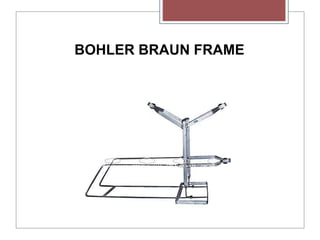
BOHLER BRAUN FRAME
Uses
• With traction:
-for lower limb injury with displacement/fragment overlap
• Without traction:
-soft tissue injury over the lower limb
ADVANTAGES
• Angle of traction can be changed without changing traction arrangements.
• Simultaneous tractions possible.
DISADVANTAGES
• Not suitable for transportation
CARE OF A PATIENT IN A SPLINT
• Splint should be properly applied, well padded at bony
prominences and at the fracture sites
• Bandage of the splint shouldn’t be too tight nor too loose.
• Patient should be encouraged to actively exercise the
muscles and the joints inside the splint as much as permitted.
• Any compression of nerve or vessel should be detected early
and managed accordingly.
• Daily checking and adjustments should be made.
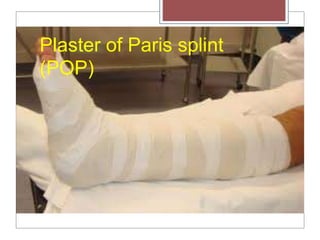
Plaster of Paris splint
(POP)
Outline
• Mechanism
• Functions
• Rules of application
• Application technique
• Complications
• POP care
Mechanism
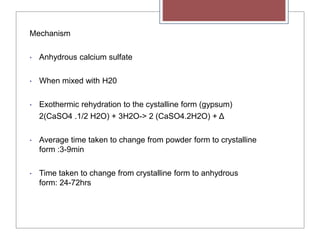
• Anhydrous calcium sulfate
• When mixed with H20
• Exothermic rehydration to the cystalline form (gypsum)
2(CaSO4 .1/2 H2O) + 3H2O-> 2 (CaSO4.2H2O) + Δ
• Average time taken to change from powder form to crystalline
form :3-9min
• Time taken to change from crystalline form to anhydrous
form: 24-72hrs
Functions
• Reduce pain
• Reduce further damage to vessels and nerves
• Facilitates patient transportation
• Immobilization of fracture site
Advantage
• Easier to mold
• Less expensive
Disadvantage
• More difficult to apply
• Gets soggy when getting wet
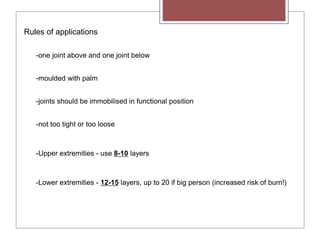
Rules of applications
-one joint above and one joint below
-moulded with palm
-joints should be immobilised in functional position
-not too tight or too loose
-Upper extremities - use 8-10 layers
-Lower extremities - 12-15 layers, up to 20 if big person (increased risk of burn!)
POP application technique
• Orthoban is rolled on it evenly
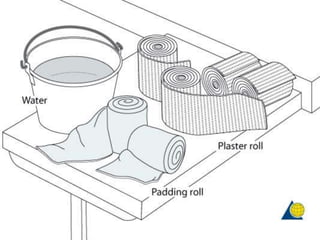
• POP is soaked in H2O until all the air bubbles
escape then hold on one end and gently
remove excess water from the plaster
• Apply POP evenly and smoothly
• Immediately mould the cast away from bony
points
Complications
• Tight cast – compartment syndrome
Prevention - elevate the limb
• Pressure sores
Prevention - padding all bony prominence before applying cast
• Skin abrasions/lacerations
(complication of removing POP)
• loose cast (not able to hold fracture securely)
Solution - replace cast
• Joint stiffness
Solution – physiotherapy
• Allergic dermatitis
Solution - fiberglass
POP care
• Not to expose POP cast to extreme heat /moisture
• Do not insert anything underneath cast
• Cover when taking bath
• Come back STAT if there is excessive swelling , bluish
or white discoloration of fingers /toes,numb, excessive
pain,crack
References
 http://www.orthobullets.com
 Orthopedics and fractures 4th ed. – T. Duckworth, C.M. Blundell
 Apley’s concise system of orthopedics and fractures – Louis Solomon
 ALL YOU NEED TO KNOW ABOUT SPLINTING - Konstantinos Gus
Agoritsas
 http://www.citizencorps.gov/cert/training_downloads.shtm
 Introduction to splinting - Jeff Harris
 emedicine.medscape.com/article/109769-overview

Ortho - Splinting, Traction, POP

  • 1.
    Traction Splinting Plaster of Paris Preparedby Dr.Poh & Dr.Wong June ‘14
  • 2.
    Fractures Principles of treatment 1.Reduce – restore the alignment of bone fragments • Manipulation • Mechanical traction • Operative reduction 2. Hold/Maintain reduction • Sustained traction • Traction by gravity • Balanced traction • Fixed traction • Cast splintage • Functional bracing • Internal fixation • External fixation 3. Rehabilitation/Exercise
  • 3.
    Outline • Introduction • Functions •Methods in Tractions -skin traction (indications/contraindications/complications) -skeletal traction (indications/application technique/pins/common sites/traction and site of fracture/contraindications/complications) • Types of traction • Post traction care
  • 4.
    TRACTION -Traction is amethod of restoring alignment to a fracture through gradual neutralisation of muscular forces -Traction is applied to the limb distal to the fracture, so as to exert a continuous pull in the long axis of the bone
  • 5.
    Functions • Reduction offractures and dislocations. • Reduce / relieve pain • Preventing deformities. • Correction of soft tissue contractures • Ensure immobilisation • Minimize muscle spasms
  • 6.
    General guidelines betweenskin traction and skeletal traction SKIN TRACTION SKELETAL TRACTION AGE Children and Adults Adults APPLIED WITH Adhesive plaster Pin,wire APPLIED Skin Bone Force to maintain reduction <5kg >5kg DURATION Short long
  • 7.
    Skin traction indications •Temporary management of # of NOF and IT # • Management of femoral shaft fracture • Undisplaced # of acetabulum • After reduction of dislocation of hip • To correct minor fixed flexion deformity of hip and knee
  • 8.
    Skin traction contraindications •Abrasion and lacerations of skin in the area to which traction is to be applied • Disturbance in blood circulation such as varicose vein or impending gangrene • Dermatitis
  • 9.
    Skin traction complications •Allergic reactions • Excoriation of skin • Pressure sores • Common peroneal nerve palsy
  • 10.
  • 11.
    Apply the overlyingbandages spirally, overlapping by half.
  • 12.
    Skeletal traction Indications • Forthose cases in which skin traction is contraindicated • Patients with external fixator in situ • Weight required for traction is more than 5kg
  • 13.
    Skeletal traction application •Under GA or LA • Area cleaned and draped • Mount the pin/wire on the hand drill • Identify the site of insertion and make a stab wound • Hold pin horizontally at right angles to the long axis of limb • Apply small cotton woolen pads soaked with povidone around the pins to seal the wound • Pin should pass only through skin, SC tissue and bone avoiding muscles and tendons
  • 14.
    Pins used • Steinmannpin • Denham pin - strong stout wires with a threaded portion in the middle. Used in cancellous bone like calcaneum and osteoporotic bone
  • 15.
    COMMON SITES FORSKELETAL TRACTION • Olecranon • Greater trochanter • Lower end of femur • Upper end of tibia • Lower end of tibia • Calcaneum
  • 16.
    Tractions and siteof fracture
  • 17.
    Olecranon Pin Traction-used for supracondylar and distal humerus fracture
  • 18.
    Upper femoral traction-usedfor medial or anterior force acetabular fracture
  • 19.
    Distal Femoral Traction– Used For Superior Force Acetabular Fracture And Femoral Shaft Fracture
  • 20.
    • Proximal tibialtraction – used for distal femoral shaft fracture
  • 21.
    Distal tibial traction– used for certain tibial plateau fracture
  • 22.
    Calcaneal traction- usedfor tibial shaft fracture and calcaneal fracture
  • 23.
    Skeletal traction complications •Mal union • Deformities • Ligamentous damage • Introduction of Infection into bone • Damage to epiphyseal growth plates • Nerve injuries
  • 24.
    •Fixed traction: Byapplying force against a fixed point of body •Traction by gravity: Only apply to fractures of upper limb •Balanced Traction: The pull is exerted against an opposing force, provided by the weight of body when the foot of bed is raised Types of traction based on mechanism
  • 25.
    CARE OF PATIENTIN TRACTION • Traction should be made comfortable. • Proper functioning of traction unit must be ensured. • Sensations over toes and fingers should be normal. • Proper position of fracture ensured by taking check xrays in traction. • Physiotherapy of limb should be continued to minimise muscle wasting.
  • 26.
    SPLINT - adevice used for support or immobilization of a limb or the spine. • Any material used to support a fracture is known as splint. • Unconventional. • Conventional.
  • 27.
    Outlines • Functions • Indications •Complications • Preparation • Types • Care of patient on splinting • POP
  • 28.
    Functions: • Temporary immobilizationof sprains, fractures, and reduced dislocations • Control of pain • Facilitates patient transportation • Prevention of further soft tissue or neurovascular injuries • Decreases risk of converting a minor injury to a major injury
  • 29.
    Indications for Splinting •Not just for fractures • Sprains • Joint Infections • Tenosynovitis • Lacerations over joints • Puncture wounds and animal bites of the hands and feet
  • 30.
    Complications of splinting •Rarely occur if applied correctly • Most common are sores, abrasions, and secondary infections from loose or ill-fitting splints. • Less common-neurovascular compromise from tight fitting splints, contact dermatitis, and thermal burns from heating of plaster.
  • 31.
    Preparation • Define injuryand what splint is required • Splint in position of function • Clean and repair skin lesions prior to splint application • Document neurovascular examination before splint application • Anticipate ability for child to remove clothes after splint is applied
  • 32.
    What kind ofsplints? • Fiberglass splints • Prefabricated splints • Air splints •Plaster splints(POP)
  • 33.
  • 34.
    Fiberglass Splints Advantage • Easierto apply • Set more quickly • Lighter • Water resistant Disadvantage • More expensive • More difficult to mold
  • 35.
    Prefabricated splints • Plasticshells lined with air cells, foam, or gel components • Same advantages and disadvantages as fiber glass splints Prefabricated splint for wrist joint Prefabricated splint for knee joint
  • 36.
    Air/Pneumatic splint • Anair splint is used to immobilize a fracture using an inflatable support. • They are plastic structures preformed in a factory to fit a specific part of the body. • Typically, an air splint wraps around an arm or leg and holds the bones still while the patient is moved to hospital. • This type of splint is not generally used for longterm support of a fracture as it is less secure and provides less structural support than plaster splints or fiberglass splints.
  • 37.
  • 38.
    Air splint onupper limb
  • 39.
    Specific Splints andOrthoses Upper Extremity • Elbow/Forearm – Long Arm Posterior – Double Sugar - Tong • Forearm/Wrist – Volar Forearm / Cockup – Sugar - Tong • Hand/Fingers – Ulnar Gutter – Radial Gutter – Thumb Spica – Finger Splints Lower Extremity • Knee – Knee Immobilizer – Posterior Knee Splint • Ankle – Posterior Ankle – Stirrup
  • 40.
    Long Arm PosteriorSplint • Indications – Elbow and forearm injuries: – Distal humerus fx – Both-bone forearm fx – Unstable proximal radius or ulna fx (sugar-tong better) • Doesn’t completely eliminate supination / pronation -either add an anterior splint or use a double sugar- tong if complex or unstable distal forearm fx.
  • 41.
    Forearm Sugar Tong •Indications – Distal radius and ulnar fx. • Prevents pronation / supination and immobilizes elbow.
  • 42.
    Double Sugar Tong •Indications – Elbow and forearm fx - prox/mid/distal radius and ulnar fx. – Better for most distal forearm and elbow fx because limits flex/extension and pronation / supination. 10 90
  • 43.
    Forearm Volar Splintaka ‘Cockup’ Splint • Indications – Soft tissue hand / wrist injuries - sprain, carpal tunnel night splints, etc – Most wrist fx, 2nd -5th metacarpal fx. – Most add a dorsal splint for increased stability - ‘sandwich splint’ (B). – Not used for distal radius or ulnar fx - can still supinate and pronate.
  • 44.
    Radial and UlnarGutter •Indications • Fractures, phalangeal and metacarpal, and soft tissue injuries of the little and ring fingers. •Indications • Fractures, phalangeal and metacarpal, and soft tissue injuries of index and long fingers.
  • 45.
    Thumb Spica • Indications –Scaphoid fx - seen or suspected (check snuffbox tenderness) – De Quervain tenosynovitis. • Notching the plaster (shown) prevents buckling when wrapping around thumb. • Wine glass position.
  • 46.
    Finger Splints • Sprains- dynamic splinting (buddy taping). • Dorsal/Volar finger splints - phalangeal fx, though gutter splints probably better for proximal fxs.
  • 47.
    Knee Immobilizer /PosteriorKnee Splint Indications: • Short term immobilization of soft tissue and ligamentous injuries to the knee or calf. • Allows slight flexion and extension - may add posterior knee splint to further immobilize the knee.
  • 48.
    Posterior Ankle Splint •Indications – Distal tibia/fibula fx. – Reduced dislocations – Severe sprains – Tarsal / metatarsal fx • Use at least 12-15 layers of plaster. • Adding a coaptation splint (stirrup) to the posterior splint eliminates inversion / eversion - especially useful for unstable fx and sprains.
  • 49.
    Stirrup Splint • Indications –Similiar to posterior splint. – Less inversion /eversion and actually less plantar flexion compared to posterior splint. – Great for ankle sprains. – 12-15 layers of 4-6 inch plaster.
  • 50.
    Complications • Burns – Thermalinjury as plaster dries – Hot water, Increased number of layers, extra fast-drying, poor padding - all increase risk – If significant pain - remove splint to cool • Ischemia – Reduced risk compared to casting but still a possibility – Do not apply Webril and ace wraps tightly – Instruct to ice and elevate extremity – Close follow up if high risk for swelling, ischemia. – When in doubt, cut it off and look – Remember - pulses lost late. • Pressure sores – Smooth Webril and plaster well • Infection – Clean, debride and dress all wounds before splint application – Recheck if significant wound or increasing pain
  • 51.
    CRAMER-WIRE SPLINT • Laddersplint. • Used for temporary splintage of fractures during transportation. • Made of 2 thick parallel wires with interlacing wires. • Can be bent into different shapes.
  • 52.
    THOMAS SPLINT Uses: • Immobilizationfor the injuries of the hip and thigh • Transportation of patient with lower limb injuries(eg: Femur fracture) • Devised by Hugh. Owen Thomas. • Initially used for immobilisation for tuberculosis of the knee.
  • 53.
    • Pulley a- calcaneal/distaltibeal traction. • Pulley b-distal femoral/proximal tibial traction • Pulley c-change angle of traction
  • 54.
  • 55.
    Uses • With traction: -forlower limb injury with displacement/fragment overlap • Without traction: -soft tissue injury over the lower limb ADVANTAGES • Angle of traction can be changed without changing traction arrangements. • Simultaneous tractions possible. DISADVANTAGES • Not suitable for transportation
  • 56.
    CARE OF APATIENT IN A SPLINT • Splint should be properly applied, well padded at bony prominences and at the fracture sites • Bandage of the splint shouldn’t be too tight nor too loose. • Patient should be encouraged to actively exercise the muscles and the joints inside the splint as much as permitted. • Any compression of nerve or vessel should be detected early and managed accordingly. • Daily checking and adjustments should be made.
  • 57.
    Plaster of Parissplint (POP)
  • 58.
    Outline • Mechanism • Functions •Rules of application • Application technique • Complications • POP care
  • 60.
    Mechanism • Anhydrous calciumsulfate • When mixed with H20 • Exothermic rehydration to the cystalline form (gypsum) 2(CaSO4 .1/2 H2O) + 3H2O-> 2 (CaSO4.2H2O) + Δ • Average time taken to change from powder form to crystalline form :3-9min • Time taken to change from crystalline form to anhydrous form: 24-72hrs
  • 61.
    Functions • Reduce pain •Reduce further damage to vessels and nerves • Facilitates patient transportation • Immobilization of fracture site
  • 62.
    Advantage • Easier tomold • Less expensive Disadvantage • More difficult to apply • Gets soggy when getting wet
  • 63.
    Rules of applications -onejoint above and one joint below -moulded with palm -joints should be immobilised in functional position -not too tight or too loose -Upper extremities - use 8-10 layers -Lower extremities - 12-15 layers, up to 20 if big person (increased risk of burn!)
  • 64.
    POP application technique •Orthoban is rolled on it evenly • POP is soaked in H2O until all the air bubbles escape then hold on one end and gently remove excess water from the plaster • Apply POP evenly and smoothly • Immediately mould the cast away from bony points
  • 65.
    Complications • Tight cast– compartment syndrome Prevention - elevate the limb • Pressure sores Prevention - padding all bony prominence before applying cast • Skin abrasions/lacerations (complication of removing POP) • loose cast (not able to hold fracture securely) Solution - replace cast • Joint stiffness Solution – physiotherapy • Allergic dermatitis Solution - fiberglass
  • 66.
    POP care • Notto expose POP cast to extreme heat /moisture • Do not insert anything underneath cast • Cover when taking bath • Come back STAT if there is excessive swelling , bluish or white discoloration of fingers /toes,numb, excessive pain,crack
  • 68.
    References  http://www.orthobullets.com  Orthopedicsand fractures 4th ed. – T. Duckworth, C.M. Blundell  Apley’s concise system of orthopedics and fractures – Louis Solomon  ALL YOU NEED TO KNOW ABOUT SPLINTING - Konstantinos Gus Agoritsas  http://www.citizencorps.gov/cert/training_downloads.shtm  Introduction to splinting - Jeff Harris  emedicine.medscape.com/article/109769-overview