Intra-Medullary Nailing
Ponnilavan
1. Evolution of intramedullary nailing
2. Effect of reaming on IM nailing
3. Biomechanics of IM nailing
Evolution of intramedullary nailing
• Now in fourth generation of nails, rapid growth and driving force???
• Driving forces:
– Radiographic imaging
– Biomaterial design
– Computer assisted manufacturing
– Realizing the importance of early mobilization of patient
• IM nailing has evolved over past 75 years
• Past 33 years IM nailing of femur has become gold standard
Evolution of intramedullary nailing
• 1st written record from 15th century from interaction from Spanish
and Aztecs
• Aztecs used wooden sticks for pseudoarthrosis
• In 1800s Heine used ivory for IM pining
• 1886 Bircher used same(Ivory) in German
• Gluck attempted IM osseous implants in late 1800s
• Lejahrs introduced concept of longer devices for stability
• Ambotte in Belgium introduced metalic IM pins
• Hey groves(England) made and surgically implanted solid
metal and hollow metal implants
• These were isolated cases without adoption by medical
community
• Smith-Petersen(1925):
– Used nail with 3 flanges for hip fractures
– Open reduction and nailing- widely accepted
– 1st concepts of biocompatible material
– Used intra-op radiographic control
• Johansen added cannulation for guide wire
Smith-Petersen Nail
• Gerhardt Kuntscher:
– Father of IM nailing
– Developed concepts and principles- foundation for 1st gen nails
– Explained principles of stable canal filling IM constructs
– Reported experimental evidence for biological effects of marrow
filling
– Believed optimal fracture healing would happened only with stable
nail construct
Gerhardt Kuntscher contd….
• Described 3 construct options:
– Pins: controls alignment only
– Canal filling rod: Controls alignment and translation
– Nail: Controls alignment, translation, rotation and length
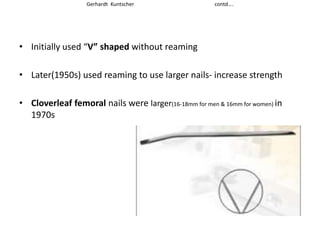
• Initially used “V” shaped without reaming
• Later(1950s) used reaming to use larger nails- increase strength
• Cloverleaf femoral nails were larger(16-18mm for men & 16mm for women) in
1970s
Gerhardt Kuntscher contd….
Kuntscher Cloverleaf Nail
• Stiff proportional to strength of nail/construct
• If too stiff, could break bone unstable construct
• If too small, flexible unstable  non-union
• In 1st multicenter after WWII study Smith stated:
– Given the proper indications, IM fixation is the most effective form of
therapy for many fractures of the shaft of the femur
• That statement was then modified:
– This technique, if applied to improperly selected cases, or if
ineffectively or unskillfully carried out, offers more possibilities of
trouble than any other so the English, Americans & Australians
rejected it
1947 – 1977- left nailing in disregard
• 3 major obstacles to adoption of nailing in north America:
– Conflicting bone healing theories
– Material, manufacturing & surgical technique errors
– Lack of radiographic image intensifying device and techniques
Theories of bone healing
• Evolved in 1700-1800s
• Alberct Haller’s believed than bone was deposited in response to
injury
– From vascular regeneration around the injury zone as a deposition of salts
1. Duhamel(France) described importance of periosteal soft tissue &
cambium layer
2. John Godsir(England) described the osteoblasts, belived osteoblast
as primary origin of repair
• Current concept/view:
– Combination of these 2 school of thoughts
– Callus is complex repair mechanism incorporating:
• Vascular proliferation
• Cell differentiation
• Mechanical factor role
• Stem cell migration & molecular modulation
Theories of bone healing cotd……
• United states and England after WWII were behind Germans in
material fabrication and radiographic imaging
• Implant failure cases due to lack of:
– Uniform manufacturing
– Medical grade materials
– Unavailability of fluoroscopic imaging
– Due to lack of imaging techniques US & UK opted for open nailing
• US & UK justification for open nailing:
– Osteoblast as primary organ of repair
– Avoid complication of fat embolism
Next step in 1st gen nail
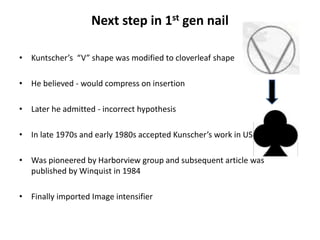
• Kuntscher’s “V” shape was modified to cloverleaf shape
• He believed - would compress on insertion
• Later he admitted - incorrect hypothesis
• In late 1970s and early 1980s accepted Kunscher’s work in US
• Was pioneered by Harborview group and subsequent article was
published by Winquist in 1984
• Finally imported Image intensifier
Second generation nailing
• Use of bicortical screws proximal & distal to fracture
• Controls length and rotation
• In 1972 Klemm & Schellam introduced 1st commercially available
interlocking nail
• Used cloverleaf design with interlocking screws with permission of
Kunscher
• Ended in high rate of implant failure due to rotational
instability(due open section design)
1st commercial interlocking nail
• Difficulty of placing locking screws focused on design of implants and
instruments
• Kempf et al introduced semi-closed nail with proximal cylinder and
distal targeting device for placing locking screws
• Used both static and dynamic lock based on surgeons preference
Second generation nailing Contd…….
• Semi-closed nail with proximal cylinder and distal targeting device
for placing locking screws Used in US with excellent results in 1980s
surpassed closed reduction
• 10% malunion rate
• These patients were treated with non-weight bearing
Closed section nail
• Different approach evolved in Memphis with goal of immediate weight
bearing
• Static construct to avoid mal-union
• To enhance stability(rotational) & increase fatigue life
• Resulted in fragmentation of bone from hoop stress during insertion
• Rheinlander believed closed section nail is not in favor as it caused more
damage to endosteal vascularity
Second generation nailing Contd…….
Russel and Taylor contribution
• Conceptualized closed section nail by designing bending stiffness
less than intact femur with 50% rotational stability to maximized
fatigue failure
• introduced 1st closed section IL nails, reported clinical results in
1986
• Brumback in 1988 reported 99% union rate with no malunion with
static lock, 1% implant failure
Second generation nailing Contd…….
• Between 1980 & 1985 closed reduction and traction for femur
fracture was replaced by Interlocking nails:
– With early mobilization
– Less hospital stay
• Russel-Taylor designed smaller stronger nails to allow less reaming
for bone conservation
• Standard sized(for femur) became 10-12mm
Second generation nailing Contd…….
• Cephalomedullary nail developed by Kuntscher for proximal
femur fractures
• Replaced plating for subtrochanteric fractures
• Retrograde nailing:
– Introduced by Seligson, Green & Henry for supracondylar fractures
– Now extended use for shaft of femur
Second generation nailing Contd…….
• In 1990s issues of endosteal vascularity disturbance reconsidered
advantages of reaming
• But unreamed nailing did not attain adequate stability with lower union
rates
• Then issue of pulmonary complications of reaming lead to reevaluation of
reamer head design
Second generation nailing Contd…….
Third generation nailing
• From 1998 to 2008 resulted from analysis of failures of 2nd gen
nails
• Involved material and structural change
• Surgeons also expanded indication for metaphyseal fractures:
– Inadequate stabilization
– High screw breakage rates with 2nd gen
• Titanium alloys screws used- more fatigue resistant
• IL screws fail by axial loading
• Can be reduced by multiaxial screw placement- more stable
• Krettek et al. improved nail stability by introducing pollar screws,
initially for tibia
• This additional blocking screws ensured translational and angular
stability
Third generation nailing Contd……
• In 1990s entry portal errors and malalignment were problems
• Russell et al documented decreased rate of malunion of proximal
femur with minimally invasive technique for entry portal
• Piriformis or trochanteric entry was dependent on nail design
• Reduction of fractures evolved through flexible wires and extensive
imaging
Third generation nailing Contd……
• Fracture table or with minimal manipulation is institution dependent-
both are equally effective
• Manual traction:
– Reduced operating time
– But required more skilled assistants
• Traction table:
– Widespread used
– In retrograde nailing cannot be used
Third generation nailing Contd……
• Supine nailing or lateral position:
– Supine is commonly performed
– Lateral has advantages for performing intramedullary
osteotomies
Third generation nailing Contd……
Fourth generation nailing
• Combination of all 3 generations
• With options to address infections, telemetry to ascertain status of
bone regeneration and mechanical reconstitution
• Newer techniques:
– Surface engineering with active or passive coupling of antibiotics
– Non-iodizing sensor technology for screw placement
– Sensors to change in pH around nail
– Load stress telemetry to asses stiffness progression at fracture site
Recent advancement
• Motorized Intramedullary nail for management of limb length
discrepancy
• Uses reliable-remote controlled mechanisms for distraction osteogenesis
• Provide reliable fragment stabilization
Motorized Intramedullary nail Contd…
• Accurate control of rate and rhythm of distraction
• Used magnetic and electrical remote control to distract
• Outcomes are promising
• Patient selection is crucial
Schneider
nail
Hansen-Street
nail
Sampson fluted
nail
Kuntschner
nail
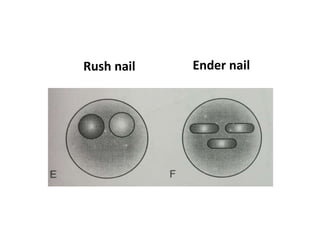
Rush nail Ender nail
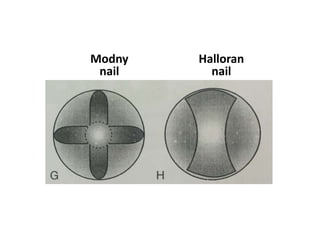
Modny
nail
Halloran
nail
Huckstep
nail
AO universal
nail
Grosse & Kempf
nail
Russel-Taylor
nail
Principle
• Extends from one end to other through medullary canal acting as splint
• Allows axial forces to be transmitted to opposing ends of fragments and
prevents angulation, translation and to some extent rotatory movements
• Contact between nail and bone exits between entry point, marrow and at
the cancellous epiphysis region of opposite side
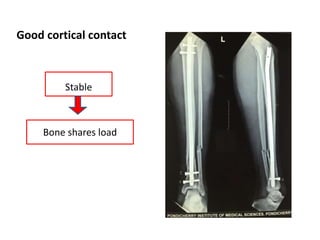
Good cortical contact
Bone shares load
Stable
Bend/break
No Cortical Contact
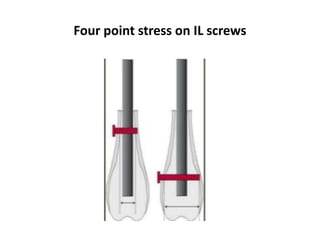
Stress on Interlocking(IL) screws
Four point stress on screws
Nail transmits load
Four point stress on IL screws
Effect of nailing on vascularity & bone
• Vascular supply of bone:
– Inner 2/3rd - endosteal supply
– Outer 1/3rd - periosteal supply
Fracture
Necrosis of 50-70% of cortex near #
Nailing
Further affected
Reaming
Endosteal supply regenerates
around nail (proportional to
space around nail)
Periosteal supply traverses
into endosteum
Marrow infiltration into
marrow supply
Damage to endosteal
supply
Attempt to increase endosteal
vascularity
Necrosis Fat embolism
Unreamed Reamed
Reaming and vascularity
• Revascularization starts from periosteal side
• Delayed by close/tight fitting nail
• Takes 12 weeks for regeneration
• Sometimes regeneration of nutrient artery may not occur for 6
months
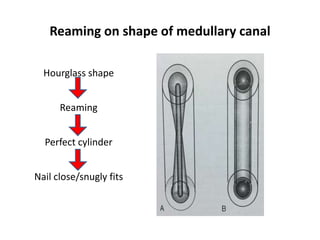
Reaming on shape of medullary canal
Hourglass shape
Reaming
Perfect cylinder
Nail close/snugly fits
Reaming and pressure in medullar canal
• Heat and pressure are by–products of reaming
• Hydraulic builds up after reaming and far exceeds BP
Increased by:
• Material in cavity like blood, clots,
fat & bone pieces
• Low clearance head
Reduced by:
• Removing material periodically
• Using hollow reamer
• Narrow shaft reamer
• Reaming:
– Increases systemic inflammatory response(2nd hit response)
– Should be gentle and slow
Thermal effect of reaming
• Heat- by-product
• Rise of temperature of 44.60C had negative effect of healing on cell
enzymes
• Threshold for Osteonecrosis is 470C for 1 minute
Increased by:
• Blunt reamer
• High speed
• High thrust
New reamer design
Reamer-Irrigator-Aspirator(RIA)
• Developed to:
– Reduce fat embolism
– Thermal necrosis
• RIA System:
– Shaft with continuous irrigation and aspiration system with closed
suction bag
– Reaming material collected is an ideal autograft
Reamer-Irrigator-Aspirator(RIA)
Bone healing after nailing
Snug/tight fitting nail
Affects endosteal
revascularization
Delayed
healing
Thin/loose fitting nail
Unstable construct
Delayed/
Non-union
Vs
• Strength of fixation:
• Shape
• Diameter
• Area of nail in contact with bone
• Material
• Working length
• Fracture reduction
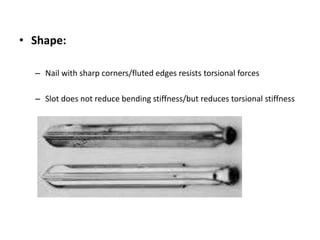
• Shape:
– Nail with sharp corners/fluted edges resists torsional forces
– Slot does not reduce bending stiffness/but reduces torsional stiffness
Nail diameter
– More important factor in determining nail strength
– Nail with diameter of 12 mm and thickness of 2mm has bending stiffness
equal to intact femur
– 16mm nail is:
• 1.5 times stiff as 14mm nail
• 2.5 times stiff as 12mm nail
Curves
• Straight, curved or helical
• Long bone has curved medullary canal
• Nails- accommodate curvatures
• Straight nail insertion- stress and may rupture bone
Curves Cotd….
• Maximum axial force at 3/4th of insertion
• Axial insertion produces hoop stress
• May split cortex
• Over reaming by 0.5-1mm makes insertion easier and reduces hoop
stress
Nail length and working length
I. Total nail length
II. Length of nail-bone contact
III. Working length
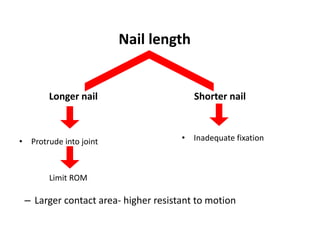
Nail length
– Larger contact area- higher resistant to motion
Longer nail
• Protrude into joint
Limit ROM
Shorter nail
• Inadequate fixation
Working length
• Length of nail spanning the fracture from its distal point of fixation in proximal
fragment to proximal point of fixation in distal fragment
• Distance between two points on either side of fracture where the bone firmly
grips nail
• Thus it is the unsuported portion of nail on either side of fracture
Working length and fixation
• Bending stiffness of nail is inversely proportional to square of its
working length
• Torsional stiffness is inversely proportional to its working length
• Shorter working length means stronger fixation
Factors influencing working length
Reaming
• Reduces working length
• Adds rotational/torsional stability
Interlocking nailing
• Modify working length
• Gives greater torsional stability
Increases stability
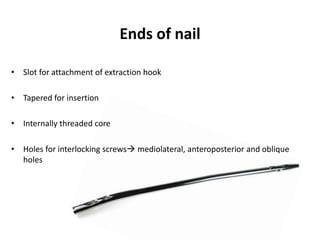
Ends of nail
• Slot for attachment of extraction hook
• Tapered for insertion
• Internally threaded core
• Holes for interlocking screws mediolateral, anteroposterior and oblique
holes
Inter-locking screws
• Weakest portion- shaft thread junction
• Partially threaded  purchase on one cortex backs out easily
screw failure
• Fully threaded & threads at either ends has better hold on both the
cortex
• Core diameter- determines strength
• Titanium screws improves strength
Inter-locking screws
Thread at one end Fully threaded Thread at Both end
Weakest
portion
Multiple nails
• Several smaller diameter nails inserted
• Stability- 3 or 4 point fixation
• Gives more bending stiffness than torsional stiffness
• Surgical exposure is minimal
Vs
Reamed nailing
• Improved nail bone contact
• Improved stability
• Increases use of larger nail
• Reduced chance of bone splinting
Non-reamed nailing
• Preferable in Compound fractures
• Suitable for tibia, humerus and
forearm
Safe Practices in reaming
• Don’t use torniquet
• Use ball-tipped guide wire
• Attention to sound and speed of reamer- if slowing and catching harbinger of jamming
• On jamming, withdraw with full power and re-advance
• Flexible reamer should be used only in forward direction
• Guide wire should be stabilized while reaming
• Follow 1st pass of guide wire under C-Arm
• Ream with increments of 0.5mm
• Overream with 2mm
• Remove reamer and clean bone debris frequently
• Use high-torque, low-rpm power source
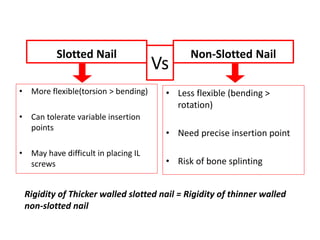
• More flexible(torsion > bending)
• Can tolerate variable insertion
points
• May have difficult in placing IL
screws
• Less flexible (bending >
rotation)
• Need precise insertion point
• Risk of bone splinting
Rigidity of Thicker walled slotted nail = Rigidity of thinner walled
non-slotted nail
Vs
Slotted Nail Non-Slotted Nail
Slotted NailNon-Slotted Nail
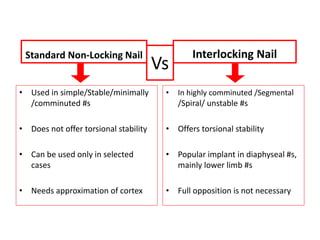
• Used in simple/Stable/minimally
/comminuted #s
• Does not offer torsional stability
• Can be used only in selected
cases
• Needs approximation of cortex
• In highly comminuted /Segmental
/Spiral/ unstable #s
• Offers torsional stability
• Popular implant in diaphyseal #s,
mainly lower limb #s
• Full opposition is not necessary
Vs
Standard Non-Locking Nail Interlocking Nail
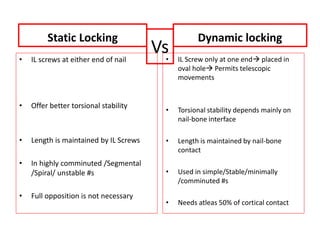
• IL screws at either end of nail
• Offer better torsional stability
• Length is maintained by IL Screws
• In highly comminuted /Segmental
/Spiral/ unstable #s
• Full opposition is not necessary
• IL Screw only at one end placed in
oval hole Permits telescopic
movements
• Torsional stability depends mainly on
nail-bone interface
• Length is maintained by nail-bone
contact
• Used in simple/Stable/minimally
/comminuted #s
• Needs atleas 50% of cortical contact
Vs
Static Locking Dynamic locking
Polar Screw and biomechanics
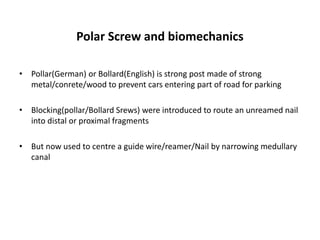
• Pollar(German) or Bollard(English) is strong post made of strong
metal/conrete/wood to prevent cars entering part of road for parking
• Blocking(pollar/Bollard Srews) were introduced to route an unreamed nail
into distal or proximal fragments
• But now used to centre a guide wire/reamer/Nail by narrowing medullary
canal
Intra-Op Post-Op
Placing a polar screw
• Drill bit, screws, locking bolt can be used
• While placing it should leave adequate space for medullary devices
• Chance of reamer jamming against pollar screws better to ream under
C-Arm guidance
• Increased primary stability of metaphyseal #s
• Effective in preventing malalignment and stability
Distal Locking Screws
• Resists axial and torsional loading
• Stress on screws is very high in unreamed cases
• Two distal screws should be used if distal fragment is less than 60% of
distance between mid-shaft and knee joint line
• Prevents toggling
• Amount of toggling proportional to:
– Length of distal fragment
– Number of distal screws
– Postion of screws
Distal Locking Screws Contd…..
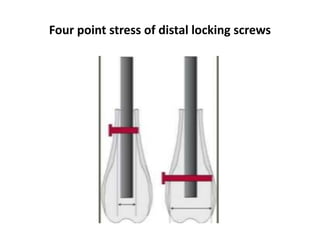
Four point stress of distal locking screws
Stress on distal femoral locking screw
Closer the fracture to
screw
Less cortical contact
of nail
Increased
stress
Stress on distal femoral locking screw
Increased four
point stress
Increased width of femoral
condyles
Increased unsupported
portion of screw
Antibiotic impregnated IM Nail(AIIN)
• PMMA(Bone Cement) elute antibiotics coated nail
• Its heat stable, good elution property and few harmful
effects on bone healing
• Ideal AIIN:
– Heat stable
– Inert
– Smooth surfaced
Dynamization
• Indicated- risk of non-union
• Removing static screw from long segment, maintaining adequate
control over short segment
• Removing from short segment/premature removing:
– Shortening
– Instability
– Non-union
Open Nailing
• Fracture site opened
• Fracture biological environment disturbed
• Hematoma removed/disturbed
• Soft tissue damage-periosteal vascularity disturbed
• Chance of infection- 6 times Vs Closed nailing
• Chance of Non-Union- 10 times Vs Closed nailing
Thank You

Im nail

  • 1.
  • 2.
    1. Evolution ofintramedullary nailing 2. Effect of reaming on IM nailing 3. Biomechanics of IM nailing
  • 3.
  • 4.
    • Now infourth generation of nails, rapid growth and driving force??? • Driving forces: – Radiographic imaging – Biomaterial design – Computer assisted manufacturing – Realizing the importance of early mobilization of patient
  • 5.
    • IM nailinghas evolved over past 75 years • Past 33 years IM nailing of femur has become gold standard
  • 6.
    Evolution of intramedullarynailing • 1st written record from 15th century from interaction from Spanish and Aztecs • Aztecs used wooden sticks for pseudoarthrosis • In 1800s Heine used ivory for IM pining • 1886 Bircher used same(Ivory) in German • Gluck attempted IM osseous implants in late 1800s
  • 7.
    • Lejahrs introducedconcept of longer devices for stability • Ambotte in Belgium introduced metalic IM pins • Hey groves(England) made and surgically implanted solid metal and hollow metal implants • These were isolated cases without adoption by medical community
  • 8.
    • Smith-Petersen(1925): – Usednail with 3 flanges for hip fractures – Open reduction and nailing- widely accepted – 1st concepts of biocompatible material – Used intra-op radiographic control • Johansen added cannulation for guide wire
  • 9.
  • 10.
    • Gerhardt Kuntscher: –Father of IM nailing – Developed concepts and principles- foundation for 1st gen nails – Explained principles of stable canal filling IM constructs – Reported experimental evidence for biological effects of marrow filling – Believed optimal fracture healing would happened only with stable nail construct
  • 12.
    Gerhardt Kuntscher contd…. •Described 3 construct options: – Pins: controls alignment only – Canal filling rod: Controls alignment and translation – Nail: Controls alignment, translation, rotation and length
  • 13.
    • Initially used“V” shaped without reaming • Later(1950s) used reaming to use larger nails- increase strength • Cloverleaf femoral nails were larger(16-18mm for men & 16mm for women) in 1970s Gerhardt Kuntscher contd….
  • 14.
  • 15.
    • Stiff proportionalto strength of nail/construct • If too stiff, could break bone unstable construct • If too small, flexible unstable  non-union
  • 16.
    • In 1stmulticenter after WWII study Smith stated: – Given the proper indications, IM fixation is the most effective form of therapy for many fractures of the shaft of the femur • That statement was then modified: – This technique, if applied to improperly selected cases, or if ineffectively or unskillfully carried out, offers more possibilities of trouble than any other so the English, Americans & Australians rejected it
  • 17.
    1947 – 1977-left nailing in disregard • 3 major obstacles to adoption of nailing in north America: – Conflicting bone healing theories – Material, manufacturing & surgical technique errors – Lack of radiographic image intensifying device and techniques
  • 18.
    Theories of bonehealing • Evolved in 1700-1800s • Alberct Haller’s believed than bone was deposited in response to injury – From vascular regeneration around the injury zone as a deposition of salts 1. Duhamel(France) described importance of periosteal soft tissue & cambium layer 2. John Godsir(England) described the osteoblasts, belived osteoblast as primary origin of repair
  • 19.
    • Current concept/view: –Combination of these 2 school of thoughts – Callus is complex repair mechanism incorporating: • Vascular proliferation • Cell differentiation • Mechanical factor role • Stem cell migration & molecular modulation Theories of bone healing cotd……
  • 20.
    • United statesand England after WWII were behind Germans in material fabrication and radiographic imaging • Implant failure cases due to lack of: – Uniform manufacturing – Medical grade materials – Unavailability of fluoroscopic imaging – Due to lack of imaging techniques US & UK opted for open nailing
  • 21.
    • US &UK justification for open nailing: – Osteoblast as primary organ of repair – Avoid complication of fat embolism
  • 22.
    Next step in1st gen nail • Kuntscher’s “V” shape was modified to cloverleaf shape • He believed - would compress on insertion • Later he admitted - incorrect hypothesis • In late 1970s and early 1980s accepted Kunscher’s work in US • Was pioneered by Harborview group and subsequent article was published by Winquist in 1984 • Finally imported Image intensifier
  • 23.
  • 24.
    Second generation nailing •Use of bicortical screws proximal & distal to fracture • Controls length and rotation • In 1972 Klemm & Schellam introduced 1st commercially available interlocking nail • Used cloverleaf design with interlocking screws with permission of Kunscher • Ended in high rate of implant failure due to rotational instability(due open section design)
  • 25.
  • 26.
    • Difficulty ofplacing locking screws focused on design of implants and instruments • Kempf et al introduced semi-closed nail with proximal cylinder and distal targeting device for placing locking screws • Used both static and dynamic lock based on surgeons preference Second generation nailing Contd…….
  • 27.
    • Semi-closed nailwith proximal cylinder and distal targeting device for placing locking screws Used in US with excellent results in 1980s surpassed closed reduction • 10% malunion rate • These patients were treated with non-weight bearing
  • 28.
    Closed section nail •Different approach evolved in Memphis with goal of immediate weight bearing • Static construct to avoid mal-union • To enhance stability(rotational) & increase fatigue life • Resulted in fragmentation of bone from hoop stress during insertion • Rheinlander believed closed section nail is not in favor as it caused more damage to endosteal vascularity Second generation nailing Contd…….
  • 29.
    Russel and Taylorcontribution • Conceptualized closed section nail by designing bending stiffness less than intact femur with 50% rotational stability to maximized fatigue failure • introduced 1st closed section IL nails, reported clinical results in 1986 • Brumback in 1988 reported 99% union rate with no malunion with static lock, 1% implant failure Second generation nailing Contd…….
  • 30.
    • Between 1980& 1985 closed reduction and traction for femur fracture was replaced by Interlocking nails: – With early mobilization – Less hospital stay • Russel-Taylor designed smaller stronger nails to allow less reaming for bone conservation • Standard sized(for femur) became 10-12mm Second generation nailing Contd…….
  • 31.
    • Cephalomedullary naildeveloped by Kuntscher for proximal femur fractures • Replaced plating for subtrochanteric fractures • Retrograde nailing: – Introduced by Seligson, Green & Henry for supracondylar fractures – Now extended use for shaft of femur Second generation nailing Contd…….
  • 32.
    • In 1990sissues of endosteal vascularity disturbance reconsidered advantages of reaming • But unreamed nailing did not attain adequate stability with lower union rates • Then issue of pulmonary complications of reaming lead to reevaluation of reamer head design Second generation nailing Contd…….
  • 33.
  • 34.
    Third generation nailing •From 1998 to 2008 resulted from analysis of failures of 2nd gen nails • Involved material and structural change • Surgeons also expanded indication for metaphyseal fractures: – Inadequate stabilization – High screw breakage rates with 2nd gen
  • 35.
    • Titanium alloysscrews used- more fatigue resistant • IL screws fail by axial loading • Can be reduced by multiaxial screw placement- more stable • Krettek et al. improved nail stability by introducing pollar screws, initially for tibia • This additional blocking screws ensured translational and angular stability Third generation nailing Contd……
  • 36.
    • In 1990sentry portal errors and malalignment were problems • Russell et al documented decreased rate of malunion of proximal femur with minimally invasive technique for entry portal • Piriformis or trochanteric entry was dependent on nail design • Reduction of fractures evolved through flexible wires and extensive imaging Third generation nailing Contd……
  • 37.
    • Fracture tableor with minimal manipulation is institution dependent- both are equally effective • Manual traction: – Reduced operating time – But required more skilled assistants • Traction table: – Widespread used – In retrograde nailing cannot be used Third generation nailing Contd……
  • 38.
    • Supine nailingor lateral position: – Supine is commonly performed – Lateral has advantages for performing intramedullary osteotomies Third generation nailing Contd……
  • 39.
    Fourth generation nailing •Combination of all 3 generations • With options to address infections, telemetry to ascertain status of bone regeneration and mechanical reconstitution • Newer techniques: – Surface engineering with active or passive coupling of antibiotics – Non-iodizing sensor technology for screw placement – Sensors to change in pH around nail – Load stress telemetry to asses stiffness progression at fracture site
  • 40.
    Recent advancement • MotorizedIntramedullary nail for management of limb length discrepancy • Uses reliable-remote controlled mechanisms for distraction osteogenesis • Provide reliable fragment stabilization
  • 42.
    Motorized Intramedullary nailContd… • Accurate control of rate and rhythm of distraction • Used magnetic and electrical remote control to distract • Outcomes are promising • Patient selection is crucial
  • 43.
  • 44.
  • 45.
  • 46.
  • 47.
  • 48.
  • 49.
    Principle • Extends fromone end to other through medullary canal acting as splint • Allows axial forces to be transmitted to opposing ends of fragments and prevents angulation, translation and to some extent rotatory movements • Contact between nail and bone exits between entry point, marrow and at the cancellous epiphysis region of opposite side
  • 51.
    Good cortical contact Boneshares load Stable
  • 52.
    Bend/break No Cortical Contact Stresson Interlocking(IL) screws Four point stress on screws Nail transmits load
  • 53.
    Four point stresson IL screws
  • 54.
    Effect of nailingon vascularity & bone • Vascular supply of bone: – Inner 2/3rd - endosteal supply – Outer 1/3rd - periosteal supply Fracture Necrosis of 50-70% of cortex near # Nailing Further affected
  • 55.
    Reaming Endosteal supply regenerates aroundnail (proportional to space around nail) Periosteal supply traverses into endosteum Marrow infiltration into marrow supply Damage to endosteal supply Attempt to increase endosteal vascularity Necrosis Fat embolism
  • 56.
  • 57.
    Reaming and vascularity •Revascularization starts from periosteal side • Delayed by close/tight fitting nail • Takes 12 weeks for regeneration • Sometimes regeneration of nutrient artery may not occur for 6 months
  • 58.
    Reaming on shapeof medullary canal Hourglass shape Reaming Perfect cylinder Nail close/snugly fits
  • 59.
    Reaming and pressurein medullar canal • Heat and pressure are by–products of reaming • Hydraulic builds up after reaming and far exceeds BP Increased by: • Material in cavity like blood, clots, fat & bone pieces • Low clearance head Reduced by: • Removing material periodically • Using hollow reamer • Narrow shaft reamer
  • 60.
    • Reaming: – Increasessystemic inflammatory response(2nd hit response) – Should be gentle and slow
  • 61.
    Thermal effect ofreaming • Heat- by-product • Rise of temperature of 44.60C had negative effect of healing on cell enzymes • Threshold for Osteonecrosis is 470C for 1 minute Increased by: • Blunt reamer • High speed • High thrust
  • 62.
  • 63.
    Reamer-Irrigator-Aspirator(RIA) • Developed to: –Reduce fat embolism – Thermal necrosis • RIA System: – Shaft with continuous irrigation and aspiration system with closed suction bag – Reaming material collected is an ideal autograft
  • 64.
  • 65.
    Bone healing afternailing Snug/tight fitting nail Affects endosteal revascularization Delayed healing Thin/loose fitting nail Unstable construct Delayed/ Non-union Vs
  • 66.
    • Strength offixation: • Shape • Diameter • Area of nail in contact with bone • Material • Working length • Fracture reduction
  • 67.
    • Shape: – Nailwith sharp corners/fluted edges resists torsional forces – Slot does not reduce bending stiffness/but reduces torsional stiffness
  • 68.
    Nail diameter – Moreimportant factor in determining nail strength – Nail with diameter of 12 mm and thickness of 2mm has bending stiffness equal to intact femur – 16mm nail is: • 1.5 times stiff as 14mm nail • 2.5 times stiff as 12mm nail
  • 69.
    Curves • Straight, curvedor helical • Long bone has curved medullary canal • Nails- accommodate curvatures • Straight nail insertion- stress and may rupture bone
  • 70.
    Curves Cotd…. • Maximumaxial force at 3/4th of insertion • Axial insertion produces hoop stress • May split cortex • Over reaming by 0.5-1mm makes insertion easier and reduces hoop stress
  • 71.
    Nail length andworking length I. Total nail length II. Length of nail-bone contact III. Working length
  • 72.
    Nail length – Largercontact area- higher resistant to motion Longer nail • Protrude into joint Limit ROM Shorter nail • Inadequate fixation
  • 73.
    Working length • Lengthof nail spanning the fracture from its distal point of fixation in proximal fragment to proximal point of fixation in distal fragment • Distance between two points on either side of fracture where the bone firmly grips nail • Thus it is the unsuported portion of nail on either side of fracture
  • 74.
    Working length andfixation • Bending stiffness of nail is inversely proportional to square of its working length • Torsional stiffness is inversely proportional to its working length • Shorter working length means stronger fixation
  • 75.
    Factors influencing workinglength Reaming • Reduces working length • Adds rotational/torsional stability Interlocking nailing • Modify working length • Gives greater torsional stability Increases stability
  • 76.
    Ends of nail •Slot for attachment of extraction hook • Tapered for insertion • Internally threaded core • Holes for interlocking screws mediolateral, anteroposterior and oblique holes
  • 77.
    Inter-locking screws • Weakestportion- shaft thread junction • Partially threaded  purchase on one cortex backs out easily screw failure • Fully threaded & threads at either ends has better hold on both the cortex • Core diameter- determines strength • Titanium screws improves strength
  • 78.
    Inter-locking screws Thread atone end Fully threaded Thread at Both end Weakest portion
  • 79.
    Multiple nails • Severalsmaller diameter nails inserted • Stability- 3 or 4 point fixation • Gives more bending stiffness than torsional stiffness • Surgical exposure is minimal
  • 80.
    Vs Reamed nailing • Improvednail bone contact • Improved stability • Increases use of larger nail • Reduced chance of bone splinting Non-reamed nailing • Preferable in Compound fractures • Suitable for tibia, humerus and forearm
  • 81.
    Safe Practices inreaming • Don’t use torniquet • Use ball-tipped guide wire • Attention to sound and speed of reamer- if slowing and catching harbinger of jamming • On jamming, withdraw with full power and re-advance • Flexible reamer should be used only in forward direction • Guide wire should be stabilized while reaming • Follow 1st pass of guide wire under C-Arm • Ream with increments of 0.5mm • Overream with 2mm • Remove reamer and clean bone debris frequently • Use high-torque, low-rpm power source
  • 82.
    • More flexible(torsion> bending) • Can tolerate variable insertion points • May have difficult in placing IL screws • Less flexible (bending > rotation) • Need precise insertion point • Risk of bone splinting Rigidity of Thicker walled slotted nail = Rigidity of thinner walled non-slotted nail Vs Slotted Nail Non-Slotted Nail
  • 83.
  • 84.
    • Used insimple/Stable/minimally /comminuted #s • Does not offer torsional stability • Can be used only in selected cases • Needs approximation of cortex • In highly comminuted /Segmental /Spiral/ unstable #s • Offers torsional stability • Popular implant in diaphyseal #s, mainly lower limb #s • Full opposition is not necessary Vs Standard Non-Locking Nail Interlocking Nail
  • 85.
    • IL screwsat either end of nail • Offer better torsional stability • Length is maintained by IL Screws • In highly comminuted /Segmental /Spiral/ unstable #s • Full opposition is not necessary • IL Screw only at one end placed in oval hole Permits telescopic movements • Torsional stability depends mainly on nail-bone interface • Length is maintained by nail-bone contact • Used in simple/Stable/minimally /comminuted #s • Needs atleas 50% of cortical contact Vs Static Locking Dynamic locking
  • 86.
  • 87.
    Polar Screw andbiomechanics • Pollar(German) or Bollard(English) is strong post made of strong metal/conrete/wood to prevent cars entering part of road for parking • Blocking(pollar/Bollard Srews) were introduced to route an unreamed nail into distal or proximal fragments • But now used to centre a guide wire/reamer/Nail by narrowing medullary canal
  • 88.
  • 89.
    Placing a polarscrew • Drill bit, screws, locking bolt can be used • While placing it should leave adequate space for medullary devices • Chance of reamer jamming against pollar screws better to ream under C-Arm guidance • Increased primary stability of metaphyseal #s • Effective in preventing malalignment and stability
  • 90.
    Distal Locking Screws •Resists axial and torsional loading • Stress on screws is very high in unreamed cases • Two distal screws should be used if distal fragment is less than 60% of distance between mid-shaft and knee joint line • Prevents toggling
  • 91.
    • Amount oftoggling proportional to: – Length of distal fragment – Number of distal screws – Postion of screws Distal Locking Screws Contd…..
  • 92.
    Four point stressof distal locking screws
  • 93.
    Stress on distalfemoral locking screw Closer the fracture to screw Less cortical contact of nail Increased stress
  • 94.
    Stress on distalfemoral locking screw Increased four point stress Increased width of femoral condyles Increased unsupported portion of screw
  • 95.
    Antibiotic impregnated IMNail(AIIN) • PMMA(Bone Cement) elute antibiotics coated nail • Its heat stable, good elution property and few harmful effects on bone healing • Ideal AIIN: – Heat stable – Inert – Smooth surfaced
  • 96.
    Dynamization • Indicated- riskof non-union • Removing static screw from long segment, maintaining adequate control over short segment • Removing from short segment/premature removing: – Shortening – Instability – Non-union
  • 97.
    Open Nailing • Fracturesite opened • Fracture biological environment disturbed • Hematoma removed/disturbed • Soft tissue damage-periosteal vascularity disturbed • Chance of infection- 6 times Vs Closed nailing • Chance of Non-Union- 10 times Vs Closed nailing
  • 98.