Abdelaziz A Ibrahim
Ortho. Specialist
HSH
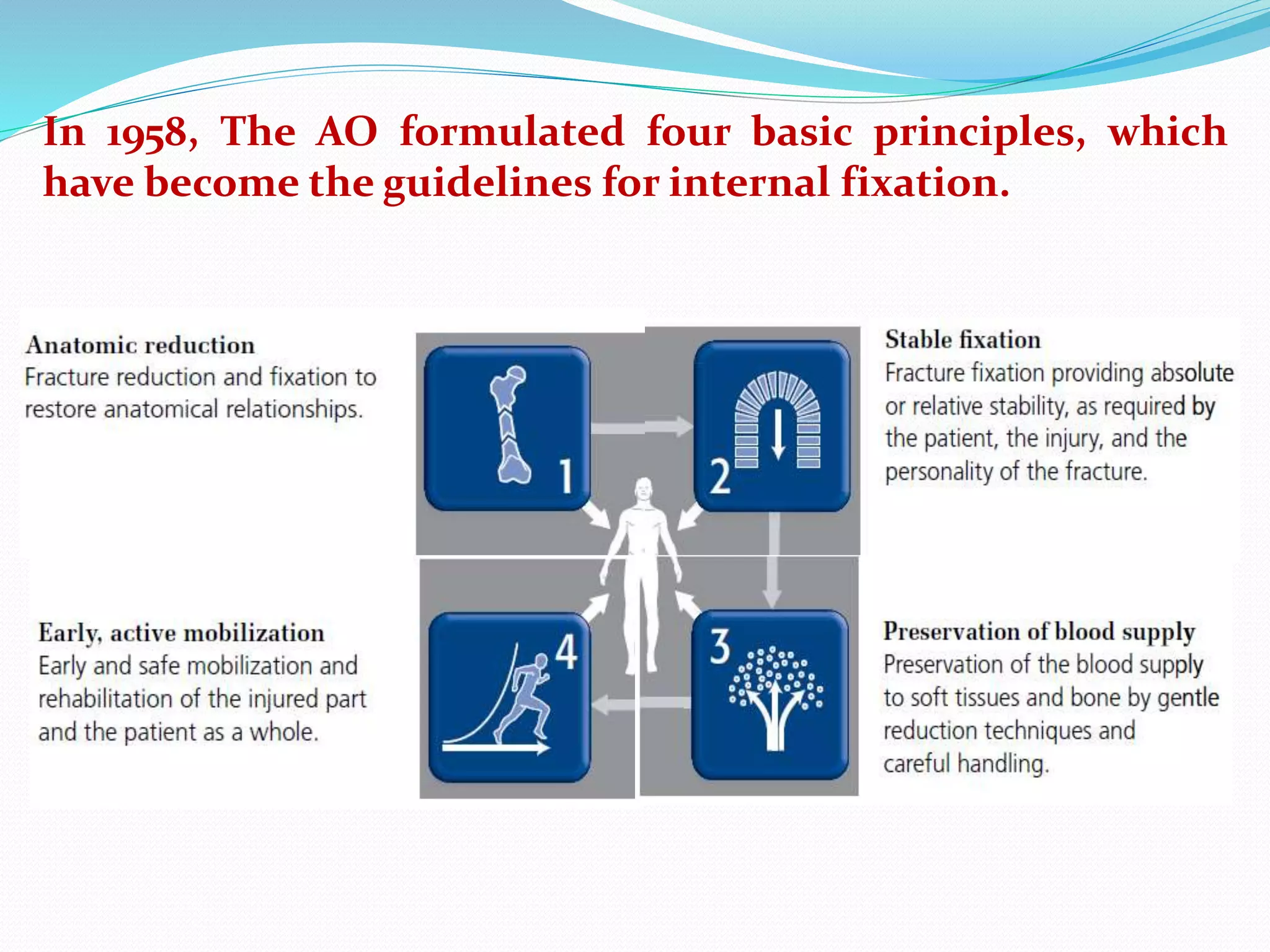
In 1958, The AO formulated four basic principles, which
have become the guidelines for internal fixation.
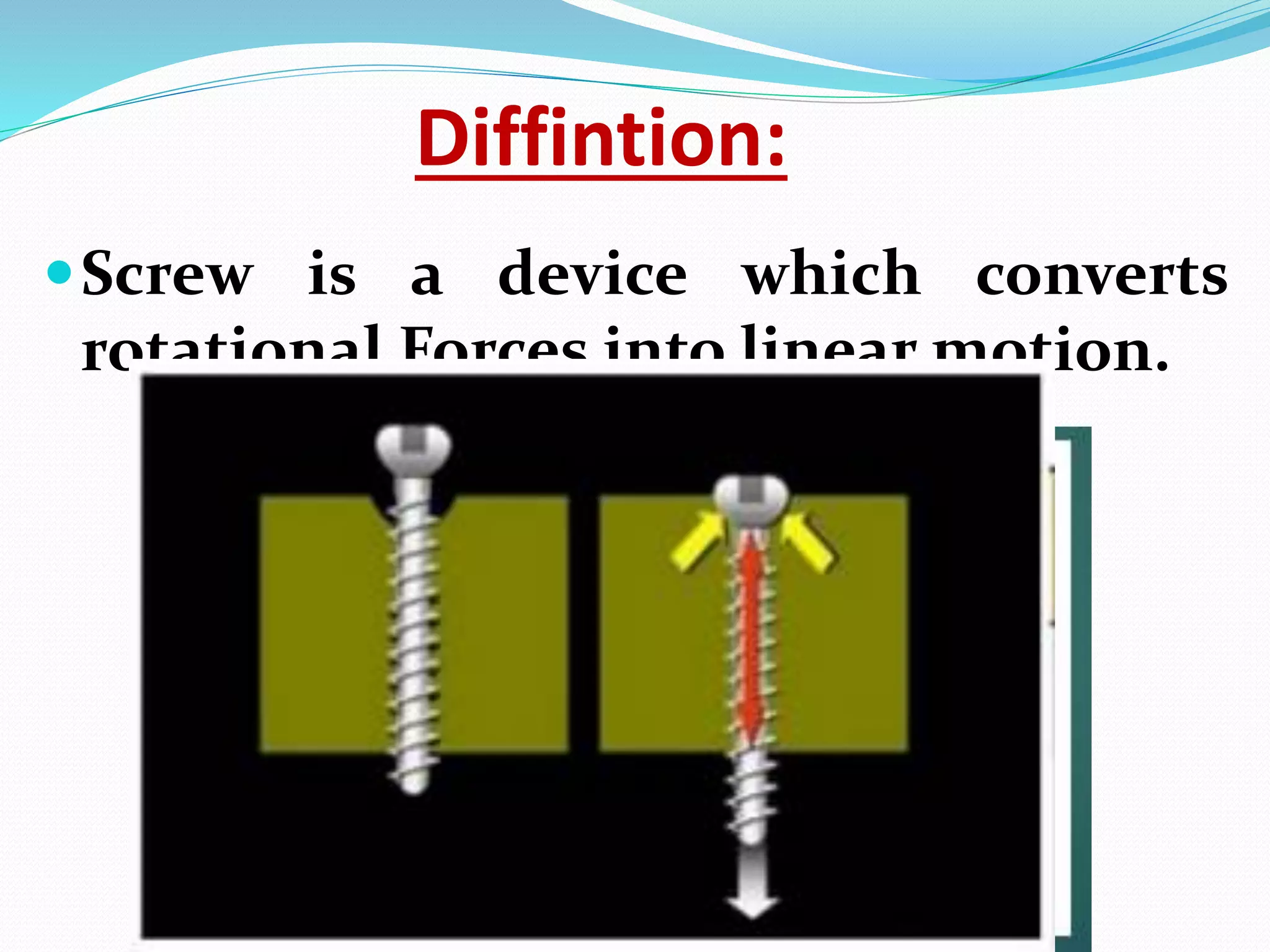
Diffintion:
Screw is a device which converts
rotational Forces into linear motion.
A screw has a core about which is wrapped a spiral
surface
Most surgical screws are made of Titanium or
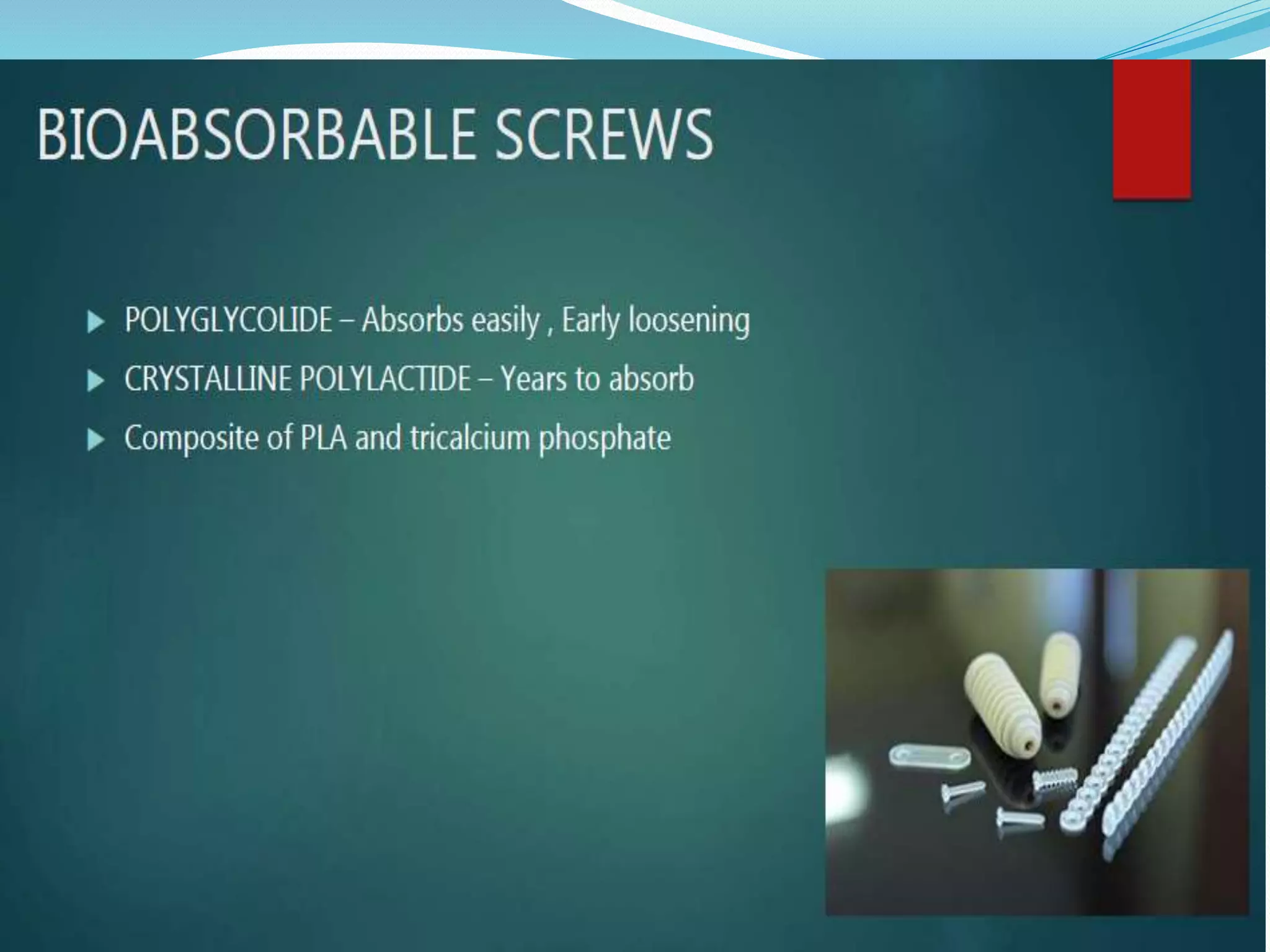
Stainless Steel or Bioabsorbable
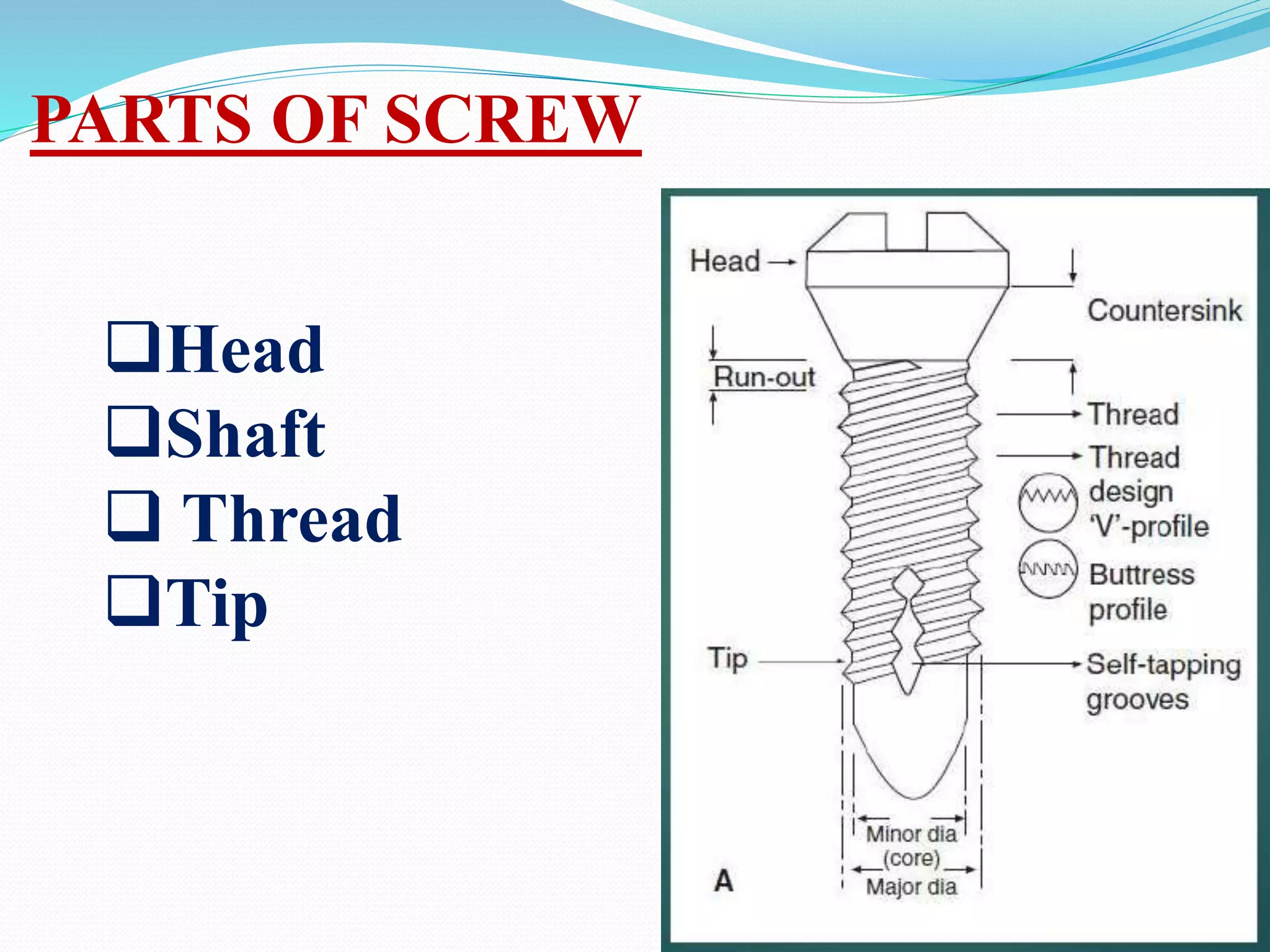
PARTS OF SCREW
Head
Shaft
 Thread
Tip
HEAD:
 Functions:
Attachment of a screwdriver – to apply torque
Arrest forward motion
A) Slotted
B) Cruciate
C) Philips
D)Hexagonal /
Allen
E) Torx Stardrive
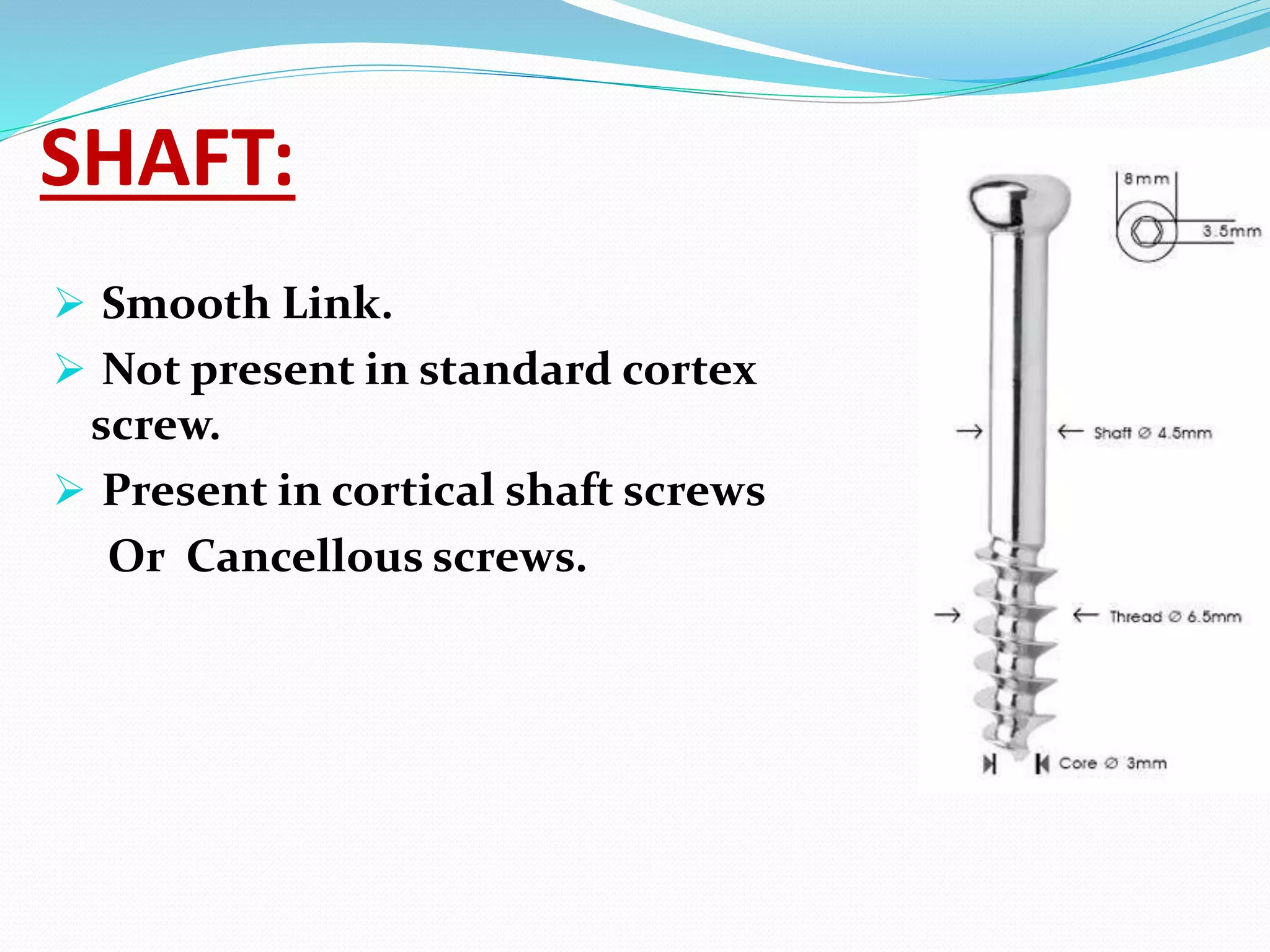
SHAFT:
 Smooth Link.
 Not present in standard cortex
screw.
 Present in cortical shaft screws
Or Cancellous screws.
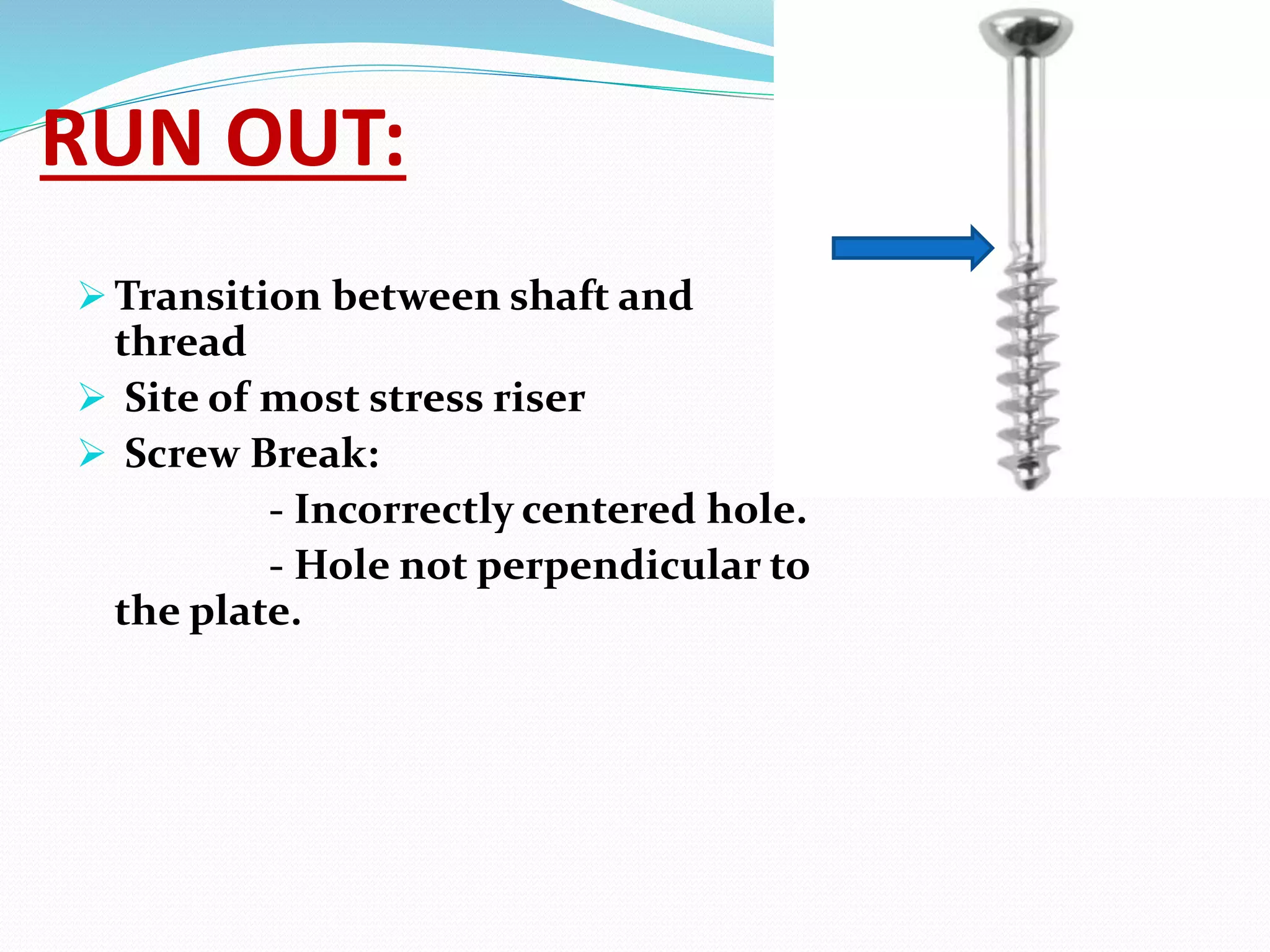
RUN OUT:
 Transition between shaft and
thread
 Site of most stress riser
 Screw Break:
- Incorrectly centered hole.
- Hole not perpendicular to
the plate.
THREAD:
DIAMETER:
 Thread diameter: Diameter across the maximum
thread width.
- Cancellous have larger thread diameter.
- Affects the pull out strength.
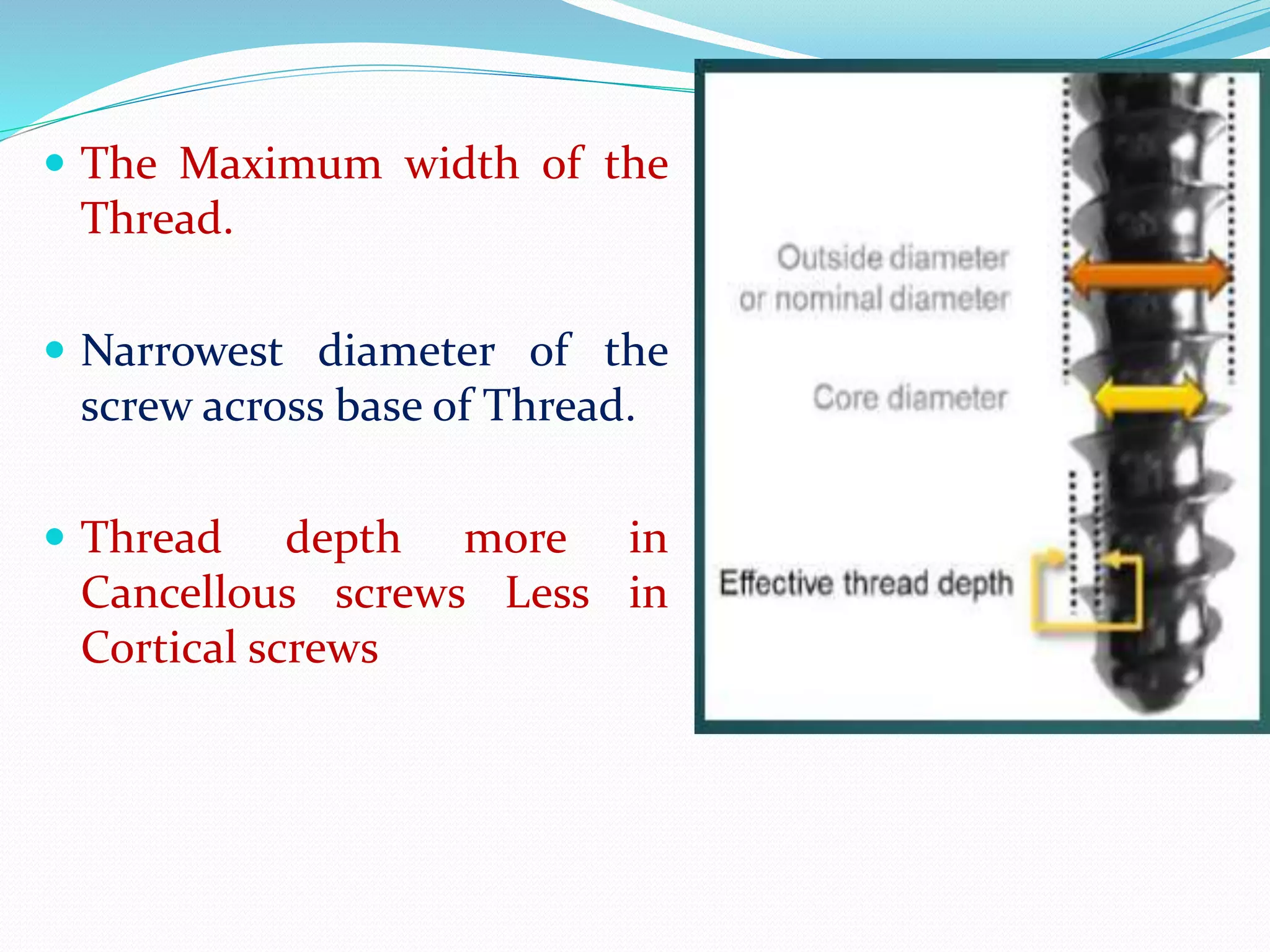
 The Maximum width of the
Thread.
 Narrowest diameter of the
screw across base of Thread.
 Thread depth more in
Cancellous screws Less in
Cortical screws
TIP:
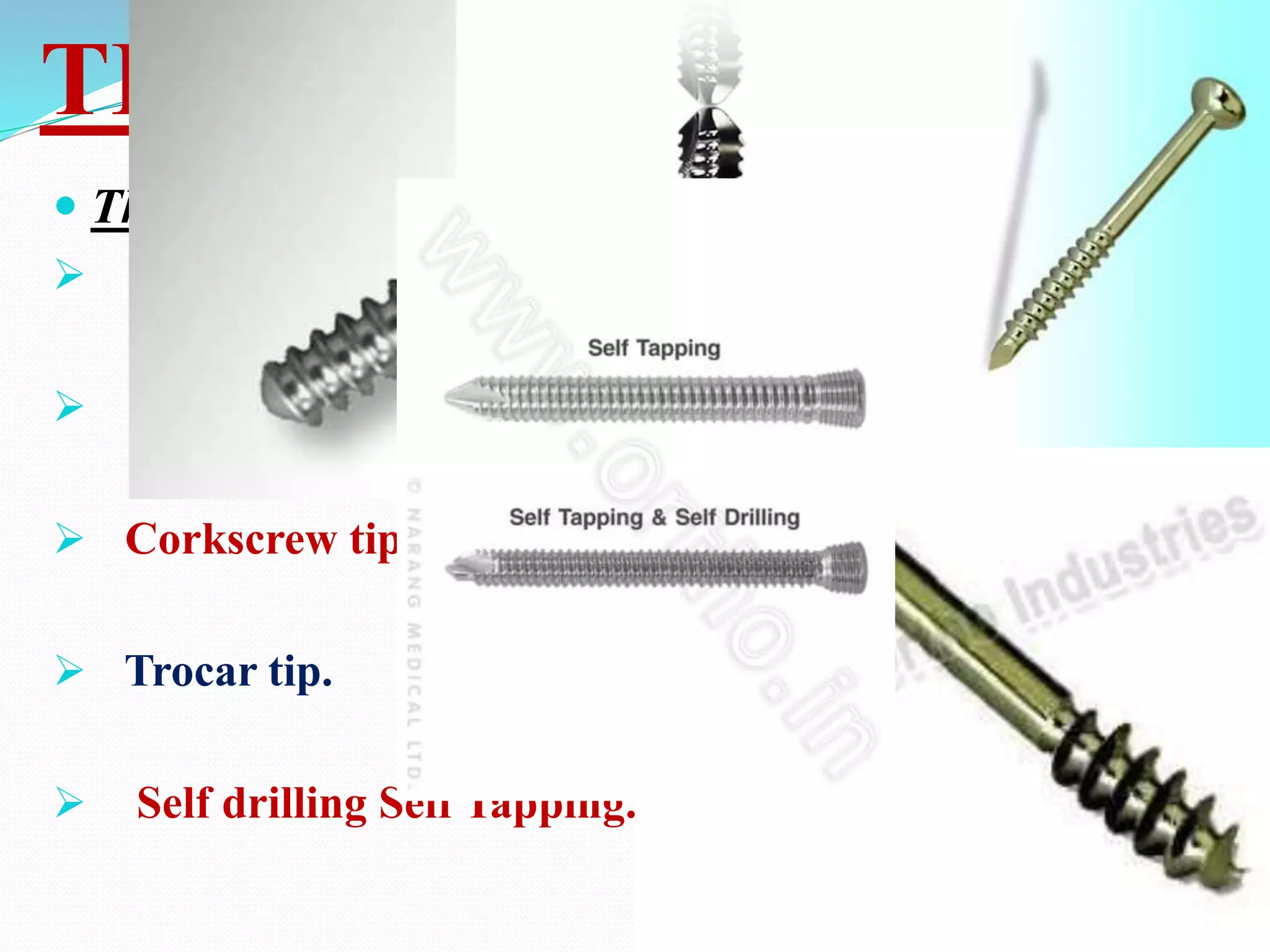
 There are five types of tips of bone screws.
 Non-self-tapping tip.
 Self-tapping tip.
 Corkscrew tip.
 Trocar tip.
 Self drilling Self Tapping.
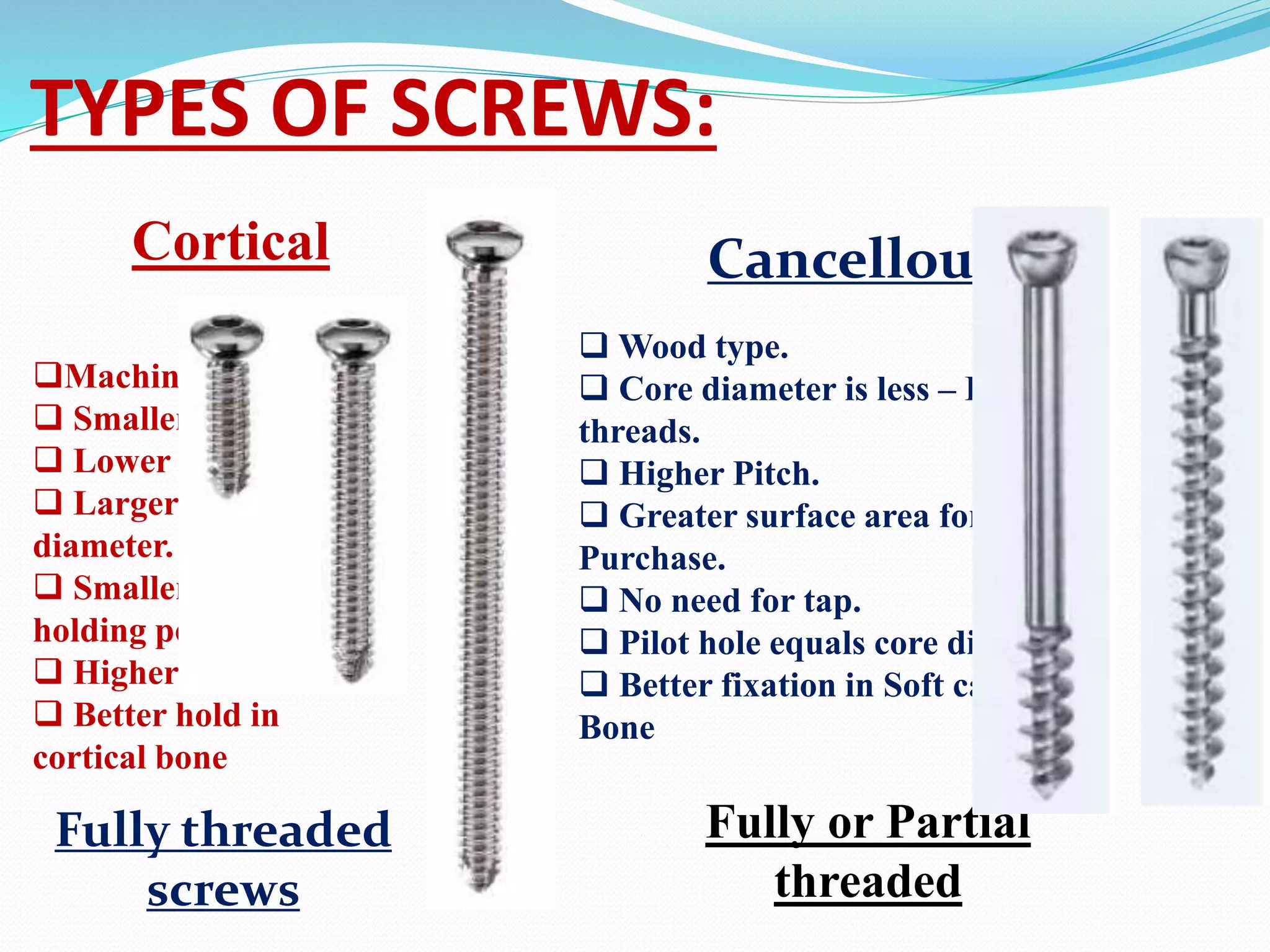
TYPES OF SCREWS:
Cortical Cancellous
Machine type.
 Smaller thread.
 Lower pitch.
 Larger core
diameter.
 Smaller pitch higher
holding power.
 Higher surface area.
 Better hold in
cortical bone
 Wood type.
 Core diameter is less – Larger
threads.
 Higher Pitch.
 Greater surface area for
Purchase.
 No need for tap.
 Pilot hole equals core diameter.
 Better fixation in Soft cancellous
Bone
Fully threaded
screws
Fully or Partial
threaded
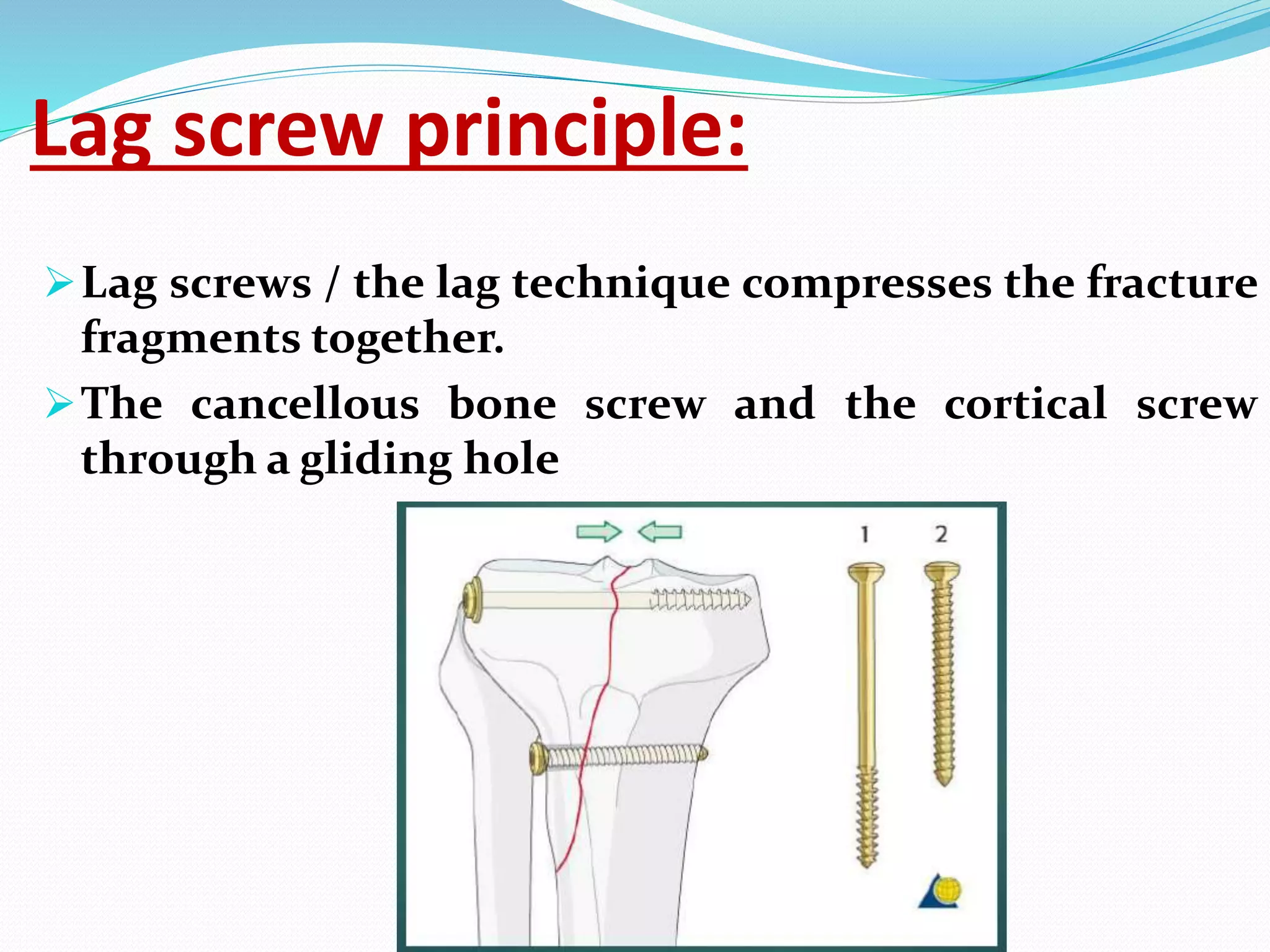
Lag screw principle:
Lag screws / the lag technique compresses the fracture
fragments together.
The cancellous bone screw and the cortical screw
through a gliding hole
Special Screws:
Herbert Screws:
Specialized implant to achieve interfragmentary
compression.
No head and threads on both ends with a pitch differential.
In small bones, such as the scaphoid, self compressing,
double pitch screws can be Used.
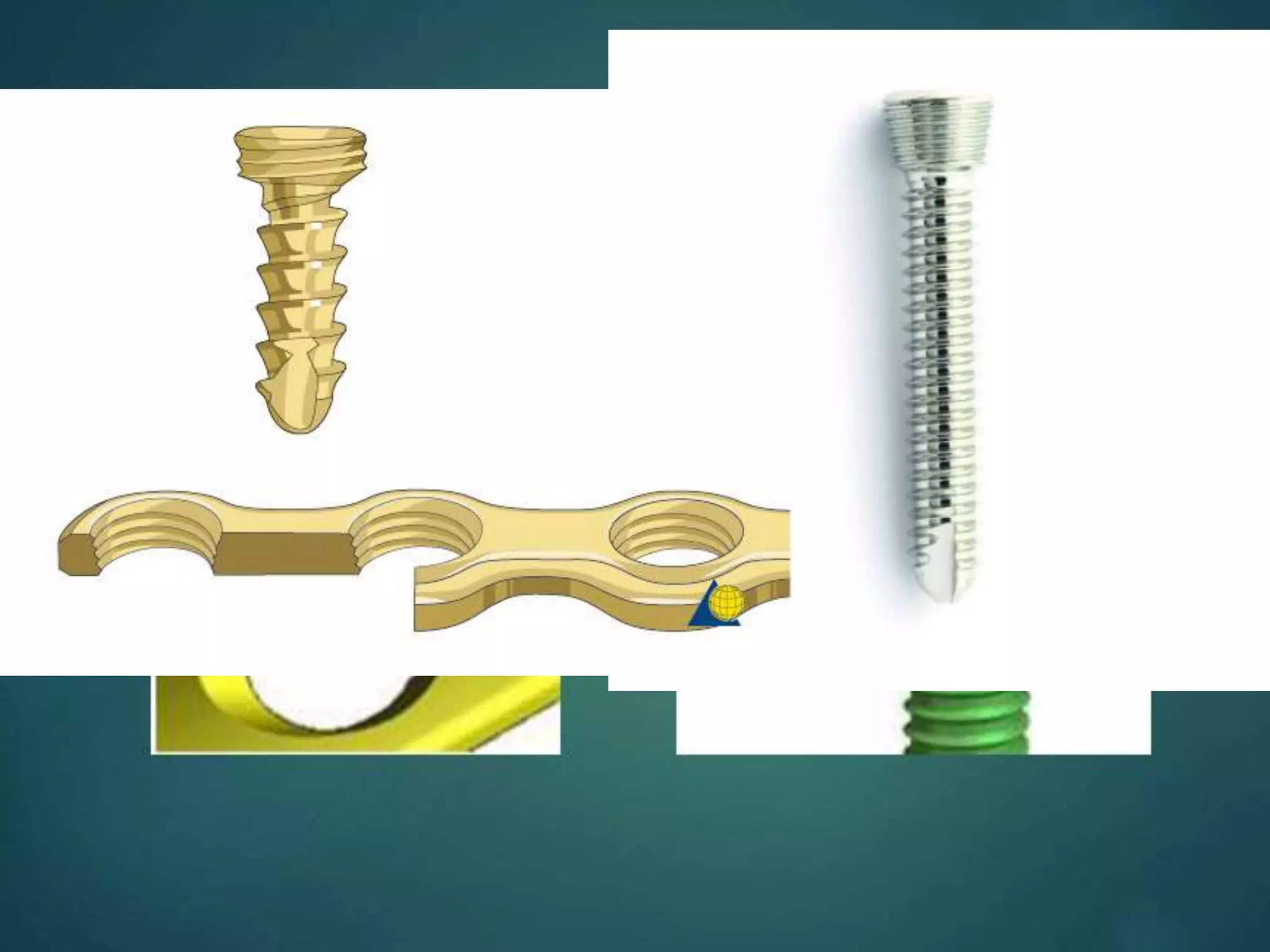
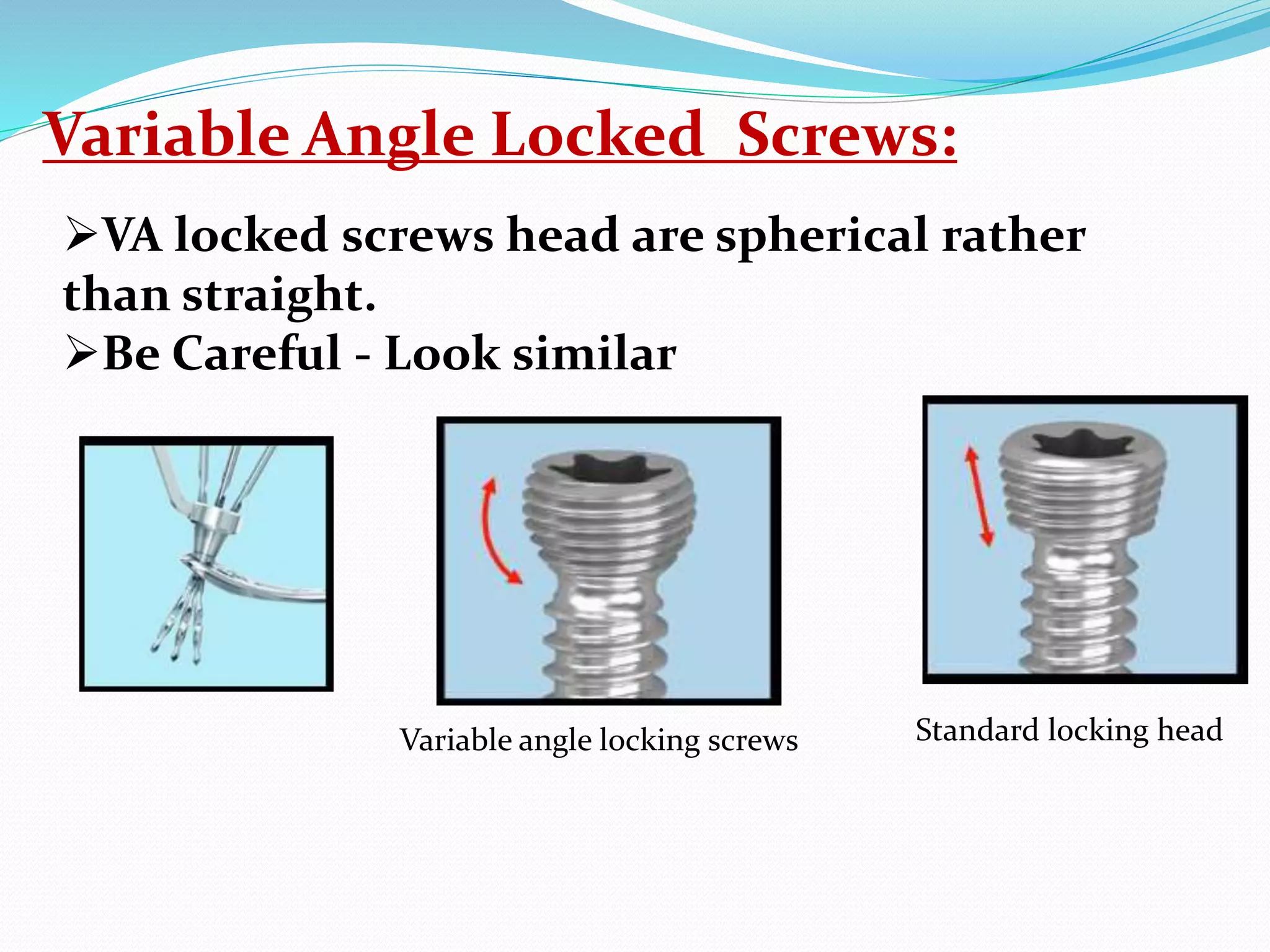
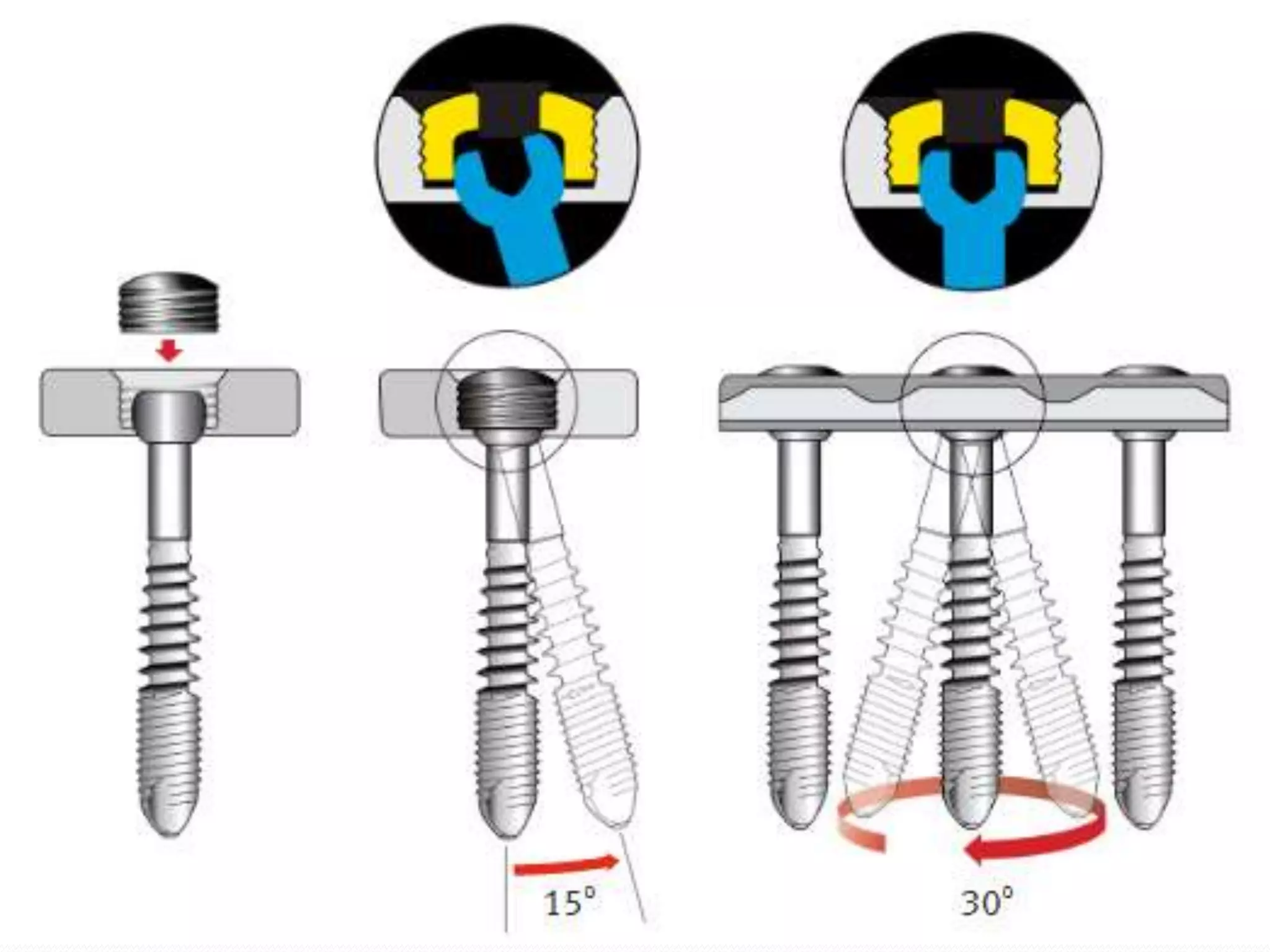
VA locked screws head are spherical rather
than straight.
Be Careful - Look similar
Variable angle locking screws Standard locking head
Variable Angle Locked Screws:
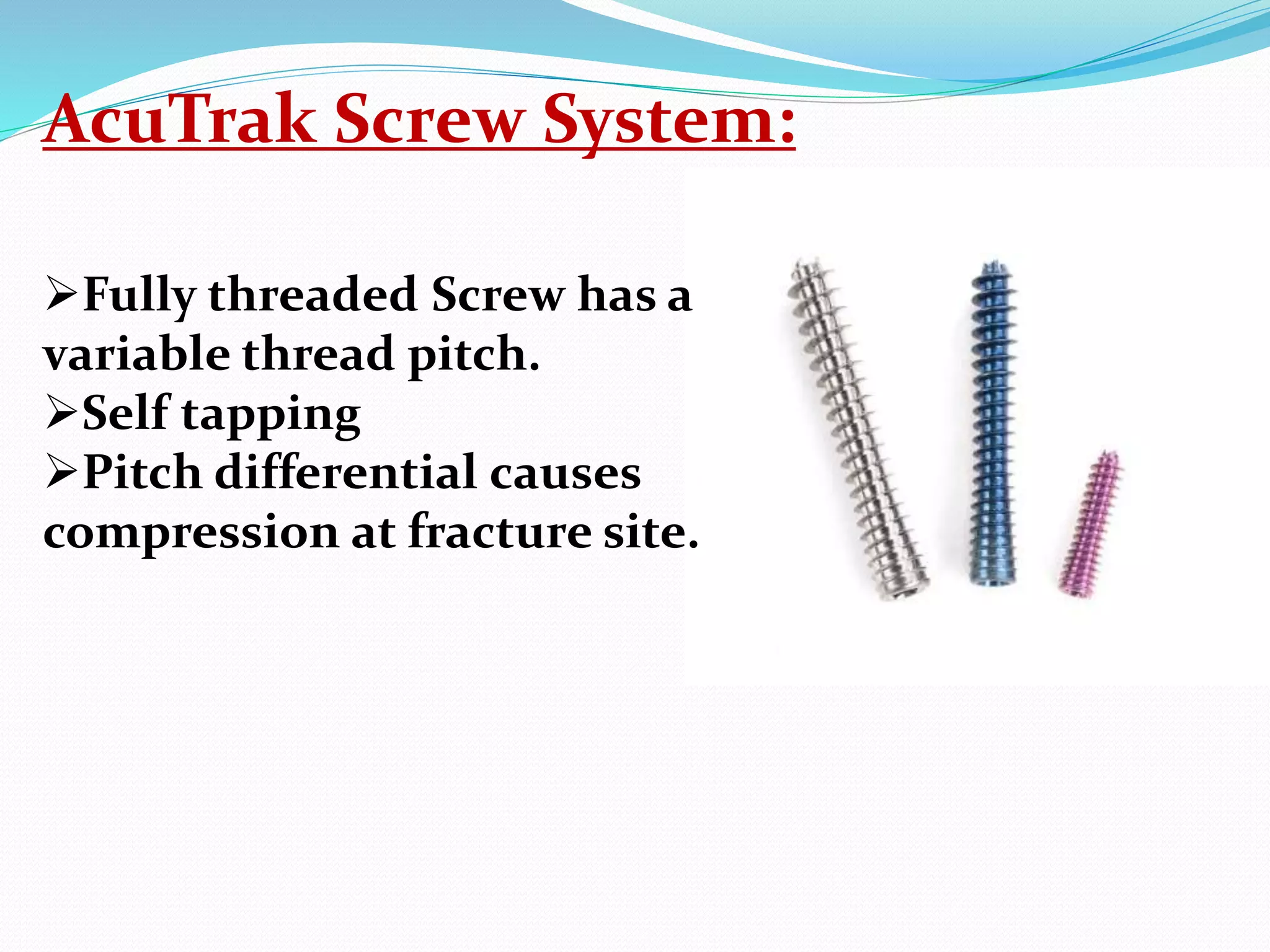
AcuTrak Screw System:
Fully threaded Screw has a
variable thread pitch.
Self tapping
Pitch differential causes
compression at fracture site.
 STANDARD LCP : (bridge plating) depends on
secondary bone healing rather than primary bone
healing traditionally achieved by external fixation
constructs more flexible inter fragmentary motion ( 10
times more than LCP / DCP).
 Can supresses interfragmentary motion ( HIGH
STIFFNESS), insufficient for secondary # healing. 1.
 Rigid locking screws - uneven stress distribution
stress shielding under the plate bone resorption.
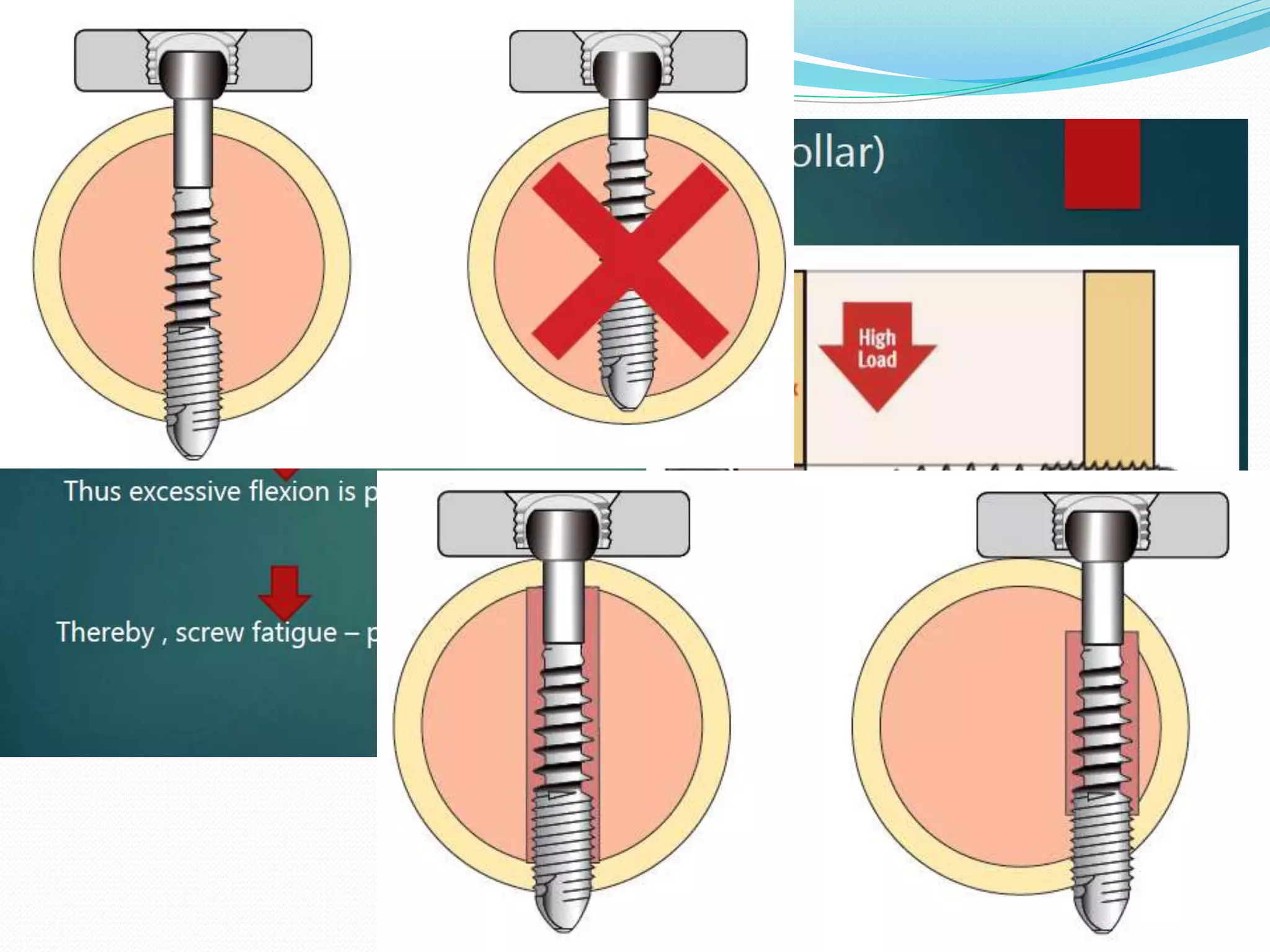
 To enable flexible fixation with LCP’s / to reduce the
stiffness FAR CORTEX LOCKING SCREWS WERE
DEVELOPED
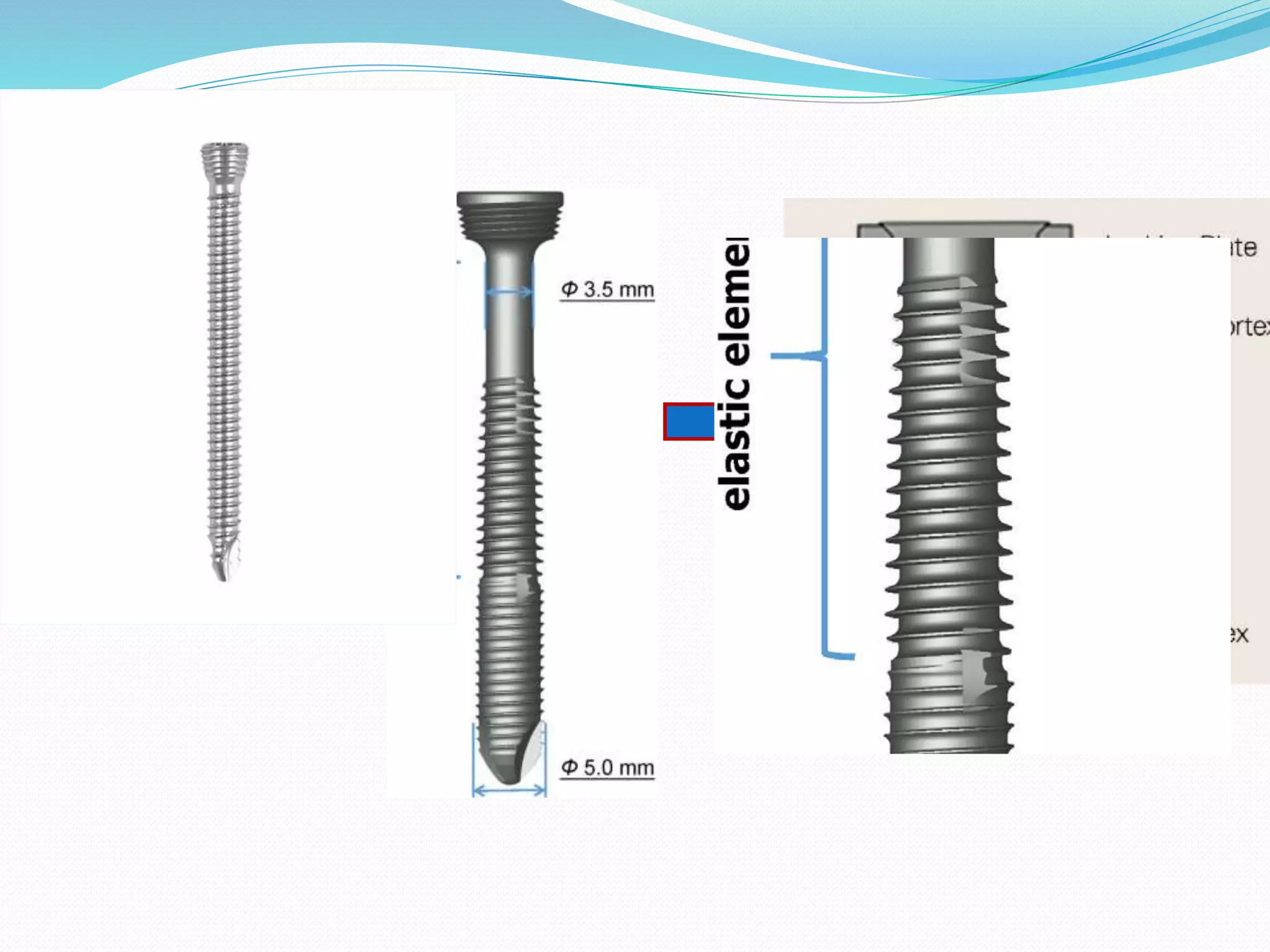
Far Cortical Locking Screws:
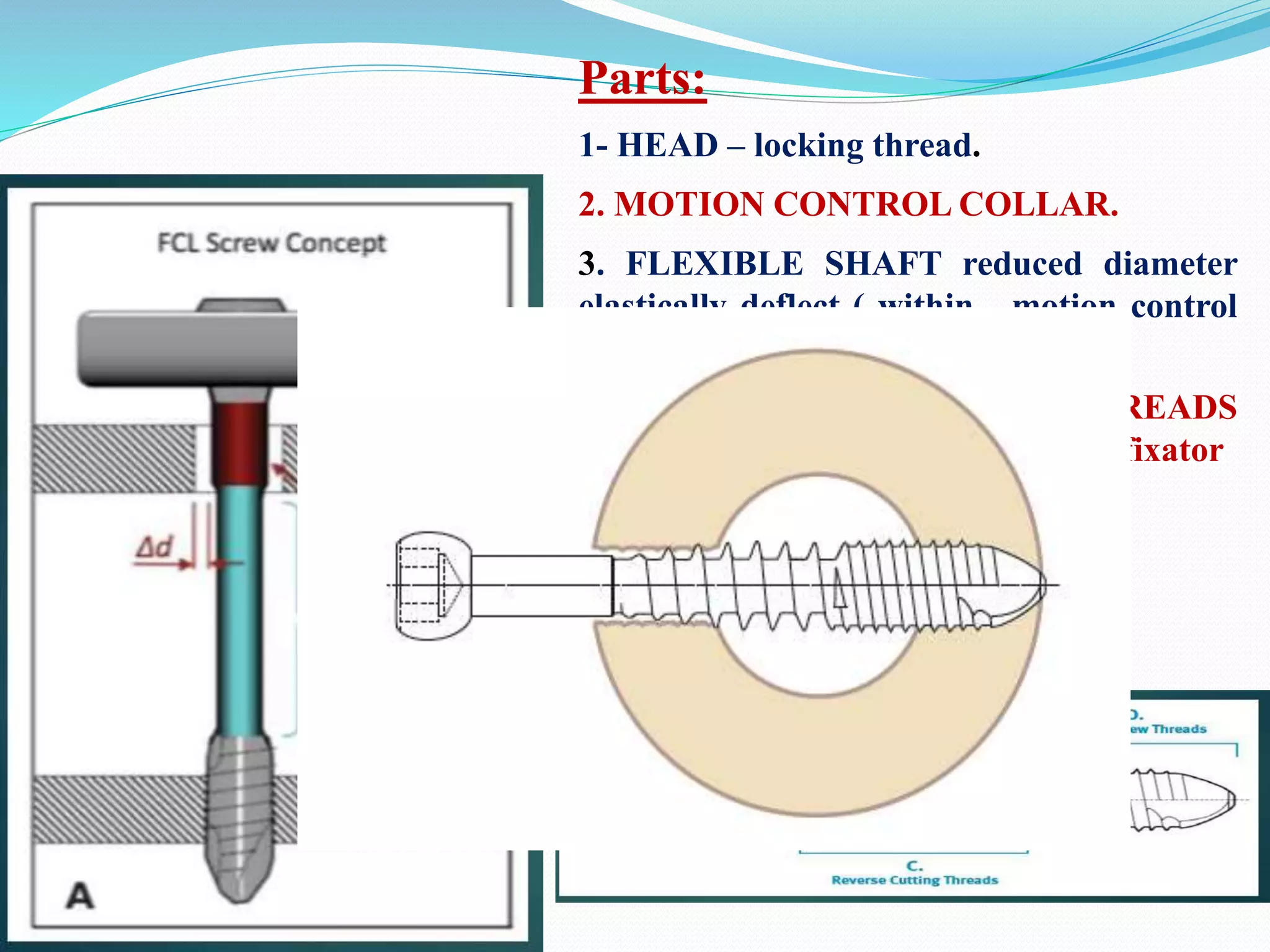
Parts:
1- HEAD – locking thread.
2. MOTION CONTROL COLLAR.
3. FLEXIBLE SHAFT reduced diameter
elastically deflect ( within - motion control
collar of near cortex).
4. FAR CORTEX LOCKING THREADS
resembling an monolateral external fixator
Flexible Fixation : Flexibility is directly proportional -
working length of the screw.
Stiffness is reduced by screws – fixed in plate & far cortex, while retaining a
controlled motion envelope at near cortex.
Thereby promoting inter-fragmentary motion [ IDEAL: 0.2 – 1 mm ] to
produce secondary callus
It has 4 Key Features:
1.Flexible fixation. ( reduces stiffness by 80- 88%)
actively promotes callus formation similar to
external fixator.
2.Uniform load distribution – mitigate stress
raisers.
3.Progressive stiffening – on increased loading.
4.Parallel inter-fragmentary motion – by ‘S’ shaped
flexion. [ FUNCTIONS AS EXTERNAL FIXATORS IN
BIOMECHANICAL BEHAVIOUR AND BIOLOGIC
HEALING ]
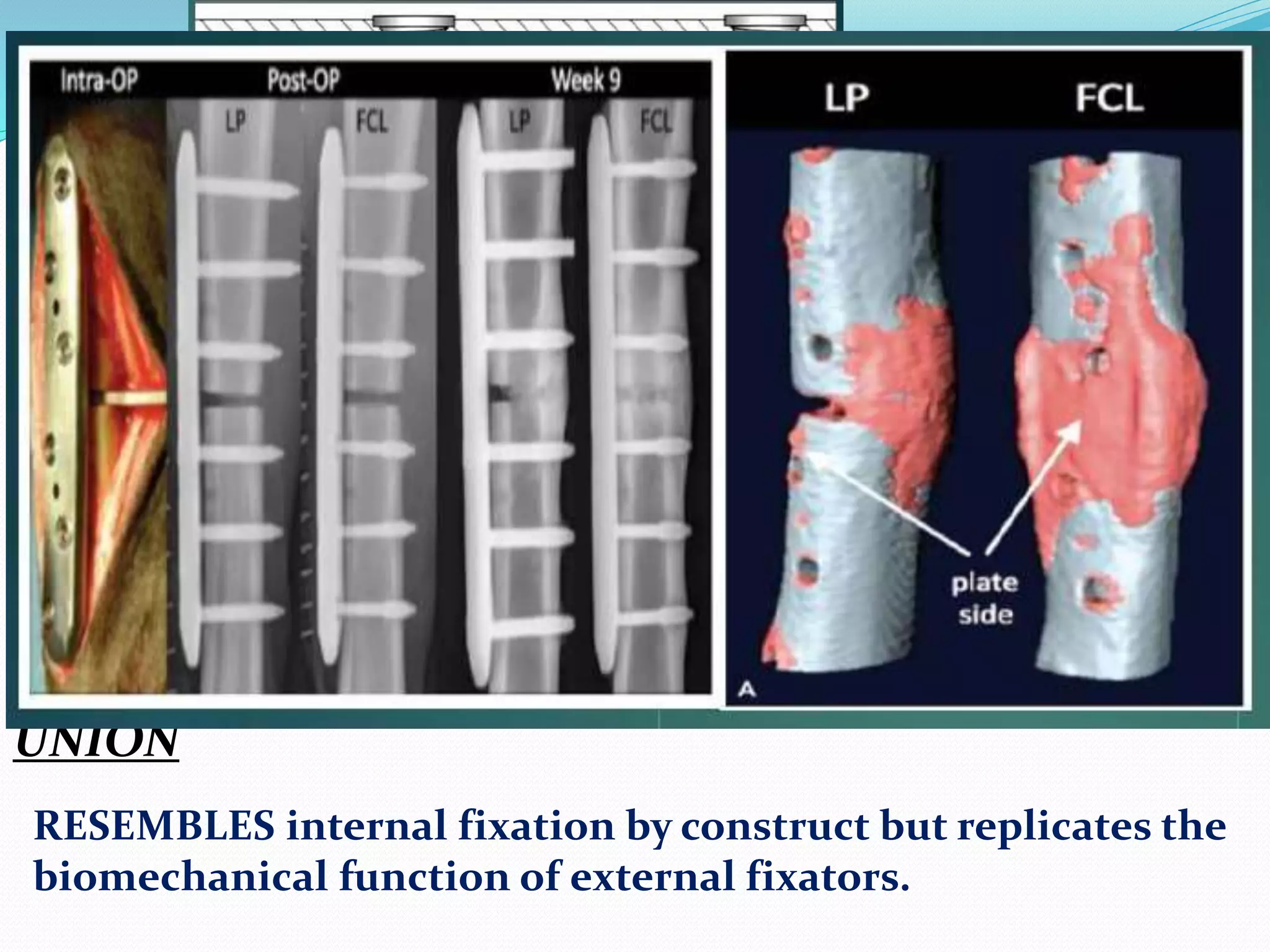
Interfragmentary motion Due to flexible shaft
produces ..... ‘S’ SHAPED FLEXION.... symmetric
callus – formed....... PREVENTING PARTIAL NON
UNION
RESEMBLES internal fixation by construct but replicates the
biomechanical function of external fixators.
Thank You

SCREWS in orthopaedic surgery.pptx

  • 1.
  • 2.
    In 1958, TheAO formulated four basic principles, which have become the guidelines for internal fixation.
  • 3.
    Diffintion: Screw is adevice which converts rotational Forces into linear motion.
  • 4.
    A screw hasa core about which is wrapped a spiral surface Most surgical screws are made of Titanium or Stainless Steel or Bioabsorbable
  • 5.
  • 6.
    HEAD:  Functions: Attachment ofa screwdriver – to apply torque Arrest forward motion A) Slotted B) Cruciate C) Philips D)Hexagonal / Allen E) Torx Stardrive
  • 8.
    SHAFT:  Smooth Link. Not present in standard cortex screw.  Present in cortical shaft screws Or Cancellous screws.
  • 9.
    RUN OUT:  Transitionbetween shaft and thread  Site of most stress riser  Screw Break: - Incorrectly centered hole. - Hole not perpendicular to the plate.
  • 10.
  • 11.
    DIAMETER:  Thread diameter:Diameter across the maximum thread width. - Cancellous have larger thread diameter. - Affects the pull out strength.
  • 12.
     The Maximumwidth of the Thread.  Narrowest diameter of the screw across base of Thread.  Thread depth more in Cancellous screws Less in Cortical screws
  • 13.
    TIP:  There arefive types of tips of bone screws.  Non-self-tapping tip.  Self-tapping tip.  Corkscrew tip.  Trocar tip.  Self drilling Self Tapping.
  • 14.
    TYPES OF SCREWS: CorticalCancellous Machine type.  Smaller thread.  Lower pitch.  Larger core diameter.  Smaller pitch higher holding power.  Higher surface area.  Better hold in cortical bone  Wood type.  Core diameter is less – Larger threads.  Higher Pitch.  Greater surface area for Purchase.  No need for tap.  Pilot hole equals core diameter.  Better fixation in Soft cancellous Bone Fully threaded screws Fully or Partial threaded
  • 15.
    Lag screw principle: Lagscrews / the lag technique compresses the fracture fragments together. The cancellous bone screw and the cortical screw through a gliding hole
  • 17.
    Special Screws: Herbert Screws: Specializedimplant to achieve interfragmentary compression. No head and threads on both ends with a pitch differential. In small bones, such as the scaphoid, self compressing, double pitch screws can be Used.
  • 19.
    VA locked screwshead are spherical rather than straight. Be Careful - Look similar Variable angle locking screws Standard locking head Variable Angle Locked Screws:
  • 21.
    AcuTrak Screw System: Fullythreaded Screw has a variable thread pitch. Self tapping Pitch differential causes compression at fracture site.
  • 23.
     STANDARD LCP: (bridge plating) depends on secondary bone healing rather than primary bone healing traditionally achieved by external fixation constructs more flexible inter fragmentary motion ( 10 times more than LCP / DCP).  Can supresses interfragmentary motion ( HIGH STIFFNESS), insufficient for secondary # healing. 1.  Rigid locking screws - uneven stress distribution stress shielding under the plate bone resorption.  To enable flexible fixation with LCP’s / to reduce the stiffness FAR CORTEX LOCKING SCREWS WERE DEVELOPED Far Cortical Locking Screws:
  • 25.
    Parts: 1- HEAD –locking thread. 2. MOTION CONTROL COLLAR. 3. FLEXIBLE SHAFT reduced diameter elastically deflect ( within - motion control collar of near cortex). 4. FAR CORTEX LOCKING THREADS resembling an monolateral external fixator
  • 26.
    Flexible Fixation :Flexibility is directly proportional - working length of the screw. Stiffness is reduced by screws – fixed in plate & far cortex, while retaining a controlled motion envelope at near cortex. Thereby promoting inter-fragmentary motion [ IDEAL: 0.2 – 1 mm ] to produce secondary callus
  • 28.
    It has 4Key Features: 1.Flexible fixation. ( reduces stiffness by 80- 88%) actively promotes callus formation similar to external fixator. 2.Uniform load distribution – mitigate stress raisers. 3.Progressive stiffening – on increased loading. 4.Parallel inter-fragmentary motion – by ‘S’ shaped flexion. [ FUNCTIONS AS EXTERNAL FIXATORS IN BIOMECHANICAL BEHAVIOUR AND BIOLOGIC HEALING ]
  • 30.
    Interfragmentary motion Dueto flexible shaft produces ..... ‘S’ SHAPED FLEXION.... symmetric callus – formed....... PREVENTING PARTIAL NON UNION RESEMBLES internal fixation by construct but replicates the biomechanical function of external fixators.
  • 34.