AJIMSHA SHOUKATH
09M2386
WHAT IS TRACTION ?
Traction - the application of a force to
stretch certain parts of the body in a
specific direction
WHY DO WE NEED TRACTION ?
Reduction of fractures and dislocations and their
maintenance
For immobilizing a painful, inflamed joint
For the prevention of deformity, by counteracting
the muscle spasms associated with painful joint
conditions.
For correction of soft tissue contractures by
stretching them out
TRACTION
 Controls pain.
 Reduces fracture.
 Maintain reduction.
 Prevents & corrects deformity.
TRACTION
 Based on principle
Fixed traction
Sliding traction
FIXED TRACTION
 Traction is applied to the leg against a fixed point of
counter pressure.
 Fixed traction inThomas’s splint
 Roger Anderson well-leg traction
 Halo-PelvicTraction
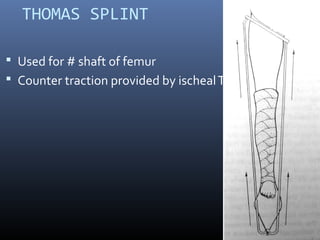
THOMAS SPLINT
 Used for # shaft of femur
 Counter traction provided by ischealTuberosity
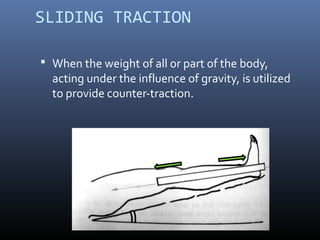
SLIDING TRACTION
 When the weight of all or part of the body,
acting under the influence of gravity, is utilized
to provide counter-traction.
TYPES OF TRACTION ON
APPLICATION
Skin traction
 Adhesive
 Non – adhesive
SkeletalTraction
SKIN TRACTION
SKIN TRACTION
 Traction force is applied over a large area of
skin
 Applied over limb distal to fracture site
 Anteromedial and posterolateral part should
be covered with cotton.
SKIN TRACTION
 Adhesive skin traction:
 Maximum weight 6.7 kg
 Non-adhesive skin traction
 Maximum weight should not exceed 4.5 kg
 Used in thin and atrophic skin,
 skin sensitive to adhesive strapping.
COMMON SKIN TRACTIONS
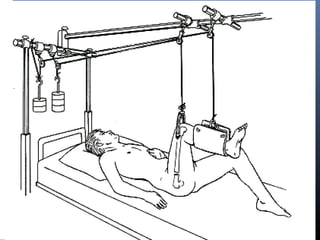
 Buck’sTraction
 Hamilton RusselTraction
 Tulloch BrownTraction
 Gallow’s or Brayant’sTraction
 Modified Brayan’sTraction
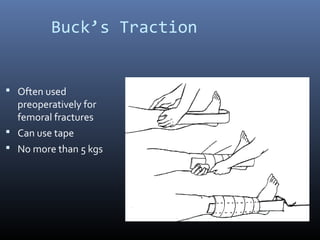
Buck’s Traction
 Often used
preoperatively for
femoral fractures
 Can use tape
 No more than 5 kgs
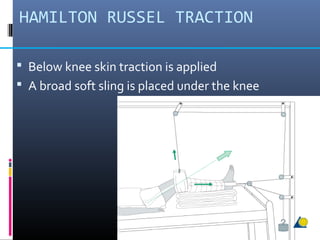
HAMILTON RUSSEL TRACTION
 Below knee skin traction is applied
 A broad soft sling is placed under the knee
BRYANT’S (GALLOW’S )
TRACTION
 the treatment of fracture shaft femur in
children up to age of 2 yrs.
 Weight of child should be less than 15- 18 kg
 Above knee skin traction is applied bilaterally
 Tie the traction to the over head
beam.
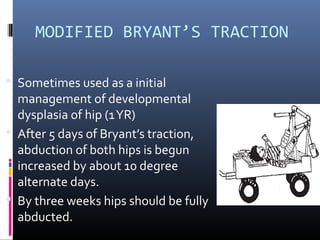
MODIFIED BRYANT’S TRACTION
 Sometimes used as a initial
management of developmental
dysplasia of hip (1YR)
 After 5 days of Bryant’s traction,
abduction of both hips is begun
increased by about 10 degree
alternate days.
 By three weeks hips should be fully
abducted.
SKIN TRACTION
COMPLICATIONS Of Adhesive SkinTraction :
 Allergic reactions to adhesives.
 Excoriation of skin.
 Pressure sores over bony prominences and
tendoachillis.
 Common peroneal nerve palsy.
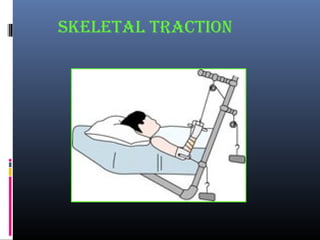
SKELETAL TRACTION
SKELETAL TRACTION
 pin or wire
 more frequently used in lower limb fractures
 Should be reserved for those cases in which
skin traction is insufficient.
 Generally used when more weight is needed
to give traction.
 To treat fractures conservatively.
SKELETAL TRACTION
 SITES
 Upper tibial
 Lower femoral
 Lower tibial
 Calcaneus
 Olecrenon
 Metacarpel
SOME SKELETAL TRACTIONS
 Lateral or Upper FemoralTraction
 Nintey / Nintey traction
 Olecrenone traction
 Perkin’sTraction
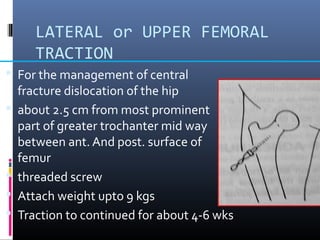
LATERAL or UPPER FEMORAL
TRACTION
 For the management of central
fracture dislocation of the hip
 about 2.5 cm from most prominent
part of greater trochanter mid way
between ant. And post. surface of
femur
 threaded screw
 Attach weight upto 9 kgs
 Traction to continued for about 4-6 wks
NINETY / NINETY TRACTION
 Used for sub trochanteric fractures and those
in the proximal third of the shaft of the femur
 Management of fractures with posterior
wound is easier
 Traction is given through lower femoral pin,
which is more efficient, or by upper tibial pin.
SKELETAL TRACTION
COMPLICATIONS
 Infection
 Cut out
 Distraction at fracture site
 Nerve Injury
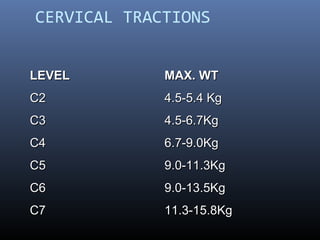
CERVICAL TRACTIONS
 SKINTRACTION Head Halter traction
 SKELETALTRACTION
Crutchfield tongs
Cone or Barton tongs
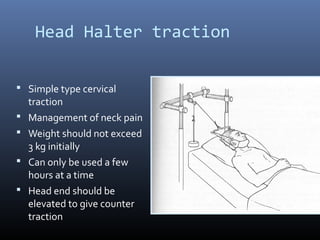
Head Halter traction
 Simple type cervical
traction
 Management of neck pain
 Weight should not exceed
3 kg initially
 Can only be used a few
hours at a time
 Head end should be
elevated to give counter
traction
CERVICAL TRACTIONS
LEVELLEVEL MAX. WTMAX. WT
C2C2 4.5-5.4 Kg4.5-5.4 Kg
C3C3 4.5-6.7Kg4.5-6.7Kg
C4C4 6.7-9.0Kg6.7-9.0Kg
C5C5 9.0-11.3Kg9.0-11.3Kg
C6C6 9.0-13.5Kg9.0-13.5Kg
C7C7 11.3-15.8Kg11.3-15.8Kg
Traction in orthopaedics

Traction in orthopaedics

  • 1.
  • 2.
    WHAT IS TRACTION? Traction - the application of a force to stretch certain parts of the body in a specific direction
  • 3.
    WHY DO WENEED TRACTION ? Reduction of fractures and dislocations and their maintenance For immobilizing a painful, inflamed joint For the prevention of deformity, by counteracting the muscle spasms associated with painful joint conditions. For correction of soft tissue contractures by stretching them out
  • 4.
    TRACTION  Controls pain. Reduces fracture.  Maintain reduction.  Prevents & corrects deformity.
  • 5.
    TRACTION  Based onprinciple Fixed traction Sliding traction
  • 6.
    FIXED TRACTION  Tractionis applied to the leg against a fixed point of counter pressure.  Fixed traction inThomas’s splint  Roger Anderson well-leg traction  Halo-PelvicTraction
  • 7.
    THOMAS SPLINT  Usedfor # shaft of femur  Counter traction provided by ischealTuberosity
  • 8.
    SLIDING TRACTION  Whenthe weight of all or part of the body, acting under the influence of gravity, is utilized to provide counter-traction.
  • 9.
    TYPES OF TRACTIONON APPLICATION Skin traction  Adhesive  Non – adhesive SkeletalTraction
  • 10.
  • 11.
    SKIN TRACTION  Tractionforce is applied over a large area of skin  Applied over limb distal to fracture site  Anteromedial and posterolateral part should be covered with cotton.
  • 12.
    SKIN TRACTION  Adhesiveskin traction:  Maximum weight 6.7 kg  Non-adhesive skin traction  Maximum weight should not exceed 4.5 kg  Used in thin and atrophic skin,  skin sensitive to adhesive strapping.
  • 13.
    COMMON SKIN TRACTIONS Buck’sTraction  Hamilton RusselTraction  Tulloch BrownTraction  Gallow’s or Brayant’sTraction  Modified Brayan’sTraction
  • 14.
    Buck’s Traction  Oftenused preoperatively for femoral fractures  Can use tape  No more than 5 kgs
  • 15.
    HAMILTON RUSSEL TRACTION Below knee skin traction is applied  A broad soft sling is placed under the knee
  • 16.
    BRYANT’S (GALLOW’S ) TRACTION the treatment of fracture shaft femur in children up to age of 2 yrs.  Weight of child should be less than 15- 18 kg  Above knee skin traction is applied bilaterally  Tie the traction to the over head beam.
  • 17.
    MODIFIED BRYANT’S TRACTION Sometimes used as a initial management of developmental dysplasia of hip (1YR)  After 5 days of Bryant’s traction, abduction of both hips is begun increased by about 10 degree alternate days.  By three weeks hips should be fully abducted.
  • 18.
    SKIN TRACTION COMPLICATIONS OfAdhesive SkinTraction :  Allergic reactions to adhesives.  Excoriation of skin.  Pressure sores over bony prominences and tendoachillis.  Common peroneal nerve palsy.
  • 19.
  • 20.
    SKELETAL TRACTION  pinor wire  more frequently used in lower limb fractures  Should be reserved for those cases in which skin traction is insufficient.  Generally used when more weight is needed to give traction.  To treat fractures conservatively.
  • 21.
    SKELETAL TRACTION  SITES Upper tibial  Lower femoral  Lower tibial  Calcaneus  Olecrenon  Metacarpel
  • 22.
    SOME SKELETAL TRACTIONS Lateral or Upper FemoralTraction  Nintey / Nintey traction  Olecrenone traction  Perkin’sTraction
  • 23.
    LATERAL or UPPERFEMORAL TRACTION  For the management of central fracture dislocation of the hip  about 2.5 cm from most prominent part of greater trochanter mid way between ant. And post. surface of femur  threaded screw  Attach weight upto 9 kgs  Traction to continued for about 4-6 wks
  • 24.
    NINETY / NINETYTRACTION  Used for sub trochanteric fractures and those in the proximal third of the shaft of the femur  Management of fractures with posterior wound is easier  Traction is given through lower femoral pin, which is more efficient, or by upper tibial pin.
  • 26.
    SKELETAL TRACTION COMPLICATIONS  Infection Cut out  Distraction at fracture site  Nerve Injury
  • 27.
    CERVICAL TRACTIONS  SKINTRACTIONHead Halter traction  SKELETALTRACTION Crutchfield tongs Cone or Barton tongs
  • 28.
    Head Halter traction Simple type cervical traction  Management of neck pain  Weight should not exceed 3 kg initially  Can only be used a few hours at a time  Head end should be elevated to give counter traction
  • 29.
    CERVICAL TRACTIONS LEVELLEVEL MAX.WTMAX. WT C2C2 4.5-5.4 Kg4.5-5.4 Kg C3C3 4.5-6.7Kg4.5-6.7Kg C4C4 6.7-9.0Kg6.7-9.0Kg C5C5 9.0-11.3Kg9.0-11.3Kg C6C6 9.0-13.5Kg9.0-13.5Kg C7C7 11.3-15.8Kg11.3-15.8Kg

Editor's Notes

  • #3 No matter how complicated a fracture might appear to be, traction will often times pull the fragments into alignment very nicely.
  • #7 the traction cords are tied to the distal end of the splint and the counter-traction force passes along the side bars of the splint to the ring and hence to the body proximal to the attachment of the muscles in spasm.
  • #9 Initially more weight for reduction then reduce