
@QCOMResearch September 8th, 2022
How will sidelink bring a
new level of 5G versatility?
San Diego, CA
For diverse devices and services beyond automotive
— smartphones, IoT, and more
2
Sidelink is a core topology
of the 5G system design
Further extending the connected intelligent edge
3
3
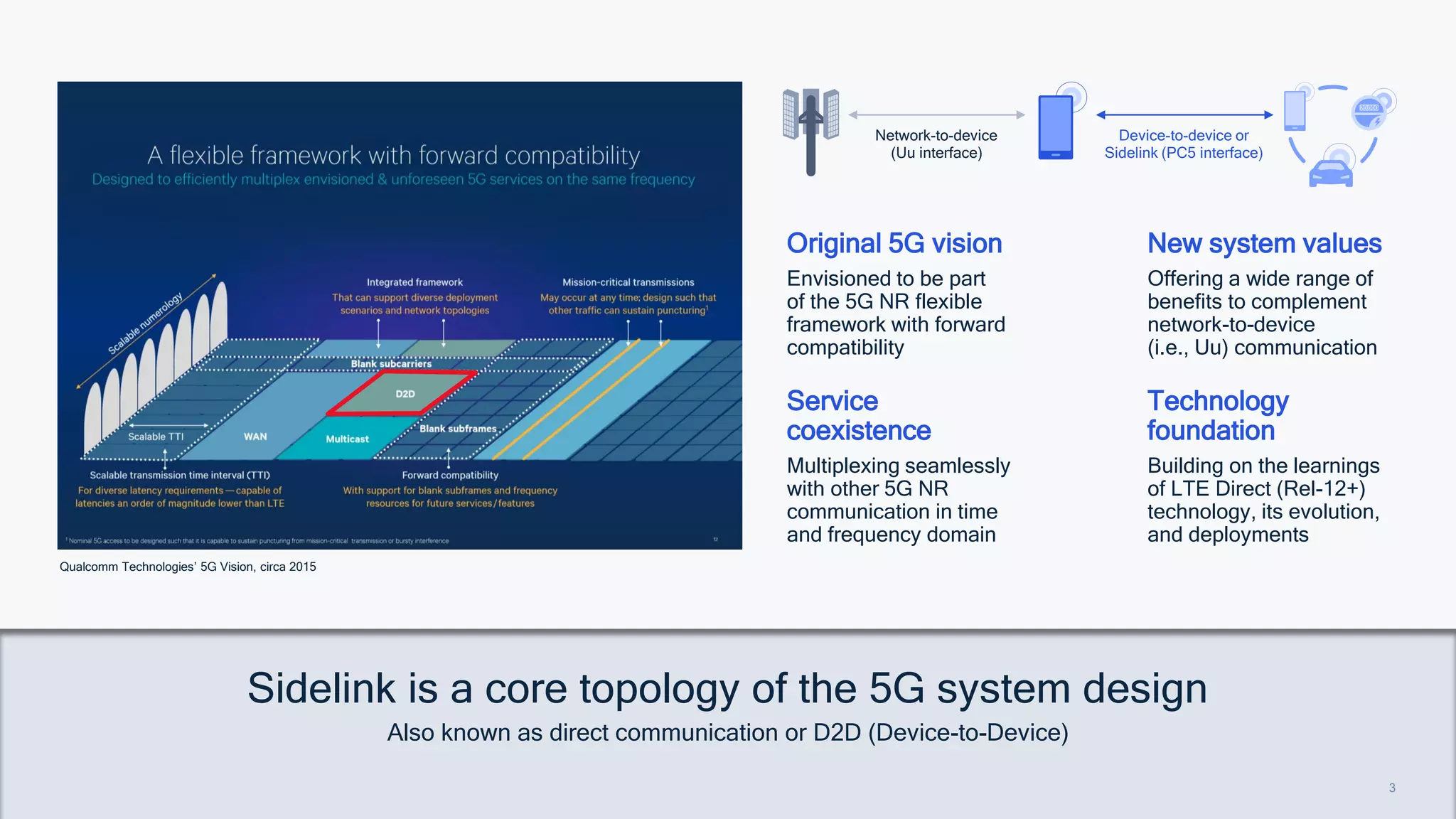
Sidelink is a core topology of the 5G system design
Also known as direct communication or D2D (Device-to-Device)
Network-to-device
(Uu interface)
Device-to-device or
Sidelink (PC5 interface)
Original 5G vision
Envisioned to be part
of the 5G NR flexible
framework with forward
compatibility
Service
coexistence
Multiplexing seamlessly
with other 5G NR
communication in time
and frequency domain
New system values
Offering a wide range of
benefits to complement
network-to-device
(i.e., Uu) communication
Technology
foundation
Building on the learnings
of LTE Direct (Rel-12+)
technology, its evolution,
and deployments
Qualcomm Technologies’ 5G Vision, circa 2015
4
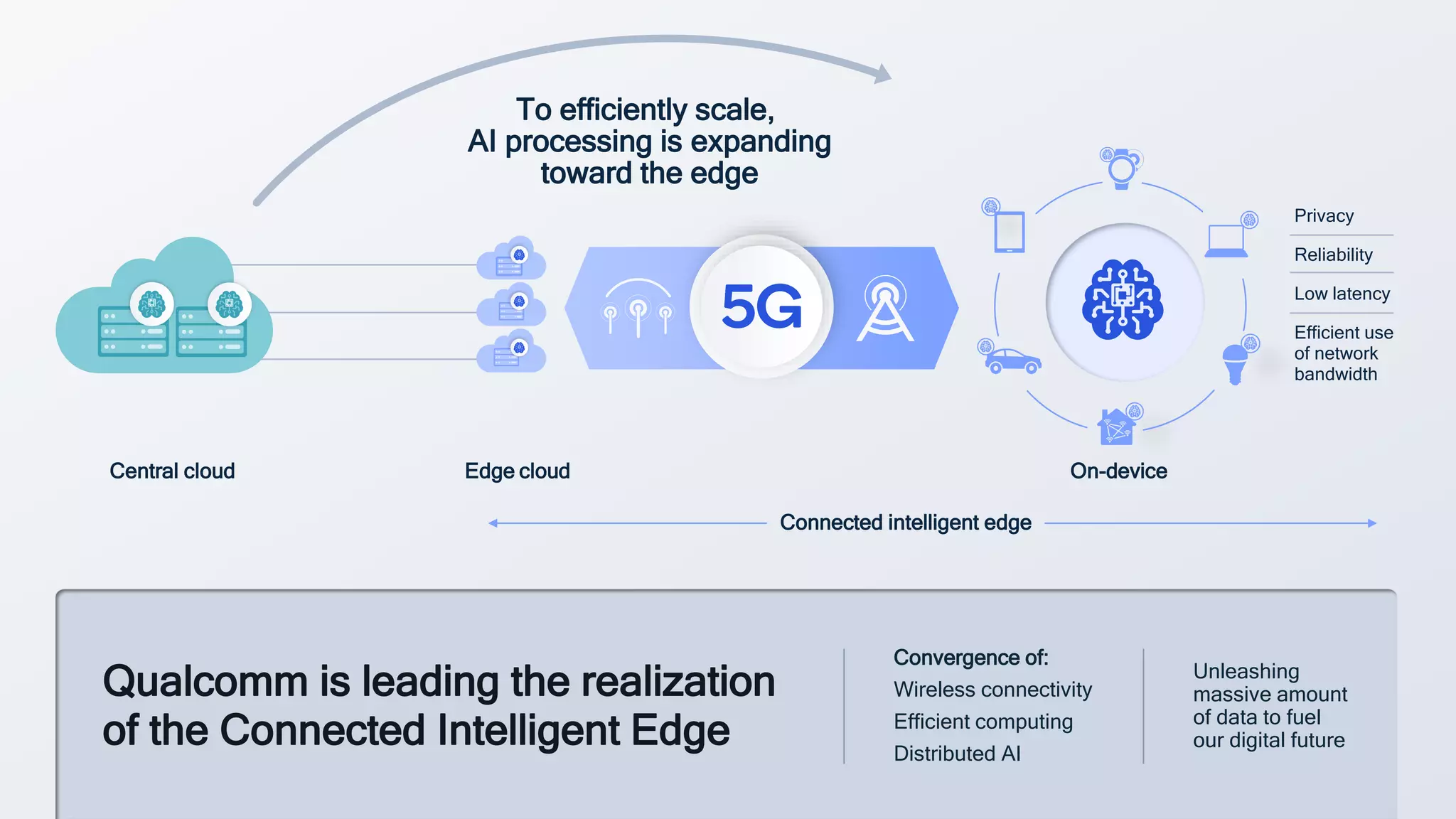
Edge cloud
Central cloud On-device
Privacy
Reliability
Low latency
Efficient use
of network
bandwidth
Connected intelligent edge
To efficiently scale,
AI processing is expanding
toward the edge
Qualcomm is leading the realization
of the Connected Intelligent Edge
Convergence of:
Wireless connectivity
Efficient computing
Distributed AI
Unleashing
massive amount
of data to fuel
our digital future
5
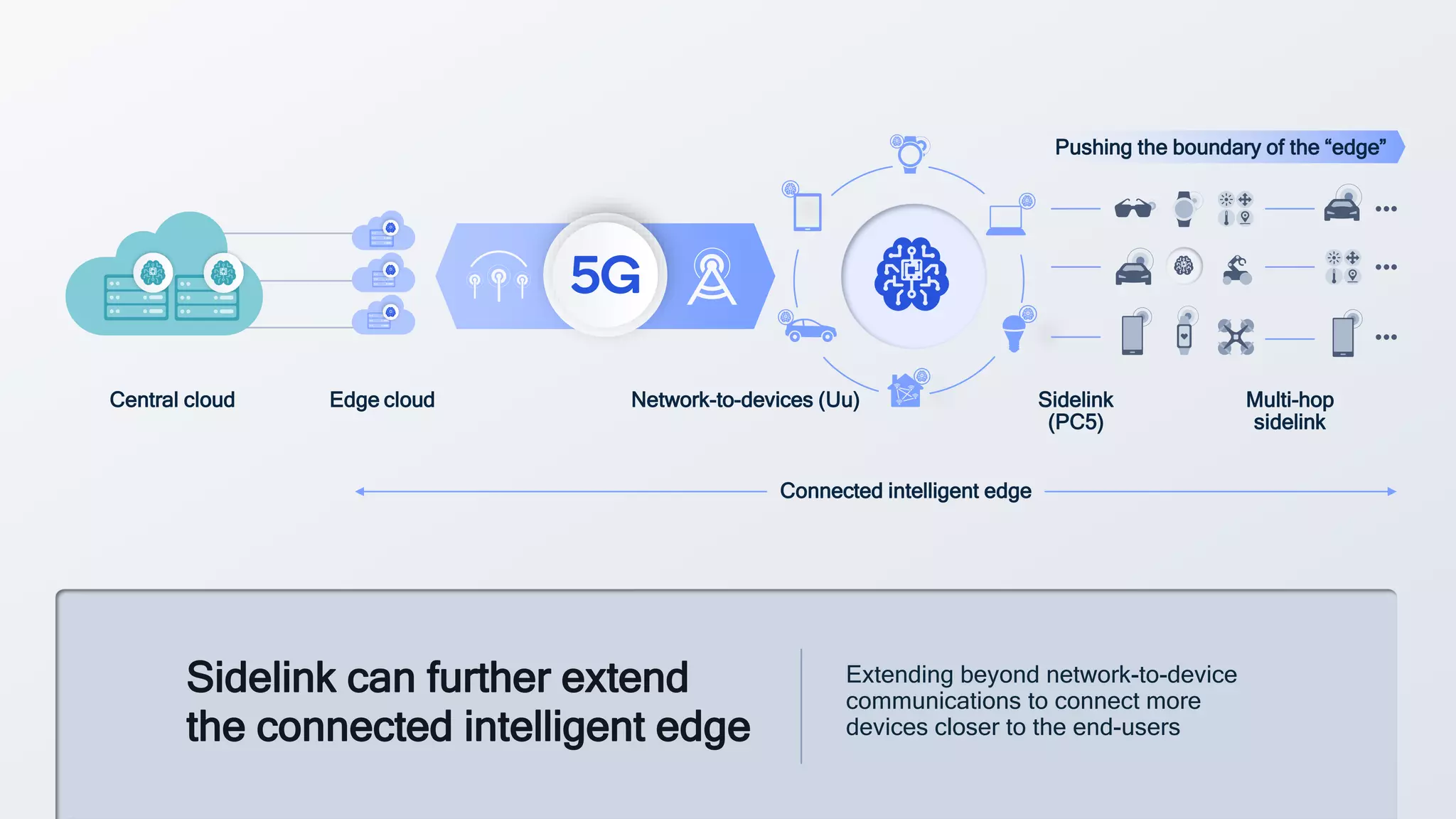
Edge cloud
Central cloud Network-to-devices (Uu)
Connected intelligent edge
Sidelink can further extend
the connected intelligent edge
Extending beyond network-to-device
communications to connect more
devices closer to the end-users
Sidelink
(PC5)
Multi-hop
sidelink
Pushing the boundary of the “edge”
6
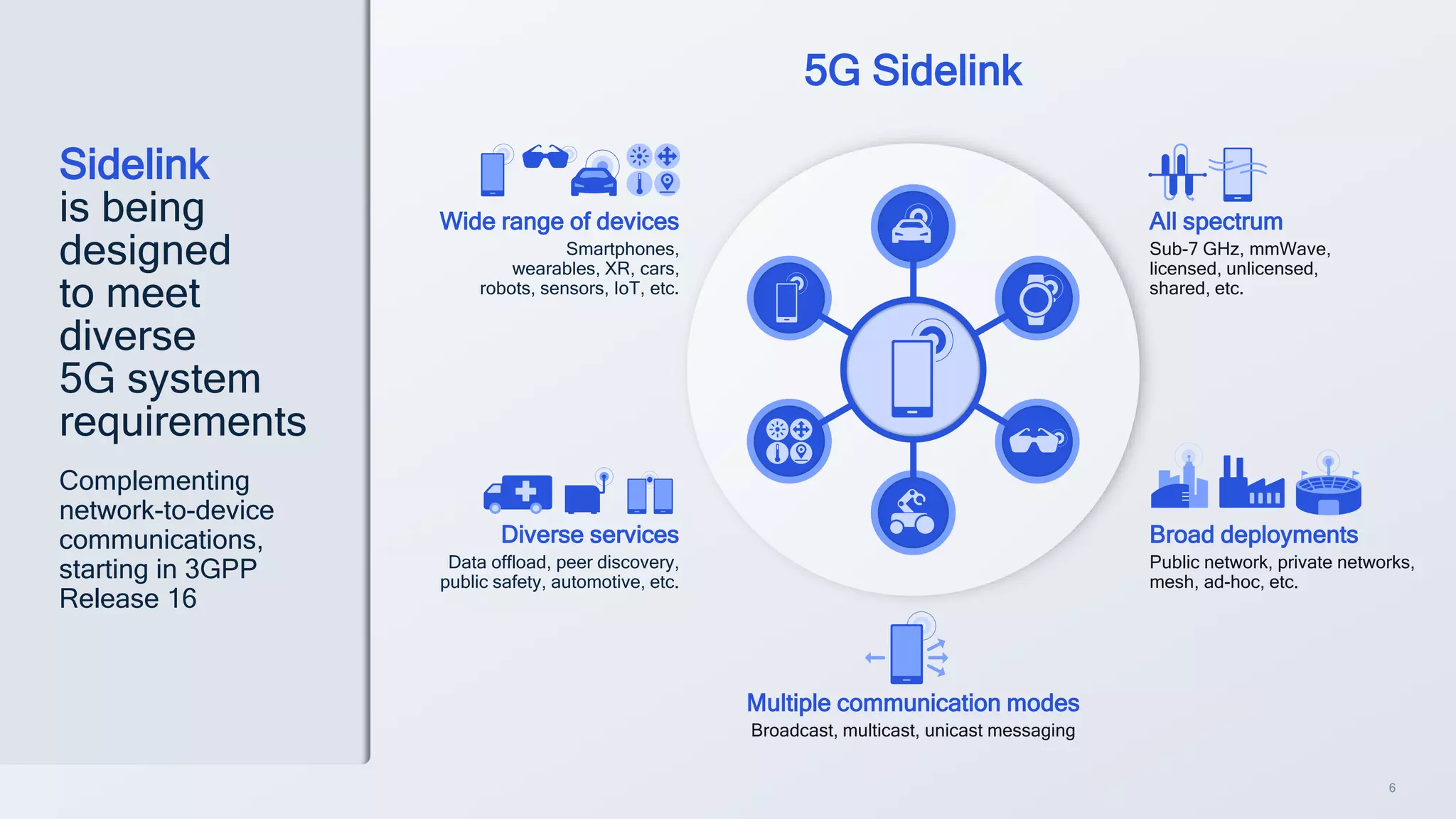
Sidelink
is being
designed
to meet
diverse
5G system
requirements
Complementing
network-to-device
communications,
starting in 3GPP
Release 16
5G Sidelink
Diverse services
Data offload, peer discovery,
public safety, automotive, etc.
Wide range of devices
Smartphones,
wearables, XR, cars,
robots, sensors, IoT, etc.
Broad deployments
Public network, private networks,
mesh, ad-hoc, etc.
All spectrum
Sub-7 GHz, mmWave,
licensed, unlicensed,
shared, etc.
Multiple communication modes
Broadcast, multicast, unicast messaging
7
7
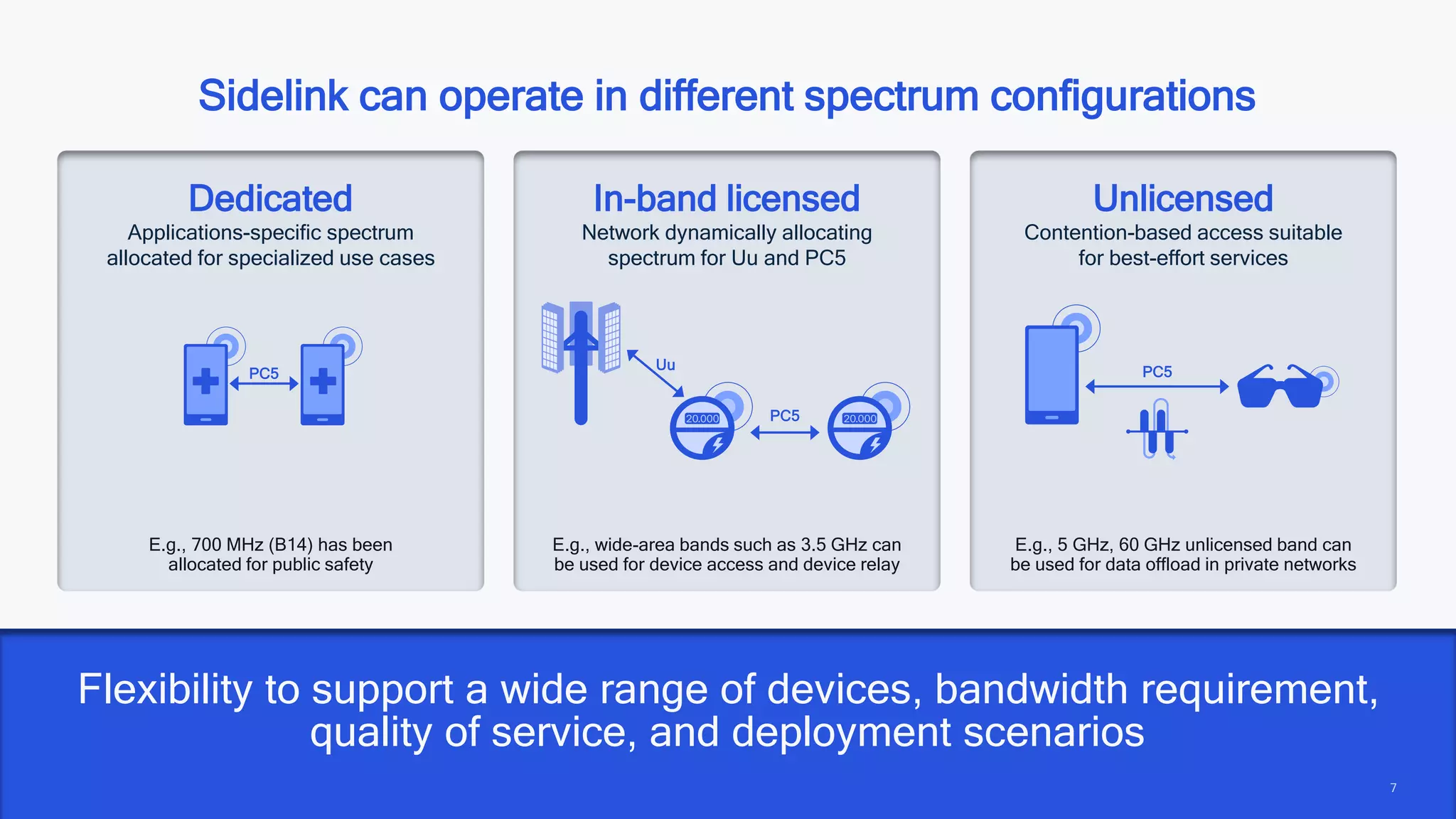
Flexibility to support a wide range of devices, bandwidth requirement,
quality of service, and deployment scenarios
Sidelink can operate in different spectrum configurations
Dedicated
Applications-specific spectrum
allocated for specialized use cases
PC5
E.g., 700 MHz (B14) has been
allocated for public safety
In-band licensed
Network dynamically allocating
spectrum for Uu and PC5
E.g., wide-area bands such as 3.5 GHz can
be used for device access and device relay
Uu
PC5
Unlicensed
Contention-based access suitable
for best-effort services
E.g., 5 GHz, 60 GHz unlicensed band can
be used for data offload in private networks
PC5
8
8
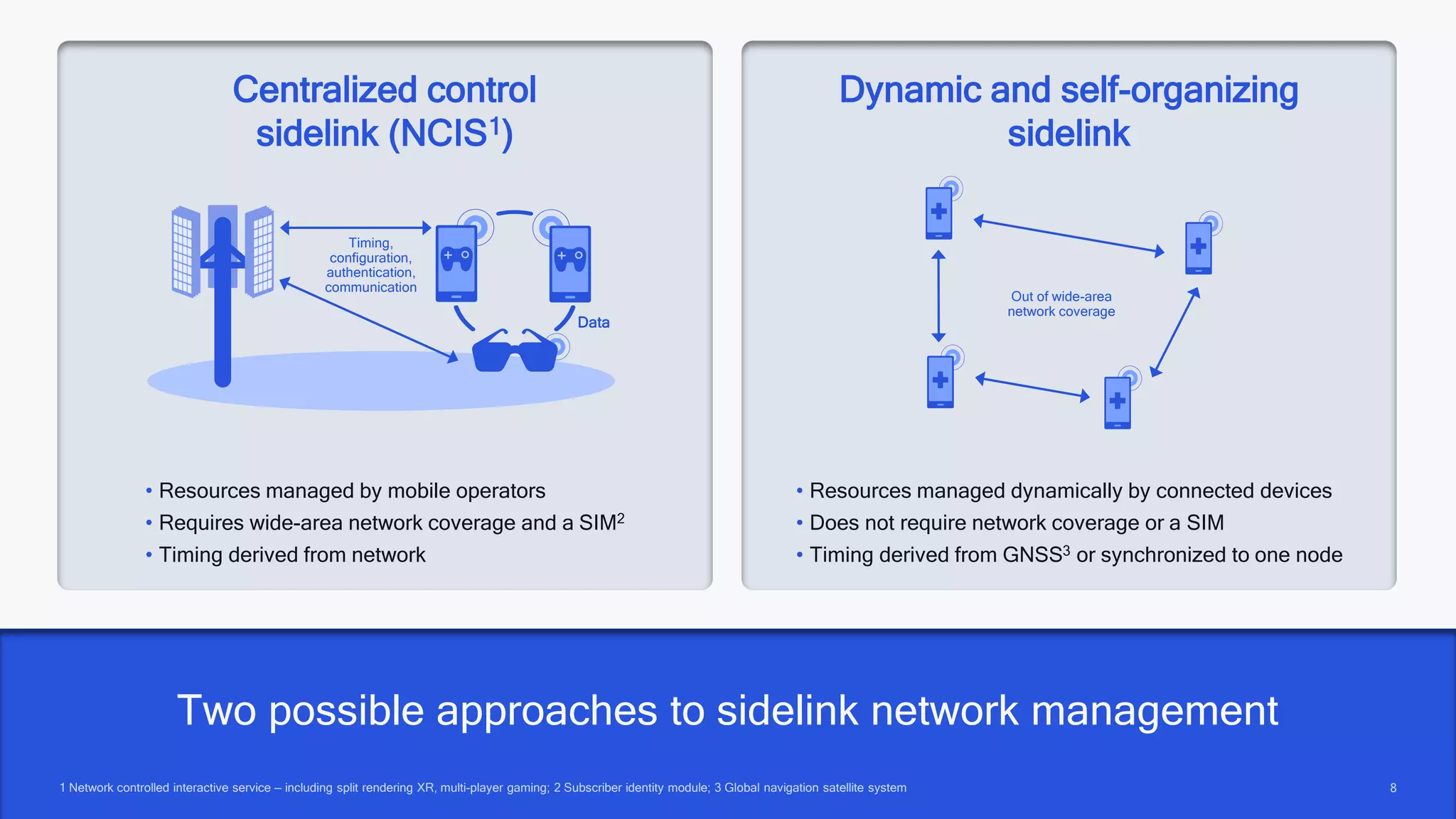
Centralized control
sidelink (NCIS1)
Two possible approaches to sidelink network management
1 Network controlled interactive service — including split rendering XR, multi-player gaming; 2 Subscriber identity module; 3 Global navigation satellite system
• Resources managed by mobile operators
• Requires wide-area network coverage and a SIM2
• Timing derived from network
Dynamic and self-organizing
sidelink
• Resources managed dynamically by connected devices
• Does not require network coverage or a SIM
• Timing derived from GNSS3 or synchronized to one node
Data
Timing,
configuration,
authentication,
communication
Out of wide-area
network coverage
9
9
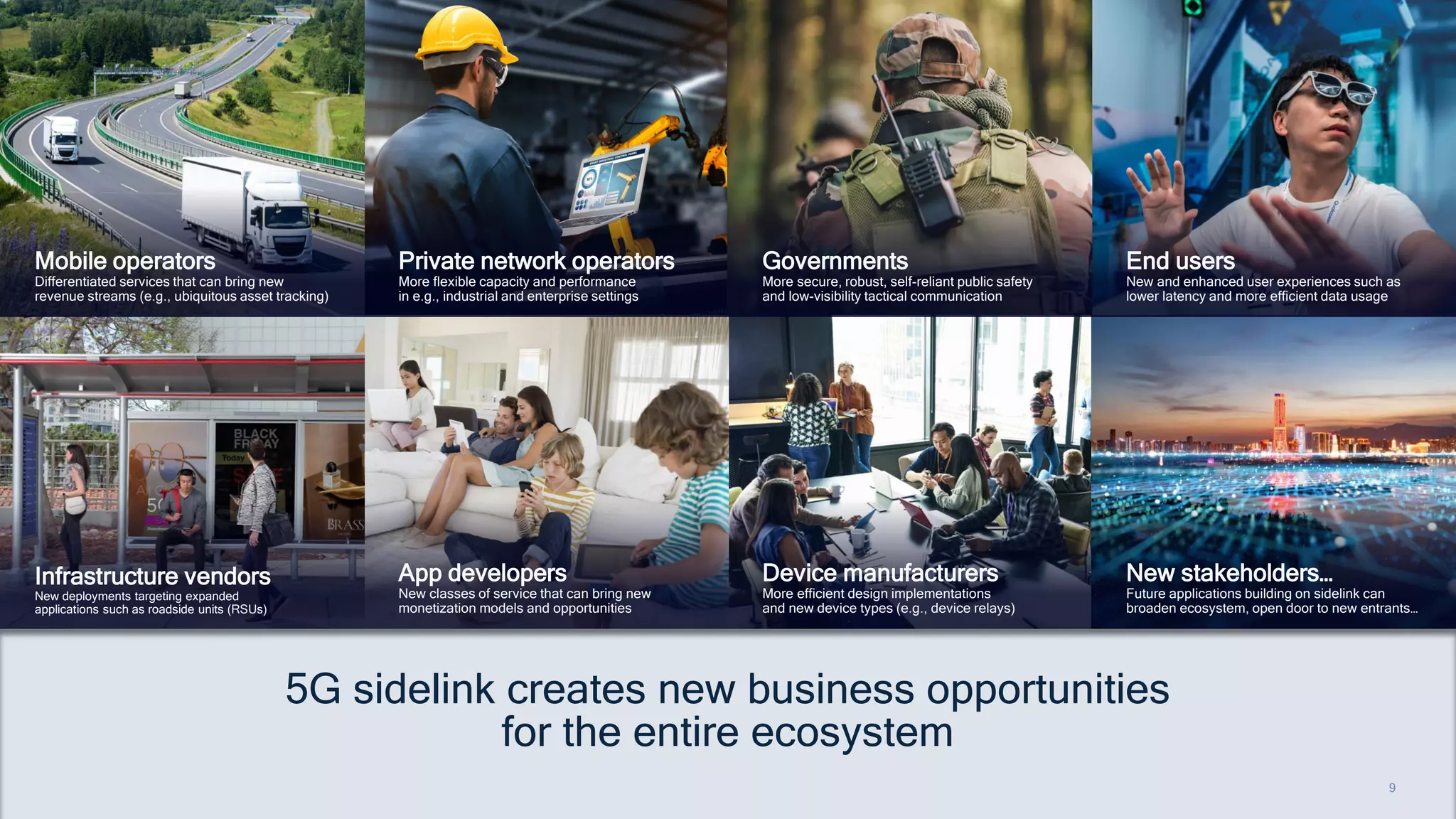
5G sidelink creates new business opportunities
for the entire ecosystem
Mobile operators
Differentiated services that can bring new
revenue streams (e.g., ubiquitous asset tracking)
End users
New and enhanced user experiences such as
lower latency and more efficient data usage
Device manufacturers
More efficient design implementations
and new device types (e.g., device relays)
App developers
New classes of service that can bring new
monetization models and opportunities
Infrastructure vendors
New deployments targeting expanded
applications such as roadside units (RSUs)
Private network operators
More flexible capacity and performance
in e.g., industrial and enterprise settings
Governments
More secure, robust, self-reliant public safety
and low-visibility tactical communication
New stakeholders…
Future applications building on sidelink can
broaden ecosystem, open door to new entrants…
10
Sidelink delivers a broad
set of system benefits
Supporting diverse 5G devices, use cases, and deployments
11
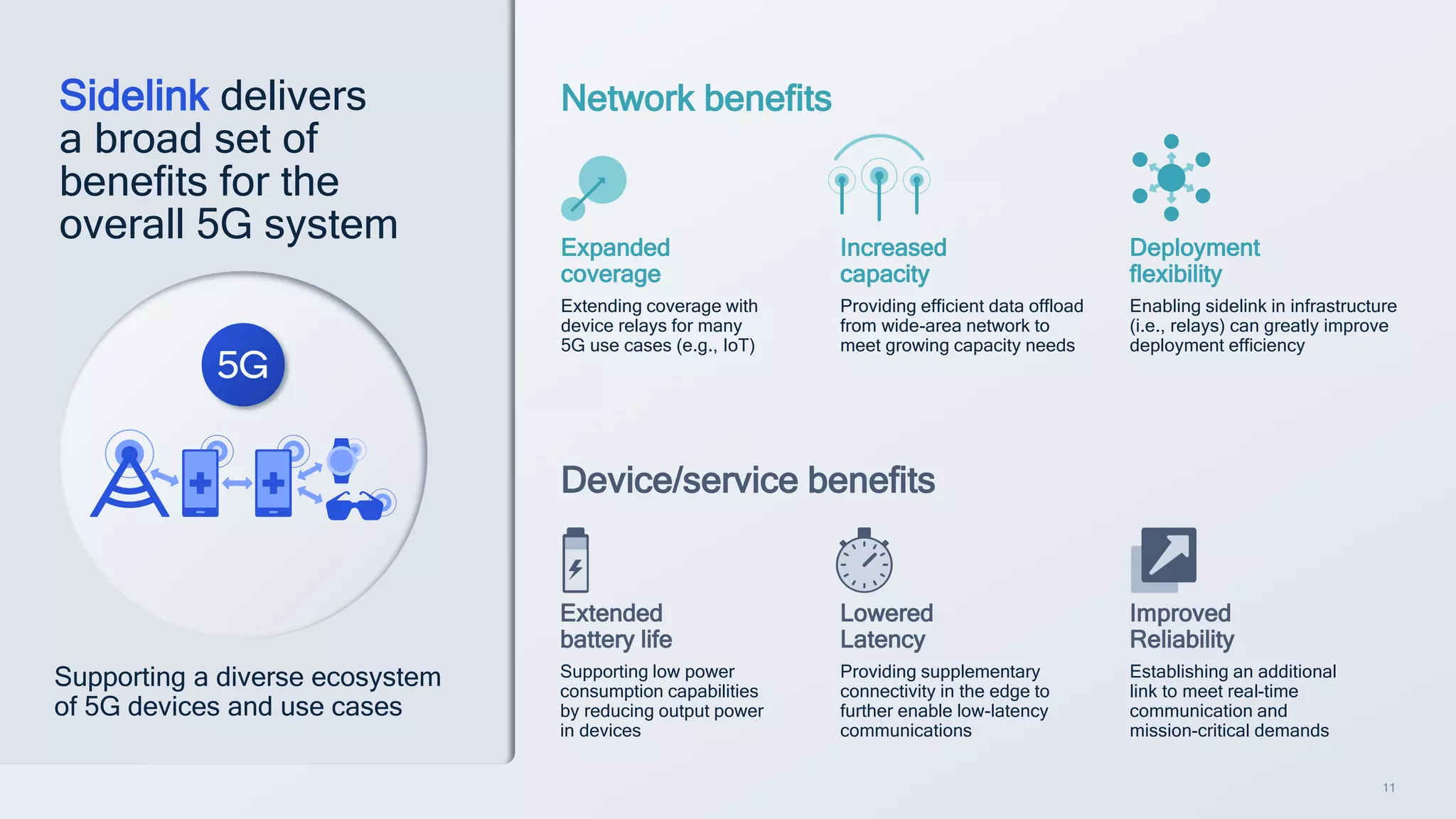
Sidelink delivers
a broad set of
benefits for the
overall 5G system
Supporting a diverse ecosystem
of 5G devices and use cases
Expanded
coverage
Extending coverage with
device relays for many
5G use cases (e.g., IoT)
Extended
battery life
Supporting low power
consumption capabilities
by reducing output power
in devices
Increased
capacity
Providing efficient data offload
from wide-area network to
meet growing capacity needs
Lowered
Latency
Providing supplementary
connectivity in the edge to
further enable low-latency
communications
Deployment
flexibility
Enabling sidelink in infrastructure
(i.e., relays) can greatly improve
deployment efficiency
Improved
Reliability
Establishing an additional
link to meet real-time
communication and
mission-critical demands
Network benefits
Device/service benefits
12
12
1 Programmable Logic Controller
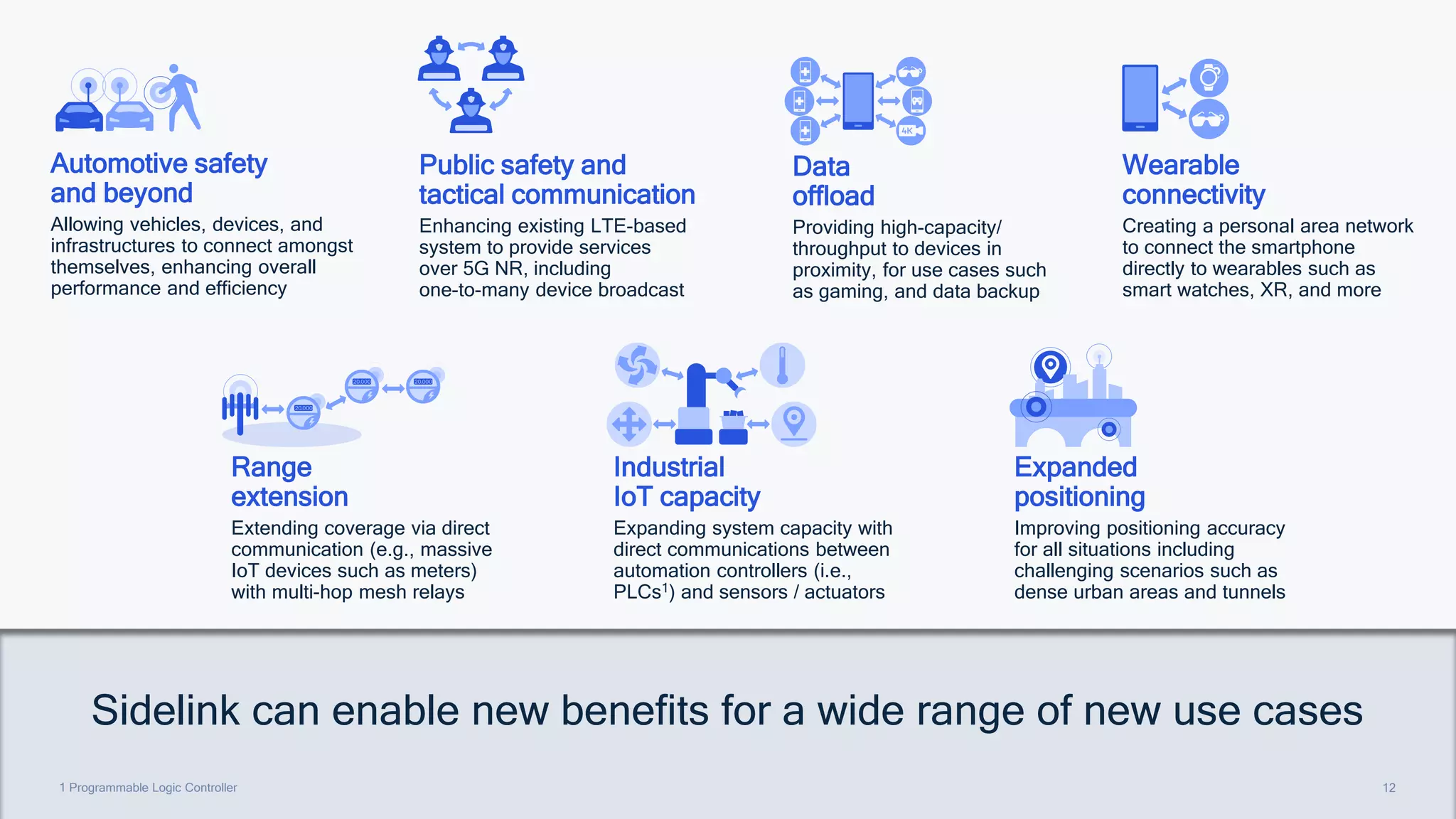
Sidelink can enable new benefits for a wide range of new use cases
Range
extension
Extending coverage via direct
communication (e.g., massive
IoT devices such as meters)
with multi-hop mesh relays
Industrial
IoT capacity
Expanding system capacity with
direct communications between
automation controllers (i.e.,
PLCs1) and sensors / actuators
Expanded
positioning
Improving positioning accuracy
for all situations including
challenging scenarios such as
dense urban areas and tunnels
Automotive safety
and beyond
Allowing vehicles, devices, and
infrastructures to connect amongst
themselves, enhancing overall
performance and efficiency
Wearable
connectivity
Creating a personal area network
to connect the smartphone
directly to wearables such as
smart watches, XR, and more
Data
offload
Providing high-capacity/
throughput to devices in
proximity, for use cases such
as gaming, and data backup
Public safety and
tactical communication
Enhancing existing LTE-based
system to provide services
over 5G NR, including
one-to-many device broadcast
13
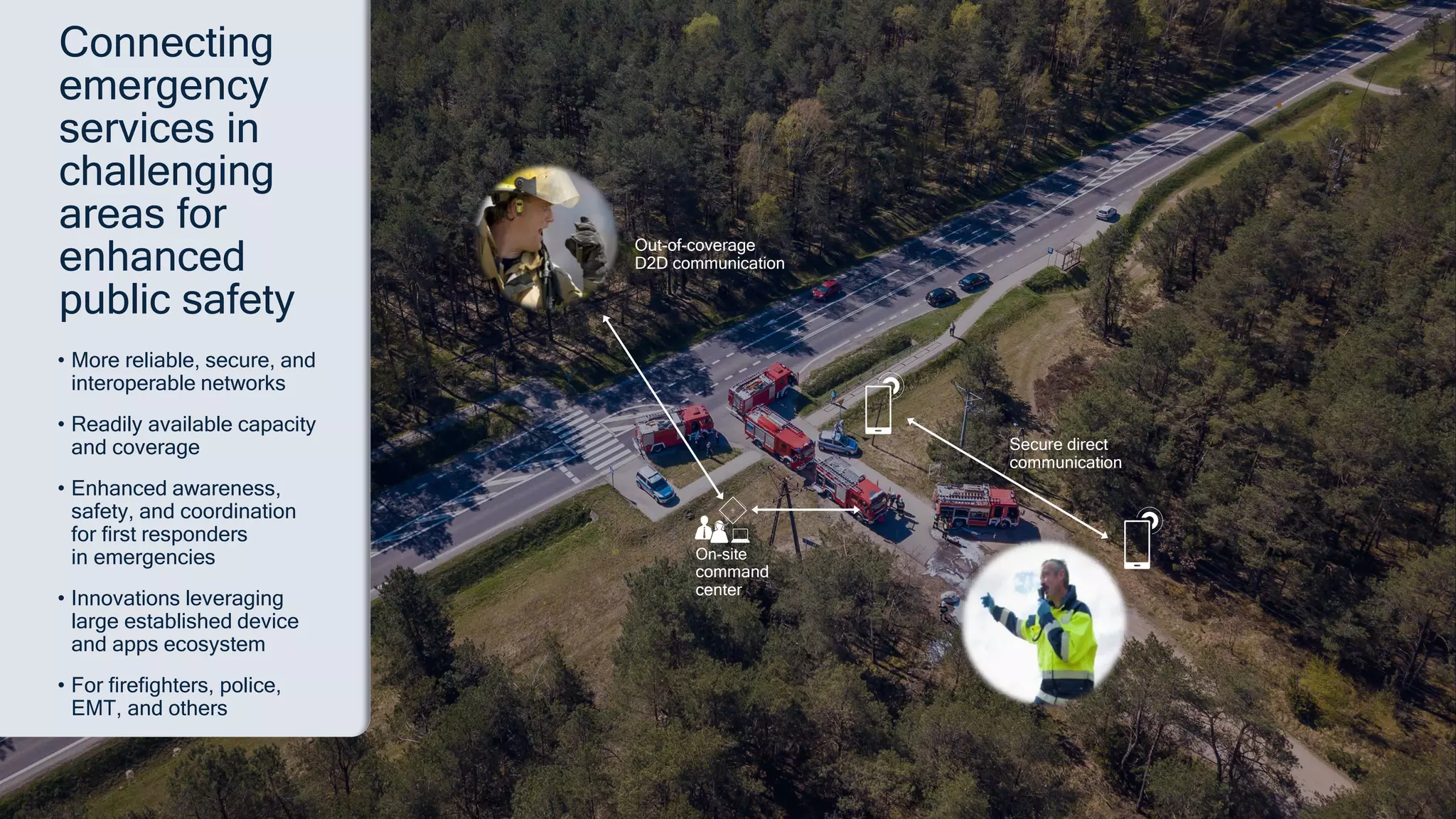
Connecting
emergency
services in
challenging
areas for
enhanced
public safety
• More reliable, secure, and
interoperable networks
• Readily available capacity
and coverage
• Enhanced awareness,
safety, and coordination
for first responders
in emergencies
• Innovations leveraging
large established device
and apps ecosystem
• For firefighters, police,
EMT, and others
On-site
command
center
Out-of-coverage
D2D communication
Secure direct
communication
14
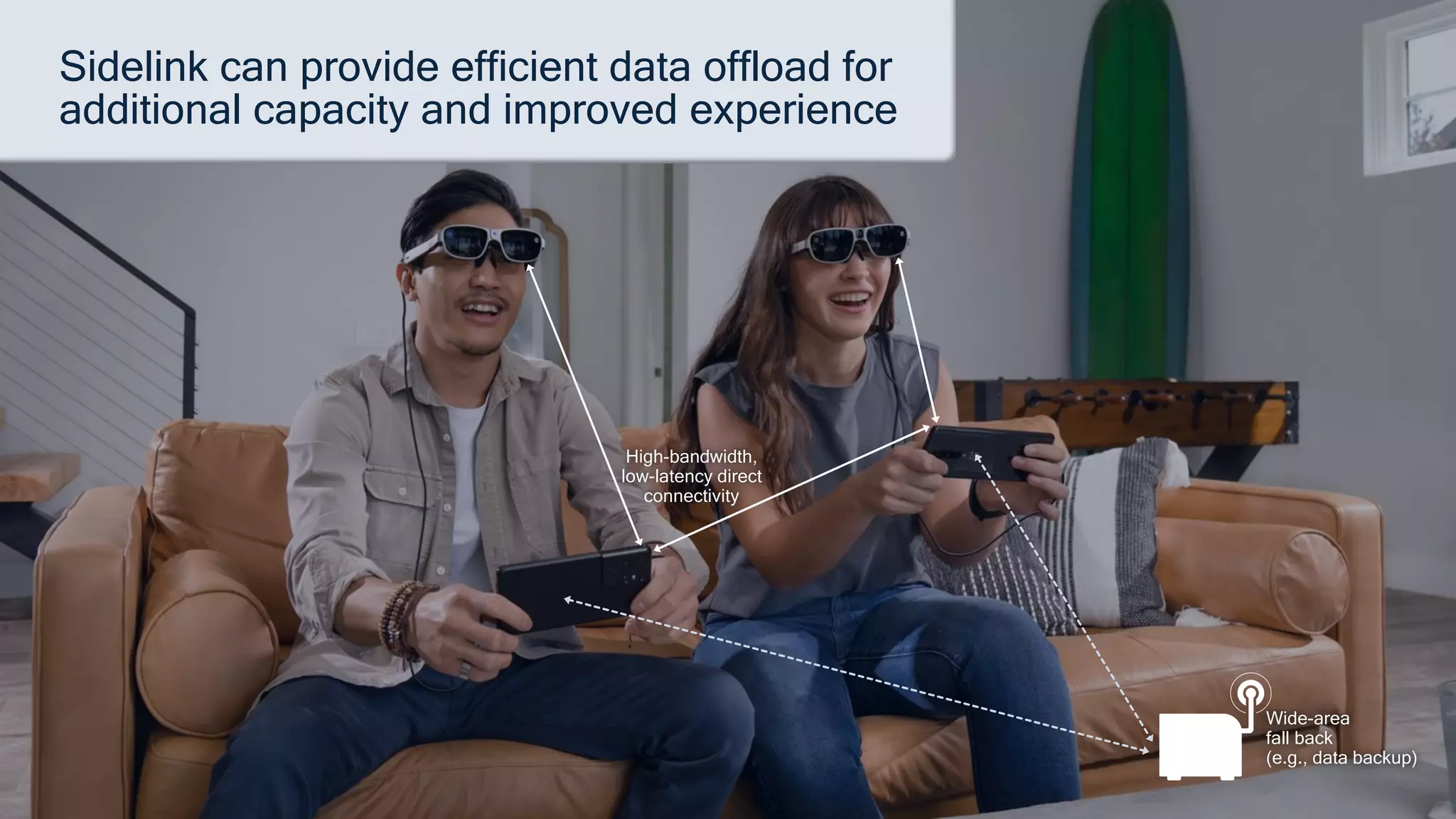
Sidelink can provide efficient data offload for
additional capacity and improved experience
Wide-area
fall back
(e.g., data backup)
High-bandwidth,
low-latency direct
connectivity
15
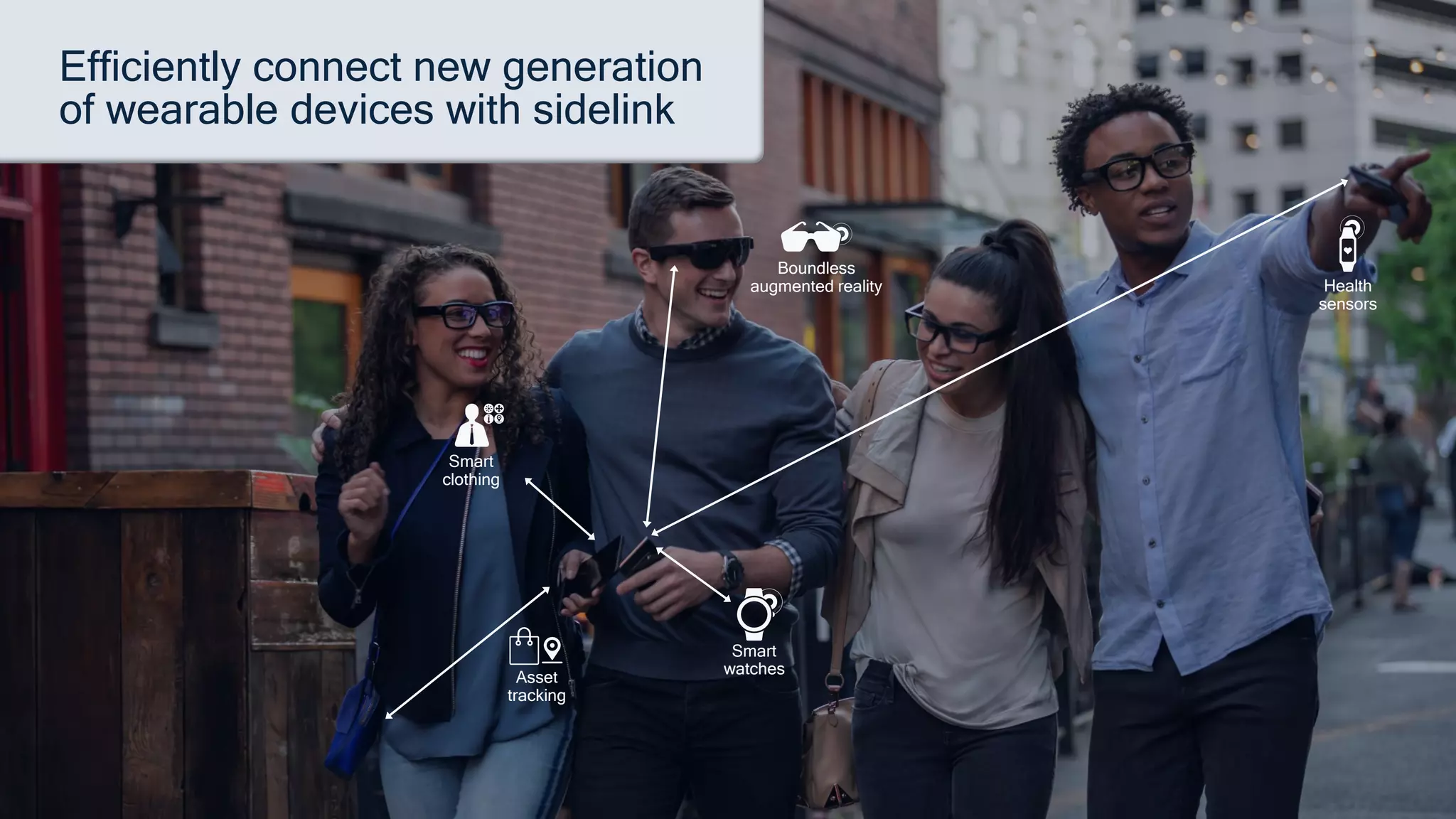
Boundless
augmented reality
Smart
watches
Health
sensors
Asset
tracking
Smart
clothing
Efficiently connect new generation
of wearable devices with sidelink
16
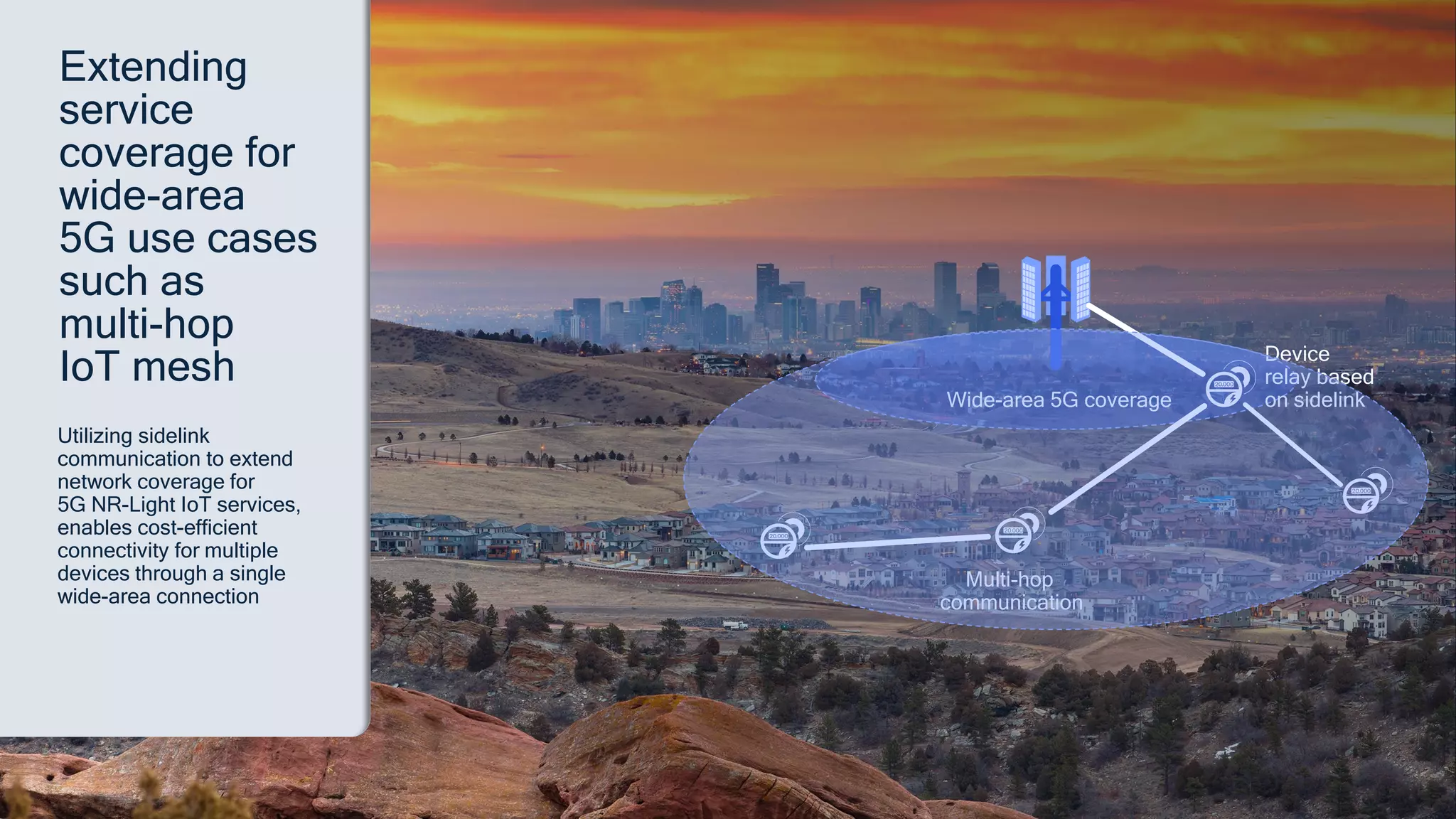
Extending
service
coverage for
wide-area
5G use cases
such as
multi-hop
IoT mesh
Utilizing sidelink
communication to extend
network coverage for
5G NR-Light IoT services,
enables cost-efficient
connectivity for multiple
devices through a single
wide-area connection
Wide-area 5G coverage
Multi-hop
communication
Device
relay based
on sidelink
17
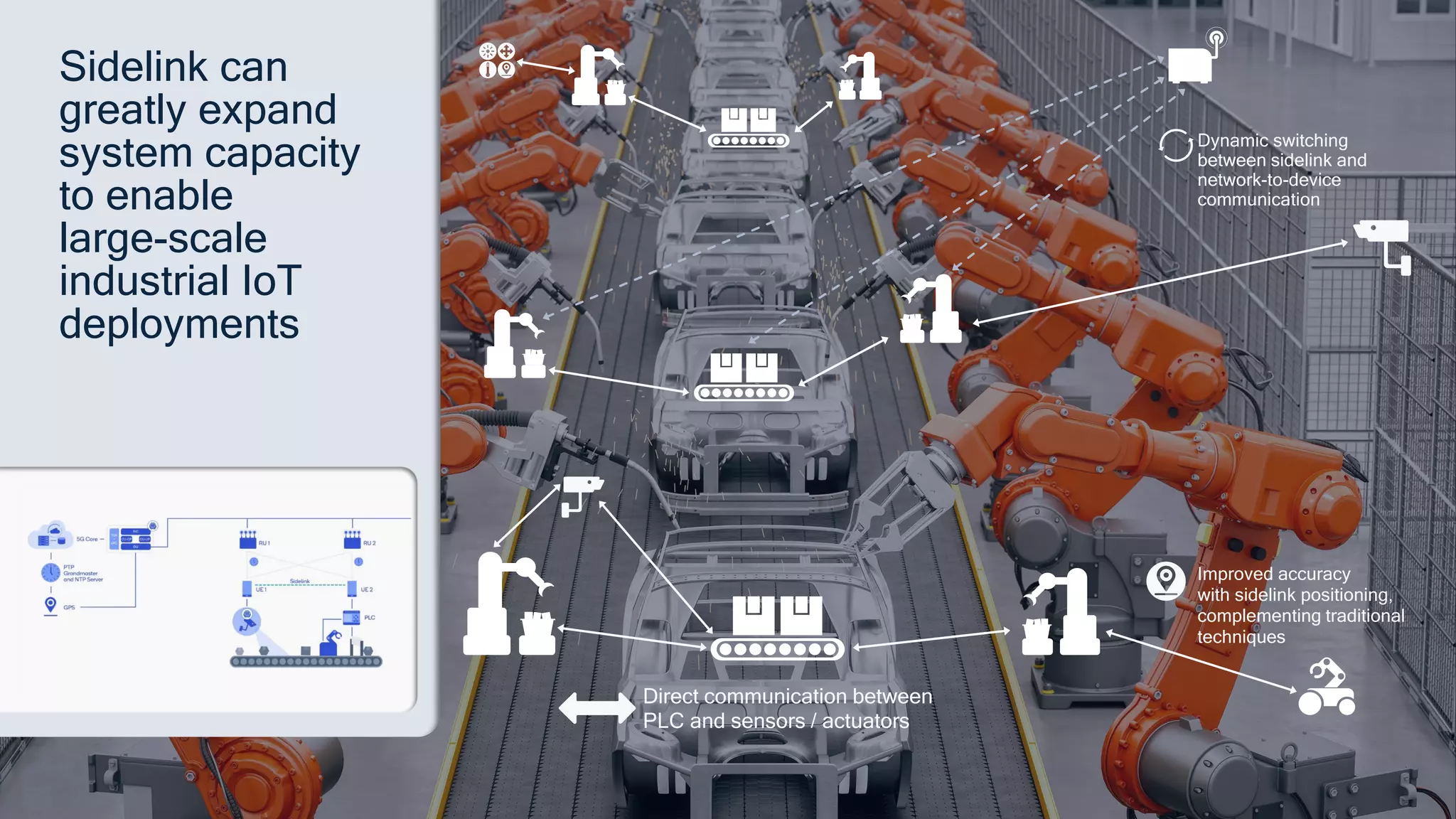
Direct communication between
PLC and sensors / actuators
Improved accuracy
with sidelink positioning,
complementing traditional
techniques
Dynamic switching
between sidelink and
network-to-device
communication
Sidelink can
greatly expand
system capacity
to enable
large-scale
industrial IoT
deployments
18
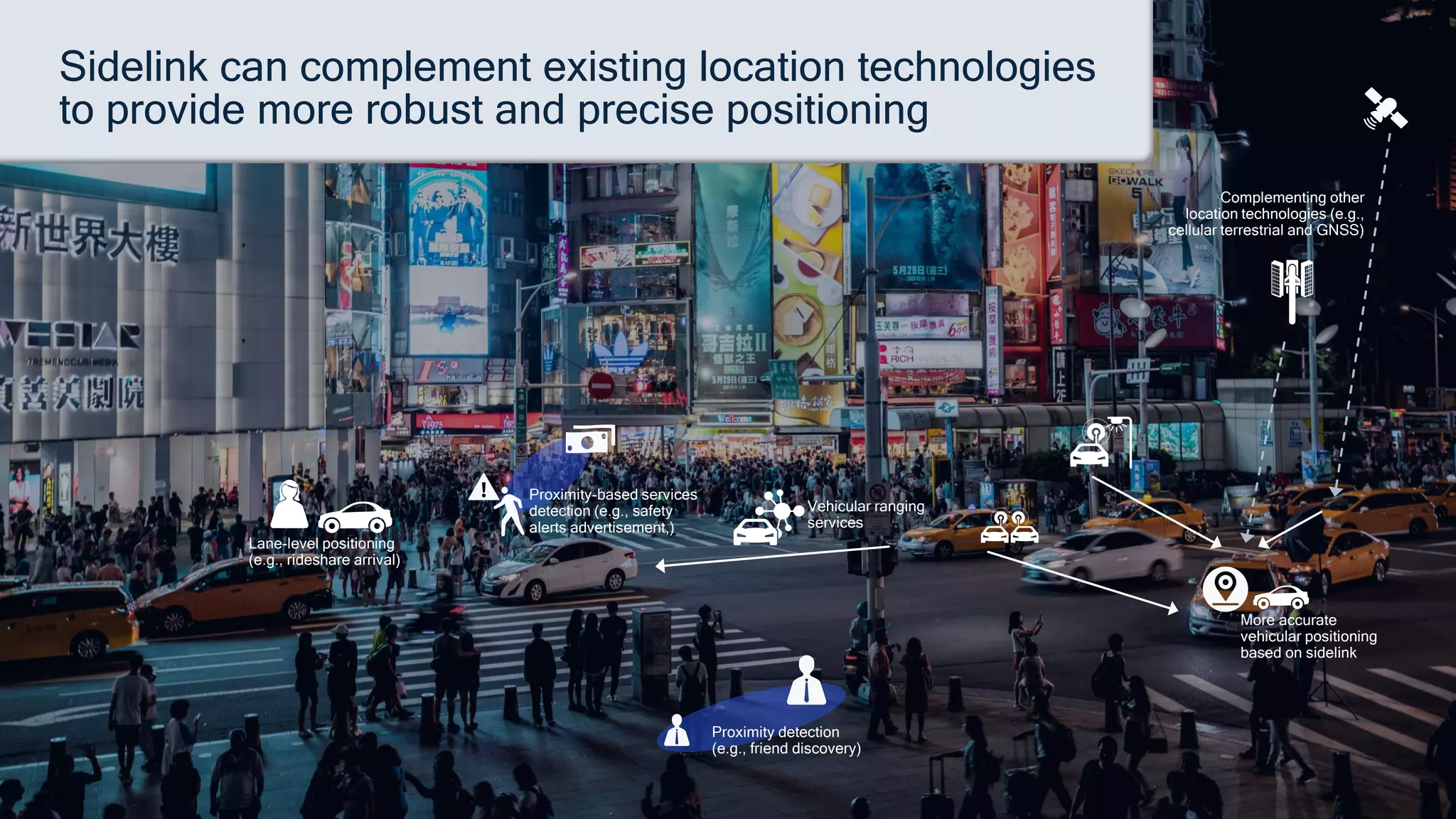
Sidelink can complement existing location technologies
to provide more robust and precise positioning
Vehicular ranging
services
More accurate
vehicular positioning
based on sidelink
Proximity detection
(e.g., friend discovery)
Proximity-based services
detection (e.g., safety
alerts advertisement,)
Lane-level positioning
(e.g., rideshare arrival)
Complementing other
location technologies (e.g.,
cellular terrestrial and GNSS)
19
Sidelink continues to evolve
in 5G Advanced and beyond
Standardized and commercialized today
20
20
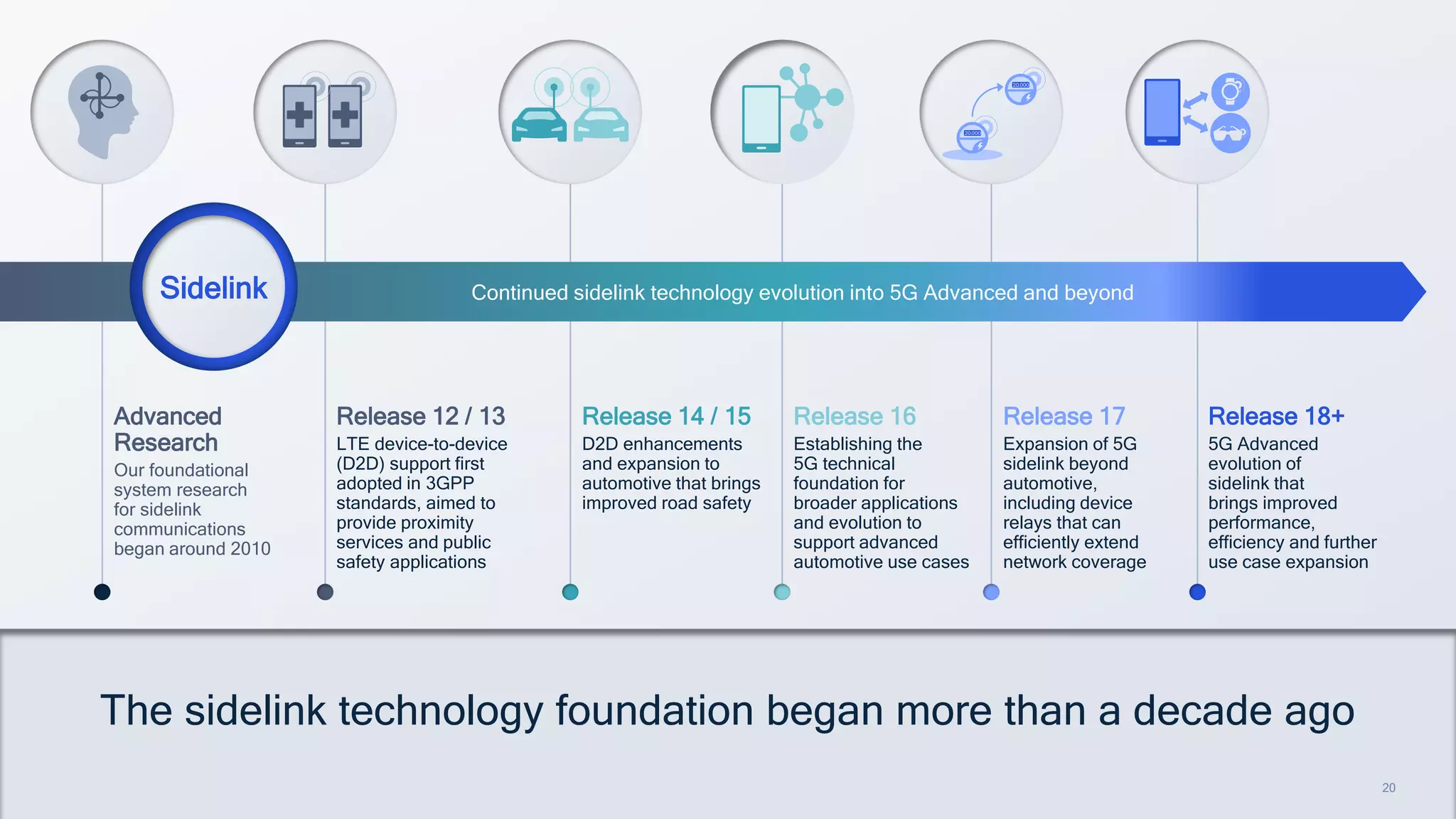
The sidelink technology foundation began more than a decade ago
Advanced
Research
Our foundational
system research
for sidelink
communications
began around 2010
Release 12 / 13
LTE device-to-device
(D2D) support first
adopted in 3GPP
standards, aimed to
provide proximity
services and public
safety applications
Release 14 / 15
D2D enhancements
and expansion to
automotive that brings
improved road safety
Release 16
Establishing the
5G technical
foundation for
broader applications
and evolution to
support advanced
automotive use cases
Release 18+
5G Advanced
evolution of
sidelink that
brings improved
performance,
efficiency and further
use case expansion
Release 17
Expansion of 5G
sidelink beyond
automotive,
including device
relays that can
efficiently extend
network coverage
Release 12
Release 14 / 15
Release 13
Sidelink Continued sidelink technology evolution into 5G Advanced and beyond
21
21
Release 16
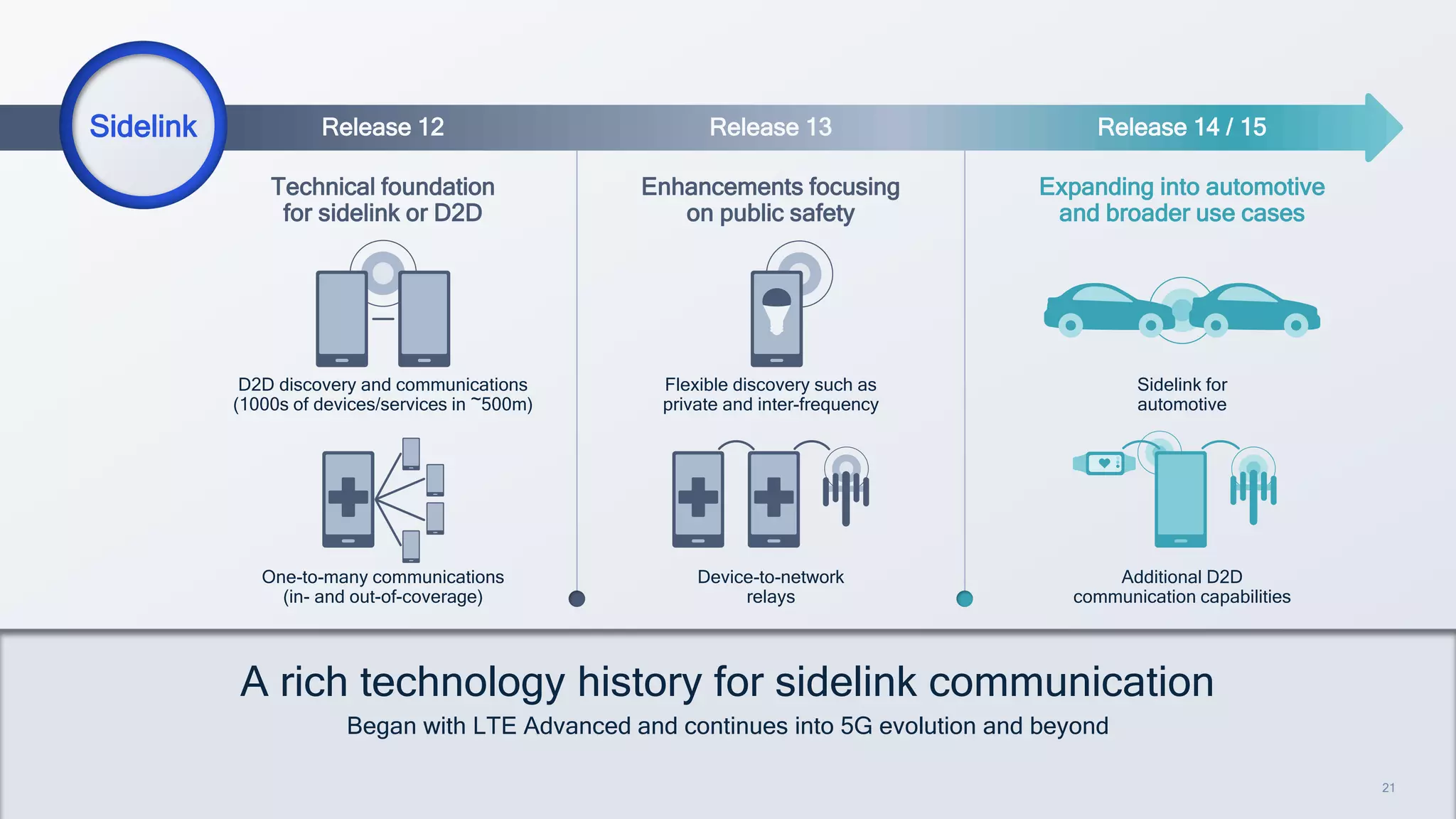
A rich technology history for sidelink communication
Began with LTE Advanced and continues into 5G evolution and beyond
Sidelink Release 12 Release 14 / 15
Release 13
Technical foundation
for sidelink or D2D
Enhancements focusing
on public safety
D2D discovery and communications
(1000s of devices/services in ~500m)
One-to-many communications
(in- and out-of-coverage)
Flexible discovery such as
private and inter-frequency
Device-to-network
relays
Expanding into automotive
and broader use cases
Sidelink for
automotive
Additional D2D
communication capabilities
22
22
Release 16
Release 17
1 Hybrid Automatic Receive Request
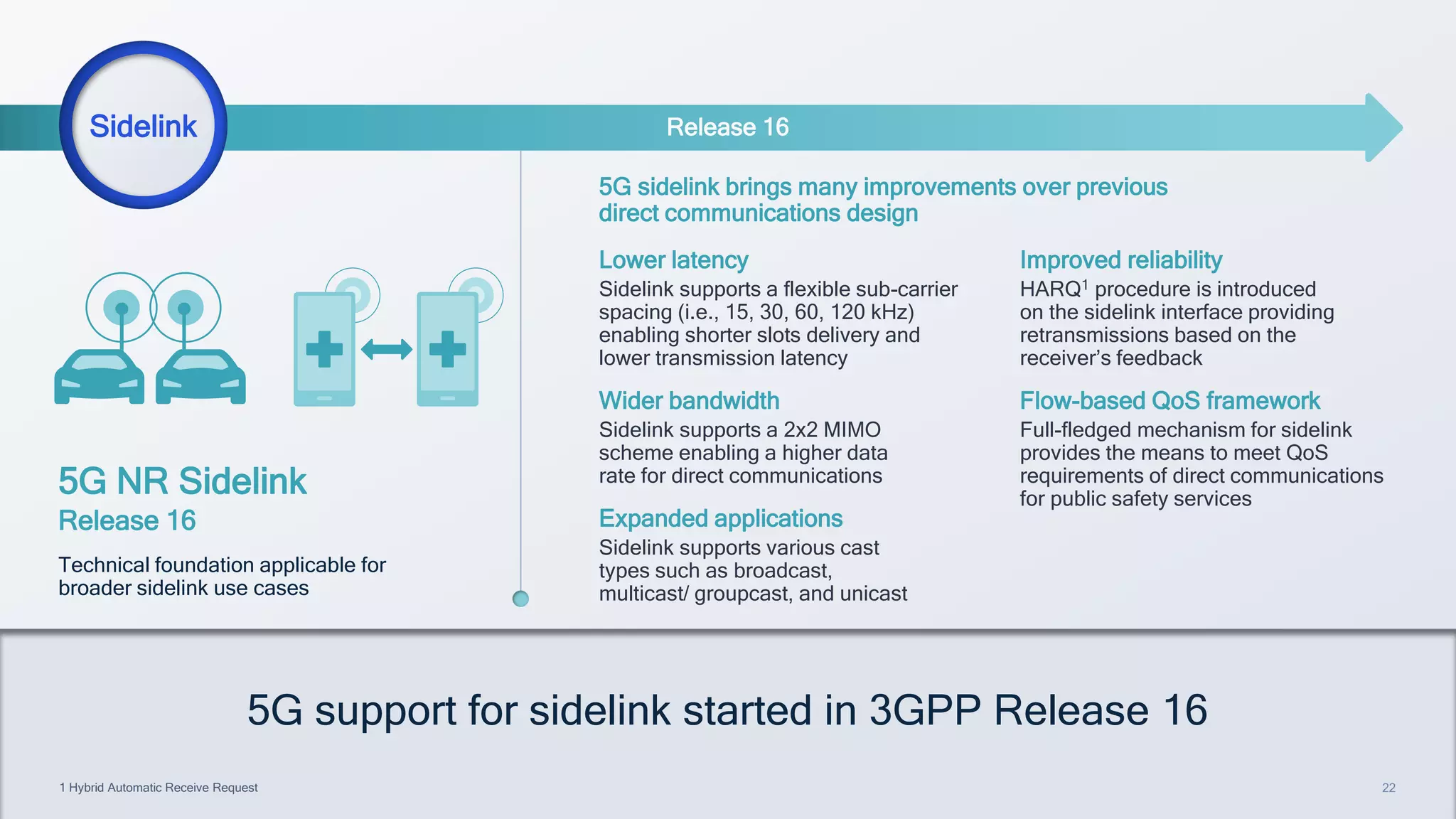
5G support for sidelink started in 3GPP Release 16
5G NR Sidelink
Release 16
Technical foundation applicable for
broader sidelink use cases
5G sidelink brings many improvements over previous
direct communications design
Lower latency
Sidelink supports a flexible sub-carrier
spacing (i.e., 15, 30, 60, 120 kHz)
enabling shorter slots delivery and
lower transmission latency
Wider bandwidth
Sidelink supports a 2x2 MIMO
scheme enabling a higher data
rate for direct communications
Expanded applications
Sidelink supports various cast
types such as broadcast,
multicast/ groupcast, and unicast
Improved reliability
HARQ1 procedure is introduced
on the sidelink interface providing
retransmissions based on the
receiver’s feedback
Flow-based QoS framework
Full-fledged mechanism for sidelink
provides the means to meet QoS
requirements of direct communications
for public safety services
Sidelink
23
23
Release 18
Source: RP-202846 (NR Sidelink enhancement); RP-212601 (NR Sidelink Relay)
1TR 36.843 and/or TR 38.840; 2 Intelligent Transport System
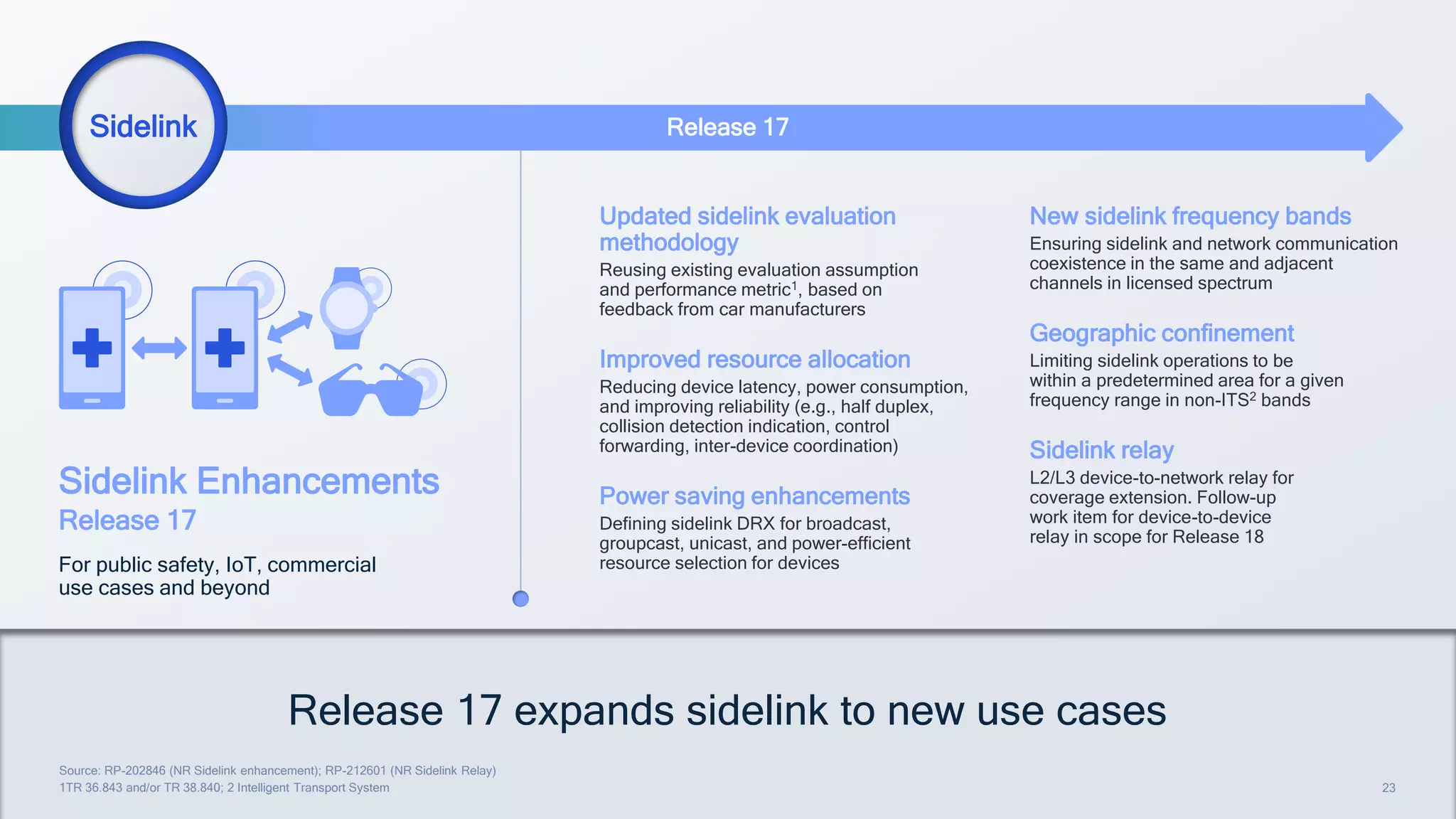
Release 17 expands sidelink to new use cases
Release 17
Sidelink Enhancements
Release 17
For public safety, IoT, commercial
use cases and beyond
Updated sidelink evaluation
methodology
Reusing existing evaluation assumption
and performance metric1, based on
feedback from car manufacturers
Improved resource allocation
Reducing device latency, power consumption,
and improving reliability (e.g., half duplex,
collision detection indication, control
forwarding, inter-device coordination)
Power saving enhancements
Defining sidelink DRX for broadcast,
groupcast, unicast, and power-efficient
resource selection for devices
New sidelink frequency bands
Ensuring sidelink and network communication
coexistence in the same and adjacent
channels in licensed spectrum
Geographic confinement
Limiting sidelink operations to be
within a predetermined area for a given
frequency range in non-ITS2 bands
Sidelink relay
L2/L3 device-to-network relay for
coverage extension. Follow-up
work item for device-to-device
relay in scope for Release 18
Sidelink
24
24
Source: RP-213678 (Sidelink enhancements)
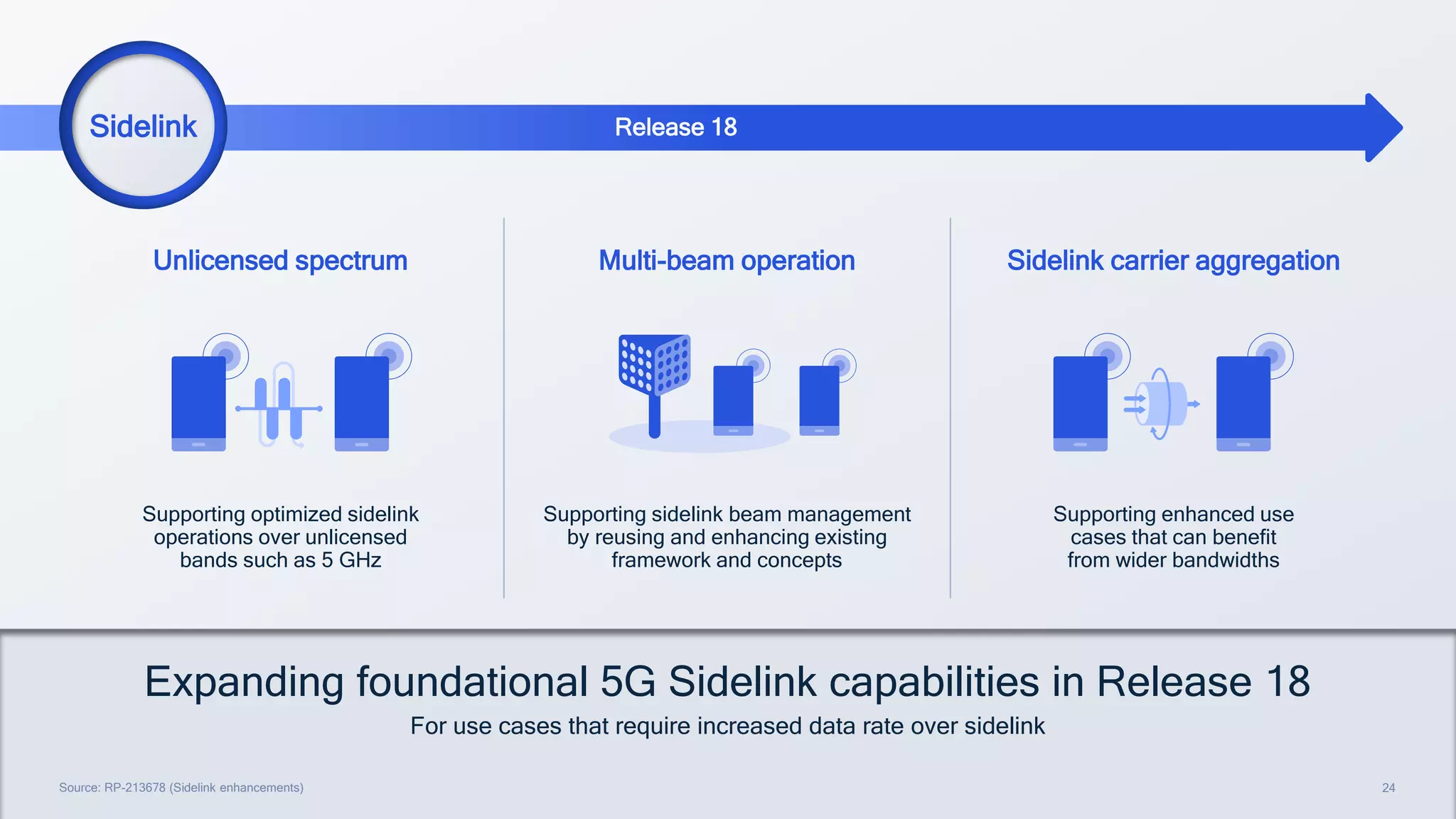
Expanding foundational 5G Sidelink capabilities in Release 18
For use cases that require increased data rate over sidelink
LTE Advanced Pro
Unlicensed spectrum
Supporting optimized sidelink
operations over unlicensed
bands such as 5 GHz
Multi-beam operation
Supporting sidelink beam management
by reusing and enhancing existing
framework and concepts
Sidelink carrier aggregation
Supporting enhanced use
cases that can benefit
from wider bandwidths
Sidelink Release 18
25
25
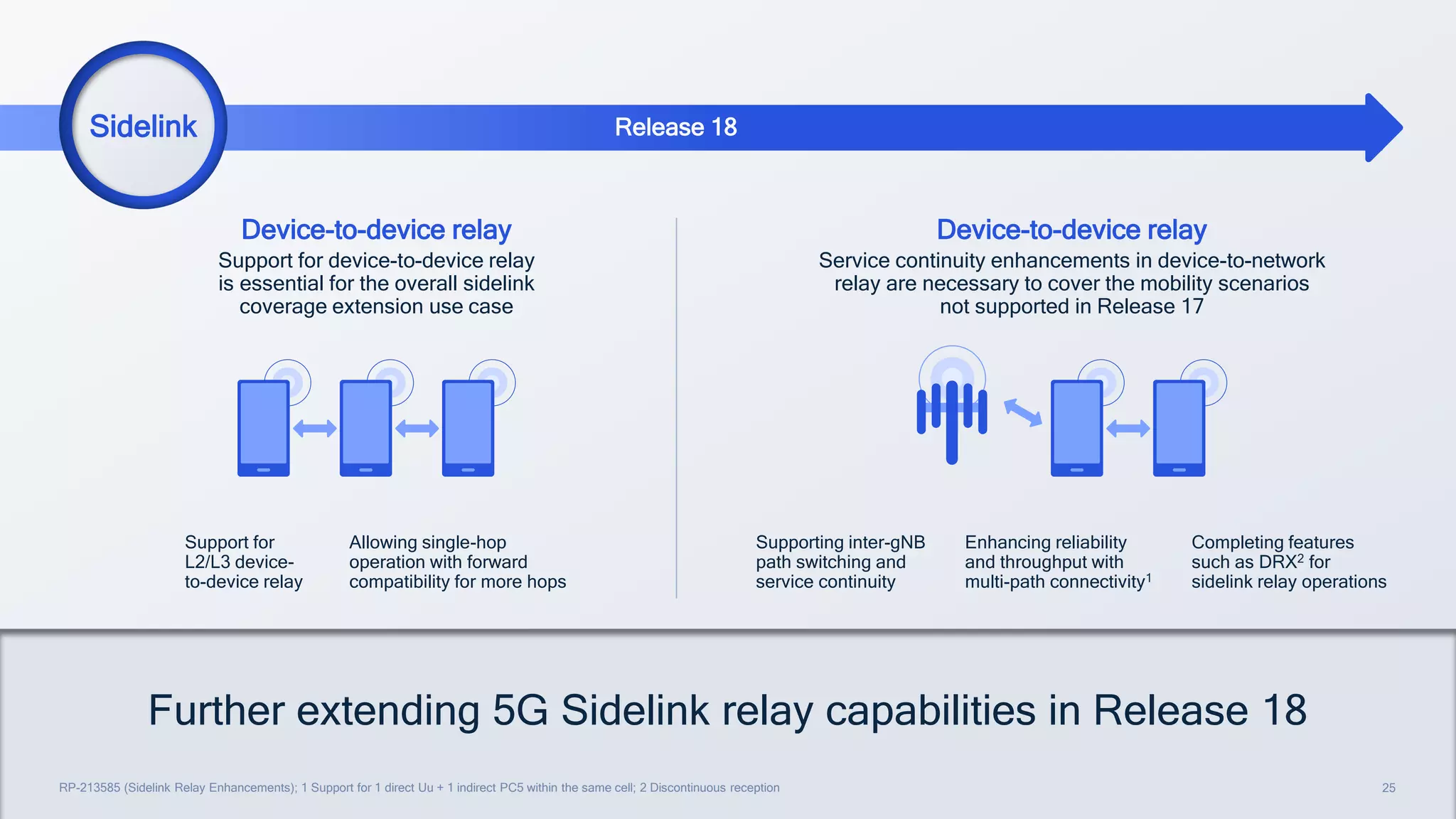
RP-213585 (Sidelink Relay Enhancements); 1 Support for 1 direct Uu + 1 indirect PC5 within the same cell; 2 Discontinuous reception
Further extending 5G Sidelink relay capabilities in Release 18
LTE Advanced Pro
Release 18
Sidelink
Support for
L2/L3 device-
to-device relay
Allowing single-hop
operation with forward
compatibility for more hops
Device-to-device relay
Support for device-to-device relay
is essential for the overall sidelink
coverage extension use case
Device-to-device relay
Service continuity enhancements in device-to-network
relay are necessary to cover the mobility scenarios
not supported in Release 17
Supporting inter-gNB
path switching and
service continuity
Enhancing reliability
and throughput with
multi-path connectivity1
Completing features
such as DRX2 for
sidelink relay operations
26
26
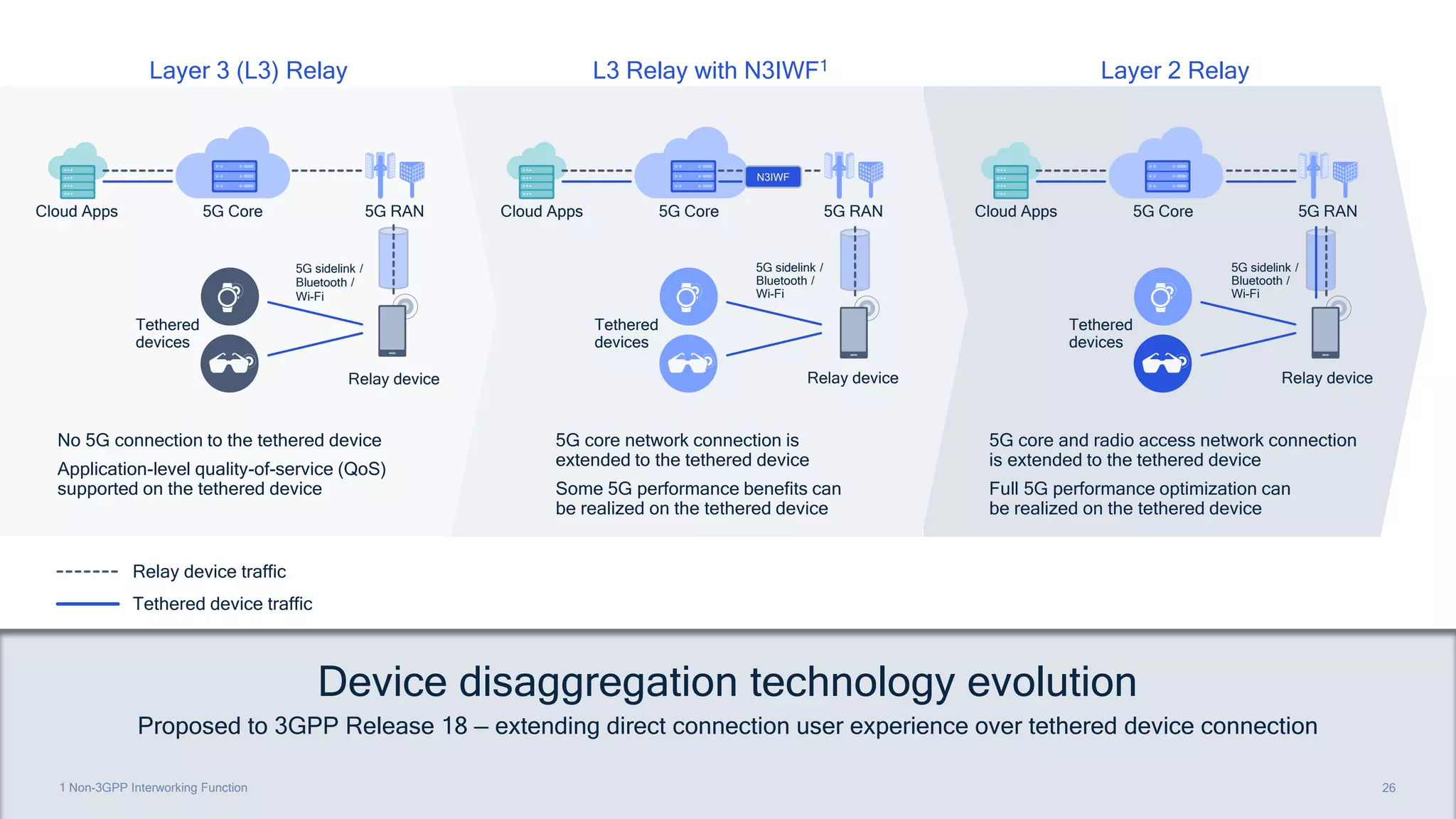
5G core and radio access network connection
is extended to the tethered device
Full 5G performance optimization can
be realized on the tethered device
Cloud Apps 5G Core 5G RAN
Relay device
Tethered
devices
5G sidelink /
Bluetooth /
Wi-Fi
Layer 2 Relay
5G core network connection is
extended to the tethered device
Some 5G performance benefits can
be realized on the tethered device
Cloud Apps 5G Core 5G RAN
Relay device
Tethered
devices
N3IWF
5G sidelink /
Bluetooth /
Wi-Fi
L3 Relay with N3IWF1
1 Non-3GPP Interworking Function
Device disaggregation technology evolution
Proposed to 3GPP Release 18 — extending direct connection user experience over tethered device connection
Relay device traffic
Tethered device traffic
No 5G connection to the tethered device
Application-level quality-of-service (QoS)
supported on the tethered device
Cloud Apps 5G Core 5G RAN
Relay device
Tethered
devices
5G sidelink /
Bluetooth /
Wi-Fi
Layer 3 (L3) Relay
27
27
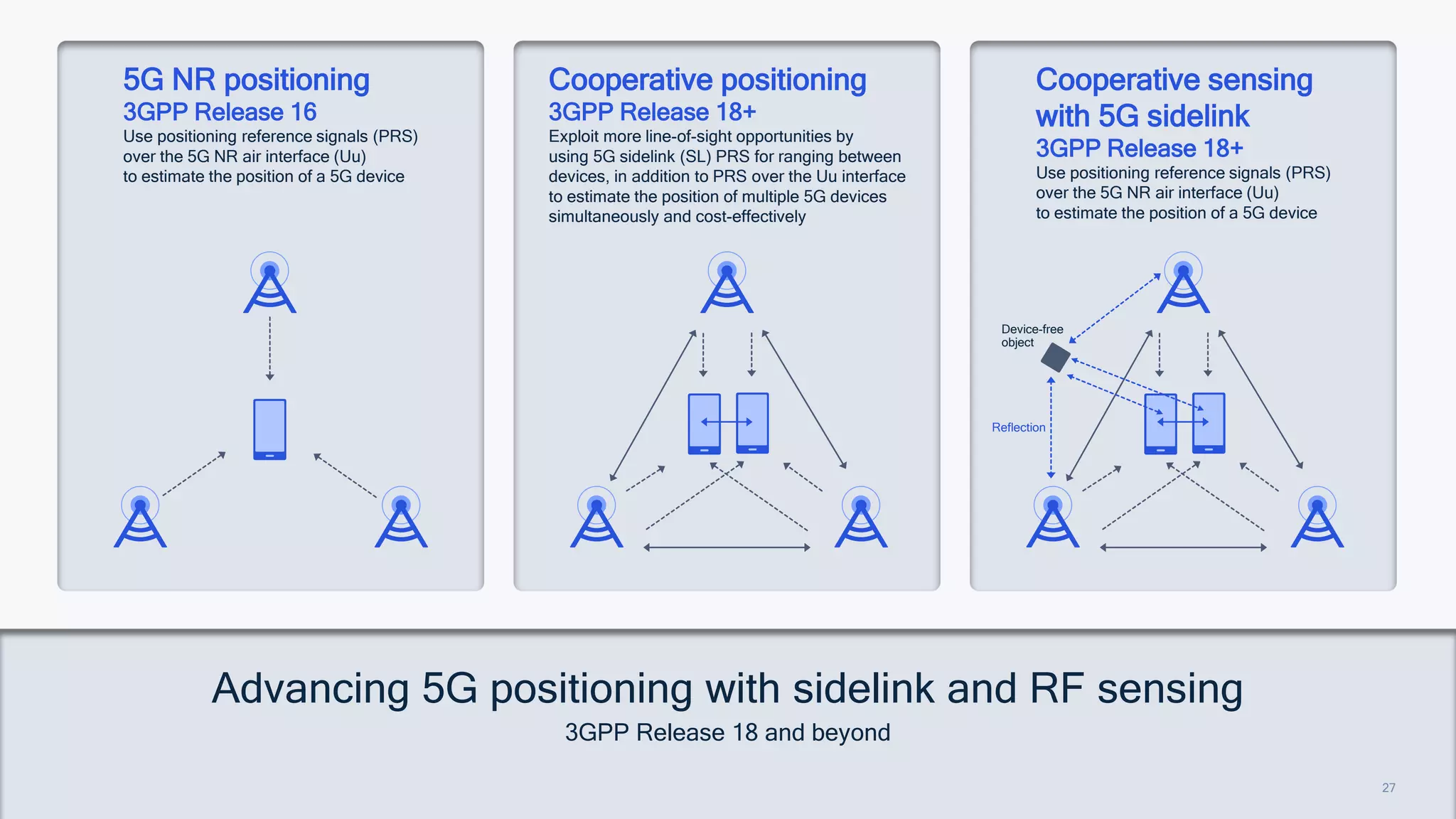
Advancing 5G positioning with sidelink and RF sensing
3GPP Release 18 and beyond
5G NR positioning
3GPP Release 16
Use positioning reference signals (PRS)
over the 5G NR air interface (Uu)
to estimate the position of a 5G device
Cooperative positioning
3GPP Release 18+
Exploit more line-of-sight opportunities by
using 5G sidelink (SL) PRS for ranging between
devices, in addition to PRS over the Uu interface
to estimate the position of multiple 5G devices
simultaneously and cost-effectively
Cooperative sensing
with 5G sidelink
3GPP Release 18+
Use positioning reference signals (PRS)
over the 5G NR air interface (Uu)
to estimate the position of a 5G device
Reflection
Device-free
object
28
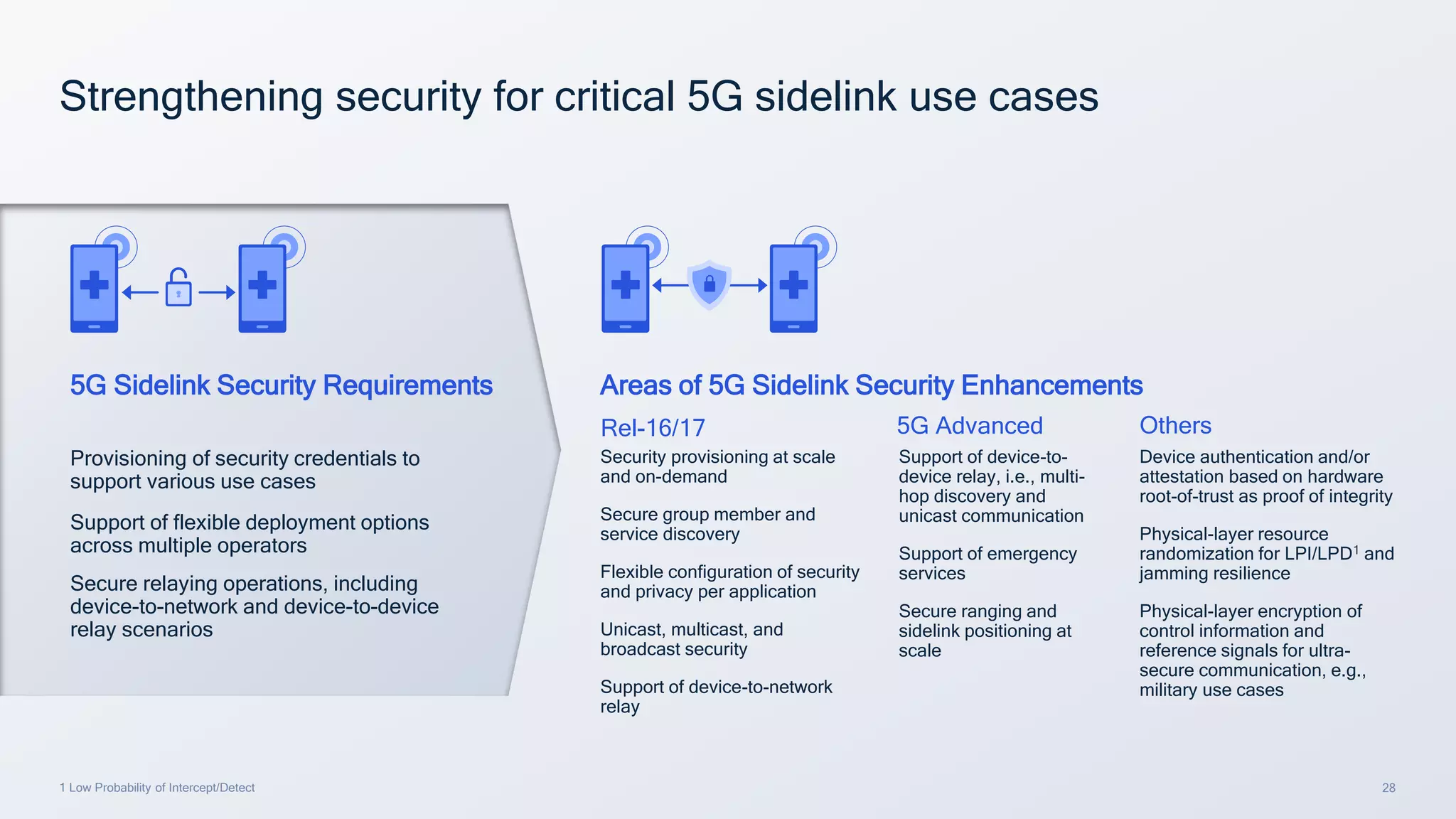
Strengthening security for critical 5G sidelink use cases
5G Sidelink Security Requirements
Provisioning of security credentials to
support various use cases
Support of flexible deployment options
across multiple operators
Security provisioning at scale
and on-demand
Secure group member and
service discovery
Flexible configuration of security
and privacy per application
Unicast, multicast, and
broadcast security
Support of device-to-network
relay
Areas of 5G Sidelink Security Enhancements
Secure relaying operations, including
device-to-network and device-to-device
relay scenarios
Support of device-to-
device relay, i.e., multi-
hop discovery and
unicast communication
Support of emergency
services
Secure ranging and
sidelink positioning at
scale
Device authentication and/or
attestation based on hardware
root-of-trust as proof of integrity
Physical-layer resource
randomization for LPI/LPD1 and
jamming resilience
Physical-layer encryption of
control information and
reference signals for ultra-
secure communication, e.g.,
military use cases
Rel-16/17 5G Advanced Others
1 Low Probability of Intercept/Detect
29
29
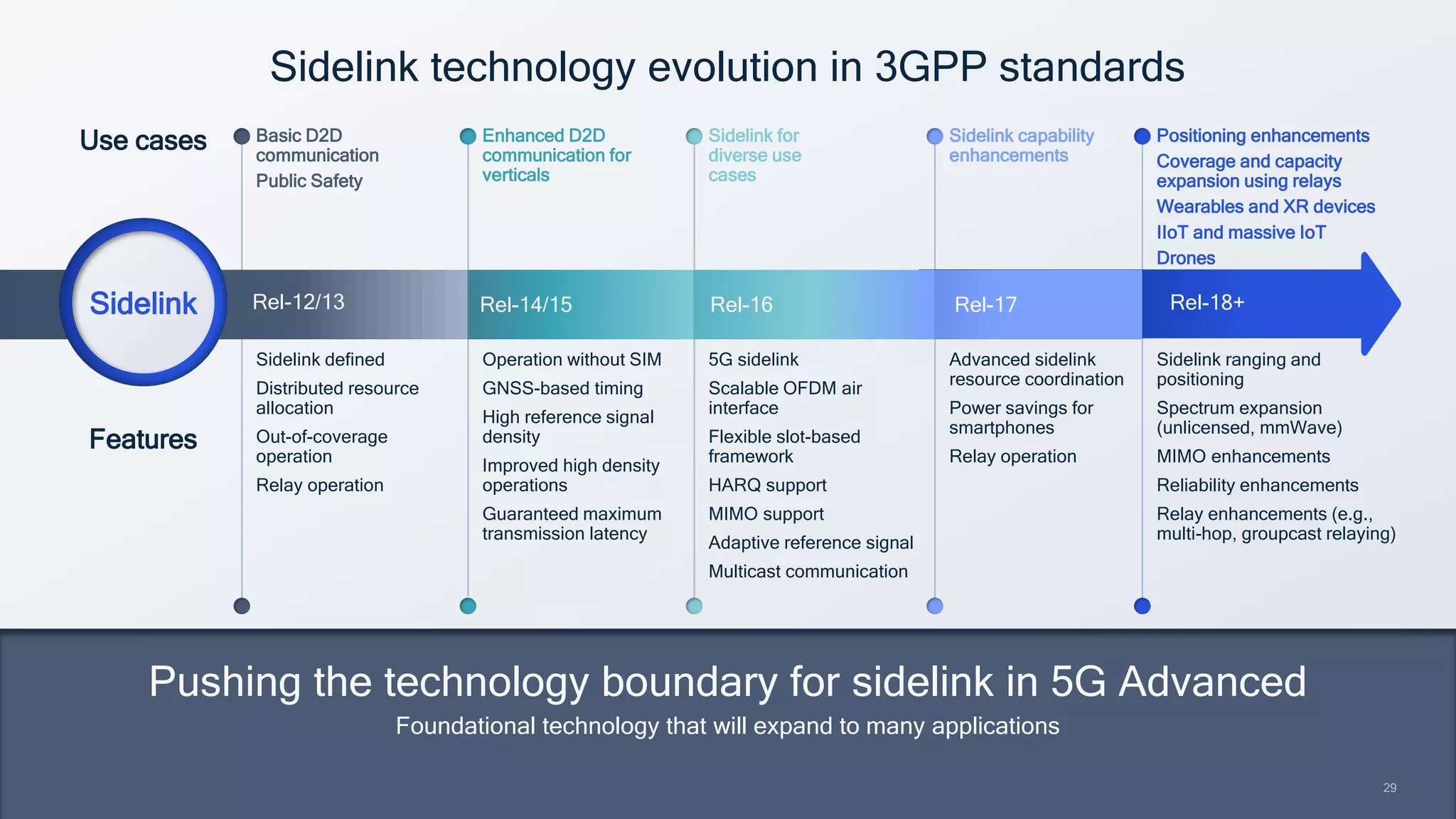
Rel-18+
Rel-17
Rel-16
Rel-14/15
Pushing the technology boundary for sidelink in 5G Advanced
Foundational technology that will expand to many applications
Features
Sidelink defined
Distributed resource
allocation
Out-of-coverage
operation
Relay operation
Operation without SIM
GNSS-based timing
High reference signal
density
Improved high density
operations
Guaranteed maximum
transmission latency
5G sidelink
Scalable OFDM air
interface
Flexible slot-based
framework
HARQ support
MIMO support
Adaptive reference signal
Multicast communication
Sidelink ranging and
positioning
Spectrum expansion
(unlicensed, mmWave)
MIMO enhancements
Reliability enhancements
Relay enhancements (e.g.,
multi-hop, groupcast relaying)
Advanced sidelink
resource coordination
Power savings for
smartphones
Relay operation
Rel-12/13
Sidelink
Use cases Basic D2D
communication
Public Safety
Enhanced D2D
communication for
verticals
Sidelink for
diverse use
cases
Positioning enhancements
Coverage and capacity
expansion using relays
Wearables and XR devices
IIoT and massive IoT
Drones
Sidelink capability
enhancements
Sidelink technology evolution in 3GPP standards
30
Qualcomm
is leading the way
Driving future 5G sidelink technologies and new use cases
31
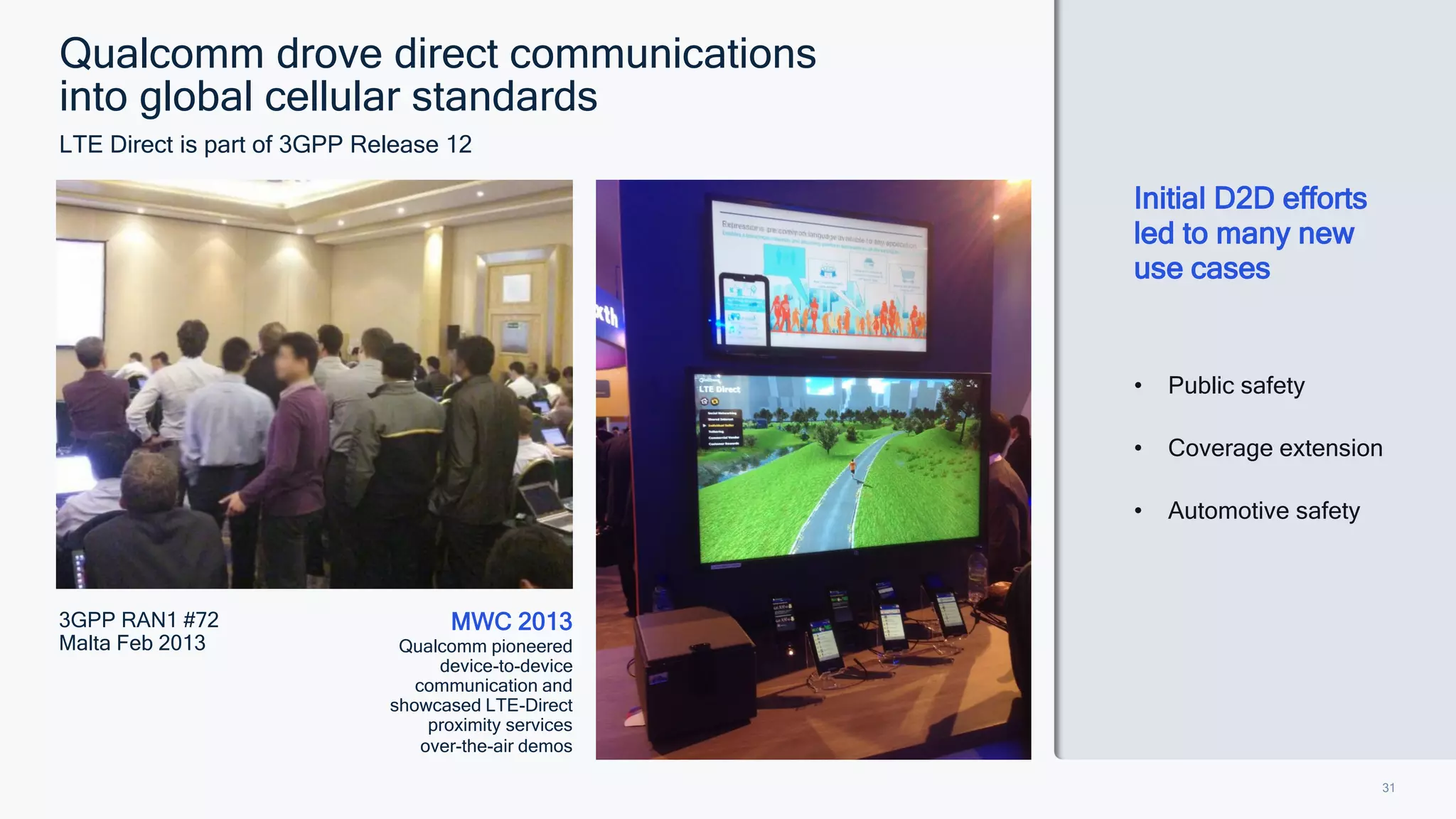
Qualcomm drove direct communications
into global cellular standards
LTE Direct is part of 3GPP Release 12
3GPP RAN1 #72
Malta Feb 2013
• Public safety
• Coverage extension
• Automotive safety
Initial D2D efforts
led to many new
use cases
MWC 2013
Qualcomm pioneered
device-to-device
communication and
showcased LTE-Direct
proximity services
over-the-air demos
32
Qualcomm 9150 and Snapdragon are products of
Qualcomm Technologies, Inc. and/or its subsidiaries.
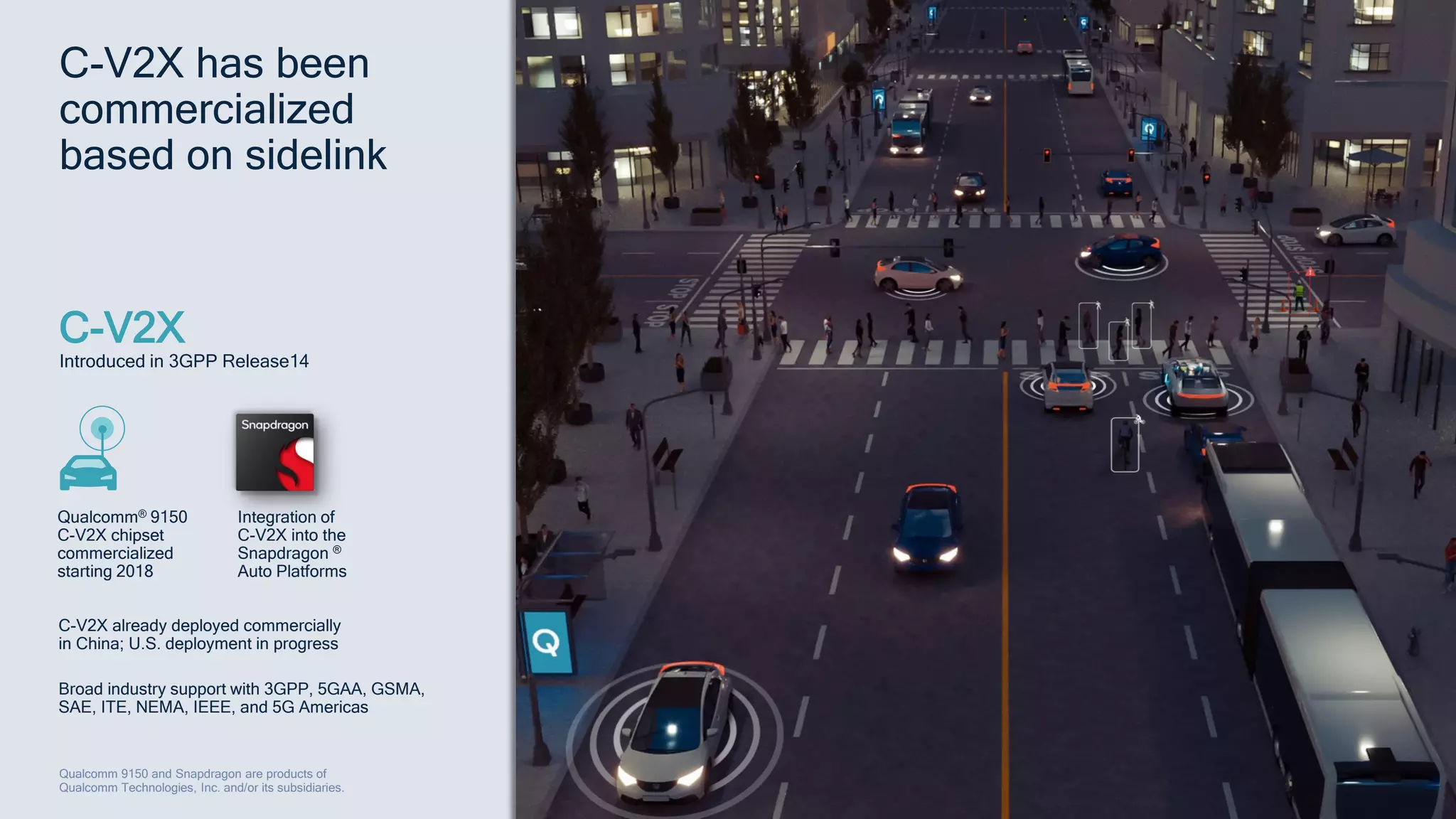
C-V2X has been
commercialized
based on sidelink
C-V2X
Introduced in 3GPP Release14
C-V2X already deployed commercially
in China; U.S. deployment in progress
Broad industry support with 3GPP, 5GAA, GSMA,
SAE, ITE, NEMA, IEEE, and 5G Americas
Qualcomm® 9150
C-V2X chipset
commercialized
starting 2018
Integration of
C-V2X into the
Snapdragon ®
Auto Platforms
33
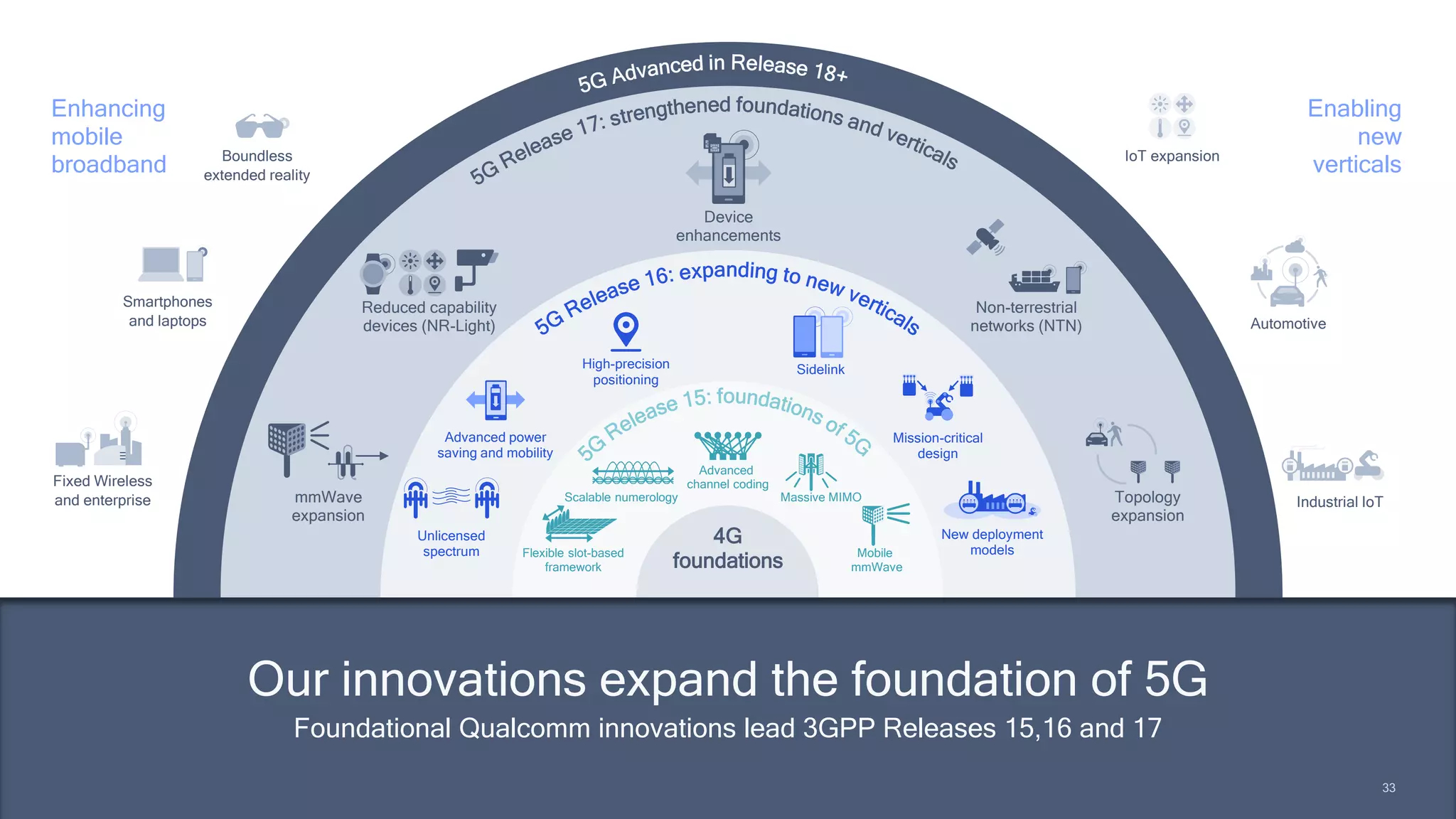
Reduced capability
devices (NR-Light)
mmWave
expansion
Topology
expansion
Device
enhancements
Non-terrestrial
networks (NTN)
Unlicensed
spectrum
Advanced power
saving and mobility
Mission-critical
design
High-precision
positioning
New deployment
models
Flexible slot-based
framework
Mobile
mmWave
Scalable numerology
Advanced
channel coding
Massive MIMO
4G
foundations
Fixed Wireless
and enterprise
Smartphones
and laptops
Boundless
extended reality
Automotive
Industrial IoT
IoT expansion
Enhancing
mobile
broadband
Enabling
new
verticals
Our innovations expand the foundation of 5G
Foundational Qualcomm innovations lead 3GPP Releases 15,16 and 17
33
Sidelink
34
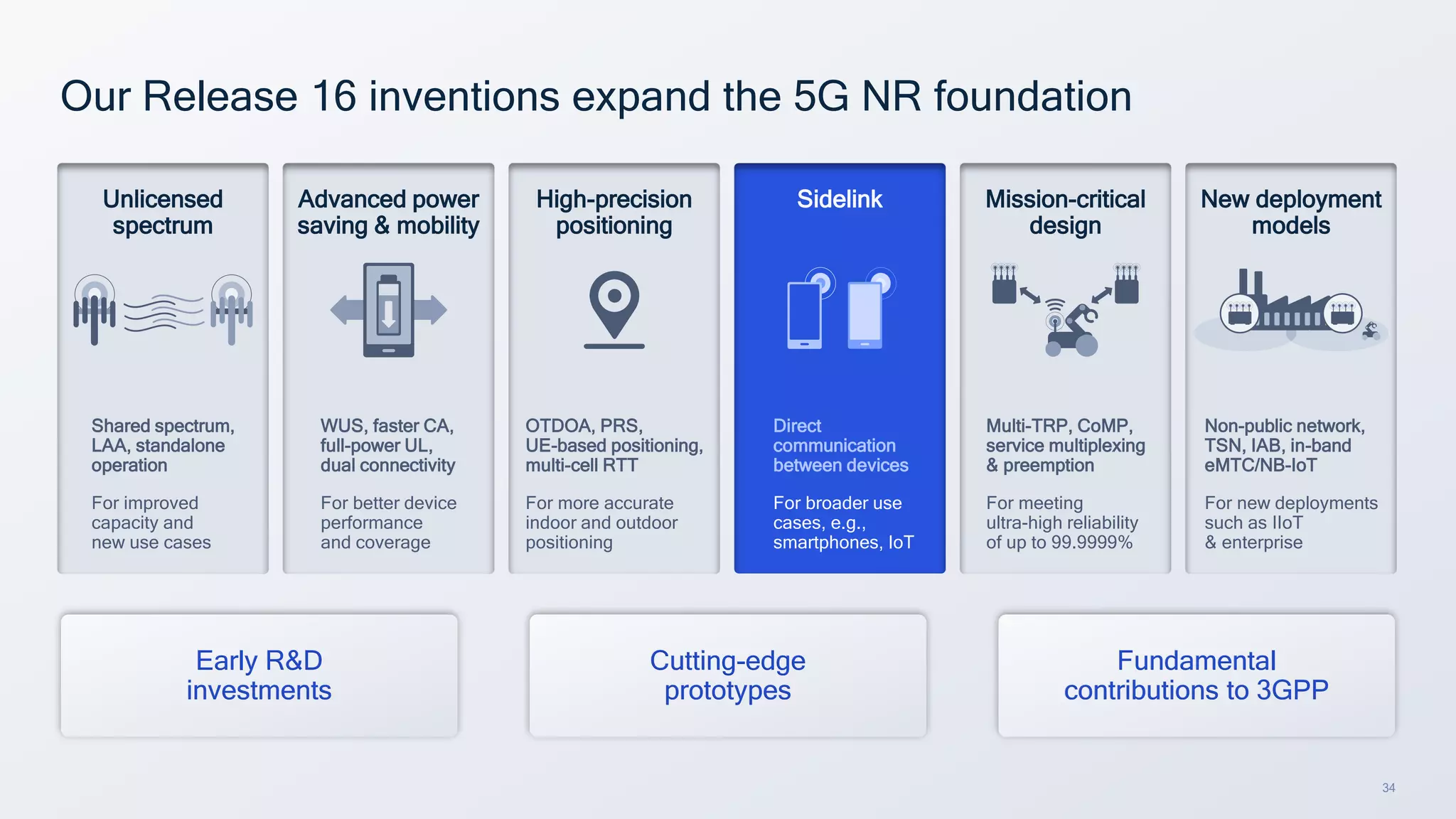
New deployment
models
Our Release 16 inventions expand the 5G NR foundation
Advanced power
saving & mobility
High-precision
positioning
Mission-critical
design
Unlicensed
spectrum
Shared spectrum,
LAA, standalone
operation
For improved
capacity and
new use cases
WUS, faster CA,
full-power UL,
dual connectivity
For better device
performance
and coverage
OTDOA, PRS,
UE-based positioning,
multi-cell RTT
For more accurate
indoor and outdoor
positioning
Multi-TRP, CoMP,
service multiplexing
& preemption
For meeting
ultra-high reliability
of up to 99.9999%
Non-public network,
TSN, IAB, in-band
eMTC/NB-IoT
For new deployments
such as IIoT
& enterprise
Fundamental
contributions to 3GPP
Cutting-edge
prototypes
Early R&D
investments
Sidelink
Direct
communication
between devices
For broader use
cases, e.g.,
smartphones, IoT
35
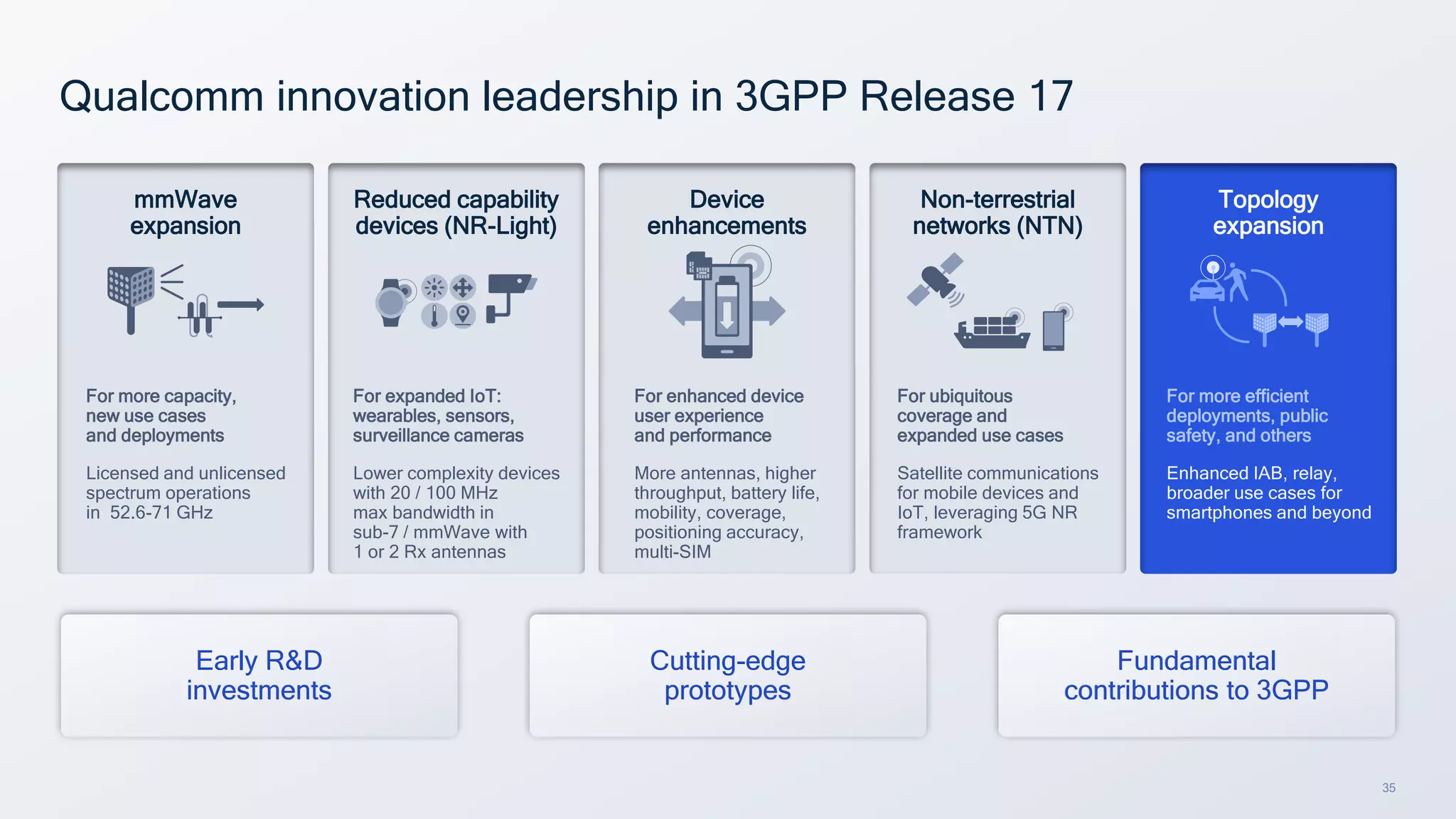
Qualcomm innovation leadership in 3GPP Release 17
Reduced capability
devices (NR-Light)
Device
enhancements
Non-terrestrial
networks (NTN)
For expanded IoT:
wearables, sensors,
surveillance cameras
Lower complexity devices
with 20 / 100 MHz
max bandwidth in
sub-7 / mmWave with
1 or 2 Rx antennas
For enhanced device
user experience
and performance
More antennas, higher
throughput, battery life,
mobility, coverage,
positioning accuracy,
multi-SIM
For ubiquitous
coverage and
expanded use cases
Satellite communications
for mobile devices and
IoT, leveraging 5G NR
framework
Fundamental
contributions to 3GPP
Cutting-edge
prototypes
Early R&D
investments
mmWave
expansion
For more capacity,
new use cases
and deployments
Licensed and unlicensed
spectrum operations
in 52.6-71 GHz
Topology
expansion
For more efficient
deployments, public
safety, and others
Enhanced IAB, relay,
broader use cases for
smartphones and beyond
36
36
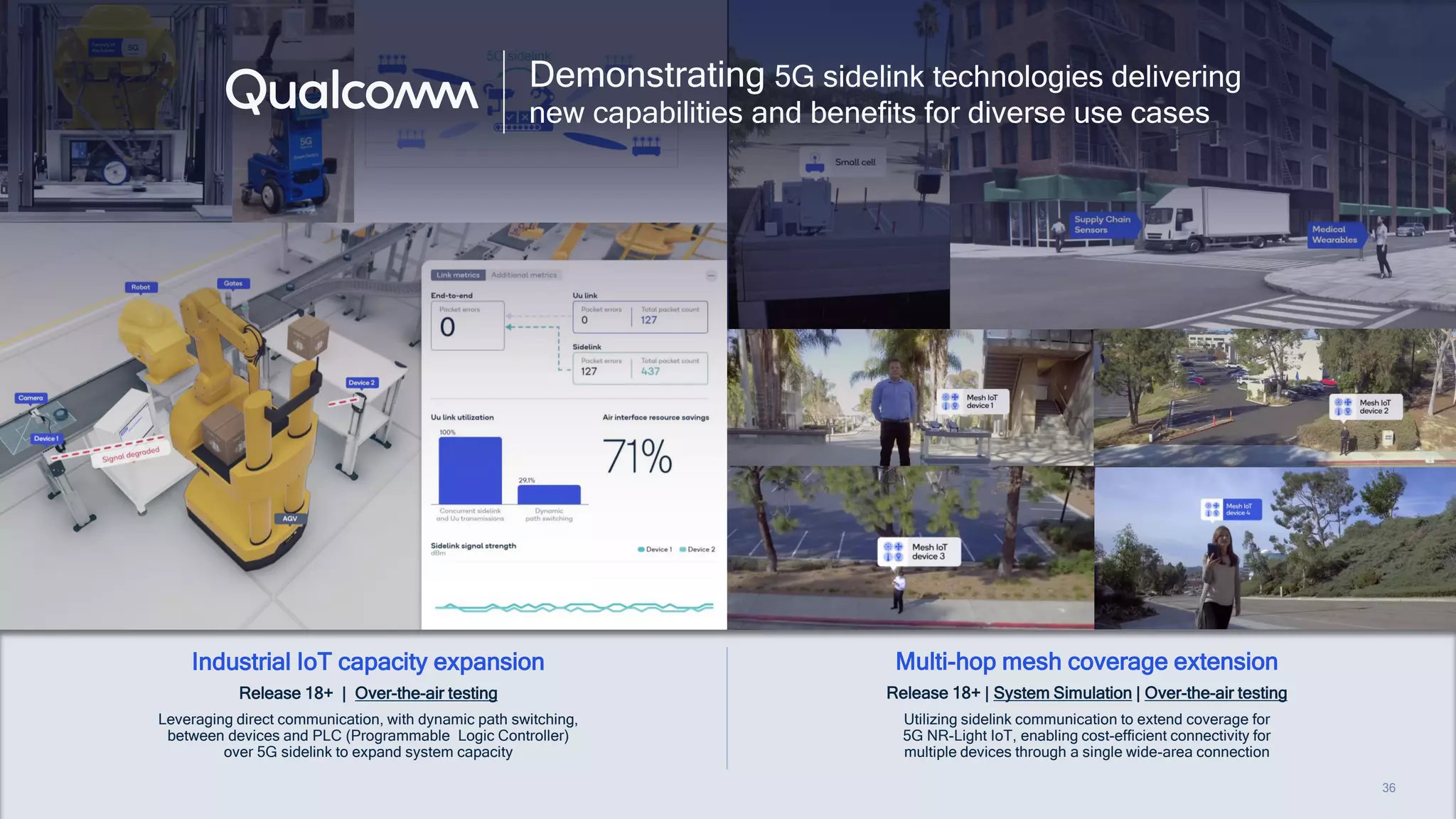
Multi-hop mesh coverage extension
Release 18+ | System Simulation | Over-the-air testing
Utilizing sidelink communication to extend coverage for
5G NR-Light IoT, enabling cost-efficient connectivity for
multiple devices through a single wide-area connection
Industrial IoT capacity expansion
Release 18+ | Over-the-air testing
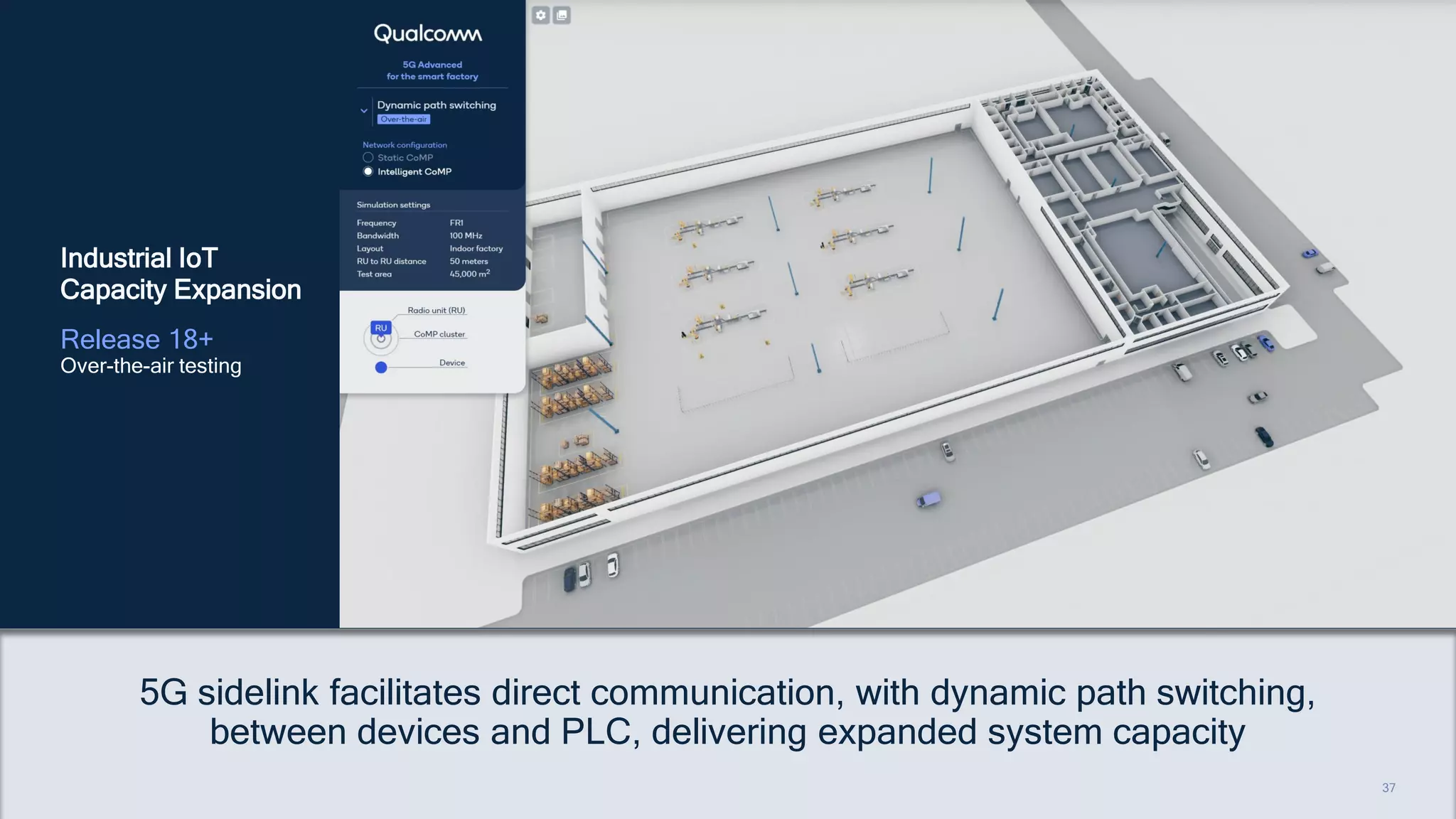
Leveraging direct communication, with dynamic path switching,
between devices and PLC (Programmable Logic Controller)
over 5G sidelink to expand system capacity
Demonstrating 5G sidelink technologies delivering
new capabilities and benefits for diverse use cases
37
37
5G sidelink facilitates direct communication, with dynamic path switching,
between devices and PLC, delivering expanded system capacity
Release 18+
Over-the-air testing
Industrial IoT
Capacity Expansion
38
38
5G sidelink can extend NR-Light coverage, enabling cost-efficient IoT
connectivity for multiple devices through a single wide-area connection
Release 18+
Over-the-air testing
Multi-hop Mesh
Coverage Extension
39
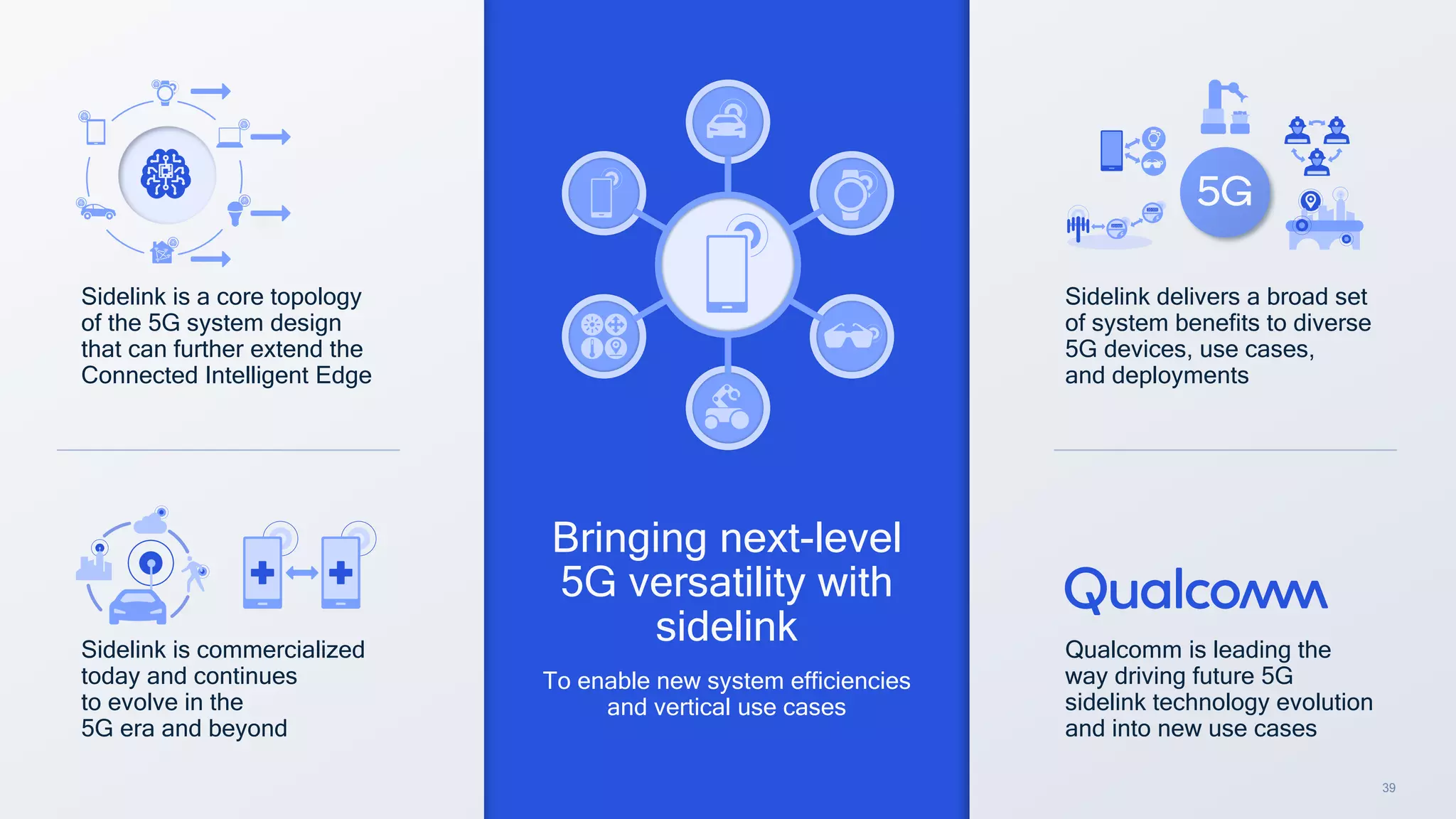
Sidelink is a core topology
of the 5G system design
that can further extend the
Connected Intelligent Edge
Qualcomm is leading the
way driving future 5G
sidelink technology evolution
and into new use cases
Sidelink delivers a broad set
of system benefits to diverse
5G devices, use cases,
and deployments
Sidelink is commercialized
today and continues
to evolve in the
5G era and beyond
To enable new system efficiencies
and vertical use cases
Bringing next-level
5G versatility with
sidelink
Nothing in these materials is an offer to sell any of the components
or devices referenced herein.
©2018-2022 Qualcomm Technologies, Inc. and/or its affiliated
companies. All Rights Reserved.
Qualcomm and Snapdragon are trademarks or registered trademarks of
Qualcomm Incorporated. Other products and brand names may be
trademarks or registered trademarks of their respective owners.
References in this presentation to “Qualcomm” may mean Qualcomm
Incorporated, Qualcomm Technologies, Inc., and/or other subsidiaries or
business units within the Qualcomm corporate structure, as applicable.
Qualcomm Incorporated includes our licensing business, QTL, and the vast
majority of our patent portfolio. Qualcomm Technologies, Inc., a subsidiary
of Qualcomm Incorporated, operates, along with its subsidiaries,
substantially all of our engineering, research and development functions,
and substantially all of our products and services businesses, including our
QCT semiconductor business.
Follow us on:
For more information, visit us at:
qualcomm.com & qualcomm.com/blog
Thank you

How will sidelink bring a new level of 5G versatility.pdf

  • 1.
    @QCOMResearch September 8th,2022 How will sidelink bring a new level of 5G versatility? San Diego, CA For diverse devices and services beyond automotive — smartphones, IoT, and more
  • 2.
    2 Sidelink is acore topology of the 5G system design Further extending the connected intelligent edge
  • 3.
    3 3 Sidelink is acore topology of the 5G system design Also known as direct communication or D2D (Device-to-Device) Network-to-device (Uu interface) Device-to-device or Sidelink (PC5 interface) Original 5G vision Envisioned to be part of the 5G NR flexible framework with forward compatibility Service coexistence Multiplexing seamlessly with other 5G NR communication in time and frequency domain New system values Offering a wide range of benefits to complement network-to-device (i.e., Uu) communication Technology foundation Building on the learnings of LTE Direct (Rel-12+) technology, its evolution, and deployments Qualcomm Technologies’ 5G Vision, circa 2015
  • 4.
    4 Edge cloud Central cloudOn-device Privacy Reliability Low latency Efficient use of network bandwidth Connected intelligent edge To efficiently scale, AI processing is expanding toward the edge Qualcomm is leading the realization of the Connected Intelligent Edge Convergence of: Wireless connectivity Efficient computing Distributed AI Unleashing massive amount of data to fuel our digital future
  • 5.
    5 Edge cloud Central cloudNetwork-to-devices (Uu) Connected intelligent edge Sidelink can further extend the connected intelligent edge Extending beyond network-to-device communications to connect more devices closer to the end-users Sidelink (PC5) Multi-hop sidelink Pushing the boundary of the “edge”
  • 6.
    6 Sidelink is being designed to meet diverse 5Gsystem requirements Complementing network-to-device communications, starting in 3GPP Release 16 5G Sidelink Diverse services Data offload, peer discovery, public safety, automotive, etc. Wide range of devices Smartphones, wearables, XR, cars, robots, sensors, IoT, etc. Broad deployments Public network, private networks, mesh, ad-hoc, etc. All spectrum Sub-7 GHz, mmWave, licensed, unlicensed, shared, etc. Multiple communication modes Broadcast, multicast, unicast messaging
  • 7.
    7 7 Flexibility to supporta wide range of devices, bandwidth requirement, quality of service, and deployment scenarios Sidelink can operate in different spectrum configurations Dedicated Applications-specific spectrum allocated for specialized use cases PC5 E.g., 700 MHz (B14) has been allocated for public safety In-band licensed Network dynamically allocating spectrum for Uu and PC5 E.g., wide-area bands such as 3.5 GHz can be used for device access and device relay Uu PC5 Unlicensed Contention-based access suitable for best-effort services E.g., 5 GHz, 60 GHz unlicensed band can be used for data offload in private networks PC5
  • 8.
    8 8 Centralized control sidelink (NCIS1) Twopossible approaches to sidelink network management 1 Network controlled interactive service — including split rendering XR, multi-player gaming; 2 Subscriber identity module; 3 Global navigation satellite system • Resources managed by mobile operators • Requires wide-area network coverage and a SIM2 • Timing derived from network Dynamic and self-organizing sidelink • Resources managed dynamically by connected devices • Does not require network coverage or a SIM • Timing derived from GNSS3 or synchronized to one node Data Timing, configuration, authentication, communication Out of wide-area network coverage
  • 9.
    9 9 5G sidelink createsnew business opportunities for the entire ecosystem Mobile operators Differentiated services that can bring new revenue streams (e.g., ubiquitous asset tracking) End users New and enhanced user experiences such as lower latency and more efficient data usage Device manufacturers More efficient design implementations and new device types (e.g., device relays) App developers New classes of service that can bring new monetization models and opportunities Infrastructure vendors New deployments targeting expanded applications such as roadside units (RSUs) Private network operators More flexible capacity and performance in e.g., industrial and enterprise settings Governments More secure, robust, self-reliant public safety and low-visibility tactical communication New stakeholders… Future applications building on sidelink can broaden ecosystem, open door to new entrants…
  • 10.
    10 Sidelink delivers abroad set of system benefits Supporting diverse 5G devices, use cases, and deployments
  • 11.
    11 Sidelink delivers a broadset of benefits for the overall 5G system Supporting a diverse ecosystem of 5G devices and use cases Expanded coverage Extending coverage with device relays for many 5G use cases (e.g., IoT) Extended battery life Supporting low power consumption capabilities by reducing output power in devices Increased capacity Providing efficient data offload from wide-area network to meet growing capacity needs Lowered Latency Providing supplementary connectivity in the edge to further enable low-latency communications Deployment flexibility Enabling sidelink in infrastructure (i.e., relays) can greatly improve deployment efficiency Improved Reliability Establishing an additional link to meet real-time communication and mission-critical demands Network benefits Device/service benefits
  • 12.
    12 12 1 Programmable LogicController Sidelink can enable new benefits for a wide range of new use cases Range extension Extending coverage via direct communication (e.g., massive IoT devices such as meters) with multi-hop mesh relays Industrial IoT capacity Expanding system capacity with direct communications between automation controllers (i.e., PLCs1) and sensors / actuators Expanded positioning Improving positioning accuracy for all situations including challenging scenarios such as dense urban areas and tunnels Automotive safety and beyond Allowing vehicles, devices, and infrastructures to connect amongst themselves, enhancing overall performance and efficiency Wearable connectivity Creating a personal area network to connect the smartphone directly to wearables such as smart watches, XR, and more Data offload Providing high-capacity/ throughput to devices in proximity, for use cases such as gaming, and data backup Public safety and tactical communication Enhancing existing LTE-based system to provide services over 5G NR, including one-to-many device broadcast
  • 13.
    13 Connecting emergency services in challenging areas for enhanced publicsafety • More reliable, secure, and interoperable networks • Readily available capacity and coverage • Enhanced awareness, safety, and coordination for first responders in emergencies • Innovations leveraging large established device and apps ecosystem • For firefighters, police, EMT, and others On-site command center Out-of-coverage D2D communication Secure direct communication
  • 14.
    14 Sidelink can provideefficient data offload for additional capacity and improved experience Wide-area fall back (e.g., data backup) High-bandwidth, low-latency direct connectivity
  • 15.
  • 16.
    16 Extending service coverage for wide-area 5G usecases such as multi-hop IoT mesh Utilizing sidelink communication to extend network coverage for 5G NR-Light IoT services, enables cost-efficient connectivity for multiple devices through a single wide-area connection Wide-area 5G coverage Multi-hop communication Device relay based on sidelink
  • 17.
    17 Direct communication between PLCand sensors / actuators Improved accuracy with sidelink positioning, complementing traditional techniques Dynamic switching between sidelink and network-to-device communication Sidelink can greatly expand system capacity to enable large-scale industrial IoT deployments
  • 18.
    18 Sidelink can complementexisting location technologies to provide more robust and precise positioning Vehicular ranging services More accurate vehicular positioning based on sidelink Proximity detection (e.g., friend discovery) Proximity-based services detection (e.g., safety alerts advertisement,) Lane-level positioning (e.g., rideshare arrival) Complementing other location technologies (e.g., cellular terrestrial and GNSS)
  • 19.
    19 Sidelink continues toevolve in 5G Advanced and beyond Standardized and commercialized today
  • 20.
    20 20 The sidelink technologyfoundation began more than a decade ago Advanced Research Our foundational system research for sidelink communications began around 2010 Release 12 / 13 LTE device-to-device (D2D) support first adopted in 3GPP standards, aimed to provide proximity services and public safety applications Release 14 / 15 D2D enhancements and expansion to automotive that brings improved road safety Release 16 Establishing the 5G technical foundation for broader applications and evolution to support advanced automotive use cases Release 18+ 5G Advanced evolution of sidelink that brings improved performance, efficiency and further use case expansion Release 17 Expansion of 5G sidelink beyond automotive, including device relays that can efficiently extend network coverage Release 12 Release 14 / 15 Release 13 Sidelink Continued sidelink technology evolution into 5G Advanced and beyond
  • 21.
    21 21 Release 16 A richtechnology history for sidelink communication Began with LTE Advanced and continues into 5G evolution and beyond Sidelink Release 12 Release 14 / 15 Release 13 Technical foundation for sidelink or D2D Enhancements focusing on public safety D2D discovery and communications (1000s of devices/services in ~500m) One-to-many communications (in- and out-of-coverage) Flexible discovery such as private and inter-frequency Device-to-network relays Expanding into automotive and broader use cases Sidelink for automotive Additional D2D communication capabilities
  • 22.
    22 22 Release 16 Release 17 1Hybrid Automatic Receive Request 5G support for sidelink started in 3GPP Release 16 5G NR Sidelink Release 16 Technical foundation applicable for broader sidelink use cases 5G sidelink brings many improvements over previous direct communications design Lower latency Sidelink supports a flexible sub-carrier spacing (i.e., 15, 30, 60, 120 kHz) enabling shorter slots delivery and lower transmission latency Wider bandwidth Sidelink supports a 2x2 MIMO scheme enabling a higher data rate for direct communications Expanded applications Sidelink supports various cast types such as broadcast, multicast/ groupcast, and unicast Improved reliability HARQ1 procedure is introduced on the sidelink interface providing retransmissions based on the receiver’s feedback Flow-based QoS framework Full-fledged mechanism for sidelink provides the means to meet QoS requirements of direct communications for public safety services Sidelink
  • 23.
    23 23 Release 18 Source: RP-202846(NR Sidelink enhancement); RP-212601 (NR Sidelink Relay) 1TR 36.843 and/or TR 38.840; 2 Intelligent Transport System Release 17 expands sidelink to new use cases Release 17 Sidelink Enhancements Release 17 For public safety, IoT, commercial use cases and beyond Updated sidelink evaluation methodology Reusing existing evaluation assumption and performance metric1, based on feedback from car manufacturers Improved resource allocation Reducing device latency, power consumption, and improving reliability (e.g., half duplex, collision detection indication, control forwarding, inter-device coordination) Power saving enhancements Defining sidelink DRX for broadcast, groupcast, unicast, and power-efficient resource selection for devices New sidelink frequency bands Ensuring sidelink and network communication coexistence in the same and adjacent channels in licensed spectrum Geographic confinement Limiting sidelink operations to be within a predetermined area for a given frequency range in non-ITS2 bands Sidelink relay L2/L3 device-to-network relay for coverage extension. Follow-up work item for device-to-device relay in scope for Release 18 Sidelink
  • 24.
    24 24 Source: RP-213678 (Sidelinkenhancements) Expanding foundational 5G Sidelink capabilities in Release 18 For use cases that require increased data rate over sidelink LTE Advanced Pro Unlicensed spectrum Supporting optimized sidelink operations over unlicensed bands such as 5 GHz Multi-beam operation Supporting sidelink beam management by reusing and enhancing existing framework and concepts Sidelink carrier aggregation Supporting enhanced use cases that can benefit from wider bandwidths Sidelink Release 18
  • 25.
    25 25 RP-213585 (Sidelink RelayEnhancements); 1 Support for 1 direct Uu + 1 indirect PC5 within the same cell; 2 Discontinuous reception Further extending 5G Sidelink relay capabilities in Release 18 LTE Advanced Pro Release 18 Sidelink Support for L2/L3 device- to-device relay Allowing single-hop operation with forward compatibility for more hops Device-to-device relay Support for device-to-device relay is essential for the overall sidelink coverage extension use case Device-to-device relay Service continuity enhancements in device-to-network relay are necessary to cover the mobility scenarios not supported in Release 17 Supporting inter-gNB path switching and service continuity Enhancing reliability and throughput with multi-path connectivity1 Completing features such as DRX2 for sidelink relay operations
  • 26.
    26 26 5G core andradio access network connection is extended to the tethered device Full 5G performance optimization can be realized on the tethered device Cloud Apps 5G Core 5G RAN Relay device Tethered devices 5G sidelink / Bluetooth / Wi-Fi Layer 2 Relay 5G core network connection is extended to the tethered device Some 5G performance benefits can be realized on the tethered device Cloud Apps 5G Core 5G RAN Relay device Tethered devices N3IWF 5G sidelink / Bluetooth / Wi-Fi L3 Relay with N3IWF1 1 Non-3GPP Interworking Function Device disaggregation technology evolution Proposed to 3GPP Release 18 — extending direct connection user experience over tethered device connection Relay device traffic Tethered device traffic No 5G connection to the tethered device Application-level quality-of-service (QoS) supported on the tethered device Cloud Apps 5G Core 5G RAN Relay device Tethered devices 5G sidelink / Bluetooth / Wi-Fi Layer 3 (L3) Relay
  • 27.
    27 27 Advancing 5G positioningwith sidelink and RF sensing 3GPP Release 18 and beyond 5G NR positioning 3GPP Release 16 Use positioning reference signals (PRS) over the 5G NR air interface (Uu) to estimate the position of a 5G device Cooperative positioning 3GPP Release 18+ Exploit more line-of-sight opportunities by using 5G sidelink (SL) PRS for ranging between devices, in addition to PRS over the Uu interface to estimate the position of multiple 5G devices simultaneously and cost-effectively Cooperative sensing with 5G sidelink 3GPP Release 18+ Use positioning reference signals (PRS) over the 5G NR air interface (Uu) to estimate the position of a 5G device Reflection Device-free object
  • 28.
    28 Strengthening security forcritical 5G sidelink use cases 5G Sidelink Security Requirements Provisioning of security credentials to support various use cases Support of flexible deployment options across multiple operators Security provisioning at scale and on-demand Secure group member and service discovery Flexible configuration of security and privacy per application Unicast, multicast, and broadcast security Support of device-to-network relay Areas of 5G Sidelink Security Enhancements Secure relaying operations, including device-to-network and device-to-device relay scenarios Support of device-to- device relay, i.e., multi- hop discovery and unicast communication Support of emergency services Secure ranging and sidelink positioning at scale Device authentication and/or attestation based on hardware root-of-trust as proof of integrity Physical-layer resource randomization for LPI/LPD1 and jamming resilience Physical-layer encryption of control information and reference signals for ultra- secure communication, e.g., military use cases Rel-16/17 5G Advanced Others 1 Low Probability of Intercept/Detect
  • 29.
    29 29 Rel-18+ Rel-17 Rel-16 Rel-14/15 Pushing the technologyboundary for sidelink in 5G Advanced Foundational technology that will expand to many applications Features Sidelink defined Distributed resource allocation Out-of-coverage operation Relay operation Operation without SIM GNSS-based timing High reference signal density Improved high density operations Guaranteed maximum transmission latency 5G sidelink Scalable OFDM air interface Flexible slot-based framework HARQ support MIMO support Adaptive reference signal Multicast communication Sidelink ranging and positioning Spectrum expansion (unlicensed, mmWave) MIMO enhancements Reliability enhancements Relay enhancements (e.g., multi-hop, groupcast relaying) Advanced sidelink resource coordination Power savings for smartphones Relay operation Rel-12/13 Sidelink Use cases Basic D2D communication Public Safety Enhanced D2D communication for verticals Sidelink for diverse use cases Positioning enhancements Coverage and capacity expansion using relays Wearables and XR devices IIoT and massive IoT Drones Sidelink capability enhancements Sidelink technology evolution in 3GPP standards
  • 30.
    30 Qualcomm is leading theway Driving future 5G sidelink technologies and new use cases
  • 31.
    31 Qualcomm drove directcommunications into global cellular standards LTE Direct is part of 3GPP Release 12 3GPP RAN1 #72 Malta Feb 2013 • Public safety • Coverage extension • Automotive safety Initial D2D efforts led to many new use cases MWC 2013 Qualcomm pioneered device-to-device communication and showcased LTE-Direct proximity services over-the-air demos
  • 32.
    32 Qualcomm 9150 andSnapdragon are products of Qualcomm Technologies, Inc. and/or its subsidiaries. C-V2X has been commercialized based on sidelink C-V2X Introduced in 3GPP Release14 C-V2X already deployed commercially in China; U.S. deployment in progress Broad industry support with 3GPP, 5GAA, GSMA, SAE, ITE, NEMA, IEEE, and 5G Americas Qualcomm® 9150 C-V2X chipset commercialized starting 2018 Integration of C-V2X into the Snapdragon ® Auto Platforms
  • 33.
    33 Reduced capability devices (NR-Light) mmWave expansion Topology expansion Device enhancements Non-terrestrial networks(NTN) Unlicensed spectrum Advanced power saving and mobility Mission-critical design High-precision positioning New deployment models Flexible slot-based framework Mobile mmWave Scalable numerology Advanced channel coding Massive MIMO 4G foundations Fixed Wireless and enterprise Smartphones and laptops Boundless extended reality Automotive Industrial IoT IoT expansion Enhancing mobile broadband Enabling new verticals Our innovations expand the foundation of 5G Foundational Qualcomm innovations lead 3GPP Releases 15,16 and 17 33 Sidelink
  • 34.
    34 New deployment models Our Release16 inventions expand the 5G NR foundation Advanced power saving & mobility High-precision positioning Mission-critical design Unlicensed spectrum Shared spectrum, LAA, standalone operation For improved capacity and new use cases WUS, faster CA, full-power UL, dual connectivity For better device performance and coverage OTDOA, PRS, UE-based positioning, multi-cell RTT For more accurate indoor and outdoor positioning Multi-TRP, CoMP, service multiplexing & preemption For meeting ultra-high reliability of up to 99.9999% Non-public network, TSN, IAB, in-band eMTC/NB-IoT For new deployments such as IIoT & enterprise Fundamental contributions to 3GPP Cutting-edge prototypes Early R&D investments Sidelink Direct communication between devices For broader use cases, e.g., smartphones, IoT
  • 35.
    35 Qualcomm innovation leadershipin 3GPP Release 17 Reduced capability devices (NR-Light) Device enhancements Non-terrestrial networks (NTN) For expanded IoT: wearables, sensors, surveillance cameras Lower complexity devices with 20 / 100 MHz max bandwidth in sub-7 / mmWave with 1 or 2 Rx antennas For enhanced device user experience and performance More antennas, higher throughput, battery life, mobility, coverage, positioning accuracy, multi-SIM For ubiquitous coverage and expanded use cases Satellite communications for mobile devices and IoT, leveraging 5G NR framework Fundamental contributions to 3GPP Cutting-edge prototypes Early R&D investments mmWave expansion For more capacity, new use cases and deployments Licensed and unlicensed spectrum operations in 52.6-71 GHz Topology expansion For more efficient deployments, public safety, and others Enhanced IAB, relay, broader use cases for smartphones and beyond
  • 36.
    36 36 Multi-hop mesh coverageextension Release 18+ | System Simulation | Over-the-air testing Utilizing sidelink communication to extend coverage for 5G NR-Light IoT, enabling cost-efficient connectivity for multiple devices through a single wide-area connection Industrial IoT capacity expansion Release 18+ | Over-the-air testing Leveraging direct communication, with dynamic path switching, between devices and PLC (Programmable Logic Controller) over 5G sidelink to expand system capacity Demonstrating 5G sidelink technologies delivering new capabilities and benefits for diverse use cases
  • 37.
    37 37 5G sidelink facilitatesdirect communication, with dynamic path switching, between devices and PLC, delivering expanded system capacity Release 18+ Over-the-air testing Industrial IoT Capacity Expansion
  • 38.
    38 38 5G sidelink canextend NR-Light coverage, enabling cost-efficient IoT connectivity for multiple devices through a single wide-area connection Release 18+ Over-the-air testing Multi-hop Mesh Coverage Extension
  • 39.
    39 Sidelink is acore topology of the 5G system design that can further extend the Connected Intelligent Edge Qualcomm is leading the way driving future 5G sidelink technology evolution and into new use cases Sidelink delivers a broad set of system benefits to diverse 5G devices, use cases, and deployments Sidelink is commercialized today and continues to evolve in the 5G era and beyond To enable new system efficiencies and vertical use cases Bringing next-level 5G versatility with sidelink
  • 40.
    Nothing in thesematerials is an offer to sell any of the components or devices referenced herein. ©2018-2022 Qualcomm Technologies, Inc. and/or its affiliated companies. All Rights Reserved. Qualcomm and Snapdragon are trademarks or registered trademarks of Qualcomm Incorporated. Other products and brand names may be trademarks or registered trademarks of their respective owners. References in this presentation to “Qualcomm” may mean Qualcomm Incorporated, Qualcomm Technologies, Inc., and/or other subsidiaries or business units within the Qualcomm corporate structure, as applicable. Qualcomm Incorporated includes our licensing business, QTL, and the vast majority of our patent portfolio. Qualcomm Technologies, Inc., a subsidiary of Qualcomm Incorporated, operates, along with its subsidiaries, substantially all of our engineering, research and development functions, and substantially all of our products and services businesses, including our QCT semiconductor business. Follow us on: For more information, visit us at: qualcomm.com & qualcomm.com/blog Thank you