MulteFire Technology Progress
and Benefits, and How It Enables
A New Breed of Neutral Hosts
Qualcomm Technologies, Inc.
May 24, 2016
2
Source: 1) Cisco, Feb. ’16; 2) Machina, Feb. ’14, Cisco, Jul. ’13; 3) Mobile Sports Report
Feb.’ 16 (16 TB DAS), Levi Stadium Feb.’ 16 (10 TB Wi-Fi); 4) Gartner ‘14
More data to
more devices in
more places
~75%
Mobile traffic that will
be rich content & video
by 2020
1
~80%
Fraction of wireless
data that is consumed
indoors
4
26 TB
Amount of data used
at a single venue
3
25-50B
Connected devices
and IoT by 2020
2
3
Need to leverage all spectrum types to meet data demands and IoT challenges
1) Regionally dependent, e.g. 500 MHz available in 5 GHz unlicensed spectrum in USA
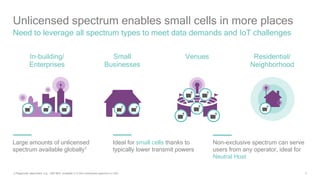
Unlicensed spectrum enables small cells in more places
In-building/
Enterprises
Small
Businesses
Residential/
Neighborhood
Venues
Large amounts of unlicensed
spectrum available globally1
Ideal for small cells thanks to
typically lower transmit powers
Non-exclusive spectrum can serve
users from any operator, ideal for
Neutral Host
4
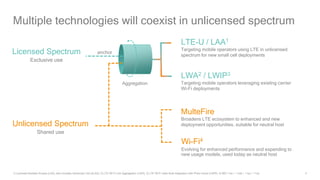
Multiple technologies will coexist in unlicensed spectrum
Wi-Fi4
Evolving for enhanced performance and expanding to
new usage models, used today as neutral host
Licensed Spectrum
Exclusive use
Unlicensed Spectrum
Shared use
Aggregation
MulteFire
Broadens LTE ecosystem to enhanced and new
deployment opportunities, suitable for neutral host
LWA2 / LWIP3
Targeting mobile operators leveraging existing carrier
Wi-Fi deployments
LTE-U / LAA1
Targeting mobile operators using LTE in unlicensed
spectrum for new small cell deployments
anchor
1) Licensed-Assisted Access (LAA), also includes enhanced LAA (eLAA); 2) LTE Wi-Fi Link Aggregation (LWA); 3) LTE Wi-Fi radio level integration with IPsec tunnel (LWIP); 4) 802.11ac / .11ad / .11ax / .11ay
5
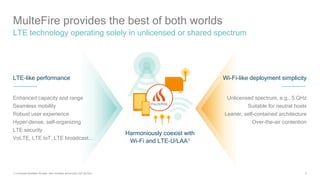
MulteFire provides the best of both worlds
LTE technology operating solely in unlicensed or shared spectrum
Wi-Fi-like deployment simplicity
Unlicensed spectrum, e.g., 5 GHz
Suitable for neutral hosts
Leaner, self-contained architecture
Over-the-air contention
LTE-like performance
Enhanced capacity and range
Seamless mobility
Robust user experience
Hyper-dense, self-organizing
LTE security
VoLTE, LTE IoT, LTE broadcast...
Harmoniously coexist with
Wi-Fi and LTE-U/LAA1
1) Licensed-Assisted Access, also includes enhanced LAA (eLAA);
6
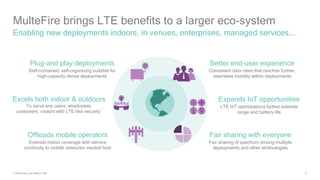
MulteFire brings LTE benefits to a larger eco-system
Enabling new deployments indoors, in venues, enterprises, managed services,…
Expands IoT opportunities
LTE IoT optimizations further extends
range and battery life
Plug-and play deployments
Self-contained, self-organizing suitable for
high-capacity dense deployments
Better end-user experience
Consistent data rates that reaches further,
seamless mobility within deployments
Excels both indoor & outdoors
To serve any users, employees,
customers, visitors with LTE-like security
1
Offloads mobile operators
Extends indoor coverage with service
continuity to mobile networks—neutral host
Fair sharing with everyone
Fair sharing of spectrum among multiple
deployments and other technologies
1) Both with and without SIM
7
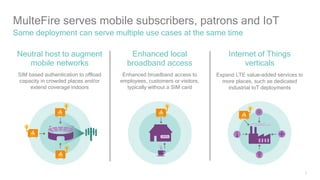
MulteFire serves mobile subscribers, patrons and IoT
Same deployment can serve multiple use cases at the same time
Neutral host to augment
mobile networks
SIM based authentication to offload
capacity in crowded places and/or
extend coverage indoors
Enhanced local
broadband access
Enhanced broadband access to
employees, customers or visitors,
typically without a SIM card
Internet of Things
verticals
Expand LTE value-added services to
more places, such as dedicated
industrial IoT deployments
8
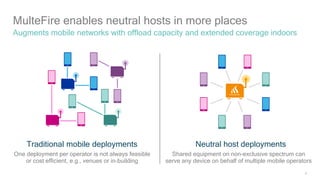
MulteFire enables neutral hosts in more places
Augments mobile networks with offload capacity and extended coverage indoors
Traditional mobile deployments
One deployment per operator is not always feasible
or cost efficient, e.g., venues or in-building
Neutral host deployments
Shared equipment on non-exclusive spectrum can
serve any device on behalf of multiple mobile operators
9
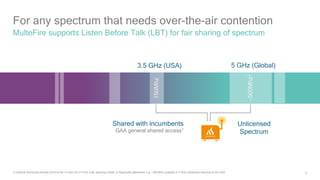
For any spectrum that needs over-the-air contention
MulteFire supports Listen Before Talk (LBT) for fair sharing of spectrum
5 GHz (Global)
1) General Authorized Access (GAA) is tier 3 in the US 3.5 GHz 3-tier licensing model; 2) Regionally dependent, e.g. 500 MHz available in 5 GHz unlicensed spectrum in the USA.
3.5 GHz (USA)
500Mhz2
150Mhz
Shared with incumbents
GAA general shared access1
Unlicensed
Spectrum
10
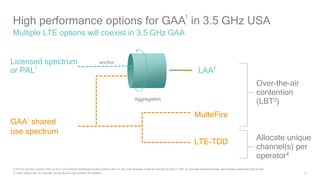
High performance options for GAA1
in 3.5 GHz USA
Multiple LTE options will coexist in 3.5 GHz GAA
1) Priority Access Licenses (PAL) is tier 2 and General Authorized Access (GAA) is tier 3 in the 3-tier licensing model for shared 3.5 GHz in USA; 2) Licensed-Assisted Access, also includes enhanced LAA (eLAA);
3) Listen before talk; 4) Channels can be reused with sufficient RF isolation
Licensed spectrum
or PAL1
GAA1
shared
use spectrum
MulteFire
LAA2
anchor
LTE-TDD
Aggregation
Over-the-air
contention
(LBT3)
Allocate unique
channel(s) per
operator4
11
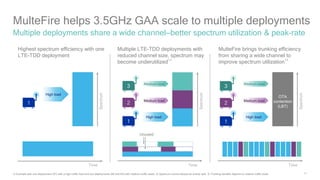
MulteFire helps 3.5GHz GAA scale to multiple deployments
Multiple deployments share a wide channel—better spectrum utilization & peak-rate
Highest spectrum efficiency with one
LTE-TDD deployment
Multiple LTE-TDD deployments with
reduced channel size, spectrum may
become underutilized
1,2
MulteFire brings trunking efficiency
from sharing a wide channel to
improve spectrum utilization
1,3
2
3
1
1
OTA
contention
(LBT)
Time Time Time
2
3
1
1) Example with one deployment (#1) with a high traffic load and two deployments (#2 and #3) with medium traffic loads; 2) Spectrum cannot always be evenly split; 3) Trunking benefits depend on relative traffic loads.
Spectrum
Spectrum
Spectrum
Unused
High load
Medium load
High load
Medium load
Medium load
High load
Medium load
12
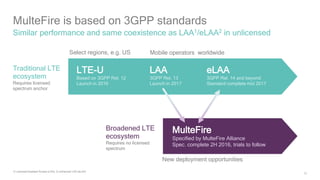
MulteFire is based on 3GPP standards
Similar performance and same coexistence as LAA1/eLAA2 in unlicensed
Traditional LTE
ecosystem
Requires licensed
spectrum anchor
Broadened LTE
ecosystem
Requires no licensed
spectrum
LTE-U
Based on 3GPP Rel. 12
Launch in 2016
LAA
3GPP Rel. 13
Launch in 2017
eLAA
3GPP Rel. 14 and beyond
Standard complete mid 2017
Select regions, e.g. US Mobile operators worldwide
MulteFire
Specified by MulteFire Alliance
Spec. complete 2H 2016, trials to follow
New deployment opportunities
1) Licensed-Assisted Access (LAA); 2) enhanced LAA (eLAA)
13
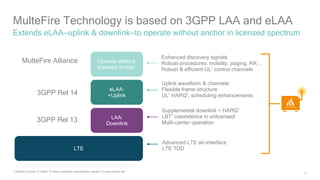
MulteFire Technology is based on 3GPP LAA and eLAA
Extends eLAA—uplink & downlink—to operate without anchor in licensed spectrum
3GPP Rel 13
3GPP Rel 14
Uplink waveform & channels
Flexible frame structure
UL2
HARQ3
, scheduling enhancements
Supplemental downlink + HARQ3
LBT4
coexistence in unlicensed
Multi-carrier operation
Enhanced discovery signals
Robust procedures: mobility, paging, RA1
...
Robust & efficient UL2
control channels
Advanced LTE air-interface
LTE TDD
MulteFire Alliance Operate without
licensed anchor
eLAA:
+Uplink
LAA:
Downlink
LTE
1) Random Access; 2) Uplink; 3) Hybrid automatic retransmission request; 4) Listen before talk
14
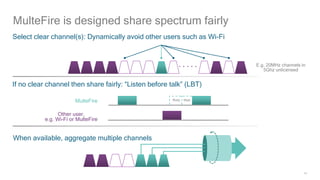
If no clear channel then share fairly: “Listen before talk” (LBT)
MulteFire is designed share spectrum fairly
Select clear channel(s): Dynamically avoid other users such as Wi-Fi
E.g. 20MHz channels in
5Ghz unlicensed
Other user,
e.g. Wi-Fi or MulteFire
When available, aggregate multiple channels
MulteFire Busy Wait
15
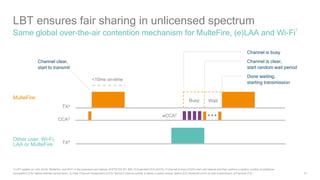
LBT ensures fair sharing in unlicensed spectrum
Same global over-the-air contention mechanism for MulteFire, (e)LAA and Wi-Fi
1
1) LBT applies on LAA, eLAA, MulteFire, and Wi-Fi in the proposed next release of ETSI EN 301 893; 2) Extended CCA (eCCA): If channel is busy (CCA3) wait until cleared and then perform a random number of additional
successful CCAs3 before starting transmission; 3) Clear Channel Assessment (CCA): Sense if channel activity is below a certain energy detect (ED) threshold and if so start transmission; 4)Transmit (TX)
MulteFire
Other user: Wi-Fi,
LAA or MulteFire
<10ms on-time
Busy Wait
CCA3
eCCA2
TX4
TX4
Channel clear,
start to transmit
Channel is busy
Channel is clear,
start random wait period
Done waiting,
starting transmission
16
Self-contained NHN1
architecture supports multiple MNOs2
Proposed by MulteFire Alliance—applies both on MulteFire and regular LTE
1) Neutral Host Network; 2) Mobile Network Operator
Local service, e.g.,
enterprise PBX
SIM card auth.
with MNO AAA
Access to
MNO services
Mobile Operators
Offload to NHN under
MNO controlled policies
Local IP
Services
UE
Service continuity
between MNO & NHN
Lightweight interworking
between NHN and MNO
CN
RAN
AAA
MNO #1
CN
RAN
IP
IMS
services
Neutral Host
Can serve any user
from multiple MNO
CN
RAN
AAA
MNO #2
IMS
services
NHN
17
MulteFire Alliance is
an open international
organization
Promote MulteFire technology
Drive global technical specifications
Enable product certification
Drive future evolution
Promote effective regulatory policy
3GPP/ETSI style organization
www.multefire.org
18
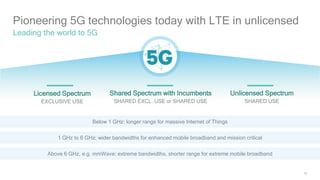
Below 1 GHz: longer range for massive Internet of Things
1 GHz to 6 GHz: wider bandwidths for enhanced mobile broadband and mission critical
Above 6 GHz, e.g. mmWave: extreme bandwidths, shorter range for extreme mobile broadband
Licensed Spectrum
EXCLUSIVE USE
Unlicensed Spectrum
SHARED USE
Shared Spectrum with Incumbents
SHARED EXCL. USE or SHARED USE
Pioneering 5G technologies today with LTE in unlicensed
Leading the world to 5G
19
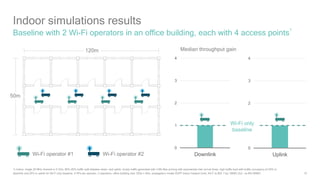
Indoor simulations results
Baseline with 2 Wi-Fi operators in an office building, each with 4 access points
1
Wi-Fi operator #1 Wi-Fi operator #2
120m
50m
1) Indoor, single 20 MHz channel in 5 GHz, 80%-20% traffic split between down- and uplink, bursty traffic generated with 4 Mb files arriving with exponential inter arrival times, high traffic load with buffer occupancy at 50% in
downlink and 20% in uplink for Wi-Fi only baseline, 4 APs per operator, 2 operators, office building size 120m x 50m, propagation model 3GPP indoor hotspot (InH), Wi-Fi is 802.11ac, MIMO 2x2, no MU-MIMO
0
1
2
3
4
Downlink
0
1
2
3
4
Uplink
Median throughput gain
Wi-Fi only
baseline
20
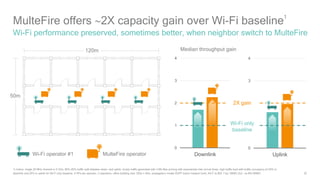
MulteFire offers 2X capacity gain over Wi-Fi baseline1
Wi-Fi performance preserved, sometimes better, when neighbor switch to MulteFire
Wi-Fi operator #1 MulteFire operator
50m
120m
1) Indoor, single 20 MHz channel in 5 GHz, 80%-20% traffic split between down- and uplink, bursty traffic generated with 4 Mb files arriving with exponential inter arrival times, high traffic load with buffer occupancy at 50% in
downlink and 20% in uplink for Wi-Fi only baseline, 4 APs per operator, 2 operators, office building size 120m x 50m, propagation model 3GPP indoor hotspot (InH), Wi-Fi is 802.11ac, MIMO 2x2, no MU-MIMO
0
1
2
3
4
Uplink
0
1
2
3
4
Downlink
Median throughput gain
Wi-Fi only
baseline
2X gain
21
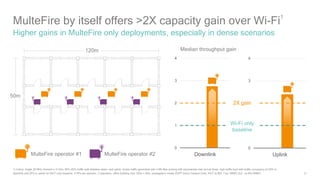
MulteFire by itself offers >2X capacity gain over Wi-Fi1
Higher gains in MulteFire only deployments, especially in dense scenarios
0
1
2
3
4
Downlink
0
1
2
3
4
UplinkMulteFire operator #1 MulteFire operator #2
Median throughput gain
Wi-Fi only
baseline
2X gain
50m
120m
1) Indoor, single 20 MHz channel in 5 GHz, 80%-20% traffic split between down- and uplink, bursty traffic generated with 4 Mb files arriving with exponential inter arrival times, high traffic load with buffer occupancy at 50% in
downlink and 20% in uplink for Wi-Fi only baseline, 4 APs per operator, 2 operators, office building size 120m x 50m, propagation model 3GPP indoor hotspot (InH), Wi-Fi is 802.11ac, MIMO 2x2, no MU-MIMO
22
0
1
2
3
4
Uplink
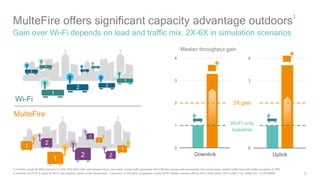
MulteFire offers significant capacity advantage outdoors1
Gain over Wi-Fi depends on load and traffic mix, 2X-6X in simulation scenarios
Wi-Fi
MulteFire
1
2
1
2
1
2
2
1
2
1
2
1
2
1
2
1
1) Outdoor, single 20 MHz channel in 5 GHz, 50%-50% traffic split between down- and uplink, bursty traffic generated with 4 Mb files arriving with exponential inter arrival times, medium traffic load with buffer occupancy at 38%
in downlink and 51% in uplink for Wi-Fi only baseline, dense cluster deployment, 2 operators, 4 APs each, propagation model 3GPP outdoor scenario with all APs in 50m radius, Wi-Fi is 802.11ac, MIMO 2x2, no MU-MIMO
0
1
2
3
4
Downlink
Median throughput gain
Wi-Fi only
baseline
2X gain
23
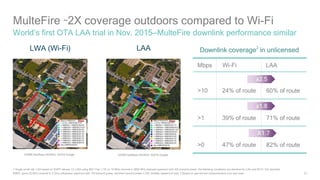
World’s first OTA LAA trial in Nov. 2015—MulteFire downlink performance similar
1 Single small cell, LAA based on 3GPP release 13; LWA using 802.11ac; LTE on 10 MHz channel in 2600 MHz licensed spectrum with 4W transmit power; the following conditions are identical for LAA and Wi-Fi: 2x2 downlink
MIMO, same 20 MHz channel in 5 GHz unlicensed spectrum with 1W transmit power. terminal transmit power 0.2W, mobility speed 6-8 mph; 2 Based on geo-binned measurements over test route
MulteFire ~2X coverage outdoors compared to Wi-Fi
Downlink coverage2
in unlicensedLWA (Wi-Fi) LAA
Mbps Wi-Fi LAA
>10 24% of route 60% of route
>1 39% of route 71% of route
>0 47% of route 82% of route
x2.5
x1.8
X1.7
©2009 GeoBasis-DE/BKG, ©2016 Google ©2009 GeoBasis-DE/BKG, ©2016 Google
24
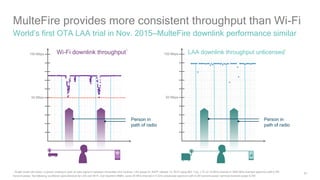
MulteFire provides more consistent throughput than Wi-Fi
World’s first OTA LAA trial in Nov. 2015—MulteFire downlink performance similar
50 Mbps
LAA downlink throughput unlicensed1
Wi-Fi downlink throughput1
100 Mbps
50 Mbps
100 Mbps
1 Single small cell indoor; a person walking in path of radio signal in between transmitter and receiver; LAA based on 3GPP release 13, Wi-Fi using 802.11ac, LTE on 10 MHz channel in 2600 MHz licensed spectrum with 0.2W
transmit power, the following conditions were identical for LAA and Wi-Fi: 2x2 downlink MIMO, same 20 MHz channel in 5 GHz unlicensed spectrum with 0.2W transmit power; terminal transmit power 0.2W;
Person in
path of radio
Person in
path of radio
25
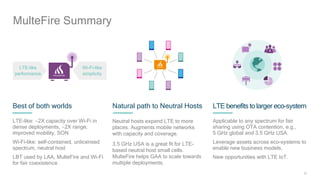
Best of both worlds
LTE-like: 2X capacity over Wi-Fi in
dense deployments, 2X range,
improved mobility, SON
Wi-Fi-like: self-contained, unlicensed
spectrum, neutral host
LBT used by LAA, MulteFire and Wi-Fi
for fair coexistence.
Natural path to Neutral Hosts
Neutral hosts expand LTE to more
places. Augments mobile networks
with capacity and coverage.
3.5 GHz USA is a great fit for LTE-
based neutral host small cells.
MulteFire helps GAA to scale towards
multiple deployments.
LTE benefits to larger eco-system
Applicable to any spectrum for fair
sharing using OTA contention, e.g.,
5 GHz global and 3.5 GHz USA.
Leverage assets across eco-systems to
enable new business models.
New opportunities with LTE IoT.
LTE-like
performance
Wi-Fi-like
simplicity
MulteFire Summary
Follow us on:
For more information, visit us at:
www.qualcomm.com & www.qualcomm.com/blog
Nothing in these materials is an offer to sell any of the components or devices referenced herein.
©2013, 2015 Qualcomm Technologies, Inc. and/or its affiliated companies. All Rights Reserved.
Qualcomm is a trademark of Qualcomm Incorporated, registered in the United States and other countries, used with permission. MulteFire is a
trademark of Qualcomm Incorporated. Other products and brand names may be trademarks or registered trademarks of their respective
owners.
References in this presentation to “Qualcomm” may mean Qualcomm Incorporated, Qualcomm Technologies, Inc., and/or other subsidiaries or
business units within the Qualcomm corporate structure, as applicable.
Qualcomm Incorporated includes Qualcomm’s licensing business, QTL, and the vast majority of its patent portfolio.
Qualcomm Technologies, Inc., a wholly-owned subsidiary of Qualcomm Incorporated, operates, along with its subsidiaries, substantially all of
Qualcomm’s engineering, research and development functions, and substantially all of its product and services businesses, including its
semiconductor business, QCT.
Thank you

MulteFire Technology Progress and Benefits

  • 1.
    MulteFire Technology Progress andBenefits, and How It Enables A New Breed of Neutral Hosts Qualcomm Technologies, Inc. May 24, 2016
  • 2.
    2 Source: 1) Cisco,Feb. ’16; 2) Machina, Feb. ’14, Cisco, Jul. ’13; 3) Mobile Sports Report Feb.’ 16 (16 TB DAS), Levi Stadium Feb.’ 16 (10 TB Wi-Fi); 4) Gartner ‘14 More data to more devices in more places ~75% Mobile traffic that will be rich content & video by 2020 1 ~80% Fraction of wireless data that is consumed indoors 4 26 TB Amount of data used at a single venue 3 25-50B Connected devices and IoT by 2020 2
  • 3.
    3 Need to leverageall spectrum types to meet data demands and IoT challenges 1) Regionally dependent, e.g. 500 MHz available in 5 GHz unlicensed spectrum in USA Unlicensed spectrum enables small cells in more places In-building/ Enterprises Small Businesses Residential/ Neighborhood Venues Large amounts of unlicensed spectrum available globally1 Ideal for small cells thanks to typically lower transmit powers Non-exclusive spectrum can serve users from any operator, ideal for Neutral Host
  • 4.
    4 Multiple technologies willcoexist in unlicensed spectrum Wi-Fi4 Evolving for enhanced performance and expanding to new usage models, used today as neutral host Licensed Spectrum Exclusive use Unlicensed Spectrum Shared use Aggregation MulteFire Broadens LTE ecosystem to enhanced and new deployment opportunities, suitable for neutral host LWA2 / LWIP3 Targeting mobile operators leveraging existing carrier Wi-Fi deployments LTE-U / LAA1 Targeting mobile operators using LTE in unlicensed spectrum for new small cell deployments anchor 1) Licensed-Assisted Access (LAA), also includes enhanced LAA (eLAA); 2) LTE Wi-Fi Link Aggregation (LWA); 3) LTE Wi-Fi radio level integration with IPsec tunnel (LWIP); 4) 802.11ac / .11ad / .11ax / .11ay
  • 5.
    5 MulteFire provides thebest of both worlds LTE technology operating solely in unlicensed or shared spectrum Wi-Fi-like deployment simplicity Unlicensed spectrum, e.g., 5 GHz Suitable for neutral hosts Leaner, self-contained architecture Over-the-air contention LTE-like performance Enhanced capacity and range Seamless mobility Robust user experience Hyper-dense, self-organizing LTE security VoLTE, LTE IoT, LTE broadcast... Harmoniously coexist with Wi-Fi and LTE-U/LAA1 1) Licensed-Assisted Access, also includes enhanced LAA (eLAA);
  • 6.
    6 MulteFire brings LTEbenefits to a larger eco-system Enabling new deployments indoors, in venues, enterprises, managed services,… Expands IoT opportunities LTE IoT optimizations further extends range and battery life Plug-and play deployments Self-contained, self-organizing suitable for high-capacity dense deployments Better end-user experience Consistent data rates that reaches further, seamless mobility within deployments Excels both indoor & outdoors To serve any users, employees, customers, visitors with LTE-like security 1 Offloads mobile operators Extends indoor coverage with service continuity to mobile networks—neutral host Fair sharing with everyone Fair sharing of spectrum among multiple deployments and other technologies 1) Both with and without SIM
  • 7.
    7 MulteFire serves mobilesubscribers, patrons and IoT Same deployment can serve multiple use cases at the same time Neutral host to augment mobile networks SIM based authentication to offload capacity in crowded places and/or extend coverage indoors Enhanced local broadband access Enhanced broadband access to employees, customers or visitors, typically without a SIM card Internet of Things verticals Expand LTE value-added services to more places, such as dedicated industrial IoT deployments
  • 8.
    8 MulteFire enables neutralhosts in more places Augments mobile networks with offload capacity and extended coverage indoors Traditional mobile deployments One deployment per operator is not always feasible or cost efficient, e.g., venues or in-building Neutral host deployments Shared equipment on non-exclusive spectrum can serve any device on behalf of multiple mobile operators
  • 9.
    9 For any spectrumthat needs over-the-air contention MulteFire supports Listen Before Talk (LBT) for fair sharing of spectrum 5 GHz (Global) 1) General Authorized Access (GAA) is tier 3 in the US 3.5 GHz 3-tier licensing model; 2) Regionally dependent, e.g. 500 MHz available in 5 GHz unlicensed spectrum in the USA. 3.5 GHz (USA) 500Mhz2 150Mhz Shared with incumbents GAA general shared access1 Unlicensed Spectrum
  • 10.
    10 High performance optionsfor GAA1 in 3.5 GHz USA Multiple LTE options will coexist in 3.5 GHz GAA 1) Priority Access Licenses (PAL) is tier 2 and General Authorized Access (GAA) is tier 3 in the 3-tier licensing model for shared 3.5 GHz in USA; 2) Licensed-Assisted Access, also includes enhanced LAA (eLAA); 3) Listen before talk; 4) Channels can be reused with sufficient RF isolation Licensed spectrum or PAL1 GAA1 shared use spectrum MulteFire LAA2 anchor LTE-TDD Aggregation Over-the-air contention (LBT3) Allocate unique channel(s) per operator4
  • 11.
    11 MulteFire helps 3.5GHzGAA scale to multiple deployments Multiple deployments share a wide channel—better spectrum utilization & peak-rate Highest spectrum efficiency with one LTE-TDD deployment Multiple LTE-TDD deployments with reduced channel size, spectrum may become underutilized 1,2 MulteFire brings trunking efficiency from sharing a wide channel to improve spectrum utilization 1,3 2 3 1 1 OTA contention (LBT) Time Time Time 2 3 1 1) Example with one deployment (#1) with a high traffic load and two deployments (#2 and #3) with medium traffic loads; 2) Spectrum cannot always be evenly split; 3) Trunking benefits depend on relative traffic loads. Spectrum Spectrum Spectrum Unused High load Medium load High load Medium load Medium load High load Medium load
  • 12.
    12 MulteFire is basedon 3GPP standards Similar performance and same coexistence as LAA1/eLAA2 in unlicensed Traditional LTE ecosystem Requires licensed spectrum anchor Broadened LTE ecosystem Requires no licensed spectrum LTE-U Based on 3GPP Rel. 12 Launch in 2016 LAA 3GPP Rel. 13 Launch in 2017 eLAA 3GPP Rel. 14 and beyond Standard complete mid 2017 Select regions, e.g. US Mobile operators worldwide MulteFire Specified by MulteFire Alliance Spec. complete 2H 2016, trials to follow New deployment opportunities 1) Licensed-Assisted Access (LAA); 2) enhanced LAA (eLAA)
  • 13.
    13 MulteFire Technology isbased on 3GPP LAA and eLAA Extends eLAA—uplink & downlink—to operate without anchor in licensed spectrum 3GPP Rel 13 3GPP Rel 14 Uplink waveform & channels Flexible frame structure UL2 HARQ3 , scheduling enhancements Supplemental downlink + HARQ3 LBT4 coexistence in unlicensed Multi-carrier operation Enhanced discovery signals Robust procedures: mobility, paging, RA1 ... Robust & efficient UL2 control channels Advanced LTE air-interface LTE TDD MulteFire Alliance Operate without licensed anchor eLAA: +Uplink LAA: Downlink LTE 1) Random Access; 2) Uplink; 3) Hybrid automatic retransmission request; 4) Listen before talk
  • 14.
    14 If no clearchannel then share fairly: “Listen before talk” (LBT) MulteFire is designed share spectrum fairly Select clear channel(s): Dynamically avoid other users such as Wi-Fi E.g. 20MHz channels in 5Ghz unlicensed Other user, e.g. Wi-Fi or MulteFire When available, aggregate multiple channels MulteFire Busy Wait
  • 15.
    15 LBT ensures fairsharing in unlicensed spectrum Same global over-the-air contention mechanism for MulteFire, (e)LAA and Wi-Fi 1 1) LBT applies on LAA, eLAA, MulteFire, and Wi-Fi in the proposed next release of ETSI EN 301 893; 2) Extended CCA (eCCA): If channel is busy (CCA3) wait until cleared and then perform a random number of additional successful CCAs3 before starting transmission; 3) Clear Channel Assessment (CCA): Sense if channel activity is below a certain energy detect (ED) threshold and if so start transmission; 4)Transmit (TX) MulteFire Other user: Wi-Fi, LAA or MulteFire <10ms on-time Busy Wait CCA3 eCCA2 TX4 TX4 Channel clear, start to transmit Channel is busy Channel is clear, start random wait period Done waiting, starting transmission
  • 16.
    16 Self-contained NHN1 architecture supportsmultiple MNOs2 Proposed by MulteFire Alliance—applies both on MulteFire and regular LTE 1) Neutral Host Network; 2) Mobile Network Operator Local service, e.g., enterprise PBX SIM card auth. with MNO AAA Access to MNO services Mobile Operators Offload to NHN under MNO controlled policies Local IP Services UE Service continuity between MNO & NHN Lightweight interworking between NHN and MNO CN RAN AAA MNO #1 CN RAN IP IMS services Neutral Host Can serve any user from multiple MNO CN RAN AAA MNO #2 IMS services NHN
  • 17.
    17 MulteFire Alliance is anopen international organization Promote MulteFire technology Drive global technical specifications Enable product certification Drive future evolution Promote effective regulatory policy 3GPP/ETSI style organization www.multefire.org
  • 18.
    18 Below 1 GHz:longer range for massive Internet of Things 1 GHz to 6 GHz: wider bandwidths for enhanced mobile broadband and mission critical Above 6 GHz, e.g. mmWave: extreme bandwidths, shorter range for extreme mobile broadband Licensed Spectrum EXCLUSIVE USE Unlicensed Spectrum SHARED USE Shared Spectrum with Incumbents SHARED EXCL. USE or SHARED USE Pioneering 5G technologies today with LTE in unlicensed Leading the world to 5G
  • 19.
    19 Indoor simulations results Baselinewith 2 Wi-Fi operators in an office building, each with 4 access points 1 Wi-Fi operator #1 Wi-Fi operator #2 120m 50m 1) Indoor, single 20 MHz channel in 5 GHz, 80%-20% traffic split between down- and uplink, bursty traffic generated with 4 Mb files arriving with exponential inter arrival times, high traffic load with buffer occupancy at 50% in downlink and 20% in uplink for Wi-Fi only baseline, 4 APs per operator, 2 operators, office building size 120m x 50m, propagation model 3GPP indoor hotspot (InH), Wi-Fi is 802.11ac, MIMO 2x2, no MU-MIMO 0 1 2 3 4 Downlink 0 1 2 3 4 Uplink Median throughput gain Wi-Fi only baseline
  • 20.
    20 MulteFire offers 2Xcapacity gain over Wi-Fi baseline1 Wi-Fi performance preserved, sometimes better, when neighbor switch to MulteFire Wi-Fi operator #1 MulteFire operator 50m 120m 1) Indoor, single 20 MHz channel in 5 GHz, 80%-20% traffic split between down- and uplink, bursty traffic generated with 4 Mb files arriving with exponential inter arrival times, high traffic load with buffer occupancy at 50% in downlink and 20% in uplink for Wi-Fi only baseline, 4 APs per operator, 2 operators, office building size 120m x 50m, propagation model 3GPP indoor hotspot (InH), Wi-Fi is 802.11ac, MIMO 2x2, no MU-MIMO 0 1 2 3 4 Uplink 0 1 2 3 4 Downlink Median throughput gain Wi-Fi only baseline 2X gain
  • 21.
    21 MulteFire by itselfoffers >2X capacity gain over Wi-Fi1 Higher gains in MulteFire only deployments, especially in dense scenarios 0 1 2 3 4 Downlink 0 1 2 3 4 UplinkMulteFire operator #1 MulteFire operator #2 Median throughput gain Wi-Fi only baseline 2X gain 50m 120m 1) Indoor, single 20 MHz channel in 5 GHz, 80%-20% traffic split between down- and uplink, bursty traffic generated with 4 Mb files arriving with exponential inter arrival times, high traffic load with buffer occupancy at 50% in downlink and 20% in uplink for Wi-Fi only baseline, 4 APs per operator, 2 operators, office building size 120m x 50m, propagation model 3GPP indoor hotspot (InH), Wi-Fi is 802.11ac, MIMO 2x2, no MU-MIMO
  • 22.
    22 0 1 2 3 4 Uplink MulteFire offers significantcapacity advantage outdoors1 Gain over Wi-Fi depends on load and traffic mix, 2X-6X in simulation scenarios Wi-Fi MulteFire 1 2 1 2 1 2 2 1 2 1 2 1 2 1 2 1 1) Outdoor, single 20 MHz channel in 5 GHz, 50%-50% traffic split between down- and uplink, bursty traffic generated with 4 Mb files arriving with exponential inter arrival times, medium traffic load with buffer occupancy at 38% in downlink and 51% in uplink for Wi-Fi only baseline, dense cluster deployment, 2 operators, 4 APs each, propagation model 3GPP outdoor scenario with all APs in 50m radius, Wi-Fi is 802.11ac, MIMO 2x2, no MU-MIMO 0 1 2 3 4 Downlink Median throughput gain Wi-Fi only baseline 2X gain
  • 23.
    23 World’s first OTALAA trial in Nov. 2015—MulteFire downlink performance similar 1 Single small cell, LAA based on 3GPP release 13; LWA using 802.11ac; LTE on 10 MHz channel in 2600 MHz licensed spectrum with 4W transmit power; the following conditions are identical for LAA and Wi-Fi: 2x2 downlink MIMO, same 20 MHz channel in 5 GHz unlicensed spectrum with 1W transmit power. terminal transmit power 0.2W, mobility speed 6-8 mph; 2 Based on geo-binned measurements over test route MulteFire ~2X coverage outdoors compared to Wi-Fi Downlink coverage2 in unlicensedLWA (Wi-Fi) LAA Mbps Wi-Fi LAA >10 24% of route 60% of route >1 39% of route 71% of route >0 47% of route 82% of route x2.5 x1.8 X1.7 ©2009 GeoBasis-DE/BKG, ©2016 Google ©2009 GeoBasis-DE/BKG, ©2016 Google
  • 24.
    24 MulteFire provides moreconsistent throughput than Wi-Fi World’s first OTA LAA trial in Nov. 2015—MulteFire downlink performance similar 50 Mbps LAA downlink throughput unlicensed1 Wi-Fi downlink throughput1 100 Mbps 50 Mbps 100 Mbps 1 Single small cell indoor; a person walking in path of radio signal in between transmitter and receiver; LAA based on 3GPP release 13, Wi-Fi using 802.11ac, LTE on 10 MHz channel in 2600 MHz licensed spectrum with 0.2W transmit power, the following conditions were identical for LAA and Wi-Fi: 2x2 downlink MIMO, same 20 MHz channel in 5 GHz unlicensed spectrum with 0.2W transmit power; terminal transmit power 0.2W; Person in path of radio Person in path of radio
  • 25.
    25 Best of bothworlds LTE-like: 2X capacity over Wi-Fi in dense deployments, 2X range, improved mobility, SON Wi-Fi-like: self-contained, unlicensed spectrum, neutral host LBT used by LAA, MulteFire and Wi-Fi for fair coexistence. Natural path to Neutral Hosts Neutral hosts expand LTE to more places. Augments mobile networks with capacity and coverage. 3.5 GHz USA is a great fit for LTE- based neutral host small cells. MulteFire helps GAA to scale towards multiple deployments. LTE benefits to larger eco-system Applicable to any spectrum for fair sharing using OTA contention, e.g., 5 GHz global and 3.5 GHz USA. Leverage assets across eco-systems to enable new business models. New opportunities with LTE IoT. LTE-like performance Wi-Fi-like simplicity MulteFire Summary
  • 26.
    Follow us on: Formore information, visit us at: www.qualcomm.com & www.qualcomm.com/blog Nothing in these materials is an offer to sell any of the components or devices referenced herein. ©2013, 2015 Qualcomm Technologies, Inc. and/or its affiliated companies. All Rights Reserved. Qualcomm is a trademark of Qualcomm Incorporated, registered in the United States and other countries, used with permission. MulteFire is a trademark of Qualcomm Incorporated. Other products and brand names may be trademarks or registered trademarks of their respective owners. References in this presentation to “Qualcomm” may mean Qualcomm Incorporated, Qualcomm Technologies, Inc., and/or other subsidiaries or business units within the Qualcomm corporate structure, as applicable. Qualcomm Incorporated includes Qualcomm’s licensing business, QTL, and the vast majority of its patent portfolio. Qualcomm Technologies, Inc., a wholly-owned subsidiary of Qualcomm Incorporated, operates, along with its subsidiaries, substantially all of Qualcomm’s engineering, research and development functions, and substantially all of its product and services businesses, including its semiconductor business, QCT. Thank you