Improving Your Workplace through Professional Ethics 4:00 – 4:30 pm  Tues Dec 7th, 2010  Infonex 951, Whitehorse Chris Hylton, MA CG Hylton & Associates Inc.  800 449-5866  [email_address]
Agenda •  Distinguishing between ethics, values, morals, opinions, and law •  Setting an ethical code for your workplace: conflicts of interest •  Role of leadership •  Setting up a procedure to report and document breaches of ethics •  How to respond to reported and unreported breaches of workplace ethics
wow How are we going to get thru this in 30 minutes? Harvard Model  anyone heard of this?
Harvard Model
Why Should I Be Moral? Because of My Character!
What makes one group virtuous and not another? Inner-City Gangs Common values Models “ Virtuous” actions Codes of honour
Ku Klux Klan? Focused Live tradition Stories and  Models Common enemy “ The family is the strength of our nation.”
The Christian Church? The Taliban? The Scouting Movement? Your community? Your friends?
Are the virtues the same for everyone? People are very different But we face the same basic problems and have the same basic needs Everyone needs  courage  as danger can always arise Some people are less well off, so we will need  generosity Everyone needs friends so we need  loyalty
Where do Ethics come from? Importance of the Person, Motive, Heart, Conscience, Spirituality Connection to Community Realization that morality is not defined by moments but by a long-term process Allowance for gray areas, varying contexts, different levels of moral maturity and life contexts
Weaknesses of Ethics Dependence on strong communities Not easily applied to ethical issues or to give us practical solutions Demands time Can be turned into a really poor duty-based ethics Might be taken as situational ethics
Pre-Contact/Old Traditions Aboriginals lived a traditional life, living off the land, relying on natural order,  laws of Creator Conduct in accordance to spiritual connection with Creator Mother Earth. Utilizing gifts, bestowed by the Creator to provide food, shelter and land for all to enjoy. Spiritual beliefs and customs were intact, along with traditions, celebrations through songs and dance. Medicine Wheel Teachings practiced. Aboriginal people had control over their lives and lived freely Everyone had a role and a responsibility, life stages were nurtured with correct teachings by Elders and those in Council.
Residential School Era Impacts
Positive Impacts Good work ethics were developed during the Residential School era, many Survivors have stated their experiences assisted in their ability to perform physical tasks and do chores that were determined with strict rules and schedules. An opportunity learn to writing and reading skills, learning how to farm for the boys, and sewing, cooking and cleaning for the girls. Long lasting friendships were formed. A sense of pride and accomplishment because Residential School Survivors made it through hard times and a sense of strength and endurance was demonstrated.
Organizational Ethics Rules or standards governing  the conduct of a organization Moral code – what is ‘right’  and what is ‘wrong’? Highly subjective nature Tension between different stakeholders Youth, elders, haves, have nots
Stakeholders Community Members  – provide services, housing, education, health, capacity building. Safety, honesty, decency and truthful. Employees  – health and safety at work, security, fair pay Suppliers  – pay on time, pay fair rates, for the work done, provide element of security For those with for profit entities, Shareholders  – Generate profits and pay dividends
Stakeholders Government s – abide by the law, pay taxes, abide by regulations Management  – their aims versus those  of the organization as a whole Environment  – limit pollution, congestion, environmental degradation, development, etc.
Organization Ethics Tensions: Profits versus higher wages Protection of culture vs. development Culture versus pollution Job creation vs. wage costs Favouritism among community members Elders vs Youth Elders vs Elders Families vs familes
Ethics / Ethical Behaviour Ethics : are subjective rules that a person sets for themselves about what is right or wrong   Influences Family  (what you were taught) Peers  (pressures, influences) Past Experiences  (consequences) Religion  (beliefs that are taught) Situation  (what is the outcome)
Ethical Spectrum A rigid code of behaviour applied uniformly regardless of situation. Situational Amoral Moralistic Conduct & behaviour influenced by needs and wants of a particular situation Conduct & behaviour applied without regard for legal or moral constraints
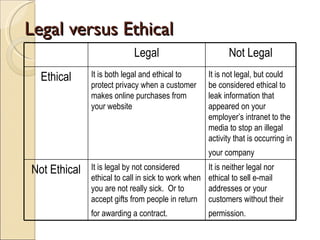
Legal versus Ethical Legal Not Legal Ethical It is both legal and ethical to protect privacy when a customer makes online purchases from your website   It is not legal, but could be considered ethical to leak information that appeared on your employer’s intranet to the media to stop an illegal activity that is occurring in your company   Not Ethical It is legal by not considered ethical to call in sick to work when you are not really sick.  Or to accept gifts from people in return for awarding a contract.   It is neither legal nor ethical to sell e-mail addresses or your customers without their permission.
Ethics and Business Business Ethics the application of general rules to business. Corporate Social Responsibility means that business decisions should take into account the social consequences of a produced course of action. Moral Code the standard of current acceptable behaviour in society. Laws of Society Are rules established by elected officials that generally reflect the values of society at a particular time.
Transformation in Organization S2 Ethics Vision Resolutions Practices Transformation
F4 There is no Finishing Line
Defining Personality Relatively stable pattern of behaviours and consistent internal states that explain a person's behavioural tendencies
Big Five Personality Dimensions Outgoing, talkative Sensitive, flexible Careful, dependable Courteous, caring Anxious, hostile Extroversion Openness to Experience Conscientiousness Agreeableness Neuroticism
Organizational Ethics  The cultural context influences organizational ethics Top managers also influence ethics The combined influence of culture and top management influence organizational ethics and ethical behaviors
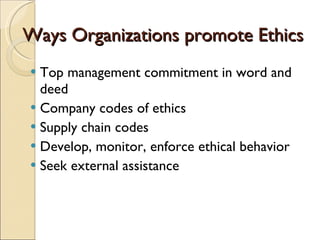
Ways Organizations promote Ethics Top management commitment in word and deed Company codes of ethics Supply chain codes Develop, monitor, enforce ethical behavior Seek external assistance
External Assistance with Ethics Industry or professional codes Certification programs, e.g., ISO 9000 Accounting standards Social services codes Elders Spirituality
Conflict of Interest Usually refers to conflict between professional duties and personal interests Can also refer to conflict between professional duties/values and other values
Objective Decision-making Often expressed in Codes of Ethics Opposite of subjectivity Does the decision and the reasoning behind it hold up to scrutiny by the “reasonable peer”? No bias, truthfulness, no conflict of interest
For Chief Name some objective decision making goals Put community first
How many decisions are clear cut? The 60 / 40 decision is common among politicians

Ethics in the workplace

  • 1.
    Improving Your Workplacethrough Professional Ethics 4:00 – 4:30 pm Tues Dec 7th, 2010 Infonex 951, Whitehorse Chris Hylton, MA CG Hylton & Associates Inc. 800 449-5866 [email_address]
  • 2.
    Agenda • Distinguishing between ethics, values, morals, opinions, and law • Setting an ethical code for your workplace: conflicts of interest • Role of leadership • Setting up a procedure to report and document breaches of ethics • How to respond to reported and unreported breaches of workplace ethics
  • 3.
    wow How arewe going to get thru this in 30 minutes? Harvard Model anyone heard of this?
  • 4.
  • 5.
    Why Should IBe Moral? Because of My Character!
  • 6.
    What makes onegroup virtuous and not another? Inner-City Gangs Common values Models “ Virtuous” actions Codes of honour
  • 7.
    Ku Klux Klan?Focused Live tradition Stories and Models Common enemy “ The family is the strength of our nation.”
  • 8.
    The Christian Church?The Taliban? The Scouting Movement? Your community? Your friends?
  • 9.
    Are the virtuesthe same for everyone? People are very different But we face the same basic problems and have the same basic needs Everyone needs courage as danger can always arise Some people are less well off, so we will need generosity Everyone needs friends so we need loyalty
  • 10.
    Where do Ethicscome from? Importance of the Person, Motive, Heart, Conscience, Spirituality Connection to Community Realization that morality is not defined by moments but by a long-term process Allowance for gray areas, varying contexts, different levels of moral maturity and life contexts
  • 11.
    Weaknesses of EthicsDependence on strong communities Not easily applied to ethical issues or to give us practical solutions Demands time Can be turned into a really poor duty-based ethics Might be taken as situational ethics
  • 12.
    Pre-Contact/Old Traditions Aboriginalslived a traditional life, living off the land, relying on natural order, laws of Creator Conduct in accordance to spiritual connection with Creator Mother Earth. Utilizing gifts, bestowed by the Creator to provide food, shelter and land for all to enjoy. Spiritual beliefs and customs were intact, along with traditions, celebrations through songs and dance. Medicine Wheel Teachings practiced. Aboriginal people had control over their lives and lived freely Everyone had a role and a responsibility, life stages were nurtured with correct teachings by Elders and those in Council.
  • 13.
  • 14.
    Positive Impacts Goodwork ethics were developed during the Residential School era, many Survivors have stated their experiences assisted in their ability to perform physical tasks and do chores that were determined with strict rules and schedules. An opportunity learn to writing and reading skills, learning how to farm for the boys, and sewing, cooking and cleaning for the girls. Long lasting friendships were formed. A sense of pride and accomplishment because Residential School Survivors made it through hard times and a sense of strength and endurance was demonstrated.
  • 15.
    Organizational Ethics Rulesor standards governing the conduct of a organization Moral code – what is ‘right’ and what is ‘wrong’? Highly subjective nature Tension between different stakeholders Youth, elders, haves, have nots
  • 16.
    Stakeholders Community Members – provide services, housing, education, health, capacity building. Safety, honesty, decency and truthful. Employees – health and safety at work, security, fair pay Suppliers – pay on time, pay fair rates, for the work done, provide element of security For those with for profit entities, Shareholders – Generate profits and pay dividends
  • 17.
    Stakeholders Government s– abide by the law, pay taxes, abide by regulations Management – their aims versus those of the organization as a whole Environment – limit pollution, congestion, environmental degradation, development, etc.
  • 18.
    Organization Ethics Tensions:Profits versus higher wages Protection of culture vs. development Culture versus pollution Job creation vs. wage costs Favouritism among community members Elders vs Youth Elders vs Elders Families vs familes
  • 19.
    Ethics / EthicalBehaviour Ethics : are subjective rules that a person sets for themselves about what is right or wrong Influences Family (what you were taught) Peers (pressures, influences) Past Experiences (consequences) Religion (beliefs that are taught) Situation (what is the outcome)
  • 20.
    Ethical Spectrum Arigid code of behaviour applied uniformly regardless of situation. Situational Amoral Moralistic Conduct & behaviour influenced by needs and wants of a particular situation Conduct & behaviour applied without regard for legal or moral constraints
  • 21.
    Legal versus EthicalLegal Not Legal Ethical It is both legal and ethical to protect privacy when a customer makes online purchases from your website It is not legal, but could be considered ethical to leak information that appeared on your employer’s intranet to the media to stop an illegal activity that is occurring in your company Not Ethical It is legal by not considered ethical to call in sick to work when you are not really sick. Or to accept gifts from people in return for awarding a contract. It is neither legal nor ethical to sell e-mail addresses or your customers without their permission.
  • 22.
    Ethics and BusinessBusiness Ethics the application of general rules to business. Corporate Social Responsibility means that business decisions should take into account the social consequences of a produced course of action. Moral Code the standard of current acceptable behaviour in society. Laws of Society Are rules established by elected officials that generally reflect the values of society at a particular time.
  • 23.
    Transformation in OrganizationS2 Ethics Vision Resolutions Practices Transformation
  • 24.
    F4 There isno Finishing Line
  • 25.
    Defining Personality Relativelystable pattern of behaviours and consistent internal states that explain a person's behavioural tendencies
  • 26.
    Big Five PersonalityDimensions Outgoing, talkative Sensitive, flexible Careful, dependable Courteous, caring Anxious, hostile Extroversion Openness to Experience Conscientiousness Agreeableness Neuroticism
  • 27.
    Organizational Ethics The cultural context influences organizational ethics Top managers also influence ethics The combined influence of culture and top management influence organizational ethics and ethical behaviors
  • 28.
    Ways Organizations promoteEthics Top management commitment in word and deed Company codes of ethics Supply chain codes Develop, monitor, enforce ethical behavior Seek external assistance
  • 29.
    External Assistance withEthics Industry or professional codes Certification programs, e.g., ISO 9000 Accounting standards Social services codes Elders Spirituality
  • 30.
    Conflict of InterestUsually refers to conflict between professional duties and personal interests Can also refer to conflict between professional duties/values and other values
  • 31.
    Objective Decision-making Oftenexpressed in Codes of Ethics Opposite of subjectivity Does the decision and the reasoning behind it hold up to scrutiny by the “reasonable peer”? No bias, truthfulness, no conflict of interest
  • 32.
    For Chief Namesome objective decision making goals Put community first
  • 33.
    How many decisionsare clear cut? The 60 / 40 decision is common among politicians

Editor's Notes

  • #2 CG Hylton & Associates Inc Mastering the Basics of HR Management
  • #28 If national practice is bribery, then most companies in that nation will use bribery . If a top manager is unethical, then he/she sets a lead that others follow . When managers behave unethically, employees can be demoralized, lose faith in the organization, and even leave their jobs. Others might follow-the-leader themselves and engage in unethical behaviors. High demands for performance and profitability led Enron employees first to cut ethical corners and finally to break laws as well. According to one Enron controller, the logic was as follows: "If your boss was [fudging] and you have never worked anywhere else, you just assume that everybody fudges earnings. Once you get there and you realized how it was, do you stand up and lose your job? It was scary. It was easy to get into 'Well, everybody else is doing it, so maybe it isn't so bad.'"  
  • #29 F undamental honesty and adherence to the law . P roduct safety and quality, workplace health and safety precautions          C onflicts of interest          E mployment practices          F air practices in selling and marketing products or services          F inancial reporting          S upplier relationships          P ricing, billing, and contracting          T rading in securities and/or use of insider information          P ayments to obtain business          A cquiring and using information about others          S ecurity and political activities          E nvironmental protection          I ntellectual property or use of proprietary information (Business Roundtable, 1988).
  • #30 Accountants have a professional code of ethics that companies rely on .