Value and
Ethics
Lesson 02
Lesson's Objectives
 Define Value & familiar with types of value
 Identify the formation of value
 Define Ethics
 Familiar with the formation of Ethics
 Define Business Ethics
 Identify the importance of Business Ethics
 Identify relationships between ethics and
organization
Value
 As we knew the firm is determined by its
values
 Edwerd Spranger define the value as "the
constellation of standards, or qualities,
characteristics, or ideas that determine a
person's view of the world
 Those standards/idea, qualities are likes,
dislikes, viewpoints, inner inclinational,
rational and irrational judgments,
prejudices, and association patterns
Value
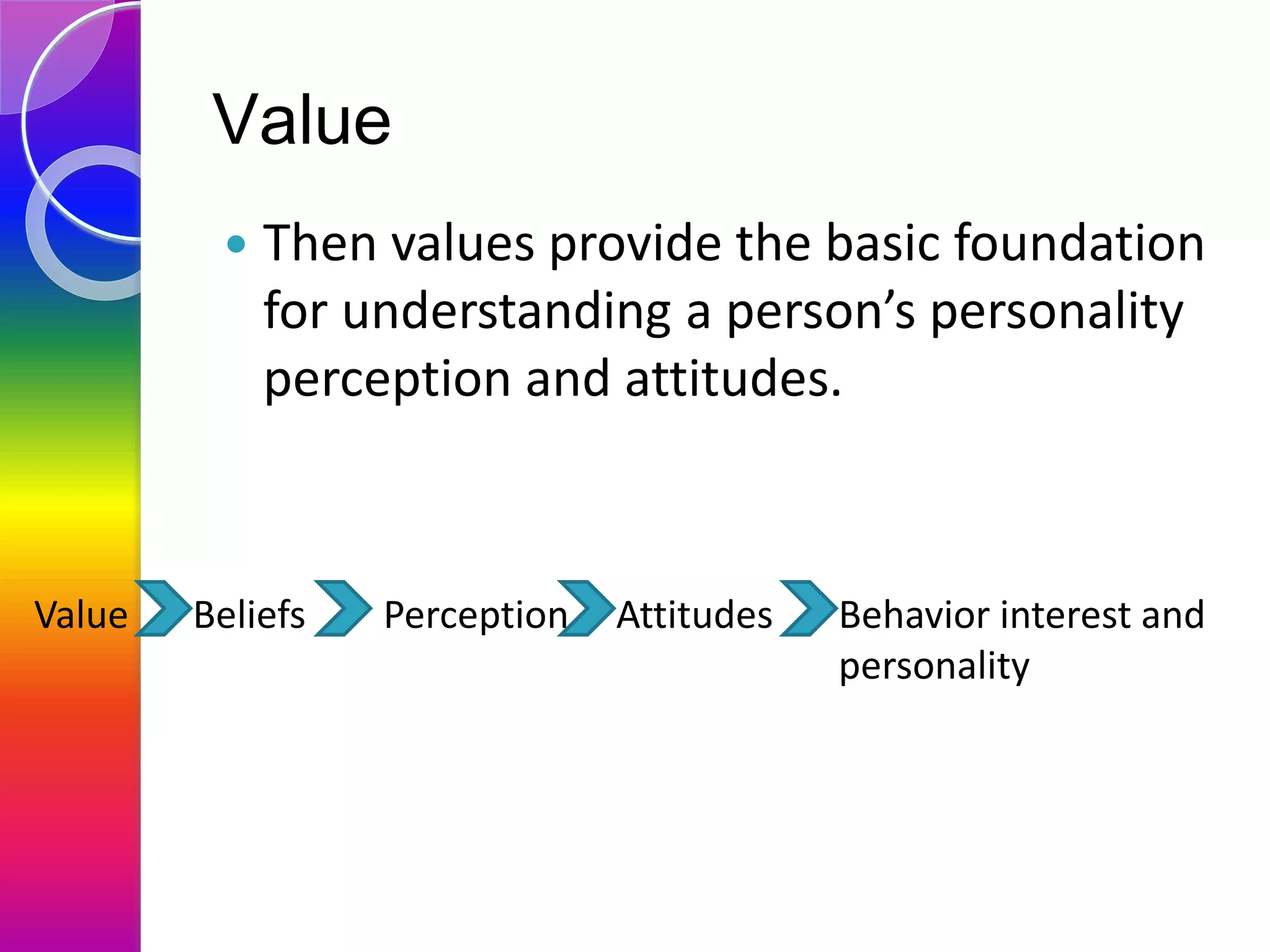
 Then values provide the basic foundation
for understanding a person’s personality
perception and attitudes.
Value Beliefs Perception Attitudes Behavior interest and
personality
Importance of Value
 A powerful force affecting behavior
 Values contain a judgmental element in that
they carry an individual's ideas as to what is
right or desirable
 Provide a way to understand organization
 Help to differentiation
 Determine the retention
Personal Value
 Personal values denote a sense of right or
wrong, good or bad, and other judgmental
criteria based on our strong sense of what
the ideal ought to be
 Personal values serve five purposes in
organizations
 Value serve as standards of behavior
 Guidelines for decision making and conflict
resolution
 Value effect our thought & action
 Influence on employee motivation & perception
 Influence on attitude and behavior
Formulation of Our Value
 40% value is genetically determined
 Balance is given by the environmental
factors
Culture
Parental dictates
Teachers
Friends and other situations
Workforce Value
 At the workplace
Old value: Hard work, conservative-
traditional, loyalty to the employer
organization.
Today value: Job satisfaction, leisure time,
loyalty to relationship, flexibility to career
Negative value: Anger, ,meanness,
arrogance (overconfidence),crookedness-
wicked, greed/lust
Positive value: Integrity, honesty,
truthfulness, kind heartedness, humility
Business Value
Scholars identified ten fundamental shared
values for successful organization
Firm can manage itself through values and core
values
Truth
Mentoring
Giving credit
Honesty
Caring
Trust
Openness
Risk taking
Social conscience
Responsibility &
accountability
Office Technology
Is it wrong to use company e-mail for personal reasons?
Is it wrong to use office equipment to help your children or
spouse do schoolwork?
Is it wrong to play computer games on office equipment
during the work day?
Is it wrong to use office equipment to do internet shopping?
Is it unethical to blame an error you made on a technological
glitch?
Is it unethical to visit pornographic web sites using office
equipment?
Gift and Environment
• What’s the value at which a gift from a supplier or client
becomes troubling?
• Is an Rs.10000 gift to boss unacceptable?
• Is an Rs.10000 gift from the boss unacceptable?
• Is it OK to take an Rs.5000 pair of cricket match tickets from
suppliers?
• Is it OK to take an Rs.120 pair of theater tickets?
• Is it OK to take an Rs.1000 holiday food basket?
• Is it ok to take a Rs.2500 gift certificate?
• Can you accept Rs750 prize won at a raffle at a supplier
conference?
Truth and Lies
•Due to on the job pressure. Have you ever abused or lied about
sick day?
•Due to on-the job pressure have you ever taken credit for
someone else’s work or idea?
Ethics
 There is no agreement to define ethics
means
 E.g.:
Helpless Boy from everything asked “Priest
I will give you an apple if you tell me where
god is”?
Priest replied, “I will give you two apples if
you tell me where he is not?”
 Value…Ethics…
Ethics
 Ethics is derived from the Greek word
“ethos” which means customs, habitual
usage, conduct and character.
 Ethics is an individual’s personal beliefs
regarding what is right and wrong or good
or bad.
 Ethics involves a discipline that examines
good or bad practices within the context of
a moral duty
Formation of Personal Ethics
 Persons ethics are formulated through the
operation of five key forces in the
individual’s environment.
Family influences
Peer influences
Experiences
Value and Morals
Situational factors
Ethics
 Philosophers today usually divide ethical
theories into four general subject areas:
◦ Descriptive ethics
◦ Metaethics
◦ Normative ethics
◦ Applied ethics
Descriptive ethics
 It is closely related to anthropology, sociology,
and psychology and leans heavily on them.
◦ It consists of studying and describing the
morality of a people, culture, or society.
◦ It compares and contrasts different moral
systems, codes, practices, beliefs, principles,
and values.
Metaethics
 Metaethics investigates where our ethical
principled come from, and what they mean.
 That attempts to discover the origin or cause of
right and wrong.”
◦ It discuss about the theoretical meaning and
reference of moral propositions and how their
truth values may be determined;
◦ questions such as “What is goodness?”
Normative ethics
 Normative ethics, about the practical
means of determining a moral course of
action.
 This may involve articulating the good
habits that we should acquire, the duties
that we should follow.
 Question as “what should one do?”
Applied ethics
 Applied ethics ,consider about how moral
outcomes can be achieved in specific
situations;
 And applied ethics involves examining
specific controversial issues, such as
abortion, infanticide, animal rights,
environmental concerns, homosexuality,
capital punishment, or nuclear war.
Ethics and Moral
 Moral is similar to ethics and many
people use the two words
interchangeably and derived from the
Latin “mores”, means custom or habit.
 And morals are based on religious beliefs
and social influence and group norms.
Ethics & Moral
 Ethics and morals both relate to “right”
and “wrong” conduct. However, ethics
refer to the series of rules provided to an
individual by an external source. E.g. their
profession. On the other hand, morals
refer to an individual’s own principles
regarding right and wrong.
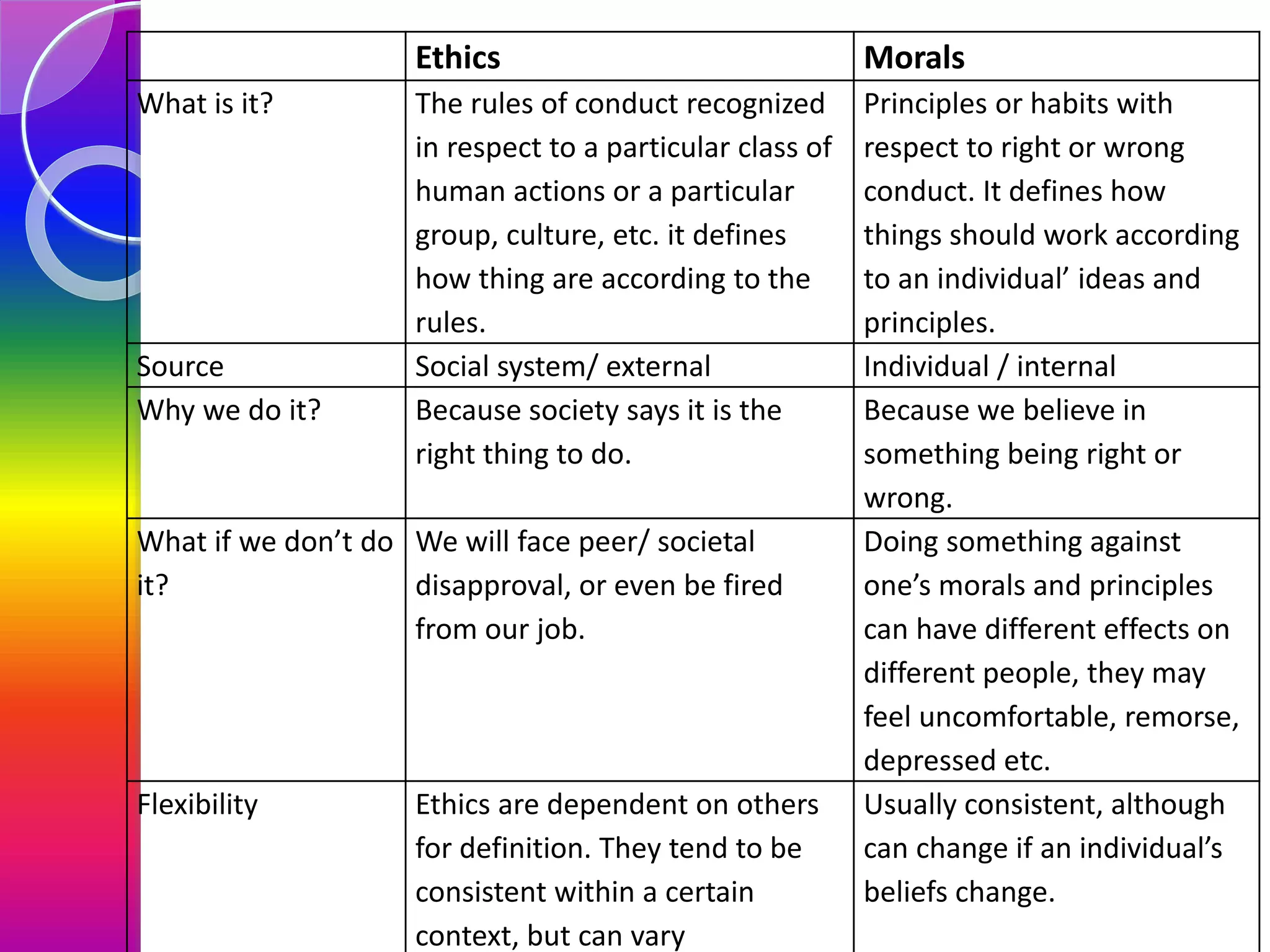
Ethics Morals
What is it? The rules of conduct recognized
in respect to a particular class of
human actions or a particular
group, culture, etc. it defines
how thing are according to the
rules.
Principles or habits with
respect to right or wrong
conduct. It defines how
things should work according
to an individual’ ideas and
principles.
Source Social system/ external Individual / internal
Why we do it? Because society says it is the
right thing to do.
Because we believe in
something being right or
wrong.
What if we don’t do
it?
We will face peer/ societal
disapproval, or even be fired
from our job.
Doing something against
one’s morals and principles
can have different effects on
different people, they may
feel uncomfortable, remorse,
depressed etc.
Flexibility Ethics are dependent on others
for definition. They tend to be
consistent within a certain
context, but can vary
Usually consistent, although
can change if an individual’s
beliefs change.
Ethics, value, Moral
 Ethics are rules that help us tell the difference
between right and wrong. They encourage us to
do the right thing.
 Values tell us what is important. They help us
make decisions about right and wrong.
 Morals are rules we use to decide what is good
or bad.
1960s 1970s 1980s 1990s 2000+
Environment
al issues
Employee
militancy (us
vs. them)
Bribery and
illegal
contracting
practices
Unsafe work
practice in
third world
countries
Emerging
technology
issues cyber
crime privacy
Employer/em
ployee
tensions
Human rights
issues (forced
labor, low
wages, work
environment)
Deceptive
advertising
Increased
corporate
Inability for
personal
damage
Intellectual
property
theft
Civil rights &
race relation
issues
Firms start
practice of
covering up
not
confronting
issues
Financial
fraud (savings
& loan
scandals)
Financial
mismanagem
ent & fraud
International
corruption
Changing
work ethics
Federal
Corrupt
Practices Act
passes (1977)
Transparency
issues arise
Federal
sentencing
Guidelines
for Org
(1991)
Sarbannes
oxley Act
(2002)
Drug use
escalated
Compliance
& legal to
values
orientation
Defense
Industry
Imitative
(1986)
Global
Sullivan
Principles
(1999)
UN
Convention
Against
Corruption
(2003)
BusinessEthicsTimeline
Sources of Ethical Norms
The
Individual
Conscience
Fellow Workers
Family
Friends
The law
Regions of
Country
Profession
Employer
Society at large
Opposites
Religious Beliefs
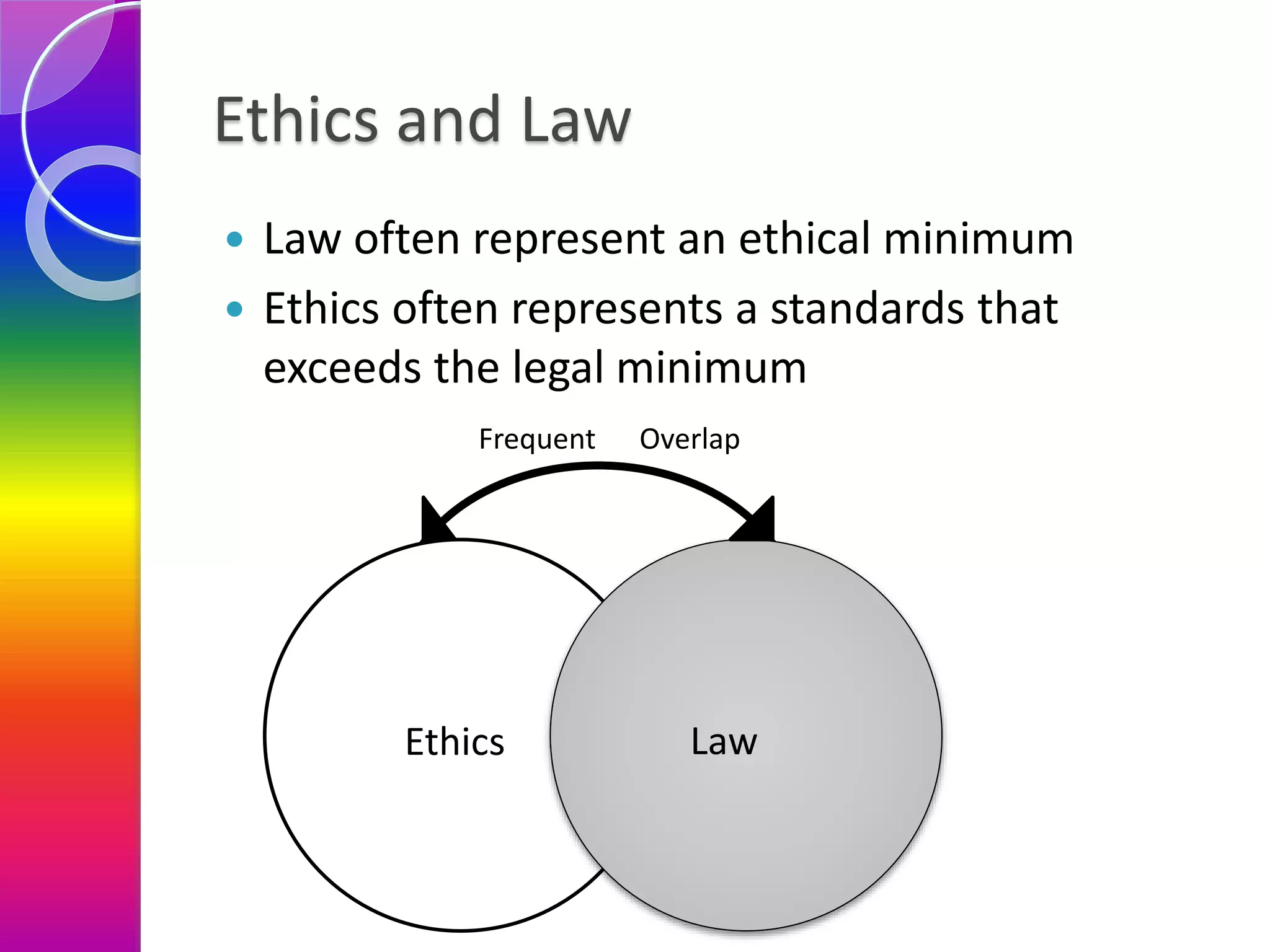
Ethics and Law
 Law often represent an ethical minimum
 Ethics often represents a standards that
exceeds the legal minimum
Frequent Overlap
Ethics Law
Concepts of Ethics
 Developed by moral philosophers over
generations and used to distinguished ethical
from unethical behavior. But each ethical
concepts has problems
 The 4 Concept of Ethics
◦ Relativism
◦ Egoism
◦ Utilitarianism
◦ Deontologism
Relativism
 There is no universal standard by which
morality can be judged
 At here what is correct for one society may be
wrong for another
 And Ethics and morality are relative
Relativism
 There are no absolutes/limits-murder, slavery,
torture, rape are also accepted
 Always directed to meant by a society as a sub-
societies
 Leads to conclusion – each person’s opinion is
correct
 Nothing that anyone does is morally wrong
Egoism
 It is one ought to act in his or her own self
interest and when it is ethical behavior is
that which promotes one’s own self interest.
And it does not mean should not obey laws
– only do so if in self interest
 Ethical egoism is the view that what a
person ought to do is always what they
judge to be in their individual best interest
to do.
 Psychological egoism is the view that
everyone, in fact, always does act from a
self-interested motive
Utilitarianism
 The morality of an action can be determined by
its consequences.
 And an action is ethical if it promotes the
greatest good for the greatest number
 The benefits of the Action is higher than its cost
means the behavior is ethical otherwise it is
unethical
 Restrictions against the majority to protect a
minority is not utilitarian
 In the eyes of a utilitarian, any action is justified
if it works towards the greatest utility.
Deontologism
 Derived from the Greek world for Duty
 Actions are not justified by their
consequences.
 Factors other than good outcomes
determine the rightness of actions
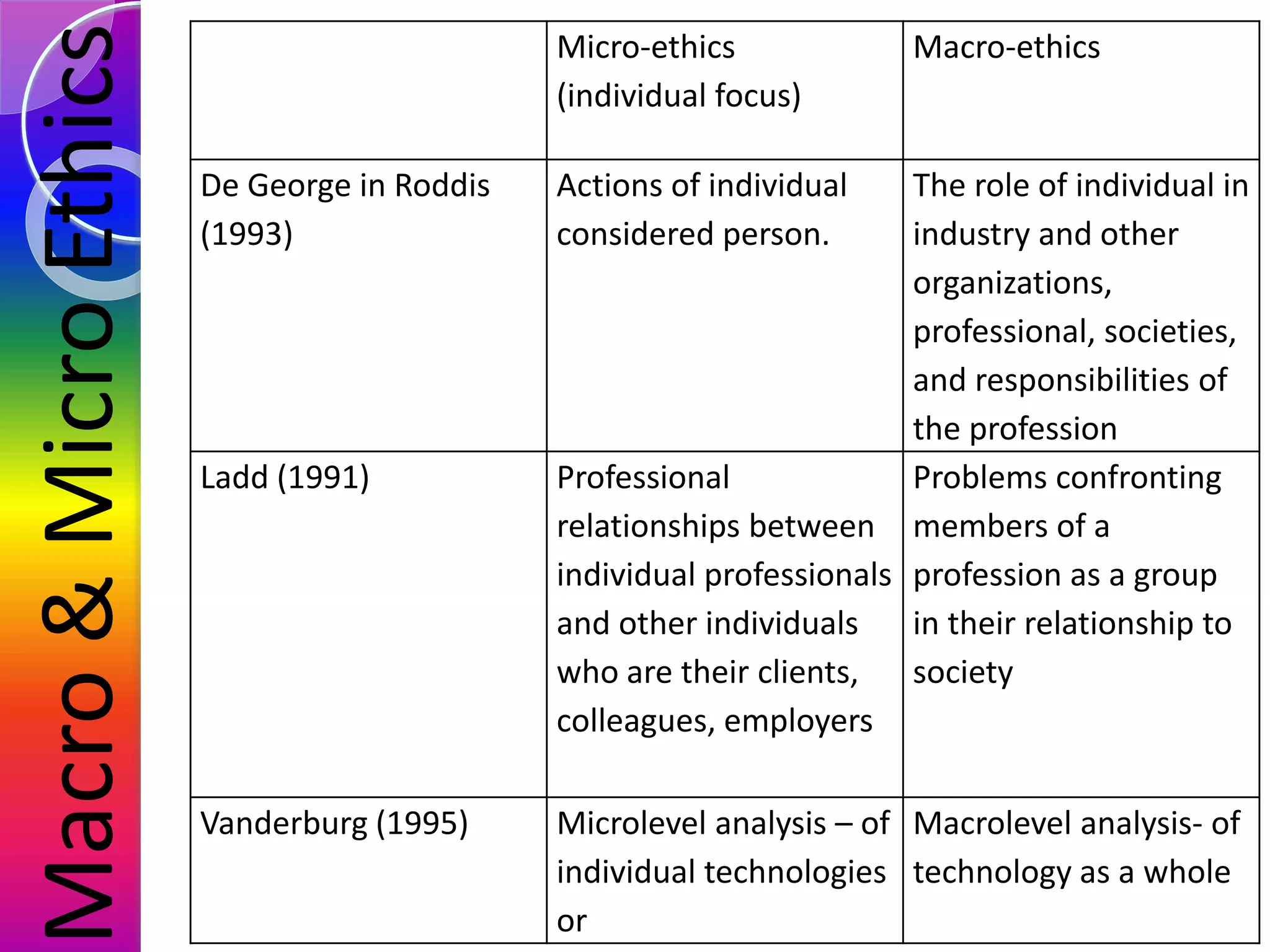
Micro-ethics
(individual focus)
Macro-ethics
De George in Roddis
(1993)
Actions of individual
considered person.
The role of individual in
industry and other
organizations,
professional, societies,
and responsibilities of
the profession
Ladd (1991) Professional
relationships between
individual professionals
and other individuals
who are their clients,
colleagues, employers
Problems confronting
members of a
profession as a group
in their relationship to
society
Vanderburg (1995) Microlevel analysis – of
individual technologies
or
Macrolevel analysis- of
technology as a whole
Macro&MicroEthics
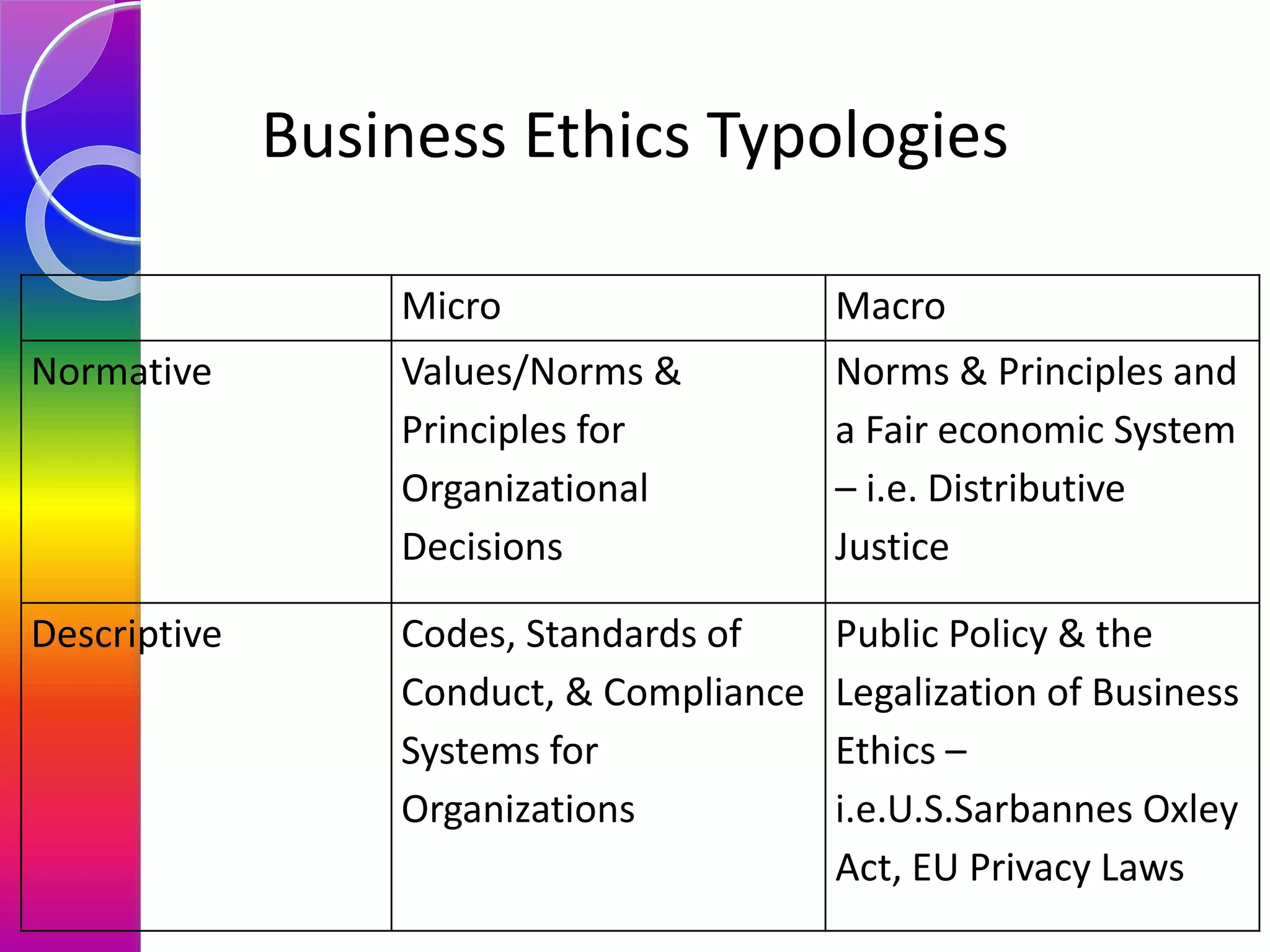
Micro Macro
Normative Values/Norms &
Principles for
Organizational
Decisions
Norms & Principles and
a Fair economic System
– i.e. Distributive
Justice
Descriptive Codes, Standards of
Conduct, & Compliance
Systems for
Organizations
Public Policy & the
Legalization of Business
Ethics –
i.e.U.S.Sarbannes Oxley
Act, EU Privacy Laws
Business Ethics Typologies
Development Of Ethics
 Different cultures have different
standards of what is good and what is
bad, but humans tend to go through a
certain process in learning to apply their
ethics and cultural morels to their own
behavior.
 Contributors
◦ Piaget – Cognitive – development Theory
◦ Kohlberg – Conventional Approach
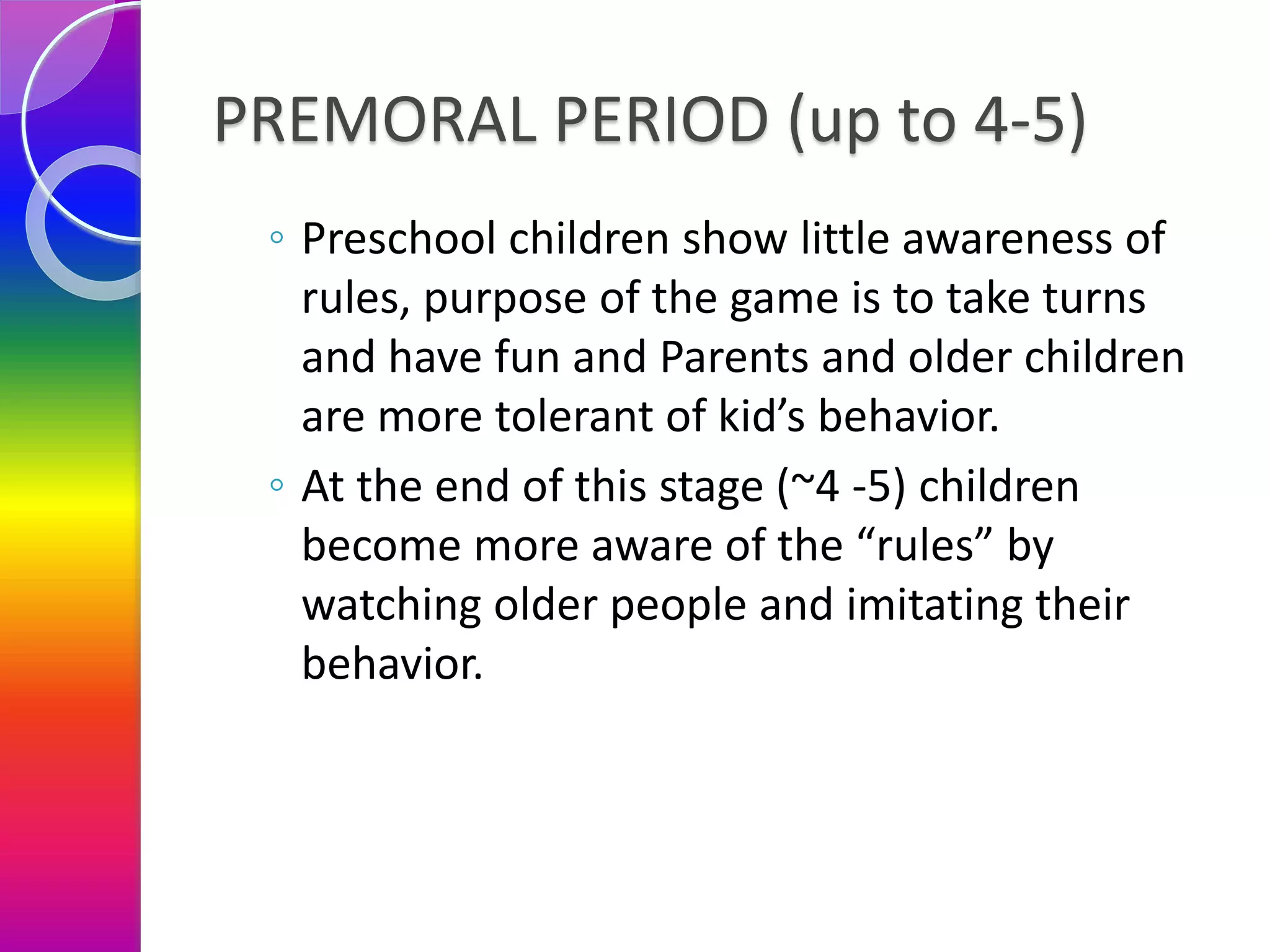
PREMORAL PERIOD (up to 4-5)
◦ Preschool children show little awareness of
rules, purpose of the game is to take turns
and have fun and Parents and older children
are more tolerant of kid’s behavior.
◦ At the end of this stage (~4 -5) children
become more aware of the “rules” by
watching older people and imitating their
behavior.
MORAL REALISM (6-10)
 Children at this stage tend to think of
rules in terms of MORAL ABSOLUTES is
“right” always means following the rules
 The child also believes in IMMANENT
JUSTICE is any violation of society rules
will be caught and punished
 In SUM: rules exist outside of themselves.
Wrong is whatever adults forbid and
punish. Rules MUST NOT be questioned.
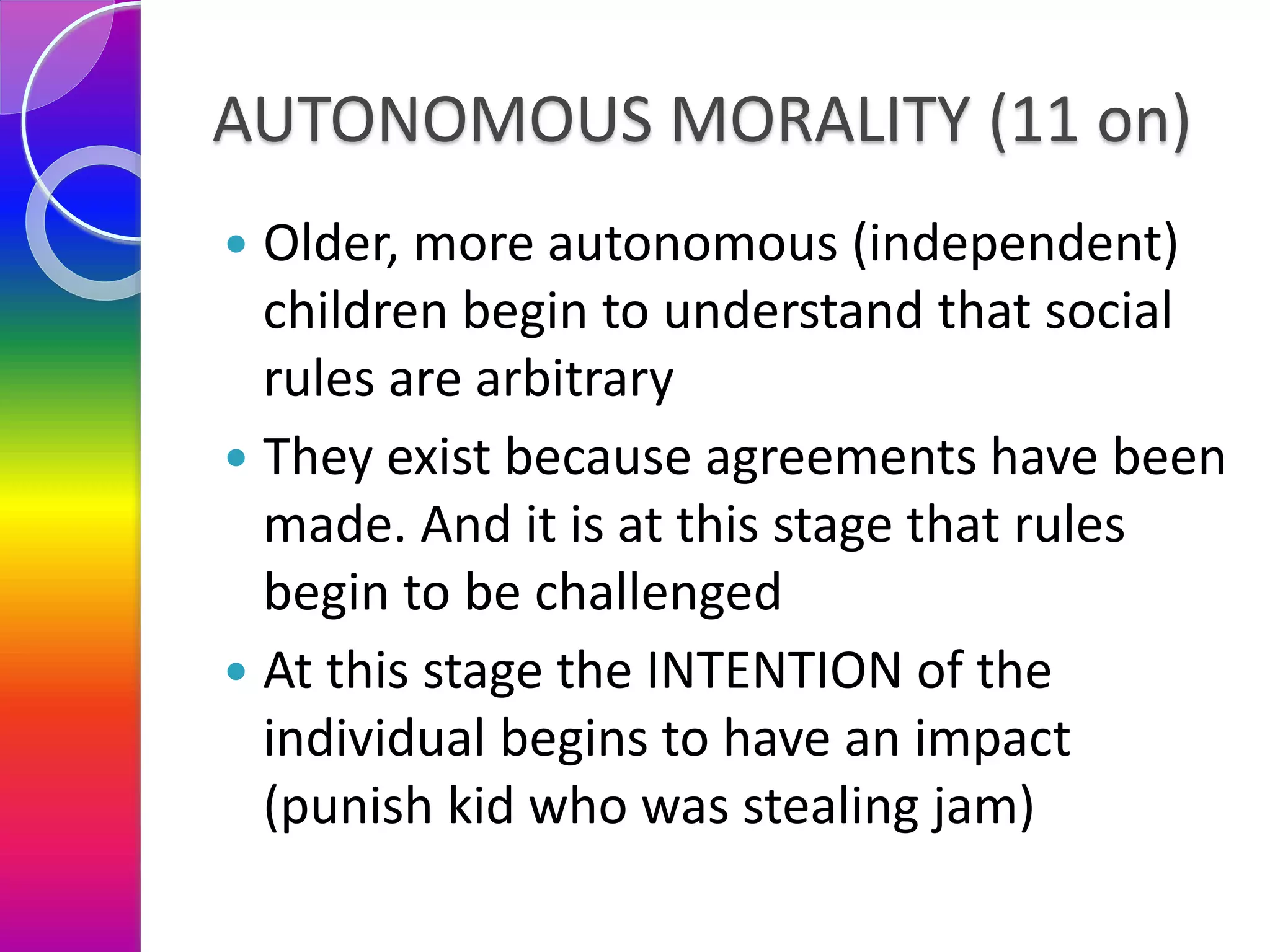
AUTONOMOUS MORALITY (11 on)
 Older, more autonomous (independent)
children begin to understand that social
rules are arbitrary
 They exist because agreements have been
made. And it is at this stage that rules
begin to be challenged
 At this stage the INTENTION of the
individual begins to have an impact
(punish kid who was stealing jam)
Kohlberg Contribution
 Kohlberg proposed 3 stages of moral
development, with each stages consisting
of 2 distinct sub stages.
◦ Level 1: preconvention morality (1&2)
◦ Level 2: conventional morality (3&4)
◦ Level 3: post-conventional morality (5&6)
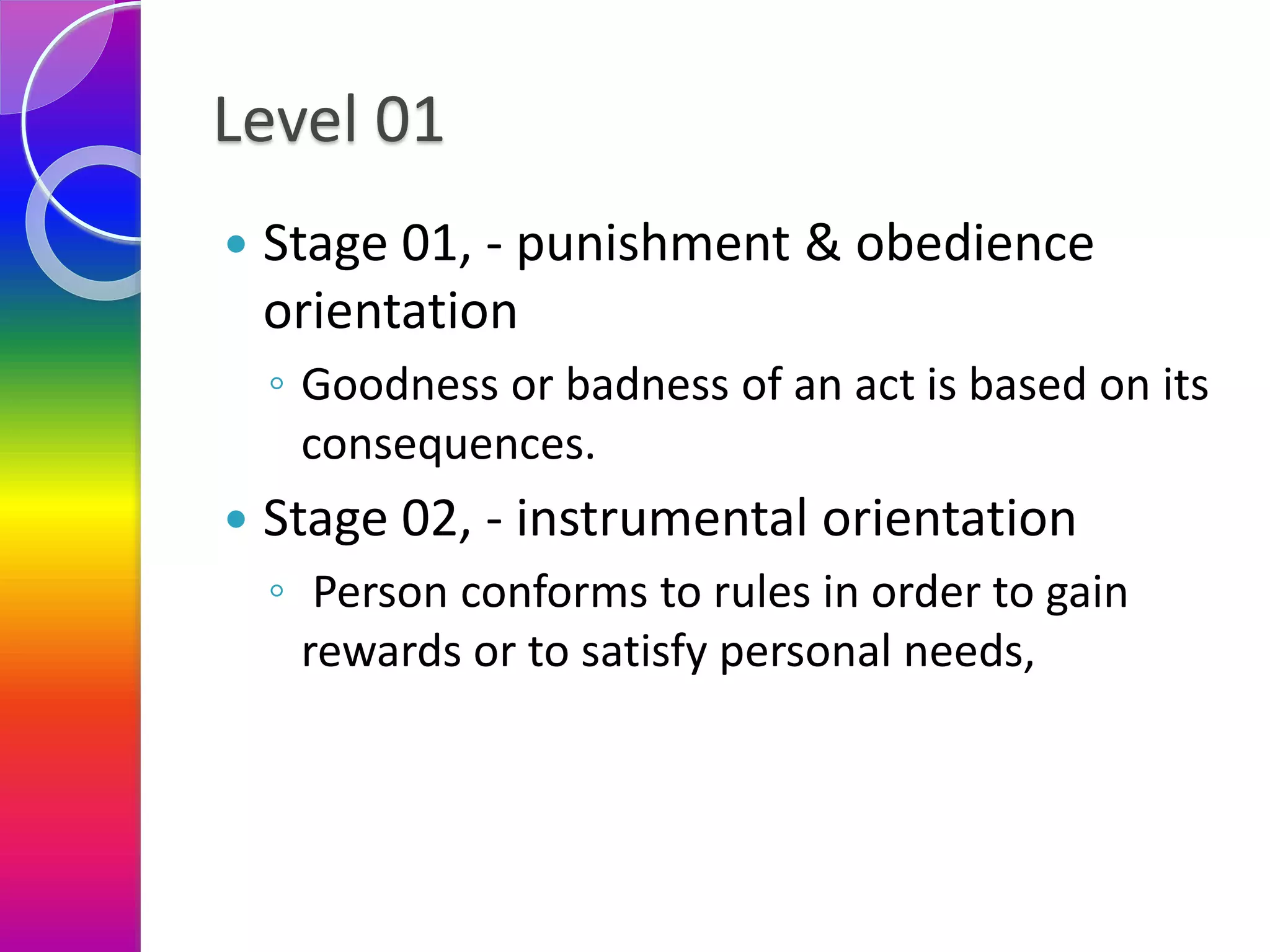
Level 01
 Stage 01, - punishment & obedience
orientation
◦ Goodness or badness of an act is based on its
consequences.
 Stage 02, - instrumental orientation
◦ Person conforms to rules in order to gain
rewards or to satisfy personal needs,
Level 02
 Stage 03: “Good-boy/good-girl” orientation
◦ Moral behavior is that which pleases, helps,
or is approved by others. And actions are
evaluated on the basis of intent with one
objective is to be thought of as a “nice”
person
 Stage 04: Authority and social-order-
maintaining morality
 Accept and conforms to social rules and
conventions because of a belief that rules
and laws maintain an order which is judged
good or moral
 Law and order mentality
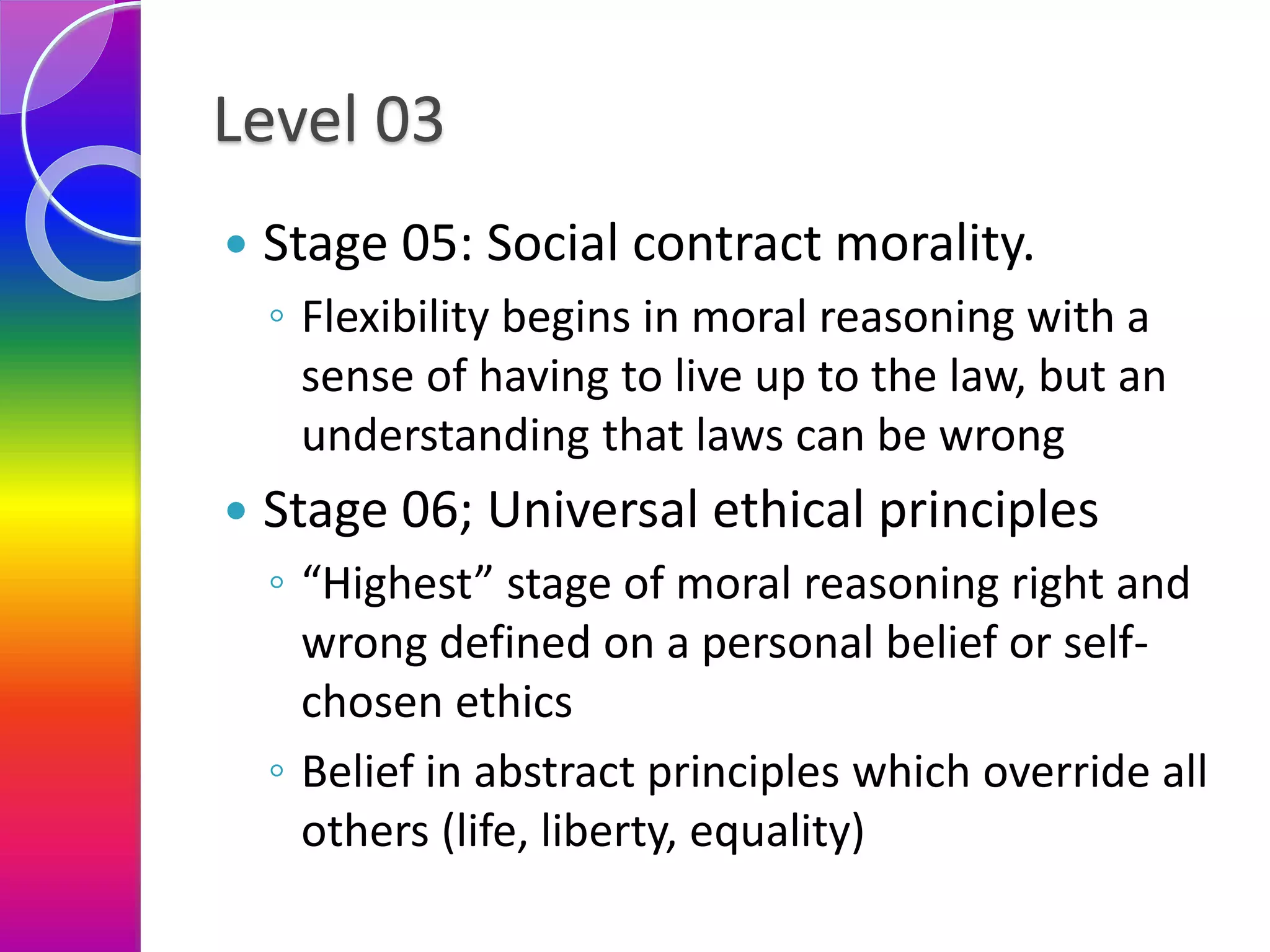
Level 03
 Stage 05: Social contract morality.
◦ Flexibility begins in moral reasoning with a
sense of having to live up to the law, but an
understanding that laws can be wrong
 Stage 06; Universal ethical principles
◦ “Highest” stage of moral reasoning right and
wrong defined on a personal belief or self-
chosen ethics
◦ Belief in abstract principles which override all
others (life, liberty, equality)
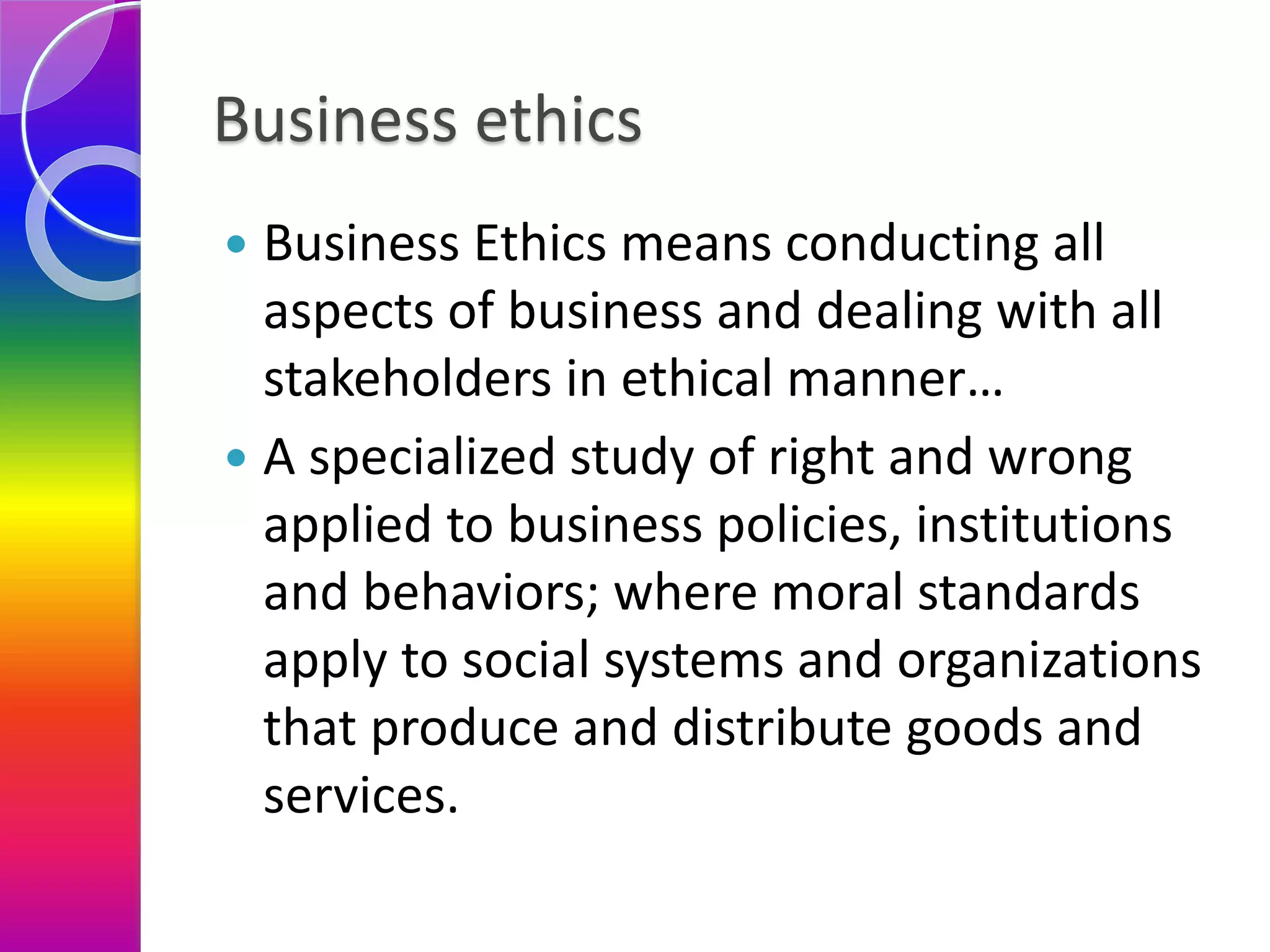
Business ethics
 Business Ethics means conducting all
aspects of business and dealing with all
stakeholders in ethical manner…
 A specialized study of right and wrong
applied to business policies, institutions
and behaviors; where moral standards
apply to social systems and organizations
that produce and distribute goods and
services.
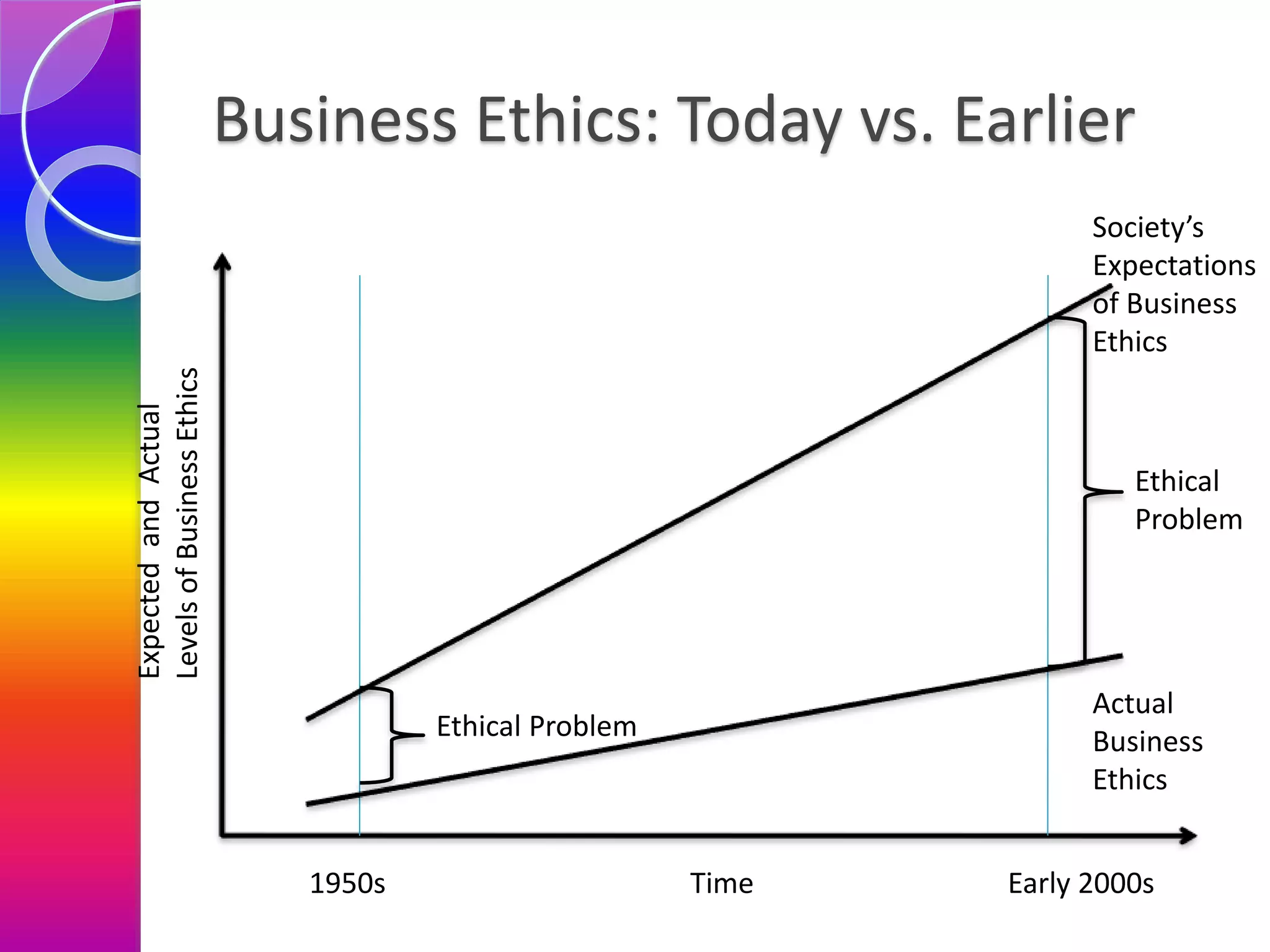
Business Ethics: Today vs. Earlier
1950s Time Early 2000s
Ethical Problem
Ethical
Problem
Actual
Business
Ethics
Society’s
Expectations
of Business
Ethics
ExpectedandActual
LevelsofBusinessEthics
Business ethics
 Three basic topics covered:
◦ Systematic Issues – Raised question about
economic, political, legal or other social
systems within which business operate
◦ Corporate Issues – raised question about a
particular company
◦ Individual Issues – Questions about a
particular individual within an organization,
their behavior & decisions
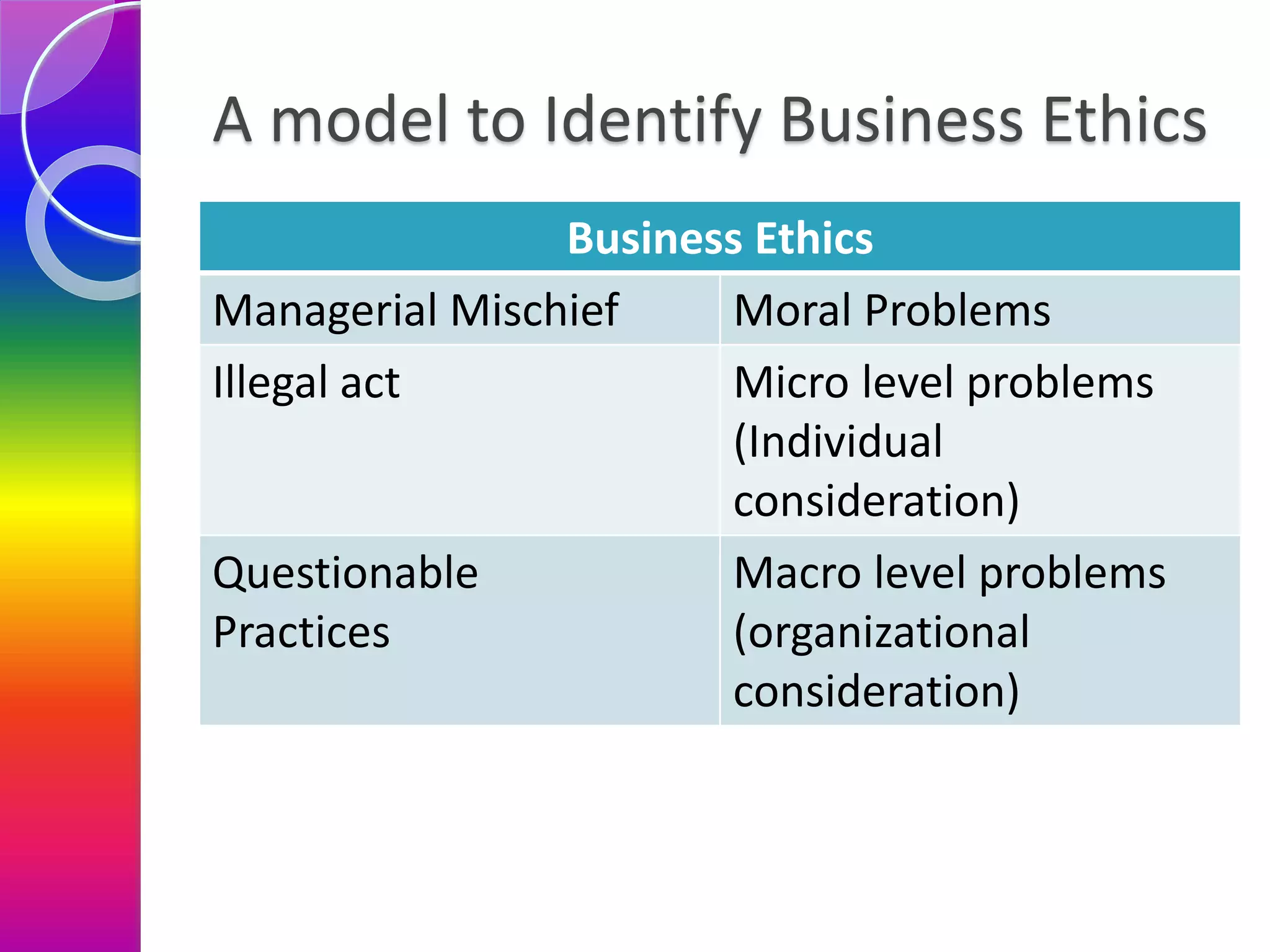
A model to Identify Business Ethics
Business Ethics
Managerial Mischief Moral Problems
Illegal act Micro level problems
(Individual
consideration)
Questionable
Practices
Macro level problems
(organizational
consideration)
Business ethics
 At the Practices of Business Ethics have to
consider
◦ Profits versus higher wages
◦ Expansion versus development
◦ Production versus pollution
◦ Supplier benefits versus consumer
prices/lower costs
◦ Survival of the business versus needs of
stakeholders
Business ethics
 Solutions for Business immoral/amoral
◦ Taxation
◦ Self Regulation
◦ Subsidies
◦ Government/EU regulation
◦ Legislation
◦ Pressure Groups
◦ Improve competition and contestability of
markets
◦ Social Environmental Audits
Significance of Business ethics
 Attract customers to the firm’s products,
thereby boosting sales and profits
 Make employees want to stay with the
business, reduce labor turnover and
therefore increase productivity
 Attract more employees wanting to work for
the business, reduce recruitment costs and
enable the company to get the most
talented employees
 Attract investors and keep the company’s
share price high, thereby protecting the
business from takeover.
Significance of Business ethics
 The need for a company to behave
“ethically” is described in terms of a
company’s need to interact productively
with its stakeholders.
 “Behavior that is trusting, trustworthy, and
cooperative, not opportunistic, will give the
firm a competitive advantage”.
 Sustainable global competitive advantage
occurs when a company implements a value-
creating strategy which other companies are
unable to imitate.
Significance of Business ethics
 It facilitates the delivery of quality of
products in an honest, reliable way.
 This approach can enhance work life by
making the workplace more fun and
challenging.
 It can improve relationships with
stakeholders and can instill a more
positive mindset that fosters creativity
and innovations among the stakeholders.
Thank you!

Values and ethics

  • 1.
  • 2.
    Lesson's Objectives  DefineValue & familiar with types of value  Identify the formation of value  Define Ethics  Familiar with the formation of Ethics  Define Business Ethics  Identify the importance of Business Ethics  Identify relationships between ethics and organization
  • 3.
    Value  As weknew the firm is determined by its values  Edwerd Spranger define the value as "the constellation of standards, or qualities, characteristics, or ideas that determine a person's view of the world  Those standards/idea, qualities are likes, dislikes, viewpoints, inner inclinational, rational and irrational judgments, prejudices, and association patterns
  • 4.
    Value  Then valuesprovide the basic foundation for understanding a person’s personality perception and attitudes. Value Beliefs Perception Attitudes Behavior interest and personality
  • 5.
    Importance of Value A powerful force affecting behavior  Values contain a judgmental element in that they carry an individual's ideas as to what is right or desirable  Provide a way to understand organization  Help to differentiation  Determine the retention
  • 6.
    Personal Value  Personalvalues denote a sense of right or wrong, good or bad, and other judgmental criteria based on our strong sense of what the ideal ought to be  Personal values serve five purposes in organizations  Value serve as standards of behavior  Guidelines for decision making and conflict resolution  Value effect our thought & action  Influence on employee motivation & perception  Influence on attitude and behavior
  • 7.
    Formulation of OurValue  40% value is genetically determined  Balance is given by the environmental factors Culture Parental dictates Teachers Friends and other situations
  • 8.
    Workforce Value  Atthe workplace Old value: Hard work, conservative- traditional, loyalty to the employer organization. Today value: Job satisfaction, leisure time, loyalty to relationship, flexibility to career Negative value: Anger, ,meanness, arrogance (overconfidence),crookedness- wicked, greed/lust Positive value: Integrity, honesty, truthfulness, kind heartedness, humility
  • 9.
    Business Value Scholars identifiedten fundamental shared values for successful organization Firm can manage itself through values and core values Truth Mentoring Giving credit Honesty Caring Trust Openness Risk taking Social conscience Responsibility & accountability
  • 10.
    Office Technology Is itwrong to use company e-mail for personal reasons? Is it wrong to use office equipment to help your children or spouse do schoolwork? Is it wrong to play computer games on office equipment during the work day? Is it wrong to use office equipment to do internet shopping? Is it unethical to blame an error you made on a technological glitch? Is it unethical to visit pornographic web sites using office equipment?
  • 11.
    Gift and Environment •What’s the value at which a gift from a supplier or client becomes troubling? • Is an Rs.10000 gift to boss unacceptable? • Is an Rs.10000 gift from the boss unacceptable? • Is it OK to take an Rs.5000 pair of cricket match tickets from suppliers? • Is it OK to take an Rs.120 pair of theater tickets? • Is it OK to take an Rs.1000 holiday food basket? • Is it ok to take a Rs.2500 gift certificate? • Can you accept Rs750 prize won at a raffle at a supplier conference? Truth and Lies •Due to on the job pressure. Have you ever abused or lied about sick day? •Due to on-the job pressure have you ever taken credit for someone else’s work or idea?
  • 12.
    Ethics  There isno agreement to define ethics means  E.g.: Helpless Boy from everything asked “Priest I will give you an apple if you tell me where god is”? Priest replied, “I will give you two apples if you tell me where he is not?”  Value…Ethics…
  • 13.
    Ethics  Ethics isderived from the Greek word “ethos” which means customs, habitual usage, conduct and character.  Ethics is an individual’s personal beliefs regarding what is right and wrong or good or bad.  Ethics involves a discipline that examines good or bad practices within the context of a moral duty
  • 14.
    Formation of PersonalEthics  Persons ethics are formulated through the operation of five key forces in the individual’s environment. Family influences Peer influences Experiences Value and Morals Situational factors
  • 15.
    Ethics  Philosophers todayusually divide ethical theories into four general subject areas: ◦ Descriptive ethics ◦ Metaethics ◦ Normative ethics ◦ Applied ethics
  • 16.
    Descriptive ethics  Itis closely related to anthropology, sociology, and psychology and leans heavily on them. ◦ It consists of studying and describing the morality of a people, culture, or society. ◦ It compares and contrasts different moral systems, codes, practices, beliefs, principles, and values.
  • 17.
    Metaethics  Metaethics investigateswhere our ethical principled come from, and what they mean.  That attempts to discover the origin or cause of right and wrong.” ◦ It discuss about the theoretical meaning and reference of moral propositions and how their truth values may be determined; ◦ questions such as “What is goodness?”
  • 18.
    Normative ethics  Normativeethics, about the practical means of determining a moral course of action.  This may involve articulating the good habits that we should acquire, the duties that we should follow.  Question as “what should one do?”
  • 19.
    Applied ethics  Appliedethics ,consider about how moral outcomes can be achieved in specific situations;  And applied ethics involves examining specific controversial issues, such as abortion, infanticide, animal rights, environmental concerns, homosexuality, capital punishment, or nuclear war.
  • 20.
    Ethics and Moral Moral is similar to ethics and many people use the two words interchangeably and derived from the Latin “mores”, means custom or habit.  And morals are based on religious beliefs and social influence and group norms.
  • 21.
    Ethics & Moral Ethics and morals both relate to “right” and “wrong” conduct. However, ethics refer to the series of rules provided to an individual by an external source. E.g. their profession. On the other hand, morals refer to an individual’s own principles regarding right and wrong.
  • 22.
    Ethics Morals What isit? The rules of conduct recognized in respect to a particular class of human actions or a particular group, culture, etc. it defines how thing are according to the rules. Principles or habits with respect to right or wrong conduct. It defines how things should work according to an individual’ ideas and principles. Source Social system/ external Individual / internal Why we do it? Because society says it is the right thing to do. Because we believe in something being right or wrong. What if we don’t do it? We will face peer/ societal disapproval, or even be fired from our job. Doing something against one’s morals and principles can have different effects on different people, they may feel uncomfortable, remorse, depressed etc. Flexibility Ethics are dependent on others for definition. They tend to be consistent within a certain context, but can vary Usually consistent, although can change if an individual’s beliefs change.
  • 23.
    Ethics, value, Moral Ethics are rules that help us tell the difference between right and wrong. They encourage us to do the right thing.  Values tell us what is important. They help us make decisions about right and wrong.  Morals are rules we use to decide what is good or bad.
  • 24.
    1960s 1970s 1980s1990s 2000+ Environment al issues Employee militancy (us vs. them) Bribery and illegal contracting practices Unsafe work practice in third world countries Emerging technology issues cyber crime privacy Employer/em ployee tensions Human rights issues (forced labor, low wages, work environment) Deceptive advertising Increased corporate Inability for personal damage Intellectual property theft Civil rights & race relation issues Firms start practice of covering up not confronting issues Financial fraud (savings & loan scandals) Financial mismanagem ent & fraud International corruption Changing work ethics Federal Corrupt Practices Act passes (1977) Transparency issues arise Federal sentencing Guidelines for Org (1991) Sarbannes oxley Act (2002) Drug use escalated Compliance & legal to values orientation Defense Industry Imitative (1986) Global Sullivan Principles (1999) UN Convention Against Corruption (2003) BusinessEthicsTimeline
  • 25.
    Sources of EthicalNorms The Individual Conscience Fellow Workers Family Friends The law Regions of Country Profession Employer Society at large Opposites Religious Beliefs
  • 26.
    Ethics and Law Law often represent an ethical minimum  Ethics often represents a standards that exceeds the legal minimum Frequent Overlap Ethics Law
  • 27.
    Concepts of Ethics Developed by moral philosophers over generations and used to distinguished ethical from unethical behavior. But each ethical concepts has problems  The 4 Concept of Ethics ◦ Relativism ◦ Egoism ◦ Utilitarianism ◦ Deontologism
  • 28.
    Relativism  There isno universal standard by which morality can be judged  At here what is correct for one society may be wrong for another  And Ethics and morality are relative
  • 29.
    Relativism  There areno absolutes/limits-murder, slavery, torture, rape are also accepted  Always directed to meant by a society as a sub- societies  Leads to conclusion – each person’s opinion is correct  Nothing that anyone does is morally wrong
  • 30.
    Egoism  It isone ought to act in his or her own self interest and when it is ethical behavior is that which promotes one’s own self interest. And it does not mean should not obey laws – only do so if in self interest  Ethical egoism is the view that what a person ought to do is always what they judge to be in their individual best interest to do.  Psychological egoism is the view that everyone, in fact, always does act from a self-interested motive
  • 31.
    Utilitarianism  The moralityof an action can be determined by its consequences.  And an action is ethical if it promotes the greatest good for the greatest number  The benefits of the Action is higher than its cost means the behavior is ethical otherwise it is unethical  Restrictions against the majority to protect a minority is not utilitarian  In the eyes of a utilitarian, any action is justified if it works towards the greatest utility.
  • 32.
    Deontologism  Derived fromthe Greek world for Duty  Actions are not justified by their consequences.  Factors other than good outcomes determine the rightness of actions
  • 33.
    Micro-ethics (individual focus) Macro-ethics De Georgein Roddis (1993) Actions of individual considered person. The role of individual in industry and other organizations, professional, societies, and responsibilities of the profession Ladd (1991) Professional relationships between individual professionals and other individuals who are their clients, colleagues, employers Problems confronting members of a profession as a group in their relationship to society Vanderburg (1995) Microlevel analysis – of individual technologies or Macrolevel analysis- of technology as a whole Macro&MicroEthics
  • 34.
    Micro Macro Normative Values/Norms& Principles for Organizational Decisions Norms & Principles and a Fair economic System – i.e. Distributive Justice Descriptive Codes, Standards of Conduct, & Compliance Systems for Organizations Public Policy & the Legalization of Business Ethics – i.e.U.S.Sarbannes Oxley Act, EU Privacy Laws Business Ethics Typologies
  • 35.
    Development Of Ethics Different cultures have different standards of what is good and what is bad, but humans tend to go through a certain process in learning to apply their ethics and cultural morels to their own behavior.  Contributors ◦ Piaget – Cognitive – development Theory ◦ Kohlberg – Conventional Approach
  • 36.
    PREMORAL PERIOD (upto 4-5) ◦ Preschool children show little awareness of rules, purpose of the game is to take turns and have fun and Parents and older children are more tolerant of kid’s behavior. ◦ At the end of this stage (~4 -5) children become more aware of the “rules” by watching older people and imitating their behavior.
  • 37.
    MORAL REALISM (6-10) Children at this stage tend to think of rules in terms of MORAL ABSOLUTES is “right” always means following the rules  The child also believes in IMMANENT JUSTICE is any violation of society rules will be caught and punished  In SUM: rules exist outside of themselves. Wrong is whatever adults forbid and punish. Rules MUST NOT be questioned.
  • 38.
    AUTONOMOUS MORALITY (11on)  Older, more autonomous (independent) children begin to understand that social rules are arbitrary  They exist because agreements have been made. And it is at this stage that rules begin to be challenged  At this stage the INTENTION of the individual begins to have an impact (punish kid who was stealing jam)
  • 39.
    Kohlberg Contribution  Kohlbergproposed 3 stages of moral development, with each stages consisting of 2 distinct sub stages. ◦ Level 1: preconvention morality (1&2) ◦ Level 2: conventional morality (3&4) ◦ Level 3: post-conventional morality (5&6)
  • 40.
    Level 01  Stage01, - punishment & obedience orientation ◦ Goodness or badness of an act is based on its consequences.  Stage 02, - instrumental orientation ◦ Person conforms to rules in order to gain rewards or to satisfy personal needs,
  • 41.
    Level 02  Stage03: “Good-boy/good-girl” orientation ◦ Moral behavior is that which pleases, helps, or is approved by others. And actions are evaluated on the basis of intent with one objective is to be thought of as a “nice” person  Stage 04: Authority and social-order- maintaining morality  Accept and conforms to social rules and conventions because of a belief that rules and laws maintain an order which is judged good or moral  Law and order mentality
  • 42.
    Level 03  Stage05: Social contract morality. ◦ Flexibility begins in moral reasoning with a sense of having to live up to the law, but an understanding that laws can be wrong  Stage 06; Universal ethical principles ◦ “Highest” stage of moral reasoning right and wrong defined on a personal belief or self- chosen ethics ◦ Belief in abstract principles which override all others (life, liberty, equality)
  • 43.
    Business ethics  BusinessEthics means conducting all aspects of business and dealing with all stakeholders in ethical manner…  A specialized study of right and wrong applied to business policies, institutions and behaviors; where moral standards apply to social systems and organizations that produce and distribute goods and services.
  • 44.
    Business Ethics: Todayvs. Earlier 1950s Time Early 2000s Ethical Problem Ethical Problem Actual Business Ethics Society’s Expectations of Business Ethics ExpectedandActual LevelsofBusinessEthics
  • 45.
    Business ethics  Threebasic topics covered: ◦ Systematic Issues – Raised question about economic, political, legal or other social systems within which business operate ◦ Corporate Issues – raised question about a particular company ◦ Individual Issues – Questions about a particular individual within an organization, their behavior & decisions
  • 46.
    A model toIdentify Business Ethics Business Ethics Managerial Mischief Moral Problems Illegal act Micro level problems (Individual consideration) Questionable Practices Macro level problems (organizational consideration)
  • 47.
    Business ethics  Atthe Practices of Business Ethics have to consider ◦ Profits versus higher wages ◦ Expansion versus development ◦ Production versus pollution ◦ Supplier benefits versus consumer prices/lower costs ◦ Survival of the business versus needs of stakeholders
  • 48.
    Business ethics  Solutionsfor Business immoral/amoral ◦ Taxation ◦ Self Regulation ◦ Subsidies ◦ Government/EU regulation ◦ Legislation ◦ Pressure Groups ◦ Improve competition and contestability of markets ◦ Social Environmental Audits
  • 49.
    Significance of Businessethics  Attract customers to the firm’s products, thereby boosting sales and profits  Make employees want to stay with the business, reduce labor turnover and therefore increase productivity  Attract more employees wanting to work for the business, reduce recruitment costs and enable the company to get the most talented employees  Attract investors and keep the company’s share price high, thereby protecting the business from takeover.
  • 50.
    Significance of Businessethics  The need for a company to behave “ethically” is described in terms of a company’s need to interact productively with its stakeholders.  “Behavior that is trusting, trustworthy, and cooperative, not opportunistic, will give the firm a competitive advantage”.  Sustainable global competitive advantage occurs when a company implements a value- creating strategy which other companies are unable to imitate.
  • 51.
    Significance of Businessethics  It facilitates the delivery of quality of products in an honest, reliable way.  This approach can enhance work life by making the workplace more fun and challenging.  It can improve relationships with stakeholders and can instill a more positive mindset that fosters creativity and innovations among the stakeholders.
  • 52.